← This Week in Tech (Audio)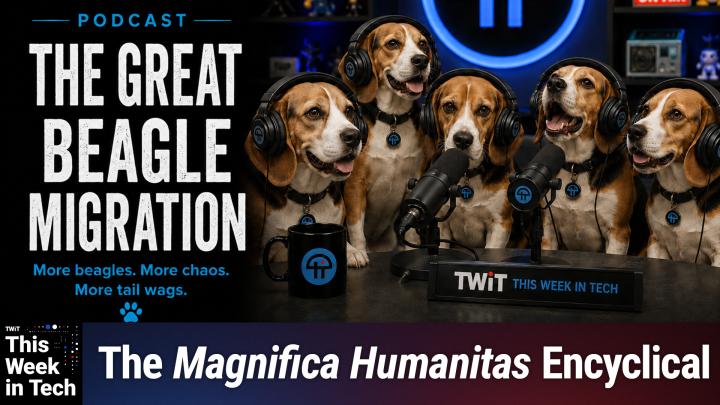
This Week in Tech (Audio)
TWiT 1086: The Great Beagle Migration - Pope Leo XIV's 1st Encyclical & Ferrari's 1st EV
02:59:02
Pope Leo XIV's 1st Encyclical & Ferrari's 1st EV
Loading summary
Transcript915 lines
- [00:00]
Leo Laporte
It's time for TWiT this week at Tech. Great panel for you. Pulitzer Prize winning author Gary Rivlin is here. The author of AI Valley, Molly White from Web3 is going great. And Sam Abulsamed my car guy. We will talk about cars, the brand new Luce from Ferrari. Sam has opinions. Google's changing its search page. Molly's mom has opinions. And what did the Pope say about AI? And why is Gary in agreement? All of that and more coming up on TWiT. Stay tuned.
- [00:33]
Gary Rivlin
Podcasts you love from people you trust.
- [00:37]
Leo Laporte
This is twit. This is TWiT this week at Tech. Episode 1086, recorded Sunday, May 31, 2026. The Great Beagle Migration. It's time for TWIT this Week in Tech, the show where we cover the week's tech news. There's quite a bit of tech news this week and good news. We have a fabulous panel to cover it. Sam Abulsamet is here. My car guy from Wheel Bearings media and the VP of research@telemetryagency.com. hi, Sam.
- [01:13]
Sam Abulsamed
Hi, Leo. How are you today?
- [01:15]
Leo Laporte
I am very, very well, thank you very much. And it's always nice to see you. From Ypsilanti, Michigan.
- [01:23]
Sam Abulsamed
Yeah.
- [01:24]
Leo Laporte
Home of Ford A view a few.
- [01:29]
Sam Abulsamed
Ford's not here.
- [01:30]
Leo Laporte
Ford's not near. Ford's nearby in Dearborn. Yeah, nearby. Molly White's also here. World renowned Wikipedia editor and the creator of Web3 is going just great. And her newsletter is CitationNeeded News. Hi, Molly.
- [01:49]
Molly White
Hello.
- [01:50]
Leo Laporte
How is Web3 going?
- [01:52]
Molly White
Just great.
- [01:55]
Leo Laporte
There's actually some funny bitcoin news we'll talk about in just a little bit.
- [02:00]
Sam Abulsamed
Has it fallen over yet?
- [02:02]
Molly White
I would say it fell over quite a while ago and it just sort of continues. It's like it's going down the stairs or something that's continuing to fall.
- [02:09]
Leo Laporte
You don't really need to. There's not even a question anymore, is it? You know, it's like if you talk about NFTs now, nobody goes, oh, these are the greatest thing ever.
- [02:19]
Molly White
Yeah. I think people have mostly ditched the Web three terminology and are just sort of going, you know, still trying to convince people that maybe crypto is a thing or bitcoin is still a good thing. But you don't hear much about Web3 anymore.
- [02:32]
Leo Laporte
No, but you cover NFTs and crypto on Web3 is going just great. It's all, it's all in. All of. All of a bundle thing.
- [02:40]
Molly White
Yes.
- [02:42]
Leo Laporte
And it's all in there, including bitcoin,
- [02:43]
Molly White
much to the Chagrin of some bitcoiners who are very upset that I.
- [02:47]
Leo Laporte
Well, you keep under that umbrella, you keep. You know, man, we're, we're like, we're way down, man. And it's all Molly White's fault. That's the. I know that's the truth. Also with us.
- [02:57]
Molly White
If it weren't for me, we'd be at a million.
- [02:58]
Leo Laporte
If it weren't for you, bitcoin would be worth a million dollars. That's what. That's right. That's right. Gary Rivlin's also here. A Pulitzer Prize winning journalist is his most recent book, AI Valley covers Microsoft, Google and the trillion dollar race to cash in on artificial intelligence. It's still true. The book came out a year ago now.
- [03:19]
Gary Rivlin
Yeah, like 14, 15 months ago.
- [03:21]
Leo Laporte
Yeah. And yet here we are with the IPOs for OpenAI around the corner and anthropic around the corner and I mean the trillion dollar race has not yet won.
- [03:34]
Gary Rivlin
Yeah, you look at the S1 for SpaceX.
- [03:39]
Leo Laporte
SpaceX is wild.
- [03:41]
Gary Rivlin
I mean, I mean I actually have. I just think it's so.
- [03:44]
Sam Abulsamed
How could anybody read that document, take this company seriously?
- [03:49]
Leo Laporte
There's so many juicy tidbits in there. It came out while we were doing intelligent machines on, on Wednesday last week and Paris, like we lost her because she was like, oh my God. And then there's this, and then there's this. We, for instance, X. We're learning about X.com and how little money they're making. What did you notice?
- [04:07]
Gary Rivlin
Making how much money they're losing.
- [04:09]
Leo Laporte
Losing.
- [04:09]
Gary Rivlin
He talks about the addressable, actionable, total. Excuse me, the actual total addressable market including 26.5 million. I love the 0.5 trillion to be made in AI and it just.
- [04:22]
Leo Laporte
Yeah, it's made up.
- [04:24]
Gary Rivlin
I really don't. It's a made up number. And you know, they are in a race with a lot of other competitors. It just, it just, it was so musky and stuff.
- [04:33]
Sam Abulsamed
Actually my favorite, my favorite part for the course for Elon, it is, it's all made up.
- [04:38]
Gary Rivlin
Well, so you know, he famously had his, his pay package that if he could create a colony at Mars, a
- [04:47]
Leo Laporte
million people on Mars, people on Mars
- [04:50]
Gary Rivlin
and data centers in space. He'll get this gazillion number of shares.
- [04:54]
Leo Laporte
He'll be a trillionaire. Yeah.
- [04:56]
Gary Rivlin
And it works out that in the S1, even though he's not granted the shares until he reaches these crazy benchmarks, he still gets the votes.
- [05:06]
Leo Laporte
Oh yeah, 10 to 1, right? Something like that.
- [05:09]
Gary Rivlin
Well, not just 10 to 1, but on shares he does not own until he hits these benchmarks. And yet, the way the S1 is written, he could still vote on the shares he doesn't yet have. He could still vote using the shares he doesn't have yet.
- [05:24]
Leo Laporte
So. And yet people are probably going to race to buy SpaceX stock when it goes public, right?
- [05:33]
Gary Rivlin
I mean, everyone wants. Or not everyone, lots of people want a piece of AI. The weird thing about SpaceX is Starlink's probably their best product, their most profitable product. And so much of that company is wound up in xai. It's why they're losing so much money, losing tens of billions of dollars through XAI. And it's called SpaceX. Like Meta. Is it Meta? But it still has that name. But people want to own a piece of anything that lets them own a piece of AI.
- [06:04]
Leo Laporte
Right.
- [06:04]
Molly White
There's also been a meme stock for years. Right. So people will probably assume the same thing will happen with SpaceX.
- [06:12]
Leo Laporte
The big difference is SpaceX is rolling in federal subsidies. In fact, they just signed another.
- [06:18]
Sam Abulsamed
But they still lose money if you take out Starlink. The actual space business of SpaceX, of launching stuff, loses money.
- [06:27]
Leo Laporte
Right.
- [06:28]
Sam Abulsamed
So even though they made this amazing breakthrough of reusable rockets that were supposed to make the cost of launches so much cheaper, they still lose money on it.
- [06:40]
Leo Laporte
Well, but you can afford to lose money when you have an $8 billion federal contract, right? I mean, we, it's really the taxpayers who are losing the money, right?
- [06:51]
Sam Abulsamed
Well, no, I mean, we, you know, we're paying, but we're paying less than what it costs SpaceX to do those launches.
- [07:00]
Leo Laporte
So they still lose money even with the federal subsidies.
- [07:04]
Sam Abulsamed
Yeah, I mean, they're technically not getting subsidies. That's, that's business.
- [07:07]
Leo Laporte
I mean, yes, you could $38 billion in business.
- [07:12]
Sam Abulsamed
Yeah, and, and, and they spend more than that on actually doing the launches.
- [07:16]
Leo Laporte
That's kind of pathetic.
- [07:20]
Gary Rivlin
Least enough Blue Origin this week.
- [07:23]
Leo Laporte
Oh, man. Well, I guess we're in our space segment. Might as well keep going on that. I was going to start with the Pope, but let's talk about Rocket go Boom. This is the most spectacular rocket explosion since N1 just happened in Florida. This is the new Glenn. And they were just doing a loading. They weren't even launching it. Right. Or maybe they were.
- [07:47]
Sam Abulsamed
They were doing a hot fire test.
- [07:49]
Leo Laporte
Hot fire.
- [07:49]
Sam Abulsamed
So they, they load up the fuel, you know, fire the rockets or fire the engines without actually launching the vehicle. So it's still clamped to the launch pad.
- [07:59]
Leo Laporte
So it wasn't supposed to go in the air, but it kind of sort of did.
- [08:03]
Sam Abulsamed
Pieces kind of went everywhere, every direction.
- [08:06]
Molly White
Explosion like that is going to go somewhere.
- [08:09]
Leo Laporte
Just damaged the pad significantly. It's the only pad.
- [08:12]
Sam Abulsamed
I would say more like destroyed the pad.
- [08:13]
Leo Laporte
Yeah, that's the one new or only one Blue Origin has, I think.
- [08:19]
Sam Abulsamed
Yeah, the only one for new Glenn. Yeah, yeah.
- [08:22]
Gary Rivlin
And I think, you know, kind of the bigger picture here is, you know, NASA, we, whatever, were counting on Blue Origin keeping SpaceX honest. Right. A competitor and, you know, they are very far behind all of a sudden.
- [08:35]
Leo Laporte
The N1 explosion was in 1969. That was a Soviet rocket that was destroyed in a launch attempt. That's how long it's been. But, you know, we really kind of started launching a lot more rockets and Elon has been doing pretty well with his Falcon Heavy and so forth. So what was the new Glenn gonna do on the lunar landing? What part of it was it.
- [08:57]
Sam Abulsamed
It was gonna launch the lander, the human lander.
- [09:01]
Leo Laporte
Okay, so much for that.
- [09:03]
Sam Abulsamed
Actually, the first thing that was supposed to go up was the rover. So they were gonna launch. Launch a lander that had the lunar. The new lunar.
- [09:13]
Leo Laporte
Two rovers they're gonna watch.
- [09:14]
Sam Abulsamed
Yeah, right. And that was supposed to go up next. Next year sometime, but it's going to take them a minimum of a year to rebuild that launch complex.
- [09:28]
Leo Laporte
Wow.
- [09:30]
Gary Rivlin
Now, SpaceX had some. Yeah, SpaceX had some famous kablooies, but. Oh, yeah, yeah, they were.
- [09:35]
Sam Abulsamed
Lots of them.
- [09:36]
Gary Rivlin
They were in the air. Right. I mean, it's never on the launch pad. Is that what makes this so unique?
- [09:40]
Sam Abulsamed
They've had them. They've had some that blew up on the launch pad. There was a starship booster about three years ago, I think three or four years. It was one of the first starship attempted launches. And it blew up on the pad and destroyed much of the pad as well.
- [09:58]
Leo Laporte
So, I mean, in a way, this we kind of forget because they've had some really successful missions. The most recent Artemis 2 around the moon. And you forget how dangerous and iffy all of this is. This is not easy to do and crazy expensive. And it's crazy expensive. I mean, Jeff Bezos, who funds Blue Origin, can afford to rebuild the pad, but it does slow down NASA's plan to get to the moon, right?
- [10:32]
Sam Abulsamed
Yeah, I think the, the diff. You know, the fundamental difference is that since. Particularly since the Apollo 1 disaster, when they had a fire and in the. The capsule on Apollo 1 before the launch and the three astronauts in there were killed after that Happened, you know, it fundamentally changed the way NASA operated and you know, they, they have still had issues since then. You know, obviously Apollo 13 had problems. They, we had two space shuttles that blew up.
- [11:08]
Leo Laporte
Yeah.
- [11:08]
Sam Abulsamed
But you know, they take, they spend a lot more time up front testing stuff, you know, and so they've had a much lower percentage of, of, of explosions, you know, either at launch or in transit than SpaceX has had. SpaceX, you know, it's move fast and break things kind of philosophy. Whereas NASA takes the time, you know, it, it takes them a lot longer to get there. But you know, they have, you know, they've sent Artemis, you know, they've sent the, the space launch system around the moon now and back safely with astronauts.
- [11:48]
Molly White
Well, the tech industry is just bringing. Move fast and break things to like.
- [11:51]
Leo Laporte
Right.
- [11:52]
Molly White
As many industries as possible where you would never want that to be the philosophy.
- [11:56]
Gary Rivlin
Including the US Government and world, World organizations. Yes.
- [12:01]
Molly White
Yeah.
- [12:01]
Leo Laporte
Well, China just had a rocket explosion too. Right. So it's just, this is, we forget how dangerous and difficult this is.
- [12:10]
Sam Abulsamed
Well, you know, one, and one of the things that's in the SpaceX IPO somewhere, they talk about terrestrial watches, you know, point to point. Terrestrial.
- [12:20]
Leo Laporte
That's what they were for cargo or for humans.
- [12:23]
Sam Abulsamed
For humans.
- [12:24]
Leo Laporte
So like you could fly to, you could fly from New York to Australia.
- [12:28]
Sam Abulsamed
Yeah. Basically anywhere on the planet in half an hour. Yeah, yeah. Given how often these things blow up, do you really need to get to Australia in half an hour? I sure as hell don't. You know, and then there's also the environmental impact, you know, because these things are burning huge amounts of methane.
- [12:47]
Leo Laporte
You know, these, this was a methane.
- [12:49]
Sam Abulsamed
All these new, all these new. Yeah, all these new rockets. All, all the, the SpaceX and Blue Origin, most of these new rocket companies are all doing methane rocket engines. So they're burning enormous amounts of methane. So the, the CO2 emissions from this, not to mention, you know, just the methane that's vented during far worse greenhouse
- [13:09]
Leo Laporte
gas than almost anything.
- [13:10]
Sam Abulsamed
And you know, you're talking about filling these things with liquid methane. It's a, you know, because it's a liquid, you know, they're in cryogenic containers rather than in pressure. High pressure, high pressure containers, which means that, you know, this stuff is boiling off continuously. If you, if you ever watch one of these things on the pad, you'll see that the clouds streaming off these things as it boil as the methane. That's liquid oxygen. Yeah. Boils off.
- [13:38]
Leo Laporte
And so Elon loves his methane. He's using it to power his data centers as well.
- [13:42]
Sam Abulsamed
Yeah.
- [13:43]
Gary Rivlin
Doesn't he use it at night? Oh, no, that's something else.
- [13:45]
Sam Abulsamed
Never mind.
- [13:46]
Leo Laporte
No, that's kethamine.
- [13:47]
Molly White
Methane in the morning.
- [13:49]
Gary Rivlin
Ketamine.
- [13:49]
Leo Laporte
Kethamine. Oh, I shouldn't joke about it.
- [13:54]
Gary Rivlin
Oh, why not?
- [13:56]
Leo Laporte
Do they mention ketamine and risk factors in the SpaceX?
- [14:01]
Gary Rivlin
I did not read the whole thing. I read the articles. It's also interesting. There's this standard thing that people, you know, they probably publicly traded companies do, like you have a number of independent directors. You only do compensation through a subcommittee of independent directors. And they just toss that out the window too. They're not following that practice of having
- [14:24]
Leo Laporte
clearly Elon's company from start to finish. Right? He has, yeah.
- [14:28]
Sam Abulsamed
There's no real corporate governance in any of Elon's enterprises.
- [14:31]
Leo Laporte
Right. Because it's Elon.
- [14:33]
Gary Rivlin
Well, I mean, in defense, you know,
- [14:34]
Molly White
it going the SEC is also a lot less, I think interested in those types of things these days. And so perhaps not applying the same level of scrutiny to these filings.
- [14:47]
Leo Laporte
Well, and let's not forget the irony of Elon trying to save federal money with Doge claiming to try. Claiming didn't save much. That may even cost money while he's getting $38 billion in federal subsidies. There's a certain irony in all of this.
- [15:09]
Gary Rivlin
Yeah. He got his money's worth from his 250 million. Whatever the problem was in that was a good deal. And you know, all the dropped investigations into this practice or that practice. So I guess in defensive, Musk here is like eyes wide open. No one is going to put money in SpaceX and think like, well, at least we're going to get good governance. You're basically betting on Elon Musk.
- [15:32]
Leo Laporte
I don't know. You know what I think you're really betting on? You're betting that others will bet on it. It's like a meme. It's a meme stock. You're betting that it will go up before it goes boom. Like the rocket, like Tesla. And you know what? Tesla's still strong, right? Even Sam. I mean, it's still a strong stock, I think, isn't it?
- [15:54]
Sam Abulsamed
Yes, inexplicably, because it's not.
- [15:57]
Leo Laporte
The company's not has suffered a lot ever since Elon took that big political stance.
- [16:02]
Sam Abulsamed
I mean, if you look at the business itself, you know what their revenues and profits are, their share price is absurd. It has no connection at all to the actual business. The share price is based almost entirely on people's belief that they're suddenly going to flip a switch someday, by the end of 2020 and turn millions of Tesla vehicles into robo taxis that are generating trillions of dol in free revenue. And that was going to happen by the end of 2020. And I believe we may have passed that date. I'm not sure what day it is right now, but I think we missed that deadline.
- [16:42]
Leo Laporte
Yeah.
- [16:44]
Gary Rivlin
Well, there's also the argument that they create the technology that other car makers theoretically would want. The BMWs, VWs of the world. But I happen to have written an article on this like six months or so ago and none of the big car companies trust Tesla. There's a couple of startups out there that are sell, you know, you could get the autonomous vehicle technology through them. So even. What in my mind would have been one of the big pluses, like, okay, well we have this amazing technology now. Let's license it to other car dealers. No, no, no, no, no. Excuse me, car makers. No carmaker seems to want to trust Elon Musk or Tesla.
- [17:22]
Leo Laporte
They're inspired by it though, right? I mean, I hear people talking about how less, how much less wiring is in modern vehicles and a lot of that is because they looked at Tesla and said, wow, they really were able to cut down the wiring. Wiring's a, you've taught me this, Sam. There's miles of wiring in a typical vehicle and it weighs a lot.
- [17:43]
Sam Abulsamed
You know, copper's getting more expensive all the time.
- [17:47]
Leo Laporte
Yeah. So people are inspired by him. Have they. But has Tesla found many licenses with car manufacturers?
- [17:53]
Sam Abulsamed
No, because the problem is most of what they've done is not patentable. You know, there's, you can't license it
- [18:01]
Leo Laporte
because they just copy you.
- [18:02]
Sam Abulsamed
Yeah, yeah. So I mean most, you know, many of the, the Chinese automakers, you know, they just straight up copied it. Ford is copying it now, Rivian's copying it, Lucid's copying it. GM is, is starting to copy some of that stuff. So yeah, there, there's no the prob. The problem Tesla has is most of what they're doing has no moat.
- [18:23]
Leo Laporte
Right. They, as I remember, were one of the first to do the metal forming that they do to make the car bodies. Right.
- [18:34]
Sam Abulsamed
Not so much that they were one of the first to do large scale castings for big parts of the structure.
- [18:40]
Leo Laporte
Right?
- [18:41]
Sam Abulsamed
Yeah. Instead of having 100 small stamped steel pieces and welding them all together, they just turned into one large aluminum casting. Right. And again, you know, that's something that, you know, they, Tesla didn't invent that patent It. Yeah, yeah. I mean, you know, they've been doing large scale castings for a long time. They just, they were the first ones to use it in that particular application.
- [19:03]
Leo Laporte
Were they the first to use these big industrial robots? I remember going, when I bought my Model X, taking a tour of the Fremont plant and they had these giant robots. One of the things they did and I. This seemed to me probably not the most efficient was they would work on the car upside down and then a robot would come and pick it up and turn it, turn it on the other side as it. And then it put it on the assembly line as it continued down the line. That was impressive.
- [19:33]
Sam Abulsamed
Those robots have been in use since the mid-1980s.
- [19:36]
Leo Laporte
Oh, okay. So that wasn't new.
- [19:37]
Sam Abulsamed
And, you know, flipping cars over, you know, to give easier, provide better ergonomics for the people bolting parts on again, that's also something that's been done for decades.
- [19:47]
Leo Laporte
Oh, okay. You know what else has been done for decades? Racism on the assembly line. And.
- [19:54]
Sam Abulsamed
Oh, yeah, that was, that was, that was big. You know, on the Model T line
- [19:58]
Leo Laporte
back in the 1910s, Henry was notice, noticeably racist. I guess Elon.
- [20:05]
Sam Abulsamed
Elon Musk is more like Henry Ford in some of the worst ways possible.
- [20:09]
Leo Laporte
The California court said that that's going to go ahead, that lawsuit against Tesla for racism. So Elon was trying to get that thrown out. He did win in court, though, against Sam Altman. No, no, he didn't. Never mind.
- [20:29]
Molly White
Those are lawsuits where it's like, you don't want anyone to win those.
- [20:33]
Leo Laporte
Yeah, no, nobody wins those kinds of losses. That would be cool. Yeah. All right, well, I wasn't going to start the show with all that, but we did, and I think it's interesting. That rocket explosion was certainly dramatic.
- [20:46]
Sam Abulsamed
I remember it was spectacular.
- [20:48]
Leo Laporte
Yeah. Saw a lot of ring camera videos from people miles away as the sky lit up. It was interesting. Yeah, we see things from many angles these days. All right, well, let's take a little break and then we'll talk because I know, Gary, you wanted to talk a little bit about this, about Pope Leo and his encyclical on AI, which I think, you know, on the face of it is kind of an interesting juxtaposition of a church as essentially a medieval institution weighing in on the most modern possible technologies.
- [21:27]
Gary Rivlin
Well, and you know, the religion of AI, I mean, you talk to some folks, they talk about AGI. It does feel very religious.
- [21:34]
Leo Laporte
Yeah, yeah, we'll talk about that. We will talk about the new. Actually, I'm curious what Sam thinks of the new Luce, the Ferrari. Or is it Luce because it's Italian Luce designed by Jony. I've. It has switches. Ironically, Johnny was famous for not liking buttons, at least when it was Apple. And a lot more, including how Google is changing search dramatically. Plus Wikipedia editors threaten to go on strike. And Amali's going to explain what that one's all about in just a little bit. Oh, and the little Easter egg somebody buried in the blockchain.
- [22:16]
Molly White
One of many.
- [22:17]
Leo Laporte
One of many. By the way. It's beautiful because it never goes away. It lives forever in the blockchain. And you will be downloading it the next time you check your wallet. Let's take a little break. You're watching this Week in Tech. Gary Rivlin is here. His book AI Valley I read and really enjoyed. And it's interesting because it really is completely timely. Last time we talked, you were going to work on another book about AI or how's that?
- [22:43]
Molly White
What's that?
- [22:44]
Gary Rivlin
I was looking at AI and energy, but I felt like I was really early on that the data centers, how it's going to overtax the grid and all this stuff. But I wrote the proposal. By the time I was passing it around, my agent was passing around. Everybody knew that story. I mean, I'll give the mainstream media credit, you know, the Times, Wall Street Journal, Washington Post, et cetera. The world, like they've really been on it. So, you know, it's one of those things like wow, this is underreported story that I thought of about a year ago and now, I mean, I wouldn't call it over reported. I think it's appropriately reported. So still thinking?
- [23:19]
Leo Laporte
Yeah, it's hard. I mean, if you're writing about AI, it's hard to stay ahead. I've never seen anything in technology move so fast. And I've been covering technology for three or four decades now and this is the fastest moving story ever. We could do 50 AI stories a day if we wanted to.
- [23:38]
Gary Rivlin
What percentage would be interesting? But anyway, I know what you're saying. Like, you know, two years ago, Google was fumbling all over the place. Now I would say Google's leading the way on AI.
- [23:49]
Leo Laporte
So the United States for the moment,
- [23:51]
Gary Rivlin
you know, anthropic was in, you know, was was kind of the also around to OpenAI. Now it's in every way, whether it's paper value through, you know, investment or how its models are doing on the leaderboard. They're even in profit.
- [24:05]
Leo Laporte
Even if philanthropics pulled ahead, ironically, they released A new model this week. That's crap. But we'll talk about that, too.
- [24:15]
Gary Rivlin
Well, they had the enterprise. They figured out that the way to pay for all this research is to get big businesses and all. And they've done a great job of that. Now OpenAI scrambling. But my point is, a year ago it was OpenAI and now anthropics. So. So you are right. It is constantly, constantly changing.
- [24:33]
Leo Laporte
No one's on top. This is a horse race where the league changes every two seconds. It's just bizarre. It's just wild.
- [24:39]
Gary Rivlin
Yeah.
- [24:40]
Leo Laporte
I wouldn't want to try to write a book. Pick something that's not going to change. Maybe the Catholic Church would be a good subject. Something that's not going to change for a few hundred years. That would be. That would be the topic.
- [24:50]
Sam Abulsamed
Or how about. How about the way that some of these AI infrastructure companies are influencing politicians to get approval for data center locations where people living there don't want them?
- [25:05]
Leo Laporte
It's fascinating to watch.
- [25:07]
Molly White
Overwhelmingly unpopular. Gallup just did a great poll on it.
- [25:11]
Leo Laporte
They said 71% of Americans do not want a data center anywhere near that.
- [25:15]
Gary Rivlin
Yeah.
- [25:15]
Sam Abulsamed
I mean, there are two that are trying to build within a few miles of me here and many more around Michigan. And Michigan Governor Gretchen Whitmer has been hugely supportive, really pushing these things, and nobody in any of these municipalities wants them anywhere near them.
- [25:35]
Leo Laporte
Right.
- [25:35]
Gary Rivlin
So the question I'm trying to figure out on that is, is it because, like, it's a noisy neighbor, what's it going to mean for the grid and your electricity and your electricity prices? Or is it just simply a physical manifestation of AI and we don't like it? And so we oppose data centers because it's really the only way we can express our dislike with AI, short of booing someone during a commencement speech.
- [26:02]
Sam Abulsamed
I would say it's actually all of the above.
- [26:03]
Leo Laporte
Yeah, I'll add one all of that. Utility prices, the cost of electricity skyrocketed for a variety of reasons, I suppose, but I think people blame data centers for that and they may be right.
- [26:14]
Gary Rivlin
Well, they are. It was flat for years. It was flat for years. In the last few years, it's gone up. I had the stat in my head a couple of months ago when I was doing it, but it's gone up 25% ish over the last four or five years. It's gone up a lot.
- [26:27]
Leo Laporte
James Carville, who said it in 1992. And it's still true. It's the economy, stupid. People vote their pocketbooks and a Politician who ignores that does so at their own peril, I'm sure. Gretchen Whitmer, Governor Whitmer supports data centers because it's good for the economy. Right. It's good for the Michigan economy. It's a good tax.
- [26:47]
Molly White
I think a lot of the opposition also comes from the fact that the data center, you know, the people who are pushing to build the data centers try to position it as good for the local economy because it will create jobs.
- [26:58]
Leo Laporte
Exactly.
- [26:59]
Molly White
But there's actually not that many jobs involved. You know, there's this construction period which involves jobs. But then, you know, once you have an established data center, it's kind of a skeleton career just keeping things going. And so people sort of see through that argument and they say, why are we subsidizing this? You know, why are we welcoming this when it's not bringing jobs? It's not helpful for the economy locally and it's introducing noise pollution, environmental pollution in some cases and so on.
- [27:29]
Leo Laporte
Here's a. This is a datacenter tracker.org website where they track data center build outs, community response and legislative action. And it is, it is a very volatile situation right now with data centers. I mean, there's just no, no question about it. Places that they've, they've been banned, places that they're going ahead, moratoriums.
- [27:58]
Molly White
And now we're seeing the AI industry building these lobbying arms as well to try to get basically preemption over the state level regulations and in some cases the moratoriums against building this. And it's sort of the crypto industry playbook of dumping hundreds of millions of dollars into politics to try to find congresspeople who are willing to push for the pro. A pro AI legislation is really horrifying.
- [28:30]
Gary Rivlin
I mean, oppose us and we'll spend millions to defeat you. Support us, be out front and you know, you be one of our advocates and we'll give you millions, tens of millions to make sure you get reelected, get elected.
- [28:42]
Molly White
Yeah, it's literally the same strategy. I'm actually, I have a project called Follow the Crypto where I follow the crypto election spending and I've actually, I'm releasing it, I think this coming week. But I've done a huge overhaul to incorporate the AI spending because they're so similar that you can't talk about one without talking about the other.
- [29:01]
Leo Laporte
Is this follow the crypto.org? is that, is that yours?
- [29:04]
Molly White
Currently it's going to be renamed because it's going to be AI and crypto.
- [29:08]
Leo Laporte
You know, I think this is where Data science is so great. Are you a data science by training, Molly?
- [29:14]
Molly White
I'm a computer scientist by training. I'm not a data scientist.
- [29:17]
Leo Laporte
Yeah, but, but this is what data science can, can give you is some real clarity on this stuff. I think this is a really good use of, of your skills. Good. Well, we'll keep an eye on follow. So it won't be follow the crypto, it'll be follow the, follow the money.
- [29:33]
Molly White
I'm renaming it to Tech Influence Watch because it's.
- [29:36]
Leo Laporte
Oh, I like that. That's good.
- [29:38]
Molly White
Thank you. You can just follow the citation needed banner. So I'm sort of centralizing my subscribe
- [29:44]
Leo Laporte
to citation needed support Molly's work and keep up to date on this stuff.
- [29:52]
Gary Rivlin
Yeah, it sounds great. You could just follow Andreessen Horowitz because they to me merge crypto and AI live in the congressional district where Alex Boros, that's who I'm going to end up voting for, where millions, probably tens of millions are being spent to defeat him. He state legislator came up with some pretty mild, I thought, legislation that made sense and of course cryptoai wanted to defeat it. Did defeat it. And now they're spending all these millions of dollars. He worked for Palantir for a while. He's a data scientist. Alex Burroughs and I get hit mail probably once a week funded in part by Palantir. Also Andreessen Horowitz OpenAI. Wait, wait, besmirching him? Like, how could you vote for this guy? He worked for Palantir and his Palantir literally paying for the, for those mailers.
- [30:47]
Molly White
Yeah, the crypto industry has done the same thing where they basically are attacking, like they ran attack ads against. I think it was Juliana Stratton maybe for trying to, basically trying to portray her as being funded by ICE contractors.
- [31:02]
Leo Laporte
They spent $9 million to keep her from getting elected.
- [31:07]
Molly White
Yes, right. But meanwhile, like half of the people who are donating to the super PAC that was funding that ad have ICE contracts. And it's like, who, who signed off on this?
- [31:21]
Leo Laporte
Let's take a little break. We will have more with this left wing Marxist communist red diaper baby panel in just a little. I don't know, I'm just saying something.
- [31:31]
Sam Abulsamed
I've been a lefty all my life
- [31:33]
Leo Laporte
to keep the, keep the, keep the red folks sticking around for a little bit longer. It's good to have all three of you. Thank you, Gary, Molly and Sam. We'll have more in just a little bit. But our first word from our sponsor this week in tech brought to you this week by the mill. I love my mill. I, you know, honestly, I didn't think a kitchen appliance would be the thing that changed how I felt about my kitchen. But the mill food recycler has really become something Lisa and I cannot live without. We got one in October. Let me just pull it up here. It's got a great app. We so we want to be good citizens. The number one cause of food waste in America is not, as one would think, restaurants. It's home. It's the food that's thrown out at home and it goes into the landfill, which is kind of a problem our locality has now composting. But that's not a great solution for us because it starts to smell and there's fruit flies. We found a kind of perfect solution. The mill. The food waste is gone. The smell is gone. Mill just took care of it. Mill is the odorless, effortless, fully automated food recycler. It's in our kitchen. Instead of having the, you know, the little recycle bin next to the kitchen sink, we have it right there next to the counter. Everything goes in it. Potato peels, avocado pits, chicken bones, dairy, all the scrapings from all the plates at the end of the meal. Mill takes almost anything. And then while you sleep, milk quietly transforms those food scraps into nutrient rich, shelf, stable grounds. No more mess, no more smells, no fruit flies. And it really reduces the size of it. Milk can process up to 10 pounds overnight. We fill it up every day. It can work for weeks before you even have to think about emptying it because it reduces it significantly in size. You can use the grounds in your garden, add them to your curbside compost. Mill will even pick them up and get them to a small farm for you. Mill turns what is really a huge climate problem in the landfill problem into a simple daily habit you can actually stick with. And we love it. You can see your impact. The mill app, I'm going to launch it here. It tracks how much food you're keeping out of, out of landfills. And look at this. This is since October. We've had it since October. We have. So that's £413 that would have gone into the landfill. That now goes into the compost bin. Without the smell, without the musk, without the fuss. 413 pounds since October. That's our family. That's us. And you'll, you'll have the same stat in your app. It's really incredible. It even shows you how much you're Recycling every month. We were on vacation for three weeks in May. So it's a little lower. All the. They gamify it, which is kind of fun. So far, Mill has helped customers put 21 million pounds of food out of the landfill. 21 million pounds of food put to good use. It's a sleek, beautiful device. Looks great in any kitchen. Mill offers a 90 day risk free trial. So if you don't absolutely love it, you can send it back. And right now you could try MILL risk free for 90 days and get $75 off@mill.com Twitter use the offer code TWIT that's $75 off mill.com TWIT the offer code is TWIT. We bought this, like I said, in October, long before we were doing ads. In fact, I said can we do ads for you? Because I think this thing is the best thing ever. I want everybody to use it. Mil.comTwit we love it. You will too. All right, back to Leo.
- [35:24]
Sam Abulsamed
Before you go on, I got a question for you about Mill.
- [35:27]
Leo Laporte
Yes.
- [35:28]
Sam Abulsamed
So when you buy one of these, do you then have to pay to to ship the stuff back to them? Because I know there was another company that was doing this that originally didn't do anything with this stuff.
- [35:39]
Leo Laporte
Yeah, I don't know if it was Milton, but one of them was. You would pay a subscription fee. They take it and you'd mail it back and they do it. Use it for chicken feet. No, there's. Once you buy it, that's it. There's no fee.
- [35:50]
Sam Abulsamed
I know you can use this stuff in your own garden.
- [35:52]
Leo Laporte
You can. It makes a composter and it looks like coffee grounds. When it's done, it's just completely dehydrating. It's all, it's really, it's a dehydrator. It's stirring it and dehydrating it so it looks like coffee grounds. Ours smells like coffee grounds because that's where I put my coffee grounds.
- [36:06]
Sam Abulsamed
Yeah, we put our coffee grounds in our composter too.
- [36:10]
Leo Laporte
It's great for compost. The only thing you know and they tell you what you can and can't put in there. If you're going to use it for animal feed, for instance, don't put things like marigolds in there. There are plants that are poisonous you don't want to give to the animals. On the other hand, if you're using
- [36:26]
Molly White
your garden, I think meat in it because I know a lot of people who compost in piles. Don't compost meat we put me everything
- [36:34]
Leo Laporte
in it, I think, like really beef bones you can't put in it, but chicken bones you can put in it. It's kind of wild.
- [36:40]
Sam Abulsamed
As long as it's something that can break. The chicken bones break down fairly easily. The beef.
- [36:46]
Leo Laporte
If you wouldn't feed it to your dog, then don't. If you. Then you can feed it to the mill. I don't know about the logic of that one.
- [36:52]
Molly White
I definitely don't feed coffee grounds to my dog. He's got enough energy.
- [36:55]
Leo Laporte
No, it's kind of wild. It's really. You know, we have ours go off at 9 at night. So I, you know, as we're going upstairs, I hear that click. And then the next morning you look at it. It's like, where did all. It's all. It's all like. It's just like coffee grounds in the bottom.
- [37:10]
Molly White
I would be so tempted to put things in there that you're not supposed to put in there just for, you know, it's like the. Will it blend? Will it compost?
- [37:17]
Leo Laporte
Yeah, well, when we first got it, we didn't know like we'd put tea bags in it. And it turns out the string gets wrapped around the stirrer and it starts to go clonk, clunk. So, yeah, there's certain things you learn.
- [37:32]
Sam Abulsamed
Just use loose leaf tea.
- [37:34]
Leo Laporte
Yes. Loose leaf tea is fine and the tea bags are fine and the coffee filters are fine. You know. Yeah, just. You know, it has. On the way on the app it says what you can, but you pretty much put everything in there. I don't. I think we. Everything goes in there. There. It's kind of amazing.
- [37:49]
Gary Rivlin
And we're each getting one free for appearing on the show.
- [37:52]
Leo Laporte
Was that congratulate. I wish. You know what, I'll talk to Mill.
- [37:55]
Gary Rivlin
And not just should.
- [37:57]
Leo Laporte
Well, especially if you live in the city. I mean, do they. What do you do with compost if you live in the city? I don't know.
- [38:02]
Gary Rivlin
Well, they have bins. They do have compost. Like a block from here there's a
- [38:08]
Leo Laporte
walk street with your little leaky bucket.
- [38:10]
Gary Rivlin
Yeah. And you know, eventually it's starting to become, you know, on the street just like you know, with recycles, but recycled.
- [38:17]
Leo Laporte
Yeah, that's what they're doing in California. I was happy that they started. Started doing that.
- [38:20]
Sam Abulsamed
We've been composting for about 30 years.
- [38:22]
Leo Laporte
So like in your. Yeah. When I lived in Santa Cruz, we had. And you. And you go out with the pitchfork and you turn it and you put worms in it.
- [38:30]
Sam Abulsamed
We have a big tumbler. It's like a 55 gallon barrel and it generates heat. Flip it over. Yeah.
- [38:37]
Leo Laporte
Because it's decomposing. Yeah.
- [38:39]
Molly White
You have to have like a traditional compost pile and one of those countertop composters. I don't know if it's the mill or not, but they use the countertop composter to like pre compost the meat and things like that that they wouldn't want to put directly into the pile. And then they put the result into the pile.
- [38:57]
Leo Laporte
That's what you would do with the mill. Exactly. Pope Leo, who named himself after he's
- [39:06]
Sam Abulsamed
a podcaster in the planet, named himself
- [39:08]
Leo Laporte
after he's a fellow twit.
- [39:09]
Gary Rivlin
I do that.
- [39:11]
Leo Laporte
I wish he hadn't picked Leo because it is a little confusing, but he.
- [39:15]
Gary Rivlin
Not really to the rest of us.
- [39:16]
Leo Laporte
No, I think everybody knows the difference.
- [39:19]
Sam Abulsamed
Padre probably suggested the name to him.
- [39:22]
Leo Laporte
Well, it was a little weird. Father Robert was on Intelligent Machines on Wednesday and he kept saying Leo and I said mutt and oh, no, that guy. Okay. Yeah. So he named himself after Leo XIII, who was pope at the turn of the 20th century, between 1800 and 1900, and wrote an encyclical about the Industrial Age, 100 years after the beginning of the industrial age, but asking to be more humane in the conversion to industrial life. And I think that's when Pope Leo was elected. He decided to choose that name for that because he wanted to honor that and do the same for our modern times. So we've been kind of waiting for Leo XIV's encyclical about the power of AI. And I don't know, you said, Gary, you had. First of all, I'm not a Catholic. Are any of you Catholics?
- [40:16]
Sam Abulsamed
I was raised Catholic, but left at about the age of 13.
- [40:22]
Leo Laporte
Yeah, this dad didn't want to be confirmed. Yeah, my dad went to Fordham, you know, Jesuit school in high school. But he kind of was a lapsed Catholic too. So. My daughter is converted. A lot of people in her age group. She's 34. A lot of people in their late 20s and 30s apparently are turning to the church. Interestingly, it's a trend. Molly, are you becoming a Catholic?
- [40:49]
Molly White
Believe it or not, I have missed that trend. I'm usually so on top of trends.
- [40:55]
Leo Laporte
Yeah, you missed it. She's actually at a retreat with the Sisters of Providence right now in western Massachusetts, believe it or not. So I am myself, and I think it's pretty well known, an atheist. I'm not a particularly religious fella, and so I Was a little skeptical that the Pope would have anything meaningful to say about AI Actually, I thought what he said was pretty good.
- [41:21]
Gary Rivlin
Yeah, I loved what he said. I mean, first off, at least someone in power is talking about this. We need human centered AI, you know, we need, you know, humans in the loop, you know, this. I. But my idea of AI where I can embrace the AI is as a co pilot, an amplifier. It's like it's helping me in my work. It's never running things. And I do think there's this thought out there that AI can take over, take over as a boss, which is getting a lot of attention, but take over essential functions. That was my favorite part of it, but really my favorite part of it was just that he was speaking out about this idea that we have this small group of tech elites deciding everything. This Silicon Valley idea. We just got to get a few smart people in the room kind of thing. It just ain't going to work for AI. It's, they, they themselves talk about how powerful and all, everything this, this stuff is. And so, you know, kind of taking on this idea that, you know, a small group in Silicon Valley, in Beijing are going to determine, you know, AI for, for everyone. And by the way, it's, it's, I saw this thought out there in Silicon Valley, you know, oh, the Pope doesn't understand anything about AI. It's really interesting, interesting. Since the mid-2010s, the Vatican has been looking into AI. They sent a group of cardinals, I think it was to Silicon Valley. They met with people like Reid Hoffman, James Monica from Google to start the conversation going, what is AI? What's its potential? There's been a group every year going to the Vatican. I know Hoffman goes regularly, Kevin Scott, the CTO of Microsoft, other big names in, in AI or in tech go. So, you know, they've really been wrestling with this. I think it is thoughtful document because the Vatican, I mean the Pope and the people helping him with this have been thoughtful about it. I assume he didn't write 42,000 words on his own in so short a period.
- [43:16]
Leo Laporte
It's so funny because there were people who said, oh, you could tell this is AI written. Which Father Robert assured us it was not a hybrid. He said there's no way involved in this encyclical. This was written by. Yeah, you're right. Not merely Pope Leo, but a committee of church people. And Robert pointed out, and I think this is true, that Pope is not merely a religious leader, he's in many ways a secular leader. He's a political figure. He leads more than a billion Catholics worldwide. He has standing to talk about this. And as a humanist, which I think it's safe to say he is, I think it's important. I didn't really disagree with anything he said. He wasn't anti AI, it seemed to me, right.
- [44:03]
Gary Rivlin
Well, he was actually very specifically pro AI in the sense that he sees lots of benefits from AI. But I think if I had to boil it down, the tech isn't the issue where the issue it's like, like who's controlling this, who's not controlling it? You know, our approach in the last couple years, it breaks in 2023. When I started at the end of 2022, I started looking at AI and kind of through the first half, most of 2023, we were talking as a country about AI, you know, Sam Altman saying, regulate us, the Sanders members of Congress, you know, we're all talking about it. And it went poof. And now there's all these things that he brought up. AI and the use of warfare, AI and mathematics, surveillance AI and the baked in bias. It's trained on our data, our works. Well, we have bias in our work, sexism, racism, whatever kind of thing. And yet we want to use it for sentencing. We want to use it to decide whether you should get a job, whether you should get this apartment. And also, I don't know, I feel like we started to have a conversation in part, we had a change of administration, but more than, I think it just became this trillion dollar race to cash in, Google, Microsoft, OpenAI, et cetera, all through safety, over the wayside and became like, well, we can't do anything to stop this because of China, China, China. And at least that Pope Leo, he gets the story, page one. He's articulating, I think, all the right issues. Will it make a difference? I don't know. But at least somebody's fighting back. At least somebody's articulating kind of a better vision than let's just let this thing ride. And AGI is around the next corner.
- [45:43]
Leo Laporte
It's, I think, appropriate to step back and take a breath. And that's part of the problem with the way AI has been moving. There's such competition, such a race, as you point out, Gary, competition between the companies, but also between us and China, that nobody's kind of really sitting back and saying, well, what is this? Do we want it? How should we proceed? How should we think about it? What guardrail should we put on it? I mean, it's Molly Reminds me of crypto in many.
- [46:12]
Molly White
Yeah, I was just going to say it's kind of the classic idea that, you know, any innovation is good. And so you hear all of this talk of, like, we have to protect innovation, which usually means no regulations, but, you know, there's. I feel like no one ever actually decided that all innovation is good. In fact, I think there are plenty of innovations that we would argue are not good. I mean, like, asbestos was not particularly good. Right. And so, you know, there's this idea that if it's innovation, we have to just go with it. And, you know, there's this idea that any technological development is inevitable, and you hear that explicitly from a lot of these people, is that AI is inevitable, so just get out of the way. You know, if we don't do it, China's going to do it, so we have to do it. And I think the Pope did a really good job of pushing back on that and saying that, like, ultimately, this is a technology developed by humans. We as humans have the ability to decide whether or not to develop it or how to go about developing it. And it's not inevitable. Like, we have the decision, you know, the capacity to make the decision that this is not something that we think would be useful or this is not something that we want to hand off to five billionaires who, you know, have their own motivations and not much interest in the public good. So I thought. I really enjoyed it for that particular reason.
- [47:29]
Leo Laporte
There is a big backlash against tech going on right now. AI has sped that for about a decade. Well, yeah, but I mean, look at what we were just talking about with data centers, the number of people, the booing at college commencements. AI has become in some ways a whipping boy for all of this technology and all of this big tech. And I think there's a lot of
- [47:54]
Molly White
helps that I think every tech company is pushing AI. Right.
- [47:57]
Leo Laporte
So pushing down our throats.
- [48:00]
Molly White
Right, right.
- [48:01]
Leo Laporte
And I. And I am a. I am a proponent. I love AI. I use it like crazy in many ways. I've done a lot of vibe coding. I have an AI agent that knows way too much about me. I'm doing. I'm playing with this because I feel like it's an important technological revolution. But. But even I acknowledge that there are some big issues and that we really need to be a little bit careful. Go ahead.
- [48:28]
Gary Rivlin
If you look at the polling on this. So Quinnipiac, I think it's called, just did a recent poll, and 65% of Americans are in favor of some guardrails some regulation. Only 22% agree with this argument. Like, oh, if we put down regulations, we're going to kill innovation. A favorite example is I'm not the only one to use it. You hear it a lot in AI Those, those guys. You know, there's the doomers, and I don't put myself on that side. There's the zoomers. Any regulation is a crime against humanity. Given all the good that AI could do, I. I couldn't. I'd call myself a bloomer. I see potential if we're smart, if we take advantage of. Of our agency here, like, because, I mean, every foundational technology cuts both ways. I mean, the Internet, a car.
- [49:19]
Leo Laporte
I mean,
- [49:21]
Molly White
I use the example, but like it did fireproof.
- [49:24]
Gary Rivlin
Yeah, yeah, well, but we weren't smart about asbestos. Can we be. Can we make it so it's more of a net positive? There will be negative things that happen because of AI But I still think we're at a point, we have agency. If we're having discussion, we can make this more of a net positive than a net negative.
- [49:40]
Sam Abulsamed
But, Sam, you know, I mean, coming from. From the auto industry perspective, you know, the auto industry has had a huge amount of regulation in the last 60 years. And we've had more innovation during that time, in part because of that regulation, than we had in the 60 years before that, the first 60 years of the auto industry. So, you know, I mean, our cars are safer, more efficient, more have better performance than they've ever had in the entire history of the industry. And a lot of that is because of the regulation that we put on the industry in. Anytime you're designing something in engineering, having constraints forces you to be more creative. You know, when you're. When you're left unconstrained, you end up with something like the Ferrari Luce, which we may talk about that later. But the, you know, constraints force a degree of creativity and innovation to figure out how can you work within these constraints and still create a better product?
- [50:46]
Leo Laporte
And I bet the audio industry, just as the big tech does, now lobbied hard against those regulations.
- [50:51]
Sam Abulsamed
Oh, they did, Absolutely. It's been to their benefit and it's been to all of our benefit.
- [50:58]
Leo Laporte
Yeah, yeah.
- [50:59]
Gary Rivlin
I mean, there's also the trust. There's also the trust factor. I use the example of the railroad, where, you know, it was really dangerous when it first came out and the railroad companies opposed any kind of regulation. Government said, no, no, no track size and block signaling and all this kind of stuff, and it made it safe. And by the way, it Thrived not despite regulation, but because of regulation. It just. People trusted the railroad that I'm not going to die.
- [51:24]
Sam Abulsamed
Same with aviation.
- [51:26]
Leo Laporte
Aviation.
- [51:28]
Molly White
I mean, like, you hear a lot of, especially in the crypto world, you hear people saying that it's financial regulations that are slowing everybody down. But people trust American financial markets hugely because of the regulations that are in place. And when that regulation goes away, you start to see what we're seeing now, which is declining trust in American financial markets.
- [51:47]
Leo Laporte
Right. Part of the problem, though, with regulating AI is how it's not hard to say, well, a car should be safer. And to know kind of how you go about that. I don't even know how you make AI safer. Do we even know what the.
- [52:01]
Sam Abulsamed
Well, I mean, clearly you have to let Donald Trump evaluate all the models before they're released.
- [52:05]
Leo Laporte
It's interesting.
- [52:06]
Sam Abulsamed
Basically, the answer Trump.
- [52:08]
Leo Laporte
It was. Part of the way Trump got elected was by promising the crypto Bros and the AI Bros there would be no regulation. One of the first things he did when he got in the White House is overturn Biden's AI executive order. And yet as soon as Mythos came out that that model from anthropic, that anthropic held back because they said if, if everybody got a hold of this, we would have a security cybersecurity nightmare because it's so good at finding cybersecurity flaws. That scared the White House. And I think he drafted an executive order that said we have to approve all AI models before they're released. And then apparently companies, and particularly David Sex, his former crypto advisor and crypto. Yeah. AI and crypto czar who was put in there basically by Peter Thiel to protect the AI and crypto industries. Apparently in an 11th hour call is according to the, I think the Wall Street Journal, the New York Times to the White House, persuaded him not to put out this executive order. But there's definitely this sense in D.C. from Congress too, that we've gotta do something. Question is, what? Yeah, I mean, approving models is not the right answer. You don't want the government to be in charge of saying which models are released and which ones aren't.
- [53:31]
Molly White
I would push back a little bit on the idea that the promise was no regulation from Trump because I would say that the promise was actually, we'll let you write the regulation.
- [53:40]
Leo Laporte
Okay.
- [53:40]
Sam Abulsamed
Captured regulation.
- [53:41]
Leo Laporte
Yeah.
- [53:42]
Molly White
Companies actually really do want regulation that benefits them. Right. And that, that entrenches their position while making it more challenging for competitors to enter the field. And I think that's what we've seen with crypto, and certainly it's what a lot of the AI lobby groups are pushing for as well, is, you know, you have this sort of like competing factions within the AI lobby, where there's the open AI and you know, those folks who are basically all gas, no brakes. We don't want any states to, you know, regulate us and enforce moratoriums on building data centers or, you know, make us liable for harms caused by our products. And then there's the anthropic lobbying group which is saying, oh, we need regulations that are safety. You know, we need to have controls and guardrails and things like that. But. But both of them are essentially doing the same thing, which is lobbying for their particular interests and sort of building a moat using regulations around their corporate business model.
- [54:45]
Leo Laporte
But who has the wisdom to come up with. With good regulations?
- [54:49]
Molly White
None of them, that's for sure.
- [54:50]
Leo Laporte
Or Congress does. Congress. I mean, even Ron Wyden, who's very techno literate. I'm not sure. I don't know who I would say.
- [54:58]
Molly White
I mean, I think that the thing with congresspeople is, you know, most congresspeople probably don't have a particularly strong grasp of AI or frankly, most of the issues that they're tasked with legislating. But, yeah, they have staff who do. And I have actually found that there are a fair number of congresspeople who do have very informed staff. And. And, you know, it used to be that you would consult, you know, the President's Council of Advisors on Science.
- [55:23]
Leo Laporte
Well, we had the Office of Technology Assessment, too, which Newt Gingrich put out
- [55:26]
Molly White
of business, and that, you know, that used to be computer scientists and doctors and, you know, professors and all that kind of thing. And now you look at the list of people on that council and there's. I was tweeting about it a while ago, or blue skying, skeeting, whatever you call it.
- [55:41]
Leo Laporte
Skating. You were skating.
- [55:43]
Molly White
Yeah, that. There are more members of the all in podcast on the Council of Science Advisors than there are professors. Yeah, it's just all CEOs. So, you know, who. Who do you turn to? Right now it's all industry executives.
- [55:58]
Leo Laporte
I'm not trusting professors either, though. I don't know who. I don't know who would know how to.
- [56:03]
Gary Rivlin
Well, I don't think we should trust any single. Anyone. I mean, I like the idea that we have a dialogue with that and, you know, policy people and, you know, a wide range.
- [56:12]
Leo Laporte
How about the Pope? Can we trust the Pope? Should the Pope be in charge. He did not make any recommendations, by the way.
- [56:18]
Gary Rivlin
But there are, but there are all sorts of, you know, for these foundational models of a certain size, you need to red team them first before releasing them. You know, I mean, that's an idea.
- [56:30]
Leo Laporte
You know, that's point out that no matter what kinds of safety, safety procedures you follow or guardrails, that within minutes Pliny the Liberator will come up with a prompt that bypasses them. It is very hard. I think we've talked about this before on Security now and other shows. The notion of AI safety might be mistaken, that it's not possible to.
- [56:56]
Molly White
Well, I think that begs the question then, is like if it's not possible to build a safe model, should we be building the models at all, right?
- [57:03]
Leo Laporte
Or should we just acknowledge that they can't be made safe any more than the Internet could be made safe?
- [57:09]
Gary Rivlin
Well, but then what do we use it for? Do we use it for mass surveillance? Anthropic took a principled standard that would
- [57:14]
Leo Laporte
be the smartest thing to do is to say don't use it for things where there is potential harm because it's not reliable.
- [57:21]
Gary Rivlin
And there is legislation out there, you know, different states in Congress, there is legislation, there's, you know, kind of intellectual property rules, you know, what can you use for training? How do you compensate those whose material, including mine, including probably everyone on this podcast is in there. So there are all sorts of ideas out there. But I think to Molly's point, the power of the crypto lobby, the power of the AI lobby, the power of tech right now means that everything's a non starter. I mean, so, so, you know, let's give Trump credit. He's like, okay, well maybe we do need to have some kind of regulation out there. I don't, you know, it was never released, so it's hard to critique it. But you just see it wasn't just Sachs, I mean Musk, some of the CEOs of, I don't know specifically, you know, Google and, or Mark Zuckerberg way Zuckerberg was one of the names that they all kind of like, no, you can't do this. And he pulls it even though it's in front of all of us, right? This wasn't just some private thing. The announcement was made. And so like we can't do anything. We can't do anything because industry is so powerful, they have so much money and they have the majority of folks in their pocket, so everything will die in the vine.
- [58:37]
Molly White
Well, and I think it's a really strong indictment of Citizens United because, you know, if you, if you look at it from the company's perspective, if they stand to make billions of dollars and the, the choice is basically, do we spend $100 million on lobbying and super PACs? You know, of course they're going to do it. The payoff is huge. Right. Like, it's just simple math.
- [59:02]
Sam Abulsamed
Right.
- [59:03]
Molly White
And so, you know, I think it's really sort of a predictable outcome that we're seeing this kind of thing coming out of the crypto industry, out of the AI industry, and certainly I think probably any other industry to follow because, you know, it returns are huge when you can capture regulators, legislators, the president. Right.
- [59:23]
Leo Laporte
Well, I mean, this is a larger rule of American politics that money talks. And when that's the case, you're never going to have a society that looks out for the people in society. You're only have a society looks out for people with money.
- [59:39]
Gary Rivlin
Because in the context of this show, it's Andreessen Horowitz that's the number one donor. Not a bank, not the bank industry, not the oil industry. They are the number one giver to the current. Yeah, yeah, yeah, yeah. More than elon during the 2026 election cycle. Yeah, yeah. So. And you know, you know what?
- [60:01]
Leo Laporte
They looked at Elon and the quarter of a billion he spent to make himself a trillionaire two years later and said that was money well invested. And they're doing the same.
- [60:11]
Gary Rivlin
And they spent 100 million plus.
- [60:13]
Molly White
I mean, they spent 2024 as well and had wonderful success with that. So I think it's no surprise that we're seeing them putting money towards again, both crypto and AI.
- [60:23]
Leo Laporte
Really, the answer is, and Larry Lessig has been saying this for years to no avail. You got to get the money out of politics before you can even talk about AI regulation or any kind of regulation. Because if money's driving policy, it's always going to be policy that supports people with money. It's just, that's how it is.
- [60:45]
Gary Rivlin
And I think it's.
- [60:46]
Sam Abulsamed
Unfortunately, that's going to be incredibly difficult to do because especially, yeah, we would need to pass a constitutional amendment because the Supreme Court has made it clear.
- [61:00]
Gary Rivlin
Right.
- [61:00]
Sam Abulsamed
You know, you know, most of the members of this court, you know, have made it pretty.
- [61:03]
Leo Laporte
They already ruled that they allowed Citizen United. That. Yeah, that was statement.
- [61:08]
Sam Abulsamed
One third, one third of this court was not on the bench when that was, when that was decided. But, you know, they would clearly support it. Right. So, you know, we settled. We obviously need, you know, some fundamental changes to the Constitution, you know, to get that money out of the system.
- [61:26]
Leo Laporte
And we've already seen. And how much courage, how much spine members of Congress have.
- [61:32]
Sam Abulsamed
Yeah, well, you know, when it comes to doing, I'm not saying it's going
- [61:35]
Leo Laporte
to happen that make it hard to get elected. They're really, really adamant, I would say,
- [61:40]
Molly White
is that it's actually hugely popular among
- [61:44]
Gary Rivlin
left and right, left and right.
- [61:46]
Leo Laporte
Not just we the people want this.
- [61:49]
Molly White
Right. And so, I mean, I do actually have some hope in the long term, certainly not the short term, that, that something like this could happen. Because we see over and over again that when it's put to everyday people, everyone supports it. I mean, Maine had a referendum question in 2024 that passed with 75% of the vote, which is enormous to basically limit, you know, corporate spending in politics. And that's been repeated in multiple places. And, you know, I think this election cycle we're seeing more and more candidates who are acknowledging the fact that people are actually pretty sickened by corporate spending in politics. And you see, you know, this wave of candidates who are refusing corporate contributions or super PAC money or whatever it might be. So I do think there's something of a shift and I think that voters are barely disgusted by any overt spending when they know about it. But I do think that you're right. It's a, it's a big hill decline.
- [62:49]
Gary Rivlin
Yeah.
- [62:49]
Sam Abulsamed
I mean, the problem is most of it is most of what's being spent is dark money that we don't know where it's coming from.
- [62:55]
Leo Laporte
Let me point out what is the money being spent on? The money is being spent on advertising, on brochures. I mean, all money gets you is votes. If the people stop being influenced by what the money's buying and start paying attention to the issues and voting their conscience, the money won't matter. Am I wrong on that?
- [63:19]
Sam Abulsamed
Well, you're right in principle. The problem is getting to that point where people do ignore those advertising messages.
- [63:28]
Leo Laporte
That's a message for our audience because tech people tend to be kind of, ah, your vote doesn't matter. I'm not gonna. I know most. I would bet a large portion of our audience doesn't vote because it doesn't matter. They're cynical. They tend to be cynical. They're smarter, so they tend to be cynical. It's not going to make any difference. My vote doesn't count. So that's what we have to overcome. We have to overcome that sense of apathy, that sense of cynicism. And especially in the people who listen to these shows, because I think it strikes me these are the people who are particularly cynical about the whole process.
- [64:01]
Sam Abulsamed
Yeah. I mean, in 2024, there were as many people who were eligible to vote that did not vote as voted for either party.
- [64:10]
Molly White
Right.
- [64:11]
Leo Laporte
It's always been that way. This, the huge percentage of people just don't vote and a lot of them are.
- [64:18]
Sam Abulsamed
Well, you know, also, I mean, part of the, part of the problem there is, you know, you know, because of the way our election system is structured, especially at the presidential level with, you know, with the Congress, with the elect, the electoral College, that it's only a handful of states where, where you, you know, where it ever really switches back and forth and where the, where the votes actually make a significant difference in who gets power.
- [64:51]
Leo Laporte
Yeah, so close.
- [64:52]
Molly White
But I mean, I would say that, you know, there is significant power in terms of, you know, races below the presidential level.
- [64:59]
Leo Laporte
Right. Yeah, Right.
- [65:01]
Gary Rivlin
Well, the problem there is redistricting means that virtually every incumbent is guaranteed reelection. They're going to get reelected by raising all the money because they're incumbents on these important committees. And it is kind of a self fulfilling thing.
- [65:17]
Leo Laporte
Do your homework, study up. Don't watch those TV ads, don't follow the brochures, don't just make your vote.
- [65:25]
Molly White
Or at least fact check the TV ads. Like that's what I was watching some of the ads from these packs that are like literally just lies.
- [65:32]
Leo Laporte
Voting is so much work. You know, in California we have, I think, more than 60 candidates for governor in this election that's coming up next Tuesday and a week from Tuesday. And it takes a lot of work to figure out who to vote for. It is nice.
- [65:45]
Gary Rivlin
And then there's, and then there's ballot initiatives. There's the low, you know, ballot.
- [65:50]
Leo Laporte
Yeah. And this is just a primary and people historically don't even vote in primaries, so. And I understand why, because you look at this and goes, I can't.
- [65:59]
Sam Abulsamed
It's the tyranny of choice applied to elections.
- [66:02]
Leo Laporte
Please, we need you to vote and we need you to care and we need you to study and vote your conscience and learn about the issues. Don't just say, well, I saw a TV ad because those TV ads are so slanted and that overcomes money in politics. That's the first step. And then you can start to whittle away at, at the, at the incumbencies and so forth and maybe make a difference.
- [66:28]
Gary Rivlin
Listen to Leo and Pope Leo both.
- [66:30]
Leo Laporte
Yeah. Pope Leo and podcaster Leo let's take
- [66:34]
Molly White
a quick break, do a plug. I do have a podcast episode coming up pretty soon with the end. Citizens United. President who?
- [66:41]
Leo Laporte
Oh, nice. So where, where is, is this a Citation Needed podcast? Where is it?
- [66:45]
Molly White
Yeah, it'll be coming out on Citation Needed.
- [66:47]
Leo Laporte
Okay, that's great. I would like to, I would like to listen to that CitationNeeded news. If you go there, there's a podcast feed right at the top and it'll
- [66:56]
Molly White
come out
- [66:59]
Leo Laporte
so you get it. Yeah. That is awesome. That is awesome. See, so you're, you're in. You agree with this then, this premise? Oh, very. Gotta do something about this.
- [67:10]
Molly White
Yeah, yeah, yeah. I mean, one of the things that people challenge me on a lot is like, why are you tracking crypto election spending? Every corporation, you know, every industry does it and it's like, yes, they do. That's a problem. And we need to stop at all speaking, not just crypto.
- [67:26]
Leo Laporte
Yeah, yeah.
- [67:27]
Sam Abulsamed
Is it Citation Needed, the podcast?
- [67:30]
Molly White
Probably not. It looks Citation Needed News.
- [67:34]
Leo Laporte
If you go to the website, another
- [67:36]
Molly White
podcast with that name, which there's, there's a couple.
- [67:40]
Sam Abulsamed
There we go. Molly White's Citation Needed.
- [67:42]
Molly White
That's. Yeah, that's it.
- [67:43]
Leo Laporte
If it's got the name, if Molly White's on the box, then it's the right one.
- [67:48]
Sam Abulsamed
Citation News. Dot News. Yeah.
- [67:50]
Gary Rivlin
Okay.
- [67:51]
Molly White
Primarily a newsletter and not a podcast. I have basically a podcast version of the newsletter. And so I hope I don't step on the other Citation Needed's toes too much because they are a very good podcast.
- [68:00]
Leo Laporte
But, well, we, you know, all we care about is, is you, Molly. So listen to Citation Needed Dot News, the podcast with Molly Wood.
- [68:12]
Gary Rivlin
And by the way, yes, every industry gives money, but what struck me about crypto in 2024 is how much money they gave in and how they almost sing. It single handedly impacted elections, Senate races in, you know, Ohio, what, California, if I'm remembering right. You know, I mean, so that to me is like, yeah, every industry gives money, but they're giving tens of millions of dollars there. You know, it's, it is a wave of money that is changing the election completely. As opposed to like, oh, this person has 5 million, that person has 7 million because they have more oil money. Crypto to me is amazing. It essentially didn't really exist for a bunch of idealists, whatever it was, 15, 20 years ago. And now they're one of the most powerful industries in all of D.C. just simply because they have, have all that crypto money matters.
- [69:06]
Leo Laporte
You can't get the electorate to do the right thing and, and vote.
- [69:11]
Molly White
Yeah, but I mean, I think one thing that's really striking is that, you know, everyone knows about Big Oil, everyone knows about Big Pharma. You know, everyone knows that there are corporate influences coming from those industries, but people are very, very unaware of the extent to which crypto is influencing election these days. I mean, people are unaware of the extent to which the President is involved in crypto. A crypto.
- [69:37]
Leo Laporte
How much is he made in his. In his year and a half in
- [69:40]
Molly White
office and just from crypto or altogether? Well, well over a billion dollars. Yeah, yeah.
- [69:46]
Leo Laporte
In crypto.
- [69:47]
Molly White
And that's not included. No, that's not including the sort of Trump coin and all price of his crypto holdings, because that's all. All illiquid. Just not even worth trying it because you'd be in the billions and billions of dollars. But just in terms of like, money, like dollars he has cashed out. It's over a billion dollars.
- [70:03]
Leo Laporte
Yeah. Before the election, the crypto ball. Yeah, well, actually, that was the inaugural ball.
- [70:09]
Molly White
It was the inaugural. Yeah. But one thing I was going to say is that, like, there's a crypto media outlet called CoinDesk that just did a poll that found that, you know, the majority of respondents were applying opposed to the idea of an elected official at a high level having personal ties to the crypto industry or, you know, personally profiting from it. But a tiny, tiny percentage were even aware that Trump was so heavily involved. And so it's really just, I think an education issue in large part is because people just aren't aware of that this is happening.
- [70:41]
Sam Abulsamed
Well, I guess that's the other thing that needs to change is that, you know, the, the fact that we allow politicians, elected politicians, to be making trades on the market. There was a report that came out a week or two ago about how many thousands of trades Trump has made personally in the last year and a half.
- [71:04]
Gary Rivlin
He's like a day trader. I mean, actually, that was the funniest quote. Like, wow, that's the number of trades of private equity.
- [71:11]
Leo Laporte
Find the time. I don't exactly.
- [71:13]
Molly White
Stan.
- [71:13]
Gary Rivlin
Tweeting it.
- [71:13]
Leo Laporte
Tweeting times a day. I don't, I don't get it. Is he a vampire?
- [71:18]
Sam Abulsamed
Well, I mean, just, just. Was it just last week, you know, they announced this deal, federal government deal with Dell for almost $10 billion. And the day before he bought a bunch of Dell stock.
- [71:28]
Leo Laporte
Yeah, right. That's insider trading. Yeah.
- [71:30]
Gary Rivlin
Yes. Unless you're the President of the United States everywhere, so.
- [71:33]
Sam Abulsamed
No, no, no. Elected politician. Yeah. No elected politician should be allowed to trade anything during their time in office.
- [71:39]
Leo Laporte
Clearly. And it's ironic that Nancy Pelosi was so upset by that notion that you might want to curtail her stock trading. It's on both sides.
- [71:48]
Molly White
One thing I think is really funny is that the Senate just passed a change to their rules basically saying that no senators can get involved in prediction markets.
- [71:58]
Leo Laporte
Right.
- [71:58]
Molly White
And it was unanimous.
- [71:59]
Leo Laporte
Can't do Kalshee, but, oh, we got this. You want to buy some stock?
- [72:03]
Molly White
I thought was so funny is like there wasn't a single congressperson who would stand up and say, actually, I do want to trade on these prediction markets. But, you know, you try to pass a law that would ban stock trading or crypto trading, and suddenly it's like this hugely controversial thing. But prediction markets, I guess that's where they draw the line.
- [72:20]
Leo Laporte
We'll talk about prediction markets. There's a lot of news there, too. All right, we got. I do have to take a break. Molly White is here. Great to have you. Sam Able, Samemit, Gary Rivlin, Great panel. Lots to talk about. Before we go on, though, I want to mention Box. I know that's a name you know, but it's a name you ought to look at because they are great. I am so impressed with what Box is doing. If you're an enterprise trying to transform your organization with AI, you are probably facing a all too common challenge. Most AI tools are great at public knowledge, but they don't really know your business, do they? They don't know your product roadmaps, they don't know your sales material, they don't know your. Your HR policies, your financial models. They don't know anything about the content that actually makes your company run. But that's what you want them to know about. But that's where Box comes in, right? Box is building the intelligent content management platform for the AI era. This is so brilliant. Serving as the secure essential context layer for Box as AI agents to access the unique institutional knowledge that makes your company run. You use Box to store the documents, use Box's AI agents to access information securely, privately. That's the key idea. The power of AI is not the model alone. We're learning this more and more. It really comes from giving the AI access to the right enterprise content. Box goes beyond file storage. It connects content to people, apps and AI agents so teams can turn information into action. With tools like Box Agent, Box Extract, Box Hubs, and more, organizations can accelerate knowledge work, pull intelligence from unstructured content and automated workflows. You've already got the data in there. Now you can use Box Agent, a unified AI experience across those files. It can understand your natural language prompts. It can pull the right content. It can help you work through the task. For agents both inside and outside Box, including tools like Chat, GPT, Copilot, Gemini, Agent, Force, Custom Agents, Box becomes the Trusted Content and File layer via its platform's APIs, MCP and CLI. Yes, they do all three. And for enterprises, that trust layer is everything. Box is built with security, with compliance, with governance, with threat protection in mind. So employees and agents only access information they're authorized to use. It's secure, but it also gives your Box agent the information it needs to make intelligent choices. If you're thinking seriously about your company's AI transformation journey, it's time to think beyond the model. Your business lives in your content, and Box helps you bring that content securely into the AI era. This is brilliant, and nobody can do it better than box. Visit box.comai to learn more. That's box.comaibox.com AI we thank them so much for their support of this Week in Tech. So Google has really doubled down on AI and its search results. And I think you're seeing. Immediately you're seeing a response. For instance, last week, DuckDuckGo installs were up 30%. 30%. And of course, right on the front page of DuckDuckGo, it says, no AI. Because now when you do a Google search, AI is at the top of the page, AI is everywhere. And I think people, you know, honestly are nostalgic for the original era of, you know, 10 blue links on a
- [76:12]
Gary Rivlin
page, or at least have the option.
- [76:15]
Molly White
My mom is using DuckDuckGo and I did not tell her about.
- [76:18]
Leo Laporte
That's huge.
- [76:19]
Molly White
Where did you find this? That's awesome.
- [76:21]
Leo Laporte
Isn't that huge?
- [76:22]
Molly White
Yeah, it's huge. Yeah.
- [76:25]
Gary Rivlin
I mean, of course Google is. Is pursuing AI. They should. But what I resent and what I have to assume a lot of people resent is, well, sometimes I just want to Google something.
- [76:38]
Leo Laporte
Right?
- [76:38]
Gary Rivlin
You know, and you're just shoving it down my throat. I mean, you know, there's a little tab, there was, you know, AI mode. You can just click that. Yeah, I want to do AI. I don't particularly like it. Gemini. I never use Gemini, but the point is, actually, I just misspoke. I sometimes use Gemini because it's right, just right there. I mean, you know, we could mock Google, but they're neck and neck with, you know, monthly users with OpenAI they're both up around, you know, a billion a month. And it's just because it's right there. You know, my kids, I make fun of them like, why do you use Gemini? It's like, dad, it's right there. I don't have to download.
- [77:12]
Leo Laporte
Got it. It's there.
- [77:13]
Gary Rivlin
It reminds me of, you know, Microsoft, you know, taking on that Netscape Navigator, like, well, okay, I guess I could download the Navigator on my Windows machine, but I have Internet Explorer right there. And that's why they want, you know, so meta, theirs is even more lame. Their AI is. I try to use them all. Theirs is even more lame than Gemini, except they're in the game too, with hundreds of millions of. Hundreds of millions of users per month. Because it's right there, you know, and I don't want to read.
- [77:42]
Leo Laporte
They have your information. That's the other side of the equation. They already know Google and Meta both a lot about you. So just as we were talking with this box ad, it's not just the model, it's having the context to put into the model that makes the model useful. So there's the button right there on every freaking Google property. We use Google sheets for our show rundowns and it's so annoying. Every time I open the sheet it says, well, you want me to summarize this? Do you want me to eliminate today it said there's blank boxes. Do you want me to fill those up with something?
- [78:14]
Gary Rivlin
It's like, no, just anything except for go to Microsoft and Microsoft has it
- [78:19]
Sam Abulsamed
every make up some links and fill them in there.
- [78:23]
Leo Laporte
Well, Microsoft has, I think started to see the backlash. They've already announced we're going to. Oh yeah, we're going to back off a little bit on format forcing copilot down your throat.
- [78:31]
Molly White
Right?
- [78:33]
Leo Laporte
So, but Google, see, here's Google's kind of in a rock and a hard place because I think they probably saw some erosion of their search leadership by companies like Perplexity that are doing AI
- [78:44]
Molly White
searches, which is hilarious because Google has been for decades eroding web traffic to all of the places they're indexing.
- [78:53]
Leo Laporte
Well, and that's the other side of this, the consequence of this. It's clear Google doesn't want you to go anywhere else. They want you to land on the Google page and stay on the Google page. We'll give you the answer. Don't click that link. You don't need to. We'll tell you everything you need to know. Now they're saying for students, we'll draw you the graph, we'll give you the explanation. We'll put graphics in there. You don't need to go to that webpage. But it's kind of killing the goose that laid the golden eggs, because all the content for those models comes from those pages that they're now disintermediating and putting out of business.
- [79:26]
Sam Abulsamed
But it's okay because they're going to make up new pages, they're just going to generate new stuff to fill.
- [79:33]
Leo Laporte
Oh, you got a blank in your web. We'll just fill that in.
- [79:36]
Molly White
I mean, it's already happening.
- [79:37]
Leo Laporte
Right.
- [79:37]
Molly White
Because they're scraping so much of the web and so much of the web now is AI generated, that you're getting this sort of ouroboros of AI generated content that's being trained on AI. And there were some really interesting papers about model collapse. When you basically feed an AI too much AI content as training data, and things just go haywire.
- [79:58]
Gary Rivlin
Mustafa Suleiman, the head of consumer AI for Microsoft, said they're not going to use to the extent they can, as you're pointing out, who knows what's AI slop and what's human slop. They're going to try not to use the fabricated data, the AI data, because it's so unreliable. But, you know, it's like, from the corporation's point of view, like every company is doing this. Every large enterprise software person there, you know, a company, they're, they're putting. If we give you your AI agent, it's right here, it could do this, it could do that. You know, it's kind of the, this, this new UI that, you know, instead of having to go anywhere, you just, wherever you are, there's all the tools you want. I mean, this seems one of these things that's really hard to stop. It drives me crazy. There might be a little bit of a backlash, but I bet if we did this show a year from now, it's going to be more integrated, not less.
- [80:53]
Leo Laporte
Yeah, yeah. Because in the long run, even if there's consumer backlash, people are going to still use Google to search, aren't they?
- [81:04]
Sam Abulsamed
I don't know. I mean, based on what they showed, you know, where now you just get a page, you know, with a window that grows as you fill in your question, and then it'll just give you an answer. I, I don't know that. I don't know that I want to continue using Google. Do you still use Cogi?
- [81:21]
Leo Laporte
Yeah, yeah. I paid 25 bucks a month to use an alternative to Google that just Gives you links. Now COGI actually has a really good perplexity style AI orchestration engine too. But I don't use that so much. I just want Google without the ads. I just want the links. Just the links, man. But also, I'll be honest, increasingly I don't go to a search page, I don't type in the browser window, I don't type a query. I use my AI agents to do all of that stuff. And my AI agents have MCP servers that query the web. I'll say things like, give me the top 10 AI stories. This, you know, in the last 48 hours. And it goes out and looks at X and Reddit and hacker news and my RSS feeds and comes up with the top stories, the stories that we're reading today. Almost all those links were AI generated through the week. I don't even, I gave it my RSS feeds. So I'm, I've noticed I'm doing a lot less searching.
- [82:26]
Gary Rivlin
I mean Google and Facebook help damage seriously news sites because people weren't going to them as much and now they're going to go to them even less. There were some statistics that there's 58% lower click through rates with AI and I'm guilty of that. Sometimes I want to check it. I'm writing about something, I need to check it. But what happens to these sites? Who are the content? Content creators have increasingly, with each increasing year they're going to have less traffic, that is less money. It just, I don't know, I just kind of play it out in my head.
- [83:01]
Leo Laporte
I feel a little guilty because we rely on all of these sites. I try to mention when I'm quoting a site, I try to mention the site often try to mention the author. But honestly, I'm not doing a lot of enterprise journalism here. I just go out and scrape sites and, and that these stories come from them.
- [83:21]
Gary Rivlin
I think that's why AI wins. It's just so easy. It's so convenient. We're all in a hurry, we're all overwhelmed.
- [83:28]
Leo Laporte
The difference is this is a human curated experience. Admittedly I'm using AI, but then I go through and say we're going to talk about this and this. I feel like human curation still has some value, but maybe not for much longer. I don't know.
- [83:41]
Gary Rivlin
Yeah, I actually think that is the secret weapon and that's what all of us do.
- [83:47]
Leo Laporte
That's what all of us on this panel do. Right? That's what you do, Gary, when you write your book. That's what Molly does when she writes citation needed. That's what Sam does when he does his analyst reporter does his Wheel Bearings podcast. What we do is people follow us because of our curation, our taste, our instincts, all that.
- [84:06]
Molly White
It's something that the AI companies underestimate a little bit, is that people really do like human created material, whether it's, you know, music or artwork or a newsletter or, you know, the news. People do value that. And, you know, I think that's why you see some of the backlash. But you also see people, I think, who seek out actual human made material as well. And I think that that's going to continue to be the case even as AI content proliferates.
- [84:38]
Leo Laporte
Do you feel like maybe I should? I mean, I, I use AI, so I, I mean, I, I'm, I'm an AI fan. I'll make that clear. I, but I use it as a, as a tool to do this human stuff that we do. I would never create a podcast that just was, you know, AI voices with AI panels.
- [85:01]
Gary Rivlin
Those exist.
- [85:02]
Leo Laporte
I. Oh, they totally do. Look at NotebookLM. I mean, they exist. And I think there'll probably be more and more of them, to be honest. Spotify's doing it. Audible does it. I imagine there'll be more and more of them.
- [85:14]
Gary Rivlin
But I've watched several podcasts of mice of, you know, here's a podcast about Gary Rublin's new book, AI Valley, that I learned because I have, you know, the Google ego search. You know, I got me a little message like, oh, wow, what did I
- [85:27]
Leo Laporte
have to say about that topic? Are they.
- [85:29]
Gary Rivlin
Yes, it's all AI generated and you know, and kind of in defense of humanity. It's like, I mean, they're. I'm sort of impressed that it could do anything like that.
- [85:38]
Leo Laporte
But like, that's more my experience. Like, I'm not saying it's great, it's just amazing that it can do even
- [85:43]
Gary Rivlin
that, but it was really lousy. It was like so quirky. Like, it just. Why'd you choose that? That's not a particularly interesting thing to explore. But I mean, I was saying this, I was saying this before when we're talking about the Pope, like, you know, if the human's at the center using AI, I use AI all day, every day for my work. But it's me, you know, I never have it, you know, write me this article, read these interviews, write the article. It's more. As I'm writing the article, I'm really struggling with this paragraph. There's something wrong with it. Tell Me, what's wrong with it kind of thing. It's just really interesting. But it's me. It's not like someone else can write that same article using the same engine. I do. And so to me, if it's, you know, human centered and it's you as security, your judgment, your ethics, your instincts, whatever those things are, given the task, you know, I, I, I'm cool, I'm cool with that. Actually, though, it's interesting. I was having a friend writing for the New York Times. Now if you're a freelancer, you have to sign something and say, I will not use AI at all in the creation of this article. Which, you know, I, I just want research, you know, I didn't read it myself. I asked that same question. He said I don't do it because I'm scared that I'm breaking the rule. But it's just like, you know, I mean, I get where they're coming from.
- [87:02]
Leo Laporte
They don't want every word on the page. I don't think that it would be a bad thing to use AI to inform yourself.
- [87:12]
Molly White
Well, it depends if you fact check, right?
- [87:14]
Leo Laporte
Well, yeah, yeah, that's true. You gotta fact check. Do you think it is our obligation, the four of us, to put more human created content into the content sphere, into the Internet? Like as human beings, we gotta fight the fight and make human created content and put it out there?
- [87:35]
Molly White
I don't think it's my obligation, but
- [87:37]
Leo Laporte
it's something, it's your duty. It's your duty.
- [87:41]
Gary Rivlin
As hard a question, it's a hard question to answer because that's simply what we do.
- [87:45]
Leo Laporte
It's what we do anyway kind of thing. By the way, that's the other point. That's the point Benito, our producer, is always making, He's a musician. So people make music because they like to make music. Writers write because they like to write. You're not going to stop people from creating.
- [87:59]
Molly White
Right.
- [88:00]
Gary Rivlin
I think the new world is going to have, you know, there's AI created art. There'll be some people who really like it. Some of it is probably going to be really interesting. But I think, think people are going to prize human centered art much more because of it. Just like, you know, when digital music came along, you know, suddenly, like records
- [88:17]
Leo Laporte
or this bespoke thing, kids are on vinyl heads.
- [88:22]
Molly White
Well, I mean. You do?
- [88:23]
Gary Rivlin
Yes.
- [88:23]
Leo Laporte
Like, yeah, I know it, I somehow I knew it. Yes.
- [88:26]
Molly White
But like teenagers are walking around with disc men.
- [88:30]
Leo Laporte
Yes.
- [88:30]
Molly White
Playing like CD players. Now there is this really strange, strong backlash, I think, to not Just AI, but like tech in general, you know, they don't want to be on their phones all the time. They don't want to be connected to the Internet all the time. They want the more analog lifestyle, which I can respect.
- [88:48]
Gary Rivlin
I think what's really interesting, the people, the people who are harshest about AI aren't older folks, which would have been my guess. It's the college kids who are bullied. They are, you know, it's like this is coming, right?
- [89:02]
Sam Abulsamed
Yeah.
- [89:02]
Leo Laporte
They're worried that they'd look at their
- [89:03]
Sam Abulsamed
whole life ahead of them. Yeah, that's going to be dominated by this stuff. I mean, you know, at least I
- [89:09]
Leo Laporte
would say to them, don't worry.
- [89:10]
Sam Abulsamed
A couple of us are, you know, closer to the end than the beginning of, of our careers.
- [89:16]
Gary Rivlin
No comment. No comment.
- [89:18]
Sam Abulsamed
So I have a friend, I know how old I am. Hi, this is Benito.
- [89:22]
Gary Rivlin
So I have a friend who has a kid who's I think seven or
- [89:25]
Sam Abulsamed
eight, and this kid love Suno.
- [89:28]
Gary Rivlin
So I think there is a generation
- [89:30]
Leo Laporte
that are like really young, that love to prompt their music.
- [89:33]
Molly White
Yeah, gap generation.
- [89:34]
Gary Rivlin
Yeah, there's going to be a gap generation.
- [89:36]
Leo Laporte
Pretty good. I enjoy Suno. There are people, we were talking to Harper Reed, there, There are people who only listen to music created by AI,
- [89:45]
Gary Rivlin
but I think those people also don't
- [89:47]
Leo Laporte
give human music of the proper the
- [89:49]
Gary Rivlin
same chance that they give AI music,
- [89:51]
Leo Laporte
maybe, or it's just a lot of work.
- [89:54]
Gary Rivlin
No, they won't sit and listen to an album from a human, but they'll listen to 10 AI tracks.
- [89:59]
Sam Abulsamed
They'll sit and listen to 10 AI tracks.
- [90:01]
Gary Rivlin
How is that less work?
- [90:02]
Leo Laporte
Yeah, it's more complex. It's less anodyne, it's less homogenized. It's, it's. There's too much.
- [90:07]
Sam Abulsamed
You don't have to think about it.
- [90:09]
Leo Laporte
Yeah.
- [90:10]
Sam Abulsamed
You know, in the camera, you know, average of it's like preaching collective.
- [90:16]
Leo Laporte
I don't want to chew, I just feed me.
- [90:21]
Sam Abulsamed
Exactly. Yeah.
- [90:24]
Gary Rivlin
When the camera came along, it was like, oh, no, it's going to destroy art. Because why do you have to paint the landscape? You just take a picture of it. And I think what's interesting is now photography is an art form. You know, art is still thriving. And I assume that the same thing is going to happen with AI like people who love AI music, I guess, but there'll be people who seek out human. It sounds different, the imperfections, you know, I'll throw my 17 year old, then 15 under the bus, like, you know. Did you write that paper about, you know, Lord of the Flies. Yeah, read it, dad. And within three sentences I just like. Which model did you use? The color drains from his face because like, it was too perfect. It was just like, it was just obvious. It's like it's either, as Sam was saying, it's just lowest combinator flat is this thing, or it's just like. No human rights are talked like that.
- [91:15]
Leo Laporte
But how long. That's the uncanny valley in prose, essentially. How long before it gets good enough that you don't. There's no uncanny valley.
- [91:26]
Gary Rivlin
We're still there with CG and movies, though. We're still there in CG with movies.
- [91:29]
Leo Laporte
We are. We're still, I think sooner music. A lot of people can't distinguish Suno music from real music.
- [91:35]
Sam Abulsamed
Well, and. And to be fair, you know, probably most of what's written by humans would fall into that. That, you know, lowest common denominator, you know, uncanny valley. Yeah.
- [91:45]
Gary Rivlin
A lot of human slop. A lot of human slop out there.
- [91:47]
Leo Laporte
That's great. Slop. Better than anybody.
- [91:50]
Molly White
I mean, there's a reason the AI sounds like that, right?
- [91:52]
Leo Laporte
That's right, exactly.
- [91:53]
Sam Abulsamed
It's just averaging all of that.
- [91:54]
Molly White
Yeah.
- [91:55]
Sam Abulsamed
But you know, there. There are exceptional writers out there like Gary, like Molly, you know, that. That do really spec. You know, that do something really distinct and different.
- [92:05]
Leo Laporte
I think that as time goes by, we will. They'll be an equilibrium. I think we're going to see some pendulums swinging back and forth. Anti AI, pro AI. And then there'll be some equilibrium. You know, I've just started watching because they were talking about it on Wednesday on the show. Have you seen the show Humans? It's on Amazon Prime. It's three seasons. It started on BBC4.
- [92:23]
Sam Abulsamed
Oh, is this the one about the robots that it's.
- [92:25]
Leo Laporte
Yeah. So the premise is it's near future and that we've come. We've come. We've actually been able to make bipedal humanoid robots and they mostly are domestic servants, although there are some sex bots and there are bots doing laboring in the fields and so forth. And they're doing the jobs the humans don't want to do or that are very hard or difficult. It's good because it isn't 100% anti bot. It's not pro bot either. And it raises a lot of the issues that will come up, I think, in the near future over all of this. You know, it starts. I've just started watching. It starts with a husband. His wife is away for work and he's got three kids and he's trying to take care of them and it's a lot of work. He's got his own job. So he buys one of these bots because somebody's got to clean and cook. And the wife comes home and said, what, are you replacing me? He says, no, no, I just want more time with you. It's a re. It's a. I think philosophically it's very interesting. And as somebody who is very much a pro AI, you user, it has kind of opened my eyes a little bit as to some of the difficulties that this is going to.
- [93:34]
Gary Rivlin
So, Leo, I want to get back to the question you sort of posed, like Will GPT10, will it be able to write a beautiful novel the way a human can?
- [93:43]
Leo Laporte
What do you think?
- [93:44]
Gary Rivlin
You know, I mean, first off, I think we're hitting some limits. We've, you know, these models have ingested all of human creation. There's no, there's no more stuff right now. It's AI slop this whole AGI thing. I think we're a breakthrough or two away before we get what Silicon Valley is saying we're gonna get. But I think it's going to keep on PAC manning up. If right now I would say AI, if you write a basic report, if you're writing a press release, if you're doing a 400 word hot take, you're toast. I'm sorry. These things are good at doing that. Can it write a basic news article? Yes. But can it write a feature? No, they're terrible. I've tried. I played around with it. It'll get better at it. But I am convinced that GPT 10, whatever, just some point 10 plus 20 years into the future, I don't think it could ever do it. I think that's the missing ingredient. AI is obviously artificial intelligence, but I think it's alien intelligence. It knows everything and understands nothing. It has no common sense. A five year old understands so much of the world that these things don't.
- [94:54]
Leo Laporte
So you don't think we'll ever bridge that uncanny valley?
- [94:58]
Gary Rivlin
I'll be dead by the time we do it, if you ask me. Back to Sam's point, how we're older journalists here, but I'll let it go.
- [95:06]
Sam Abulsamed
Sam, No, I was including myself in that group,
- [95:11]
Gary Rivlin
but I guess I am. Dude, there's a really fun thing the New York Times did a year ago.
- [95:17]
Leo Laporte
Oh, I know what you're going to talk about. Yes,
- [95:22]
Gary Rivlin
Curtis Sitfield. I'm mispronouncing your name. My Apologies. But they had this really accomplished novelist, short story writer, go up against a machine and, you know, I'll tell you the short story with the same prompts. They all had the same prompts that it'd be, you know, a summer romance with flip flops, blah, blah, blah kind of thing. And, you know, I happen to have read the AI One first. I was like, wow, this is good. Is this her? And then the moment I started her story, like, within three or four sentences, like, oh, no, this is the novelist. This is the real writer. It's that, you know, by definition, it's flat. By definition, as low as common denominator.
- [95:58]
Leo Laporte
But a couple of months ago, I thought you were going to talk about this. The New York Times, Kevin Roose and Stuart Thompson did a quiz. Who's a better writer? AI are humans, and they have passages. And they asked people. And more than half of the people, regular people who read them, like, preferred the AI Version and couldn't distinguish between the one or the other. I actually did it. And the only reason I. I got almost all right, I. I missed one was because I had read some of the books.
- [96:31]
Molly White
I was gonna say if you. A lot of them, you can recognize.
- [96:33]
Leo Laporte
I recognize the book.
- [96:35]
Molly White
Yeah.
- [96:36]
Leo Laporte
Which helped. But the AI writing was pretty good. Right, Molly? I mean, did you do this?
- [96:43]
Molly White
I did it. I was. I had the same problem that you did, which is that I recognized a lot of the books, but I also. Definitely. A lot of it read AI to me.
- [96:52]
Leo Laporte
Did it. Okay.
- [96:53]
Molly White
Yeah.
- [96:56]
Leo Laporte
I may be tone deaf when it comes to AI I may actually not have the detection abilities you guys have.
- [97:02]
Molly White
And it's interesting to me how much that varies between people. Also, like, I feel like some people have a really good Spidey sense for it, and some people cannot tell whatsoever.
- [97:11]
Leo Laporte
I like wordplay, and a lot of the AI Stuff had kind of bizarro wordplay, which maybe have won me over a little bit. Like, they often do weird similes and things, and I kind of enjoy them. Right.
- [97:26]
Gary Rivlin
I think there might be an age element. I mean, I'm using a, you know, universe of one or a pair here. My son and I, when this is 2023, there was some sight and you had a minute to decide, are you talking to a human? Are you talking to a machine? I'll confess, I was kind of 50. 50. I couldn't tell. But he was, I guess, 12 at the time. And, like, he was getting, like, 80, 90%. Right.
- [97:54]
Leo Laporte
Well, that's encouraging. That's.
- [97:56]
Gary Rivlin
And so, like, I mean, I don't know, I just, I just kind of assume from that, that we're talking about, you know, that a young person's better, they're more native, whatever. But, you know, I mean, I don't know. I haven't seen any studies on that.
- [98:09]
Molly White
Yeah, I'd be curious to see a study on it. Like, how much of it is age related versus, you know, level of technological.
- [98:16]
Leo Laporte
Well, I'm older than all of you and I'm easily fooled, so I guess that says something. I don't know. Yeah, maybe if you grew up, if you're AI native, you can tell the difference. I don't know. Time for another break. Molly White is here. Citationneeded News. Subscribe now. Listen to the podcast coming up about Citizens united. She's also mollywhite.net and you will see the announcement when she updates the bitcoin giving this cryptocurrency giving to all technology giving. I think that'll be a really good site. I'll make sure we plug that. I really appreciate what you do with those websites. Mollywhite.net Gary Rivlin, also here. Pulitzer Prize winning, not novelist, nonfiction writer. Have you written a novel? I mean, you've written many books.
- [99:05]
Gary Rivlin
I've never written a novel. My 17 year old asked me, like, dad, when are you going to write something interesting that you know, like fiction?
- [99:11]
Leo Laporte
So I love your stuff. The book you did on Katrina was. That's the one you won the Pulitzer for. Incredible. The book Broke USA about debt, was just amazing. Thank you. I like your nonfiction, but I feel like, don't they say that everybody's got a novel in their desk drawer next to bourbon?
- [99:33]
Gary Rivlin
I have neither, but I like bourbon. I'm getting it. Work done. But actually this summer, it's funny you should say this, this summer he decides he wants to be a screenwriter. God help me.
- [99:43]
Leo Laporte
Oh, good.
- [99:44]
Gary Rivlin
And this summer we're gonna write together. I mean, right in the same place together. And I'm thinking, like, maybe this will be the moment when I do a fiction, a work of fiction. But to now not then.
- [99:57]
Leo Laporte
You wouldn't be kind of competing with him in your own turf. You'd be kind of on another, you know, unfamiliar ground. It would probably be a good idea. I like it.
- [100:06]
Gary Rivlin
Given he's 17, he's like, well, dad, I'm, I'm better at storytelling than you. I mean, he literally said that to me this week and I laughed at
- [100:13]
Leo Laporte
him, God bless him.
- [100:15]
Gary Rivlin
And he stuck by it.
- [100:16]
Leo Laporte
You know what we did on Friday night? So there was 4chan had a 4chan. Yeah, you're definitely not weird. Okay, I understand they call it a creepypasta. You know, copy pasta where you pay something, it's a creepypasta. Some years ago, they had a creepypasta of a kind of a empty room, yellow walls, kind of this liminal space. And then there was this guy named Kane Pixels who turned it into a viral video called Back Rooms. And there were a number of YouTube viral videos he created using Blender and others about these kind of weird spaces. Well, Hollywood said, you know, we need to, we need more kids coming to movies. So this guy is 20 years old. His motion picture Back Rooms debuted on Friday. We went to the opening because he's from our little town here. He was there. My 23 year old is a big fan, got his picture taken with him. And this is now the fourth fastest highest grossing first weekend for a horror movie ever. They made it for $10 million. It's grossed more than 30 million already in three days. It's called Back Rooms. It's a 20 year old director. So, Gary, you're a teenager in three years. Maybe writing that novel might have that booker prize in hand. So I don't know.
- [101:43]
Gary Rivlin
Okay.
- [101:44]
Leo Laporte
I don't know. You know, it's just, it happens. We're in a, you know, this is. This happened. So you're old enough, Gary. I certainly grew up in this because I was a baby boomer. It was a youth culture when I was growing up in the 60s and 70s, right, the youth dominated everything. And then we continued to dominate it right up to the present. And now it's a bunch of 70 and 80 year olds dominating the world. I wonder.
- [102:10]
Sam Abulsamed
Grip on power. You never want to let go.
- [102:12]
Leo Laporte
You don't want to let go. We boomers, we love it. I'm wondering though, we're going to all die soon. Maybe the swing back to youth is starting to happen. I think this might be people like
- [102:22]
Molly White
me who are stuck in the middle are just going to always.
- [102:24]
Leo Laporte
I feel bad for you, Molly. I do.
- [102:26]
Gary Rivlin
All right.
- [102:27]
Leo Laporte
I'm so sorry, Molly. We ruined it for you. We boomers really ruined it for everybody. And I apologize on behalf of my cohort. We're gonna take a break, come back with more Samoba. Samet is also here. I want to ask you about the Luce Johnny Ives Ferrari, which apparently is getting some bad reviews. Have you driven it?
- [102:50]
Sam Abulsamed
Nobody's. Nobody outside of Ferrari has driven it yet. Although probably some of their best customers have had a chance to sample it.
- [102:56]
Leo Laporte
But how much is it?
- [102:58]
Sam Abulsamed
$640,000.
- [103:00]
Leo Laporte
Okay, well, it won't be me driving
- [103:01]
Sam Abulsamed
it, that's for sure. But I do have a novel in my drawer, but I didn't write it, so.
- [103:08]
Gary Rivlin
Do you burp it in your drawer?
- [103:11]
Leo Laporte
I was visiting a friend named Jeff, Jeff Atwood, the other day, and on his kitchen counter, he had what looked a lot like Infinite Jest. You know, the book, the long book everybody pretends to have read. And I said, oh, who's reading Infinite Jest? And they said, no, no, no, look closely. It wasn't Infinite Jest. It was Infinite Jeffs. Somebody, as a joke. And you can buy it on Amazon, by the way, has made a book that looks just like Infinite Jest, but the text of it, the blurbs, the front cover, the back cover, all it is, is Jeff, Jeff, Jeff, Jeff, Jeff, Jeff.
- [103:50]
Molly White
AI could never do this right.
- [103:52]
Leo Laporte
This is brilliant. You can buy it for 25 bucks on Amazon. If you know somebody named Jeff, this would make a great gift. That's all I can say.
- [104:02]
Gary Rivlin
Are you saying if you open it up, the only thing you see is the word Jeff repeated?
- [104:06]
Leo Laporte
Yes. You want to read a sample here? Let's just open it up.
- [104:11]
Gary Rivlin
Don't give anything away. Don't give anything away
- [104:15]
Leo Laporte
from Jeff. Jeff, Jeff, Jeff. The dedication, Jeff. The first chapter, Jeff, Jeff, Jeff, Jeff, Jeff, Jeff, Jeff, Jeff. It is like 800 pages of the word Jeff. And by the way, I don't even
- [104:31]
Molly White
know anyone named Jeff, but I kind of want to copy that.
- [104:34]
Leo Laporte
You want to know somebody named Jeff? Now, by the way, it says on the. On the Amazon excerpt copyrighted material. So don't steal this.
- [104:42]
Gary Rivlin
Written by. Written by.
- [104:44]
Leo Laporte
If somebody wants to write, you know, Molly. I don't know. Molly Jones diary. I don't know. You could do that. The back cover is great. Here's the blurbs. They're all by Jeff, and apparently it was written by a cat named Jeff. So now you don't have to buy it because you've read it. I hope AI ingest this. I'd like to see what AI does with this. All right, we'll have. That's the novel in my drawer. And no, there's no bourbon next to that either, unfortunately. Our show today, brought to you by Zscaler, the world's largest cloud security platform. I think it's becoming pretty apparent in business the potential rewards of AI are, you know, too great to ignore. But then, so are the risks. Loss of sensitive data is a big risk. People don't even think about attacks against enterprise, managed AI. And then, of course, Generative AI helps the bad guys too. It increases the opportunities for threat actors, helping them to rapidly create phishing lures that are indistinguishable from the real thing. I get bit all the time now. That's real, right? No, they're also using it to write malicious code. We were talking about this on security. Now they're using it to speed up data extraction once they get into your system. And then there's this whole issue of of you and your employees using your private AI or your generative AI and accidentally exfiltrating information, you know, uploading the company's tax returns, things like that. There were 1.3 million instances of Social Security numbers leaked to AI applications last year. You got to do something about this. You want to use AI, but you got to use it safely. That's why you need a modern approach with Z scalars Zero Trust plus AI. Because it's Zero Trust, it removes your attack surface, it secures your data everywhere. But the AI also helps safeguard your use of public and private AI. And Zscaler can also protect you against ransomware and AI powered phishing attacks. You don't have to take my word for it. Just look what its users say. Siva is the director of Security and Infrastructure at Zuora. They love zscaler. This is what he has to say about it. AI provides tremendous opportunities, but it also brings tremendous security concerns when it comes to data privacy and data security. The benefit of Zscaler with ZIA rolled
- [107:10]
Sam Abulsamed
out for us right now is giving us the insights of how our employees
- [107:14]
Leo Laporte
are using various gen AI tools. So ability to monitor the activity, make sure that what we consider confidential and sensitive information according to, you know, companies data classification does not get fed into the public LLM models, et cetera. Thank you Siva. With Zero Trust plus AI you can thrive in the AI era. You can stay ahead of the competition. You can remain resilient even as threats and risks evolve. Learn more@zscaler.com Security that's Zscaler.com Security we thank him so much for supporting this Week in Tech. And you support us when you go to that address so they know you saw it here. Zscaler.com Security you're watching this Week in Tech. Sam Abel. Sammit, Gary Rivlin, Molly White. Sam. A week from Monday it's wwdc. We will be covering that conference and we Expect speaking of AI, Apple to clarify, shall we say, its position on AI on the iPhone. They will also show iOS27 Mark Bloomberg. I'm sorry Mark. Gurman at Bloomberg, although I think of him as Mark Bloomberg got a leak of the look of the new iOS 27 series. Gonna be in that, in that little window up at the top, living there all the time. These are illustrations, not actual photos, but illustrations created by Bloomberg showing the revamped Siri interface, a new chatbot style app, and other major changes that Apple will announce a week from Monday. Gurman writes the images are based on information viewed by Bloomberg and people with knowledge of the company's plans who asked not to be identified because the software isn't yet public. And of course, Apple declined to comment. But I think one thing that we know for sure is that AI will take front and center at, at the keynote at WWDC and on the new iPhones. And suddenly for a lot of people, maybe your mom, Molly, who aren't really used to using AI, it will be on their phone. It will be a big presence. And I think that is going to be a sea change, I expect, in how people feel about AI and maybe help its acceptance a little bit. Molly, you think your mom will. Does she use an iPhone?
- [109:46]
Molly White
I believe so, yes. But I mean, I would say that AI is already kind of ubiquitous. Right? Like if you use Gmail, it's trying to summarize your emails. If you search something that's coming up, you know, I don't know how much it will change to have one more, you know, insertion of AI into your everyday life.
- [110:03]
Leo Laporte
But the only reason I'd say it might be different is because Apple is notorious for being good at productizing this stuff in a way that is not as offensive. Look at what Google and Microsoft have done has become offensive to people. That's why your mom's using DuckDuckGo.
- [110:19]
Molly White
Yeah.
- [110:19]
Leo Laporte
I think Apple maybe has a lighter touch. I don't know, maybe not. Maybe they're backlash.
- [110:25]
Molly White
I feel like people were really annoyed by the, the attempts to summarize your text message or whatever it was, you know, that was just always gone very well.
- [110:35]
Leo Laporte
Yeah, exactly.
- [110:35]
Molly White
Right.
- [110:36]
Leo Laporte
They were just bad. And they, I left them on because they were hysterical. They still are hysterical.
- [110:41]
Molly White
Yeah. Maybe some suspicion.
- [110:43]
Leo Laporte
I see this all the time. I just got it again. There were, there were, there was motion at your front door multiple times. Yeah.
- [110:52]
Molly White
Is it your cat?
- [110:53]
Leo Laporte
Yeah, probably. But it's like, that's the summary. And if the first time you see it, it's like, what? And then you realize, oh no, it's just wrapping up about a bunch of kitty motion.
- [111:03]
Sam Abulsamed
Wow.
- [111:04]
Leo Laporte
There were quite a few. Okay, maybe Apple wasn't so wrong on that one.
- [111:09]
Molly White
Kitten really wants to come inside.
- [111:11]
Leo Laporte
That cat really wants to come in. Holy komole. Okay, somebody's gonna have to answer.
- [111:16]
Molly White
Are you dancing in front of your friend?
- [111:18]
Leo Laporte
What's going on? All right, you know what? Apple got it right. There were multiple. I'm scrolling downplayed it a little bit.
- [111:29]
Gary Rivlin
So I mean to your, to your non cat point here, Leo, it's, I mean, I do think that these huge companies with, you know, billion plus platforms, you know, or platforms with a billion plus people on it. We talked about meta before, we were talking about Google before and I think Apple falls in the same category. Yes. We might resent it. Yes. We're a bunch of tech reporters, so we in particular are resenting it. But I just have to think if it's there in front, people are going to use it. And I think Apple, you know, the story on Apple is they've just been fumbling it every bit of the way. They were absent in 2023, 24, 25. Now in 2026, they're yes. Yet again going to unveil their, you know, AI AI strategy. And you know, I'm dubious of that. I'm sure they're going to be using other models and they're going to use Gemini.
- [112:20]
Leo Laporte
They're going to use Google's model.
- [112:21]
Gary Rivlin
Well, they're, Google's paying for them to use Gemini. And just you, you can opt for others, you can, you know, if you choose, you can have ChatGPT, whatever underneath it. But my point is by just having in a box right there, I do think it becomes more ubiquitous. Ubiquitous in the sense that more and more people are using it. Yes. Molly, AI is everywhere we talk about. We can't help but think about it. But that doesn't mean, you know, everyone's using it. I just think Apple is another big step in a larger portion of the planet using AI because it's right there.
- [112:53]
Sam Abulsamed
Yeah, that's kind of hard to avoid.
- [112:58]
Leo Laporte
Have they given up on Siri? Because if people still use Siri, Siri is going to presumably suddenly be smart and useful.
- [113:07]
Gary Rivlin
Yeah, Alexa and Siri, you know, it's funny like, so basically those, you know, Amazon and Apple were way ahead of most everyone on AI. Right. I mean, you know, that's what that is. And I just assume like, oh, okay, well, you know, it's more rules based. It's not, you know, machine learning. But they'll make the shift and it's a lot harder to do than you would would think to give it Intelligence, I mean, you might as well like, you know, we've seen this with technology a lot that, you know, kind of bolting something on something else is never as good as something that's, you know, built from scratch. And I just think that Siri's problem, and that's, you know, Alexa's problem. Supposedly Amazon has taken that on and finally they have a better product. I don't use either, either of those, so I have no idea. But it's taking a lot longer than I would have of thought to make the jump from, you know, kind of the old fashioned, you know. Okay, here are the responses to this question as opposed to the conversational aspect that we're all used to now with chat.
- [114:08]
Sam Abulsamed
But well, and you know, I'm an Android user and Gemini is far less functional now than Google Assistant was before. There are so many things I, you know, the things I used to use Google Assistant for. Gemini does not work like for example, you know, I, you know, I have garage door opener that is, was, you know, was compatible with Google. I used to be able to open that, you know, from the car with, you know, using Google Assistant. That does not work with Gemini. I have, we have some LED lights
- [114:43]
Leo Laporte
around notable failure for Google.
- [114:45]
Sam Abulsamed
Yeah, automations that do not work with Assistant. So there's a bunch of functionality that just isn't there. And this is one of the things that really annoys me about Google is that they'll take stuff that was working reasonably well and they say, no, we're going to replace this with something else and you lose half the functionality or more from that thing and it takes them years to get it back to where it was. You know, they did this with, with Google Play Music when they went to YouTube music and they did it with Assistant going to Gemini and they've done it with lots of things over the years and it's very, very annoying.
- [115:26]
Leo Laporte
I think as somebody who's spent a lot of time building an agent, this was going to be the year of the agent started with openclaw, right? Moltbot, Claude Bot, slash opencloth. I use a agent tool from a company called Noose Research called Hermes. But the idea is it's similar to Siri with a big difference. It remembers your conversations, your prior conversations. It knows about you, it has some background about what you're looking for, what you want. It can even, it can even joke around with you based on it does with me anyway. Based on what it knows about me. You know, when I have, I, you know, I record my meals in it I say, hey, I call it Quicksilver. Hey, Quicksilver. I just had a sandwich and a, and a can of Coke. And it will say things like, lots, a lot of carbs. Leo, you better, you better eat a salad for dinner tonight. That experience is pretty satisfying. If Siri can become more of a personal assistant, I think that there's. And of course, yes, Sam, it'll also have to be able to open your garage door. Or it's just a dumb bot. But if it can be more functional and be more personal, isn't that a big step toward what people want from AI? Or is that just me?
- [116:48]
Gary Rivlin
No, personal assistant is the holy grail for a lot of companies. The AI agent. I mean, 2025 was the year the AI agent. And that didn't work. So now it's 2026, the year of the AI age agent. And you know, this stuff is hard. It finally is starting to have a pretty good memory.
- [117:03]
Leo Laporte
I've had to put a lot of work into it. I mean, it doesn't happen automatically, that's for sure.
- [117:07]
Gary Rivlin
So, and that's my point. Like, you know, it's just, I think 2027 and 2028 are going to be the year of the AI agent because, you know, I mean, humans are resistant to change. This stuff is complicated. The technology isn't quite there yet. There's a whole list of reasons and, you know, but just to get a little bit, you know, nerdy for a sec, like, like, you know, the history of AI was, you know, rules based. We'll just kind of through sheer muscle, just like give every alternative and like expert systems. Expert systems. Millions and millions of lines of code that was rejected. No machine learning. Just let it learn in the fashion of a human. Just give it a bunch of, you know, data, whether it's, you know, books, movies, whatever kind of thing. But I really think the answer is it's not an either or, you know, I think the next step is going to be something of a hybrid because like, like, yes, it's brilliant. It could tell you have a conversation with you, but can it open my garage door? And so one version, one approach is really good at a set of things, the other approach is good to a different set of things. I'm kind of thinking that even though rules based expert systems were rejected, I do think they're going to be in our future again for exactly what Sam is talking about.
- [118:17]
Sam Abulsamed
Maybe I'm just, just getting old and cranky, but I don't need the assistant to be funny with me. I don't need it to be joking with me.
- [118:24]
Leo Laporte
That's pretty much Alexa.
- [118:25]
Sam Abulsamed
Plus, I just need it to do exactly what I ask it to do.
- [118:29]
Leo Laporte
Alexa. Basically, there's a sassy mode, which we turned on, and all anybody ever uses Alexa for is set a timer for asparagus and Alexa will say, oh, that's going to be some crunchy asparagus. Or dinner sounds great. When can I come over? And, and it's no smarter. It's just sassier.
- [118:51]
Sam Abulsamed
Yeah, I mean, I, I don't, I want, I want it smart. Not. I don't care if it's, I don't care if it's sassy, if it's dumb. No, it's. That, that's not helpful.
- [118:59]
Leo Laporte
It isn't.
- [119:00]
Molly White
I'm also, maybe I'm old school for this, but I hate talking to computers, like, speaking to computers. And I don't know if I'm ever gonna get over that.
- [119:08]
Leo Laporte
You don't have carpal tunnel syndrome, obviously.
- [119:11]
Molly White
No.
- [119:12]
Leo Laporte
Yeah, no, Yeah.
- [119:15]
Gary Rivlin
I think you're in the minority on that, Molly. I think people, you know, once, what was it, mid 2024, you can speak to, chat, GBT. I think that was kind of a big breakthrough for them. I, I, you know, the idea, I mean, that's kind of the Star Trek vision. We just talk to the machine. Yeah, exactly. And it talks back.
- [119:34]
Sam Abulsamed
Do you do, do either. I don't think. I assume neither of you work in an office with other people. I don't either. I work. I've worked remotely for a dozen years. But when I worked in an office with other people, and increasingly people are being called back to office full time, you don't want to be talking to your computer in an office. That, that is just not a good thing. That's a terrible experience.
- [119:57]
Gary Rivlin
You say that. Sam and I 100% relate to what you're saying. But the big thing now was it whisper flow.
- [120:04]
Leo Laporte
I got it going right here. Look at this. This is on my Mac. As we're speaking, it has been transcribing everything that you've been saying.
- [120:14]
Gary Rivlin
And so what's going on is like the fellow who made Claude code spoke about this journey. Yeah, yeah, you got it. Instead of typing into a box where we're kind of thinking about it going back, trying to perfect it, he found that using whisper flow and just speaking the way humans speak, the machine gets so much more out of it. And so I saw this picture, some articles where they showed a room full of computer coders, all of them whispering to whisper, and you Know, I think it's terrible. Exactly. It's like the movie 1984, like the dystopian thing. But I actually had the vision, Sam. I think that in some Silicon Valley places now, given that this genius fellow has said it, that now everyone's going to be talking to their machines aloud.
- [121:04]
Sam Abulsamed
I am so glad that I'm old enough that I am probably never going to have another office job.
- [121:08]
Molly White
Same. But I went to a conference actually where there's this basically kid, I think, I mean, I think he was in college, but barely, who had created some sort of a device that was exactly for that purpose. And it was. The idea was that you didn't actually need to really vocalize. You just sort of mouthed, I think.
- [121:26]
Leo Laporte
Oh, I saw that video. That looks so dopey.
- [121:30]
Molly White
I don't know if it's the same guy or not, but it was an interesting idea at least, which is that, you know, maybe we wouldn't.
- [121:36]
Leo Laporte
Is it lip reading or sub vocalization? It was a thing.
- [121:39]
Molly White
No, it's. Yeah, it sort of attaches back here. Yeah.
- [121:43]
Sam Abulsamed
Sort of a reverse bone conduction.
- [121:45]
Leo Laporte
Yeah.
- [121:45]
Molly White
Yeah, kind of.
- [121:49]
Leo Laporte
There. I mean, people are doing that. There's a company that. That's has a chip that you wear in a hat that is reading your brain waves. They're not good enough yet, but I imagine at some point machine learning will get good enough so that it can turn those brain waves into.
- [122:01]
Gary Rivlin
Into.
- [122:02]
Leo Laporte
Into letters and words.
- [122:04]
Molly White
Then I won't even have to type. I can just think it.
- [122:06]
Leo Laporte
You just think it.
- [122:08]
Sam Abulsamed
Well, there's a. A friend of mine, he's got a. He's in a startup now called Numo that they're developing a system that goes into the headrest of the car that measures the EEG waves to help detect when you're distracted or drowsy and detects a bunch of things about the driver to.
- [122:27]
Leo Laporte
Instead of watch.
- [122:27]
Sam Abulsamed
High end. Yeah. Well, and it works in conjunction with that. So it gives you more information than what you get from just looking at, you know, where you're looking.
- [122:37]
Leo Laporte
But it's actually brilliant.
- [122:38]
Sam Abulsamed
Yeah.
- [122:39]
Leo Laporte
Because I. I get sleeping.
- [122:41]
Molly White
Always end up getting used as surveillance, which is what freaks me out.
- [122:45]
Sam Abulsamed
Yeah.
- [122:45]
Leo Laporte
Your insurance is going to go up if your beta waves are too prominent.
- [122:49]
Molly White
Right.
- [122:49]
Gary Rivlin
Exactly.
- [122:50]
Leo Laporte
Have to pay more insurance. Yeah, that's a little scary. Somebody. Oh, let's take a break and then I'm going to talk about the fake EULA in the blockchain. I'm sure you saw this story, Molly. It's hysterical. You're watching this Week in tech with Gary Rivlin, Molly White, who knows a little bit about crypto, and Sam Abbas Samit, who knows a little bit about cars. We have crypto and cars coming up. Just a little bit as we continue our show today, brought to you by ZipRecruiter. Isn't it great when you find somebody who's qualified for the role you're hiring for? I can tell you that is a special time. And then you can also tell how genuinely interested they are in the position. Oh, man, that's heaven. That's gold. If you're hiring, you want a candidate who's passionate about your role. But you can't get that insight from a resume unless you post your job on ZipRecruiter. And now you can try it for free at ZipRecruiter.com TWIT ZipRecruiter's powerful matching technology doesn't just find qualified candidates quickly. Yes, it does that. And ZipRecruiter has a new feature that shows you the most interested qualified candidates first so you meet the right people faster. I mean, isn't that great? Not only somebody who's right for the job, somebody who wants the job. That's the kind of people you want to hire. Candidates can tell you in their own words why they're interested in your job. No wonder ZipRecruiter is the number one rated hiring site based on G2. Find candidates who really want your job on ZipRecruiter. Four out of five employers who post on ZipRecruiter get a quality candidate within the first day. Try it for free at ZipRecruiter.com TWIT that's ZipRecruiter.com TWiT meet your match on ZipRecruiter. We thank him so much for supporting this week. In text ziprecruiter.com twit so this happened yesterday. May 30, 1529 UTC. Somebody wrote a fake EULA into the blockchain. The EULA read by downloading this op return. I'll have to ask Molly what an op return is. You hereby consent to unrestricted access by federal law enforcement agencies to your residents, digital devices and personal properties. Assets may be searched, seized or redistributed without further notice. Signed Donald J. Trump, President of the Internet. So, first of all, what's an OP return?
- [125:26]
Molly White
So the OP return is basically this location where you can store arbitrary data in a bitcoin transaction and you can't
- [125:35]
Leo Laporte
help but download it, right? Because you doubt when you. When you're using blockchain, you download a copy of the blockchain, right?
- [125:42]
Molly White
Yeah. So all the transaction data is in there. I mean, there's definitely, like, ways that people will prune out a lot of excess data. But, yeah, for the most part, everyone downloads.
- [125:51]
Leo Laporte
Yeah. When I. When I use my wallet, the first time I use it on a machine, it downloads. I mean, what is it now? It's 100 giga. It's a huge amount. 100 gigabytes or something. Something of the entire blockchain literally downloads every.
- [126:04]
Molly White
You have to validate it from the
- [126:05]
Leo Laporte
beginning, every single transaction since Satoshi Nakamoto pushed the start button to now, now. Then you can prune it. After that, you can prune it and it gets much smaller. But that's a lot to download. Including this eula, six blocks later, which means almost instantly, they posted. I revoked my previous statement. Signed, Donald J. Trump, President of the Internet. But here's the thing. Nothing ever dies in the blockchain. Block 951,728 and block 951,734 will live for all eternity.
- [126:44]
Molly White
Yep. Along with every other block that people
- [126:47]
Leo Laporte
inscribe, there's a lot of other crap. There's a whole bunch of stuff.
- [126:50]
Molly White
Uploaded the constitution the other day really cost him like, 80 bucks to do it.
- [126:56]
Leo Laporte
See, that'll be a nice historical record. There is. I'm told there are other records of it.
- [127:04]
Molly White
Actually, that was the funniest thing is I read what I think was basically like an AI generated crypto slop media article, and it was like, finally, people can read the constitution on the blockchain. And I was like, how many people have been trying to do that?
- [127:15]
Leo Laporte
But there is other less salubrious stuff on. There's. There's CSAM on the blockchain.
- [127:20]
Molly White
Yeah, well, and there has been a long running. Maybe not long running, but for a couple of years, there's been an ongoing fight within the bitcoin core developer community about whether or not they should basically limit the opportunity. Because it used to be that there was a very small cap on how much data you could put into the op return field. And then they lifted the cap and so now there's. You can put really long stuff in there.
- [127:46]
Leo Laporte
It was limited to 83 bytes, according to this.
- [127:48]
Molly White
Yeah, exactly. It was tiny. And. And so now people are making like, Bitcoin NFTs basically because you can store so much data than you previously could. And one of the core developers is, like, really concerned about the possibility of bitcoin becoming a CSAM haven because there's no way to erase it. And. But yeah, there's this huge debate within the bitcoin community around whether or not they should cap it, whether they should, should fork bitcoin so that, you know, there could be a version of it that doesn't have the cap. It's, it's a mess. Wow.
- [128:23]
Leo Laporte
So just one more wonderful little feature of bitcoin.
- [128:28]
Molly White
Well, in many cryptocurrencies, I mean, a lot of, you know, especially it's blockchain.
- [128:33]
Leo Laporte
That's how blockchain works.
- [128:34]
Molly White
Any, any blockchain that has arbitrary data, which is most of them, has this same issue.
- [128:42]
Leo Laporte
The whole premise of blockchain is it's a decentralized, unforgable ledger.
- [128:48]
Molly White
Immutable.
- [128:49]
Leo Laporte
Immutable ledger. And so that's kind of in the nature of. Does become a little bit unmanageable when you get, when you get to hundreds of gigabytes.
- [129:00]
Molly White
Yeah, I mean, I, I'm not sure how much Satoshi Nakamoto was thinking on like century scale where he designed.
- [129:08]
Leo Laporte
Does it bog down because it's so big? No, it doesn't slow it down.
- [129:12]
Molly White
I mean, it was slow to begin with, but for different reasons.
- [129:16]
Leo Laporte
The proof of work is slow all by itself. Potentially slow.
- [129:21]
Gary Rivlin
So the question I have is, so Trump comes in, he's pro crypto, their policies are going to buy bitcoin, whatever, for the reserves. I would have figured that for a four year period, the price of bitcoin, any cryptocurrency would go up and it did for whatever few months, and then it just plummeted. Why? I mean, the administration is so favorable, its policies are so favorable, they've backed it, they're legitimizing it. Presumably they're buying up a bunch for our reserve. Why would it have fallen down like the way it did? I'm curious, but what you think?
- [129:58]
Molly White
Well, for one, they're not buying it for the reserve. So there isn't that initial demand. There's. They haven't been able to. They would need to pass a law to actually authorize spending to purchase bitcoin for the reserve.
- [130:10]
Leo Laporte
What's in the reserve right now is just confiscated by law enforcement, right?
- [130:14]
Molly White
Yeah. So there's no basically purchasing of bitcoin going on. But yeah, I mean, I think you're right. Like there, there was the Trump pump where you know that it broke a new all time high shortly after Trump's inauguration. And you know, it's doing well for a while, but ultimately, you know, Bitcoin and other crypto assets are high risk, volatile assets. And we've seen so much macroeconomic instability coming largely from the Trump administration, that people don't want to hold Bitcoin when they think that, you know, there's going to be huge tariffs or when there isn't a war with. With Iran or, you know, whatever it might be. And you see people following those same behaviors, which is that if they're worried about, you know, the economy in general, they don't want to be holding bitcoin. They want to be holding dollars or gold or whatever it might be. And, you know, there's that effect on the bitcoin price. But I think also people have a concern that, and especially increasing now that Trump is essentially damaging crypto.
- [131:17]
Leo Laporte
Oh, interesting.
- [131:18]
Molly White
Because his, you know, now so many people think crypto, they think, oh, that's that grift that the President of the United States is all tied up with.
- [131:26]
Leo Laporte
And I think ransomware is also harming the.
- [131:29]
Molly White
Well, certainly. I mean, and it always has been. Right. That's not new.
- [131:33]
Leo Laporte
Ransomware was basically empowered by crypto before.
- [131:38]
Molly White
Yeah.
- [131:39]
Leo Laporte
I mean, literally, cryptocurrency. You had to buy cards at 711 to pay off your ransomware.
- [131:44]
Molly White
Yeah. I mean, it's a rounding error of ransomware that doesn't use cryptocurrencies.
- [131:49]
Leo Laporte
Right.
- [131:49]
Gary Rivlin
It's a use case for crypto.
- [131:51]
Leo Laporte
To me, at its peak, Bitcoin was $125,000. It's off 40% off. Its peak is now $73,000. So it's. It is. Do you think so? And there were people like the Winklevoss twins who said, oh, it's going to reach a million.
- [132:06]
Molly White
They still say that.
- [132:07]
Leo Laporte
Yeah, well, yeah, because they have quite a bit of it.
- [132:10]
Molly White
That's the thing is the people who say that tend to have sort of a vested interest in it doing that.
- [132:14]
Leo Laporte
They're hoping it hits a million.
- [132:16]
Molly White
Yeah.
- [132:17]
Leo Laporte
On the other hand, if you, if you bought it when it was a buck or ten bucks or a thousand bucks, you're still way ahead.
- [132:23]
Molly White
Like the Winklevoss wins.
- [132:25]
Leo Laporte
Like the Winkleville. Yeah. The problem I always had with it is, unlike almost any other investment, it's not tied to performance of anything. The value is tied to perception, nothing else.
- [132:39]
Molly White
I would say that's not unlike everything else. I mean, if you look at the
- [132:42]
Sam Abulsamed
stock market, any fiat currency, it's different
- [132:47]
Molly White
for fiat currency because you have the weight of the United States military.
- [132:50]
Leo Laporte
I guess you're right. The dollar is worth only what people say it's worth. I guess you're right. But if you buy a share of Apple, it's to some degree tied to Apple's performance.
- [133:00]
Molly White
But what if you buy only to
- [133:01]
Sam Abulsamed
the degree that investors think it is?
- [133:03]
Molly White
Yeah. Like, what about GameStop or Bed, Bath and Beyond or Tesla? Yeah. I mean, I would say that, you know, increasingly we're getting more and more financial instruments that are just. They're literally purely speculative, whether it's a meme coin, a more traditional type of cryptocurrency, a stock.
- [133:22]
Leo Laporte
I tricked you all, because I've been arguing this for years, and everybody yells at me when I say it, that stocks are just as. Just as imaginary as anything else. So I tricked you into agreeing with me. Thank you very much. Not that I can. Briefly, I thought I better get out of the stock market, because this is it. I mean, I have to live on this for the rest of my life. That's my retirement savings. And I thought, well, what if I just have cash? Because then I know how much I'll have? But then inflation started to whittle it away, and I thought, I. And then I looked at the stock market, and unaccountably, it's been going up, and I thought, well, I guess I'm making a mistake not being. Even if it's imaginary, you kind of have to play the game.
- [134:06]
Gary Rivlin
Yeah, I'm with you. The same set of reasons that Molly gave for why bitcoin crypto has not just soared. Tariffs, wars, instability, all that kind of stuff, and yet we just set another
- [134:22]
Leo Laporte
record, I believe, for the stock market. Yeah. So I wanted to ask you about this also, Molly. Hundreds of prolific Wikipedia editors are threatening to go on strike. What happened?
- [134:35]
Molly White
Yeah.
- [134:37]
Leo Laporte
So, because I should give you, the audience the information that you are one of those prolific Wikipedia editors, since you were a teenager, you've been editing Wikipedia. Yes.
- [134:50]
Molly White
Although I'm doing a great job to go on strike.
- [134:52]
Leo Laporte
But that's largely because you're not one of them.
- [134:53]
Molly White
Busy. I haven't been doing it anyway.
- [134:55]
Leo Laporte
Okay. You're not one of the people threatening to strike?
- [134:58]
Molly White
Not at the current moment, but yeah. So I think basically what happened is there's something called the Community Wish List, which is a way for community members to basically request software features from the Wikimedia Foundation. And as a little bit of backstory, the community members are the people who edit the encyclopedia, write the content, all that kind of thing.
- [135:20]
Leo Laporte
Volunteers for the most part, Right?
- [135:22]
Molly White
Yes. Correct. The Wikimedia foundation is a foundation that employs software engineers and many other types of employees, and they, among other things, develop the MediaWiki software that the Wikipedia and other wikis like it run on. The community wish list was a way for them, for community members to request that the software engineers at the foundation prioritize various features that the community felt were important.
- [135:49]
Leo Laporte
Those engineers are paid staff, correct?
- [135:52]
Molly White
They're staff members. Yes, there are volunteer community developers, but that's a whole other can of worms. And not particularly pertinent to this. What happened recently was that the Wikimedia foundation announced that they would be changing the way that they handle the community wish list. And instead of having a team that was largely devoted to that task, they would instead sort of spread the work among the foundation's existing software engineers working on various other projects. And in doing so, they would also lay off a number of the engineers who were on that team.
- [136:28]
Leo Laporte
Suman, who was writing about this, deputy chief, Chief Product and Technology Officer at Wikimedia foundation, said it's a bottleneck to have this centralized team.
- [136:36]
Molly White
That was what. Yeah, they were sort of portraying it as, you know, this isn't working very well. We want. We hear feedback from the community that there's not enough priority going to this wish list. And so we're changing how it works because we think it's going to work better for you. But the community really took it more as we're getting rid of the people who do the wish list stuff. And all these other engineers who have their own list, list of tasks that they're trying to do already are not going to prioritize the community wish list tasks. And so it's going to only make the problem worse. And then there is the added fact that some people at least are. There's been an effort among Wikimedia foundation employees to unionize, and they're. Some of the people who were laid off were active in the unionization efforts. And so there's been allegations, at least, that the layoffs were more to do with union busting than to do with any particular community wish list material. And so that's where a lot of the anger is coming from, is not just the fact that they feel like the wish list is being deprioritized, but they feel that the Wikimedia foundation was also punishing people who are trying to unionize.
- [137:42]
Leo Laporte
The foundation has responded. Selena Duckelman, who's the CPTO of the foundation, has responded and thank you, thanked people for the conversations. Do you feel like, I don't know if you've followed this closely, maybe this is something you haven't been following. But was her response sufficient, you think?
- [137:59]
Molly White
No, it wasn't sufficient. Certainly not to the people in the community. And I mean, I think one bit of background that's a little challenging for people who are not heavily involved with the Wikimedia projects is that there is a long running issue between the Wikimedia community, the volunteers and the foundation that has been a very strained relationship for decades. It's, I mean, almost an adversarial relationship and it's one that I think the Wikimedia foundation is working to improve. But incidents like this happen fairly often where the community feels like they're not being heard, like they're being deprioritized. And you know, in this case, I think people from the Wick Community foundation made comments along the lines of like, this is us listening to you, we're trying to do. And you know, the community is saying, we didn't ask for this, we didn't want you to lay off these people. You know, this is the opposite of what we want. And so I think it was a miss there. I mean, I'm actually on a group or I'm a member of a group that is specifically supposed to be improving communication between sort of the technical staff at the Wikimedia foundation and the community. And we were barely consulted and sort of not brought into the loop. So I think it was just a really bad situation all around. And another in a long list of examples where the Wikimedia foundation has not handled well its relationship with the community of volunteers that it relies upon to continue existing.
- [139:29]
Leo Laporte
This is historic tension. I mean, you've seen it again and again in so many areas. Do you think the Wikimedia foundation is not a good steward of Wikipedia?
- [139:41]
Molly White
No, I actually think the Wikimedia foundation is a good steward, but I think that it is unfortunately prone to stepping on rakes when it comes to its relationship with the community. I mean, despite having been the steward of Wikimedia for so long, it seems to have a very poor understanding, understanding of the Wikimedia community and how to interact with that community. And to give, I mean, to be fair, the community is very challenging and I've been on the opposite side of it before as well. But you know, this is, I think it's just frustrating to see things like this happening over and over and over again. And I should add that some of the people who are laid off were they started as community members, they were community developers, they had some of the background, best context available as far as developing some of the features on the wish list and so to see them removed and then have that painted as this is us prioritizing the wish list. We're trying to make things better for all of you, like you asked. You know, I think it. It felt like a slap in the face.
- [140:42]
Leo Laporte
They did say that all six are currently still employed and that they've been trying to place them elsewhere in the organization. And three people have been offered jobs. So maybe there will be a happy outcome.
- [140:56]
Molly White
Well, we'll see. I mean, I think. I think there's a lot of hope that, you know, the community wish list will continue to be maintained. I have my doubts that the strategy of trying to just have every engineer try to remember to work on it once in a while is actually going to, you know, cause it to be prioritized. But we'll see.
- [141:15]
Leo Laporte
It's good to have a dedicated team. I agree. Yeah. Well, good. Well, thank you. I mean, I donate to Wikimedia every month. I feel like the Wikipedia is such a huge, valuable thing. I'm really grateful to volunteers like you, Molly, who work so hard to keep it useful. And even in this age of AI and disinformation and truthiness, it remains still an amazing, useful tool and full of facts. And in fact, frankly, most AI would not be as good without Wikipedia. I know Google wouldn't be as good without Wikipedia.
- [141:53]
Molly White
I don't think any of them would. It's. It's a core part of the training set.
- [141:56]
Leo Laporte
Right.
- [141:57]
Molly White
And I think that's a big portion of why the conversation around a strike among editors is somewhat controversial. Because ultimately editors, you know, the top priority is to provide high quality information. And so doing something that would stop, that is, you know, even if. If editors think it would potentially further their aims, you know, it doesn't feel good to do that. And it's why things like blacking out Wikipedia like we did, I think a decade ago for the sopa. Yeah, that was enormously controversial. And, you know, this type of a thing is.
- [142:35]
Leo Laporte
We blacked out Twitter as well. In fact, we did all our shows in black and white that day for. Yeah, yeah. Okay. Well, I'm. Things continue. And does Wikimedia do, you know, get any support from these frontier AI companies? I mean.
- [142:57]
Molly White
Yes.
- [142:57]
Leo Laporte
Oh, good.
- [142:58]
Molly White
Yeah. So there is.
- [142:59]
Leo Laporte
They should be donating like crazy.
- [143:01]
Molly White
Yeah. There is basically a model called Wikimedia Enterprise where AI companies pay for. They don't pay. It's not that they're paying for the data. They sort of pay for the highway. So it's, you know, a sort of a high access. Yeah. It's a high speed sort of API and it's, it's formatted in such a way that is much easier for these companies to ingest and they in turn, you know, pay for the, for the privilege. And so I think it's a fairly good system. It was, it was controversial when it was announced, I remember, because it was misunderstood.
- [143:37]
Leo Laporte
Right. Doing deals with AI companies own, you know.
- [143:40]
Molly White
Yeah, well, and I think people thought that, you know, that it was. There were some questionably written headlines, I think, around the announcement that almost implied that the wiki or that Wikipedia was incorporating AI content into Wikipedia. Yeah. And so I think people were upset about that. And then, I mean, some people, it was like, oh, you're doing a deal with the devil. Which, you know, you can't really.
- [144:01]
Leo Laporte
We had Jimmy Wales on right about that time to clarify things on intelligent machines. I remember. Yeah, good. Because it would be the greatest tragedy ever if anything were to happen to Wikipedia. It is, Yeah.
- [144:13]
Gary Rivlin
I mean, the big picture here, I mean, I've been around long enough to see it go from, you know, a small site into what it is now. Like, I remember literally in the mid-2000s, I was at the New York Times. A memo came out, was sent out to all of us, all of the reporters. Like, if you use Wikipedia as your source, it's a fireable offense.
- [144:32]
Leo Laporte
Wow.
- [144:33]
Gary Rivlin
And, you know, I mean, well, because
- [144:34]
Leo Laporte
back then it's the same as the AI regulation today, it's the same rule.
- [144:39]
Gary Rivlin
And you know, and back then I kind of got it that, you know, there was a lot of revenge. You didn't like someone, so you wrote up the entry. And like, I've just been so impressed. Like, when I want to get smart about something, it's so good.
- [144:51]
Leo Laporte
What a resource.
- [144:51]
Gary Rivlin
The history, why it works, how it works, that kind of, that kind of stuff. But it really kind of, I guess the shame, I mean, listening to this, I knew nothing about this, is that, you know, I feel like in the mid 2000s, I couldn't have told you Wikimedia Wikipedia was going to, in quotes work or not. Well, it would it be. Essentially no one knew, neither could we. Yeah. And you know, and just they did such a great job of bringing in the volunteers and all this. So, yes, this is, this is credit
- [145:20]
Leo Laporte
to people like Molly.
- [145:21]
Sam Abulsamed
It is an amazing resource.
- [145:23]
Leo Laporte
Buckled down and made sure the content stays good.
- [145:26]
Molly White
Well, and credit to journalists like you guys, because that's where it comes. That's where the information comes from, among other places.
- [145:32]
Leo Laporte
But those volunteers who sit there on the discussion pages and you know, who really protect the content, I mean, God bless them, that is. This is the most important work in the world, especially in a world of AI filled with AI. Slop.
- [145:44]
Molly White
Yep.
- [145:45]
Leo Laporte
Speaking of slop, Gary. What Are you ready? Now here's the Lucha. This is Ferrari's first ev. Jony, I've and love, whatever. What is this love from Weirdest name of a company ever designed this thing. Johnny said, oh, I love switches. Which is hysterical because he never seemed to love switches much when he was at.
- [146:09]
Sam Abulsamed
Well, was it him or was it Steve that hated buttons?
- [146:11]
Leo Laporte
Steve hated buttons. Yeah. People have commented on the design. The interior looks pretty sweet. I like the interior. The exterior maybe not so much.
- [146:24]
Sam Abulsamed
There's another good picture in the discord of the Luce being charged. I think, you know, the problem, the fundamental problem with the Lucha.
- [146:35]
Leo Laporte
Johnny always wanted to charge everything from the bottom.
- [146:38]
Sam Abulsamed
So that was the fundamental problem with the luche is not necessarily so much the design itself, it's just that it's not, it doesn't fit as a Ferrari.
- [146:50]
Leo Laporte
It doesn't look, it makes no sense. Ferrari.
- [146:53]
Sam Abulsamed
Yeah, yeah. I mean a lot of people commented, you know, this, this would have been a great design for something like, you know, Honda's now canceled zero series evs. You know, it's, it's also got a lot of resemblance to a Jaguar. I pace there's, there's, you know, a lot of things that it looks like, but it doesn't, it doesn't look like what, what they think a Ferrari should look like.
- [147:15]
Leo Laporte
Yeah.
- [147:16]
Sam Abulsamed
And you know, the executives from Ferrari have been talking this week about it, you know, and you know, the way they explain it is that, you know, we, we still have all the other traditional Ferraris, the cars that Ferrari lovers expect. But Ferrari, you know, Ferrari owners tend to own multiple cars. They don't just own a Ferrari. They, they own many different kinds of vehicles and some, sometimes they want a sedan like this. You know, I mean, if you, if you look across the industry at premium brands, you know, Porsche really got this kicked off 25ish years ago when they launched the Cayenne, you know, their first suv and the, the Cayenne. You know, a lot of Porsche fans still dislike the Cayenne, but the fact is the Cayenne has been the best selling Porsche ever since it launched.
- [148:10]
Leo Laporte
Wow.
- [148:10]
Sam Abulsamed
And if it wasn't for the poor, if it wasn't for the Porsche Cayenne and then subsequently the The Macan and, and the, the Icon which is, well, not so much the Taycan but the, the Panamera. If it wasn't for those vehicles, then Porsche probably would not be in business. Still building 911s today. They could not survive just on building. You know, same thing is true with Lamborghini. They, you know, they have the Urus, Rolls Royce, Ferrari Cullinan, a few years.
- [148:41]
Leo Laporte
It's like just a car for everybody.
- [148:43]
Sam Abulsamed
No, no, but, but you know, they, they, I think they feel like they need, or they wanted some other option, you know and they, they were looking for some way to get into the EV business now. Yeah, Grant, I am not defending this particular car. I still think, you know, I, I don't, I don't think it was necessarily a bad idea to do a Ferrari sedan. This, I don't think that this is a good design for a Ferrari. It could have been for any number of other brands, but not as a Ferrari. That, so that's, that's where the, the problem is. But I, I do like the interior. I think the interior has got some cool, really interesting analog clock for one. Yeah, yeah. And you know, the, the touchscreen that you know, is on a pivot, you know, so you can pivot it over towards the, the passenger. You know, if they want to do something on the touch screen, you've got manual vents, you know that you can just reach out and grab and redirect the airflow.
- [149:39]
Leo Laporte
Unlike, unlike the BMW which has.
- [149:42]
Sam Abulsamed
Yes.
- [149:43]
Leo Laporte
A touch screen for fence.
- [149:44]
Sam Abulsamed
Yeah, yeah.
- [149:46]
Leo Laporte
Tesla.
- [149:46]
Sam Abulsamed
Yeah, yeah. There's, you know, there's obviously been a lot of speculation in the last, the last week that this is actually, this originated as the design for the Apple car.
- [150:00]
Leo Laporte
Well, that's what the question was for me and I'd seen that is that this is what Johnny I've wanted the Project Titan Apple car to look like. You think that's true?
- [150:09]
Sam Abulsamed
I wouldn't be surprised if it would have been similar to this shape. But you know, I think the interior,
- [150:15]
Leo Laporte
it was going to be self driving. Right?
- [150:17]
Sam Abulsamed
Yeah, well, that was, the goal was to make it, you know, self driving to have no, have no human controls in it.
- [150:22]
Leo Laporte
Right.
- [150:23]
Sam Abulsamed
You know, they, Apple was nowhere close to being able to achieve that.
- [150:27]
Leo Laporte
Right. But that's why they killed it.
- [150:29]
Sam Abulsamed
Yeah, well, I mean there's lots of, lot of reasons why they killed it. You know, I think, you know, they, they, they probably realized that they were never going to get the kind of margins on a car that they get with the rest of their business and you know, they figured if we can't get 35, 40% profit margins on the car, you know, and they're, you know, they're certainly not going to be able to sell very many, you know, six hundred thousand dollar cars. So if they can't get the profit margins they want, then, you know, they, they killed it. So, you know, and I think that was probably a, a wise choice, you know, for Apple. Apple doesn't need to be in the car business. Yeah. But you know, Ferrari I think could have, could have done something more Ferrari like and still achieved the overall goals of this particular car.
- [151:19]
Leo Laporte
Well, Jony, I've has many jobs, one of which is for which he got paid $3.2 billion is designing a device for OpenAI. We don't know what will be, what it will look like or. But there's some rumor that it might be out by next year. A pendant perhaps? I don't know. We'll see.
- [151:39]
Gary Rivlin
Yeah, that would be my guess.
- [151:41]
Leo Laporte
You know, kind of not glasses. Seems like the rest of the world's kind of converging on the idea that glasses are going to be the AI interface.
- [151:49]
Molly White
But people get creeped out by glasses, especially if it has a camera they think you're recording.
- [151:54]
Leo Laporte
Yeah.
- [151:55]
Sam Abulsamed
Well, would that, would they be any less creeped out by a pendant that had a camera on it?
- [151:58]
Molly White
That's true. If it has a camera, it's kind of the same deal.
- [152:01]
Sam Abulsamed
I did actually see somebody with one of those Humane AI pen on a plane once. Yeah, on an airplane a couple of weeks before Humane AI went poof.
- [152:12]
Leo Laporte
Yeah. Apparently Apple's glasses, which they're calling or going to call the Audio, Apple Audio. Even though they will have cameras, I think they don't want anybody to think about the cameras. You kind of need cameras because part of this is the AI seeing what you're seeing and informing you about it. It's going to be interesting. Apple's going to try this. I think that's the rumor.
- [152:37]
Gary Rivlin
It's funny, I'm more creeped out by the audio. It's like wearing a pen and it's always listening.
- [152:43]
Leo Laporte
Oh, recording.
- [152:45]
Gary Rivlin
Yeah. I mean, you know, do I have to get permission?
- [152:47]
Sam Abulsamed
I didn't want to hang around with Leo then.
- [152:49]
Leo Laporte
Well, no, I stopped wearing all those people yelled at me. I used to wear the B bracelet and I had all the recording devices because that's part of the personal agent thing. The ideal personal agent would hear everything I am hearing, see everything I'm seeing, digest it, absorb it and offer it for my consumption later or for my queries down the road, what were Molly White and I talking about with Wikimedia? What was that all about, Leo? Don't you remember? No.
- [153:21]
Sam Abulsamed
That's why I asked the question.
- [153:23]
Leo Laporte
I'm asking you. Don't you remember? I have no idea. Idea, Leo.
- [153:28]
Sam Abulsamed
I don't know.
- [153:29]
Gary Rivlin
I'm not sure if this. I'm not sure if this is great for marriages or the worst thing like that.
- [153:33]
Leo Laporte
The reason I said this.
- [153:34]
Gary Rivlin
No, I said that.
- [153:35]
Leo Laporte
Yeah. No, my wife told me not to wear it. That's exactly
- [153:41]
Gary Rivlin
a lot of arguments, but I'm not sure that's a good thing.
- [153:43]
Leo Laporte
Gerald TopPkins in our YouTube chat says that's because your wife's job is to remind you your personal agent is your wife. Oh, yeah, that's right.
- [153:52]
Gary Rivlin
Oh, boy. Okay, don't touch that one.
- [153:55]
Leo Laporte
She is not available at all during all conversations. All right, one more break and then a couple of just wrap it up stories, including Peter Thiel evacuating the United States. Oh, boy. Oh, boy. More to come. You're watching this week in tech with Molly White, Sam Abulsamed, and Gary Rivlin's great panel. Great to have all three of you here. Our show today, brought to you by Doppel. This is something I take to heart. We got bit by a phishing email the other day. And my greatest fear, honestly, is not so much the phishing email, but the vishing email. You've heard about vishing, right? It's voice phishing, where you can actually duplicate somebody's voice so well that, like, you're. Well, listen, this could be. This could be your CEO. Hey, Burke, this is definitely not Leo asking you to buy gift cards. But seriously, can you grab me 100 Apple gift cards? Just kidding. That was. That is not me. That was not my voice. It is my voice, but it was generated by our AI guru, Anthony Nielsen, as an example of how easy it is. He said, with four minutes of your voice, I was able to go to make this and imagine, you know, maybe that voicemail is an urgent message from your CEO, or maybe it's a deep fake targeting your business. Now, these days, AI can impersonate trusted individuals like that. That's why you need Doppel. Doppel's platform can protect you. They did, they. They actually did an interesting test to illustrate how frequently users fall for these phishing attempts. They did voice call simulation deployments. Target users spent on average 6 minutes conversing with deepfakes, conversing with deep fakes. And afterwards, when asked 100% of them believed the AI was human was real. Doppel is the AI native social engineering defense platform. Doppel strengthens human risk management by training employees to recognize deception while their digital risk protection detects and disrupts attacks across every channel. As attackers turn to AI to power increasingly sophisticated strikes like the one you just heard, Doppel uses it to fight back. With automated takedowns, multi channel coverage and AI defenses that build intelligence with every fight, Doppel works relentlessly to protect people, brands and trust. Doppel offers best in class integrations and partnerships to seamlessly integrate into your existing security tech stack. You'll like that. And Doppel's industry awards and testimonials speak for themselves. Doppel's been recognized as a winner 2026 G2 leader in users Most Likely to Recommend Momentum Leader and Best Support Join hundreds of companies already using Doppel to protect their brand and people from social engineering attacks. We need IT these days. We need it. Doppel outpacing what's next in social engineering? Learn more@doppel.com that's-o p p e l.com and Burke don't buy those, those gift cards. That wasn't me. That wasn't me saying it. A couple of real quickies before we wrap things up. Peter Thiel, who has invested a lot into companies like Palantir, has decided it's not safe to be in the United States anymore. He has moved to Argentina, according to the New York Times, partly motivated by concerns about the future of the United States and shared beliefs with Argentina's right wing leader. There he goes into the Presidential palace in Argentina. This is so annoying. Thanks for screwing everything up Peter and then leaving.
- [157:59]
Gary Rivlin
So he bought this huge compound in New Zealand. He became a New Zealand citizen. It was like many hundreds of acres.
- [158:06]
Leo Laporte
Yep.
- [158:06]
Gary Rivlin
And you know, I mean, I don't know from their government.
- [158:10]
Leo Laporte
He has citizenship in New Zealand. He got that in 2011. He applied for a Maltese passport in 2022. Basically this is what these rich guys do now. They have plan B, C and D.
- [158:24]
Molly White
Yeah, whenever I see someone accumulating passports I'm like, are they trying to flee the country at some point to like a non extradition country? Like you see it with the crypto billionaires. A lot of the time I'm always like, where are you trying to end up?
- [158:37]
Leo Laporte
The New York Times says he's moved himself and his family to Argentina. His children are enrolled in a local school. The Argentine government is offering him permanent residence or even a citizen citizenship. He's bought plot properties in not only in The Beverly Hills of Buenos Aires, but also in neighboring Uruguay.
- [159:02]
Molly White
He's just covering all his bases.
- [159:03]
Sam Abulsamed
You know who else ran off to Argentina and Uruguay in 1945?
- [159:08]
Gary Rivlin
Right.
- [159:10]
Leo Laporte
Interesting.
- [159:11]
Molly White
I will say both of those countries do have extradition treaties with the United States, so maybe not. What's happening.
- [159:17]
Leo Laporte
Yeah, I don't. I don't think he's fleeing prosecution. I think he's fleeing the. The economy that he built. Yeah, well, the surveillance.
- [159:26]
Sam Abulsamed
But he doesn't need to flee. When you're that rich, it's a people.
- [159:30]
Leo Laporte
I know.
- [159:30]
Molly White
Well, have you read Douglas Rushkoff's book about that? About how, like, all these billionaires who are ruining the world are themselves building bunkers because they sort of fear what they've created? It's.
- [159:41]
Leo Laporte
We add Douglas on to talk about that book. It's a great book and it talks about, you know, the. The former anti ballistic missile sites and the ICBM sites billionaires are building little hidey holes in.
- [159:55]
Molly White
Yeah. Under the Ballroom.
- [159:58]
Leo Laporte
Oh, yeah. The Ballroom would make an excellent place to put many, many stories. I mean, it's just. It's just wild. Survival of the Richest is the name of that book, by the way.
- [160:13]
Gary Rivlin
You know, I kind of knew Thiel for a while. I wrote a profile. I profiled him in the New York times magazine in 2005, before he was such a big deal. I remember we were talking in the 2010s, and he was talking about New Zealand and leaving, like, you know, we were talking about Trump and just like, yeah, I don't know how it's going to go, but that. It's such a broken system. Let's twist the kaleidoscope. It's like, okay, dude, like, I have kids. I, you know, I earn. I can't just do that now. I guess he has kids, too, and he's gonna run.
- [160:44]
Leo Laporte
Doesn't matter. He can afford to do it. Right.
- [160:47]
Gary Rivlin
Well, but the state, the stakes in, like, the experimentation, I think are different. When it's just for you, like, you just kind of. It almost reminds me of Trading Places. You know, for a dollar bet you could screw up all these people's lives kind of thing, because you're immune, you're protected from the consequences. But I guess the news from that is like, Peter Thiel has kids. I did not know that.
- [161:08]
Sam Abulsamed
I mean, I would have no problem with just loading all these guys on a starship and sending them to Mars. They all seem to want to go there anyway.
- [161:19]
Gary Rivlin
Musk will get richer. He'll reach his million faster.
- [161:22]
Leo Laporte
It's so Frustrating that they create this dystopia.
- [161:26]
Molly White
I will say I did love the part about the Pope quote, not quoting but sort of alluding to Tolkien in his area where when Peter Thiel names all his companies after Lord of the
- [161:39]
Leo Laporte
Rings volunteer
- [161:42]
Molly White
just felt like a little bit of a shady choice.
- [161:45]
Leo Laporte
I think the Pope knew exactly what he was doing is what you're saying.
- [161:50]
Sam Abulsamed
Yeah, that was not a coincidence.
- [161:51]
Molly White
No, absolutely not.
- [161:53]
Leo Laporte
I think you're right. Robo taxis are spreading across the US Says the Wall Street Journal. And so is the backlash. You've seen this, Sam, I'm sure.
- [162:07]
Sam Abulsamed
Yeah, they're having a few issues. Waymo, as they keep scaling to more and more cities are encountering more and more problems. Recent weeks, you know, following some storms in the south, you know, you had multiple Waymo Robo taxis driving into floodwaters and getting stuck with passengers.
- [162:30]
Leo Laporte
This is Atlanta cul de sac.
- [162:33]
Sam Abulsamed
Yeah.
- [162:33]
Leo Laporte
For some reason all these Waymos have
- [162:35]
Sam Abulsamed
decided to basically repeating what they did in San Francisco. Yeah, well, there was another, there was another neighborhood where there was just strings of them just going round and round this roundabout in a neighborhood.
- [162:47]
Molly White
It's like the ant thing where they
- [162:49]
Sam Abulsamed
get stuck in the spiral basically. Yeah. They're still having some issues with recognizing school buses and responding properly to school.
- [162:59]
Leo Laporte
That's not good.
- [163:01]
Sam Abulsamed
There was, there was at least one incident in California where one went speeding through a construction zone. So they have, they have paused all highway operations, you know, which they've been doing for, for a while now, so they, they stopped driving on the highway and they have reduced the, some of the operations in a variety of cities under, you know, under various conditions while they try to sort out these problems. But part of the problem here is, you know, over the last eight, nine years or so, Waymo, like everybody else has transitioned to a, more, a more and more AI based approach for their software stack, which actually makes it much more difficult to diagnose what's going wrong. You know, so they've gotten away from the rules based system that they started with and they're, it's much more of a monolithic AI.
- [163:57]
Leo Laporte
Should we be worried? Morgan Stanley says 30% of the rideshare industry will be autonomous by 2032. Or is that, is that maybe a little.
- [164:09]
Sam Abulsamed
Yeah, I mean, well, you know, I mean it's, it's a big industry, you know, and it's not, it's not going to entirely replace the rideshare industry anytime in the foreseeable future. Because the problem is the costs are still high and unless you get A really high level of utilization. The, the economics don't really work with these.
- [164:29]
Leo Laporte
So they're currently still losing money then?
- [164:31]
Sam Abulsamed
Oh yeah, they're every, every. Nobody's making money on this and they probably won't be for of years. Which is why companies like Ford and GM pulled out and said, yeah, we're, we're not going to get into the robo taxi business. We got, we got too many other fish to fry right now. We don't need to be spending our money on this. So you know what, what you'll see happening in more and more cities is that the robo taxis will kind of form the baseline, you know, because you, you have a real fluctuation in demand through the course of the day. It's not constant through the day, through the course of a day. So robo taxis will kind of form the baseline and then during heavy demand periods, that's when you'll see the human driven cars coming in to supplement and crank up the supply of vehicles.
- [165:17]
Leo Laporte
Here's something for you, Gary. There is a company called SHIFT that is offering free house cleaning in New York City.
- [165:26]
Gary Rivlin
Train their robots. You have free, but you have to allow, you have to be observed. I am not signing up. Exactly.
- [165:34]
Leo Laporte
We record first person cleaning footage to help train the next generation of household robots. So for a limited time, we cover the cost of professional cleaners. They come in, they have cameras attached to their head, they record first person video. And then you get a spotless apartment. We get training data, everybody wins, says Shift. You know, I could do it, huh?
- [166:00]
Gary Rivlin
Yeah, I'm not going to do it. I, you know, almost the same reaction I do to cars is like, you know, 35,000, 40,000Americans die every year in cars. I think that autonomous vehicles, you know, could be safer. I'm all for, you know, what was from the Jetsons, Genie and Rosie. Rosie, you know, the idea that, you know, some robots could clean up like, it just, it's gonna cost tens of thousands of dollars to buy the robot that's gonna clean up or to enlist the service. So I don't know, this seems like a very long play. Let me put it that way. It'll be a long, long time before, you know, these, these bots will be cleaning up.
- [166:41]
Molly White
Is this like a bipedal robot cleaning?
- [166:45]
Leo Laporte
Well, we don't know because it's a human that comes in with the camera.
- [166:48]
Molly White
Right. But do you know what they're training for?
- [166:51]
Sam Abulsamed
Well, I think to create bipedal robots because.
- [166:54]
Leo Laporte
Yeah.
- [166:55]
Sam Abulsamed
Or to sell the training data to companies that are doing bipedal robots.
- [166:58]
Leo Laporte
More likely it's that Sam, that they, they know that, you know, Optimus. Elon Musk's Optimus robots.
- [167:04]
Sam Abulsamed
There's the one. I can't remember the name of the company. Joanna Stern did a great video on this one a few months ago where she had one of these robots, one of these bipedal robots in her house. And it turned out that, you know, most of what it was doing was being. It was being teleoperated. So there was somebody sitting back in Silicon Valley watching the screen, the view of the cameras of the, of the robot and teleoperating this thing. And, you know, so far, none of these things are. The only ones that are even remotely impressive are the. The Boston Dynamics, Atlas, and a few of the Chinese robots.
- [167:41]
Leo Laporte
The dog robots.
- [167:43]
Sam Abulsamed
Yeah, well, Atlas. Atlas is the bipedal one. Oh, it's Spot is the dog.
- [167:47]
Leo Laporte
Oh, yeah. Okay.
- [167:48]
Molly White
But I have recently come around to robot vacuums, and I am a convert in that department.
- [167:55]
Sam Abulsamed
Even. Even with having a dog in your house?
- [167:57]
Molly White
Oh, yeah, yeah, yeah.
- [167:59]
Sam Abulsamed
Okay.
- [167:59]
Leo Laporte
Which one do you have?
- [168:01]
Molly White
He's a little, like, afraid of it, but it's no big deal.
- [168:04]
Leo Laporte
Which one do you use, Molly? Do you want to give them?
- [168:06]
Molly White
It's one of the dreams ones. I can't remember which model. Dreamy, maybe. Yeah, my, my biggest thing, like the vacuum, I could sort of take or leave, but it mops and I hate mopping so much that. That has made a huge difference for me.
- [168:21]
Leo Laporte
Oh, I, I entered dreamy and I got a picture of Cristiano Ronaldo.
- [168:25]
Molly White
It's dream with an E. Oh, no, that's still.
- [168:27]
Leo Laporte
It is him. It is them.
- [168:32]
Molly White
Your thing for.
- [168:33]
Sam Abulsamed
These are the guys that had an event in San Francisco about a month ago and they unveiled this rocket powered EV that would go 0 to 60 in like 0.9 seconds.
- [168:44]
Molly White
Hell yeah.
- [168:44]
Leo Laporte
Can they do that to my vacuum Crash even faster? Ladies and gentlemen, I think we can wrap things up with that dystopian note. Ladies and gentlemen, thank you so much for being here. Gary Rivlin, whose house will not be cleaned by volunteers, is the author of a very good book about this, which turned out to be kind of prophetic. AI Valley. You could find more on his website. Gary rivlin.com. when's your podcast? Are you starting a podcast, Gary?
- [169:15]
Gary Rivlin
No, I'm not starting a podcast. I don't think there's enough of them, though. But I'm not doing my part.
- [169:19]
Leo Laporte
No, we need more podcasts. Well, I just look forward to your Novel or your son's screenplay? One or the other. One or the other.
- [169:25]
Gary Rivlin
I think that's such a. I'm looking forward to making. Making 20 million in the first three days.
- [169:29]
Leo Laporte
There you go. That's right. That's right. Tell them to fight fortune.
- [169:33]
Gary Rivlin
You did it in my apartment. I want points.
- [169:36]
Leo Laporte
Gary, always a pleasure. Great to see you. Thank you for joining us. I appreciate it.
- [169:40]
Gary Rivlin
My pleasure.
- [169:40]
Leo Laporte
Molly White. You gotta go there. CitationNeeded news. Great newsletter and podcast. If you look at the podcast feed, there will be a story about Citizens United coming soon.
- [169:53]
Molly White
It'll be on the newsletter too. You can't miss it.
- [169:55]
Leo Laporte
Nice, nice. And of course, all of our other sites as well. It's always a pleasure, Molly. Thank you for the work you do. It's, I think, so important. We appreciate it.
- [170:04]
Molly White
Thanks for having me back.
- [170:05]
Leo Laporte
Yeah, always a pleasure. And my car guy, Sam Abulsamed, who secretly feeds me car ideas. I have an AI. Go out every week, Sam, and look at everything and try to. Because I've got to decide what to get in the next few months and. But I think your recommendations are ten times better than the AI, so maybe could. Would you mind if I can incorporate your brain into.
- [170:28]
Sam Abulsamed
Absolutely.
- [170:29]
Leo Laporte
Okay. I think I will.
- [170:31]
Sam Abulsamed
And I would like to put in a plug. Starting next Sunday, my friends and I will be doing another Operation Frodo event.
- [170:42]
Leo Laporte
What's that?
- [170:43]
Sam Abulsamed
This is.
- [170:43]
Leo Laporte
Are you throwing a ring into a volcano?
- [170:45]
Sam Abulsamed
No, no, no. No rings, no volcanoes. This is dog rescue. So we've been doing this every December now for the last four years. And we transport rescue dogs from Nebraska to the Pacific Northwest. So it's, it's all people in automotive media. Uh, and so we, we borrow vehicles, uh, from automaker press fleets, uh, and we get donations to cover the costs. Uh, and so we will be leaving one week from today. Next Sunday morning, June 7th, we'll be leaving Omaha, driving to Cheyenne and, and then on to Salt Lake City, Ontario, Oregon, and finishing up in Portland with about 12 or 13 dogs this time. We've. So far we've transported 88 dogs over the last four years. And this time is going to be a little different because we're doing it all with a fleet of electric vehicles.
- [171:43]
Leo Laporte
Oh, cool.
- [171:44]
Sam Abulsamed
So we've got a Cadillac Escalade IQ, a Lucid Gravity, a Hyundai Ioniq 9, and a Kia EV9.
- [171:51]
Leo Laporte
Are the car makers providing those vehicles?
- [171:54]
Sam Abulsamed
Yeah, they're loaning us the vehicles Evgo is sponsoring. They're providing us with free charging at pilot Flying J travel centers, which there's a whole string of them all the way along I80 and I mean there's, there's actually a lot of, a lot more DC Fast charging stations popping up this year Even, even with the, the federal government trying to pull back and kill this stuff. There was a thousand new DC Fast charging stations that launched in the first quarter of this year. So we will, I will be driving that Cadillac from here from my home out to Omaha starting on Friday afternoon. So, so we go on about 2,700 miles to transport these dogs.
- [172:38]
Leo Laporte
Where can we learn more about this year? This is last year's Operation Frodo.
- [172:42]
Sam Abulsamed
Yeah. So this is, this is the main site, Animal rescue rigs. Okay. And they're, you know, you'll find stuff on here and you'll find on social media from, from all of the participants. So just look around on Instagram and Blue sky and elsewhere. Some, some people will be posting on Facebook. And our, the longer term goal, we're, you know, raising a fund to purchase and equip vehicles to put with shelters and rescue organizations around the country so that they can transport animals whenever they need to rather than just waiting on us to do it a couple of times a year.
- [173:24]
Leo Laporte
Yeah.
- [173:25]
Sam Abulsamed
And so, you know, you can, there's a donate button on the site on animal rescue rigs. You can make donations there as we, as we build up this fund and continue rescuing dogs.
- [173:37]
Leo Laporte
That is, that is so.
- [173:38]
Sam Abulsamed
And you can also, you can, yeah, you can also donate to some of the specific rescue organizations that we work
- [173:45]
Leo Laporte
with car makers for doing this. That is.
- [173:47]
Sam Abulsamed
Yeah, we've had a whole bunch of automakers that have, that have supported us over the last four years. Subaru's always been a big supporter of.
- [173:55]
Leo Laporte
Yes. Because everybody who has a Subaru has a dog. I've noticed that.
- [173:58]
Sam Abulsamed
But yeah, Toyota is, Toyota's a big supporter. Hyundai and Kia are really big supporters. They've helped us out on pretty much every one of these drives.
- [174:08]
Leo Laporte
That's really cool.
- [174:09]
Sam Abulsamed
And this is the first time with GM and with lucid participating.
- [174:13]
Leo Laporte
So what are you going to be driving?
- [174:15]
Sam Abulsamed
We, I'll be driving the Escalade. But then once we get to Omaha we'll be over the four days of the trip we will be rotating through all four vehicles that we've got. So I'll spend some more time in the Escalade.
- [174:28]
Leo Laporte
But also, is it all, is it all beagles? I see a lot of beagles.
- [174:31]
Sam Abulsamed
Yeah. So the organization in Omaha is the Bassett and Beagle Rescue of, of the Heartland. So it's mostly Beagles or beagle mixes. And the reason why, why, why? There's a lot of beagles. Nick Miles, who started this whole thing four and a half years ago, one of his dogs, a beagle, died, and he got connected with Bassett and Beagle Rescue of the Heartland, and he wanted to adopt one of their dogs. And he found out that there was a real surplus of beagles, especially in the fall in the Midwest. Because what happened, what happens is hunters at the end of hunting season, the dogs that aren't doing the trick for them, they will just abandon them or shoot them. And then puppy mills that were, you know, if they don't sell the pups by the time they're about four months old, they want to get rid of them. So they have. There's a surplus of them in that. That part of the country, but they
- [175:28]
Leo Laporte
need them in Washington State.
- [175:29]
Sam Abulsamed
There's a demand for them in the Pacific Northwest, people. There's not. There's not very many of them that you can find, so we work with.
- [175:36]
Leo Laporte
Drop one off in Petaluma on your way, would you? Because I love beagles. I would love a beagle. Yeah, they got the.
- [175:41]
Sam Abulsamed
Probably make that happen.
- [175:42]
Leo Laporte
Yeah, they got really good ears.
- [175:44]
Sam Abulsamed
Yeah.
- [175:45]
Molly White
There's a remarkable sort of like, dog distribution systems for every from the south to the north.
- [175:53]
Sam Abulsamed
And yeah, I mean, with. With so much, you know, with so much of the bad stuff that we like what we've talked about today, something happened. It feels so good to do something positive, you know, and we all get. We get really attached to these dogs after four days.
- [176:05]
Leo Laporte
I bet you do.
- [176:06]
Sam Abulsamed
But Robbie. Robbie Baldwin's going to be with us. He's going to be one of our drivers this time.
- [176:11]
Leo Laporte
Wheel Bearings, your podcast.
- [176:12]
Sam Abulsamed
Yeah. So. So watch out for. Watch out for Operation Frodo on social media next week. Clyde. My friend Paul adopted Clyde in December. He fell in love with Clyde.
- [176:25]
Leo Laporte
Clyde's adorable.
- [176:27]
Sam Abulsamed
Clyde is a beagle and border collie mix.
- [176:32]
Leo Laporte
Oh, boy. That's an interesting mix.
- [176:35]
Sam Abulsamed
Yeah, he's a sweetie.
- [176:36]
Leo Laporte
An interesting mix. Oh, look at these sweeties. I love that. Well, have fun on your drive. That is really, really.
- [176:45]
Sam Abulsamed
Yeah, I'm looking forward to it.
- [176:47]
Gary Rivlin
Should.
- [176:47]
Sam Abulsamed
Should be great. And. And, you know, we'll be writing stories about the. The trip, and I'll be doing a story for greencars.com on road tripping across the country with EVs. So there'll be lots of interesting stories coming out of this over the next few weeks.
- [177:03]
Leo Laporte
It's a great beagle migration.
- [177:05]
Sam Abulsamed
Yeah.
- [177:06]
Leo Laporte
Thank you, Samit. Bullsamit of course, Wheelbearings Media is his podcast. Thanks to all three of you. Really great show. We really appreciate it. We do Twit every Sunday afternoon and and you know, I love doing this because I get to talk to smart people about what's going on in the world. I hope you enjoy the show. You can watch us do it live if you want, from 2 to 5pm Pacific, 5 to 8 Eastern or 2100 UTC if you're in the club. Of course, club members get to watch special access behind the velvet rope in our club, Twit Discord. But we also stream it on YouTube, Twitch, X dot com, Facebook, LinkedIn and Kickstarter. You can watch and chat with us from 2 to 5 Pacific every Sunday. After the fact, you can download the show. We have audio and video available at our website, Twit TV. There is a YouTube channel dedicated to this week in tech. Great way to share clips. And of course the best way to get any of the shows on the Twitt network is to subscribe. Just find your favorite podcast client, we're in all of them and search for TWiT. Pick the shows you want, get them automatically as soon as we're done. And if you like the show, leave us a good review because that helps spread the word. We've been doing this for a long time and I thank everybody for your support over these 21 years. A special thanks to our club members who really make this possible. They cover the costs, advertising helps, but it's the club members that get us to pay. Everybody who's working on the staff, people like Benito and Kevin King will be editing the show. We appreciate your support. TWiT TV Club TWiT if you're not a member and you'd to like, thanks for joining us. We'll see you next time. And as I've been saying for 21 years, smile for the camera. Another Twit is in the can. Take a picture of them right there. That one. Got it.
- [178:51]
Gary Rivlin
This is amazing. Have no fear.
- [179:04]
Molly White
Chosen Foods is here to defend your favorite foods from the forces of seedy oils and sketchy ingredients. With cooking oils, salad dressings and mayo, all powered by the good fats from 100% pure avocado oil and simple delicious ingredients.
- [179:17]
Gary Rivlin
Chosen foods. Ryan Reynolds here from Mint Mobile with a message for everyone paying Big Wireless way too much. Please, for the love of everything good in this world, stop with Mint. You can get premium wireless for just $15 a month. Of course, if you enjoy overpaying. No judgments. But that's weird. Okay, one judgment anyway, give it a try@mintmobile.com Switch upfront payment of $45 for
- [179:41]
Molly White
three month plan equivalent to $15 per month required intro rate first three months only, then full price plan options available, taxes and fees extra. See full terms at mintmobile. Com.