← Threads Magazine Podcast: "Sewing With Threads"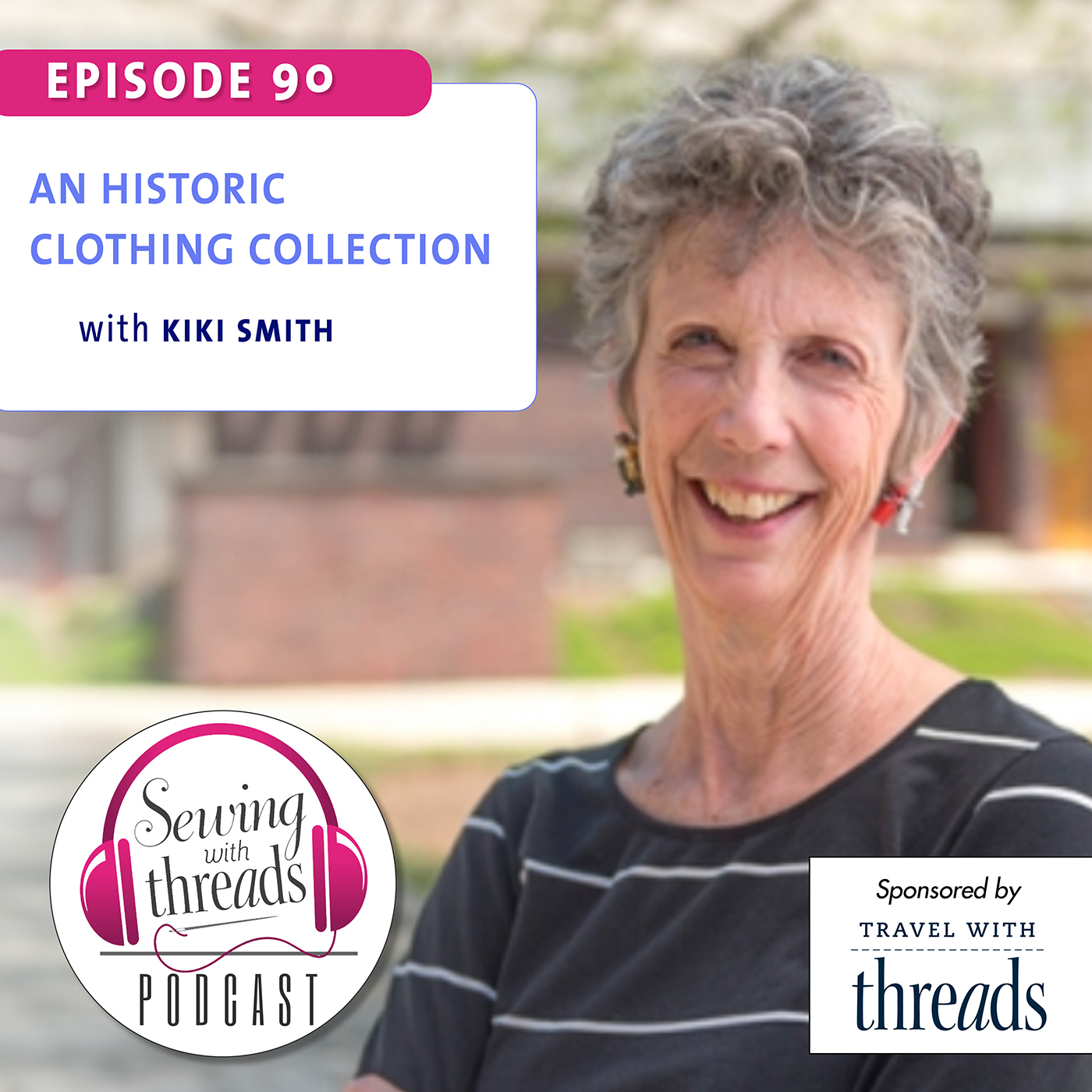
Threads Magazine Podcast: "Sewing With Threads"
An Historic Clothing Collection, with Kiki Smith | Episode 90
00:36:49
Loading summary
Transcript67 lines
- [00:00]
Unknown Host
We're back with an invitation to all of you Threads family to join us on our second adventure to the Netherlands. Our first trip was such a huge success that we've planned another in 2025. It runs September 16th through the 24th and there are lots of new activities and workshops to enjoy on this exclusive tour. We'll visit world class museums, fine fabric shops and our main event is a three day workshop with Saskia Tervela of the Dutch Couture Academy. Saskia hosted us last year and she's planning all new hands on learning alongside her wonderful hospitality. She'll focus on large frame couture embroidery, Chanel style trims and Japanese pattern making. This trip is filled with activities that will inspire you and fellow sewing travelers. To find out more about the 2025 Travel with Threads Netherlands tour, go to threadsmagazine.com the group is limited to 20 participants, so be sure to reserve your space today.
- [01:03]
Carol Fraser
Welcome to Sewing with Threads, the monthly podcast with the staff of Threads Magazine. I'm your host Carol Fraser and my guest today is Kiki Smith. Kiki is a professor of Costume Design at the Smith College Theater Department in Northampton, Massachusetts. She's also the director of the Smith College Historic Clothing Collection. The collection was founded 42 years ago by a student and is based in the basement of Smith's Theater building near the costume shop. Kiki's book Real Clothes, Real 200 Years of what Women Wore was published in 2023 by Rizzoli and is based on garments in the collection. The book documents garments and accessories that are what she calls real clothes worn by real women for all aspects of their lives. Selections from the book are now on exhibit at New York Historical Kiki is a professional costume and set designer working with theater companies including Shakespeare and Company in Lenox, Massachusetts and the Talking Band in New York, and she received an Obie Award for a production with that company. Welcome Kiki, and thank you for joining me.
- [02:03]
Kiki Smith
I'm delighted to be here. I've been a long fan of this magazine.
- [02:07]
Carol Fraser
Well, I've been a long fan of you and what you've been doing and I want to congratulate you on your book and on the exhibition, which are both have been getting a lot of press since the book first came out and the show is something that people are really talking about. I think it's amazing. I would like our readers to know that it closes on June 22, so they should rush out to see it and if they cannot because it is in New York, some people can't get there. The book is available through the museum website and at the museum itself and from local stores and also online. I just finished my second read of it the other day and. And I have to say it is such an enjoyable book to read for many reasons that we will be getting into when we talk about the collection.
- [02:47]
Kiki Smith
Thank you, Kiki.
- [02:48]
Carol Fraser
Being the director of this collection of historic clothing sounds like what I would consider to be a dream job. But I think there must be challenges. Can you tell us a little bit about how the collection began, how it's changed over the years and what you.
- [03:02]
Kiki Smith
Do with has changed over the years? Well, its use mentioned it was the brainchild of a remarkable student. I have lots of remarkable students here. And that one was very involved in the gray metal cabinets that I had moved out to a hallway in which I was filing all kinds of really exquisite dresses that had come in as a donation when this building first opened about 50 years ago. They were French and big names in the whole works. And they. My predecessor had just put them in the stock room along with, you know, monk's robes from Romeo and Juliet and an errant tutu or something. So I knew that they don't belong on human bodies particularly. Particularly actors who were too hard on the clothes. But I also knew that they'd be wonderful research. So I moved them out to the hallway. I started using them in class. A few people started donating clothes and that really got Beth going. So she did a little mini exhibit and she packed up her two favorite garments from the collection in an acid free box, of course, and hiked herself to New York City to meet up in appointments with Elizabeth Coleman, who was then the director of the costume department at the Brooklyn Museum, and Stella Blum, who was at that point running the Met. Both of those women were amazed at this young lady who was wanting to find out how to set up a collection and in that case on museum standards. She found it out. She spent on top of everything else she did. By the time she graduated, she made a 350 page typed manual which is still current and just sort of got us started. Raised money that could be used to hire student interns. And that was a real basis of this collection. It is for. For. It's a teaching archive. I've labeled it. Now it's not a museum. And as such it gives a different kind of leeway of what kinds of clothes, besides the exquisite couture pieces, what kinds of clothes would be useful to a costume designer, to a sociologist, to an anthropologist of some kind? So it has grown in spurts and often because I'll have a student intern and she will do a mini exhibit and then I'll make sure to get that photographed and published in an alumni bulletin. And lo and behold, there are some alumni who are cleaning out their parents attics. Would we please take these clothes off their hands? So it accumulated that way and then other friends who heard about it. But then I confess, about 12 years ago I discovered ebay. And at that point the kind of clothes I was interested in were really cheap. And I'm talking about waitress uniforms that have stains on them that only adds to their veneer as far as I'm concerned. And I figured out that I could buy a range of clothes every year and as an alum of the college, I would donate it at the end of the year. Probably not the kind of donation the college really would have liked, but for me it only made the teaching collection even better. So I don't buy so much anymore, partly because the prices have gone up and we're out of space. I have put cabinets every place I can find, figure out down here in the basement, in dressing rooms under the stage, you name it. And there's really no room left at the inn. So until I find out what can happen to this collection, I'm kind of at a standstill. So that's where I am hoping, I think, to hear from the administration. Thumbs up, thumbs down. But if I can give one more little story in this. At the 40th anniversary of this collection with an ensemble of remarkable women who happen to be Smith alums. Two of them in their 80s, one of them a former student who is hell bent to get this thing going. We organized a 40th anniversary which was a day long event. There were about 150 people who came. Former interns, faculty from the valley, local people and museum curators from around the area. Well, we invited, we old folks thought it would be great to have a interesting speaker. And we who read the New York Times thought Vanessa Friedman would be great. Now I have to confess, none of my students know who Vanessa Friedman is because they don't read the New York Times. That we didn't care. We wanted her here and thought she would be an interesting draw. She agreed to come if I would interview her. She had no clue why we were asking her really. She had no reason to know. But nonetheless, two of my star team said, now Kiki. And at lunch you take Vanessa from the building where we're doing this down to the theater building to the basement and show her the collection. And I went, are you kidding me? This is a woman who goes sees Balenciagas, and she's going to have high heels this tall, clip clop across the campus? I don't think so. So, anyway, she came, I interviewed her, and then before lunch, I gave a kind of update about the collection and showed slides, at the end of which Vanessa came up to me and said, would you take me down there and show me the collection? So in her high heels that high down, we went for an hour into the basement, and I showed her what I would say are the antithesis of couture clothes. And she nodded and went, mm, okay. Then, of course, she figured out why we were celebrating this collection and said, how are you guys gonna raise the money to do this? And one of my colleague stars said, well, we thought maybe we go to a wealthy fashion designer like Diane von Furstenberg. At which point, Vanessa's eyebrow rose and said, that's a brilliant idea. I know her. I'll put you in touch. A month later, there I am sitting in this over the top, amazing office with this amazing powerhouse of a woman who professes to love my collection. This collection. It's not mine. This one. And that she understands we're having a hard time getting attention from the college. And she said, you need to make the college love, love, love your collection. Yeah. And I frankly thought, well, she could fund it, you know, but that's not her way. She said, you need to do a big exhibit and take it all over the country. At which point inside, I went, I'm going to die before I can do that. And the other thing is, you need to write a book about it. And I'm calling Rizzoli right now because they do my books. And gosh darn if she didn't. And a month after that, we were in discussion with Rizzoli. Now, it took about two years to raise the money to get the photographs and things, but she was absolutely right. The book came out and was sort of like, what is this book? Why are we celebrating these things? And these, I have to admit, I say they're beautiful photographs because the women who dressed them and the woman who took the photographs are inestimably talented. So anyway, and then before the book even came out, one of the vice presidents at New York historical knew one of the women who'd worked on the project and heard about it and said, I think we ought to talk. And so the exhibit is in the women's history gallery at the museum, which was funded, founded and funded by a Smith alum. So it feels like we're home. And it's gotten amazing coverage. Yes. Which is very heartwarming to me that people get it.
- [12:21]
Carol Fraser
What do you think it is that appeals to people? I mean, generally, we go to the museum and we see these big collections of couture clothing and, you know, the fancy stuff all the way back to Marie Antoinette, that sort of stuff. These are really real clothes. And, I mean, I have to say, I love them, too. The photography is stunning in the book. It feels very real. And at the same time, you read it, and every single piece resonates in some way with your experience as a person. At least for me, I think I agree.
- [12:53]
Kiki Smith
And sometimes we know where the garment came from and its circumstances and why it was saved and how it came to us. But most of them, we don't. The ones I get from ebay, I write on the back of the accession tag where the ebay seller came from. So, for instance, I bought a pair of cotton dresses from about 1938 that even in the photographs, they look shabby. And let me tell you, these are worn out, faded, patched. There are rips in the collar, behind the collar. The buttons have faded from red to white plastic buttons and lined with a piece of quite obviously feed sack cotton. And they are, for a very slender person, the same person, because they're almost identical. And all I know is they came from a dealer in Chillicothe, Ohio. So I started to look carefully at them with a student, and we noticed there was this kind of odd arrangement of fading. It was across the shoulders, maybe had been sitting in a store window, not this dress. And it was faded on the back, but not on the front. And then it hit us both. That's where her apron was. Forever her apron was there. So that helped to establish. Now, this is in the height of the Depression. Then a couple of years later, a student in one of my classes, I had the dress available as a group of garments for students to pick to do research on. And she said, I want to do that dress because I'm from Chillicothe, Ohio, and it is coal country. Oh, my God. That added a whole new layer to the idea of this woman who wore these dresses to almost dissolving and at a time which must have been pretty darn miserable in that case, I still don't know who wore it. I don't have that much information. But a friend of mine had done a research piece about another garment, and she was wondering herself, why did this garment get saved And I wondered, why did these garments survive? Why weren't they pitched out in a dumpster? Well, maybe, maybe she had a granddaughter who loved her nama. And these were two pieces that were left and they didn't have many photographs of her, but these were great. Maybe, maybe they were used as insulation inside a house and whoever was emptying the house out went, oh, we'll just sell it in the, in the tag sale. I don't know. I'm sure glad they did save it though.
- [16:03]
Carol Fraser
Yes. And there's so many things, so many stories that you can come up with and you know, a lot of patchwork quilts were made from people's clothing and from, from feed sack prints and that kind of thing. Maybe these things were saved. Thinking I can paste this into a quilt. Eventually never happened. And now there's still dresses, which is really amazing. I mean, I would be surprised if there's a listener who hasn't saved something sentimentally, even if it doesn't have any other so called value.
- [16:31]
Kiki Smith
Absolutely. I was speaking to a group of students who just had been accepted by Smith and were were probably coming. And so the auditorium was filled with students and their bored looking brothers and their very attentive parents. And so I started it off saying, how many of you have saved a pair of pants, a T shirt, or a locket that your grandmother gave you that you couldn't bear to give away? I swear, every single hand went up. So yes, clothes hold people and memories. And I think that that's one of the things that's so attractive about them. There's another little story I want to tell. When the book first came out, my former student gave it to a neighbor of hers. This is in New York state, and her neighbor is the librarian at an elementary school. And that woman's sister, who was also a librarian at another children's elementary school, they were both there and they were knitting together or something and they took turns reading pages out loud to each other. And at a certain point the sister stopped and said, you know, I never thought I was part of history. Okay, that's good. If people walk out of that exhibit and realize that they have a story and that is really reflective of their own life and a way of life, that's terrific.
- [18:02]
Carol Fraser
Yes, I agree with you. And that's part of what is so wonderful to read in the book is that each garment is placed in a context and often related to what it's like today too. So you sort of feel like, oh yes, I am part of a legacy somehow. Things are different or things are the same. Sometimes you see it that way. It's just never changed, you know, but. And sometimes you look at them and think, I mean, for me, I look at the things from the 70s and think, oh, my gosh. Yeah, we used to just see that stuff that used to just be what people wore.
- [18:32]
Kiki Smith
Right, right. We're vintage at least. And I feel like I'm verging on antique at this point.
- [18:39]
Carol Fraser
But.
- [18:39]
Kiki Smith
Yeah.
- [18:40]
Carol Fraser
Well, it's fascinating to look at, to look at those clothes. I have to say that you the. When I look at a collection of haute couture or very high fashion clothing, it's hard for me to sort of think I would want to wear any of those. Mostly I don't. But a lot of these clothes are kind of appealing. There is a sense of, oh, the 40s, that's a silhouette that I would like or I wouldn't like, depending on who you are. It's much easier to project yourself into these clothes. So it's a very fun book for that reason. For that reason alone, in fact. So it sounds like you and your students, I guess, do quite a bit of detective work indeed on these things. How do you approach it? How do you use these in your teaching?
- [19:24]
Kiki Smith
Well, I teach a course that every year, or this year I've done it both semesters that is called reading in Air Quotes, Reading dress, Archival studies of clothing. Because there is a program here about this wonderful collection of books, a book collection here. There's programs in the greenhouse for the botany collection there and other archives. So it makes sense to have a variation on this just to give students an idea of the complexity of things that's useful to know, to engage with, with somebody else's clothes from a period that doesn't look familiar. So from the beginning, I have selected a topic and then pulled a rack or two of clothes that fit into that and bring it to the class. And that sets a kind of boundary of a focus of what we're gonna study. So usually, ideally, it's something I don't necessarily know about completely. I mean, I'm a costume designer. I'm not a trained clothing historian, so I got lots to learn. So one semester we looked at wool, another one linen, one cotton, and the horrors of its background. We've done uniforms. And to me, a uniform is everything from a World War I volunteer outfit to a house dress is a kind of uniform, to a lawyer's suit is a kind of uniform. One time we did suits based on that remarkable book by Anne Hollander. Called Sex and Suits and boy, that was marvelously illuminating. And so this fall we looked at coats because I'd never had a chance to really explore the range of those. I. I've just finished up a semester looking at women and pants that is kind of written about, but not with an overview that I think is at all adequate. I think the students today kind of go, pants, meh. What's the problem? And without any idea of where we've come from in Western culture. There are other cultures where women have worn pants forever, but not in this world. So I think it's important to remember some of the important steps that have made pants our kind of go to outfit now.
- [22:10]
Carol Fraser
Oh, yes. I don't think of myself as that old, although others might disagree. But I do remember somebody being sent home when I was in second grade for wearing a pair of pants to school in a snowstorm.
- [22:20]
Kiki Smith
Yep.
- [22:21]
Carol Fraser
Yeah. She was made to walk home and come back in a dress.
- [22:25]
Kiki Smith
I know those were the days.
- [22:26]
Carol Fraser
And I do remember that by third grade we were allowed to wear pants in the winter. And it was, it was really amazing. It was really quite an amazing thing. And, you know, then everybody was getting bell bottoms and stuff. So, yeah, it was quite a change. And I tend to. I tend to date people by like, do you remember when pantyhose were first introduced, as opposed to stockings and garter belts?
- [22:47]
Kiki Smith
Yeah.
- [22:48]
Carol Fraser
Even in the book, there's even. Oh, my goodness, the underwear section is. Is a little bit gruesome. I mean, there's a lot of stuff that you are. We're very happy we're not wearing anymore.
- [23:00]
Kiki Smith
I definitely have heard that many times.
- [23:03]
Carol Fraser
For example, the maternity corset or girdle or whatever that was. Wow.
- [23:09]
Kiki Smith
Well, you know, women now wear Spanx to hold support themselves. And so it's not totally out to lunch as long as it's not harming the baby.
- [23:21]
Carol Fraser
But yes, that's true. If it's a support rather than a constriction. That's true.
- [23:24]
Kiki Smith
Right.
- [23:25]
Carol Fraser
Yeah. Most of our listeners probably are people who sew their own clothing. And I'd love to know what kind of what percentage of your collection and in the book really would be handmade or homemade.
- [23:35]
Kiki Smith
Most things before 1860, which is when the sewing machine became available for women to buy on credit and it was encouraged to put them in housed in such a way that they could be in their parlors because they would be in an elegant cabinet. But even after that, it kind of. By the time we get to say those two dresses from the 30s, yes. The longer seams are all done by a machine, but there's still a lot of handwork. And in suits from the teens and the twenties, the arms, eyes are all laid in by hand. Even if they're sold, say, at a department store, there'll be hand stitching in them. Nowadays, as you know, we have very little hand stitching because there are machines that can do just about all the stages, still requiring good labor to run the machines.
- [24:41]
Carol Fraser
Oh, absolutely, absolutely. I know. And today, if you make your own clothing, you do it almost entirely by machine. But it's still. It's still work. It's still. I mean, it's. People don't do it just out of drudgery, which I think has been the case in the past. I think now it's really a creative endeavor, and it's exciting and fun, and the feeling of making something is. Is a feeling that we now value in a way that we did not used to. So that's actually kind of wonderful. And I think maybe one of the latest garments that you have in the book that was made at home would be maybe the blue quinceanera dress. It's from the 1980s. It is an absolute labor of love. Beautiful thing. And the story brought tears to my eyes. There were wonderful stories in this book. That one really. Really, I really felt that one. And I think the chapter on service and the maids uniforms and the waitress uniforms, really, they really kind of touch your heart when you think about what these women had to go through and what they did for themselves, for their families, and how that is exemplified in the clothing that they wore and made.
- [25:49]
Kiki Smith
Yep, I agree. I do know that regularly, students, any of us will be looking at a garment. I love the ones from the 40s and go, oh, God, we should make a pattern for this, because people ought to be able to make this garment. And so that'll be another side project. But I can see where the temptation is to renew different shapes and sewing forms from these earlier times.
- [26:22]
Carol Fraser
Oh, yes. I was rediscovering the forties through this book, too, because that's an era that I don't pay a lot of attention to. And most of us are sort of new look 50s. We are familiar with that from Mrs. Maisel and various other. And then Mad Men introduced us all to 50s, 60s, and then into the 70s. But the 40s, really, they're great clothes and really could be very modern, I think. And even the clothing that, you know, is purchased has a lot of wonderful details. That's another thing. Do Your students appreciate the detailing that exists in this clothing that was probably bought for somebody to wear.
- [26:59]
Kiki Smith
Generally the ones in my class learn to appreciate it. I mean, one of the projects they have to do is a sewing sample. And some of these students have never threaded a needle. Just teaching that how you make a knot at the end of end of a single strand and how they. They have to sew on a four hole and a two hole buttons. They have to learn how to install snaps to do a hem stitch, a running stitch, a basting stitch. And some of them are not very well done, may I say. But I always say, all right, I'm going to call the registrar and say you can graduate now because you've got these skills under your belt in theory and just that. And then when they begin to look, and it takes a lot of looking and comparing clothes from different eras, clothes from within an era, and what the differences are. So they learn to appreciate and to recognize clues that otherwise, which are often on the inside, of course, that otherwise people wouldn't notice or have any reason to see.
- [28:16]
Carol Fraser
Do you have students who come in already proficient at garment sewing?
- [28:21]
Kiki Smith
Occasionally, yes, a few. Not quite as many as a long time ago, but yes. And the interest in sewing is very high. There are two women who oversee the costume shop across the hall from my office here. And they have made what I call the center of the universe. Down here in the basement. There is amazing music, there's often good food, there is willing ears, good jokes. And you can hide, focus on what the project is you're doing or you can ask any question now. So on Friday afternoons, it's an open time and it's packed in there with students everywhere from learning how to patch their jeans to wanting a spread out and cut out a dress they're going to wear for graduation.
- [29:19]
Carol Fraser
That's amazing. That's really amazing. I do know one person who sewed a dress out of. I don't know if they do this anymore, but they used to have sheets. You could just take sheets in the closet and the sheet supply would decrease markedly around the time of IV day. For anyone who doesn't, Ivy hay is a spirit tradition where you must wear a white dress and students would take the sheets and turn them into often somewhat rudimentary, but. But they were white dresses indeed.
- [29:45]
Kiki Smith
You're so discreet, Carol, in your descriptions.
- [29:49]
Carol Fraser
Well, no, I do. I had a friend who made a really great. She had a white blouse and she made this really pretty skirt with like a pleated cummerbund. It was really. It was charming. And I didn't really know. I grew up in a sewing house, and my mother was excited to make me my white dress for Ivy Day, so I didn't have to do that. And I was probably the only person, one of the very few, rather, who came to Smith with a pretty good foundation in sewing.
- [30:11]
Kiki Smith
And.
- [30:11]
Carol Fraser
And of course, you weren't there yet, and I. Because I would have taken your class for sure if you had been there, that would have been just really a wonderful experience to do. I think that looking at older clothing and finding out what you can from those pieces is so marvelous. And even the style of prints and the types of fabric, the use of rayon, really interesting.
- [30:36]
Kiki Smith
Yes.
- [30:37]
Carol Fraser
For a period of time, which, growing up, I think we had all moved to polyester, so that was quite a change, too.
- [30:45]
Kiki Smith
Right.
- [30:45]
Carol Fraser
Yeah. Yeah. We're kind of going back. Yeah. So do you have a favorite item from the collection?
- [30:52]
Kiki Smith
Well, it is a bit like Sophie's Choice. You know, I don't want to hurt the feelings of anybody of any of the garments.
- [30:58]
Carol Fraser
Right.
- [30:59]
Kiki Smith
I have to say, those two dresses from the 1930s, I think, never fail to move me. You know, there's remarkable pieces, like when this was first getting put together, the college bought the paper, many of the papers from Sylvia Plath's mother. And. Because Sylvia Plath, as you know, went to Smith, so. But part of the purchase was her Girl Scout uniform and a prom dress that she had purchased while she was here. And so, you know, there used to be gatherings of scholars about Sylvia Plath coming to see the archives of her papers. And they'd come downstairs and I'd open up the boxes, and it's sort of like they would stand over the boxes to inhale the DNA. Understandably, you know, I did find out the prom dress with the help of Karen Kukiel, who was the major editor of all of Plath's papers here at Smith, who, when she looked at Sylvia Plath's armload of badges, said, yep, she was a type A personality. But she also knew that Sylvia had written about this very dress in her journal at the time. She'd written just raving about it and the beauty. She was going to be describing it and drawing it for her mother in a letter and just ecstatic about it. And then the next time it shows up is in the Bell Jar, her novel, which is based on her time in New York City as an editor, as college editor for a month. I think it's. What is it, Mademoiselle? I think so Glamour. I think so, yeah, and there are photographs there of her wearing the dress at a cocktail party for it. But by the time she wrote the book, the lead character is doing the same job, going to cocktail parties wearing this ridiculously shabby, stupid dress. I mean, her attitude about the dress had completely changed. So it is all right there in this kind of cheap. It's not a fancy wedding prom gown, let me tell you. It's pretty cheap, but it holds itself. A lot of stories.
- [33:30]
Carol Fraser
Oh, my gosh. Yes, yes, yes. That is a very familiar feeling for most of us, I think something that you think is going to transform your life and then you look back at it and think, oh, well, A, it didn't transform my life, and B, I see why.
- [33:44]
Kiki Smith
And she uses.
- [33:45]
Carol Fraser
Not as much as she uses the.
- [33:47]
Kiki Smith
Word transform in her journal and in her letter. It was going to transform her into a goddess.
- [33:55]
Unknown Host
Wow.
- [33:56]
Kiki Smith
So, anyway, so they're delicious things down here, and I can find a lot of pleasure in just about every single one of them.
- [34:05]
Carol Fraser
Oh, absolutely. I feel the same way. I ran across the little chapter on bonnets, and this is just a silly personal story, but the plastic rainbonnets, they're hysterical. I mean, you know, I grew up in the 70s where we wore hair. Hair wild and free. So it didn't. We didn't understand the concept of it at all. But of course, my aunts had, you know, once a week to the hairdresser and got the salon do and everything. And so for every every year, at least one or two times, as a little present, they would give us one of these little foldable plastic rain bonnets. And my uncle would needle point us a little tiny case to put the little bonnet. And so we could keep it in our purse and it would stay neat. And then when we needed to cover our hair.
- [34:48]
Kiki Smith
Oh, Carol, do you still have one of those little purses?
- [34:51]
Carol Fraser
Oh, I don't know. My sister might have one. I probably don't. If I find one, I will send it to you, though, because it's hysterical. I just. And we, my sisters and I sometimes would look at each other and all we do is just say rainbonnet. And it just is. Tells you the whole story of, like, where we've been, where we're going, what's happening.
- [35:11]
Kiki Smith
Right, right. I don't think you ever had to wear curlers and sleep on them overnight, which means they end up with a bouffant hairdress and you don't want to get it, or your mother doesn't want you to get it wet.
- [35:22]
Carol Fraser
Let's put it that way. That's true.
- [35:24]
Kiki Smith
So anyway, yes, thank you for noticing those.
- [35:27]
Carol Fraser
I know I will never forget the Rainbonnet. And thank you ever, ever so much for talking to us, Kiki. It was wonderful to hear the stories about this collection and about about the people, known or unknown, who are behind all those clothes and how their clothes carry their stories forward. You know, there's a lot of imagination, there's a lot of expertise and detective work involved in finding that all out, and we really appreciate you sharing it. I do recommend that our listeners try to get to the exhibition if they're close enough to do that, but to look for the book because it's it's such a fun read.
- [36:01]
Kiki Smith
Great.
- [36:02]
Carol Fraser
It'll take you into your, into your past life and the life of your your female forebears also.
- [36:08]
Kiki Smith
Yes, indeed. This has been delightful. Thank you, Carol.
- [36:12]
Carol Fraser
Thanks so much. And thank you to our listeners for tuning in today. You can find show notes for this episode@threadsmagazine.com as well as links to previous podcasts. Meanwhile, keep on Sewing with Threads.
- [36:24]
Unknown Host
Thank you to our guests for joining us and thanks to all of you for listening. Please remember to send your comments, questions and suggestions to threadsmagazine.com and please like comment and subscribe wherever you are listening. Until next time, Keep on Sewing with Threads.