← Threads Magazine Podcast: "Sewing With Threads"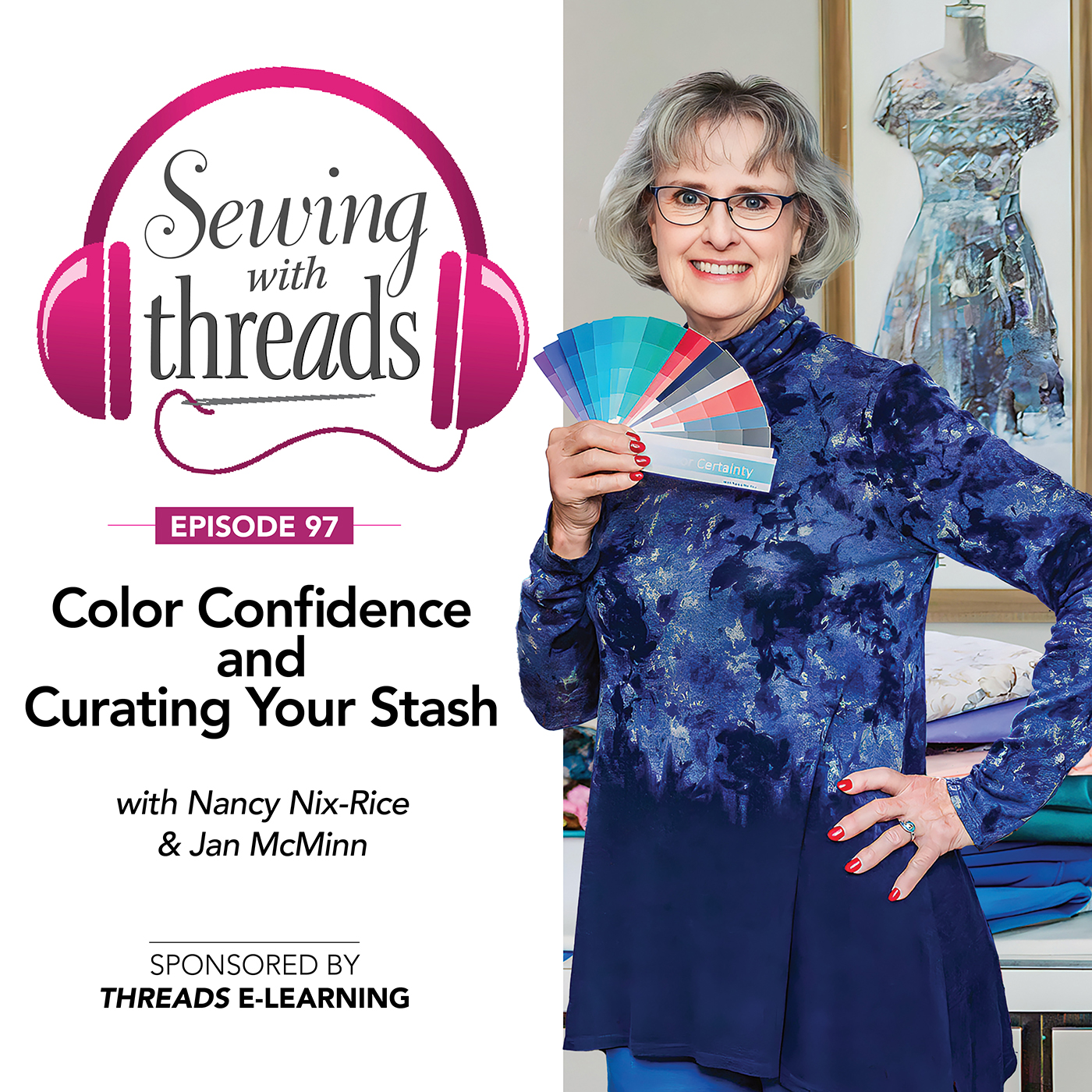
Threads Magazine Podcast: "Sewing With Threads"
Color Confidence and Curating Your Stash | Episode 97
00:52:37
Loading summary
Transcript104 lines
- [00:00]
Podcast Announcer
We've just released a must try elearning course titled Fitting youg Hanger with the late Cynthia Guffey. You'll benefit from Cynthia's in depth explanation of how to fit your shoulders and upper back on tops, dresses and jackets. Once you've mastered this area, other fit issues will fall into place easily. Plus, garments will feel comfortable and look fabulous. You get nearly four hours of instruction on measuring your body than adjusting a variety of pattern types to accommodate your unique posture. To sign up and to find other on demand learning opportunities, go to courses.threadsmagazine.com.
- [00:44]
Carol Frase
Welcome to Sewing with Threads, the monthly podcast with the staff of Threads Magazine. I'm your host Carol Frase and my guests this month are Nancy Nix rice and Jan McMinn. Nancy is a certified Image consultant and the author of three books on wardrobe development. She has a background in the home sewing industry and combines her knowledge of fabrics, patterns and garment construction with her understanding of how women like to dress. To feel confident every day, you can find her at nancynixrice.com Jan is a retired corporate professional as well as a certified Palmer Pletch fitting instructor. She's been sewing since her early teens when she realized she could create unique garments that no other girl had. Throughout her career, she continued to sew most for clothing. These days she teaches at fabric stores in the Kansas City metro area. Welcome Nancy and Jan.
- [01:33]
Jan McMinn
Thank you.
- [01:34]
Nancy Nix Rice
Thanks.
- [01:35]
Carol Frase
It's really good to have the two of you here. I'm very excited to talk to you. Just a little background for our listeners. Recently, Nancy wrote an article about the experience she and Jan shared when Nancy helped lifelong sewist Jan cull her substantial fabric stash. Their goal was to plan a versatile wardrobe based on fabrics Jan already owned and to set aside fabrics that weren't going to work for her. Parting company with any of my fabric stash makes me a little anxious, and I think that's probably true of many of our listeners. So let's find out from Nancy and Jan how the process went and what the results were. Jan, let's start with why you agreed to be Nancy's example subject or guinea pig for this article. What made you think now is the time I need to curate my stash?
- [02:19]
Jan McMinn
Well, I'd had multiple life changes, the biggest one being retirement, and that's where I really realized I needed help. When you've worked in a professional setting wearing business dress, most of your wardrobe is geared toward that, and once I retired I felt like I had nothing to wear. In addition, I had moved and changed From Colorado to Missouri, I had lost some weight, which I'm not complaining about, and, and I had let my hair go gray. So I felt like I was ready for a new me.
- [02:52]
Carol Frase
I can understand that. And I think a lot of our, a lot of our listeners probably feel that way, too. I know that the, the average Threads reader is in the getting ready to retire or retired age range and life changes for people at that point often.
- [03:07]
Jan McMinn
Usually it should, and it's a wonderful change.
- [03:11]
Carol Frase
We hope so. We hope so. Well, so, Nancy, do you find that when you, you work with clients of a lot of different ages and different times of their life, and I know that you work with people who sew and people who don't sew also. But for sewists, do you see that there's a particular impetus for them when they just decide that they need to revisit their stash?
- [03:29]
Nancy Nix Rice
Well, sometimes they simply become aware that there are factors that determine what looks the best on them that they may not have considered when they made some of those fabric purchases. Especially with prints, it's really easy to just get drawn into, oh, it's so pretty and never stop to think how it's going to look on them. But you're right that often some kind of life change triggers people again, both sewers and women who buy their clothes to step back and want to rethink their wardrobe choices for sure.
- [04:09]
Carol Frase
Yeah. Well, Jan, you said that you discovered you just weren't wearing the same kind of clothes. You just really needed a different style of wardrobe, one that maybe I'm assuming is a little more casual, but possibly, maybe it was more creative or less creative. Creative or, or something. But I wonder if people, people are able to sort of see that the clothes they have don't work with the things they want to do anymore almost before they realize they're not maybe the best color choices or print choices for them, too.
- [04:39]
Jan McMinn
Yes, I think so.
- [04:41]
Carol Frase
So how long have you been collecting fabric, Jan?
- [04:44]
Jan McMinn
Oh my. That's a rather personal question.
- [04:48]
Carol Frase
Hey, I think we would all be. We would all answer it. I would answer it.
- [04:51]
Jan McMinn
Yes, I'll answer it. My I will stash was very well aged. Now, I had culled a great deal of it as a result of moving across country because as we discussed earlier, fabric is heavy and I was trying to really be with a critical eye, get rid of the things I really thought I wouldn't use. But I still had a lot of fabric, some better than others. Some pieces that I had, I'd had for a very long time. I really liked them, but I wasn't sure sure what I could do with them. And I really had never had someone come alongside and give me suggestions. But I do know that having room to keep fabric doesn't necessarily relate to using it.
- [05:36]
Carol Frase
Well, that's a very good point to make. It's easy enough to sort of say, I don't have space for my fabric, I have to get rid of it. But it's different when you sort of think, I can just keep adding to my stash. So. Yeah. Well, Nancy, I know that one of the things that you started with in the article that you worked on with Jan that you say to start with color confidence. Can you tell us a little bit more about what that means for somebody?
- [06:02]
Nancy Nix Rice
Sure. In all the years that I've worked with helping women develop their wardrobes, I just become more and more and more and more convinced that color knowledge, really understanding what colors showcase an individual woman and is the most foundational concept in building a wardrobe that really works. Because no matter how fine the fabric, no matter how meticulous the construction, if the color makes the person, I use the expression look like she died yesterday and no one has yet shoveled any dirt on top, then the outfit just can't be a success. And a side advantage of really understanding a person's best range of colors is that because what defines them as best is that they share temperature, value, and intensity characteristics with that unique woman. All those colors then are going to play well in the sandbox together. So almost without even planning coordination, it's going to happen when the color direction is right.
- [07:23]
Carol Frase
Can you give us some examples? I mean, we will not have video with this, but there will be pictures in the show. Notes to this podcast that listeners can find@threadsmagazine.com and you'll see maybe some photos from the article. But talking about Jan, for example, what were you identifying in Jan's overall coloring that you were trying to bring out with her fabric choices?
- [07:46]
Nancy Nix Rice
Well, Jan's coloring overall is cool, which means a lack of golden pigmentation in any part of her coloring. And that's something that we assess along a continuum. In fact, all of these characteristics exist along a continuum. So it's not like there are cool people on one side of the room and warm people on the other side of the room. There's a question of degree. But Jan's coloring was very far to the cool side. Her coloring is also soft and gentle, partly because as her hair color has softened, our eye color and skin color soften in parallel and there's not a lot of light, dark contrast in her coloring. So we're looking for colors that were soft, gentle, not. Not pastely or sugary or sweet, with a little bit of a complexity to them, but in that cool temperature range, mid tone value and a little bit softer. And it's so interesting. When we first looked at the photos that Jan sent me of her whole fabric collection, you didn't get any sense of cohesiveness at all, really. But as we started pulling out just the things that were mountaintop choices or mountaintop adjacent choices for her coloring, all of a sudden little groupings, little clusters just started to form so naturally and so easily. I think the green grouping was really the surprise of. Of all of it because she had a really substantial cut of this interesting, slightly dusty blue toned green pinwheel corduroy. And it was an unusual color, not something that you would really think of as being a great wardrobe basic. But once we had that solid in our hands, all of a sudden print things and patterned things and lighter tones of the same color just materialized like magic and defined a grouping before we even knew what hit us.
- [10:16]
Carol Frase
Chan, do you mind my asking, your hair is. Your hair is lightish colored now. Was it completely dark when you started this whole process when you were younger?
- [10:25]
Jan McMinn
Yes, I was a brunette with a little bit of barely. Barely red under it. So.
- [10:34]
Podcast Announcer
And.
- [10:35]
Carol Frase
And did you used to wear more high contrast colors and darker colors? Yeah. And. And so what happened to all those clothes, I hate to ask.
- [10:45]
Jan McMinn
Oh, it's been very sad. You know, those, for the most part, those are my babies, and I made them. And it is really hard to think about not having them. But at the same time, when I understood what Nancy was saying about my cooler skin tone and hair and eyes, I realized she's right. Some of those pieces that I had were made for. I made when I was dark haired, and there was a real contrast between my hair and eyes. And so it's. I completely agree with. With her assessment that I am better in cooler colors now with less contrast.
- [11:29]
Nancy Nix Rice
Yeah.
- [11:30]
Carol Frase
Yeah.
- [11:30]
Nancy Nix Rice
Even in the handful of pictures that we were able to include in the article of Jan either wearing or holding up some of her previous garments, they were so bright and so high contrast that they were creating what I call the clothes wearing the person instead of the person wearing the clothes. And honestly, that can cause some confusion on a client's part, because when we wear something that's out of sync with our own characteristics, people notice the clothes, and then they're likely to say, oh, my gosh I love that shirt. Or I love that, whatever. And we think that means that we've got it right, when a lot of the time, it really means that they're seeing the garment and that we are, for all practical purposes, invisible in the mix. And. And once in a while, I'll even have a client who says, oh, I don't know, I don't really want people to see me, but that's us. That's who we are. And of course, we want people to see us. And when we frame our own characteristics in the colors and the shapes and the styles that suit us, then we can appreciate that each one of us is beautiful in our own distinct way. I think when we don't like how we feel that we look, then, yeah, maybe we do want to be invisible. But once we see ourselves showcased in the way that right colors and styles do, then it's a celebration to be seen.
- [13:17]
Carol Frase
Yes, I agree completely with you on that. And I think that is a. That can be an obstacle for many people. I think it's true, especially for people who sew, who sew well and creatively, and who see images of others who've made these beautiful clothes, and they think, I love that. I want to do something like that, and I've put my time and effort into it, and I'm going to wear it. And then you get the feedback of, oh, my gosh, that's an amazing jacket, or whatever. It's really hard to step back and say, it is an amazing jacket. But I am, you know, I'm an amazing person, and I could have a jacket that actually brings out that aspect. And it's not just the jacket. It can be. It can be me. I would say that one of the places where I see this kind of thing is, well, I read a fashion blog, and so you see the red carpet and you see people wearing these amazing gowns and think, I'm sorry that you're wearing it. It should have been on that other person. It would have been better. Or. And the other one is when I'm watching Jeopardy. And I'm like, I kind of wish they had, you know, just a wardrobe consultant, because I know people come in and they just. They want to wear something that they feel comfortable in. But then I want to say, you know what? You know, the black cardigan sweater is just making you seem like a black hole, and look at your beautiful hair, and there's things you could do well.
- [14:32]
Nancy Nix Rice
And it's. It's interesting that those of us who sew kind of use the rationale that we don't get to see how something looks on us until we've already invested the time and energy. And, oh, those lucky people who buy their clothes get to try them on first and know. And as someone who works with a variety of women, some of who sew and some of whom, I will tell you that getting ready, getting to try it on before you buy it, is not a guarantee of a flattering outcome. Sit at the airport or at the mall and look around and you'll realize that really, those of us who sew are at such a big advantage because we get to choose the color and the fabric and the style and make it all come together in the way that's the best for us. We just have to have that base of information to make good decisions in the first place.
- [15:37]
Carol Frase
So, Jan, I saw in the article you showed your color palette, which is just a beautiful color palette full of things that make me think of spring flowers and just all the lovely, cool, nice hues that I really enjoy. Is that the normal number of colors in a palette, Nancy? And I'm just wondering what the range in somebody's palette would be if you were to give them like a custom palette.
- [16:03]
Nancy Nix Rice
So I do customized color palettes. I don't put people into a category and hand them a pre printed or pre selected group of colors, so they're always individually chosen. And I don't base it on a number of colors, but rather covering the categories of color. So every color palette includes strips of color that duplicate what we see when we look at the person. Their skin tone, their hair color, their eye color, and their natural body red. Then it includes their most effective dark neutrals. You sort of made a reference to black not being the optimal choice for the vast majority of women, but we need something that fills that basic function. So what are the two or three or four base neutrals that are most effective with that person's coloring? Then we look at pale neutrals, and again, that bright paper white is overpowering for almost everyone. But we need that functionality of a light neutral in our wardrobe. So there's always a strip of recommendations for that. And then we simply go around the color wheel. Red, orange, yellow, green, blue, purple, almost everyone can wear almost every color family. The bright yellows and oranges get really tricky. They're almost a no go for cool coloring. But with that exception, everyone has their best choices from the red family, their best choices from the blue family. And that's what we look at, is covering the full range of the color wheel. And showing the person their very best choices within each one. And then honestly, I do a zoom class with my color clients that talks about, now, are you going to be able to find exactly dyed to the mat dye to match colors for every swatch in your set? Probably not. So then how do you evaluate how much wiggle room do you have, how much lighter, how much darker, a little warmer, a little cooler, how to navigate that? Because literally I work from a set of nearly 2,000 color choices when I'm making the selections for any client's color fan. And if I tried to put in there every color that the client could wear successfully, it would have to be on wheels in order for her to be able to take it to the store. So we're looking for, I explain to people that I'm incredibly rigid and picky when I'm choosing what goes in their fan. So then they have some built in wiggle room to either side and still be absolutely fine. Does that make sense?
- [19:12]
Carol Frase
Yes. And I'm thinking, so you could take your, you could take your fan and hold it against a fabric and if it looks good with that fabric, then maybe that fabric is going to work for you, even if it doesn't exactly match it. If it goes with the colors that are in your fan, then you're in the right area there.
- [19:27]
Nancy Nix Rice
And, and I teach people three different ways to assess that. Number one is that I try to put at least three related colors on every strip in their color fan so they can hold that strip against what they're considering, whether they're considering buying it or they're considering keeping it in their stash and say, does this harmonize? Then they can also fan out the strips that represent their skin tone, hair color, eye color, and body red, which is in effect an abstraction of them, and hold that against the color and say, is this harmonious? And then the last test is to fan out the whole fan and hold that against the thing that they're considering and say, is this color or, or this print or this stripe about the same temperature, value, intensity and degree of contrast if it's a pattern. And so any one of those is a good clue and all of them used together make it right next door to foolproof.
- [20:43]
Carol Frase
Can I ask you quickly, you've been mentioning the term body red. What is that? Is that sort of liptone or where you're.
- [20:51]
Nancy Nix Rice
I'm really glad that you asked that because really often a client will get her color fan and come right back to me and say, but there's no red in Here, because they're defining red not as a color family, but as.
- [21:08]
Strawberries and fire trucks.
- [21:10]
And there really are not that many.
- [21:12]
People who look great in fire truck red. What we mean by body red is, is the narrow range of choices from the red color family that most closely align with that client's color temperature, her.
- [21:28]
Degree of goldenness or absence of goldenness, her color value, how light or dark.
- [21:36]
The overall read of her coloring is, and then intensity. Does her coloring have a brightness and crispness to it, or is it more softened and blended? The comparison I sometimes use for that is that intensity is satin, and more muted intensity is velveteen. Does that help you envision what we're talking about? So I say body red because it's that defining thing from the red color family.
- [22:10]
Carol Frase
That's interesting. And, Jan, what did you get? Did you have mostly. Did you have sort of on the pinker range of red? I think.
- [22:19]
Jan McMinn
Not bright pink. I wish I brought my color fan with me that that might have been helpful. We do have some red in the fabrics that we chose and in my swatch, so I have worked with a couple of reds. I don't know that I would ever wear an entire red column, but I do. I do like red.
- [22:44]
Carol Frase
I remember now that there was red. Yes. For. For to go with a jacket that had little red dots.
- [22:50]
Nancy Nix Rice
And that, honestly, red was a little bit far astray from Jan's absolute mountaintop coloring. But because we had all those other navy pieces going on, and then we had that navy with that darling little red dot in it, we felt like that in a combination, would tone down the bright red enough to make it work just fine for her. That's another example of that. How far can you wiggle? And that amount of wiggle room is just not so terribly clear cut, because it's not only the color itself. It's how are you putting it together in combinations of garments for an outfit?
- [23:38]
Carol Frase
Yeah, well, that. That I understand completely. And you think sometimes, oh, I've got this top that's so beautiful, and I love it, and it looks good on me. And then you wear it with something and think, oh, everything has gone downhill. It's just totally like the colors negate each other somehow, or the proportions suddenly become weird, and you just need to try again. Which makes me come to the question I have for you, Nancy, about when you're doing this stash cleanout, which is what this all started with. It was it. Color was the first step, but the next step was to pick out fabrics that Jan had where There was enough to make kind of a core four. Can you, can you just run over what the core four is and maybe give us an idea of what kind of yardage you need to do the core four generally?
- [24:22]
Nancy Nix Rice
Sure. One of the biggest wardrobe mistakes that I see women make is sewing or.
- [24:30]
Buying just random orphan items that aren't.
- [24:35]
Part of a plan. And doing multiple garments in the same fabric or closely related color family is.
- [24:46]
Really the basis for unbelievable degree of mixing and matching.
- [24:51]
So when I talk about a core.
- [24:52]
Four generally that means two different bottoms.
- [24:56]
Typically a pant and a skirt, some sort of under layer top and some sort of overlayer top. And the magic of that is that certainly you can build monochromatic outfits out of that and it's fine.
- [25:13]
But much more valuable you can use either one of the bottoms with the.
- [25:18]
Under layer top and create what we call a color column and then just start layering every different kind of jacket.
- [25:27]
Cardigan, vest, whatever over it and making.
- [25:30]
More and more outfits.
- [25:32]
And comparably you can wear either of the bottoms with its matching or closely blended overlay or top and start trading in shells, camisoles, shirts, blouses in a whole variety of colors and keep making new outfits that way. So one of the really great things about Jan's stash, and this isn't always the case, but she did have several different pieces of fabric in colors that.
- [26:07]
Were great for her, where she had.
- [26:09]
Enough yardage to do the four pieces or three of the four, whatever it.
- [26:15]
Might be in a 60 inch fabric. Generally a core four is going to take a yard and a quarter for the pants, unless you're super tall. Three quarters for the skirt, three quarters for the shell. So now we're at three and then whatever yardage your overlayer needs. So five yards in 60 should be oodles. And again that is dependent on the size of the pattern that somebody sewing and if there's a match involved in a one way design and whatever. But. But five's a pretty good guesstimate.
- [26:57]
Carol Frase
But that's a good idea. And ever since I've talked to you about it, when I buy a solid colored fabric, I try to buy four or five just depending on if the weight is, you know, sometimes the fabric is going to be great for pants, skirt and jacket, but not for a top. And then I know I'll have to find something else to go underneath or I know I'll never make a skirt in this grouping or something like that. So I just am going to do the core three.
- [27:17]
Nancy Nix Rice
Sure. Well, and sometimes too you might want to do a core five. And a great example of that is when you're working in navy. And you might do a navy skirt, a navy dress pant, a shell of some sort and the jacket. But then you think, gosh, I could do dark wash jeans, or I have dark wash jeans that'll play right into this. And maybe the jacket that I made.
- [27:45]
Was a dressier style, but I'd also.
- [27:47]
Like a jean style jacket. And so you're not required to make.
- [27:53]
All four, nor are you limited to just four.
- [27:57]
So.
- [27:58]
Carol Frase
Oh, here's a question for you because you talked about the sort of dark neutral and the, and the light neutral. And I always have a lot of questions about these. First, the, the light neutral. Do you have any rules? I realize how hard it is if you're not going to buy plain white, which is what you see in the stores, usually plain white, or maybe there's sort of an off white. And a few years ago, there started to be more options for a blush color. But it's still. They're hard to. It's hard. I do not know what my light neutral would be, and I don't know how I would tell.
- [28:30]
Nancy Nix Rice
Well, most people have multiple light neutrals. Most people are much better in some.
- [28:37]
Sort of ivory or pearl kind of color, rather than bright optic white, which.
- [28:44]
Really overpowers almost everyone. And you're absolutely right about that blush color. It's almost a pale pink, but a little more complex, a little more subtle. And it relates to the tone of virtually all Caucasian skin. And so it's very softening and very, very flattering. Women of color often get that same effect with a really soft, sandy color, that same thing. It's not so bright that it pulls the attention away from them, and it relates to their skin tone. And people are surprised at how versatile that color really can be. If you think about that blush, for instance, gosh, it works fine with black. It's beautiful. Back to gray. It's a wonderful way to soften up navy. Instead of doing a navy pantsuit with a white blouse, that blush just tones it down. It's gorgeous against brown. It's beautiful with taupe. It's beautiful with that unusual green that we did, the corduroy capsule for Jan. And for many women, paler values of their eye colors are also really good pale neutrals. So a soft sage green, a pale dusty aqua. And the pale dusty aqua leads us back to the conversation about teal turquoise aqua colors, which didn't actually happen to show up in Jan's color stash at all. But as long as we're talking color here, that teal turquoise aqua is the direct color wheel opposite of almost all human skin tone, lighter or darker. And anytime you put those color wheel opposite colors together, they brighten one another. We call them complementary colors or intensifier colors. So when we wear them, they automatically make our skin tone look glowing and fabulous. So another great option for a pale.
- [31:03]
Carol Frase
Neutral, I hadn't thought about in the, in that blue family at all. For the neutrals, I was really thinking of things that were closer to sort of skin tone and, and I was thinking about women with darker skin tones, what they wear. I think the idea of like a nice, a sandy color, sometimes there's some beautiful kind of golden, bronzy tones that, that look really amazing and just have a lot of depth and, and sort of shimmer almost. Yeah, very, very nice.
- [31:29]
Nancy Nix Rice
Well, and, and actually that blush can work for lighter skinned women of color. At my daughter's wedding, the groom's mom is a woman of color, lighter toned, and her dress for the wedding was rose gold. And I took one look at her at that dress and thought I could have saved all the aggravation I put into choosing my mother of the bride dress because nobody's going to even look at me. She was so jaw dropping in that color. I'm off track for stash clearing.
- [32:07]
Carol Frase
Well, you're on track for probably experiences that most of us have had at some point. Point, not at some event. Jan, I wanted to ask you, I know that you and Nancy worked somewhat remotely and also in person to a certain degree. And how did you communicate to her what your stash looked like in pretty good detail. And how did you show her what your coloring was like? I ask this because I'm currently looking at the display on my screen which has the three of us up here. And I know what Nancy looks. Looks like. She looks pretty realistic to me. I don't know what you look like in real life, Chan, but I do know that I am not purple and I look kind of grayish purple on the screen. So how would that work if, like, if the camera doesn't give you a really good accurate color? Did you send photos first or what?
- [32:53]
Jan McMinn
I did. Nancy asked me for several photos. And it's ironic. Most women will tell you that we're not in the pictures, we're the one taking them. And so I had to kind of dig to find some photos that I thought would work. But I sent her some photos and I was able to send her pictures of My stash, not in detail, but my fabric is rolled and then on metal shelving. And so I just sent pictures of that. She could see at least the end of the fabric and get the color. And so we just worked from that.
- [33:28]
Nancy Nix Rice
If I can interject a couple of words and about that. I had never done color remotely digitally. I had done it with physical pictures that people had sent me. But during the pandemic, I had clients who simply would not take no for an answer, despite the fact that I insisted that their lighting would be different. Monitors are different. This is never going to work. And to my absolute amazement, I worked with a photographer who suggested ideas about the best lighting, the best time of day, the best surroundings for the pictures that the client took to be as accurate as possible. And then I had my computer monitor.
- [34:16]
Adjusted to give me the truest possible color.
- [34:20]
And it has been un, unbelievably effective. I've had women tell me that they had had multiple color consultations in person with other. In other situations, and had never felt that they got an accurate result until we worked together virtually. And I can't explain why it works. By all logic, it shouldn't. And. And I'm the first person to agree it shouldn't work, but it has worked beautifully. And I think Jan's color fan is a terrific example of that.
- [34:57]
That was done entirely virtually.
- [34:59]
And it's her. You just can see it, right?
- [35:03]
Carol Frase
You really can. And I am surprised that I thought you had done in person. I didn't realize you did that one remotely. Well, Nancy, I think also you have developed an eye for this over time. So probably for you, it's, you know, you may, you may be able to suss out things that the rank amateur might not.
- [35:20]
Nancy Nix Rice
But, yes, I certainly do not want to suggest that every online color situation that somebody might run into is high quality. And I'll immodestly say that I have been doing this for 30 years. If I'm not pretty dang good at it by now, I should hang it up. But it also is due in part to the system that I use, which doesn't look at drawing lines and putting people in boxes. It gives me, again, literally 2000 colors to choose from to find exactly the things that align with that person so I don't have to compromise and say, well, you're close to this category, so will plug you in there.
- [36:08]
Carol Frase
I think that's really important. I know that there's a lot of chitter chatter online about people doing color analysis through various online sources, and I don't I've never done them, so I don't know if they're good or bad, but a lot of it is they talk back about the seasonal analysis that people did in the 80s. And, you know, every time I look at one of these things, I think, I. I don't know. I mean, I don't know what color my veins are or the they purple, Are they green? You know, is my face yellow? Is it gray? I just. I really can't tell. The only thing I can tell is my hair, and my hair is not actually my hair color. So, I mean, it is the hair color I used to have, but.
- [36:47]
Nancy Nix Rice
Well, and if it's what people see today, then it's part of the color pattern that you want your wardrobe to work back to. And most of the time, when I'm working with a client who has. Has colored her hair, that's the case. Once in a while, though, I will run into a client who has colored her hair in some direction that's out of sync with the rest of her coloring. And it's so interesting. I pride myself on being diplomatic, so I'm not going to say, oh, my gosh, what were you thinking? But instead, I'll say, so talk to me about your hair. And without exception, they'll say, you know, I do this color thing. I, you know, I color it. But I don't know. I'm not sure it's right. People seem to have a sense of when that element is off. And then we do a separate consultation to help them decide what a optimal color choice would be if they're not going back to their natural color. Yeah, yeah.
- [37:53]
Carol Frase
I can't even. I mean, I think it's hard enough to even try to be at the color that I would consider my natural color. I couldn't. You know, you sometimes go. And they say, well, you know, you could go a little blonder. And I think, are you kidding me? That would be insane on me. Anyway, we're far away from the stash again, and I would love to know how. How do you. Do you recommend going through the stash the same way or even your wardrobe like, every. Every year or two? How often do you think it's important to do this? Nancy?
- [38:24]
Nancy Nix Rice
I like to think that with a stash reorganization or curation or whatever we're going to call it, that once we've done it with the client, they're likely to stay pretty consistent with what they add. And as they start sewing up the pieces that we've defined as being optimal for them, they get so many compliments, they get so much more versatility out of their wardrobe that it's very self reinforcing. And it's not unusual for somebody to look at their color fan that first time or look at the stash recommendations that we're making together and say, I don't know if I like this. Those aren't the colors I love. And my response is, yes, honey, but those are the colors that love you. And within weeks after they start wearing them, the positive feedback is just so overwhelming that generally they have the guideline not only of their color fan, if we done one, but also the guideline of now the clothes that they already have. So new things that go with what they have almost by default also go with them.
- [39:52]
Podcast Announcer
Yeah.
- [39:52]
Carol Frase
And I think that as long as you have the discipline to not be sort of magpie about. I love that print. Look at that beautiful print with the red, yellow and orange flowers on it, which is jam. Don't buy that. You know, to look at it, appreciate it, and then don't buy it. That's, that's the, the thing you have.
- [40:10]
Nancy Nix Rice
To do or buy it and make a throw pillow or, you know, some other thing. And actually a lot of the fabrics that, that were in Jan's stash that we didn't prioritize for her wardrobe, she didn't just get rid of them, she saved them for, for wearable muslins, she saved them for home deck items, she saved them for gift items for other people. So it's not like where the non chosen fabric goes to die, it still gets to live.
- [40:47]
Carol Frase
Jan, I was going to ask you about that. You know, you said it was really hard to give up your babies, your favorite clothes that you had made. And I did see pictures of your clothing and it was beautiful. And I can see that it's hard to let that go. But the same with fabric. Sometimes, however, if you find new uses for them, it makes sense. Or if you find someone who can wear it and is going to love it, that can feel almost better than wearing something that you know isn't really right for you, where it can benefit the other person and the other person can benefit the piece of clothing too. You would hope.
- [41:18]
Nancy Nix Rice
It's often the case, Carol. When I go to American Sewing Guild chapter, for instance, and do a live workshop that shortly after that the chapter decides they need to do a fabric swap so that people can trade the things that, that aren't mountaintop choices for them to somebody on whom they're terrific. And hopefully in the process End up with some new additions that are great for them.
- [41:49]
Carol Frase
That's a great idea.
- [41:50]
Jan McMinn
And, and I'm involved with several groups that, that are all involved in garment sewing. So if I have something that's a really nice piece and I, I don't want to even save it for a wearable muslin, maybe it's just really too nice to chance. I offer that first to my groups and then there's places in Kansas City and I'm sure everywhere that take fabric that are non profit organizations. So, you know, you're supporting the community. I know that Denver's American Sewing Guild had marvelous fabric sales once or twice a year and they, they still do that. But there are ways to get rid of it. I would never just throw a piece of fabric away. I would always find a place to donate or gift it to someone.
- [42:40]
Carol Frase
Well, it's really important. Now in the issue that just came out the last week or so, we have an article about what to do now that Joanne's has closed because people don't have access to, you know, just supplies generally, not necessarily only fabric. But we're encouraging, you know, try to do some fabric swaps, try to help people find things that will work for them if they're not going to work for you. Maybe you trade, maybe you sell, maybe you just donate and then you figure it's going to, you're going to pay it forward, forward and something's going to come into your hands that is beautiful and unexpected too, which, which would be wonderful. Well, I think all of this is, is really fascinating and one thing that I think about that, that is, Nancy, you were talking about, this is a self reinforcing process how when you go into a really nice upscale boutique, generally the racks of clothing are like kind of coordinated in this beautiful way and you look at it and you think, oh, I want all that because it all looks so good together and it all works together. It's designed to work together. To think that you can turn your closet into that through this process, but it's actually customized to you, is in itself a real goal to go for, I think.
- [43:49]
Nancy Nix Rice
Well, and people who know you should be able to look in your closet and go, oh my gosh, that's so Jan. Oh my gosh, that's so Carol. It should look like you and then it's going to feel wonderful. On the topic of process, I just want to mention that there's no one exact process that I use when I'm working with a client. So with Jan, we started with those photos that Showed the ends of the rolls of all our fabrics. And then I was able just from that to say, no, no, no, yes, maybe, and cull it down. And then we moved into actual physical swatches so I could see the exact colors and the weights of the fabric and whatever. And we worked back and forth that way. I've had other times when a client just mailed me a package with all, all the patterns they were thinking of sewing and a snip of the fabric attached to them. And we worked from that. I've worked with clients who flew me to their city and we, you know, had a huge day of doing their closet and their fabrics and making a wardrobe plan. I've had people that I've met up with at chapter visits or sewing exposure who have these incredibly organized notebooks of every fabric they own, you know, in a two by two swatch and the fiber content and how much, and we go through those and say priority, not priority. Especially now that we're all attuned to working on Zoom, it's really easier than you might imagine to work across the miles with a client. On my blog right now, I'm following not only Jan's progress, but also another young woman, Julie, who's a newer sewer and following her whole stash, prioritizing and in her case, some additions and wardrobe plan. So it can take a lot of different formats, just depending on how big the person's stash is, how organized they have it, all kinds of factors. It's not a cookie cutter, one size fits all kind of process, but it's always fun.
- [46:25]
Carol Frase
And it starts with color. It has to start with color.
- [46:28]
Jan McMinn
And I've done the swatches of fabric and mounted them to an index card. And I have those in my notebook arranged by the cores that we set up when Nancy was there. And I've. I'm going to keep that and keep that going so that I could always look back and say, oh, this, this green would match well with what I already have. And now I've got. I take it with me whenever I go to a fabric store. So it's just right there with me and I can look at it in, in the different light and know that it would match something I've got or if it's just a random piece that I think I've done absolutely got to have, then I'll start thinking of how I could incorporate it into something or pull something to match it. So I. And I'm kind of a information gathering nerd. So that kind of organization really helped me to start thinking about what I can do to translate some of those pieces of fabric into garments that I will be pleased to wear, where I.
- [47:30]
Carol Frase
Love to hear that, because I do feel like a lot of sewers. Or maybe I'm just talking about myself. We have a lot of ideas, and we learn to hang on to those ideas, even if we don't ever realize them. You need to have something that will push you into making it happen, and then after you've made one thing happen, the next thing can happen. Yeah. So you have to make me retire. That's what has to happen for me.
- [47:53]
Nancy Nix Rice
Well, and even those of us who retire still have other demands on our time. I've never met anybody who says, oh, I have all the time I want to sew. So if there's a limit on that, we want to be sure that we're using it on projects that, number one, are going to be fun to do, but also then that we're really going to get the value from the time that we've invested in making that item, that it's not going to just hang in the closet and be an orphan for the rest of its life. Yeah.
- [48:32]
Jan McMinn
And I want to go back and go back to something we started talking about was putting my fabrics together and determining patterns to use and so forth. And then as I got into this, I realized that some of the plans we made at the beginning, I didn't have enough fabric to make a whole core out of it, but there were pieces that I really wanted to use. And so I was able. Because we had this. This setup of. Of swatches, I was able to say, I don't have enough to make a jacket out of this piece unless I color block it somehow. And I've done that now on two different pieces, and I've been very happy with the results because they coordinate. Even though it's not a straight navy jacket, it coordinates beautifully with this red that we were looking at that is in that tiny little diamond shape. And so being able to have the fabrics where I can look at coordination of them and go back to them, even if you don't have a lot of fabric, you may still be able to use that piece somehow.
- [49:38]
Carol Frase
How? That's good advice. I know that having seen some of your previous clothes, I know that you're actually very good at coordinating and bringing together fabrics that work. That work in blocking like that. So that's. That's. I'm glad you're doing that still, and that you can do it with the fabrics that you've chosen. Your. Your mountaintop fabrics.
- [49:54]
Nancy Nix Rice
Well, and speaking of not necessarily having enough fabric in your current collection to do a whole core four, for example, example, I ran into that with the wardrobe that I'm working on with Julia, the younger, newer se, and she had a really gorgeous kind of caramel color, wide whale corduroy, and nothing else really to go with it. And it was just the color of her hair. It was so perfect for her. And then I realized that the Ponte knit that I carry comes in a very compatible color, and because it's such a different texture, it didn't have to be an exact color match. Very, very often, textural differences will let your eyes see two fabrics as being air quotes the same color when they're really not. And then we found from one of the subscription online fabric services a gorgeous piece of faux leather in just a slightly darker tone of that same caramel. So she was able to make a whole set of core pieces that worked together, even though she didn't have enough of any one fabric to do it.
- [51:17]
Carol Frase
That sounds really delicious. That sounds fabulous. Well, we are coming to our time, so I'm going to thank you both so, so much for joining me. I think that, you know, stash management is something that we all have to deal with, and we want to make sure that as, as you said, Nancy, that when we put our time into sewing, we wind up with clothes that we really like and that we're not overwhelmed and end up scrambling around making a whole bunch of orphans that we can't do anything with. So I appreciate your advice. Jan, thank you so much for weighing in about how this was for you and tips on how you were absolutely fabulous. I'm so glad to hear that. It's fun to hear about it from. From both sides of this process. I'm going to. Also, I'd like to thank our listeners for tuning in today. You can find show notes for this episode@threadsmagazine.com as well as links to previous episodes. Meanwhile, keep on sewing with Threads.
- [52:12]
Podcast Announcer
Thank you to our guests for joining us and thanks to all of you for listening. Please remember to send your comments, questions and suggestions to th at threadsmagazine. Com and please like, comment and subscribe wherever you are listening. Until next time, Keep on Sewing with threads.