← Threads Magazine Podcast: "Sewing With Threads"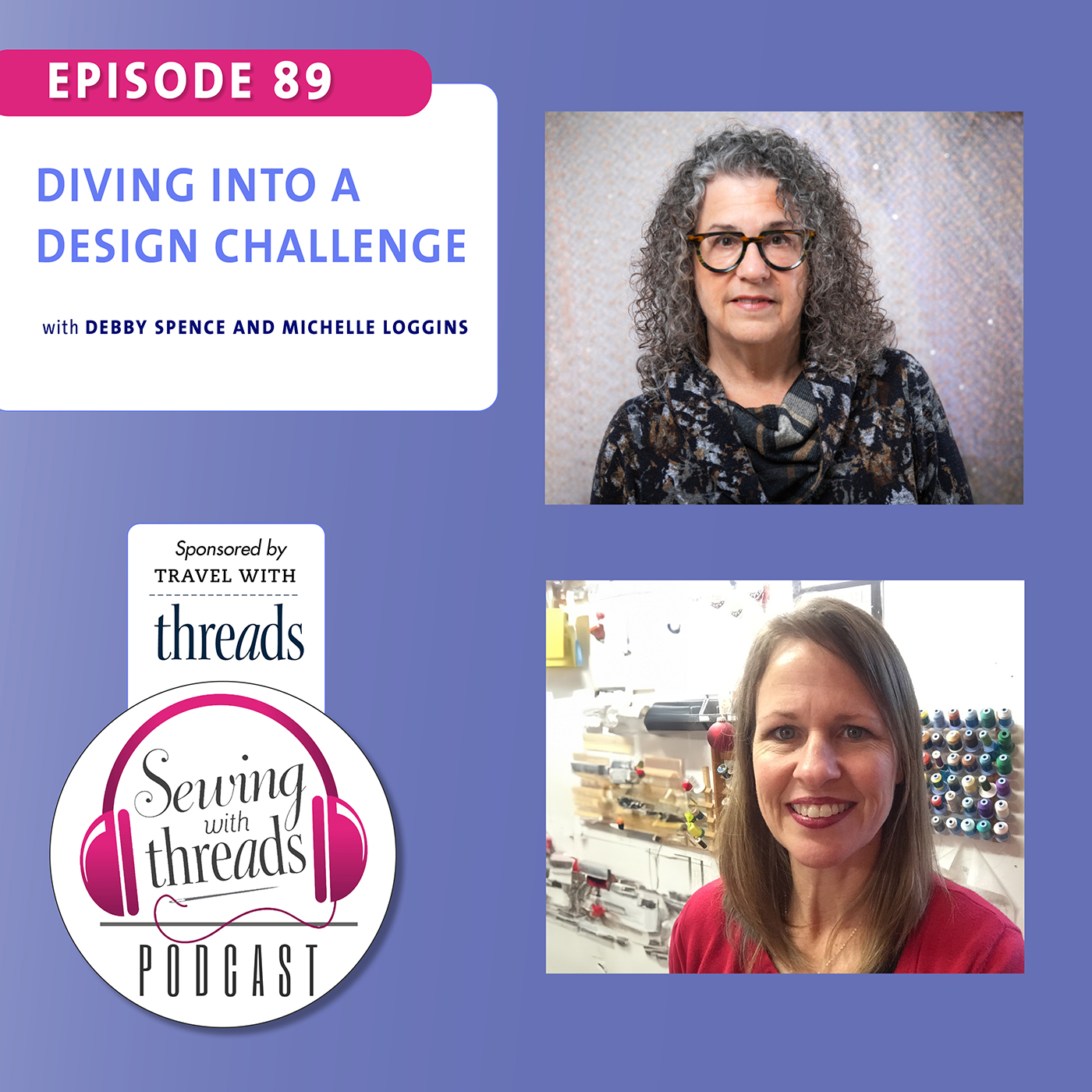
Threads Magazine Podcast: "Sewing With Threads"
Diving into a Design Challenge, with Debby Spence and Michelle Loggins | Episode 89
00:39:31
Sewing garments for design competitions calls for imagination, problem-solving, time management, and enthusiasm for turning obstacles into learning opportunities. Two winning designers share their strategies for success.
Loading summary
Transcript57 lines
- [00:00]
Host
We're back with an invitation to all of you Threads family to join us on our second adventure to the Netherlands. Our first trip was such a huge success that we've planned another in 2025. It runs September 16th through the 24th and there are lots of new activities and workshops to enjoy on this exclusive tour. We'll visit world class museums, fine fabric shops and our main event is a three day workshop with Saskia Tervela of the Dutch Couture Academy. Saskia hosted us last year and she's planning all new hands on learning. Alongside her wonderful hospitality, she'll focus on large frame couture embroidery, Chanel style trims and Japanese pattern making. This trip is filled with activities that will inspire you and fellow sewing travelers. To find out more about the 2025 Travel with Threads Netherlands tour, go to threadsmagazine.com the group is limited to 20 participants, so be sure to reserve your space today.
- [01:02]
Podcast Host
Welcome to Sewing the Threads, the monthly podcast with the staff of Threads Magazine. For this episode I'm joined by designers Debbie Spence and Michelle Loggins and we'll be talking about their experiences participating in the association of Sewing and Design Professionals Design Challenge. Debbie is a longtime member of the ASDP and has received awards in 8 Threads Threads Challenges starting in 2014. She's the author of several Threads articles too. Her double cloth jacket was on the COVID of the Fall 2022 issue. Debbie not only creates custom designs, she also specializes in restyling existing clothes for better fit and a more modern look. This year Debbie's taken on the role of Challenge Coordinator for the asdp. She resides in Lancaster, Pennsylvania and you can find her online at. Debbie Spencer Michelle is a relative newcomer to the Threads Challenge and she's a three time winner, including in the most recent iteration, which is covered in the just released Summer issue of Threads. She's the owner and designer at EM Studio in High Point, North Carolina. She's earned her certification as a Master Sewing and Design Professional and she does a wide range of custom design and sewing work. You can read her article on sewing for charity in the Winter 2024 issue. Michelle is online@mdressmaker.com welcome Debbie and Michelle, and thank you both for joining me today.
- [02:30]
Michelle Loggins
Thank you.
- [02:31]
Debbie Spence
Happy to be here.
- [02:32]
Podcast Host
I'm glad you both could make it. For listeners who aren't familiar, I'd like to start with a quick explanation of the Threads ASDP Challenge. Every year in October, Threads post poses a design challenge to the members of the association of Sewing and Design Professionals. They have several months to organize their thoughts. And by April of the following year, they declare their intent to enter. Their entries are due in August, and the judging panel does a first round of evaluation based on photos and artists statements. At that point, we narrow the field to a group of 12 to 15 finalists. The final judging is done with the actual garments. At the ASDP's annual conference in October, there's a Runway show, and the winners are announced at that time. Threads then presents the winners in an article a few months later. That's what readers will see in our summer issue. It takes a long time to get all of this together because there needs to be lots of design time, construction time, and then the time for us to produce the article for the magazine. So by the time you see it, it's been around for a long time, and our designers have had their heads in it for a bit, and so have I. So even though I think that they did their sewing a year ago, I'm still sort of high on last year's challenge. And just so that you know, if anybody who wins the best overall prize is a judge in the pan in the judging panel the following year. So the years that Debbie and Michelle didn't win, they were probably judging. So they've been involved in this from both sides of the of the challenge for quite a while. So I'm trying to find out a little bit, like, what the experience is like, and I'd love to know, Debbie and Michelle, what your motivation is for participating in the challenge regularly and frequently.
- [04:21]
Debbie Spence
Well, I would say, like, the first time that I ever entered it was a number of challenges into the process. I didn't, I didn't know a lot of people in the organization because I wasn't in a chapter and I wasn't going to too many conferences. But when I started going and seeing the Threads challenges, I thought I sort of didn't want to be left out and I wanted to make a connection with other people in that way. So that was the first reason why I started doing it. And I had been intimidated about the process before that. And I'm sure everybody who ever enters for the first time feels that way. And even though making a garment for a custom is a sort of a challenge in its own way, it's still different when you're doing something like this and it's going to be judged by people. So it's a little different. The other thing that I. One reason I like to enter them is because I make things that I wouldn't normally make. You know, my clients don't normally want to have garments made that like the challenges that we've had in front of us. So that's another reason that I like to do it, too, and I learn new things.
- [05:35]
Podcast Host
How about you, Michelle? What brought you to doing this?
- [05:39]
Michelle Loggins
Well, I entered because, well, it was my first time to go to conference, and I knew about the challenge and kind of like what Debbie said. I, you know, I wanted to make something with the creative freedom of the challenge and of what I wanted to be able to do without the restrictions of a client. And I just wanted to push the limits of what I could create under the pressure and purpose of the challenge. And it gave me space to explore not just technique, but storytelling through design. And I just love to be able to. It felt like an invitation to honor my skills, the chance to learn new skills and my spirit that I bring to the table. And I also just thought it was just a great way to relate to other, other the wider professional sewing and design community, because oftentimes, I mean, I don't know anyone in my local area that does what I do. So I just thought it would be a great way to also get out there and show what I do and hopefully, you know, be able to meet other people, other ladies that do the same thing or that I could learn from actually, too.
- [07:00]
Podcast Host
You know, I find it interesting, Michelle, that you say you see it as a sort of a freedom. It gives you a freedom to explore. I always worry that the challenges we set will feel restrictive, and it worries me. I don't want that to be the case. I want it to be a little bit of a parameter, and then you can let things work out within those parameters, and that those are just a guide to help people sort of steer themselves in a way that they may or may not have gone. And, Debbie, you brought that up. It gives you a chance to make something you might not have tried making otherwise. So I find that interesting. So what kinds of things have you learned from doing the challenge?
- [07:40]
Michelle Loggins
I think it just kind of sharpens everything I already know. And like I said before, it gives me an opportunity to possibly learn a new technique to put into the new garment. And it could be a technique that I can learn and then adopt as my own and further designs when it comes to clients through the challenge. It also helps with kind of, you know, expanding outside of my creative box and just go further. It helps me further my skills with time management because, you know, it's always tough because, you know, I'm running a studio, and then to put on top of that a garment challenge, it can be the challenge. And also it helps with discipline. It helps me to. Especially with the deadline. And if it's that important to me, I will make sure that I meet the deadline. And it is important because, well, I like to start and finish, and then just the idea of being in my favorite magazine, you know, you can't beat that. I also feel that these challenges, they help me to trust my intuition more, and they help mirror client work in a lot of ways, but with, you know, more freedom, even though sometimes it could be harder. But it's just a challenge, you know, it's a growth opportunity. And then I just love. It's not just about designing. It's translating, you know, an idea into something that moves, speaks, and then just lives on the body. And it. And then to see it come down that Runway, the fashion show we put together, well, I guess I don't see it because I'm in it. But anyway, regardless, it's fun to know it and then watch other. Other ladies put their interpretation on the Runway. And it's just really fascinating to see how everyone interprets it, because dressmaking is a visual art, and the interpretation is different for everyone. You know, we all bring a story behind it.
- [09:47]
Debbie Spence
Yeah, it's always fascinating at the fashion show to see how all the different interpretations there are for each challenge. I, too, have learned a number of new techniques. For example, with the quilted garment challenge, I used four different types of quilting in that jacket that I made. So I had. I had never done free motion quilting before. So that was, you know, something I had to practice, practice, practice until I got it the way I wanted it to look. So. So you have to make sure you put that kind of time into your time management schedule. And another thing I hadn't done before was on my. The Dallas challenge, the 50s couture, I made these little flowers that I embellished the bodice of the top with. And that was a new technique for me to do. And. And it's also a lot of problem solving when you're working on these things, you know, and I'm a. I love solving problems. So, you know, you get to a certain point in a design and you think, okay, so how can I actually implement this design? How can I? What can I do? And so you try different things until you find one that works. And. And I've also used, you know, tried to hone my pattern making skills. The sleeves challenge was quite a challenge for me, making the pattern for those sleeves and the collar that to my dress. So that was an example of that.
- [11:21]
Podcast Host
I'm just going to butt in for a minute here and say, anybody who's listening? If you go to threadsmagazine.com and search ASDP, you may also search PACC, because that's the former acronym for the organization. You'll find articles about many of these challenges, and you'll see some of these garments that Debbie and Michelle are mentioning. It's so interesting because the garments that come into us generally are so, so well executed that you never feel as though there's been a lot of. It doesn't feel like they're like a learning experience. It feels like they're fully realized. And I'm always really impressed by that. I love to know that. And when I hear it's like, oh, I had to practice these things before I could put them into my garment. That's also gratifying because that's what we kind of want the challenge to be. An opportunity to try something new and, you know, hopefully feel good about having mastered a new technique or a new pattern making skill, any of those things that you, that you bring into your new work. So how long. How long does it take to, to put together one of these, these looks? I mean, what's the process for coming up with the design? Once you hear the, you hear the, the challenge brief in October, and then you have a few months. What are you doing during that time?
- [12:37]
Debbie Spence
Well, I'm kind of stewing on it, and I use Pinterest and fashion magazines just to be inspired. You know, sometimes I might see an elephant in a garment, and I think, oh, that would work really great for this challenge. And then I expand on it in some way or try to incorporate it somehow. Some challenges take a lot more time than others. Of course, my zero waste dress that I did for that challenge took me the least amount of time. And that one, I just sort of draped it on my dress form to get it. The other ones require, you know, a lot more work and that I'm usually actively working on it for two or three months, you know, once I figure out, you know, and sometimes it coming up with an idea takes longer than actually executing it, you know, but that's part of the process.
- [13:36]
Podcast Host
Debbie, do you sketch or do you drape or. A little bit of.
- [13:39]
Debbie Spence
Sometimes I do. Yeah. Like, I might just sketch different versions of what I'm thinking and try to decide which is the best one I want to use. And then sometimes I just drape things on my dress form to see how I'm going to like how the fabric's performing. So I use a combination of things. Yeah.
- [13:59]
Podcast Host
How about you, Michelle? How do you. How do you get into this?
- [14:02]
Michelle Loggins
Well, I usually end up. I start with a, you know, a few loose pencil sketches right on the piece of paper they give us with the new brief right there before I ever leave the conference. So I start with pencil sketches and then, like Debbie said, I just kind of stew on it for a little while. After the first of the year, I start coming up with ideas for fabric and if there's any embellishments. And so for as long as it takes, I'm really not sure because I space it out over the whole year. Well, until the time to turn in pictures, because I am running a studio, so this is extra. So it's either early in the morning, late at night, or both through the weekends. And for me, I've been the last two challenges, the outerwear challenge as well as last year's challenge, there's been a lot of hand techniques and embellishments, especially the very last one. I mean, the last year's took the longest, I mean, hours and hours. I can't even. I don't know. But the second, the one, the outerwear, it was kind of strange. I had to do the embellishment hand stitching on the self fabric before I could line it. So that was a whole nother way of trying to do the time management. The one for last year, I embellished after the whole thing was done. So it's a lot of learning and figuring out your time management. And for me, it's just spaced out over the whole course, from the end of conference to the deadline that they're due. And then I usually just have to do time blocking, whether it's 30 minutes or an hour each day. I would put it in my planner. Sometimes I'd make it, sometimes I'd go over. But what's important is getting it before 10 o'clock on that day, that night in August, before it's, you know, too late. And all that work, you can't be late. Otherwise it's. That's it.
- [16:06]
Podcast Host
I imagine that neither one of you is, you know, the sort of student who did all nighters on a regular basis when you're in school, still doing it. There's a phrase that one of our online influencers exposed me to called negative work, where you're working well past your ability to be functional and you do work that basically actually takes away from what you've accomplished. You don't want to do that, right? Yeah, I think we've all done it, but we hope not to. The challenge briefs are written by now. They're written by me, but they've been written by a bunch of different people over the years when we had different people running this. And they. They vary from year to year. And we've. We've tried to focus on sometimes a garment type, sometimes a fabric, a technique, an embellishment method, even just a section of a garment or type of garment, that sort of thing. And I'm just wondering, when you read the brief, how. How do you go about interpreting that? Do you look at it and just think, how does it speak to me? Or do you think, what are the judges asking me for here? And how can I best provide that?
- [17:16]
Debbie Spence
Yeah, I would say that's the way I handle it. I read it several, numerous times to make sure I'm seeing and hear reading everything that you're asking of us. And then I go from there when I'm designing the garment and just make sure I've got all the elements in there that are needed and what would best express, you know, what you're looking for.
- [17:40]
Michelle Loggins
I usually read it, reread it. I don't know how many times I read it before I just start thinking, sitting with it. You know, I have a sharpened pencil by my side and just trying to sketch lines and ideas and then continue sitting with it over the course of a few months until I start thinking. You know, it just kind of all evolves in your mind as you start the thinking. More thoughts come in, details, fabrics. And the design itself does change from the first sketch to the final garment, but I have found it's usually as you keep going, it's usually for the better. So your great idea turns into a masterpiece as long as you keep going through all the frustrations. You know, you just have to. Every challenge is just another growth opportunity in the whole design phase. And so I. And, like Debbie, through the whole year, because I keep thinking sometimes what if I went down a rabbit hole and that wasn't part of the challenge and I forgot something? So I keep the brief with all my notes and sketches and swatches that I've accumulated just to make sure I didn't vary from the brief because, you know, I don't want to be, after all that work, get disqualified. Devastating.
- [19:01]
Podcast Host
I don't think I've. I can't think that we've disqualified anybody. Maybe somebody didn't send in a whole artist statement, and that's kind of a reason for disqualification. But that. That's about it, you know, And. And we often are. Are a little bit flexible about things, too, because we know that things can happen sometimes along the way. Yeah. But so. So after you. I have to say, from. From my point of view as the person who writes the brief and then who does some of the judging, it is really exciting to see these different interpretations. They can be really vastly different, and sometimes they can all be alike. But I have generally been astonished by the wide range of different ways that people come at the. At the different challenge themes. It's really fun. It's like a highlight of the year. And then getting to work on the article is also really fun. You know, we're picking models to wear the clothes. That's something else I know you design for, not our specific model, obviously. Do you design for yourselves? Do you have anybody in mind when you're trying to make an outfit?
- [20:09]
Debbie Spence
Mostly I design for me because I think if I'm going to put all this energy into this garment, I want to be able to wear it. But I did have one. It was the sheath dress inspired by art that I created for a client. And that worked out great because I don't really wear sheath dresses. So I asked this woman, this one client, if she would be willing to let me make this for her. And the really interesting thing is she and her husband are quite the philanthropists. And not long after I got that dress back, they. They had a governor's art event that she wore the dress to. So it was really exciting that she wore the dress to that event.
- [20:54]
Podcast Host
This is a Matisse dress for our listeners. You can look it up. It's really great. Yeah. How about you, Michelle? I know that you wore this last one anyway to an event, right?
- [21:04]
Michelle Loggins
Yes. Because I don't know who else would wear it. I don't have a model in mind or anything. I. I just make them to fit me. Yeah, this last one, I have plans. I didn't get to make it to the event this year like I wanted, but we've started a jar putting the money in there to save for going next year. It's to a ball, the Lemon Ball in January or February. I haven't gotten the dates yet, but that. That's. That's actually the end of the story for this dress. But, yeah, I make it to fit me because, well, I'm the only one around here. And I like the style because I still use kind of style lines and silhouettes from the 50s. That's just what I'm inspired by. And Then, yeah, so I just look for where. Where I can wear these things too, like the outerwear. I've worn it a couple times, but it's. It hasn't been quite cold enough, and it's very warm, so I've only worn it a couple times. I'm waiting for a really big snow day so I can wear that thing. And the other one, the green, the McGillicuddy dress. I did wear it to a couple of weddings, and that was fun. You know, I'm the only one there that looks like that, so, you know. But, yeah, whenever I'm finished with the story of last year's dress, I will be looking for other events to wear it to, because it's a special dress, and it, I think, deserves to go to special events. And with, like, Debbie said, all that work. Yes, I'm wearing it. Otherwise, I don't have dresses like that. I'm busy with clients, so this challenge gives me a chance to be able to have nice things custom made.
- [22:54]
Podcast Host
I do like to hear that. What is it like when you see them in the magazine being worn by a model?
- [23:01]
Michelle Loggins
It's just incredible. I mean, my husband travels for work, and he was in California when the. I think it was 2022, the McGillicuddy dress was in there. He actually saw this elderly man reading Threads magazine, and my husband went over there, who's not. He's not shy at all. He goes over there, and he was on the page of the Threads challenge, and he said, hey, my wife made that dress. You know, and he was like, what? And I think he bought the magazine for his wife, but it was really, you know, it's just. The story continues. It was just incredible. I couldn't believe it, you know, so to see it in a national publication, that's really. It's gratifying, and it's really special, and I just love it.
- [23:50]
Podcast Host
Debbie, you're. Debbie's. Debbie's quite petite, and our models are probably like 10 inches taller than Debbie. So sometimes the fitting is a little bit of an issue when we're trying to do it, but we do the best we can. And I think that there's been, you know, some models who do have bring some nice flair to these looks.
- [24:07]
Debbie Spence
Yeah. I think you've had to use different pants sometimes for my garments because they don't fit the models. But I'm always thrilled to see how you photograph them and the models that you choose. There's one dress that sleeves dress in particular on me. The length of the dress goes down below My shin. And on your model, it was up to her knees. She was that much taller. Yeah. And it looked. I thought it looked better on her than me. So there you go.
- [24:38]
Podcast Host
Well, I love the stalactite dress that you made. That one was great. And we actually did choose that model that year specifically because we knew that that dress was going to be shot in that, that, that day. And she's somebody that we used at least two times, maybe three times for the ASDP challenge, just because she brought real life to some of these clothes. It was really fun to work with her and really wanted to do it.
- [25:04]
Debbie Spence
Yeah, yeah.
- [25:05]
Podcast Host
That one looked. That one looked very nice. Enjoyed it. So what do you do with all these, Debbie? You keep yours, I think, except the Matisse dress. I know you've.
- [25:12]
Debbie Spence
Yes, I have them hanging now. I work at home. I see my clients in my dining room because I don't have any other dedicated space for that. And I've got a folding screen and I have them all hanging on my screen. And I've been keeping the stalagmite dress on a dress form there, too. And for one thing, it lets my clients see the, you know, range of work that I can do. And they're always really impressed with these garments because they're all kind of interesting. The other thing that's really helpful is if I'm explaining to them how I'm going to make a garment for them and I want to use a certain seam finish or a certain type of fabric, I often can find it in one of my garments and show them, well, this is what this will be like, or this is what this fabric is like, you know, so it's. It's really great that way.
- [26:03]
Podcast Host
Yeah. And I'm sorry, I called it a stalactite and it's a stalagmite. Yes.
- [26:07]
Debbie Spence
Oh, right. Yeah.
- [26:08]
Podcast Host
Michelle, you keep yours and you wear them when you can.
- [26:10]
Michelle Loggins
Yes, I keep mine. But every now and then when I know I have a. A new client and I sense maybe where she's coming from or what she's thinking of, I'll. I'll grab one and put it on a dress form. But I do have plans to. We're looking at a place that has a really great studio space. And I have ideas of doing somewhat of like a neighborhood fashion trunk show kind of open house thing where I want to get more dress. Dress forms. Put them on there, put a little write up by them. You know, I saw. I went to the Karla Lagerfeld exhibit a couple years ago, and that's how they did it with the a framed information sketch, story behind the dress kind of thing, with the dress display. And so I've just been thinking about how I'm going to do something like that. I don't have space to put them out here, except maybe one at a time. But, yeah, I think it's a great display to be able to display them and show future possible clients, see what the range of what you can do. So that. Because I found that clients need help with their creativity, so if they see good visuals, then it'll help get their creativity going. And around where I live, there's a lot of higher society people that go to galas and they're into philanthropy, and the hospital's here, and there's art and the museum. And so I really want to tap into that and then be able to show them. And I often open up the magazine for them, too.
- [27:54]
Podcast Host
I think that's a great idea because you really do want them to trust that you have the design acumen and the sewing skills to bring to life something that they really want. Yeah. And that they will. That will be special and unique.
- [28:08]
Debbie Spence
So right now, several of us have loaned some of our challenge garments. Terry Tips was setting up a display for ASDP at some sewing expos down south, and she said she got fabulous feedback from people remarking about our garments. And that's just sort of a promotion, you know, marketing thing for asdp. So they're serving that purpose for us right now, too. And then when we had our conference in Novi, we were doing that along with the other. Some other sewing expo. I always get them all mixed up. I don't remember which one it was, but we had a display of a lot of the garments there, so other people in the public who were there for the other sewing things could look at them. So that was another way to advertise ourselves.
- [28:58]
Podcast Host
I think that's great. Well, Debbie, you've been involved in many of these challenges. Do you have a favorite?
- [29:07]
Debbie Spence
Yeah, I think the quilted garment challenge, that garment that I came up with, was probably my favorite thing, and that's probably the thing that I probably wear more regularly because it fits into my wardrobe. The fabric for that was something that I had been sitting on for years because I wanted. It was so special. I got it at Mekong River Textiles. It was a shibori dyed fabric, and I just love the colors. But. And I knew it had to be something really, really special. And when this challenge was announced, it was like, oh, my goodness. That is what I'M going to use that fabric for. So I knew right away that was what I was going to do. So I. That's. I started out with that and that. So in that challenge, I started out with the fabric, you know. Yeah.
- [29:54]
Podcast Host
How about you, Michelle? What's your favorite?
- [29:57]
Michelle Loggins
I mean, they're all really great, but I suppose the one for last year is my favorite. It had a lot of. It was a lot. A lot of notes, sketches and more sketches, and then the embellishment and then the story. I mean, it kept unfolding up to a week before the deadline. I. I thought I was just going to lose my mind, but, I mean, you know when they say blood, sweat, and tears. For real? Yeah, that's what happened. I was hoping there wasn't stains, but. Yeah, the story, the feather, the angel feathers, and then the idea that I had at the midnight hour of letting them break apart and float away, I just. It made me cry. But I think garments, whether you see them or make them wear them, all three, if they can cause an emotional, you know, response, then that's. That's just. That's it. That's the thing. And this one, even making it, much less wearing it that night of the fashion show, you know, it's just special. I can't even. I don't have the words.
- [31:08]
Podcast Host
Most people didn't have the words. When we. When we took it out of the bag, there was really a sense of sort of just like a little silence among. Among those of us in the photo shoots, like, oh, my gosh. You know, and the. The model loved wearing it. You know, anything. Anything that's big and twirly, they like. And it just was. This is very beautiful, listeners. Please get your hands on the summer issue and take a look to Debbie. Did you have a least favorite.
- [31:35]
Debbie Spence
Well, maybe the one that we had to all use the same pattern. Oh, I forget what you called that.
- [31:45]
Podcast Host
Mother of the bride. Was it mother of the bride or something?
- [31:49]
Debbie Spence
No, it was a suit that we all used. It had a jacket and maybe pants and a couple versions of the jacket or something. And I made a suit that I really like, but I don't know. It just isn't something. I had a couple construction issues with it that. So it precludes me from being able to wear it very much because I don't like the way it looks with this little problem it has. And so I don't. As much as I would love to be wearing it, I don't wear it. So that's a problem. Yeah, but when you go Back to the discussion we were having about feeling restricted by the challenge. Are you thinking it might be too restrictive? Well, if you look at that challenge and the wide range of things that people came up with using the same pattern was actually pretty amazing.
- [32:43]
Podcast Host
Yeah, that's something that is very impressive about the asdp. There really is a lot of imagination and a lot of skill for coming up with new ideas from something that might be a relatively standard starting point. The sheath dress challenge. The Inspired by Art sheath dress challenge. That was a great one. That's the one with that. Debbie had the Matisse dress, but there were just so many different interpretations there. They were really great. And because it was a sheath dress, they were pretty wearable. Sometimes the garments are really extravagant, and. And I love them, but then I think, ooh, there's not many opportunities for people to wear these, sadly. So, yeah. So both of you have served as a judge at least one time, maybe more, and that means that you kind of see this from a different perspective. Does that change how you understand the challenge? Did you learn new things from being able to judge other people's work?
- [33:47]
Michelle Loggins
It did for me, because, you know, we're all. I think most of us doing the challenge, we're all working a business outside of, or that's our main thing, the challenges outside of that. And there were. There are sometimes garments that come through there where you could tell they were busy on something else. And I did. And it made me to think to remember time management, breathe, and focus only on my garment when I'm working on it, rather than trying to multitask several at the same time. Because I did not ever want my garment to show up looking like it was rushed or hurried, because for me, it's just important enough to really give it my whole attention. And then, well, it also helped to see because, you know, there's a few judges, at least three, and it was really good. You know, just like all the people who enter, all the ladies who enter and have a different perspective. The judges all have a different perspective too. It's very subjective. And so what catches the eye of one doesn't on the other, and the opinion of one is not the same as the other. And everyone has their reasons, and they're all legitimate, you know, but it's a very, you know, personal judging kind of thing. So it was interesting to hear and see that. And the one that I got to do was with Susan Kalji, and it was really great to just listen to her and all her years of experience and to listen to what she sees and, you know, how she responded. So it was really, really fun to just watch and listen, especially others who have been in it longer than me or have been further. Like, she goes to Europe and things. So I'm like, yeah, I just wanted to listen to her.
- [35:51]
Debbie Spence
Well, I would go along with everything that Michelle said, but also, I know. I realize how important it is to pay attention to details and how techniques are really important to get them right with your garment, because sometimes the judges are. Get it down to, you know, a couple of garments, and so what makes this one better than the other? And sometimes it's those details, the construction, you know, something small like that that makes the difference for the judges.
- [36:24]
Podcast Host
Yeah. Yeah. I mean, that's definitely true. We sometimes do come down to this really difficult task of we choose four, and then there's an audience choice that is voted for during the. During the fashion show in the evening. So trying to get down to four is really hard to do sometimes because we all are opinionated, and we all have our ideas, and some of us will want to prioritize whether we think it's a fantastic design and other people want to prioritize. Is the construction absolutely perfect or do those things come together, that kind of thing. Were problems solved the way they needed to be? Were they not even recognized? Sometimes you can sort of look at something and say, this really needed one more round of a design look, and then there's so much potential in it. It just didn't quite get there. And I feel bad because those may not win, but there's always work in there and design effort that you want to honor. So it is very tough to do. And now Debbie's now in charge of coordinating the challenge. Will be working together on this. So you're now in this sort of the role of shepherding all these designers into getting their things done on time. And I think it'll be interesting. I'm looking forward to working with you on that.
- [37:46]
Debbie Spence
Yes, it will definitely be interesting challenge, I imagine.
- [37:52]
Podcast Host
Yeah. Although there's somebody else who. Who actually puts together the fashion show, though. Right? So, yeah, that. That helps.
- [37:58]
Debbie Spence
Yeah.
- [37:59]
Podcast Host
Well, I think we're coming to the end of our time. I would love to thank both of you for. For joining me and talking about your experience with this. Debbie, I don't know how long your tenure will be. Two to three years, maybe, as the.
- [38:14]
Debbie Spence
Coordinator, probably something like that.
- [38:15]
Podcast Host
So. So that means Debbie won't be entering. I'm hoping that Michelle will continue to sharing her beautiful garments with us and all the other designers who year after year have supplied me with eye candy that I can enjoy for like a good two or three months every year, a couple months during the judging part and then another period of time when I'm writing the article and photographing. It's so fun. And thank you all of you for doing that and sticking with us. Please keep on competing and I'd like to thank our listeners for joining us today too. On this episode you can find show notes@threadsmagazine.com as well as links to previous podcasts. The show notes we'll try to put in some of the photographs of the garments that Debbie and Michelle mentioned during this podcast so you can go and look. But again you can look up asdpredsmagazine.com.
- [39:06]
Host
Thank you to our guests for joining us and thanks to all of you for listening. Please remember to send your comments, questions and suggestions to to th@threadsmagazine.com and please like comment and subscribe wherever you are listening. Until next time, keep on sewing with threads.