← Threads Magazine Podcast: "Sewing With Threads"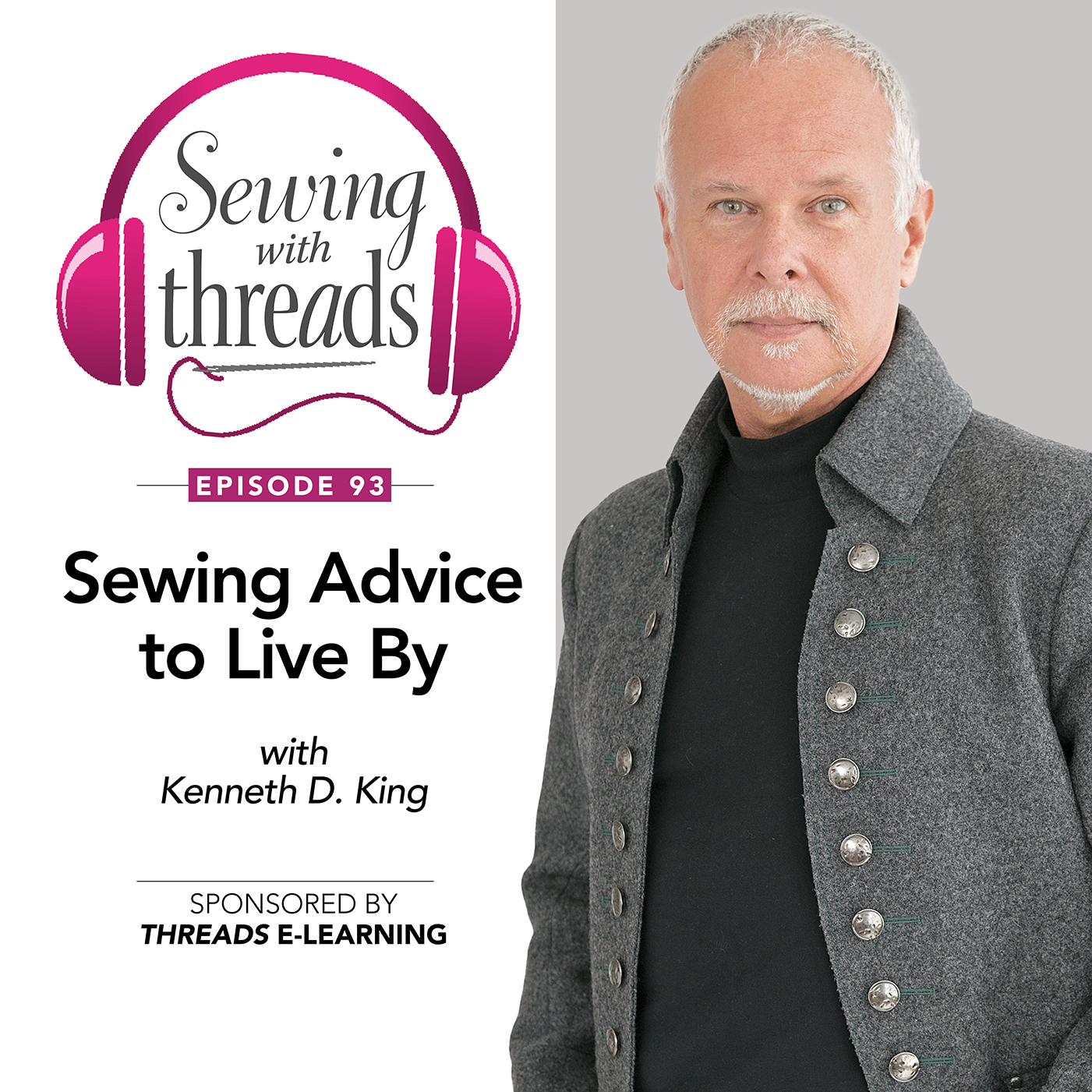
Threads Magazine Podcast: "Sewing With Threads"
Sewing Advice to Live By, with Kenneth D. King | Episode 93
00:36:19
Loading summary
Transcript63 lines
- [00:01]
A
Check out our just released elearning course your Go to Easy Fitting and Refined. Taught by the late Cynthia Guffey, this on demand video class walks through constructing a versatile jacket with high end details. In nearly seven hours of instruction, you'll learn to fit and sew the jacket step by step. The course even comes with a downloadable pattern. You'll discover valuable tips to improve all your sewing or while making this stylish wardrobe staple. To sign up and to find other on demand learning opportunities, go to courses.threadsmagazine.com welcome to Sewing with Threads, the monthly podcast with the staff of Threads magazine. I'm your host Carol Frase, and I'm joined today by contributing editor Kenneth D. King. Of course, Kenneth is very well known to our readers and to our listeners, but I'll give you a short version of his bio. Kenneth is a couture designer and a professor at the Fashion Institute of Technology in New York. He's also an instructor for a series of popular E learning classes for Threads and he teaches privately. His book Doll Red Carpet Edition is coming out this fall. It's a sequel to the beloved book Doll Couture. Kenneth's first article for Threads was published in 1993. Threads is celebrating our 40th anniversary this October, so it seemed like an ideal time to bring Kenneth in for a chat. I'd love to talk to you, Kenneth, about your work as a designer, a teacher, a writer, and much more.
- [01:38]
B
I'm going to talk about my background. To begin with. I started out making Barbie clothes. Then I went on to make clothes for myself as a teenager. My degree is in fashion merchandising with my specialization window display. And that is how I got out of Oklahoma to California. So for 10 years I had a career in retail, specifically window display. So in window display you have to have a broad, a broad skill set. It doesn't necessarily have to be too deep, but you have to have a working knowledge of a lot of different things. So what that did for me because I like making things, that's kind of what I do. Having an understanding of different kinds of things enabled me to cross pollinate from different disciplines. So when I was working for Macy's especially this was after I was in California, I had, I worked with two guys who were extremely good and the first thing they said to me was don't put your time where it doesn't show. And for me that is where that's my starting point. I was not trained in the couture. I had couture pattern making later. But I had come into it from window display. So the idea of not putting your time where it doesn't show really informs the way I approach constructing things. So that said, I think what completed my education, I studied with a woman in San Francisco named Simone. Simone. Simone trained at the ecoleguer Levine in Paris. She got her certificates from the Chambre Syndical. She got her immigration to the United States. Based on all of that, they said that was a master's degree. So I had an idea of how pattern making worked, but I didn't. But I needed to know the rules. So I studied with her, and she said I finished early because I understood a lot and she didn't have to explain it. So moving forward, how I approach the construction, how I approach teaching students, is that it's repeatable and reliable. There are many different ways to do something. And I tell these kids, you have a broad spectrum of how you execute things, and there are three things you look at. How much time do you have to make it, how much money the person is willing to spend, and how long it needs to last. So there is a bandwidth of techniques that I choose from to arrive at that particular project. But the thing is repeatable and reliable. I don't want to waste time ripping seams. I don't want to waste time picking out basting that I don't need to pick out. There are all sorts of things like that that I come at because I was not trained, say, in the couture. Does that answer your question?
- [04:30]
A
Yes. And it. And it raises a whole bunch of other questions for me because they're, well, I'll try to keep them. I'll try to remember them all and keep them in order. The first one was you were talking about the advice you were given about don't waste time on things that won't show. Now, I realize that that could be interpreted as, you know, make it look good on the outside, but don't worry about what's happening on the inside. And I know that's not how you actually work. So can you explain a bit what shows and what doesn't show in your tailoring or sewing?
- [04:59]
B
Okay, one, one example, basting with white thread. I understand that that is how it's done in the couture, and that's great for me. I baste with what's in the machine, because if I have to pick the basting out, I don't want to have to sit there with the tweezers, picking every little piece of thread out of the stitching. It's A good example. I will baste. Some people think, oh, you know, shortcuts and all of this. And I know this may sound a little bit fancy, but there are times, you know, that people will think that I'm not taking the shortcut, but for me, it's the shortcut because I know it works. And so one of those things really is I based. And so, you know, some people would think, oh, that's, you know, that's not, that's not worth your time. Actually, it is, because these tailors, when I worked my first job in San Francisco was at a store called Roos Brothers. And the display shop and the tailor shop were both in this gigantic room. And there was this whole, whole crew of these Italian tailors. And one of the things they taught me when they decided I was okay was basting as half sewn, like sleeves. I will always baste a sleeve in and check it before I sew it because it's easier to rip basting out than it is to rip out stitching. So that. That's one example of that.
- [06:14]
A
Yes, that. That makes a lot of sense. And, and I think it's interesting that you specify not using the white thread, that you use a matching thread, because that takes away one of the steps of potentially picking out all this white thread. And that feels like a small thing, but it's probably a big thing when you're actually trying to repeat this over and over again and keep it quick and not make yourself crazy at the same time. So, yes, absolutely. That seems very logical to me. I know that you like to insert a lining by hand and you don't like to bag it by machine. That seems fancy to a lot of people. But can you defend that choice? I know you can.
- [06:56]
B
Yes, I can, because I like to nail down the facings, I like to put up the hem, I like to secure the cuffs. You can't do that if it's bagged. I'm pretty good with construction. Never been able to make a bagged lining work. Something always hangs funny and you end up sewing that final seam, like in the sleeve or something. And so this is a case of it may sound fancy to hand install a lining. It may. Some people roll their eyes, but what I found is, for me, it's faster. And the other advantage of it is you have a lot more control by sewing with the hand stitches. So it may seem counterintuitive, but putting a lining in by hand gives you a lot more control. You get a better result. And in my, in my construction, it's Faster.
- [07:44]
A
That sounds like a good defense of putting in a lining by hand. And I do know a lot of people do that. I've had the same problem with bagging a lining, especially when there's a vent. It just. You always get something that hikes up somewhere and it doesn't. It doesn't look good. I mean, I know that there are people who can do it, but I'm not one of those, alas. And again, I agree with you. I don't want to have to, like, bag it and then rip something out and try to fix that bit by hand, because that just feels so sloppy to me compared to just doing it by hand from the start of it. Yeah. So, Kenneth, when you're working on a sewing project, what amount of time would you put. What percentage of your time would you spend in the design process versus construction?
- [08:30]
B
Well, I think the design and pattern making process, I would say it's probably a 50. 50. There have been times. One example years ago, I made a little bolero jacket for a customer. She was going to the Nobel banquet. And just a little trivia for our listeners. When the royal family of Sweden is present, you cannot have an exposed armpit. And she had this strapless gown, so she needed a little bolero over it. Now, the. The pattern. There were five muslins for that pattern. And I did things like set a table with the silverware and the glasses. You know, ask her, how tall is your husband so you dance. All of that was the groundwork that I laid so that when I made the little jacket. And she said, it looks like this took five minutes to make. But she understood because she had been there for the five muslins. So it's a tremendous amount of groundwork. And some people don't want to do the muslin, some people don't want to do all of that. And, okay, that's great. But what I have found is that putting that time in first off, it made that little jacket successful. But the advantage of that is that I recycle that little bolero jacket pattern endlessly. And my customers say it's comfortable. So all in the research and development, a lot of times, I'll make samples. One of the things people ask me, you know, do you draw? Do you? I don't draw. My drawing skills are terrible. However, I make binders, and there are times I'll just. If I'm not feeling like doing any creating, I'll ask a question. Okay, what would happen if. And then I'll burn through some fabric and if it's successful, I will take lots of notes, and I have a whole series of binders that I'll put, like, seams, finishes, whatever. So it's in there with all the notes so that I don't have to reinvent it when I'm using it for a project. So it's. It's. Yeah, that's my research.
- [10:34]
A
I'm fascinated by that. I was going to ask you about technical experimentation, and does it always relate to a particular garment or project that you're working on? But it sounds like you just sometimes go down a little rabbit hole of figuring out how to handle a piece of this type of fabric or a finish and edge or any of those things.
- [10:54]
B
Absolutely. The souffle pieces and the cut work and the leafing that all was born from. What would happen if.
- [11:04]
A
I'm actually really impressed by that. And I think that most of us don't have a lot of time to do that. But I know that you can always make time because you always pack your day with a lot of work. And I think you. I get the sense sometimes that when you have a project going, you're like, I'm going to finish this one, and then I'm going to give myself the time to play around with some other stuff.
- [11:23]
B
Yes.
- [11:24]
A
So when you were talking about what techniques you really like, you said they should be repeatable and reliable, especially if you're making the same kind of garment over and over again. At one point, I think you told us a story about tailored jackets and how you just needed to learn to make them faster so that you could actually produce them in a way that your bottom line was going to be okay. So that makes sense to me because those jackets are all kind of a similar garment. But when you have a unique project, how do you deal with that? There's no real. There's no repeatable aspect to it. Or is there?
- [11:58]
B
You know, I think, again, it depends on the project. But if I'm working with a fabric I haven't worked with before, I will buy at least a yard extra just to experiment, because you want to make sure that the proper needle, the stitch length, how do you press it, all of these sorts of things. If there's going to be something like a welt pocket. If I haven't put a welt pocket in this particular fabric, I want to see if it accepts a welt pocket or a bound buttonhole, anything like that, before I even cut the darn thing out, because I don't want to cut it out and have to Recut fronts or something because something went up in flames because I didn't do any testing. So I encourage my students make samples. If you're unsure, you make your samples. So it may seem like it's busy work or not important, but it is. It gives you some information about that specific fabric and what it needs so that it performs the way you wish.
- [12:55]
A
Yeah. And I think that's excellent information for everybody who sews. I'm probably the worst offender in that I have so little time that if I want to do something, I tend to just dive in and then try to troubleshoot along the way. And, you know, we like to say, oh, you fix a mistake, that's a design opportunity. But sometimes it's like, oh, I don't really want that design opportunity. I kind of wanted it the way I had it in my mind.
- [13:19]
B
Well, I always called them saves.
- [13:21]
A
Yeah.
- [13:21]
B
You know, and there. There are times in. In Cool Couture, there's a pleated edge that I show with the little corners tacked down. That was a save. That was three. You know, because pleated. Pleated edging along the top line of a bustier has to be dead parallel to the seam, despite all of the basting and all the precautions. It was three in the morning. The thing had to be on a plane at nine o' clock to Los Angeles. I turned it right side out, and it wasn't. I thought, damn, what am I going to do now? And so I hit upon that little. Tacking the little corners down, and it. It camouflaged that it wasn't dead parallel. And I was, you know, and I created something that I show as a technique now. So sometimes, no matter how much you experiment with, sometimes when you go to the project, something's going to happen. And so this is where I would say perfectionism is a disease, because I create the illusion of perfection. I don't create perfection. I will be the first to say. And so in that particular situation, I had to create the illusion of perfection because I was under the gun to get this thing on a plane to Los Angeles. So you can experiment, you can make your tests, but then the thing is, when you're in the project, don't be so attached to a particular tiny little way it's supposed to look if it's going south. But, you know, you need to save it, take a little risk and experiment.
- [14:50]
A
Good advice. So now let's talk a little bit about your teaching. I know you teach a range of people, including relatively new students at FIT and all the way through to People with quite a bit of sewing experience. When you, you go to Ryla Spode's school in Tacoma and you do sit and sews with Susan Kalge and, and.
- [15:17]
B
Ann at Gorgeous Fabrics and at Gorgeous Fabrics.
- [15:18]
A
Yeah. So you're working with people with quite a lot of experience. How do you find these, these different types of student bodies in their approach to sewing?
- [15:27]
B
Well, at fit, I get there, there are different, two different groups. There's usually the first or second semester sewing people and when I get them, last fall I taught second semester sewing and I had this student ask me because I use the yellow headed quilting pins and some people clutch their pearls about that, but I like them and they work. And I had my pin cushion on my cart and the student pointed and said, can we use those pins? I said, I don't care what pins you use as long as you turn in the homework. And she said, well, our professor last semester said that we could, we couldn't even hope to be a designer if we use those pins. So I have, on the back of my phone, I have a gown that is in the permanent collection of the LA County Museum of Art. And so I pulled out my phone and I showed her and I said, can you tell I used yellow headed pins on that? And she said, no. I said, precisely my point. This lives in the permanent collection at the LA County Museum of Art. I also have work in the Victoria and Albert does she. And they, you know, you know, it was one of the, it got, I said it, it's all, if it gets you the results you need, go for it. So those, that's one group. The other group is the, the people who come to my classes say at Rilus's or Susan's or Ann's, they're a lot more fun because they have more sewing experience. And so I can kind of do a riff with, well, you could do it this way or you can do this way, or you could do it this way and explain the differences. And they know they can see kind of the results because they've had a lot more sewing experience. So it's two different groups. Both are fun to teach for different reasons.
- [17:10]
A
Are those experienced people that come to your classes, are they there because they want to be given this freedom to use what they've learned, learn some new things and, and not be told this is the right way to do it?
- [17:23]
B
Yes, absolutely. Recently there was this post on Instagram and this gal was going about, you don't ever clip curves on princess seams. And, and so what I Say is to people is, there's. There's not never or always in this, there is. You know, someone asks a question, the question, the answer is, it depends. And so. And people ask me, well, how do you know something works over something else? And what I always say is, I have burned through several acres of fabric. Firehouse behind us. I have burned through several acres of fabric. In my day, it is the dues you pay for being proficient. I know how these work. I know why these work, because I have. I have done them. And so when you're working on a project, you know, observe what's happening, observe the results and see if they're the results that you wish, and make a mental note when it works, and also make a mental note when it doesn't work.
- [18:22]
A
Are your younger students, your new students, willing to put in the time and do the practicing and test things, or are they looking for a quick result? I suppose their deadline makes a difference.
- [18:36]
B
Well, deadline, yes. You know, it's interesting because they're the ones that want to be famous because they saw Project Runway. And I had a student. I was teaching the second semester sewing class, and she was a little older. She was probably 26. And she didn't understand why she had to learn this. She wanted to hurry up and be a designer. I'm like, okay. And I brought in one day because I think it's fair to show my students at FIT that, yes, I still do this outside of here because some of them have never researched me. I brought in one of the souffle coats and one of, you know, the organza souffle coats. This one was, like, 30 yards of fabric, two seams, 11 inches each. I'm not telling you where they are. And I laid it on the desk, and most of the students just kind of looked at it. You could tell it didn't land. But it was fun to see her looking at it. She looked at it, and she looked at me, and she said, how did you arrive at this? I said, I was once where you are now. So you have to know this. There's no shortcut. You have to burn through those acres of fabric and make those mistakes and make all those garments so that at some point, you're going to get to a point where you can stand on the shoulders of the people who you learned from and go off on your.
- [19:56]
A
Own and add to that. Be able to determine when you're going in a good direction maybe, and when. You should just kind of call a halt to some exploration because it's going nowhere. Do they come in with this sense of editorial understanding, or do you teach them that?
- [20:14]
B
I try. You know, some of them. And, you know, this is the thing, being a professor with college students. Some of them are going to hear it. Some of them are not. And one of the things I've had to accept over the years is that they're not all going to hear it, but the ones that will will do the work, and they'll go on and make something of themselves.
- [20:36]
A
I feel like anybody who's teaching fashion students in the era of Project Runway is facing a completely different job than the people who were doing it before Project Runway. Yes, it is really interesting. And if you could say to them, what, Watch this. Find out what the background of these different contestants is, and then you'll see who's struggling. It's the people who are coming at this wanting to be a designer but not having some fundamental skills that they need to actually realize what their goal is. And I don't know if people get that. I think a lot of people don't. They're just like, oh, her dress is beautiful. And I think, well, yeah, it had, you know, a piece of fabric that she tied up. It was a beautiful fabric. She wrapped a thing around it and made this ethereal caftan. It did look amazing, but it's not a particularly difficult garment. So if. If you want to go further than that, you need to understand more than that.
- [21:32]
B
I had a jewelry teacher in the 80s because I wanted to know jewelry as well. And in San Francisco, the Legion of Honor had the Gulbenkian collection of Lalit jewels on exhibit. Traveled the country. He said, you have to go to that exhibit. You have to see it. And I went, and I was astonished with just how perfect everything was. It looked like they just fell down from heaven. And so we had a conversation about it. He said, make the process so seamless that it is invisible, and people then will have to accept you on aesthetics alone. And I tell my students this. You know, you look at my things, and the first thing isn't, how did he make this? The first impression is, wow, then you may wonder how he made that. So he said, you know, like, you talked about caftan. You know, she put the fabric over tied. It's calf tan. That's a fluke. He said, if your process is solid, nothing you do looks like a fluke. And so that's what I talk to these kids about.
- [22:38]
A
Oh, well. And I can say that looking at some of the most recent collections to walk down the runways in Paris And New York, there, there are some things that are maybe shouldn't have gone down the Runway. I feel like there are designs where people, the designer thinks, I'm going to try this, I guess I can try this and do this, and I'll put it in front of people. And it's just, who's going to ever wear that? That is a whole different story. Obviously that's sort of an aesthetic story. But even they don't even look. They don't look well done. They don't look effortless in some way. And I think that's too bad to put that in front of the paying public. It should be a little bit more quality than that. Yeah. So this is about construction, is also about design. And I know that a lot of what you need to focus on when you're teaching at FIT is sort of technical skill, but, but how that relates to being successful as a designer. So this leads me to another question for you, since you do work with a range of different kinds of people. And that is how do you see the interests of the sewing community in general changing over the last two or three decades?
- [23:47]
B
You know, that's a tough one. The thing that is paramount even now, it was then back when I started and is still paramount, is making it fit. And you know, that is always going to be an interest. What I tell people is have a good jacket pattern, a good blouse pattern, one or two skirts, a trouser, have a limited range of patterns that, you know, fit you and then experiment with fabrics and different details from there. So that I think has been constant through the entire time. I'm starting to see a few, not a lot, but a few younger people showing up, which is, I'm really glad, glad of because Judy Newcomb and I were talking one time and she was talking about doing the teach herself to sew. And the reason she arm twisted me into doing smart fitting and the other ones, she said, what we need to do is get all of this in the record because we may not be talking to our kids, we may be talking to the grandkids. I know it sounds kind of crazy.
- [24:48]
A
Yeah.
- [24:49]
B
So, you know, I think there are some young people who want to actually know this. And I tell them, in the land of the blind, the one eyed man is king. And so if you know how to make this stuff, that's. You're gonna, you're never gonna lack for work. If you know your craft, you'll always have work. And I talked to them about, okay, when I was working on doll couture, that was what I, you know, and I would bring it in. And then after that was this project for darpa. Can't talk much about that. But you know, spy clothes and then, you know, Dol Couture red carpet edition. You know, I have a private client looming on the horizon starting next week. So, you know, I say to them, if you know your craft and see, this is, I think, where my particular background has trained me. Because like I said, I can make something that gets on a Runway in an hour. I can live make something that's going to live in a museum collection after 30 years of useful life and all in between. And so understanding. Okay, what part of my skill set do I use for, for this particular project? It's put me at an advantage because I have a lot of skills to draw from.
- [25:57]
A
Yes, that's true. And it's interesting that you juxtapose the idea of something that you can get on the Runway in an hour versus something that is going to last for 30 years and then go into a museum. Are there any techniques that translate between those two or is there something where you feel like the long hard way is actually the fast way is a particular seam or edge finish that you have discovered?
- [26:19]
B
Well, you know, the, the, the thing that I especially love if you're working with man made fibers is the stencil cutter. No, seriously. No, if you're working.
- [26:29]
A
That went through my head. Yeah.
- [26:31]
B
Yes. Okay. And, you know, I, and this weekend I was in Los Angeles teaching this costume college convention thing. And so one of the things I talk about is with the stencil cutter, I call it the poor man's laser cutter, you can use it to cut out metallic fabrics. Because if you, I mean, you've worked with metallic fabrics, you cut the seam and everything just turns into a frayed mess. But you have to cut it single layer. But if you cut it on a piece of glass with the stencil cutter, your, your edges are not going to fray. And so if you, you know, if you don't want to do a seam finish on that, you just trim it down with your stencil cutter and it, it doesn't fray.
- [27:13]
A
Let us clarify to listeners who don't know what a stencil cutter is. It's kind of like an X acto knife that's heated up.
- [27:19]
B
Yes.
- [27:19]
A
Right. Is it a knife or is it like a pointy?
- [27:21]
B
Well, it depends. There are different ones. Some of them have knives. The one I use is from this company called Air Nouveau and it, you know, has this little what looks like a little hook with, you know, the little point. And it has different, you know, you have to change the bits every now and then because they wear out. You know, it is, it's like a soldering iron, but soldering iron isn't quite hot enough. So you want to get a stencil cutter. I learned this through the quilting world because they would cut stencils for quilt tops with the stencil cutter. So it's quite a useful tool.
- [27:53]
A
Yeah. And I can imagine not only fast and effective, but also times when you don't want to have an edge finish. And some of those kinds of materials don't fold up very well. And if you wanted to fold an edge, it's just going to be stiff and prickly and not great. So that's a really interesting and good tip. I recall that a couple of years ago, we had an association of sewing and design professionals challenge garment that was made pretty much all cut out that way and also seamed with something that was hot. So it was kind of fused together. The theme was fire and she basically heat fused the dress and used that to finish the edges. And I thought it was very modern and interesting and it gave a very good effect because you didn't have. And everything was very fluid all the way to the very edge of the fabric. So it was a. Came out really great. We're getting close to the end. I wanted to ask you two more questions. One of them is, do you have any predictions about what is going to happen with garment sewing in the next 15 to 20 years?
- [28:48]
B
Well, my concern with the pattern companies see the thing and this is where, okay, shout out to the sewing machine companies, someone, if they allow the pattern companies to disappear, the demand for your product is going to go down. So, you know, there are the independent pattern companies. I, you know, I have mixed reviews on the different ones. I'm not going to call out any pro or con. I think people would be better served also to learn how to draft some patterns because if you, if you have a basic something that you like, you can kind of do riffs on that. So you're not so dependent on the pattern company. That said, I don't really, I can't see that far forward to predict what else is going to happen.
- [29:39]
A
And I think it's different what young people will want to do. They may be geared toward being designers more than sewing for themselves. I mean, I keep hoping that fast fashion is going to take a nosedive and that more people are going to take on sewing just to get past that and to feel like they have control over what they're wearing, that would be. That would really be my wish. I don't know if that's going to really take place, but you're right. I think with the. If the big commercial pattern companies actually shutter themselves completely, we may have trouble with that. Even with the very, very large number of independent pattern companies, it's still hard for people to get the same kind of sewing education, in my opinion, as they would get from a commercial pattern.
- [30:26]
B
So.
- [30:27]
A
So that was one question.
- [30:27]
B
Yeah, well.
- [30:28]
A
Oh, go ahead.
- [30:29]
B
So. So one thing. The. I think the entry. One of the entryways I'm seeing with the young people is repurposing and remaking existing. You know, I think at some point they'll get tired of being dependent on what they can get at the thrift store or whatever. But that seems to be the gateway. Gateway thing, so to speak, to get some of these people interested.
- [30:52]
A
Yes, and that's true. And I do know that there are some people who started out doing that and they thought that was very cool. And then one day we're like, I, I. The thrift store does not provide me with the thing that I need to make, the vision that I have. And then they do need to start learning how to sew. And that's, that's, that's where we want them to be, where they have full control over their creative process. I think that would be great.
- [31:12]
B
Yes.
- [31:12]
A
And my final question is, can you give us a little. I don't know if you're allowed to, but a little preview of the upcoming book.
- [31:19]
B
Oh, the upcoming book, yes. So delighted you asked. Yes, I was asked to do. It was. She wants to do another one, Doll Couture Red Carpet Edition. So I said, you know, we can't have just a, you know, a lineup of red carpet clothes. There has to be a story. So the characters from Doll Couture, Crazy Bella, Lola, Medusa, Dimitri, you know, the. Some of the main characters. So it's a red carpet. It is the opening night of. Yes, yes, Bernadette at the Palace Theater in New York. And so Crazy Bella is on the Runway with the microphone. And so the different characters come up. And so it's like a bunch of characters. We needed a conceit to string everything together. So the thing is, she's on the red carpet talking to these people. So they come up. There is a little kind of character sketch or whatever about where they're from or whatever. And it's. God, it was so much fun. To do. And so then there is the how to for the clothing and the pattern and so forth. So there, I want to say there are 10. I think there are 10 outfits because crazy Bella has her outfit too. And then at the end, you know, she bids goodbye and she drives off in her sports car. So that is, it's, it's a little different story. It's not a linear story. Whereas doll couture Lola was the, the main character and the clothes we made for her were things that she could use in her daily life, getting her life back together. This is just all fantasy. So there are, there, there's the, the tuxedos, which. That took like six weeks to work that out. There's different ball gowns. There's different, you know, they're, they're different, different looks, but they're all more fantasy. They're all more red carpet than day wear. So it is, I'm told it's coming out in November of this year. So if anyone is. Is cares to buy it or look at it, please do.
- [33:23]
A
Yes. And so you will have tuxedos. And can we ask, are these. I don't think they can be gender neutral because the, the sort of Barbie body versus the Ken body are a little bit different. Yeah, but are they fitted for Ken style tuxedos and then Barbie's got gowns and so forth?
- [33:45]
B
That's correct, yes.
- [33:46]
A
Okay.
- [33:46]
B
Now the one that's kind of. I don't say gender neutral, but his name is Ambrose Freeman and he is the Billy Porter character in this thing. And he's. Oh, my God, when you see it, you're just gonna love it. It's this 18th century frock coat. And then because I wanted to do a ball gown skirt because Billy Porter wears big full skirts sometimes with his outfits, but he ended up looking like a Christmas tree. So I thought I got to do something else. I hit upon doing kind of. It's sort of a Cambodian, sort of a take on a salvar pant or a doty pant. So it kind of reads like a skirt, but it kind of reads like a, a trouser. So he's the one. And, and that particular the pants could work for the ladies or for the men.
- [34:31]
A
Well, I'm looking forward to seeing this. This sounds very interesting and creative and gives everybody a new. A new opportunity to do some additional sewing for their 11 and a half to 12 inch tall friends as this season closes down. Well, thank you for spending some time with me, Kenneth. It was so good to talk to you. Thank you. For all your years of working with Threads. I say this to you, but I don't know that any of our readers know that. Every time I work with Kenneth as an author, I am so thrilled because his manuscripts are fantastic and he sends beautiful pictures that I can work with, with, and everything is organized and in, you know, great, great shape. So it's such an easy edit and that makes my life easier and more enjoyable. And I also always learn something new from from working with what with Kenneth and his great techniques.
- [35:27]
B
That's part of the Repeatable and reliable.
- [35:29]
A
Yes, yes, that's right. You are repeatable and reliable. I'm sorry, you're much more fabulous than that. But those two words, I hope you understand that those are very high praise. Repeatable and reliable.
- [35:39]
B
Absolutely, yes.
- [35:42]
A
So I'd like to also thank our listeners for tuning in today. You can find show notes for this episode@threadsmagazine.com as well as links to previous episodes. Meanwhile, keep on Sewing with Threads. Thank you to our guests for joining us and thanks to all of you for listening. Please remember to send your comments, questions and suggestions to th at threadsmagazine. Com and please like comment and subscribe wherever you are listening. Until next time, Keep on Sewing with Threads.