← Threads Magazine Podcast: "Sewing With Threads"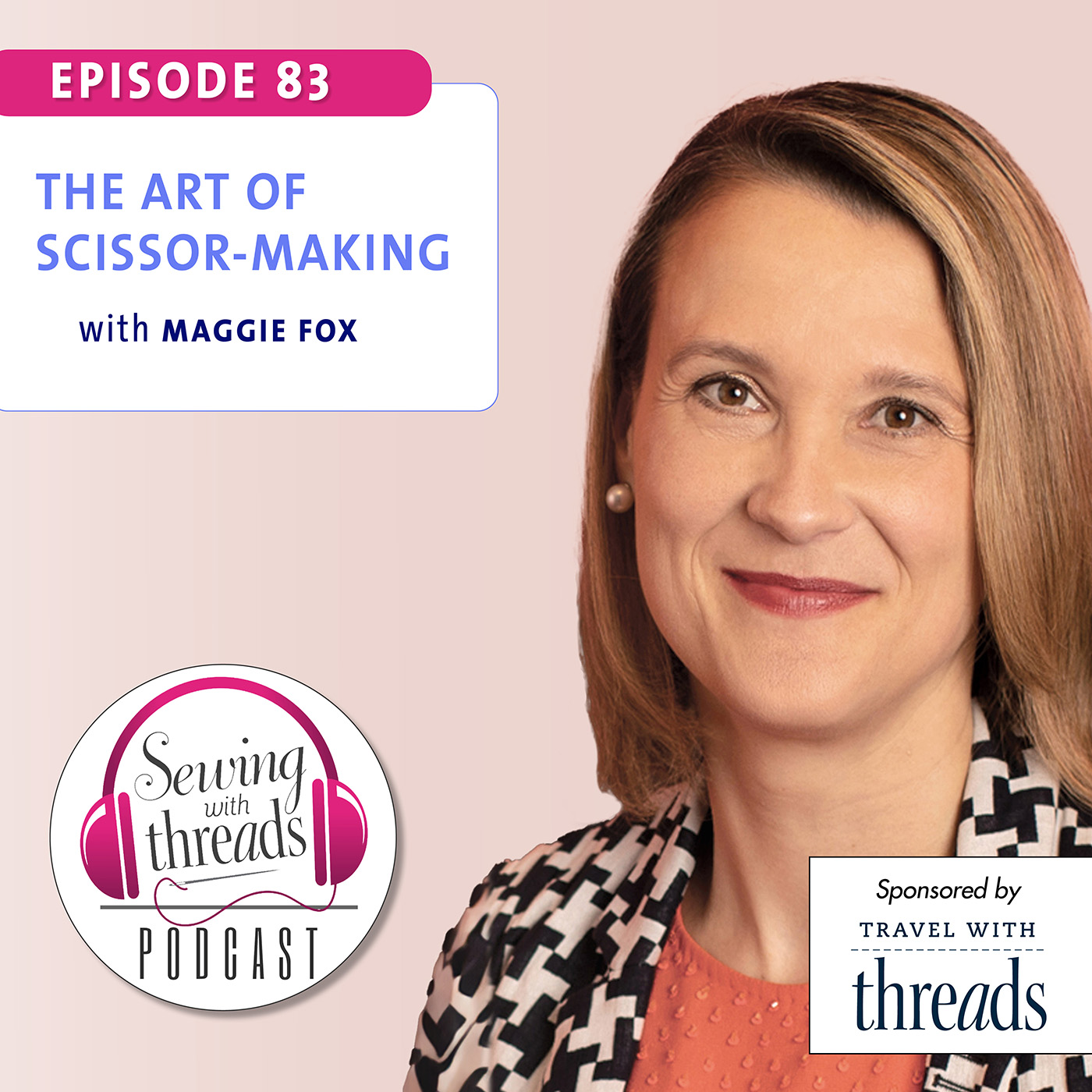
Threads Magazine Podcast: "Sewing With Threads"
The Art of Scissor Making, with Maggie Fox | Episode 83
00:32:21
Learn about the craft of scissor making and the artisans who excel at it from the owner of luxury scissor purveyor Ciselier.
Loading summary
Transcript60 lines
- [00:01]
Claire Schaeffer
Check out our newly available Threads classic course, the Couture Skirt, with longtime Threads contributor and Chanel expert Claire Schaeffer. In this course, Claire teaches you to sew your own faux wrap skirt, one of the most popular Chanel designs. It's comfortable and easy to wear. Right now, you'll get 35% off the couture skirt course when you use code PODCAST35. Go to threadsmagazine.com coutureskirt to sign up.
- [00:36]
Carol Frazier
Welcome to Sewing with Threads, the monthly podcast with the staff of Threads magazine. I'm your host, Carol Frazier, and today my guest is Maggie Fox. Maggie has a background in marketing in the technology and software spaces with expertise in startups. She also has a passion for small businesses and heritage crafts with her attendant tools and materials. These varied areas of experience blend perfectly in her e commerce brand, Cecilia, which specializes in luxury scissors. Maggie cares as much about the makers of the items she sells as about her customers. And she works hard to bring great quality cutting tools to those who can truly appreciate them. I'm looking forward to finding out about the craft of scissor making, the artisans who excel at it, and what this means for textile and sewing fans. Welcome, Maggie.
- [01:22]
Maggie Fox
Hi, Carol. Thank you very much. Thank you very much for having me.
- [01:25]
Carol Frazier
Well, I'm so glad we could catch up and talk. Maggie is currently based in the uk, so we're working with some time differences, but it seems to have. It seems to have all panned out. Well, I've got so many questions, but the first one for you is, where did you get the idea, you know, we need a luxury scissor brand out there?
- [01:42]
Maggie Fox
It. So I'm a marketer at heart and always have been, and I love finding blank spots, right. Even in this complex world that we live in, you know, just that little space that nobody's in for some reason. And it really was honestly, my husband and I, a number of years ago were walking around Lisbon, Portugal, and there's a very beautiful notion shop in the old part of the sort of grand part of the city. And we walked by and saw a bunch of really gorgeous scissors in the window. You know, storks, sort of the classic little embroidery scissors. And I turned to him and I said, where do you buy really good scissors? And we started talking. We realized we have no idea. No idea. And it is so unusual to come across things like that in this day and age where it feels like everybody's figured everything out. So I just sort of parked it. But it was a question that was open and then a Few years ago, during the pandemic, actually, I was thinking about what I wanted to do. I had been doing some great work in the Shopify ecosystem with E commerce companies, and I thought, oh, it's probably time for me to do something on my own again. And I had a list of things and where do you buy great scissors? Was one of the questions on the list. And I just started Googling and realized, doesn't exist.
- [02:58]
Carol Frazier
I became familiar with your business through an ad in the New Yorker, and it really hit me. It was exactly that. It was, oh, my gosh, I've never seen a place that specializes in a range of beautiful scissors. I was so excited about it, because if you're a sewer, you care a lot about your cutting tools, and they're your friends. You want them to be reliable, and you want them to be a beautiful object that you trust and you enjoy working with. And it felt like you had really grasped that. And I know that you don't just do sewing scissors. You do a lot of different kinds of household scissors, which we can talk about that, too, at some point, because that's. That's kind of interesting. I don't know a lot about those, but for one thing, how did you come up with a name?
- [03:43]
Maggie Fox
Well, Cecilia means scissor maker in French. And as. Honestly, to be very candid, as a marketer, you want to find a name that you can. Oh, you know, it's not competitive. You're not confused with someone else. And it was just. It was a list. I had a list of a few optional names. And I realized that Cecilia was available all the social channels, that it was something that we could be consistent with right across everything that mattered. And so it was kind of a natural. I'm also Canadian, so, you know, there was a. There's a little bit of French influence there as well. But, of course, the. The irony is that this industry of heritage and handmade scissors is shrinking so quickly, and so many of the artisans are getting old and retiring. France was once a center of incredible scissor making. No. And a couple of other regions. We actually don't have any French scissors in our collection because there is only one family left making them, and they're really not available for purchase. So the irony is we have a. The French name for scissor maker is our name, but there is only one French scissor maker left, and we have, at this point, been unable to actually carry their products. So.
- [04:54]
Carol Frazier
Yeah, that's a shame. But it doesn't surprise me. I do think that this kind of craftsman approach to making these sorts of tools is dying in a lot of places. But where are the big centers or the existing centers for scissor making?
- [05:10]
Maggie Fox
So the biggest, there are sort of three, four at this point. And when I say four, I mean quality, right? You have, you have a lot of. The vast majority of scissor production actually takes place place in China. But the average price is about US$4 per pair. So it's mass production, not very high quality. The typical stuff you would probably find in the average person's kitchen drawer, you know, get, still breaks, whatever. But when you talk about that sort of heritage, high quality historical scissor production, there is Sheffield in England, there is Zollingen in Germany, which is also very famous for knives. City of blades, Zolan. There is Pramana in Italy, which is in the Italian Alps, a historic center of iron working since Roman times. There are productions in Japan as well. But again, that's an area that we haven't been able to make connections with producers yet. But Japan produces beautiful, beautiful scissors. Very, very high end. So those are the, really the major areas. There is a little bit of production in Spain, there is one large factory there, but this is Urbis is. How do I put it? It's very secretive and also too, a lot of outsourcing happens and that is a result of downward pressure on costs. People don't know what it costs to make a pair of scissors and so they won't pay that cost. And so what you do see are some producers, no one we work with, but some producers actually outsource to lower cost regions and label them, you know, made in one of these historic areas. So, so they're like, you really do actually have to be quite careful about the brands that you buy from because it is, it is quite opaque where they're actually made and the level of quality is inconsistent.
- [07:00]
Carol Frazier
That's very interesting to hear. Good to know. What, when you're talking about scissor quality, what would you say is your platonic ideal for a pair of scissors? If you are a person needing scissors for whatever you need them for, what are you looking for?
- [07:17]
Maggie Fox
So you want, the very first thing you want are forged scissors, not stamped. So hot forged and not cold forged. Cold being relative, you know, hot being many thousands of degrees Fahrenheit and cold being slightly less. So you want hot forged scissors made of high carbon steel. There's something called the hrc, which is the Rockwell hardness scale. And it is an indicator of the durability and strength of the scissors, which means kind of an edge will the blade keep? So anyway, long story short, you want scissors that are forged, not stamped out of a sheet of metal. You never want scissors with plastic handles. Plastic handles, although comfortable, are actually an indication of poor quality. Polishing up and forming the, the bows of the handle is actually some of the most intensive work in scissor making. It has to be smooth. You know, they have to, they have to smooth, smooth off the signs of the forge. They need to polish them up. That's really, really time consuming and so that's where people cut corners. So you want forged scissors, all one piece metal and you want a hardwell, you know, a hardwell rockness. I keep saying it wrong. You want something, you want something high carbon that is going to retain an edge and be very sharp.
- [08:35]
Carol Frazier
So is there, is there like a number quantification for this type of steel that people should look for?
- [08:41]
Maggie Fox
Yeah, one of the indications you'll often see is the AISI 420. So that is an indication of carbon content. That is a very high quality durable steel that will, is not too brittle that it would break, but hard enough that it will retain an edge. So if you see AISI420, that is a very good quality pair of scissors.
- [09:05]
Carol Frazier
So how long will these scissors last you when you get them?
- [09:09]
Maggie Fox
Listen, they should last a lifetime if you take care of them just as much as a good knife. Like, you know, I suppose you could ask the same question of like how long is a good knife last? Well, ideally, you know, someone is your kids are fighting over the knives, right? Ideally your kids are fighting over the scissors that they're such high quality. I mean there really is nothing that can mechanically go wrong with a pair of scissors if they're properly cared for. You know, they might discolor but you know, it's usually easily wiped off. Like stainless steel isn't actually stainless as probably most of us know. But what you will often see with sewing scissors in particular is that they're nickel plated to protect them from discoloration. So a well cared for pair of scissors should last a lifetime. I mean, you know, they're simple, they're well put together, they can be resharpened. Yeah, that's, that's my hope anyway that we sort of get away from this notion of disposable scissors that are $4 each and people actually buy something that is a sort of a heritage, heritage legacy that they can hand on to their, to their grandchildren even.
- [10:15]
Carol Frazier
Are there any things that you would say don't Ever use your great scissors on tin cans?
- [10:22]
Maggie Fox
Definitely not a great idea. I did once cut a bunch of twist ties with one of our pair of kitchen scissors. And so, of course they've got that little strip of metal in the center. That was not a good idea. That did. That did dull the center, but I was actually able to sharpen it up again like it wasn't the end of the world. But yeah, so I would say, like a little mitt full of twist ties. Don't do that. You'll. You'll dull your scissors for sure.
- [10:45]
Carol Frazier
Okay, that's. That's excellent information. My mother used to have the rule like, no grape stems, no window screens, but, I mean, that was just any scissors, but her sewing scissors in particular. You know, this is the thing that everybody has. Anybody who sews. Don't ever use my sewing scissors for paper. Is that a myth or is that a reality that it's bad for you to cut paper with your sewing shears?
- [11:13]
Maggie Fox
No, it's real. It's real. Yeah, it is real, and it's real for a reason. So obviously, as everyone who's listening to this podcast knows, sewing scissors are incredibly sharp. Right? You know, the edge on a beautiful pair of sewing scissors is beautiful. So that you don't tear the fabric you, in fact cut, or the fibers, rather, you actually cut right through them. And so maintaining that edge is critical to their ongoing functioning. Nobody, nobody enjoys kind of trying to work at a piece of fabric with a pair of scissors. You pretty quickly start to wreck the weave. So the reason for that is that the edge is very, very sharp. It's very hard. It's very sharp. When you use fabric scissors on paper, it won't ruin them because they're very, you know, they're. They're hardened steel. But it will dull them very quickly. And the reason for that is the fiber. So the fibers in. In paper are very small, and they. They actually can be incredibly abrasive on those sharp edges, and they also linger. So you're not going to ruin your scissors, but you're going to make them dull more quickly, which is annoying. So not. Not advised and. And vice versa. Same deal. You know, paper scissors, not intended for fabric. They really won't get through it. So, you know, obviously there are scissors that are purpose built for certain jobs.
- [12:30]
Carol Frazier
Are the blades formed differently for paper versus fabric?
- [12:34]
Maggie Fox
They are, yeah. The edge. The edge is different. So you will see if you look, I mean, it's almost a micro. Not microscope, but a magnifying glass type of look. If you at a pair of fabric scissors, they come. It's really about the angle. So I'm, I'm holding up scissors right now just so I can actually talk through it. But of course, our listeners can't see what I'm doing. So if you look at the angle of the blade itself, right, there is, there is the flat side of the blade. And then the edge itself is extremely steep on fabric scissors, which gives you a smaller cutting surface, but a very, very sharp one. And what you'll see on paper is that angle is slightly different, so you have a bit of a bigger cutting surface, but not as sharp. It doesn't need to be as sharp. So that is really the predominant difference. And that's that very last thing that's done when the pair of scissors are made. That edge, it's called grinding, is put on and by the, by the experts who make these scissors, which is quite an impressive thing to see, actually.
- [13:34]
Carol Frazier
And when your scissors get dull, is it possible to sharpen them at home or do you not recommend it?
- [13:41]
Maggie Fox
I don't like to recommend that people who don't know how to sharpen scissors do it as a diy. If you have invested in a beautiful pair of fabric shears or any other beautiful pair of scissors, you should treat them well, you know, and we are in some cases talking hundreds of dollars. You know, these are beautiful, beautiful handmade tools. And so what we typically recommend is actually there's a great solution, which is you have all these hairdressers in your neighborhood, hairstylists. They also buy very high quality scissors, many, many thousands of dollars in some cases. Find out who sharpens the hairdressing scissors and see if that person will sharpen your household scissors. If you're an expert, go ahead. If you're not an expert, we don't recommend you try to practice on your beautiful Cecilia scissors.
- [14:34]
Carol Frazier
Thank you for that advice. I sent you a little preview note about this idea that people say if your scissors feel dull, to cut through aluminum foil or even very, very, you know, fine sandpaper. Have you ever heard that?
- [14:52]
Maggie Fox
I have. I have. And I do not think for a precision instrument like a pair of fabric shears, which really, like, we are talking gorgeous quality, I don't think it's going to do it. I don't think you're going to get that, that fine, fine edge back again. It's just too imprecise. That's really something that's produced on a grinding wheel, you know, not, not a piece of tin foil.
- [15:16]
Carol Frazier
Yeah. And I also think you Know, cutting through sandpaper sounds like it would, you know, hurt your blades more than help them.
- [15:24]
Maggie Fox
I think you're going to damage that top edge. You're probably going to make it jagged.
- [15:28]
Carol Frazier
Yeah.
- [15:28]
Maggie Fox
And then you're not going to enjoy cutting the. Those scissors. Yep.
- [15:32]
Carol Frazier
Yeah. So everyone who's listening, please don't try those at home things. Check out your, Check out your local hair hairdressers. There used to be, back probably 20 years ago, the Joann stores used to occasionally have an event where you could drop your scissors off and they would sharpen them and then you'd pick them up in a week. Some guy would just come in and do just a lot of sharpening and it wasn't expensive and I kept my eye out for that, but I haven't seen that in a long time. So, yeah, I think many people living in, you know, the craftsmanship deserts, which is most of the United States at this point, don't have access to things. But the hairdressers, that's a very good idea.
- [16:07]
Maggie Fox
Yeah.
- [16:08]
Carol Frazier
Yeah.
- [16:08]
Maggie Fox
And yeah, I mean, you know, you want to talk about scissor production, you know, many of this, the many pairs of hairdressing scissors, many models, many brands are from Japan and you're talking three, four, $5,000 or more like these. These are also tools of the trade, very serious. So I would, I would entrust one of our pairs of scissors to someone who's been entrusted with that, that quality of tool. For sure.
- [16:34]
Carol Frazier
I'm thinking about other things that can go wrong with your scissors. Dropping them.
- [16:39]
Maggie Fox
Yeah.
- [16:39]
Carol Frazier
Can they break?
- [16:40]
Maggie Fox
Yes.
- [16:41]
Carol Frazier
Do they just snap brittlely?
- [16:43]
Maggie Fox
They can, they can. And the analogy again is the fine knife. Right. When you look at, there's, there's always this balance with hardened metals that the harder it is, the higher carbon, the more brittle it is. But it also means it's sharper and the lower the carbon, the softer, the more quickly it dulls. So there's this kind of sweet spot. But the reality is that as with a beautiful Japanese knife, like just Google, I chipped my Japanese knife and there are many people who have suffered this unfortunate fate. As we've certainly seen it, that just a well placed, not so much this. So I would say not the fabric scissors because they are more substantial, but where we see that sometimes is the kitchen scissors. They're sort of short, pretty, pretty straight and not as much metal to them. And I have absolutely seen them crack when they hit a tile floor. Yeah, sad. Sad but true. But I've also broken a knife that way. So you know, it's just the reality of the material.
- [17:42]
Carol Frazier
Yeah. And how do you recommend caring for your scissors? I know you sell kitchen scissors and other types of things. Those get a lot messier. What would you do with these different types of scissors to keep them clean in good working order?
- [17:54]
Maggie Fox
Great question. And really with any non kitchen scissor, don't get them wet. That is the number one key thing. Because although many pairs of fabric shears are nickel plated, and the reason they're nickel plated is because when they're used extensively, your hands get a little moist in the bows, they can start to rust. So, so you'll typically see Taylor shears being coated or, or sometimes a coated handle, which is called a japanned handle. And the reason for that is to reduce the appearance of rust. Just that just comes from natural moisture. But where there is no coating is on the, in interior of the blade, on the flat of the interior of the blade. And what will happen if this, if that interior gets wet is it will rust and it can be difficult to remove. It also causes buildup because of course, rust is that corrosion, that oxidization on the surface. So you're actually getting something in between the two blades. So whatever you do, don't get them wet. And if you do, dry them off very, very, very carefully, because that is something that, that will shorten life. And now what you see sometimes is very interesting. So one of the scissors, one of the world's best scissor producers is in Sheffield, England. The brand called Ernest Wright. And they were profiled by Bloomberg. Oh, sorry. No, I think it was. Business Insider did a video of the world's most expensive scissors and how they're made. And they will actually take old tailor shears and refurbish them. So they'll go to, they're here in England, so they'll go to Savile Row and actually take tailor's shears because they get loose over time as well, and polish them up completely, put them through the rumbler, take them apart and then re grind them, re put an edge on and put them back together again. So in some cases you see tailors in Savile Row and some of the other men's tailoring shops who've been using scissors that are 80 years old or more. Some of these great big ones, like, it's, it's quite, it's quite something.
- [19:46]
Carol Frazier
Is there a point where you've had them sharpened or reground enough times that there's like the metal doesn't meet up anymore? Properly for cutting.
- [19:54]
Maggie Fox
If a proper refurbishment is going to be done, the scissors need to be completely disassembled. So in essence, you. Once they're ground, they're polished and reground the edges. Reground, they are then reassembled. So that means what's called pudding, which is done by a putter together, which is the actual name of that trade, and that's that sort of crafts person. So the putter together will remarry the blades. So they'll. They'll always. I mean, that's an essential part of the refurbishment, is to remarry the blade so that you get that. That fine meat where they cut all the way down the blade. Yeah, that's essential. If you take your scissors apart and then put them back together again without doing that, they're probably going to be loose and they're probably not going to cut very well.
- [20:42]
Carol Frazier
Okay. Is it okay for people to try to twist the little bolt on their own scissors if they're loose or tight?
- [20:50]
Maggie Fox
If so with fabric scissors, again, because of the precision, you're kind of playing with fire if you do it on your own. But I would say with kitchen scissors and other household scissors, which don't require that kind of precision, that's fine, that's fine. And in fact, you'll see often with kitchen scissors, the bolts can become loose because a lot of them, you can throw them in the dishwasher and they're heavy. You know, they're heavy duty sort of workhorses. Right. So they do get abused a little bit more. And sometimes those bolts, they're only screwed in, they can get a little loose. And so we actually recommend you do check on them, make sure they're tight so they don't fall out. But, yeah, I would say with a more precision tool, like a fabric sheer. Yeah, I don't know.
- [21:36]
Carol Frazier
You just mentioned the putter together, which is the name of my next band, I think probably now the Pudders. What other kind of jobs are there involved in making scissors? I'm imagining a lot of stuff happening in a big hot room full of clanking metal. But there must be other things.
- [21:58]
Maggie Fox
Well, there are many stages of scissor production. And, you know, if anyone's interested, we have great articles about how scissors are made, and they're about 22 different steps that they go through. But the final stage where you have the putter together, or in Germany they're called a nagler, which means a nailer. When you have that final stage of the two halves of the scissors being put Together, that is an incredibly highly skilled operation, because if you think about it, a knife is one blade, scissors are two that must come together just so in order to work. And in our travels and conversations with people who make scissors, typically the average. And this is where, whether it's England, Germany or Italy, the average training time to get to that level of skill is about five years. So people actually have to. And you can see why the industry struggles because that is a major commitment of time and people don't know about it also as a skilled area of work, but it takes about five years to learn how to make, to properly put a pair of scissors together. And you watch, folks, I mean, it's. We have. I have video that I'd be. I'd be delighted to share actually with you, Carol, for. For whatever purpose. But we have video of, you know, tap, tap, tap, looking at the blade. Tap, tap, tap, looking at the blade. And the two blades are together at this point. And then cut, cut, cut, you know, bring them together. Doesn't quite feel right. Tap, tap, tap, just. And it's all done by hand just to get the bows, the curves of those two blades together in just the right way. It's incredible, actually. The magic and mystery of the scissor.
- [23:41]
Carol Frazier
Are they mainly family businesses still? And do people kind of grow up and continue and work, do the job that their parents might have done?
- [23:50]
Maggie Fox
We see that in Italy, where the production. The businesses are relatively small. So there are many small scissor producers in Italy, and it's in a town called Pramana, Spain specifically. And the way that it's up high in the Alps and the way the town is set up is quite interesting. So you have the family home, and then historically and traditionally underneath the family home is the forge or the workshop. So, yes, you have the family members going downstairs and going to work and producing scissors and knives and other things there. So we see that in Italy, where it's smaller and the production is smaller. One of our favorite makers is a maker called Fennec, and they do some, in my opinion, some of the highest quality quality scissor making in the world. They are six people, two brothers, their father and a sister, and then they have other folks who help them, other family members. But it is a family business. If you go somewhere like Germany, where most of the scissor production is gone, but what is left is privately held companies, but a bit. They're more. I mean, Germany's a very industrialized country, so those businesses are a little bit larger, but still privately held. And still not huge. We are not talking huge businesses by any stretch of the imagination. So I think where we see things looking promising is where there is a family involved, because you have sort of the next generation interested in coming in. People like Ernest Wright and Sheffield have done a great job of raising their profile so people are aware of the brand. They do have a consumer brand. You can buy their scissors directly. And they've been attracting people who historically might be interested in making knives, which is very cool. Like, everybody wants to make cool knives. And they've done a great job of educating people about, in fact, making scissors is the next level beyond that in terms of skill.
- [25:46]
Carol Frazier
Yeah. I feel a little encouraged hearing this because you don't want this kind of craft to die away. It's. It feels really important for it to. To be maintained.
- [25:56]
Maggie Fox
It is. And it's. It's amazing when you hear about the numbers that, you know, at a, you know, given point in. In Zolingen in Germany, there were like dozens and dozens and dozens of scissor makers. Now there really are two really, like, people who are actually making them. Two. And I'm. I feel like it's actually still at an inflection point, like which way it's going to go. Is it going to vanish forever or will there be a bit of a renaissance? I think it's actually still up in the air. There just are not enough people learning how to make scissors.
- [26:33]
Carol Frazier
Yeah, I know where you're coming from with that. That makes a lot of sense to me because we're at a period where there's a lot of talk about sustainability and people wanting to maintain heritage brands in all kinds of ways. But it's expensive to buy a fancy pair of scissors and it's inexpensive to buy cheap scissors, clearly. And I know that those are taking over the world, which is probably part of this big problem. But I think if you look at it and say, I'm investing in these scissors for the next generation or two generations after this, and especially if you know that there's a way to maintain them, somebody who can sharpen them and keep them in good working order, then it feels like it's well worth it. As you say, scissors are, I mean, relatively simple mechanically compared to, say, a sewing machine. You don't need to replace your scissors, you just need to keep them really working. A sewing machine you might want to upgrade, but good scissors, you don't need to do that, I don't think.
- [27:23]
Maggie Fox
Yeah, yeah, absolutely. And, I mean, the reason I got so excited about this as well, this opportunity and just sort of thinking about, you know, helping these makers get their scissors new markets, because they're manufacturers, they are not marketers. Right. They, they. They are selling wholesale. You know, they are. They're not going to package stuff up and ship it to, you know, somebody in Toronto, Ontario, or wherever else. And they have no real ability to get into other markets. So the idea that we could help educate people about what these little family businesses are doing, about the quality that they're producing, and really help people understand that by supporting. Supporting it, you're supporting a heritage craft like this. In England, scissor making is considered an endangered craft. It's actually been recognized by the government as an endangered craft. And it is like, I mean, at this point, I would guess, Carol, there are no more than 24 to 30 people on Earth.
- [28:22]
Carol Frazier
Wow.
- [28:22]
Maggie Fox
Who can make a pair of scissors. Okay.
- [28:24]
Carol Frazier
I. I feel like I have a new career idea now. Like, it could be kind of fun to do all that. All that interesting perfectionism for such a good reward at the end. Now, there is one final question for you, and this is, what is the deal with storks? Why are the little embroidery scissors storks? And I know you. You were carrying this, the. The big storks, but are having trouble keeping those in stock. But where did the stork come from?
- [28:54]
Maggie Fox
So that, historically. So there is one version of the story that storks were. The consistent piece is that storks are used by midwives. One version says they were used to cut the umbilical cord. But in our research, what we've actually found, and their scholars have actually done work on this, if you can believe it, and we're happy to share that stork scissors are actually used by midwives while they were waiting for the baby to be born. So obviously, those of us who've had children know it can happen quickly or not so quickly. And so as the midwife is waiting for things to progress naturally, you know, you obviously take out your sewing, take out your embroidery and start to work. And just traditionally, it's been a motif. Obviously, storks bring babies, clearly, and it's just been a traditional motif. So that actually is the origin that it is the shape that midwives would typically use while they were assisting with birth. And now it's just become a classic. You know, it sort of feels like the basic embroidery scissor is that stork shape. And it's very interesting to watch the change in quality over the decades and even more in the storks Themselves and the quality of the forging and the quality of what they call the blank, which is the raw piece of forged metal. We have a pair of stork scissors that we got from Robusto, which is our German maker, and they'd found them in their archives. So they were, I think they were probably from the 40s or 50s. And the level of detail was absolutely mind blowing, like just incredible. Incredible nuance to the shape of it. And we are just unable to find that level of quality now, in part because the forge that made them closed, which means that the material, the mold they used is gone. So those scissors are simply never going to be made again. There's. It's not possible to make them again. So that's one thing that's quite sad actually, is to see the. A lot of the forges and the shapes that they've had just become extinct because the forge closes and the mold only works with their machinery. So that's it, it's over.
- [31:02]
Carol Frazier
That is a shame. But that's, that's an interesting story. I mean, I always assumed it because the shape of a stork lends itself to these little pointy scissors, but I didn't really know the midwife connection. That's actually, that's actually quite cool. And they always look pretty if you keep them as part of a chatelaine or something like that, so. Well, Maggie, thank you so much for telling us all about this. This is really fascinating. I hope our listeners have gotten a good understanding of what it takes to make beautiful scissors and why it's worth investing in something like that. To make yourself sewing practice just more pleasurable and to feel like you're supporting an industry that cares about hands on making, which we all do, all those of us who make our own clothing. And thank you for helping that all along and helping give them a marketing presence. That's, that's actually great. Thank you for joining me today and I'd like to thank everybody also for listening.
- [31:53]
Maggie Fox
Thank you so much, Carol. It's been a pleasure.
- [31:56]
Claire Schaeffer
Thank you to our guests for joining us and thanks to all of you for listening. Please remember to send your comments, questions and suggestions to thdsmagazine.com and please like, comment and subscribe wherever you are listening. Until next time, keep on sewing with threads.