← Through the ESV Bible in a Year with Jackie Hill Perry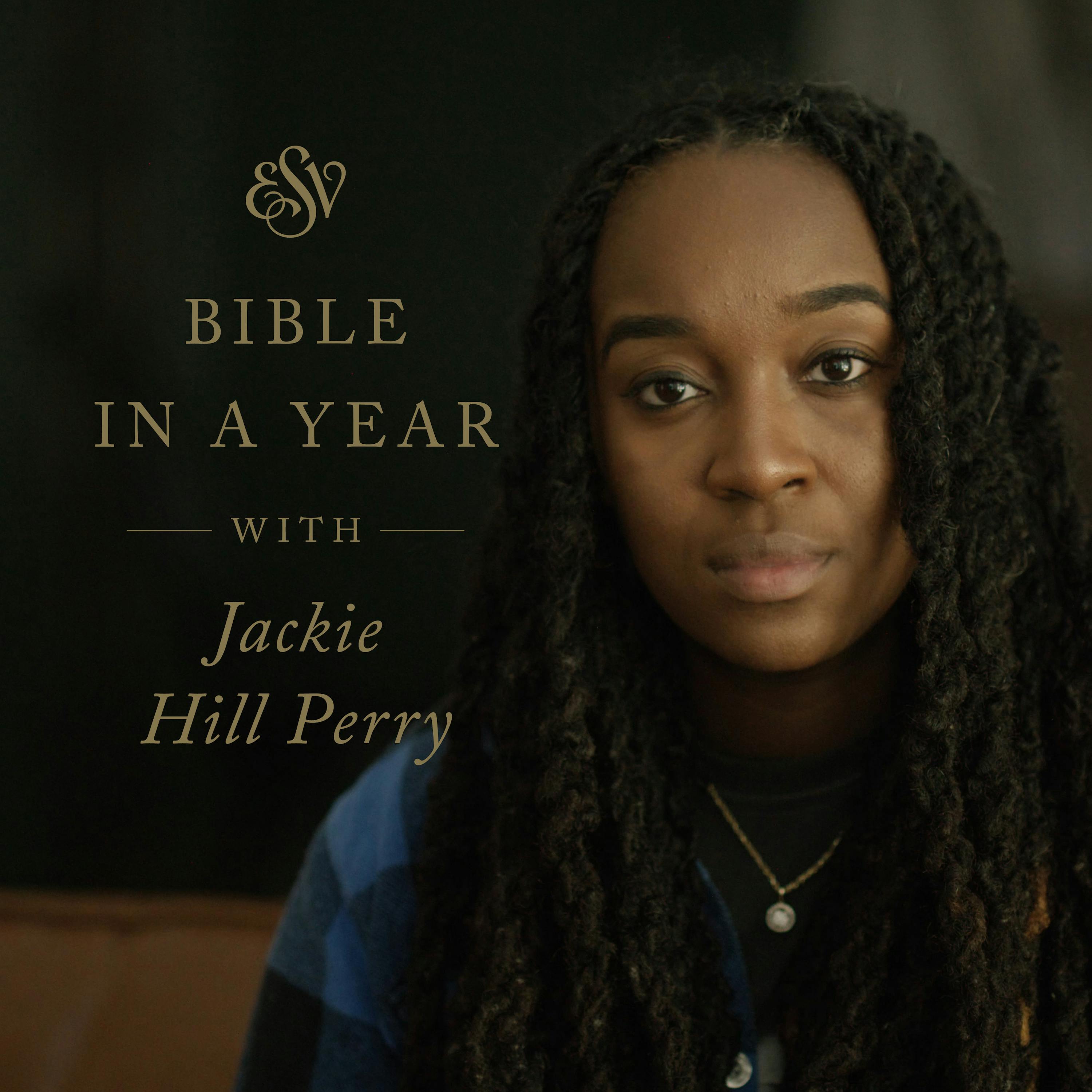
Through the ESV Bible in a Year with Jackie Hill Perry
January 4 (Genesis 7–8; Psalm 4; Matthew 6)
00:10:05
Loading summary
Transcript14 lines
- [00:02]
Reader
A reading from the book of Genesis. Then the Lord said to Noah, go into the ark, you and all your household, for I have seen that you are righteous before me in this generation. Take with you seven pairs of all clean animals, the male and his mate, and a pair of the animals that are not clean, the male and his mate. And seven pairs of the birds of the heavens, also male and female, to keep their offspring alive on the face of all the Earth. For in seven days, I will send rain on the Earth. Forty days and forty nights, and every living thing that I have made, I will blot out from the face of the ground. And Noah did all that the Lord had commanded him. Noah was 600 years old when the flood of waters came upon the Earth. And Noah and his sons and his wife and his sons, wives with him, went into the ark to escape the waters of the flood of clean animals and of animals that are not clean, and of birds and of. And of everything that creeps on the ground. Two and two, male and female, went into the ark with Noah, as God had commanded Noah. And after seven days, the waters of the flood came upon the earth. In the 600th year of Noah's life, in the second month, on the 17th day of the month on that day, all the fountains of the great deep burst forth and the windows of the heavens were opened and rain fell upon the earth. 40 days and 40 nights on the very same day, Noah and his sons and Shem and Ham and Japheth and Noah's wife and the three wives of his sons with them entered the ark. They and every beast, according to its kind, and all the livestock, according to their kinds, and every creeping thing that creeps on the Earth, according to its kind, and every bird, according to its kind, every winged creature, they went into the ark with Noah 2 and 2 of all flesh in which there was the breath of life. And those that entered, male and female of all flesh, went in as God had commanded him. And. And the Lord shut him in. The flood continued 40 days on the Earth. The waters increased and bore up the ark. And it rose high above the Earth. The waters prevailed and increased greatly on the Earth. And the ark floated on the face of the waters. And the waters prevailed so mightily on the Earth that all the high mountains under the whole heaven were covered. The waters prevailed above the mountains, covering them 15 cubits deep. And all flesh died that moved on the Earth. Birds, livestock, beasts, all swarming creatures that swarm on the Earth. And all mankind, everything on the dry land, in whose nostrils was the Breath of life died.
- [02:24]
Respondent
He blotted out every living thing that.
- [02:26]
Reader
Was on the face of the ground. Man and animals and creeping things and birds of the heavens, they were blotted out from the Earth. Only Noah was left and those who were with him in the ark. And the waters prevailed on the earth 150 days. But God remembered Noah and all the beasts and all the livestock that were with him in the ark. And God made a wind blow over the Earth, and the waters subsided. The fountains of the deep and the windows of the heavens were closed. The rain from the heavens was restrained, and the waters receded from the Earth continually. At the end of 150 days, the waters had abated. And in the seventh month, on the 17th day of the month, the ark came to rest on the mountains of Ararat. And and the waters continued to abate until the 10th month and the 10th month. On the first day of the month, the tops of the mountains were seen. At the end of 40 days, Noah opened the window of the ark that he had made and sent forth a raven. It went to and fro until the waters were dried up from the earth. Then he sent forth a dove from him to see if the waters had subsided from the face of the ground. But the dove found no place to set her foot, and she returned to him to the ark, for the waters were still on the face of the whole Earth. So he put out his hand and took her and brought her into the ark with him. He waited another seven days. And again he sent forth the dove out of the ark. And the dove came back to him in the evening. And behold, in her mouth was a freshly plucked olive leaf. So no one knew that the waters had subsided from the Earth. Then he waited another seven days and sent forth the dove. And she did not return to him anymore. In the 601st year, in the first month, the first day of the month, the waters were dried from off the Earth. And Noah removed the covering of the ark and looked. And behold, the face of the ground was dry. In the second month, on the 27th day of the month, the Earth had dried out. Then God said to Noah, go out from the ark, you and your wife and your sons and your sons, wives with you. Bring out with you every living thing that is with you of all flesh, birds and animals, and every creeping thing that creeps on the Earth, that they may swarm on the Earth and be fruitful and multiply on the Earth. So Noah went out, and his sons and his wife and his sons, wives with him. Every beast, every Creeping thing. And every bird, everything that moves on the earth went out by families from the ark. Then Noah built an altar to the Lord and took some of every clean animal and some of every clean bird and offered burnt offerings on the altar. And when the Lord smelled the pleasing aroma, the Lord said in his heart, I will never again curse the ground because of man, for the intention of man's heart is evil from his youth. Neither will I ever again strike down every living creature as I have done while the earth remains seedtime and harvest, cold and heat, summer and winter, day and night shall not cease. A reading from the Book of Psalms to the choirmaster with stringed instruments. A Psalm of David. Answer me when I call, O God of my righteousness.
- [05:22]
Respondent
You have given me relief when I was in distress. Be gracious to me and hear my prayer.
- [05:27]
Reader
O men.
- [05:27]
Respondent
How long shall my honor be turned into shame? How long will you love vain words.
- [05:32]
Reader
And seek after lies? Selah. But know that the Lord has set apart the godly for himself. The Lord hears when I call to him.
- [05:40]
Respondent
Be angry and do not sin.
- [05:42]
Reader
Ponder in your own hearts on your.
- [05:44]
Respondent
Beds, and be silent.
- [05:46]
Reader
Selah. Offer right sacrifices and put your trust in the Lord. There are many who say who will show us some good. Lift up the light of your face upon us, O Lord, you have put.
- [05:57]
Respondent
More joy in my heart than they have.
- [05:58]
Reader
When their grain and wine abound in peace I will both lie down and sleep for you alone, O Lord, make me dwell in safety. A reading of the Gospel According to Matthew.
- [06:11]
Respondent
Beware of practicing your righteousness before other people in order to be seen by them, for then you will have no reward from your Father who is in heaven. Thus when you give to the needy, sound no trumpet before you, as the hypocrites do in the synagogues and in the streets, that they may be praised by others. Truly I say to you, they have received their reward. But when you give to the needy, do not let your left hand know what your right hand is doing, so that your giving may be in secret, and your Father, who sees in secret will reward you. And when you pray, you must not be like the hypocrites, for they love to stand and pray in the synagogues and at the street corners, that they may be seen by others. Truly I say to you, they have received their reward. But when you pray, go into your room and shut the door, and pray to your Father, who is in secret, and your Father, who sees in secret will reward you. And when you pray, do not heap up empty phrases as the Gentiles do, for they think that they will be heard. For their many words do not be like them. For your Father knows what you need. Before you ask Him, Pray then. Like our Father in heaven, hallowed be youe name, Your kingdom come, your will be done, on earth as it is in heaven. Give us this day our daily bread, and forgive us our debts, as we also have forgiven our debtors. And lead us not into temptation, but deliver us from evil. For if you forgive others their trespasses, your Heavenly Father will also forgive you. But if you do not forgive others their trespasses, neither will your Father forgive your trespasses. And when you fast, do not look gloomy like the hypocrites, for they disfigure their faces that their fasting may be seen by others. Truly, I say to you, they have received their reward. But when you fast, anoint your head and wash your face, that your fasting may not be seen by others, but by your Father, who is in secret, and your Father, who sees in secret, will reward you. Do not lay up for yourselves treasures on earth where moth and rust destroy and where thieves break in and steal, but lay up for yourselves treasures in heaven, where neither moth nor rust destroys and where thieves do not break in and steal. For where your treasure is, there your heart will be also. The eye is the lamp of the body. So if your eye is healthy, your whole body will be full of light. But if your eye is bad, your whole body will be full of darkness. If, then the light in you is darkness, how great is the darkness. No one can serve two masters. For either he will hate the one and love the other, or he will be devoted to the one and despise the other. You cannot serve God and money. Therefore I tell you, do not be anxious about your life, what you will eat or what you will drink, nor about your body, what you will put on. Is not life more than food and the body more than clothing? Look at the birds of the air. They neither sow nor reap nor gather into barns. And yet your Heavenly Father feeds them. Are you not of more value than they? And which of you, by being anxious, can add a single hour to his span of life? And why are you anxious about clothing? Consider the lilies of the field, how they grow. They neither toil nor spin. Yet I tell you, even Solomon in all his glory was not arrayed like one of these. But if God so clothes the grass of the field, which today is alive and tomorrow is thrown into the oven, will he not much more clothe you? O you of little faith. Therefore do not be anxious, saying, what shall we eat? Or what shall we drink? Or what shall we wear? For the Gentiles seek after all these things, and your Heavenly Father knows that you need them all. But seek first the kingdom of God and his righteousness, and all these things will be added to you. Therefore do not be anxious about tomorrow, for tomorrow will be anxious for itself. Sufficient for the day is its own trouble.