Loading summary
Transcript94 lines
- [00:00]
NPR Sponsor Announcer
Support for NPR and the following message come from Warby Parker, the One Stop Shop for all your vision needs. They offer expertly crafted prescription eyewear plus contacts, eye exams and more. For everything you need to see. Visit your nearest Warby Parker store or head to warbyparker.com a quick heads up.
- [00:19]
Ramtin Arablouei
Before we get started. This episode contains some strong language, including a racial slur and mention of suicide.
- [00:33]
James Baldwin (voice/reading)
Until the moment comes when we, the Americans, we the American people, are able to accept the fact that I have to accept, for example, that my ancestors are both white and black, that on that continent we are trying to forge a new identity for which we need each other. Until this moment, there is scarcely any hope for the American dream because the people who are denied participation in it by their very presence will wreck it. And if that happens, it's a very grave moment for the West. Thank you.
- [01:34]
Rund Abdelfatah
Hey, I'm Rund Abnin Fattah.
- [01:36]
Ramtin Arablouei
I'm Ramtin Arablouei. You may have noticed a quote making the rounds on social media. It goes, not everything that is faced can be changed, but nothing can be changed until it is faced. Those words are written by James Baldwin, whose voice you heard at the top in an essay for the New York times published in 1962. For many people, it rings as true today as it did then. The words have a power and clarity that seem to cut through time and space.
- [02:07]
Rund Abdelfatah
It also shows how ideas re emerge in times when they seem most needed. And actually, that's something we talk about a lot when we develop episodes. Historical figures and their ideas. They inspire us, challenge our assumptions, and sometimes push us to ask questions we might not otherwise have asked. And what better way than to look at the philosophy of James Baldwin, a writer who used the power of his words to confront in order to connect something we can relate to today.
- [02:38]
Ramtin Arablouei
Baldwin was an insightful commentator on black identity, American democracy and racism. He saw something deep and ugly and stubborn in American culture, and he never hesitated to call it by its name, to bear witness, regardless of what it cost him.
- [02:56]
Rund Abdelfatah
Baldwin was a black man, he was gay, and he was active from the 1940s to his death in 1987. He's still considered one of the greatest American writers of the 20th century. His story is amazing, but that isn't what we're going to focus on in this episode. We're going to meet someone who spent his career diving into the meaning and purpose of James Baldwin's work, of his ideas, someone who can help us see the world through his eyes so that maybe, just maybe, we can gather a little more strength to face the things that must be changed in ourselves and our culture.
- [03:44]
Eddie Glaude
Foreign. Hello, my name is Lola Manuel Valentin calling from Charlotte, North Carolina, and you're listening to Throughline from NPR with Rand Abdel SATA and Ramtin Arablouei. Keep up the great work, guys.
- [04:12]
Sponsor Message Announcer
This message comes from BetterHelp President Fernando Madera shares BetterHelp's commitment to expanding access to therapy.
- [04:19]
Ramtin Arablouei
Our State of Stigma report helped us understand that believing in mental health is easy, but asking for help is not.
- [04:29]
Eddie Glaude
Now, with the report on our hands.
- [04:32]
Ramtin Arablouei
We can work to make mental health care more accessible.
- [04:36]
Sponsor Message Announcer
To get matched with a therapist, visit betterhelp.com NPR for 10% off your first month.
- [04:43]
NPR Sponsor Announcer
This message comes from NPR sponsor Capella University. Interested in a quality online education? Capella is accredited by the Higher Learning Commission. A different future is closer than you think with Capella University. Learn more@capella.edu this message comes from Netsuite. Every business is asking, how can they make AI work for them? No more waiting. With Netsuite by Oracle, you can put AI to work today, trusted by over 43,000 businesses, it's the unified suite that brings your financials, inventory, commerce, HR and CRM into a single source of truth. That connected data is what makes your AI smarter, helping you make fast decisions. Right now. Get the business guide demystifying AI free at netsuite.com story.
- [05:35]
Rund Abdelfatah
Part one confronting the.
- [05:37]
Eddie Glaude
Lie I started reading Baldwin seriously in graduate school. I fell in love with the sound of his voice, the power of his pen, his courage, the way he queered politics, how he inhabited his own misfittedness, the way in which he balanced his rage and love.
- [06:01]
Ramtin Arablouei
This is Eddie Glaud, professor of African American Studies at Princeton University.
- [06:06]
Eddie Glaude
I'm the author of begin James Baldwin's America and Its Urgent Lessons for Our Own.
- [06:12]
Rund Abdelfatah
In 2018, Eddie was starting to write that book about Baldwin, but he was struggling. So he went to Heidelberg, Germany, on a fellowship to try and figure it out.
- [06:23]
Eddie Glaude
You know, I had been thinking I was going to write this intellectual biography of Baldwin, and I was having all of this trouble. The archives weren't yielding what I hoped they would yield. I'm in Heidelberg and I experienced this horrible scene.
- [06:42]
Rund Abdelfatah
He just arrived at the train station when he saw something disturbingly familiar. Here's how he describes it in his book.
- [06:50]
Eddie Glaude
As we entered the station, I heard screaming. People in front of us stood still and stared at some kind of commotion. I followed their eyes. Four policemen were piled on a black man. One officer had his Knee in the man's back. The others twisted his arms. His pants were halfway down his legs. His bare ass was exposed. The police pressed his head down into the concrete as if they were trying to leave the imprint of a leaf there. With each attempt to cuff him, the man let out a blood curdling scream. All eyes were on him as the crowd stood by and watched intently like spectators at a soccer game without any real attachment to the team's playing. I watched them as they watched the police and the black man. Their faces revealed nothing. They were inscrutable, at least to me. I had not been in Heidelberg for two hours and police had a black man's face pressed down on the concrete with a knee in his back.
- [07:52]
Ramtin Arablouei
The intensity of that scene snapped things into focus for Eddie. He wasn't going to write an intellectual history of James Baldwin as he had originally planned. He was going to try and write with Baldwin to try to put him in a deeper, more philosophical context and understand what his work offers us in our world. He went back to his room and the words just started pouring out. And to do it, he had to call back to when he started reading James Baldwin more than 30 years earlier.
- [08:23]
Eddie Glaude
And I knew that when I started reading him in graduate school that he was going to have me deal with my own traumas, my own wounds, my own pains. And I didn't have a philosophical language for that yet. He would, in effect, open me up and then I would have to deal with the fact. And it is a disturbing fact in some ways that I am and remain a vulnerable little boy. But in order for me to say anything substantive about the world, I would have to confront that vulnerable little boy, you know.
- [09:00]
Rund Abdelfatah
So just to establish who.
- [09:03]
Eddie Glaude
Was James Baldwin, he's this child of Harlem, not Sugar Hill Harlem, but, you know, the ghetto of Harlem. Born in August of 1924, who had stories dancing around in his head, who was misfitted and the like, but whose mind was. Was unbounded by. By his circumstance and his environment. Yet he had to fight and work desperately to hold off what the world said about him in all of its ugliness. And he willed himself into becoming one of America's most amazing and accomplished writers. I think he's this mixture of Henry James, Malcolm X and Freud. You know, his writing demands a kind of deep sea dive. You know, he believes in the Socratic dictum that the unexamined life is not worth living. Before we can say anything about the world we inhabit, we need to say something about ourselves. Because the messiness of the world is actually a reflection of the messiness of our interior lives. So there's a kind of demand for self examination.
- [10:16]
James Baldwin (voice/reading)
That's part of the dilemma of being an American Negro. That one is a little bit colored, a little bit white, and not only in terms of physical terms. You're in the head and in the heart. And there are days, one of them, when you wonder what your role is in this country and what your future is in it.
- [10:43]
Eddie Glaude
To my mind, he is perhaps the most insightful critic of American democracy and race we've ever produced.
- [10:53]
James Baldwin (voice/reading)
I'm terrified at the moral apathy, the death of the heart, which is happening in my country. These people have deluded themselves for so long, they really don't think I'm human. And this means that they have become in themselves moral monsters.
- [11:20]
Ramtin Arablouei
In the book, you kind of refer to this notion that there's a kind of lie at the center of America's self image. And it's something that comes out in your voice and also in the kind of Baldwin's observations. What is that lie and how does it apply today?
- [11:40]
Eddie Glaude
Yeah, so the lie is what I call the value gap. And that is the belief that white people matter more than others. And that belief evidences itself in our dispositions, our habits, our practices, our social and political and economic arrangements. And they're protected by the lies we tell ourselves. You know, Baldwin, in 1964, wrote an essay entitled the White Problem. And he has this wonderful passage, it's so poignant, where he, and I'm paraphrasing here, where he says, you know, the founders of the country, you know, had a fatal flaw. They said that they were Christian, they said that they were fascists, the nation, on these principles, but yet they had chattel, they had us. And in order to justify the role that these chattel played in their lives, they had to basically say that these men and women were not human beings. Because if they weren't human beings, then no crime had been committed. And then here's the line, that lie is the basis of our present trouble. And so we tell ourselves this story that we're the redeemer nation, that we're the shining city on the hill, as Ronald Reagan said. And we tell ourselves we're the example of democracy achieved, as if we didn't do what we did in Haiti, as if we didn't do what we did in Cuba or what we did in Puerto Rico, or what we did in Hiroshima or what we did in Nagasaki. Right? So we do all of that to protect our innocence. So Baldwin is insisting, you know, we have to confront the messiness of who we are, our ghastly failures, in order to release ourselves into being otherwise. And that at the personal level also must happen at the societal level. So we have to tell the truth about who we are and what we've done. But the lies get in the way.
- [13:29]
Rund Abdelfatah
You know, those lies that as you say, we tell ourselves personally and socially, like as a society we tell ourselves on the one hand, it's that sort of self preservation, preservation reflex that we have on both that sort of micro and macro level. And it just makes me think, you know, there's a certain vulnerability that it takes to own up to a lie and to look it straight in the eye and say, this is not the truth.
- [13:56]
Eddie Glaude
Yeah.
- [13:57]
Rund Abdelfatah
And so in some ways, you know, that process of confrontation that you yourself, it seems, had to go through just to tackle this subject is also sort of a process of confrontation that Baldwin was saying the country needed to experience.
- [14:15]
Eddie Glaude
Yeah. You know, confrontation is also a sign of maturity where we've grown into the resources requisite to do it. Honestly, he has this line, and I'm paraphrasing again, you know, is that, you know, the trouble we're in is deeper than we thought because the trouble is in us. You know, you're so right to say that. We have to confront it. It requires, you know, being willing to be vulnerable.
- [14:49]
Ramtin Arablouei
There is this personal versus systemic tension in Baldwin's writings in that he deeply reflects on the personal impacts that America as a country has had on individual people in terms of what it does to their self confidence. And, and that actually brings me to one of the quotes from your book that really, really stuck with me. I, I, I want to really, I want to read it really quick for you, if that's okay.
- [15:16]
Eddie Glaude
Sure.
- [15:18]
Ramtin Arablouei
America in its racist assumptions had indelibly shaped who Baldwin was. But he insisted we are not the mere product of social forces. Each of us has a say in who we take ourselves to be. And no matter what America said about him as a black person, Baldwin argued he had the last word about who he was as a human being and as a black man. Just as we must examine our individual experiences and the tears that shape how we come to see ourselves together as a country, we must do the same. The two are bound together. What I love is while, is while it's deeply personal, it's very much examining the systemic, of the broader responsibility of the country, of its government, of its policies. Today there seems to be a real tension between those things. For many people what do you think Baldwin would have made of that tension today?
- [16:14]
Eddie Glaude
Well, you know, so one of the most powerful things about Baldwin is that he goes to the interior, not to stay there, but as the launching pad to go outward. So the interior is the basis for moving to a broader form of social criticism. Some people will move from social criticism to the interior, and you end up with this kind of narcissistic kind of account where it's just simply about the individual and their own pain and suffering. Right. For Jimmy, that individual pain as early as reading Notes of a Native Son, where you end with him at the funeral of his stepfather, with the birth of his youngest sister and him leaving to get ready to go to Paris and of course, the riots in New York. So there's a way in which the autobiographical is the kind of point of entry to the broader social context. I think that's really important in our own moment because we live in a moment that's so driven by our own individual brands, our social media platforms or micro reality shows. It's very difficult for us to move outside of our own selves into a broader understanding of our relationship, genuine relationship with others. Jim.
- [17:40]
James Baldwin (voice/reading)
What do you see deep in the recesses of your own mind as the future of our nation? Well, I'm both glad and sorry you asked me that question. I'll do my best to answer it. I can't be a pessimist because I'm alive. To be a pessimist means that you have agreed that human life is an academic matter.
- [18:08]
Eddie Glaude
When Jimmy says choose life, don't wallow in the illusion. Don't settle for safety. That's not about a how to manual. That's not about a corporate strategy for dealing with difference in your midst. The point here is to choose life is a deeper existential question about who do you take yourself to be?
- [18:33]
James Baldwin (voice/reading)
Now, the artist, no matter how he sounds, is by definition a religious man, believing that we can create and transcend or our gods, that it is entirely up to us. It is the work of human beings to make the world more human.
- [19:01]
Eddie Glaude
We travel and we move around the surfaces because we're afraid of what's in the dark cellar. We don't want to look the terror squarely in the face. But, you know, America is like. Like Never never Land. You know, we all want to be lost boys and girls where we don't want to be responsible or accountable. We rather be safe and secure in our innocence.
- [19:28]
James Baldwin (voice/reading)
One of the things that most afflicts this country is that white people don't know who they are or where they come from. That's why you think I'm a problem. I am not the problem. Your history is. And as long as you pretend you don't know your history, you're gonna be the prisoner of it.
- [19:43]
Eddie Glaude
And you know, it's that moment in Baldwin's the Fire next time where he says people either don't know or they don't want to admit, in effect, what's happened to thousands of thousands of their countrymen. And he said, you can't be innocent in the face of that. The innocence is the crime.
- [19:59]
James Baldwin (voice/reading)
When quote, unquote, white people talk about progress in relationship with black people, all they are saying and all they can possibly mean by the word progress is how quickly and how thoroughly I become white. I don't want to become white. I want to grow up and so should you.
- [20:18]
Eddie Glaude
So America's not unique in its sins, right? We may be unique in the efficient way in which we deny them.
- [20:38]
Rund Abdelfatah
When we come back, James Baldwin refuses to take the bribe and pays a heavy price.
- [21:11]
Eddie Glaude
This is Shirlene Reese from Mesquite, Texas. And you're listening to through lines from npr.
- [21:20]
Sponsor Message Announcer
This message comes from Midi Health introducing age well longevity care designed by women for women. Women can feel overlooked by the healthcare industry, especially when it comes to aging. Midi Health offers personalized services conveniently accessible through telehealth visits and covered by major insurance providers. Your health is worth it. Book your virtual visit today@joinmidi.com that's joinmidi.com.
- [21:46]
NPR Sponsor Announcer
This message comes from Lisa from night one. You'll feel the difference. Premium materials that deliver serious comfort and full body. Go to leesa.com for 25% off mattresses, plus get an extra $50 off with promo code.
- [22:02]
Sponsor Message Announcer
NPR this message comes from Carvana, who makes buying and financing your next car easy. Thousands of vehicles, terms up front and 100% online, even get it delivered to your door. Buy your car the easy way with Carvana. Delivery fee may apply.
- [22:23]
Rund Abdelfatah
Part 2 the bribe.
- [22:29]
Ramtin Arablouei
During the 1960s, different groups emerged in the movement for black liberation and civil rights. There was the nonviolent direct action wing of the movement, headed by groups like sncc, the Student Nonviolent Coordinating Committee, and people like Martin Luther King and John Lewis.
- [22:46]
Rund Abdelfatah
And then there was the more radical wings, often called the Black Power movement, with groups like the Black Panthers who vowed to defend themselves and their communities with arms if necessary. They were painted as extremist and dangerous by much of the mainstream media.
- [23:03]
Ramtin Arablouei
And James Baldwin, who was a well known figure by this point kind of had a choice to make, clearly pick a side or potentially lose support from the mainstream.
- [23:14]
Eddie Glaude
Sometimes you gotta sing off key to be heard, you know. When everyone was turning their backs on black power, Baldwin didn't. And he knew the cost. He should have won a Nobel a long time ago. He knew the cost.
- [23:30]
James Baldwin (voice/reading)
If we were Irish, if we were Jewish, if we were Poles, if we had, in fact, in your mind, a frame of reference, our heroes would be your heroes too. Nat Turner would be a hero for you. Instead of a threat. Malcolm X might still be alive.
- [23:47]
Eddie Glaude
He turned his back on the New York intellectuals, all of those white writers, the chattering classes of New York, that gave him the platform that projected him out. He turned his back on them.
- [23:58]
James Baldwin (voice/reading)
But you know, when the Israelis pick up guns, or the Poles or the Irish, or any white man in the world says, give me liberty or give me death, the entire white world applauds. When a black man says exactly the same thing word for word, he is judged a criminal and treated like one. And everything possible is done to make an example of this bad nigger so there won't be any more like him.
- [24:31]
Eddie Glaude
When he told those young college students at Howard University in 1963, if you promise your elder brother that you will never believe what the world says about you, I promise you that I will never betray you. And even when they question his manhood, his sexuality, his dedication to black folk, he never betrayed him. That doesn't mean he wasn't critical. He understood from whence these young folk came. And he was trying to tell a story about how they. How their eyes darkened. How these once holy fools who risked all. Everything to transform the country in the bowels of the south as they organized non violently, these same children were now screaming black power. And burning cities down. He said, no, no, these children are ours. We produce. So what does it mean to do that in this moment? I'm sorry I'm getting so emotion, you know, I guess passionate about it. Because we're constantly faced with taking the bribe. Jimmy, he could have taken the bribe. And what is the bribe? The bribe is your silence. The bribe is, you know, just pursue your craft and make your money. The bribe is to adjust yourself to injustice. And then in the context of the world in which we inhabit, that bribe involves the deformation of attention, right? So we don't. So we start producing work that doesn't capture folks attention. It actually becomes a part of this white noise that. That leaves folks eyes blank, right? It's not. Doesn't force them to do Much. I'm sorry.
- [26:23]
Rund Abdelfatah
No, no, don't apologize. I mean, there's something in that emotion that you're expressing, just the. The literal feelings that. That are bubbling up that, like, come through in so many of Baldwin's writings, Right? Like, he. He had so much emotion packed into what he was saying because of the things he was seeing, Right? And he was angry. And I wonder what you make of the. What you make of that anger and how it related to the. The country's anger. I mean, was he channeling it?
- [26:59]
Eddie Glaude
You know, in an interview in 1968 in Esquire, the reporter is asking him, how do we get black people to cool it? He says, it's not for them to get. It's not for us to cool. He said, but aren't you dying? You know, but aren't you the ones dying? And he responds, no, we're just the ones dying the fastest. And the reporter didn't quite get what he was saying. We tend to think of the Black power movement and the civil rights movement as if they were wholly separate, as if the people who inhabited black power, who advocated for black power, weren't at some point risking their lives. Just a few years earlier, earlier engaged in nonviolent protests in Selma, Stokely Carmichael was one of the most brilliant nonviolent organizers in the movement. What happened to him? Right. John Lewis wasn't just simply this man who risked everything on the Edmund Pettus Bridge. He was the chairperson of SNCC from 1963 to 1966. But these movements are continuing continuous. They're linked. The rage, the anger. If you weren't angry, what the hell was wrong with you? So I think for me, he gives me license to be rageful. And then he says, if you're not rageful, then what is wrong? What is wrong? We have to go through this brook of fire to get to the other side. There's no going around it.
- [28:37]
Ramtin Arablouei
Throughout the book, just to follow up on that, there is this feeling that while he holds that rage, as you just said, he's also capable of simultaneously understanding that the white citizens of the United States who are responsible for the state of. I play major role and responsible of the state of racism in the system in America, he also holds a deep love and a sense of brotherhood and sisterhood for those people. And do you think part of the reason he was able to do that so well beyond just his ability to write and think was that he was a witness and not necessarily a participant in the sense that he wasn't an activist. He intentionally Chose to be a witness, to bear witness, to document in a lot of ways what he was seeing. What does that tell us about kind of where, you know, many of us sit? And do you think that was what really enabled him to kind of really be able to balance those heavy emotions?
- [29:46]
Eddie Glaude
You know, I don't know, to be honest with you. There is a sense in which Baldwin is the poet in the Emersonian sense. Baldwin never gave up on the fundamental sacrality of human being. We're all sacred. And then that line where he says, I want us to do something unprecedented, and that is to create a self without the need for enemies. Oh, my Lord, every time. I mean, that's just. I just love that line. So part of what he's saying. I know I'm going around in circles. He's saying that what white supremacy does, it not only causes all of this hell for me and how I have to raise my children and live my life, it is literally deforming and disfiguring the character of the people who embrace it. Your character is fundamentally affected by all of this. Can't you see?
- [30:49]
James Baldwin (voice/reading)
I think that you and I might learn a great deal from each other if you can overcome the curtain of my color. This country is mine, too. I paid as much for it as you. White means that you are European still, and black means that I'm African. And we both know we've both been here too long. You can't go back to Ireland or Poland or England, and I can't go back to Africa. And we will live here together or we'll die here together. And it's not, I am telling you, time is telling you, you will listen or you will perish.
- [31:27]
Eddie Glaude
And what he's warning us is not to fall into the trap, because if it disfigures them, if we buy into his logic, if we will disfigure us, we can't release the trap, man, but we can't. We also can't fall into this stuff of sentimentality either. But anyway.
- [32:00]
Rund Abdelfatah
What Jamie Baldwin can teach us about dealing with our loneliness when we come back.
- [32:11]
Eddie Glaude
Hey, what's up? This is J.C. williams calling from Zurich, Switzerland, and you're listening to throughline on npr.
- [32:18]
Sponsor Message Announcer
Support for this podcast and the following message come from Strawberry Me. If you could go back and talk to your younger self, would you tell yourself that you have a job that truly makes you happy? Many people are stuck in jobs they've outgrown or never really wanted. A career coach from Strawberry Me can help you move on to something you actually love. Benefit from having a dedicated coach in your Corner and get 50% off your first coaching session at Strawberry Me.
- [32:46]
NPR Sponsor Announcer
NPR support for NPR and the following message come from Washington Wise decisions made in Washington can affect your portfolio every day. Washington Wise from Charles Schwab is an original podcast that unpacks the stories, making news and how they may affect your finances and portfolio. Host Mike Townsend and his guests explore policy initiatives for retirement, savings, taxes, trade and more. Download the latest episode and follow@schwab.com WashingtonWise or wherever you listen.
- [33:20]
Rund Abdelfatah
Part 3 the Elsewheres throughout his life, James Baldwin felt the solitude of being an outsider. He was a nomad, spending many years living abroad in France and other parts of Europe, and whether it was because of the color of his skin, his sexuality, or his fiercely independent thinking, he could never escape being alone. And the more successful he became as a writer, the more the loneliness followed him.
- [33:50]
Eddie Glaude
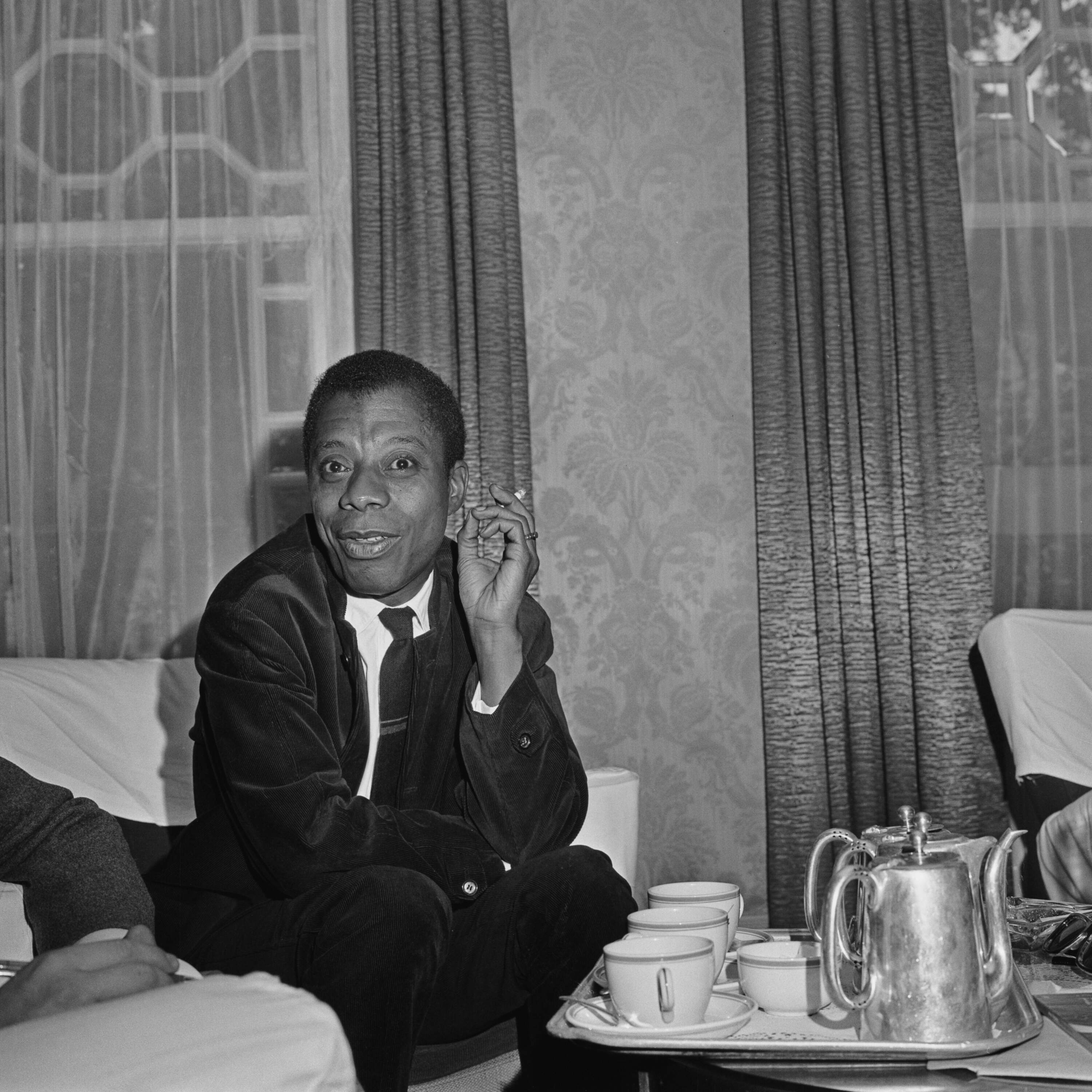
You know, the first thing I would say is that fame is a motherfucker, you know. But I chose the photo, the image for the COVID precisely for this reason. It is it comes from Sadat Piguet's haunting and beautiful short film From Another Place, and he's sitting in an old tea house in Vibec in Istanbul. And in the film, he's surrounded by people, but his eyes betray the company. He's looking elsewhere. He's in a fragile place in that moment in his life, even though he's in the company of others, loneliness is his companion because he has to get his work done. But I also say that we have to find our elsewheres. That doesn't mean we have to retreat to some other country, but we certainly have to find communities of love, people who allow us to laugh, full belly laughs, to rage, to be quirky, to be ourselves without cost. That people who hold us to account. We have to find the way to create the distance from the status quo so that we can develop resources to say no to the bride as it comes to us over and over again. So we avoid, not necessarily, the existential condition of loneliness per se. Custard is how can I say this? What I've chosen to do with my life is by definition. By definition requires solitude. It requires a kind of loneliness, especially when people want you to sing in the chorus and you think what they're singing is wrong. I experienced that from 2008 to 2016 with the Obama administration. But that's another story. Tell us more. No, in Democracy and Black I was really critical of the Obama administration. I wanted him to do more. And you know, people were Many people were delighted to get invitations to the White House, and they were delighted by the symbolism of a black president. And I was more distraught by what was happening to black communities. And so I wrote a book and called him a confidence man in the line of Melville. I'm still not living that one down, along with some other things I wrote. But if you're going to speak the truth, if you're going to bear witness and make the suffering real, you're going to risk loneliness. But in the midst of it all, you have to find the community of love that will love you to death, no matter your faults, who will give you the space to replenish so that you can join the fight again.
- [36:57]
Rund Abdelfatah
You know what I love about the way that you're talking about James Baldwin is. Or Jimmy. You refer to him as Jimmy a few times is this sense of intimacy I feel listening to you talk about him, that you almost know him. I mean, do you feel that? I mean, his words resonate so much today as you're repeating them back to us. I mean, do you feel that his message and his ideas, you know, apply just as much today as they did then?
- [37:38]
Eddie Glaude
Oh, yeah. He got to the heart of the matter. You know, I call him Jimmy because his closest friends called him Jimmy. And even though I never got to know him, I feel like, you know, he walks with me. He has been constantly present. I mean, I could talk about images flitting by from the side of my eye when I'm writing or when someone would show up in the middle of a lull and give me an interview that would suddenly take me in a different direction or a mistake, being caught. It's like he was editing the book as I was writing. It was wild. Now, all that to say is that that's my personal journey. But because he's the most. It's like reading De Tocqueville on American democracy. You go, wow, this man really got us. When you read Jimmy on American democracy and race, it's like that cuts even deeper. He got us. He understands the contradiction at the heart of the country.
- [38:47]
James Baldwin (voice/reading)
What is it you wanted me to reconcile myself to? I was born here almost 60 years ago. I'm not going to live another 60 years. You always told me it takes time. It's taking my father's time, my mother's time, my uncle's time, my brother's and my sister's time, my nieces and my nephew's time. How much time do you want for your progress?
- [39:11]
Rund Abdelfatah
Did he come. Come out of the civil rights Movement, feeling hopeful, because I look at the moment that we're in now and the. And there's a lot of potential for change. There's a lot of potential for a real kind of awareness, a reckoning with our history. But there's also a potential for things.
- [39:40]
Sponsor Message Announcer
To continue.
- [39:43]
Rund Abdelfatah
As they've been. And I guess, I wonder, is the ultimate kind of takeaway from Baldwin a sense of hope in where the country's headed?
- [39:58]
Eddie Glaude
You know, that's a great question, and in some ways, it's a question that is in part the motivation for writing the book. Because I focus on the later Jimmy Baldwin's. I focus on his later work for a reason, because he witnessed the country turn its back on the civil rights movement. You know something, they murdered the apostle of love. They assassinated Dr. King. He collapsed, you know, tried to commit suicide in 69. So he was despairing, disillusioned. But he had to pick up the pieces. He had to bear witness, because he also saw the country elect Ronald Reagan. And he, you know, Reagan, for black activists during this period, was as bad, if not worse than George Wallace. And they were calling him the redeemer in chief. This was the man who led the hunt, you know, that destroyed the Black Panther Party. This was the man who put Angela Davis, in effect, on the FBI Most wanted list. This was the man who despised the poor in California, as Baldwin put it. He was the. He became the avatar of all of those who rejected and resisted the Great Society and the civil rights movement. And the country elected him, this B list Hollywood actor. He was their latest fantasy. Sounds like an echo. We live in a moment similar. And so Baldwin, in that moment, said the country had turned its back on it, on the possibility of being otherwise. And so he had to figure out how to pick up the pieces so that we could push this damn boulder up the hill again. In 1970, an Ebony interviewer came to Istanbul while Baldwin was trying to pick up the pieces and working on no Name in the Street. And he asked him about hope. And Jimmy, who is barely keeping it together, although he's in a community of love, offers the advice that I found in the ruins and in the rubble that I offer us today. Hope is invented every day. Hope is invented every day. And so I'll say this really quickly. There's reason to think that we are on the precipice of change, but there's no guarantee. But wherever human beings are, we at least have a chance. Because we're not only disasters, we're also miracles. We have to dare everything Right now, we have to try to be otherwise. We have to risk everything to be otherwise. We have to figure out how to be together differently. I don't want to see another generation of Americans having to bear the burden of this lie. To use an image that Baldwin used. You know, we're all midwives trying to give birth to a new America. In the past, every time we came to the moment in which the new America could be born, white supremacy was the umbilical cord wrapped around the baby's neck and we let it snuff the life out of let's be better midwives as we try to be better people.
- [43:26]
James Baldwin (voice/reading)
This is the demand that the artist makes of his society, which society inevitably, unfailingly, and always resists. Resists because it knows that it could do it, but prefers to believe that what it can see and touch is more real than what it knows and feels at that moment. For example, when the baby is born, the role of the artist and responsibility of the artist is to make you respect that moment above all other moments, to recognize that there is nothing under heaven, no creed and no flag, and no cause more important than the single human life.
- [44:19]
Rund Abdelfatah
Eddie Glaud is a professor at Princeton University and author of Begin James Baldwin's America and Its Urgent Lessons for Our Own.
- [44:31]
Ramtin Arablouei
If you or someone you know may be considering suing or is in crisis, call or text 988 to reach the Suicide and Crisis lifeline. That's it for this week's show. I'm Ramtin Arablouei.
- [44:53]
Rund Abdelfatah
I'm Rund Abdelfatah and you've been listening to Throughline from npr.
- [44:57]
Ramtin Arablouei
This episode was produced by me and me and Jamie York, Lawrence Wu, Layne.
- [45:03]
Rund Abdelfatah
Kaplan Levinson, Julie Kane, Kia Miyaka Natis, Victoria Whitley Berry. Fact checking for this episode was done by Julia Wuhl and Greta Pittenger from the NPR RAD team.
- [45:14]
Ramtin Arablouei
Thanks also to Camille Smiley and Anya Grundmann.
- [45:18]
Rund Abdelfatah
Our music was composed by Ramtin and his band Drop Electric, which includes Naveed.
- [45:24]
Ramtin Arablouei
Marvi Shof Fujiwara, Anya Mizani. And before we let you go, we wanted to highlight a comment on Apple Podcasts from a listener named Brooke who said, quote, I so appreciate the episode about the history of the conflict in Sudan because this massive conflict gets so little media attention in the Western media. I've struggled to understand the basics, but your show was an excellent education. Thanks. Thanks for sharing this, Brooke. And if you have a minute, please leave us a review and rating on Spotify or Apple just like Brooke did. And who knows Maybe we'll read your comment on a future episode.
- [46:02]
Rund Abdelfatah
Thanks for listening.
- [46:12]
Sponsor Message Announcer
This message comes from Squarespace for building a custom on brand website, choose from award winning templates, showcase your work and manage payments with ease. Visit squarespace.comtal to get 10% off your first purchase of a website or domain.
- [46:28]
NPR Sponsor Announcer
Support for this podcast and the following message come from the NPR Wine Club, which has generated over $1.75 million to support NPR programming, whether buying a few bottles or joining the club. You can learn more@nprwinclub.org podcast must be 21 or older to purchase.
- [46:48]
Sponsor Message Announcer
This message comes from Charles Schwab. When it comes to managing your wealth, Schwab gives you more choices like full service, wealth management and advice when you need it. You can also invest on your own and trade on thinkorswim. Visit schwab.com to learn more.