
Podcast
Thy Strong Word Archives - KFUO Radio
Hosted by Unknown Author · EN
A Listener Supported Broadcast Ministry of the Lutheran Church—Missouri Synod
101episodes
Episodes
Newest firstAll episodes
Thy Strong Word — Acts 7:23-60: Forgiving the Stones
Jun 29Tap to summarizedocument.createElement('audio'); https://kfuo-od.streamguys1.com/recast/thy-strong-word/20260629121716-2026-06-29_TSW.mp3Download Audio File It is hard to imagine praying for the people actively trying to kill you. Stephen does exactly that, asking God to forgive the very men stoning him while a young man named Saul watches at the edge of the crowd, holding the coats. The first Christian martyr dies praying for his murderers, and one of those murderers becomes the missionary who later carries the gospel across the empire. This chapter shows what it looks like to die the way Christ taught us to live. The Rev. Mark Loder, pastor of St. James Lutheran Church & School in Howard Lake, MN, joins the Rev. Dr. Phil Booe to study Acts 7:23-60. To learn more about St. James Lutheran, visit stjameshl.org. The book of Acts picks up where the Gospels leave off. Jesus has risen. He has ascended. And now what? Acts answers that question. Luke tells the story of how the Holy Spirit built the Church from a handful of frightened disciples in Jerusalem into a movement that reached Rome itself. Along the way, you get Pentecost, the first sermons, the first martyrs, the conversion of Paul, the first church councils, shipwrecks, riots, and the persistent, stubborn work of God through Word and Sacrament even when His people didn’t have a plan. If you’ve ever wondered how we got from Easter morning to the Church you sit in today, this is the book. Tune in for this new series on Thy Strong Word with Pastor Phil Booe and guest pastors as we open up the Book of Acts. Thy Strong Word, hosted by Rev. Dr. Phil Booe, pastor of St. John Lutheran Church of Luverne, MN, reveals the light of our salvation in Christ through study of God’s Word, breaking our darkness with His redeeming light. Each weekday, two pastors fix our eyes on Jesus by considering Holy Scripture, verse by verse, in order to be strengthened in the Word and be equipped to faithfully serve in our daily vocations. Submit comments or questions to: thystrongword@kfuo.org. Thy Strong Word is graciously underwritten by the Lutheran Heritage Foundation. Through the mission gifts of people like you, LHF translates, publishes, distributes and introduces books that are Bible-based, Christ-centered and Reformation-driven. Learn more at lhfmissions.org. Acts 7:23-60 [23] “When he was forty years old, it came into his heart to visit his brothers, the children of Israel. [24] And seeing one of them being wronged, he defended the oppressed man and avenged him by striking down the Egyptian. [25] He supposed that his brothers would understand that God was giving them salvation by his hand, but they did not understand. [26] And on the following day he appeared to them as they were quarreling and tried to reconcile them, saying, ‘Men, you are brothers. Why do you wrong each other?’ [27] But the man who was wronging his neighbor thrust him aside, saying, ‘Who made you a ruler and a judge over us? [28] Do you want to kill me as you killed the Egyptian yesterday?’ [29] At this retort Moses fled and became an exile in the land of Midian, where he became the father of two sons. [30] “Now when forty years had passed, an angel appeared to him in the wilderness of Mount Sinai, in a flame of fire in a bush. [31] When Moses saw it, he was amazed at the sight, and as he drew near to look, there came the voice of the Lord: [32] ‘I am the God of your fathers, the God of Abraham and of Isaac and of Jacob.’ And Moses trembled and did not dare to look. [33] Then the Lord said to him, ‘Take off the sandals from your feet, for the place where you are standing is holy ground. [34] I have surely seen the affliction of my people who are in Egypt, and have heard their groaning, and I have come down to deliver them. And now come, I will send you to Egypt.’ [35] “This Moses, whom they rejected, saying, ‘Who made you a ruler and a judge?’—this man God sent as both ruler and redeemer by the hand of the angel who appeared to him in the bush. [36] This man led them out, performing wonders and signs in Egypt and at the Red Sea and in the wilderness for forty years. [37] This is the Moses who said to the Israelites, ‘God will raise up for you a prophet like me from your brothers.’ [38] This is the one who was in the congregation in the wilderness with the angel who spoke to him at Mount Sinai, and with our fathers. He received living oracles to give to us. [39] Our fathers refused to obey him, but thrust him aside, and in their hearts they turned to Egypt, [40] saying to Aaron, ‘Make for us gods who will go before us. As for this Moses who led us out from the land of Egypt, we do not know what has become of him.’ [41] And they made a calf in those days, and offered a sacrifice to the idol and were rejoicing in the works of their hands. [42] But God turned away and gave them over to worship the host of heaven, as it is written in the book of the prophets: “‘Did you bring to me slain beasts and sacrifices, during the forty years in the wilderness, O house of Israel? [43] You took up the tent of Moloch and the star of your god Rephan, the images that you made to worship; and I will send you into exile beyond Babylon.’ [44] “Our fathers had the tent of witness in the wilderness, just as he who spoke to Moses directed him to make it, according to the pattern that he had seen. [45] Our fathers in turn brought it in with Joshua when they dispossessed the nations that God drove out before our fathers. So it was until the days of David, [46] who found favor in the sight of God and asked to find a dwelling place for the God of Jacob. [47] But it was Solomon who built a house for him. [48] Yet the Most High does not dwell in houses made by hands, as the prophet says, [49] “‘Heaven is my throne, and the earth is my footstool. What kind of house will you build for me, says the Lord, or what is the place of my rest? [50] Did not my hand make all these things?’ [51] “You stiff-necked people, uncircumcised in heart and ears, you always resist the Holy Spirit. As your fathers did, so do you. [52] Which of the prophets did your fathers not persecute? And they killed those who announced beforehand the coming of the Righteous One, whom you have now betrayed and murdered, [53] you who received the law as delivered by angels and did not keep it.” The Stoning of Stephen [54] Now when they heard these things they were enraged, and they ground their teeth at him. [55] But he, full of the Holy Spirit, gazed into heaven and saw the glory of God, and Jesus standing at the right hand of God. [56] And he said, “Behold, I see the heavens opened, and the Son of Man standing at the right hand of God.” [57] But they cried out with a loud voice and stopped their ears and rushed together at him. [58] Then they cast him out of the city and stoned him. And the witnesses laid down their garments at the feet of a young man named Saul. [59] And as they were stoning Stephen, he called out, “Lord Jesus, receive my spirit.” [60] And falling to his knees he cried out with a loud voice, “Lord, do not hold this sin against them.” And when he had said this, he fell asleep. Scripture quotations are from the ESV® Bible (The Holy Bible, English Standard Version®), © ...
Transcribe →
Thy Strong Word — Acts 6:1-7:22: Serving Tables and Preaching Christ
Jun 26Tap to summarizehttps://kfuo-od.streamguys1.com/recast/thy-strong-word/20260626134431-2026-06-26_TSW.mp3Download Audio File The early church hits a snag in its efforts to take care of the vulnerable among them: some widows are being overlooked in the daily distribution of food, and people are upset. Rather than ignore it, the apostles appoint seven trustworthy men to handle the work so the preaching can continue, honoring both practical care and the ministry of the word. One of those seven, Stephen, turns out to be so full of grace and power that he is hauled before the council on false charges. This episode shows a church learning to serve tables and proclaim Christ at the same time. The Rev. Steven Theiss, serving St. John Lutheran Church (AALC) in Pocahontas, MO, joins the Rev. Dr. Phil Booe to study Acts 6:1-7:22. The book of Acts picks up where the Gospels leave off. Jesus has risen. He has ascended. And now what? Acts answers that question. Luke tells the story of how the Holy Spirit built the Church from a handful of frightened disciples in Jerusalem into a movement that reached Rome itself. Along the way, you get Pentecost, the first sermons, the first martyrs, the conversion of Paul, the first church councils, shipwrecks, riots, and the persistent, stubborn work of God through Word and Sacrament even when His people didn’t have a plan. If you’ve ever wondered how we got from Easter morning to the Church you sit in today, this is the book. Tune in for this new series on Thy Strong Word with Pastor Phil Booe and guest pastors as we open up the Book of Acts. Thy Strong Word, hosted by Rev. Dr. Phil Booe, pastor of St. John Lutheran Church of Luverne, MN, reveals the light of our salvation in Christ through study of God’s Word, breaking our darkness with His redeeming light. Each weekday, two pastors fix our eyes on Jesus by considering Holy Scripture, verse by verse, in order to be strengthened in the Word and be equipped to faithfully serve in our daily vocations. Submit comments or questions to: thystrongword@kfuo.org. Thy Strong Word is graciously underwritten by the Lutheran Heritage Foundation. Through the mission gifts of people like you, LHF translates, publishes, distributes and introduces books that are Bible-based, Christ-centered and Reformation-driven. Learn more at lhfmissions.org. Acts 6:1-7:22 Seven Chosen to Serve 6[1] Now in these days when the disciples were increasing in number, a complaint by the Hellenists arose against the Hebrews because their widows were being neglected in the daily distribution. [2] And the twelve summoned the full number of the disciples and said, “It is not right that we should give up preaching the word of God to serve tables. [3] Therefore, brothers, pick out from among you seven men of good repute, full of the Spirit and of wisdom, whom we will appoint to this duty. [4] But we will devote ourselves to prayer and to the ministry of the word.” [5] And what they said pleased the whole gathering, and they chose Stephen, a man full of faith and of the Holy Spirit, and Philip, and Prochorus, and Nicanor, and Timon, and Parmenas, and Nicolaus, a proselyte of Antioch. [6] These they set before the apostles, and they prayed and laid their hands on them. [7] And the word of God continued to increase, and the number of the disciples multiplied greatly in Jerusalem, and a great many of the priests became obedient to the faith. Stephen Is Seized [8] And Stephen, full of grace and power, was doing great wonders and signs among the people. [9] Then some of those who belonged to the synagogue of the Freedmen (as it was called), and of the Cyrenians, and of the Alexandrians, and of those from Cilicia and Asia, rose up and disputed with Stephen. [10] But they could not withstand the wisdom and the Spirit with which he was speaking. [11] Then they secretly instigated men who said, “We have heard him speak blasphemous words against Moses and God.” [12] And they stirred up the people and the elders and the scribes, and they came upon him and seized him and brought him before the council, [13] and they set up false witnesses who said, “This man never ceases to speak words against this holy place and the law, [14] for we have heard him say that this Jesus of Nazareth will destroy this place and will change the customs that Moses delivered to us.” [15] And gazing at him, all who sat in the council saw that his face was like the face of an angel. Stephen’s Speech 7[1] And the high priest said, “Are these things so?” [2] And Stephen said: “Brothers and fathers, hear me. The God of glory appeared to our father Abraham when he was in Mesopotamia, before he lived in Haran, [3] and said to him, ‘Go out from your land and from your kindred and go into the land that I will show you.’ [4] Then he went out from the land of the Chaldeans and lived in Haran. And after his father died, God removed him from there into this land in which you are now living. [5] Yet he gave him no inheritance in it, not even a foot’s length, but promised to give it to him as a possession and to his offspring after him, though he had no child. [6] And God spoke to this effect—that his offspring would be sojourners in a land belonging to others, who would enslave them and afflict them four hundred years. [7] ‘But I will judge the nation that they serve,’ said God, ‘and after that they shall come out and worship me in this place.’ [8] And he gave him the covenant of circumcision. And so Abraham became the father of Isaac, and circumcised him on the eighth day, and Isaac became the father of Jacob, and Jacob of the twelve patriarchs. [9] “And the patriarchs, jealous of Joseph, sold him into Egypt; but God was with him [10] and rescued him out of all his afflictions and gave him favor and wisdom before Pharaoh, king of Egypt, who made him ruler over Egypt and over all his household. [11] Now there came a famine throughout all Egypt and Canaan, and great affliction, and our fathers could find no food. [12] But when Jacob heard that there was grain in Egypt, he sent out our fathers on their first visit. [13] And on the second visit Joseph made himself known to his brothers, and Joseph’s family became known to Pharaoh. [14] And Joseph sent and summoned Jacob his father and all his kindred, seventy-five persons in all. [15] And Jacob went down into Egypt, and he died, he and our fathers, [16] and they were carried back to Shechem and laid in the tomb that Abraham had bought for a sum of silver from the sons of Hamor in Shechem. [17] “But as the time of the promise drew near, which God had granted to Abraham, the people increased and multiplied in Egypt [18] until there arose over Egypt another king who did not know Joseph. [19] He dealt shrewdly with our race and forced our fathers to expose their infants, so that they would not be kept alive. [20] At this time Moses was born; and he was beautiful in God’s sight. And he was brought up for three months in his father’s house, [21] and when he was exposed, Pharaoh’s daughter adopted him and brought him up as her own son. [22] And Moses was instructed in all the wisdom of the Egyptians, and he was mighty in his words and deeds. Scripture quotations are from the ESV® Bible (The Holy Bible, English Standard Version®), © 2001 by Crossway, a publishing ministry of Good News Publishers. ESV Text Edition: 2025. The ESV text may not be quoted in any publication made available to the public by a Creative Commons license. The ESV may not be translated in whole or in part into any other language. Used by permission. All rights reserved.
Transcribe →
Thy Strong Word — Acts 5:12-42: Counted Worthy to Suffer
Jun 25Tap to summarizehttps://kfuo-od.streamguys1.com/recast/thy-strong-word/20260625130558-2026-06-25_TSW.mp3Download Audio File The apostles are arrested, freed by an angel during the night, and found the next morning right back in the temple, preaching, which is the last thing their jailers expected. As the authorities scramble, a respected teacher named Gamaliel cools the room with a shrewd warning: if this movement is merely human, it will collapse on its own, but if it is from God, you will not be able to stop it, and you may find yourselves fighting against God. The apostles are flogged and released, and they leave rejoicing that they were counted worthy to suffer for the name. This chapter puts a hard question to all of us: are we willing and worthy to suffer for the faith? The Rev. Dr. William Knippa, pastor emeritus in Austin, Texas, joins the Rev. Dr. Phil Booe to study Acts 5:12-42. The book of Acts picks up where the Gospels leave off. Jesus has risen. He has ascended. And now what? Acts answers that question. Luke tells the story of how the Holy Spirit built the Church from a handful of frightened disciples in Jerusalem into a movement that reached Rome itself. Along the way, you get Pentecost, the first sermons, the first martyrs, the conversion of Paul, the first church councils, shipwrecks, riots, and the persistent, stubborn work of God through Word and Sacrament even when His people didn’t have a plan. If you’ve ever wondered how we got from Easter morning to the Church you sit in today, this is the book. Tune in for this new series on Thy Strong Word with Pastor Phil Booe and guest pastors as we open up the Book of Acts. Thy Strong Word, hosted by Rev. Dr. Phil Booe, pastor of St. John Lutheran Church of Luverne, MN, reveals the light of our salvation in Christ through study of God’s Word, breaking our darkness with His redeeming light. Each weekday, two pastors fix our eyes on Jesus by considering Holy Scripture, verse by verse, in order to be strengthened in the Word and be equipped to faithfully serve in our daily vocations. Submit comments or questions to: thystrongword@kfuo.org. Thy Strong Word is graciously underwritten by the Lutheran Heritage Foundation. Through the mission gifts of people like you, LHF translates, publishes, distributes and introduces books that are Bible-based, Christ-centered and Reformation-driven. Learn more at lhfmissions.org. Acts 5:12-42 Many Signs and Wonders Done [12] Now many signs and wonders were regularly done among the people by the hands of the apostles. And they were all together in Solomon’s Portico. [13] None of the rest dared join them, but the people held them in high esteem. [14] And more than ever believers were added to the Lord, multitudes of both men and women, [15] so that they even carried out the sick into the streets and laid them on cots and mats, that as Peter came by at least his shadow might fall on some of them. [16] The people also gathered from the towns around Jerusalem, bringing the sick and those afflicted with unclean spirits, and they were all healed. The Apostles Arrested and Freed [17] But the high priest rose up, and all who were with him (that is, the party of the Sadducees), and filled with jealousy [18] they arrested the apostles and put them in the public prison. [19] But during the night an angel of the Lord opened the prison doors and brought them out, and said, [20] “Go and stand in the temple and speak to the people all the words of this Life.” [21] And when they heard this, they entered the temple at daybreak and began to teach. Now when the high priest came, and those who were with him, they called together the council, all the senate of the people of Israel, and sent to the prison to have them brought. [22] But when the officers came, they did not find them in the prison, so they returned and reported, [23] “We found the prison securely locked and the guards standing at the doors, but when we opened them we found no one inside.” [24] Now when the captain of the temple and the chief priests heard these words, they were greatly perplexed about them, wondering what this would come to. [25] And someone came and told them, “Look! The men whom you put in prison are standing in the temple and teaching the people.” [26] Then the captain with the officers went and brought them, but not by force, for they were afraid of being stoned by the people. [27] And when they had brought them, they set them before the council. And the high priest questioned them, [28] saying, “We strictly charged you not to teach in this name, yet here you have filled Jerusalem with your teaching, and you intend to bring this man’s blood upon us.” [29] But Peter and the apostles answered, “We must obey God rather than men. [30] The God of our fathers raised Jesus, whom you killed by hanging him on a tree. [31] God exalted him at his right hand as Leader and Savior, to give repentance to Israel and forgiveness of sins. [32] And we are witnesses to these things, and so is the Holy Spirit, whom God has given to those who obey him.” [33] When they heard this, they were enraged and wanted to kill them. [34] But a Pharisee in the council named Gamaliel, a teacher of the law held in honor by all the people, stood up and gave orders to put the men outside for a little while. [35] And he said to them, “Men of Israel, take care what you are about to do with these men. [36] For before these days Theudas rose up, claiming to be somebody, and a number of men, about four hundred, joined him. He was killed, and all who followed him were dispersed and came to nothing. [37] After him Judas the Galilean rose up in the days of the census and drew away some of the people after him. He too perished, and all who followed him were scattered. [38] So in the present case I tell you, keep away from these men and let them alone, for if this plan or this undertaking is of man, it will fail; [39] but if it is of God, you will not be able to overthrow them. You might even be found opposing God!” So they took his advice, [40] and when they had called in the apostles, they beat them and charged them not to speak in the name of Jesus, and let them go. [41] Then they left the presence of the council, rejoicing that they were counted worthy to suffer dishonor for the name. [42] And every day, in the temple and from house to house, they did not cease teaching and preaching that the Christ is Jesus. Scripture quotations are from the ESV® Bible (The Holy Bible, English Standard Version®), © 2001 by Crossway, a publishing ministry of Good News Publishers. ESV Text Edition: 2025. The ESV text may not be quoted in any publication made available to the public by a Creative Commons license. The ESV may not be translated in whole or in part into any other language. Used by permission. All rights reserved.
Transcribe →
Thy Strong Word — Acts 4:32-5:11: The Cost of Pretending
Jun 24Tap to summarizehttps://kfuo-od.streamguys1.com/recast/thy-strong-word/20260624164051-2026-06-24_TSW.mp3Download Audio File A community so generous that no one claimed anything as their own sounds like a dream until the next scene turns deadly serious. Ananias and Sapphira sell some property, keep part of the money, and lie about it to look more sacrificial than they were, and what condemned them was the pretending. The early church needed to learn that the God who fills his people with grace is not mocked by play-acting. This episode is a sober word for every Christian tempted to manage an image instead of living honestly before God. The Rev. David Boisclair, senior pastor at Our Redeemer Lutheran Church in Overland, MO, joins the Rev. Dr. Phil Booe to study Acts 4:32-5:11. To learn more about Our Redeemer, visit ourredeemerstl.org. The book of Acts picks up where the Gospels leave off. Jesus has risen. He has ascended. And now what? Acts answers that question. Luke tells the story of how the Holy Spirit built the Church from a handful of frightened disciples in Jerusalem into a movement that reached Rome itself. Along the way, you get Pentecost, the first sermons, the first martyrs, the conversion of Paul, the first church councils, shipwrecks, riots, and the persistent, stubborn work of God through Word and Sacrament even when His people didn’t have a plan. If you’ve ever wondered how we got from Easter morning to the Church you sit in today, this is the book. Tune in for this new series on Thy Strong Word with Pastor Phil Booe and guest pastors as we open up the Book of Acts. Thy Strong Word, hosted by Rev. Dr. Phil Booe, pastor of St. John Lutheran Church of Luverne, MN, reveals the light of our salvation in Christ through study of God’s Word, breaking our darkness with His redeeming light. Each weekday, two pastors fix our eyes on Jesus by considering Holy Scripture, verse by verse, in order to be strengthened in the Word and be equipped to faithfully serve in our daily vocations. Submit comments or questions to: thystrongword@kfuo.org. Thy Strong Word is graciously underwritten by the Lutheran Heritage Foundation. Through the mission gifts of people like you, LHF translates, publishes, distributes and introduces books that are Bible-based, Christ-centered and Reformation-driven. Learn more at lhfmissions.org. Acts 4:32-5:11 They Had Everything in Common [32] Now the full number of those who believed were of one heart and soul, and no one said that any of the things that belonged to him was his own, but they had everything in common. [33] And with great power the apostles were giving their testimony to the resurrection of the Lord Jesus, and great grace was upon them all. [34] There was not a needy person among them, for as many as were owners of lands or houses sold them and brought the proceeds of what was sold [35] and laid it at the apostles’ feet, and it was distributed to each as any had need. [36] Thus Joseph, who was also called by the apostles Barnabas (which means son of encouragement), a Levite, a native of Cyprus, [37] sold a field that belonged to him and brought the money and laid it at the apostles’ feet. Ananias and Sapphira [1] But a man named Ananias, with his wife Sapphira, sold a piece of property, [2] and with his wife’s knowledge he kept back for himself some of the proceeds and brought only a part of it and laid it at the apostles’ feet. [3] But Peter said, “Ananias, why has Satan filled your heart to lie to the Holy Spirit and to keep back for yourself part of the proceeds of the land? [4] While it remained unsold, did it not remain your own? And after it was sold, was it not at your disposal? Why is it that you have contrived this deed in your heart? You have not lied to man but to God.” [5] When Ananias heard these words, he fell down and breathed his last. And great fear came upon all who heard of it. [6] The young men rose and wrapped him up and carried him out and buried him. [7] After an interval of about three hours his wife came in, not knowing what had happened. [8] And Peter said to her, “Tell me whether you sold the land for so much.” And she said, “Yes, for so much.” [9] But Peter said to her, “How is it that you have agreed together to test the Spirit of the Lord? Behold, the feet of those who have buried your husband are at the door, and they will carry you out.” [10] Immediately she fell down at his feet and breathed her last. When the young men came in they found her dead, and they carried her out and buried her beside her husband. [11] And great fear came upon the whole church and upon all who heard of these things. Scripture quotations are from the ESV® Bible (The Holy Bible, English Standard Version®), © 2001 by Crossway, a publishing ministry of Good News Publishers. ESV Text Edition: 2025. The ESV text may not be quoted in any publication made available to the public by a Creative Commons license. The ESV may not be translated in whole or in part into any other language. Used by permission. All rights reserved.
Transcribe →
Thy Strong Word — Acts 4:1-31: Praying for Courage, Not Cover
Jun 23Tap to summarizehttps://kfuo-od.streamguys1.com/recast/thy-strong-word/20260623120631-2026-06-23_TSW.mp3Download Audio File Peter and John heal a man crippled from birth, and their reward is arrest. By the time the guards haul them in, the number of believers has grown to about five thousand, and the temple authorities have seen enough. The next day the two apostles stand before the same council that had condemned Jesus, with Annas and Caiaphas presiding. The order is blunt: stop speaking in this name. Peter and John refuse, because they cannot keep silent about what they have seen and heard. The Rev. Jacob Hercamp, pastor of Christ Lutheran Church in Noblesville, IN joins the Rev. Dr. Phil Booe to study Acts 4:1-31. To learn more about Christ Lutheran, visit clc-in.org. The book of Acts picks up where the Gospels leave off. Jesus has risen. He has ascended. And now what? Acts answers that question. Luke tells the story of how the Holy Spirit built the Church from a handful of frightened disciples in Jerusalem into a movement that reached Rome itself. Along the way, you get Pentecost, the first sermons, the first martyrs, the conversion of Paul, the first church councils, shipwrecks, riots, and the persistent, stubborn work of God through Word and Sacrament even when His people didn’t have a plan. If you’ve ever wondered how we got from Easter morning to the Church you sit in today, this is the book. Tune in for this new series on Thy Strong Word with Pastor Phil Booe and guest pastors as we open up the Book of Acts. Thy Strong Word, hosted by Rev. Dr. Phil Booe, pastor of St. John Lutheran Church of Luverne, MN, reveals the light of our salvation in Christ through study of God’s Word, breaking our darkness with His redeeming light. Each weekday, two pastors fix our eyes on Jesus by considering Holy Scripture, verse by verse, in order to be strengthened in the Word and be equipped to faithfully serve in our daily vocations. Submit comments or questions to: thystrongword@kfuo.org. Thy Strong Word is graciously underwritten by the Lutheran Heritage Foundation. Through the mission gifts of people like you, LHF translates, publishes, distributes and introduces books that are Bible-based, Christ-centered and Reformation-driven. Learn more at lhfmissions.org. Acts 4:1-31 Peter and John Before the Council [1] And as they were speaking to the people, the priests and the captain of the temple and the Sadducees came upon them, [2] greatly annoyed because they were teaching the people and proclaiming in Jesus the resurrection from the dead. [3] And they arrested them and put them in custody until the next day, for it was already evening. [4] But many of those who had heard the word believed, and the number of the men came to about five thousand. [5] On the next day their rulers and elders and scribes gathered together in Jerusalem, [6] with Annas the high priest and Caiaphas and John and Alexander, and all who were of the high-priestly family. [7] And when they had set them in the midst, they inquired, “By what power or by what name did you do this?” [8] Then Peter, filled with the Holy Spirit, said to them, “Rulers of the people and elders, [9] if we are being examined today concerning a good deed done to a crippled man, by what means this man has been healed, [10] let it be known to all of you and to all the people of Israel that by the name of Jesus Christ of Nazareth, whom you crucified, whom God raised from the dead—by him this man is standing before you well. [11] This Jesus is the stone that was rejected by you, the builders, which has become the cornerstone. [12] And there is salvation in no one else, for there is no other name under heaven given among men by which we must be saved.” [13] Now when they saw the boldness of Peter and John, and perceived that they were uneducated, common men, they were astonished. And they recognized that they had been with Jesus. [14] But seeing the man who was healed standing beside them, they had nothing to say in opposition. [15] But when they had commanded them to leave the council, they conferred with one another, [16] saying, “What shall we do with these men? For that a notable sign has been performed through them is evident to all the inhabitants of Jerusalem, and we cannot deny it. [17] But in order that it may spread no further among the people, let us warn them to speak no more to anyone in this name.” [18] So they called them and charged them not to speak or teach at all in the name of Jesus. [19] But Peter and John answered them, “Whether it is right in the sight of God to listen to you rather than to God, you must judge, [20] for we cannot but speak of what we have seen and heard.” [21] And when they had further threatened them, they let them go, finding no way to punish them, because of the people, for all were praising God for what had happened. [22] For the man on whom this sign of healing was performed was more than forty years old. The Believers Pray for Boldness [23] When they were released, they went to their friends and reported what the chief priests and the elders had said to them. [24] And when they heard it, they lifted their voices together to God and said, “Sovereign Lord, who made the heaven and the earth and the sea and everything in them, [25] who through the mouth of our father David, your servant, said by the Holy Spirit, “‘Why did the Gentiles rage, and the peoples plot in vain? [26] The kings of the earth set themselves, and the rulers were gathered together, against the Lord and against his Anointed’— [27] for truly in this city there were gathered together against your holy servant Jesus, whom you anointed, both Herod and Pontius Pilate, along with the Gentiles and the peoples of Israel, [28] to do whatever your hand and your plan had predestined to take place. [29] And now, Lord, look upon their threats and grant to your servants to continue to speak your word with all boldness, [30] while you stretch out your hand to heal, and signs and wonders are performed through the name of your holy servant Jesus.” [31] And when they had prayed, the place in which they were gathered together was shaken, and they were all filled with the Holy Spirit and continued to speak the word of God with boldness. Scripture quotations are from the ESV® Bible (The Holy Bible, English Standard Version®), © 2001 by Crossway, a publishing ministry of Good News Publishers. ESV Text Edition: 2025. The ESV text may not be quoted in any publication made available to the public by a Creative Commons license. The ESV may not be translated in whole or in part into any other language. Used by permission. All rights reserved.
Transcribe →
Thy Strong Word — Acts 2:42-3:26: Silver and Gold I Do Not Have
Jun 22Tap to summarizehttps://kfuo-od.streamguys1.com/recast/thy-strong-word/20260622120855-2026-06-22_TSW.mp3Download Audio File Luke gives us a snapshot of the first church that still makes congregations homesick: devoted to the apostles’ teaching, to the breaking of bread, to prayer, and to one another. Then a man lame from birth, who has begged at the temple gate his whole life, asks Peter for money and gets something he never imagined instead, walking and leaping in the name of Jesus. This chapter holds together the ordinary rhythms of church life and the extraordinary power that runs through them. It speaks to anyone who has settled for begging at the gate when God meant to bring them inside. The Rev. James Hopkins, pastor of First Lutheran Church in Boston, MA and a chaplain in the U.S. Navy Reserve joins the Rev. Dr. Phil Booe to study Acts 2:42-3:26. To learn more about First Lutheran in Boston, visit flc-boston.org. The book of Acts picks up where the Gospels leave off. Jesus has risen. He has ascended. And now what? Acts answers that question. Luke tells the story of how the Holy Spirit built the Church from a handful of frightened disciples in Jerusalem into a movement that reached Rome itself. Along the way, you get Pentecost, the first sermons, the first martyrs, the conversion of Paul, the first church councils, shipwrecks, riots, and the persistent, stubborn work of God through Word and Sacrament even when His people didn’t have a plan. If you’ve ever wondered how we got from Easter morning to the Church you sit in today, this is the book. Tune in for this new series on Thy Strong Word with Pastor Phil Booe and guest pastors as we open up the Book of Acts. Thy Strong Word, hosted by Rev. Dr. Phil Booe, pastor of St. John Lutheran Church of Luverne, MN, reveals the light of our salvation in Christ through study of God’s Word, breaking our darkness with His redeeming light. Each weekday, two pastors fix our eyes on Jesus by considering Holy Scripture, verse by verse, in order to be strengthened in the Word and be equipped to faithfully serve in our daily vocations. Submit comments or questions to: thystrongword@kfuo.org. Thy Strong Word is graciously underwritten by the Lutheran Heritage Foundation. Through the mission gifts of people like you, LHF translates, publishes, distributes and introduces books that are Bible-based, Christ-centered and Reformation-driven. Learn more at lhfmissions.org. Acts 2:42-3:26 The Fellowship of the Believers [42] And they devoted themselves to the apostles’ teaching and the fellowship, to the breaking of bread and the prayers. [43] And awe came upon every soul, and many wonders and signs were being done through the apostles. [44] And all who believed were together and had all things in common. [45] And they were selling their possessions and belongings and distributing the proceeds to all, as any had need. [46] And day by day, attending the temple together and breaking bread in their homes, they received their food with glad and generous hearts, [47] praising God and having favor with all the people. And the Lord added to their number day by day those who were being saved. The Lame Beggar Healed 3[1] Now Peter and John were going up to the temple at the hour of prayer, the ninth hour. [2] And a man lame from birth was being carried, whom they laid daily at the gate of the temple that is called the Beautiful Gate to ask alms of those entering the temple. [3] Seeing Peter and John about to go into the temple, he asked to receive alms. [4] And Peter directed his gaze at him, as did John, and said, “Look at us.” [5] And he fixed his attention on them, expecting to receive something from them. [6] But Peter said, “I have no silver and gold, but what I do have I give to you. In the name of Jesus Christ of Nazareth, rise up and walk!” [7] And he took him by the right hand and raised him up, and immediately his feet and ankles were made strong. [8] And leaping up, he stood and began to walk, and entered the temple with them, walking and leaping and praising God. [9] And all the people saw him walking and praising God, [10] and recognized him as the one who sat at the Beautiful Gate of the temple, asking for alms. And they were filled with wonder and amazement at what had happened to him. Peter Speaks in Solomon’s Portico [11] While he clung to Peter and John, all the people, utterly astounded, ran together to them in the portico called Solomon’s. [12] And when Peter saw it he addressed the people: “Men of Israel, why do you wonder at this, or why do you stare at us, as though by our own power or piety we have made him walk? [13] The God of Abraham, the God of Isaac, and the God of Jacob, the God of our fathers, glorified his servant Jesus, whom you delivered over and denied in the presence of Pilate, when he had decided to release him. [14] But you denied the Holy and Righteous One, and asked for a murderer to be granted to you, [15] and you killed the Author of life, whom God raised from the dead. To this we are witnesses. [16] And his name—by faith in his name—has made this man strong whom you see and know, and the faith that is through Jesus has given the man this perfect health in the presence of you all. [17] “And now, brothers, I know that you acted in ignorance, as did also your rulers. [18] But what God foretold by the mouth of all the prophets, that his Christ would suffer, he thus fulfilled. [19] Repent therefore, and turn back, that your sins may be blotted out, [20] that times of refreshing may come from the presence of the Lord, and that he may send the Christ appointed for you, Jesus, [21] whom heaven must receive until the time for restoring all the things about which God spoke by the mouth of his holy prophets long ago. [22] Moses said, ‘The Lord God will raise up for you a prophet like me from your brothers. You shall listen to him in whatever he tells you. [23] And it shall be that every soul who does not listen to that prophet shall be destroyed from the people.’ [24] And all the prophets who have spoken, from Samuel and those who came after him, also proclaimed these days. [25] You are the sons of the prophets and of the covenant that God made with your fathers, saying to Abraham, ‘And in your offspring shall all the families of the earth be blessed.’ [26] God, having raised up his servant, sent him to you first, to bless you by turning every one of you from your wickedness.” Scripture quotations are from the ESV® Bible (The Holy Bible, English Standard Version®), © 2001 by Crossway, a publishing ministry of Good News Publishers. ESV Text Edition: 2025. The ESV text may not be quoted in any publication made available to the public by a Creative Commons license. The ESV may not be translated in whole or in part into any other language. Used by permission. All rights reserved.
Transcribe →
Thy Strong Word — Acts 2:22-41: A Coward and a Crowd of Murderers
Jun 19Tap to summarizehttps://kfuo-od.streamguys1.com/recast/thy-strong-word/20260619130842-2026-06-19_TSW.mp3Download Audio File Weeks after denying he even knew Jesus, Peter stands before a crowd in Jerusalem and preaches that the man they crucified is Lord and Christ. When the words land and the people ask what they should do, Peter answers with repentance, baptism, and forgiveness rather than a load of guilt, and three thousand are baptized that day. The same Peter who crumbled before a servant girl now cannot be silenced, which tells you what the resurrection does to a coward. This episode is about the power of plain preaching and a promise that reaches as far as the Lord will call. The Rev. Matthew Kusch, pastor of King of Glory Lutheran Church in Elgin, IL, joins the Rev. Dr. Phil Booe to study Acts 2:22-41. To learn more about King of Glory, visit kogelgin.org. The book of Acts picks up where the Gospels leave off. Jesus has risen. He has ascended. And now what? Acts answers that question. Luke tells the story of how the Holy Spirit built the Church from a handful of frightened disciples in Jerusalem into a movement that reached Rome itself. Along the way, you get Pentecost, the first sermons, the first martyrs, the conversion of Paul, the first church councils, shipwrecks, riots, and the persistent, stubborn work of God through Word and Sacrament even when His people didn’t have a plan. If you’ve ever wondered how we got from Easter morning to the Church you sit in today, this is the book. Tune in for this new series on Thy Strong Word with Pastor Phil Booe and guest pastors as we open up the Book of Acts. Thy Strong Word, hosted by Rev. Dr. Phil Booe, pastor of St. John Lutheran Church of Luverne, MN, reveals the light of our salvation in Christ through study of God’s Word, breaking our darkness with His redeeming light. Each weekday, two pastors fix our eyes on Jesus by considering Holy Scripture, verse by verse, in order to be strengthened in the Word and be equipped to faithfully serve in our daily vocations. Submit comments or questions to: thystrongword@kfuo.org. Thy Strong Word is graciously underwritten by the Lutheran Heritage Foundation. Through the mission gifts of people like you, LHF translates, publishes, distributes and introduces books that are Bible-based, Christ-centered and Reformation-driven. Learn more at lhfmissions.org. Acts 2:22-41 [22] “Men of Israel, hear these words: Jesus of Nazareth, a man attested to you by God with mighty works and wonders and signs that God did through him in your midst, as you yourselves know—[23] this Jesus, delivered up according to the definite plan and foreknowledge of God, you crucified and killed by the hands of lawless men. [24] God raised him up, loosing the pangs of death, because it was not possible for him to be held by it. [25] For David says concerning him, “‘I saw the Lord always before me, for he is at my right hand that I may not be shaken; [26] therefore my heart was glad, and my tongue rejoiced; my flesh also will dwell in hope. [27] For you will not abandon my soul to Hades, or let your Holy One see corruption. [28] You have made known to me the paths of life; you will make me full of gladness with your presence.’ [29] “Brothers, I may say to you with confidence about the patriarch David that he both died and was buried, and his tomb is with us to this day. [30] Being therefore a prophet, and knowing that God had sworn with an oath to him that he would set one of his descendants on his throne, [31] he foresaw and spoke about the resurrection of the Christ, that he was not abandoned to Hades, nor did his flesh see corruption. [32] This Jesus God raised up, and of that we all are witnesses. [33] Being therefore exalted at the right hand of God, and having received from the Father the promise of the Holy Spirit, he has poured out this that you yourselves are seeing and hearing. [34] For David did not ascend into the heavens, but he himself says, “‘The Lord said to my Lord, “Sit at my right hand, [35] until I make your enemies your footstool.”’ [36] Let all the house of Israel therefore know for certain that God has made him both Lord and Christ, this Jesus whom you crucified.” [37] Now when they heard this they were cut to the heart, and said to Peter and the rest of the apostles, “Brothers, what shall we do?” [38] And Peter said to them, “Repent and be baptized every one of you in the name of Jesus Christ for the forgiveness of your sins, and you will receive the gift of the Holy Spirit. [39] For the promise is for you and for your children and for all who are far off, everyone whom the Lord our God calls to himself.” [40] And with many other words he bore witness and continued to exhort them, saying, “Save yourselves from this crooked generation.” [41] So those who received his word were baptized, and there were added that day about three thousand souls. Scripture quotations are from the ESV® Bible (The Holy Bible, English Standard Version®), © 2001 by Crossway, a publishing ministry of Good News Publishers. ESV Text Edition: 2025. The ESV text may not be quoted in any publication made available to the public by a Creative Commons license. The ESV may not be translated in whole or in part into any other language. Used by permission. All rights reserved.
Transcribe →
Thy Strong Word — Acts 2:1-21: The Day the Church Found Its Voice
Jun 18Tap to summarizehttps://kfuo-od.streamguys1.com/recast/thy-strong-word/20260618133200-2026-06-18_TSW.mp3Download Audio File Have you ever wished God would do something so plain that no one could explain it away? Pentecost is that kind of morning, when a sound like a violent wind fills the house, fire rests on each of them, and ordinary Galileans start speaking languages they never learned. The same Spirit who turned frightened followers into bold preachers is the one given to the church to turn the world’s eyes toward Christ. This chapter is the birthday of the church and a study of what the Spirit was actually given to do. The Rev. Benjamin Meyer, pastor of Hope Lutheran Church in Condit, OH, joins the Rev. Dr. Phil Booe to study Acts 2:1-21. To learn more about Hope Lutheran Church, visit hopelutheransunbury.org. The book of Acts picks up where the Gospels leave off. Jesus has risen. He has ascended. And now what? Acts answers that question. Luke tells the story of how the Holy Spirit built the Church from a handful of frightened disciples in Jerusalem into a movement that reached Rome itself. Along the way, you get Pentecost, the first sermons, the first martyrs, the conversion of Paul, the first church councils, shipwrecks, riots, and the persistent, stubborn work of God through Word and Sacrament even when His people didn’t have a plan. If you’ve ever wondered how we got from Easter morning to the Church you sit in today, this is the book. Tune in for this new series on Thy Strong Word with Pastor Phil Booe and guest pastors as we open up the Book of Acts. Thy Strong Word, hosted by Rev. Dr. Phil Booe, pastor of St. John Lutheran Church of Luverne, MN, reveals the light of our salvation in Christ through study of God’s Word, breaking our darkness with His redeeming light. Each weekday, two pastors fix our eyes on Jesus by considering Holy Scripture, verse by verse, in order to be strengthened in the Word and be equipped to faithfully serve in our daily vocations. Submit comments or questions to: thystrongword@kfuo.org. Thy Strong Word is graciously underwritten by the Lutheran Heritage Foundation. Through the mission gifts of people like you, LHF translates, publishes, distributes and introduces books that are Bible-based, Christ-centered and Reformation-driven. Learn more at lhfmissions.org. Acts 2:1-21 The Coming of the Holy Spirit [1] When the day of Pentecost arrived, they were all together in one place. [2] And suddenly there came from heaven a sound like a mighty rushing wind, and it filled the entire house where they were sitting. [3] And divided tongues as of fire appeared to them and rested on each one of them. [4] And they were all filled with the Holy Spirit and began to speak in other tongues as the Spirit gave them utterance. [5] Now there were dwelling in Jerusalem Jews, devout men from every nation under heaven. [6] And at this sound the multitude came together, and they were bewildered, because each one was hearing them speak in his own language. [7] And they were amazed and astonished, saying, “Are not all these who are speaking Galileans? [8] And how is it that we hear, each of us in his own native language? [9] Parthians and Medes and Elamites and residents of Mesopotamia, Judea and Cappadocia, Pontus and Asia, [10] Phrygia and Pamphylia, Egypt and the parts of Libya belonging to Cyrene, and visitors from Rome, [11] both Jews and proselytes, Cretans and Arabians—we hear them telling in our own tongues the mighty works of God.” [12] And all were amazed and perplexed, saying to one another, “What does this mean?” [13] But others mocking said, “They are filled with new wine.” Peter’s Sermon at Pentecost [14] But Peter, standing with the eleven, lifted up his voice and addressed them: “Men of Judea and all who dwell in Jerusalem, let this be known to you, and give ear to my words. [15] For these people are not drunk, as you suppose, since it is only the third hour of the day. [16] But this is what was uttered through the prophet Joel: [17] “‘And in the last days it shall be, God declares, that I will pour out my Spirit on all flesh, and your sons and your daughters shall prophesy, and your young men shall see visions, and your old men shall dream dreams; [18] even on my male servants and female servants in those days I will pour out my Spirit, and they shall prophesy. [19] And I will show wonders in the heavens above and signs on the earth below, blood, and fire, and vapor of smoke; [20] the sun shall be turned to darkness and the moon to blood, before the day of the Lord comes, the great and magnificent day. [21] And it shall come to pass that everyone who calls upon the name of the Lord shall be saved.’ Scripture quotations are from the ESV® Bible (The Holy Bible, English Standard Version®), © 2001 by Crossway, a publishing ministry of Good News Publishers. ESV Text Edition: 2025. The ESV text may not be quoted in any publication made available to the public by a Creative Commons license. The ESV may not be translated in whole or in part into any other language. Used by permission. All rights reserved.
Transcribe →
Thy Strong Word — Acts 1:1-26: Waiting for the Promise
Jun 17Tap to summarizehttps://kfuo-od.streamguys1.com/recast/thy-strong-word/20260617121000-2026-06-17_TSW.mp3Download Audio File Jesus has risen, the disciples have him back, and the first thing he tells them is to wait, which may be the hardest command in the book. Then he is taken up, and two angels gently ask why they are still staring at the sky. Most of the Christian life is lived in that in-between space, after the promise and before the fulfillment. This first episode sets the table for everything that follows and speaks to anyone weary of waiting on God. The Rev. John David Duke, Jr., pastor of Salem Lutheran Church in Buffalo, NY, joins the Rev. Dr. Phil Booe to study Acts 1:1-26. To learn more about Salem Lutheran, visit salembuffalo.com. The book of Acts picks up where the Gospels leave off. Jesus has risen. He has ascended. And now what? Acts answers that question. Luke tells the story of how the Holy Spirit built the Church from a handful of frightened disciples in Jerusalem into a movement that reached Rome itself. Along the way, you get Pentecost, the first sermons, the first martyrs, the conversion of Paul, the first church councils, shipwrecks, riots, and the persistent, stubborn work of God through Word and Sacrament even when His people didn’t have a plan. If you’ve ever wondered how we got from Easter morning to the Church you sit in today, this is the book. Tune in for this new series on Thy Strong Word with Pastor Phil Booe and guest pastors as we open up the Book of Acts. Thy Strong Word, hosted by Rev. Dr. Phil Booe, pastor of St. John Lutheran Church of Luverne, MN, reveals the light of our salvation in Christ through study of God’s Word, breaking our darkness with His redeeming light. Each weekday, two pastors fix our eyes on Jesus by considering Holy Scripture, verse by verse, in order to be strengthened in the Word and be equipped to faithfully serve in our daily vocations. Submit comments or questions to: thystrongword@kfuo.org. Thy Strong Word is graciously underwritten by the Lutheran Heritage Foundation. Through the mission gifts of people like you, LHF translates, publishes, distributes and introduces books that are Bible-based, Christ-centered and Reformation-driven. Learn more at lhfmissions.org. Acts 1:1-26 The Promise of the Holy Spirit [1] In the first book, O Theophilus, I have dealt with all that Jesus began to do and teach, [2] until the day when he was taken up, after he had given commands through the Holy Spirit to the apostles whom he had chosen. [3] He presented himself alive to them after his suffering by many proofs, appearing to them during forty days and speaking about the kingdom of God. [4] And while staying with them he ordered them not to depart from Jerusalem, but to wait for the promise of the Father, which, he said, “you heard from me; [5] for John baptized with water, but you will be baptized with the Holy Spirit not many days from now.” The Ascension [6] So when they had come together, they asked him, “Lord, will you at this time restore the kingdom to Israel?” [7] He said to them, “It is not for you to know times or seasons that the Father has fixed by his own authority. [8] But you will receive power when the Holy Spirit has come upon you, and you will be my witnesses in Jerusalem and in all Judea and Samaria, and to the end of the earth.” [9] And when he had said these things, as they were looking on, he was lifted up, and a cloud took him out of their sight. [10] And while they were gazing into heaven as he went, behold, two men stood by them in white robes, [11] and said, “Men of Galilee, why do you stand looking into heaven? This Jesus, who was taken up from you into heaven, will come in the same way as you saw him go into heaven.” Matthias Chosen to Replace Judas [12] Then they returned to Jerusalem from the mount called Olivet, which is near Jerusalem, a Sabbath day’s journey away. [13] And when they had entered, they went up to the upper room, where they were staying, Peter and John and James and Andrew, Philip and Thomas, Bartholomew and Matthew, James the son of Alphaeus and Simon the Zealot and Judas the son of James. [14] All these with one accord were devoting themselves to prayer, together with the women and Mary the mother of Jesus, and his brothers. [15] In those days Peter stood up among the brothers (the company of persons was in all about 120) and said, [16] “Brothers, the Scripture had to be fulfilled, which the Holy Spirit spoke beforehand by the mouth of David concerning Judas, who became a guide to those who arrested Jesus. [17] For he was numbered among us and was allotted his share in this ministry.” [18] (Now this man acquired a field with the reward of his wickedness, and falling headlong he burst open in the middle and all his bowels gushed out. [19] And it became known to all the inhabitants of Jerusalem, so that the field was called in their own language Akeldama, that is, Field of Blood.) [20] “For it is written in the Book of Psalms, “‘May his camp become desolate, and let there be no one to dwell in it’; and “‘Let another take his office.’ [21] So one of the men who have accompanied us during all the time that the Lord Jesus went in and out among us, [22] beginning from the baptism of John until the day when he was taken up from us—one of these men must become with us a witness to his resurrection.” [23] And they put forward two, Joseph called Barsabbas, who was also called Justus, and Matthias. [24] And they prayed and said, “You, Lord, who know the hearts of all, show which one of these two you have chosen [25] to take the place in this ministry and apostleship from which Judas turned aside to go to his own place.” [26] And they cast lots for them, and the lot fell on Matthias, and he was numbered with the eleven apostles. Scripture quotations are from the ESV® Bible (The Holy Bible, English Standard Version®), © 2001 by Crossway, a publishing ministry of Good News Publishers. ESV Text Edition: 2025. The ESV text may not be quoted in any publication made available to the public by a Creative Commons license. The ESV may not be translated in whole or in part into any other language. Used by permission. All rights reserved.
Transcribe →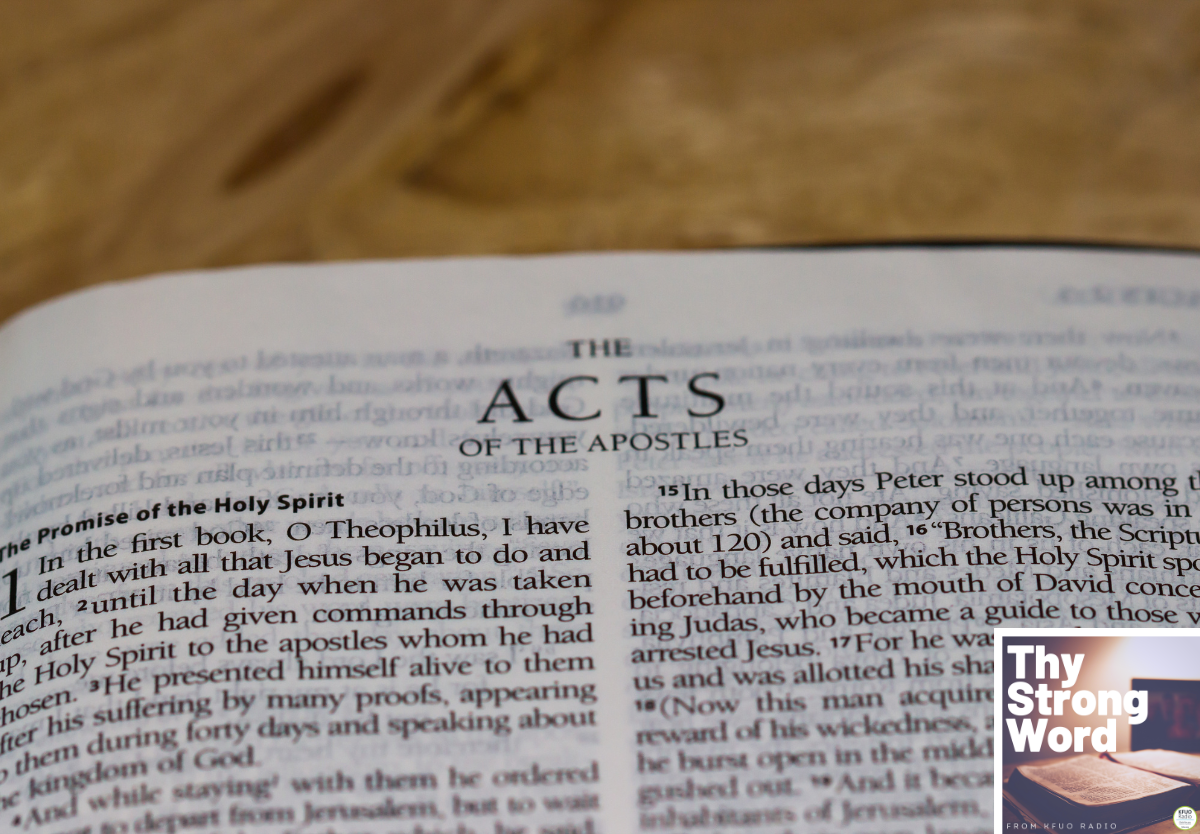
Thy Strong Word — NEW STUDY: The Book of Acts
Jun 17Tap to summarizehttps://kfuo-od.streamguys1.com/recast/thy-strong-word/20260618161453-TSW_ACTSPROMO_2026.mp3Download Audio File The book of Acts picks up where the Gospels leave off. Jesus has risen. He has ascended. And now what? Acts answers that question. Luke tells the story of how the Holy Spirit built the Church from a handful of frightened disciples in Jerusalem into a movement that reached Rome itself. Along the way, you get Pentecost, the first sermons, the first martyrs, the conversion of Paul, the first church councils, shipwrecks, riots, and the persistent, stubborn work of God through Word and Sacrament even when His people didn’t have a plan. If you’ve ever wondered how we got from Easter morning to the Church you sit in today, this is the book. Tune in for this new series on Thy Strong Word with Pastor Phil Booe and guest pastors as we open up the Book of Acts. Thy Strong Word, hosted by Rev. Dr. Phil Booe, pastor of St. John Lutheran Church of Luverne, MN, reveals the light of our salvation in Christ through study of God’s Word, breaking our darkness with His redeeming light. Each weekday, two pastors fix our eyes on Jesus by considering Holy Scripture, verse by verse, in order to be strengthened in the Word and be equipped to faithfully serve in our daily vocations. Submit comments or questions to: thystrongword@kfuo.org. Thy Strong Word is graciously underwritten by the Lutheran Heritage Foundation. Through the mission gifts of people like you, LHF translates, publishes, distributes and introduces books that are Bible-based, Christ-centered and Reformation-driven. Learn more at lhfmissions.org.
Transcribe →