Loading summary
Transcript82 lines
- [00:00]
Grainger Announcer
If you work in university maintenance, Grainger considers you an MVP because your playbook ensures your arena is always ready for tip off. And Grainger is your trusted partner, offering the products you need all in one place, from H Vac and plumbing supplies to lighting and more, and all delivered with plenty of time left on the clock so your team always gets the win. Call 1-800-GRAINGER visit grainger.com or just stop by Granger for the ones who get it done.
- [00:32]
Charlie Sykes
Acast powers the World's Best Podcasts Here's a show that we recommend.
- [00:40]
Liv Albert
The world of ancient Greek myth and the wider history of the Mediterranean is and always will be incredibly relevant. Whether you have a casual interest in myth or are a dyed in the wool nerd for the ancient world, you will find your fix with let's Talk About Myths Baby. I'm Liv Albert and together with my amazing producer Mikayla Penguish, we bring the context, intricacies and the stories of ancient Greece and sometimes the wider Mediterranean to life. Let's Talk About Myths Baby has something for everyone. Listen to let's Talk About Myths Baby wherever you get your podcasts, new episodes every Tuesday and Friday or or find
- [01:20]
Justin Wolfers
more information@mythsbaby.com Acast helps creators launch, grow
- [01:27]
Charlie Sykes
and monetize their podcasts everywhere.
- [01:30]
Justin Wolfers
Acast.com
- [01:34]
Charlie Sykes
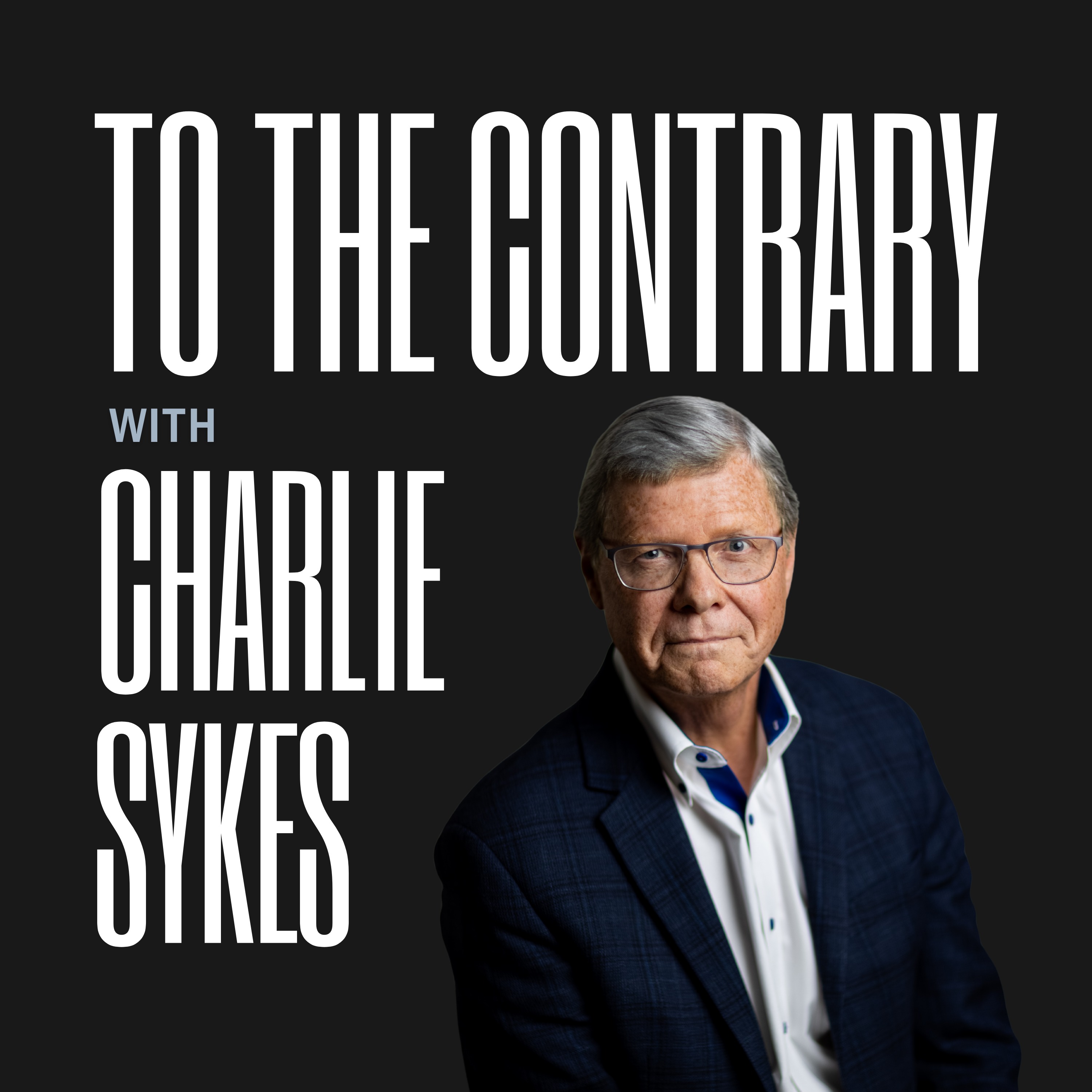
I'm Charlie Sykes. Welcome to the to the Contrary podcast. This weekend the Washington press corps is holding its capitulation dinner with Donald Trump and I'm gonna spare you a rant. You can find my rants elsewhere. But of course, you know all the media folks get all dressed up and they go to parties and they hang out with Ste. Stephen Miller and Peter Hegseth. And check out my newsletter yesterday about Barry Weiss's fanciest grovel. Meanwhile, some updates on our grifted age. Even the fail sons are cashing in. You probably saw this story. Eric Trump backed robot startup lands $24 million Pentagon deal. Imagine Eric Trump. Eric Trump is very, very jazzed about getting a Pentagon deal. And pure merit, I'm sure. Now the prediction markets. The Department of Justice has arrested a soldier who made $400,000 betting on Maduro's removal. He actually was a special ops soldier and he figured I know exactly what's about to happen. My prediction is you're going to see a lot more of this. Meanwhile, Donald Trump is floating more bailouts, including of Spirit Airlines. We're going to get into all of that and I feel the need to mention this today. Cyan, our stable genius president, may not be I Don't know that things may not be going that well. You might have missed. Early Friday morning, he posted that if the Southern Poverty Law center charges go through, which, by the way, have nothing to do with the 2020 election, if it is true, he writes, this is the President of the United States. The 2020 presidential election should, should be permanently wiped from the books and be of no further force or effect. Thank you for your attention to this matter. President DONALD J. Trump. Okay, so here's the president taking time out from everything else to basically say that we should retroactively just pretend the 2020 election, which he lost, should be wiped from the books. What could possibly go wrong? All right, joining us this weekend to make sense of it all, our friend Justin Wilfers, economist from the University of Michigan. Justin, you will make it all make sense, right?
- [03:55]
Justin Wolfers
Well, that was just quite the lead, Charlie. Like, I didn't really know how crazy the world was until you just explained it to me slowly. And it wasn't just one thing. It was boom, boom, boom, boom, boom, boom, boom. I mean, you're an artist as you stitch it all together. But, Charlie, I want to come back. The White House Correspondent's Dinner. Now, did you used to go to that?
- [04:18]
Charlie Sykes
Never. I'm a Wisconsin guy. I never get invited to any parties. Anyway, this whole bit of you're never a Trumper because you wanted to get invited to these Georgetown parties. Never once. Not once, Zip.
- [04:29]
Justin Wolfers
Charlie, I've got a thought. You know, those of us who are independent media, maybe you and I could don a tux and just zoom for a little together, you know, and just talk about the world and we'll call it the Not White House, Not Correspondence, Not Dinner.
- [04:48]
Charlie Sykes
That would be a good idea. I love the way the. Now you're, see, you're poking the bear because, you know, the White House correspondents, you know, they, they know this is embarrassing, that they're going to sit down and honor Donald Trump, that, that Stephen Miller is going to be there and Peter Hegseth is going to be there, and they're trying to put like, you know, lipstick on this particular pig, you know, the, the tote bags and everything. But I mean, it cringeworthy. And I just, I just, you know, Sunday morning we're gonna wake up and see all of the, these, these folks sitting there and trying to find some way to rationalize it. But I'm sorry, I feel I'm burnt out on this particular subject.
- [05:31]
Justin Wolfers
About 50% of the Trump cabinet will have a wicked hangover, according to recent press reports. Charlie Maybe you and I can do it real Midwestern style. We'll have a casserole.
- [05:42]
Charlie Sykes
Yeah, we can bring a casserole.
- [05:44]
Justin Wolfers
Non alcoholic beers.
- [05:47]
Charlie Sykes
There would definitely have to be alcoholic beers. I'm sorry, if we're wearing tuxes, I'm gonna have to have cognac. I mean, do you know what time it is? Do you know what the times require? Okay, so I want to get your take on the spirit bailout, whether the markets in fact have decided to price in Donald Trump's bullshit and everything. But let's start with this because we have a new no to head the Federal Reserve, Kevin Warsh. Obviously, this is one of Donald Trump's obsessions. He is, you know, pushing the criminal prosecution of the current Chairman Jerome Powell for something that nobody quite understands. And of course, the big question is, is Kevin Warsh going to be just a Trump toady? Will he do Donald Trump's bidding? And he went before the Senate and there was very, very contentious back and forth between Elizabeth Warren, who asked him some, you know, tough questions, like, you know, are you really a tough guy? Can you name anything that you've ever disagreed with with Donald Trump? Let's just play a little bit of this because it gives you a little bit of a flavor. And again, it's a little bit contentious. But listen to Kevin Warsh, the next chair of the Federal Reserve, in theory. Listen to his answers. Non answers here. Let's play that.
- [07:05]
Liv Albert
Let's check out your independence and your courage. We'll start easy. Mr. Warsh, did Donald Trump lose the 2020 election? We try to keep politics, if I'm confirmed out of the federal. I'm just asking a factual question. I need to know. I need to measure your independence and your courage. Senator, I believe that this body certified that election many years ago. That's not the question I'm asking. I'm asking, did Donald Trump lose in 2020? And I'm suggesting you in 2020. The Fed mandates of that. Your huge inflation problem. And you certified the election. So let me ask another. Out of monetary policy in our meeting. Monetary policy out of politics. Independent. Because you're, quote, a tough guy. Those were your words, tough guy. And you will be able to stand up to President Trice Trump. So let's try it again. Name one aspect of President Trump's economic agenda with which you disagree. Well, Senator, the Federal Reserve in recent years has wandered outside of its remit, wandered into. I'm asking for something that's not something Trump on. If I'm confirmed, the Federal Reserve should stay in its lane. Just one. Just one little place where you disagree with Donald. Well, I do have a disagreement, actually, Senator, with the President. I think even this morning he said that he thought I was out of central casting. I think central casting, I'd look older, grayer, and maybe show up here with a cigar of sorts. Quite adorable.
- [08:34]
Charlie Sykes
All right, Justin, you were watching that. Your thoughts about next Fed chair Kevin Warsh? Stand up guy. Were you impressed?
- [08:44]
Justin Wolfers
I had to go through maybe the seven stages, mate. I was outraged and angry at first, and then I come in sadness that this is where we are. And then, you know, the third stage when you're an economist is actually analytics, and I want to analyze it. So, look, let's talk about what he just said, because I think it's one of the most disappointing things and arguably disqualifying on its face. Walsh talks a lot about the idea of Fed independence. Let's just get on the table what that is. This is not about political point scoring. This is about getting the economics right. Fed independence. Here's the problem it's trying to solve. The problem is politicians like to get reelected. So just before an election, they like to juice the economy that serves their best interests, but not the best interests of the American people helps them get reelected. And then the day after, we, the American people, bear the hangover, which would be if you've juiced the economy for no reason, often that causes an inflationary surge. So that sounds like a bad cycle to be in. It's actually a step worse than that if people understand that politicians have an incentive to juice the economy. And if inflation expectations are one of the most important determinants of inflation, and they are, then my expectation that you're going to juice the economy actually is enough that I start to expect inflation, which actually creates the next level, which creates the reality of higher inflation. And that's why studies have shown that countries that don't have independent central banks tend to have higher inflation. So what do we want to do? Well, what we want to do is we want to create monetary policy, interest rates that is set in the best interest of the American people rather than that of the President, the President's political interests. That's what independence means. So it has to be that when the president wants something from you and he says if you don't do what I want, it will hurt my feelings that you say to yourself, there are more important things to me than. Than your feelings, Mr. President, I'm going to do the job Congress gave me in that clip. Elizabeth Warren asked him, who won the 2020 election? Not a hard question. I'm going to come back to folks who think it's a gotcha, but I just want to point out, not a hard question. Right. Joe Biden won the 2020 election. He responded in a way that basically said, I don't want to hurt the President's feelings. Well, if he does that at a point where he's already got the nomination, what's he gonna do when the President says, you know, I want a little bit of juice before the next election? He has shown that when there are small stakes, he doesn't want to hurt the President's feelings rather than do the right thing, which is to.
- [11:39]
Charlie Sykes
It's a tell, isn't it? That really is a tell.
- [11:43]
Justin Wolfers
It's the whole game. The whole question of Fed independence is, do you care about doing the right thing or not hurting the President's feelings? And Walsh didn't care, didn't want to hurt the President's feelings. Now, look, there's a school of thought, and I have some sympathy, which is, look, this was a totally unfair. Gotcha. Everyone understands we're now in an Animal Farm world where you have to say, two legs good, four legs bad. And instead, what you have to say is, 2020 election bad. But Walsh can tell the truth on other things, important things, economics. And so the second beat of Elizabeth Warren's question was, can you name one thing you disagree with the President on? And the only thing Handsome Kevin could disagree with the President on is that the President thinks he's handsome. And Kevin's not sure how handsome.
- [12:38]
Charlie Sykes
He. He is very handsome.
- [12:41]
Justin Wolfers
Very handsome. Now, go a step further. Remember, this is a president who is on the record as calling for interest rates right now, as saying interest rates should be close to zero right now. There is not a human being on earth who thinks that's an appropriate stance for monetary policy. The president said maybe 1% interest rate. Even Steven Moran, his own guy, Trump toady number one. The guy who walks into Fed meetings with a big foam hand that says Trump number one, even he votes for 3% interest rates. So this was an opportunity for him to say, I am not going to deliver a 1% interest rate, which everyone understands would be absurd. And he couldn't even do that. So, look, I'm rambling. No, I'm not. I'm angry.
- [13:30]
Charlie Sykes
No, you're basically making the case that he's a toady.
- [13:34]
Justin Wolfers
I'm doing more than that. I'm making the case that this particular form of toady standard Economics tells us there's a particular form of toady that is unsuited for the job. And Walsh had a chance to prove he's not that guy, and instead he proved he is that guy. So it's not just, look, I don't like suck ups, but that's not the point. You can be a suck up, you can be an inflation hawk, you can be a dove, you can be tall, you can be short. But the standard economic theory that tells us we want Fed independence says independence means you're willing to tell hard truths and to follow the data where it leads you. If you can't follow the 2020 election returns to where it leads you, you fail that test.
- [14:28]
Charlie Sykes
Well, also, you know, just going back, we need to put this in context about the attack on the independence of the Fed. And apparently even the Supreme Court seems to understand the importance of the independence of the Fed. The markets clearly understand the independence of the Fed. Donald Trump is not just challenging the independence of the Fed. The criminal charges against Jerome Powell, which had been thrown out by a federal judge, clearly is an escalation, basically saying if you do not do my bidding, if we have a disagreement about interest rate policy, I am not just simply going to jawbone you or criticize you or call you names and social, you know, truth, social post, I'm going to sic the Department of Justice on you and potentially arrest and indict you. Which strikes me as, I mean, Thom Tillis, for all of his faults, seems to understand that this is a red line. He is, of course, the senator who's saying he's gonna vote against Kevin Warsh unless the Jerome Powell investigation is completely dropped. But this is, I think, object speaking, the most aggressive attack on the independence of the Fed that we have ever seen in American history, in recent American history.
- [15:35]
Justin Wolfers
I'm a very bad historian, so I'm just going to say in my lifetime, if I may.
- [15:40]
Charlie Sykes
Yeah, that's fair, but it's.
- [15:42]
Justin Wolfers
No, no, look, threatening to jail the Fed chief, I'm sure is the worst we've seen in our history. It is not the worst we've seen in the world. We've seen other countries do this. We've seen Russia do it in Zimbabwe and Turkey and Argentina.
- [15:56]
Charlie Sykes
It hasn't worked out well for them. I mean, those are not great role models for stable economies or currency whose
- [16:05]
Justin Wolfers
economies whose currencies, whose inflation records have been destroyed at various points by bouts of hyperinflation. So there's not a serious, what the President has done is not something that would happen in any serious industrialized country and is a true mark of tinpot dictatorship. And again, the point I want to make to folks at home is not I'm a guy on a podcast having a wine that offends my sensibilities. It's that this undermines the future path of it. It undermines the likelihood that we continue to be a low inflation country. It undermines the economy, it undermines your prosperity and that for your children. So I'm not just outraged, I am. Can I spend a moment on outrage? Sure. How fucking spineless do you have to be? How utterly without grace? How. I have some understanding of the role of economists in public life. And our role is always to be devoted to the truth. And people disagree with me, but they're sincere disagreements. I've never once lied in public about how the economy works. What I believe, what I think should happen, no serious economist does. Our job is to investigate the truth, uncover the truth, and give bold and fearless advice. And I'm proud to be an economist. Not everyone is. People think we're kind of nerdy, we're awful, we're ugly, whatever, that's all true. But it's a noble profession where we're dedicated to trying to make the world a better place. And if you can't stand up in public and state simple truths and simple foundational truths, truths that are foundational to our democracy, like who won an election? You don't belong in any club I want to be a member of. You do not deserve to be called an economist. And you don't deserve any damn respect from any of us. Sorry, I was cranky.
- [18:15]
Charlie Sykes
No, we should be cranky like that pretty much every day. Okay, so this is also what I want you to try to make sense of, and we've talked about this before, what the markets are doing. The war in Iran has not stopped. The Strait of Hormuz is either open or closed. It certainly seems like it is somewhat closed. Oil futures are up, the cost of living is up, consumer confidence is really in the tank. And yet the stock market seems to be still pretty jiggy with this. They feel copacetic with this. Is it simply because they've priced in Donald Trump's bullshit that they've sort of just kind of figured out that, you know, he's not gonna wipe civilization off the map? So that's good. This is good news. We actually have not had Armageddon. So, hey, happy days are here again. So give me some sense, what appears to be real cognitive dissonance, especially as the public continues to sour on the economy. But the stock market continues to be somewhat buoyed. Explain if you can.
- [19:25]
Justin Wolfers
So let me just point out that the claim that the stock market is happy right now is a claim that needs one more data point. See, the thing is, we know what the stock market looks like today, but what you and I would like to do is compare it to what it would look like if we didn't have this madness and that index isn't traded. And so we're implicitly just using one data point to make a comparison that requires two. Maybe I'm sounding a little bit too much like a university professor there.
- [19:55]
Charlie Sykes
No, no, this is interesting.
- [19:57]
Justin Wolfers
Let me try and say it another way. If the question that you want to ask is, are markets comfortable with war? Looking at the level of the market isn't enough. So essentially what you want to do is compare if we do have war, if we don't have war, and see what's different. Well, one way of doing that. So you can't just look at the level of the stock market. That's what most people in the news media have been doing. One way of comparing it is to say, well, let's look at the level of the stock market just before we lean into war and just after. Now we're comparing what does the market think in a state of nature where war is less on the agenda or we're leading into it less versus when we're leaning into it more. And if we do that over a very short time horizon, there's also not other things going on, like an AI boom and all the other things that happen in the world. If you do that sort of an exercise, you look at every time the US has escalated and just look at what happens 10 minutes before compared to 10 minutes after. Every time we've escalated, stocks have fallen dramatically. Every time we've de. Escalated, stocks have risen dramatically. What that tells you then is the stock market hates what's going on right now in the Middle East. The stock market thinks this fundamentally undermines the future value of American businesses. So when you say the stock market's comfortable with this. No, it's not the stock market. I guarantee you the stock market would be a whole heck of a lot higher if we'd never gone in. And higher still. Well, not high still. Sorry. And it would also be higher if they just give the whole game up, hug it out and get on with business. I understand. In saying that we're pushing aside a whole lot of very, very important issues, the dignity, freedom, basic rights of the Iranian people, by some measure the reason we went in. And I don't want to dismiss any of that for a moment, but if those are not the issues that are on the table, if this is somehow a claim that this is good for America, blah, blah, blah, blah, blah. It appears that financial markets deeply disagree.
- [21:54]
Charlie Sykes
So let's talk for a moment about the distortion in the markets. We've had these reports of insider trad where moments before announcement is made, we suddenly have these mysterious purchases of oil futures. How does that kind of market distortion affect the overall situation? Because clearly it does feel at the moment that the markets at least partially are rigged for the benefit of certain cronies and insiders. How does that distort the operation of a free market?
- [22:32]
Justin Wolfers
This is an issue where I'm not going to buy it very hard, which may upset some of your listeners. I am not. So a common liberal talking point right now is they're manipulating the hell out of the markets and what's going on is Don, Don is buying the night before and selling the night after. Could be happening. You know what else could be not happening? The quality of the evidence that Trump insiders are involved in trading on this information is extraordinarily low. Now, there are a few exceptions to that. There was, I think you said in the intro, a soldier caught list the prediction markets winning $400,000 on prediction markets. And there's a few actually very specific cases like that. They're almost all prediction market cases. I think what's going on is it's very difficult for any of us to make sense of the President's actions. He's for the war, he's against the war. He's for the trade war, against the trade war. It's creating enormous volatility in financial markets, as it should because the stakes are high. And the President seems to be changing his mind for many folks, they want to try and make sense of that. One view is he's just not very good at presidenting. A different view is he's doing this because of some profit opportunity. I can see the attraction of that view. I just don't think the evidence in favor of it is currently very strong.
- [23:58]
Charlie Sykes
I think it was those 15 minute bursts right before the truth social things came out that I think, you know, got that going. Look, if you're like me, you're thinking a lot more about what you wear day to day and are looking for pieces that feel easy, comfortable and still look put together. It just makes getting dressed simpler. Quince has been my go to their fabrics feel elevated, their fits are clean and everything just works without needing to overthink it. And I definitely do not want to overthink what I wear every day. I actually bought two of their pullovers, one dark colored, one gray color. And they're just amazing. I mean, they're comfortable, they fit perfectly well. The quality really kind of surprised me. It's been on constant rotation. In fact, if you watch the podcast on YouTube or my live streams, you'll often see me wearing one of them. And those are Quint's pullovers. So refresh your everyday with luxury. You will actually use head to quince.com contrary for free shipping on your order and 365 day returns. Now available in Canada too. That's Q-U-I-N-C-E.com contrary for free shipping and 365 day returns. Quince.com contrary.
- [25:15]
Grainger Announcer
If you work in university maintenance, Grainger considers you an MVP because your playbook ensures your arena is always ready for tip off. And Grainger is your trusted partner, offering the products you need all in one place, from H vac and plumbing supplies to lighting and more. And all delivered with plenty of time left on the clock. So your team always gets the win. Call 1-800-GRAINGER visit grainger.com or just stop by Granger for the ones who get it done.
- [25:48]
Charlie Sykes
So let's just pull back a little bit about. I mean, so the markets may still be hovering around 50,000. Obviously hate the war, think that it's going to be resolved in some positive way. But public opinion has turned very, very sour on the economy. And this is one of the things that I think the Biden administration learned is you can't talk people out of lived experience. You can't just show them a whiteboard. But let me just show you this latest Fox News poll because I think there's a very, very revealing number. It's more political than economic. Again, this is the Fox News poll. 57% of the respondents think that Donald Trump does not have the judgment to be president. 60% think that Donald Trump does not have the temperament to be president. 55% do not believe he has the mental soundness to be president. Which are, I mean, kind of stunning numbers. But, but this is the one that I wanted to focus on because this, I think, is the most devastating finding about, for, for, for Trump. Do you think Donald Trump cares about people like you or not? And this is something that I think that he rode into the White House in 2024. Do you think that Donald Trump cares about people like you or not. Only 37% say he does. 63% of the respondents think that Donald Trump does not care about people like you. From a political point of view, this is just absolutely devastating because, remember, he ran that campaign. I'm for you. I am the voice of the forgotten American. And I think the optics of some of the grift that we talk about, maybe the optics of the ballroom and the arch and all of this stuff, and the various cronies that he's hanging around with, it was really kind of landing with people who are going, wait, why are you concerned about this? Why have you launched this war in Iran, the Middle East? Why are you bailing out, you know, some of your cronies here when I can't afford to fill my car up with gas or go to the grocery store? So just in terms of where economics intersects with politics, that I think is one of the most devastating numbers that I've seen in a poll, and it's the Fox News poll that, you know, people want to think that the economy works for them. Right? You work hard, you play by the rules, and things work out for you. People are looking at this economy, and that is not their reaction. Justin?
- [28:09]
Justin Wolfers
Yeah, some of those numbers were striking. And I think that you and I can agree, Charlie, it has to be the case that what we're learning here is that men are too emotional to be present.
- [28:23]
Charlie Sykes
Yeah, I think that must be the case.
- [28:27]
Justin Wolfers
Hormones, an inability to pay attention.
- [28:31]
Charlie Sykes
Can you imagine if this was a woman, by the way? Can you imagine if a woman was behaving in this way? Imagine what the commentary would be.
- [28:39]
Justin Wolfers
Yeah, I have a funny feeling that Barack Obama might ask himself that fairly often after he wore a tan suit. I do think the feeling that the economy is working for you is important. It's important politically, but it's also at some level important economically. If I don't think that there are rules, if I don't think that if I work hard, I get ahead, then I don't work hard. And I want to share with you a moment that I had. I'm not going to admit anything illegal. I might hint at it, but I bet thousands of people around the country had. It was April 15 and my taxes were due. And I'm thinking about, should I take this extra deduction? I'm not really sure I have all the receipts. And then I thought, you know, if there's one thing I've learned, there's a guy in the White House who's paid zero taxes and as far as ProPublica, New York Times and others have been able to figure out, has clearly violated our tax laws over and over and over again and paid no penalty. And it feels like this whole system, which underneath it all, we would like to believe the tax system is based on checks and balances and they have all the data they need, but at the end of the day, runs on trust and telling the truth. And it turns out if you're willing to lie, you get to keep more of your money and the government doesn't get it and they're not going to come after you and they're not going to get you, despite what your mum told you. I thought to myself, should I, what should I do? I bet millions of people had that thought.
- [30:27]
Charlie Sykes
Oh, absolutely.
- [30:29]
Justin Wolfers
Do you recognize any of that? Charlie did it.
- [30:33]
Charlie Sykes
I could not possibly say. Actually, I filed an extension on my taxes. So that's something that's going to be in the future. There was once a time when, and I think that Donald Trump, at some level, for years, did not want people to know that he didn't pay anything in taxes. And because there was a time when people would have been outraged about that, you know, that only little people pay taxes. And once again, Donald Trump has managed to, you know, at least in his world, normalize it. But I don't think it totally normalized. And I guess the point about the poll number showing that he doesn't care about average people, as I, and I've said this before, I think that Donald Trump, in the past, I've given him credit for kind of a reptilian instinct about what the public mood is. He seems increasingly tone deaf. And he's also surrounded himself with people who are increasingly tone deaf when he goes down to Mar A Lago, you know, I mean, first of all, you think that Donald Trump has ever put gas in his own car ever in his entire life? That's number one. Think Donald Trump has ever gone to a grocery store himself. And the thing is that when he goes down to Mar A Lago or sits around with his billionaire cabinet, he may be in a room with people, none of whom have ever done any of that stuff, have never mowed their own lawn, have never done any of these things. And so when they talk about the economy, there is a disconnect that is, I think, coming home to. Coming home to roost here for him. And I think it makes it harder and harder. Okay, so speaking of economics, under Donald Trump, I'm old enough to remember.
- [32:07]
Justin Wolfers
Yeah, I like that point. So one by the way I'm basically sick of being run by millionaires and billionaires. And I do think there are deep, important questions whether people worth hundreds of millions of dollars can empathize and understand economic challenges. I'm not saying it's impossible. It requires a serious moral compass. But it's not just that. I've sometimes thought and I. Two thirds joking and one third serious, we shouldn't allow billionaires in government. And it's actually not the issues you're talking about. It's not that they don't go to the store and they don't pump their own gas. It's actually something different. If you've ever met any of these guys, and I know that you have, Charlie, but many of our audience have not, they walk around in a bubble where everyone tells them they're right all the time. Because when you got that much money, there's so many grifters who want a handout, who want a big tip, who want to be employed, who want a promotion, and they literally just never hear the word no. They never get told they're wrong. I will say one of the most profoundly grounding experiences of my life is being a dad. I have little people who love to tell me that I'm wrong. Fortunately, I'm also not a billionaire. But it ought to give one pause as one is thinking about fitness for higher office, whether the person you're looking at voting for, and this is not a statement about Trump, it's far more general, whether they actually have the ability to. To be told, to hear and believe that they can be wrong about things.
- [33:45]
Charlie Sykes
I think this is a very, very important point because not only do they never hear no, but because they are billionaires, they develop the belief that they have great wisdom in all kinds of fields that they know nothing about. You actually see that sort of in a cartoon way with Donald Trump, that nobody knows medicine like me. Nobody is a bigger expert on nuclear weapons than me. And you hang around with these people after a while, and they may have. They may have made their billions of dollars by selling guacamole, but now, because they're a billionaire, they are an expert in interstellar travel, they are an expert in immigration, they're an expert in all of these things, and no one's going to tell them, yeah, maybe you ought to stick with the guacamole. Just simply because you're rich and you got the trophy wife and the big house and all that stuff and you fly around your Gulf Stream jet does not mean that you're really as Smart, as everyone tells you. Okay. Speaking of flying around, I am old enough to remember when conservatives actually didn't like the idea of government owning private business. Donald Trump is now talking about bailing out Spirit Airlines. Taking a government ownership. Apparently in the last 24 hours, he said, yes, we're going to take it and then we're going to sell it for profit. So just give me your sense about this weird world of a free market president, allegedly, who will save this company, but not this company. Where are we going with the Spirit bailout?
- [35:17]
Justin Wolfers
Yeah, well, I mean, fortunately, this is a president who has a lot of experience. He ran Trump Airlines
- [35:24]
Charlie Sykes
into the ground.
- [35:26]
Justin Wolfers
And I think probably the next thing the US Government should do is maybe buy an XFL team, maybe sell some stakes as well. I think it'd be terrific. Look, Charlie, I think this conversation's more interesting if you and I lay some cards out on the table for your audience just to show the span of opinion between the two of us. So I think I normally identify as sort of a center left Democrat. I'm guessing you would identify as a Reagan Republican. Do you want to speak for yourself?
- [35:54]
Charlie Sykes
No, that's done. But I would say center right. More and more skeptical of the ability of government to pick the winners and losers. I guess so. I'll cop to center right.
- [36:06]
Justin Wolfers
Okay. And so I think you and I would argue then that between us, we span 80% of the political spectrum, which makes our robust agreement more interesting. Right. I'm not just Charlie's mate, I'm actually Charlie's enemy on this. Yeah, but I agree with you. So the first thing is, why are we bailing out Spirit? There are times and places where whole industries go south or the financial system would have malfunctioned. Where you think markets can't do the job markets are meant to do. That's usually when whole economies or whole sectors go down the chips. We're not in one of those moments. This is one airline going south. And so under what conditions does the US Government end up buying a stake? It's under the conditions when the US Private, when the global private sector doesn't want to buy Spirit, we only. The American taxpayer only gets to buy the companies that every private sector firm has thought to themselves. Not profitable. I'm staying out. If that's the conditions under which we're coming in, I'm saying no thanks. Look, I really want the low cost airline sector to thrive and survive. I think we should regulate it appropriately. I think we want to do everything we can to ensure this competition in the sector. But the idea that the federal government is a good stock picker, which is what we'd be doing, doesn't make any sense. If we were to become a good stock picker, there are such a thing as sovereign wealth funds, then you would want to sit down and think hard. How would we do it? How would we structure it? How would we hire the best and brightest? How would we make sure we're buying the best stocks rather than those that help the President get reelected? How would we respect the taxpayers money? Instead what we have is a bloke behind a desk chewing on a pen, a Sharpie saying, how about that one? We'll buy that company. Which doesn't seem like optimal portfolio allocation.
- [38:08]
Charlie Sykes
No, I would say that is not optimal at all. And Donald Trump's instincts are the thing about going back to our talk about billionaire, that Donald Trump still thinks that he is this brilliant art of the deal businessman, despite the fact that clearly he's a really shitty negotiator. And as we've sort of alluded to, he has crashed one business after another. I mean, it is not easy to go broke running a casino. I mean, isn't a casino sort of by definition something where you can't actually lose any money because it's always rigged for the housing? Donald Trump has managed to tank one business after another and yet continues to be regarded as this brilliant businessman by millions of people and of course by Donald Trump himself. And I think that's one of those moments of real cognitive dissonance, isn't it really? That you know, that he has this infinite confidence in his ability to do this despite, I mean, if I'd gone bankrupt that time, you know, that many times, I would have a self esteem issue. I would have a confidence issue. Not a problem for Donald Trump, is it? Yes, yes, yes. Okay, so I, I am, I'm reluctant to get into this because I know absolutely nothing about it. And I suspect that most people know absolutely nothing about the private credit market. And yet I have this, this, this inkling that six from six months from now, we will all be experts in it, we will all have deep thoughts about the private credit markets because something might go wrong. So I see that you have been talking about it. Keeping in mind that I know absolutely nothing about the issue. Can you give me just the short version of whether we have a problem there? Because there's a lot of concern that the private credit market might go bust and that that might be the thread that unravels everything else. So where are we at on that. Give me the short five minute education.
- [40:08]
Justin Wolfers
Yeah, I love and appreciate the question. And it shows that you've been doing something that I'm particularly grateful for, which is Charlie tuned into my YouTube channel. So one of the things I like to do as an economist is teach the world economics. And what I did is basically realized private credit is a big thing. Most commentators lack language, framework, anything for thinking about it. And so I made the world's wonkiest 20 minute explainer. And maybe a producer can put it in the notes to the show or something so people can see it. Let me now go ahead and give you the far shorter version. So look, if you're running the business, it used to be what you do is if you want to expand, you go to the bank. If you're a small business, if you're a big business, what you do is you issue bonds, that's the bond market. If you're a middle sized business, it sometimes got hard because you'd want more money than the bank manager would want to give you, but you're too small for the bond market. And so what's risen is something that people call private credit, which is basically go to a bunch of blokes and say, hey, could I borrow $100 million? And they have a look at your business. Who's going to be successful in this? It's going to be the sorts of businesses that struggled with banks. That's often businesses that don't have a lot of physical collateral because banks are used to looking for machines and stuff that has value. It's actually been really successful among software companies where the only thing they own is zeros and ones. So the banks didn't want to touch them, but they go to some Wall street guys and say, hey, can we just borrow some money directly from you?
- [41:44]
Charlie Sykes
I'm hearing risky.
- [41:46]
Justin Wolfers
Well, let's be. So this is where it's really important to be thoughtful about this. So I say, can I borrow some money directly from you? And we work out terms where you understand my needs, I understand your needs, we write a contract, all of that. So in some sense private credit is doing the job that banks do, that you sit down, you've got a relationship, they're a little bit more nimble, a little bit more flexible, but they're not regulated like banks. Now that's why Charlie's like, oh, ow. If you're not regulated by like banks, you'd call you a shadow bank. And if you remember 2008, the thing about banks, we have lots of regulations to Prevent bank runs. And in 2008, we had a lot of shadow banks that weren't regulated. They had bank runs that caused a financial crisis that spread around the world. So is private credit going to cause bank runs and the next financial crisis? Let me give you the answer for no, and then I'll give you the answer for yes, because that's how economists roll. The answer for no is if a very serious company says, what I'm going to do is I'm going to lend you money for five years, and I understand I'm not getting my money back for five years, then that's just a deal between two consenting adults. Fine. What causes bank runs is what economists call maturity transformation. But the issue is, I put my money in the bank, but I reserve the right to pull it out the next day. But the bank doesn't just put my money in the safe. It lends it to someone for 10, 20 years. If a whole lot of people want to get their money, the money's not in the safe and the bank collapses. So bank runs occur when people can pull their money out at short notice, even though it's being lent for long periods. Short, long. That's maturity transformation done right. Private credit doesn't involve maturity transformation. I say I'm going to lend it to you for 10 years. Give it back to me in 10 years. Done wrong. I lend it to you for 10 years. But maybe every month or so I can ask for some money back. If you allow that. Now we're in the world of bankruptcy. What's happening with private credit is we're starting to see movement towards this maturity transformation, which is to say these loans become the sort of loans that could cause a bank run problem number one. Problem number two, this is most successful for the sorts of companies that don't have a lot of physical assets. That's software. Guess what AI is destroying right now.
- [44:10]
Charlie Sykes
Right.
- [44:11]
Justin Wolfers
And so a lot of these loans are the companies that may not be able to pay back. And problem number three, it's okay for you and I for you to lend me money or me to lend you money. Charlie, we're arm's length, we're consenting adults. It's good. But if you turn out to be tightly connected to the banking system so that my failure to repay you cascades into the financial system, now we're getting into trouble, and we're starting to see some linkages between private credit and the rest of the financial system. The analogy I use in the video is it's like water and plumbing Water has so many ways of creating trouble, and it's always looking for the weakest spot. Well, so does money in the financial system. And so when we're in under regulated areas, that's when you start to worry about leaks and plumbing problems.
- [45:01]
Charlie Sykes
So how worried should we be? What should our level of anxiety? Is there an index of anxiety that you would have the Wolfer index if it was 1 to 100. 100 being our hair should be on fire. Where should we be here on the private credit.
- [45:16]
Justin Wolfers
So if I said on a 1 to 10 scale, I'm worried at a 6, I'm going to sound foolish when a couple of private credit deals go south. But they're going to happen. But that's not necessarily a problem. If I lend you money and you don't repay me, that sucks for me. But if it doesn't cause broader macroeconomic problems, that's the risk I took. So we're going to see those stories. I guarantee it. What I am currently less worried about is whether that's going to cause substantial, widespread macroeconomic problems. But the reason we're up to a six is if this keeps evolving the way it's evolving or, and this is the other part of it. We've never seen a deep recession and a big private credit market because the private credit market's new. So we don't know that it's as bulletproof as we want it to be. So somewhat worried, but I really am not hair on fire about it. The point here is, I think I want us to all understand it and be able to talk about it like adults.
- [46:16]
Charlie Sykes
Well, that's what I wanted to do. I just wanted to bookmark it because it was something that, you know, could become incredibly comprehensive, you know, consequential. And I would like to know something about it. It was like, remember back in, in 2008, everybody, you know, had to do this crash course in, you know, credit default swaps and all kinds of things that we had literally never heard about before, you know, five minutes before, and then crash the world economy. Right.
- [46:41]
Justin Wolfers
So. Absolutely. And that's what makes your approach to understanding the news so responsible, Charlie, that we're doing the homework ahead of time. It's the same sense that we're all doing a crash course on choke points in the Strait of Hormuz. The truth is, the Strait of Hormuz was a choke point for years. We shouldn't have been doing the crash course over the past few weeks. In fact, the administration should have understood it. Experts in the field understood it. It's okay for generalists maybe not to be on top of every choke point, but that there are real risks is something that was very knowable. And so I do think it's deeply responsible of you to bring your audience along for the private crime.
- [47:24]
Charlie Sykes
Well, because of course, there are the known unknowns and the consequences that you can predict, and then there are the completely like, surprising consequences. Like, okay, so, I mean, I, and I'll admit that I have not spent more than 10 minutes of my life thinking about the Strait of Hormuz before all of this happened. And now, of course, it dominates everything. And I think there's an understanding of what it might mean for the price of oil. But I have to admit I was taken a little bit surprised by one of the downstream effects. The big story of the last 24 hours. Now, this is going to shake consumer confidence, this is going to have a cultural impact when we find out that this, the closure of the Strait of Hormuz is causing the price of condoms to rise dramatically, that apparently their material costs have gone up. So you're seeing at least one condom manufacturer saying that their prices are going to go by 20 to 30%. Which. Boy. You want to talk about downstream effects, you know what I'm saying? I mean, attacks on fix, that's what
- [48:23]
Justin Wolfers
you're talking about here.
- [48:26]
Charlie Sykes
It is bad. All right, Anything else? We should be keeping an eye out for Justin. I mean, what should we be, what should we be watching in a macro sense, but also like, what are you up to? Just, can you give us a short update?
- [48:40]
Justin Wolfers
Let me tell you what I'm up to. Well, actually, I want to come. I'm going to make one point to you and then I'm going to answer that question. So ask me what are you up to? In a minute. Okay. Yes, you have been very, very clear that we should watch Grift.
- [48:51]
Charlie Sykes
Yes.
- [48:52]
Justin Wolfers
Now, I think grift is less an obviously direct macroeconomic issue, but it's one of outrage, it's one of integrity, it's one that speaks to the form of governance. It's also a very difficult point to make. So I've been thinking hard about this and I think maybe this is the simplest way, but maybe it's not. Barron Trump is worth $150 million. There's only two ways to make sense of this. Either by sheer statistical fluke, the President's 19 year old son is a genius, or there's family grift. They're the only two options I can think about. The likelihood that one man would have a son who was so good that by age 19 he was worth $150 million on the merits. That's got to be 1 in 10 million at least. So I think there's a 1 in 10 million chance that that it's honest, which I think gives me a 9,999,999 in 10 million chance that it's grift. Anyway, now you can ask me what I'm doing.
- [50:12]
Charlie Sykes
Yeah. What are you doing? What are you up to?
- [50:14]
Justin Wolfers
Well, I have a big announcement that's coming on Wednesday. I cannot say too much about it right now, but Charlie, one of the things we do that I love doing with you is teaching the world economics. And I'm going to be taking that a whole lot more seriously awfully soon. And I can't wait till I can talk more about it.
- [50:34]
Charlie Sykes
Well, we'll definitely have to talk about that once you have done this, because I am fascinated and as somebody that constantly needs to be educated, I am very much looking forward to that. Justin Wolfers, thank you so much for your time and your insight today.
- [50:47]
Justin Wolfers
A great joy.
- [50:49]
Charlie Sykes
And thank you all for listening to this episode of to the Contrary podcast. I'm Charlie Sykes. You know why we do this? I say it every single time. Because it is so crucial that as you watch everything that is going on, as you watch the insanity, to remember to remind yourselves that we are not the crazy ones.
- [51:07]
Liv Albert
Thank you.
- [51:18]
Grainger Announcer
If you work in university maintenance, Grainger considers you an MVP because your playbook ensures your arena is always ready for tip off. And Granger is your trusted partner, offering the products you need all in one place. From H Vac and plumbing supplies to lighting and more. And all delivered with plenty of time left on the clock. So you, your team always gets the win. Call 1-800-granger. Visit grainger.com or just stop by Granger for the ones who get it done.
- [51:48]
Charlie Sykes
High interest debt is one of the toughest opponents you'll face unless you power up with a SOFI personal loan. A SOFI personal loan could repackage your bad debt into one low fixed rate monthly payment. It's even got super speed since you could get the funds as soon as a same day you sign. Visit sofi.compower to learn more. That's s o f I.com p-o w e r loans originated by Sofi bank and a member FDIC terms and conditions apply. MLS 696891 Acast powers the world's best podcasts.
- [52:23]
Justin Wolfers
Here's a show that we recommend.
- [52:27]
Liv Albert
Do you want to know the best part about being married to a woman? That there's no man involved. I mean, true, but I was gonna say that it's a sleepover every single night with your best friend. Oh yeah, that part's cute too. I'm Taryn, she's Cami. We're married. And staying up is our weekly pillow talk out loud with you. We're giggling, we're gossiping, we're arguing. Classic marriage stuff. Just having fun being wives while we navigate growing up and building a family together. Then our sleepover grows. Our listeners call the pee pee hotline with their own gossip, burning questions, late night night spirals, all the stuff they'd only tell their best friends. So it's a private sleepover, but you are invited. Staying up with Taryn and Cammie. New episodes weekly follow wherever you listen.
- [53:07]
Charlie Sykes
ACAST helps creators launch, grow and monetize their podcasts everywhere.
- [53:12]
Justin Wolfers
Acast. Com.