← Today, Explained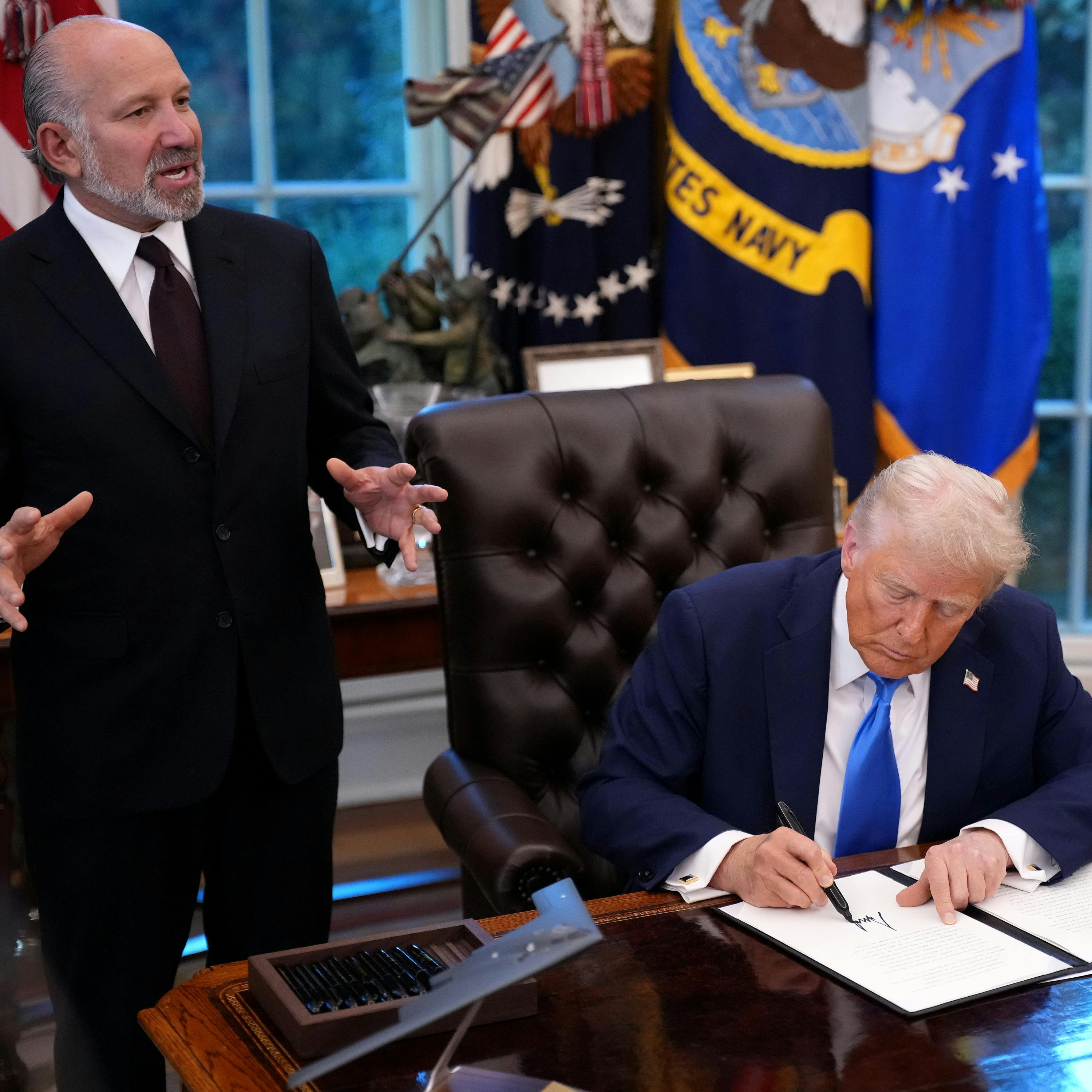
Today, Explained
$100,000 for a visa
00:26:19
With its announcement that an H-1B visa will now cost $100,000, the Trump administration is proving it's willing to wreak havoc on American industry in exchange for a flashy headline.
Loading summary
Transcript81 lines
- [00:01]
Sean Ramaswamy
The President loves to say things. Let's just look at the last week or so. There was a time his teleprompter broke, but he still managed to charm the whole world.
- [00:10]
Doug Limu
I'm really good at this stuff. Your countries are going to hell.
- [00:13]
Sean Ramaswamy
And then you've surely heard that it can only good happen.
- [00:16]
Doug Limu
Nothing bad can happen. It can only good happen.
- [00:18]
Sean Ramaswamy
And that same day he tried to pronounce a big word.
- [00:21]
Doug Limu
Well, let's see how we say that. Acetaminophen. Acetaminophen. Is that okay?
- [00:30]
Sean Ramaswamy
Sure, bud. Unclear what impact a lot of these statements and mispronunciations will have, but recently there was one that could have major implications soon. $100,000 for an H1B visa the country.
- [00:41]
Doug Limu
Would rather not have to pay $100,000, but they'd rather how do you do that? You hire Americans.
- [00:49]
Sean Ramaswamy
That's not how it works. But how does it work? We're going to try and find out on today. Support for the show today comes from Anthropic, the team behind Claude. Today's news moves fast, but the most important stories deserve deeper thinking. Whether you're trying to understand the implications of a policy change or connecting dots across breaking stories, Claude, your new AI collaborator, can help you go beyond the headlines. Claude doesn't just summarize the news. It helps you explore the context, analyze the patterns, and think through what it all means together. Try Claude for free at Claude AI todayexplained this message is brought to you by Apple Card. Each Apple product, like the iPhone, is thoughtfully designed by skilled designers. The Titanium Apple Card is no different. It's laser etched, has no numbers, and it earns you daily cash on everything you buy, including 3% back on everything at Apple. Apply for Apple Card on your iPhone in minutes, subject to credit approval. Apple Card is issued by Goldman Sachs Bank USA Salt Lake City Branch terms and more@applecard.com.
- [02:05]
Britta Glennon
You are listening to TODAY Explained.
- [02:08]
Sean Ramaswamy
Michelle Hackman covers immigration for the Wall Street Journal. That's why we reached out to her to talk about H1B visas.
- [02:15]
Michelle Hackman
The H1B visa is the, I would say the primary visa that people use to come work in this country as foreign professionals. So most often at tech companies in finance and consulting foreign doctors. It's the primary visa foreign doctors use at foreign scientists. A lot of them are on H1B visas. It's also the primary vehicle that foreign students who come and study here are able to stay in the country after they graduate and their student visas expire. It's a three year visa, you can renew it for another three years, and then you eventually can apply for a green card off of it. There are 85,000 of them handed out each year. There are a few extras that go to people, you know, Universities and a few other nonprofit organizations are exempt from that 85,000 cap, but the 85,000 cap applies to all the companies in America. And there are way more applicants for the visa every year than there are actually slots. And so every year they run a lottery to decide who gets the visa.
- [03:18]
Sean Ramaswamy
So this is like a big fuss over a relatively small program.
- [03:24]
Michelle Hackman
Yeah, I guess relatively small is sort of how you look at it. But I think the issue here, Sean, is that these are visas that go to some of the most high profile companies in America, that conservatives believe that should be hiring Americans instead of foreigners. I mean, we're talking about Amazon and Microsoft and Google, and actually Tesla is one of the biggest users of the H1B visa program. And there are some legit complaints about it, too. A lot of these visas actually go to companies. There's sort of a whole business model that's sprung up around the H1B visa of sort of IT companies who staff almost their entire companies with primarily Indian men on H1B visas. And their model is that they do it a little bit cheaper than a lot of companies in house IT offices. And so what's happened over the last 20 or 30 years is that a lot of companies have actually laid off their internal IT and hired these sort of IT external companies on H1B visas to come work for them instead. That, I would say, is the big, big reason that a lot of people have issues with the H1B visa program. It's not so much Microsoft and Amazon, it is these.
- [04:43]
Sean Ramaswamy
And you said you were surprised by the $100,000 fee the Trump administration just slapped on these visas. Is this the first time the Trump administration, part two or part one, has tried to reform H1B visas?
- [04:59]
Michelle Hackman
No, not at all. I mean, the Trump administration or a lot of people in it, H1B has sort of been like a boogeyman for them for years. And so in the first Trump administration, we saw a lot of efforts to sort of reform, change, downsize the H1B visa program. And I would say some Democrats are in support of some of these changes. Too much work has to be done to truly fix the full scope of the H1B program and more broadly, to make sure that Americans have the access to the training necessary to fill these jobs.
- [05:32]
Sean Ramaswamy
The idea that in the United States of America today, we need more people to come from other countries who will work at high tech jobs because we just don't have the workers in America is absolute nonsense.
- [05:45]
Michelle Hackman
I think a lot of people think the way that the system works right now just sort of doing a random lottery to decide who gets to stay in the country on an H1B visa makes no sense. And so the first Trump administration tried to put out a regulation that basically gave preference to people who were had job offers with higher salaries.
- [06:08]
Doug Limu
They should be given to the most skilled and highest paid applicants, and they should never, ever be used to replace Americans.
- [06:16]
Michelle Hackman
That was supposed to sort of undercut this argument that Companies are hiring H1BS because they want to pay them less than Americans. There was a lawsuit over that. It didn't end up going through, but I always thought that they were going to sort of try something like that again. Instead, they went for something much sort of bigger.
- [06:33]
Sean Ramaswamy
And do we know how or why Trump landed on this hundred thousand dollar application fee? Was it just like a nice big round number, like $1 million style?
- [06:44]
Michelle Hackman
Actually, Sean, I think you're onto something. From what I've been able to gather, I think that this actually started around a separate visa that Trump is calling the gold card.
- [06:58]
Doug Limu
The gold card, we will allow the most successful job creating people from all over the world to buy a path to US Citizenship. It's like the green card, but better and more sophisticated.
- [07:12]
Michelle Hackman
Sophisticated. He's gotten a quite a bit of blowback for that idea, especially actually from his sort of hardline, you know, anti immigrant groups on the right that are typically his allies. Ouch. And those people feel like, oh my gosh, that's just like a pay for play scheme. Why would we just sell US Citizenship? And so it seems that the idea has sprung up that let's also do this to the H1B visa program. Let's attach a huge fee to that too, so that we're only getting the best, the wealthiest, the smartest, you know, the people who companies are really, really only willing to pay for so that we can sort of downsize the overall immigration program and only get the best, the richest, the smartest.
- [08:02]
Sean Ramaswamy
And the initial reaction to this was from big tech firms, from smaller tech firms, from startups, from just about everyone. Over the weekend seemed to be confusion.
- [08:14]
Michelle Hackman
Yes.
- [08:14]
Sean Ramaswamy
Has the White House cleared up the confusion around this price hike for an H1B visa?
- [08:20]
Michelle Hackman
Definitely not. Okay. This was one of the messiest rollouts I have seen. And that's saying something because it's the Trump administration who changes policy on the fly all the time. On Friday, we had Howard Lutnick, who's the, the Commerce Secretary, and I'll say the Commerce Department doesn't set immigration policy. So it was a little bizarre that he was the person doing this rollout. He came, stood next to President Trump in the Oval Office, said, is the.
- [08:50]
Doug Limu
Person valuable enough to have $100,000 a year payment to the government? It's annual. It can be a total of six years.
- [08:58]
Michelle Hackman
He emphasized it a few times. He emphasized it in a call with reporters later. He even said, we haven't decided yet. It might be a $300,000 fee at the beginning of the three year period. We're still talking about that. He made it sound like this was going to apply to current H1B visa holders and to renewals of H1B visas. And when the White House sort of policy actually came out, this thing called a proclamation, when people read it, it pretty plainly made it sound like anyone who was currently outside of the United States, like a current H1B visa holder who might be visiting family overseas, wouldn't be let back into the country unless they paid $100,000. Now, on Saturday, the White House sort of scrambled to clean this up. They, they put out statements, they put out videos, they had different surrogates reach out to reporters and basically correct the record and say anyone who was telling us otherwise was actually lying. But it's gotten even more confusing. So, you know, I think companies came out of the weekend thinking that the White House guidance was this is only going to apply to people who are applying for H1B visas in the future. Coming up, let's say in this, this spring cycle for the next round of H1B visas. But literally on Tuesday, we reached out to the Commerce Department and they told us it actually still hasn't been decided, that they actually still are looking at making this an annual fee instead of a one time fee. So I think a lot remains to be seen.
- [10:26]
Sean Ramaswamy
Okay, so people still don't know how this works. Is it even happening or is it sort of tbd? Could they just wipe this idea off the face of the planet tomorrow?
- [10:38]
Michelle Hackman
I think anything's possible. Probably the likelier route is that I would imagine someone is going to sue over this policy and then we see if the courts let it go forward.
- [10:48]
Sean Ramaswamy
Huh? Why sue? Is there something untoward going on here?
- [10:52]
Michelle Hackman
I think that people believe that sort of, this is a, this is a real overreach in presidential authority. You know, Congress really is supposed to decide how visas Work, not the administration. Congress has given the, you know, the government or the executive branch the ability to raise fees, but just in order to cover the cost of processing visas. You know, you're not supposed to just slap a ridiculously huge deterrent fee onto a visa category to make sure that more, you know, a lot of people don't apply for it. So I think that's probably the big argument people are going to make. The other thing is that President Trump, in order to do this, is basically using the exact same authority that he used for his travel ban against Muslim majority countries. And so, you know, a question is, is he allowed to do that? He basically is really testing the limits of his authority to use his travel ban authority to just basically ban whatever types of immigrants he doesn't want. The interesting thing, Sean, is that now that it's come out, I sort of expected there to be uniform opposition from tech. But we've seen a little bit more of a mixed and muted reaction from them. Earlier this week, we actually saw the CEO of Nvidia go on TV and say he thought this was a good idea.
- [12:16]
Sean Ramaswamy
I think immigration is really important to our company and it's really important to our nation's future. And I'm glad to see President Trump making the moves he's making.
- [12:24]
Michelle Hackman
You know, I think Some, some tech CEOs feel like, especially some of the most deep pocketed ones feel like, hey, if there's $100,000 fee and we can afford that, and also that means that not a lot of other people are going to apply for this visa, we're going to at least get all of the visas we want. You know, right now, you enter the lottery and maybe a third of the people you apply for get the visa. So I think some of these top CEOs are saying that's actually a price I'm willing to pay if I'm guaranteed these visas. I think there's also a really real phenomenon of companies who are afraid of sticking their necks out and going against Trump. And so we've seen a few companies, you know, quietly communicate that they're not going to participate in a lawsuit, even though they would like to see a lawsuit happen.
- [13:29]
Sean Ramaswamy
Hackman Michel Journal, wall street.com WSJ Is there a better way to reform how the H1B visa is handed out? Of course there is. When we're back on Today Explained. Support for Today Explained comes from Anthropic, the team behind Claude. Every entrepreneur knows that moment when breaking news hits and you're thinking, what does this actually mean for my business. New regulations drop, markets shift, geopolitical events unfold, and suddenly you need to understand not just what happened, but how it connects to everything else. Claude by Anthropic is an AI collaborator that can help you work through information in real time. You can upload docs, regulatory filings, or multiple news sources to help you see the bigger picture. Need to verify claims or research background context? Claude searches current sources and provides citations you can check. It works through complex news stories step by step, asking questions that reveal deeper meanings and connections others miss. See why the world's best problem solvers choose Claude as their thinking partner and try Claude for free at Claude AI todayexplained.
- [15:08]
Michelle Hackman
When did making plans get this complicated? It's time to streamline with WhatsApp, the secure messaging app that brings the whole group together. Use polls to settle dinner plans, send event invites and pin messages so no one forgets mom 60th and never miss a meme or milestone. All protected with end to end encryption. It's time for WhatsApp message privately with everyone.
- [15:32]
Sean Ramaswamy
Learn more@WhatsApp.com Mint is still $15 a month for premium wireless and if you haven't made the switch yet, here are 15 reasons why you should 1. It's $15 a month.
- [15:44]
Michelle Hackman
2.
- [15:44]
Sean Ramaswamy
Seriously, it's $15 a month.
- [15:46]
Michelle Hackman
3.
- [15:47]
Sean Ramaswamy
No big contracts.
- [15:48]
Britta Glennon
4.
- [15:49]
Sean Ramaswamy
I use it. 5. My mom uses it. Are you. Are you playing me off? That's what's happening, right? Okay, give it a try@mintmobile.com Switch upfront.
- [15:57]
Michelle Hackman
Payment of $45 for three month plan $15 per month equivalent required. New customer offer first three months only, then full price plan options available, taxes and fees extra. See mintmobile.com today today.
- [16:11]
Britta Glennon
I'm Britta Glennon and I'm a professor at the Wharton School at the University of Pennsylvania.
- [16:17]
Sean Ramaswamy
Someone famous went to that school.
- [16:19]
Doug Limu
Hardest school to get into, I can tell you.
- [16:21]
Britta Glennon
Yes, more than one. More than one. Actually.
- [16:25]
Doug Limu
Everybody knows what a great school it is.
- [16:28]
Sean Ramaswamy
That person signed this new decree that says it'll cost $100,000 for an H1B visa. This is something that you specialize in, and I wonder what you think of this decision.
- [16:42]
Britta Glennon
Yeah, so the short answer is I don't think it's a good idea.
- [16:46]
Doug Limu
Who do you work for?
- [16:47]
Britta Glennon
The fee before this was somewhere between 2 and $10,000, depending on the type of company and a variety of other things. And so as a result, I think it's going to really constrain the use of the H1B program, which is going to hurt the US economy and actually the American worker. We actually have a lot of evidence showing sort of the positive benefits that H1B workers and immigrants, skilled immigrants more generally, have brought to the US Just to lay out some of them. Right. So just so that we kind of understand what's at stake here. Right. Immigrants are extremely innovative. There's one paper that found that even though they account for about 14% of the US population, they're responsible for 36% of aggregate innovation.
- [17:43]
Sean Ramaswamy
Hell, yeah.
- [17:44]
Britta Glennon
Some of that is because they actually make Americans more innovative. So it's sort of the combination of, like, a diversity of ideas and perspectives. And actually, when we restricted immigrants in the 1920s with the National Origins act, the US experienced a 68% decline in patenting. And part of that was because Americans actually became less innovative without immigrants around.
- [18:11]
Sean Ramaswamy
Lin Manuel Miranda would say, immigrants, we.
- [18:14]
Doug Limu
Get the job done.
- [18:15]
Britta Glennon
Yes, exactly.
- [18:16]
Sean Ramaswamy
Half our audience just turned off the show.
- [18:18]
Britta Glennon
Immigrants are also highly entrepreneurial, so they're 80% more likely to start companies than Americans are. And that, of course, means more jobs as well. Right, because those startups are hiring Americans and also more investment. And we also know from research what happens when it's restricted. So I have a paper that shows that when the cap fell. So there's a cap like a limit on sort of the number of H1B visas that can be issued in any given year or when that was reduced, US Companies actually responded by offshoring. So they actually opened up more offices, they employed more people in their foreign countries. Others have shown that when startups lose the H1B lottery, you know, when they're unable to hire the H1B workers that they want to hire, they actually are less likely to ipo, they're less likely to be successfully acquired. They patent less. Right. So lots of bad outcomes if they can't hire those H1B workers. So, you know, there's a lot of research to draw on here that really actually tells us a lot about what happens when you make these H1B visas harder to get. And, of course, more expensive is another version of harder to get.
- [19:39]
Sean Ramaswamy
Okay, it doesn't sound like President Trump consulted you before he made this decision.
- [19:45]
Doug Limu
I'm a very intelligent person.
- [19:49]
Sean Ramaswamy
Help us understand why he would make this move that, in your estimation, will hurt the U.S. economy and hurt U.S. workers.
- [20:00]
Britta Glennon
There's two general arguments that I've heard that could be driving this. One is this belief that H1B visas are actually not about skilled labor. They're about cheap workers who can undercut US Labor. They're bringing in these workers because they.
- [20:15]
Sean Ramaswamy
Want to have cheaper workers. This program is not only grossly unfair to American workers, many ways unfair to foreign workers as well.
- [20:24]
Britta Glennon
This is not really borne out in the literature, Right? So, for example, I talked about how lots of big firms are offshoring or even acquiring other firms in response to H1B restrictions. That's a lot more costly than hiring an American. Right. Even at higher wages. So that kind of response doesn't seem likely if that's true. But I think actually there's sort of a more important sort of underlying issue here, which is that it relies on this belief that there's a fixed number of jobs in the US Economy.
- [21:04]
Sean Ramaswamy
We want the very best and the brightest to make America their home. We want them to build great companies and so forth.
- [21:09]
Britta Glennon
And.
- [21:10]
Sean Ramaswamy
But I don't want companies to fire 9,000American workers and then to go and say we can't find workers here in America.
- [21:18]
Britta Glennon
People think there are 100 jobs, and if an immigrant comes and they take one of those jobs, there's only 99 left for everyone else. That's not actually true. Right. When an immigrant comes and takes one of those jobs, they are also consuming goods and services, right? So they're creating demand for more goods, which companies have to then provide, Right? So they have to increase production, which often means hiring more people, more demand for services, right? So maybe they have kids and they need to hire childcare. Right? So more demand for childcare workers. So they are increasing demand for other jobs. Right. So they're likely to create jobs that way. And so it's relying on this false notion that if an immigrant takes a job, there are fewer jobs for everyone else. And that's simply not true, sort of theoretically or empirically. Now, the second motivation is, I think, in my view, a bit more valid, and that is to deal with some of the abuses in the H1B program. So there are some companies that don't use the visa in the way that it's intended, often outsourcing companies that are flooding the H1B lottery with applications to try to kind of ensure that they're getting some H1B holders. And a lot of those companies are relying on sort of cheaper foreign labor, right? So this is a legitimate concern. There are companies that are abusing the program. But, you know, that's not because we offer H1B visas, first of all, right? That has to do with how it's allocated. There have been a lot of reforms proposed for how to change the system to try to deal with these kinds of abuses. None of Those are proposing $100,000 fee. The problem with a $100,000 fee is that is not targeted in any way. And so it's going to disproportionately hurt, you know, those startups who can't, who definitely can't pay that fee. It's going to hurt entry level positions. It's going to hurt universities who rely on H1B visas. It's also making the country a lot less attractive for foreign talent. Right. So the top people in the world are going to be a lot less interested in coming to the US if they see an environment where there's going to be far fewer companies that are willing to pay this.
- [23:50]
Sean Ramaswamy
Well, it sounds like the administration hasn't fully made up their mind about how they're going to roll this change out. So just in case Our secretary of H1B visas, Howard Lutnick, is listening to this show right now, what do you think a better way to reform would be?
- [24:07]
Britta Glennon
One big reform that's necessary is just to raise the cap. It is way too low. I mean, I think it hasn't changed since the 90s with a little bit of a blip around 2000. But once you've increased the cap, then I think you, you have to do away with the current lottery system. The two most common reforms that I've seen that both I think are reasonable. One would be an auction, right. Where you actually auction off petitions. And the other would be a lottery that's basically weighted by salary or something like that. Now, in both of those cases, you would just have to be careful to make sure that there's sort of some separate mechanism for like startups and entry level positions. Because of course they're, they're going to be at a disadvantage in a system like that. But I think that would get rid of sort of this abuse issue and it would still allow skilled workers, skilled immigrant workers to come into the country and sort of create all those benefits I talked about.
- [25:09]
Doug Limu
Hmm.
- [25:09]
Sean Ramaswamy
Do you think there's any chance that that's where we end up?
- [25:12]
Britta Glennon
I think there is a chance that we end up with an auction or a sort of weighted salary lottery. I have seen some signals from the administration that they, that's, that is sort of a potential option. I think the raising the cap, which actually, I think is the bigger issue, that seems less likely because that would actually require an act of Congress. I don't think that's something the administration can actually do without Congress.
- [25:50]
Sean Ramaswamy
Britta Glennon, she's a professor of management at the Wharton School out there in Philly. Shout outs to expertise. Shout outs to Patrick Boyd and Adrian Lilly for mixing the show today. Shout outs to Laura Bullard for making sure we were factually sound, Aman Al Asadi for editing and Hadi Mwagdi for producing. Hadi would like to shout out Jennifer Hunt at Rutgers and Michael Clemens at George Mason for their help. I'm Sean Ramaswoorom. This is Today Explained, and Doug Limu and I always tell you to customize your car insurance and save hundreds with Liberty Mutual. But now we want you to feel it. Cue the emu music. Limu Save yourself money today.
- [27:06]
Britta Glennon
Increase your wealth.
- [27:08]
Michelle Hackman
Customize and save.
- [27:10]
Sean Ramaswamy
We say that may have been too much feeling. Only pay for what you need@libertymutual.com Liberty Liberty Liberty Liberty Savings Very underwritten by Liberty Mutual Insurance Company Affiliates. Excludes Massachusetts.