← Today, Explained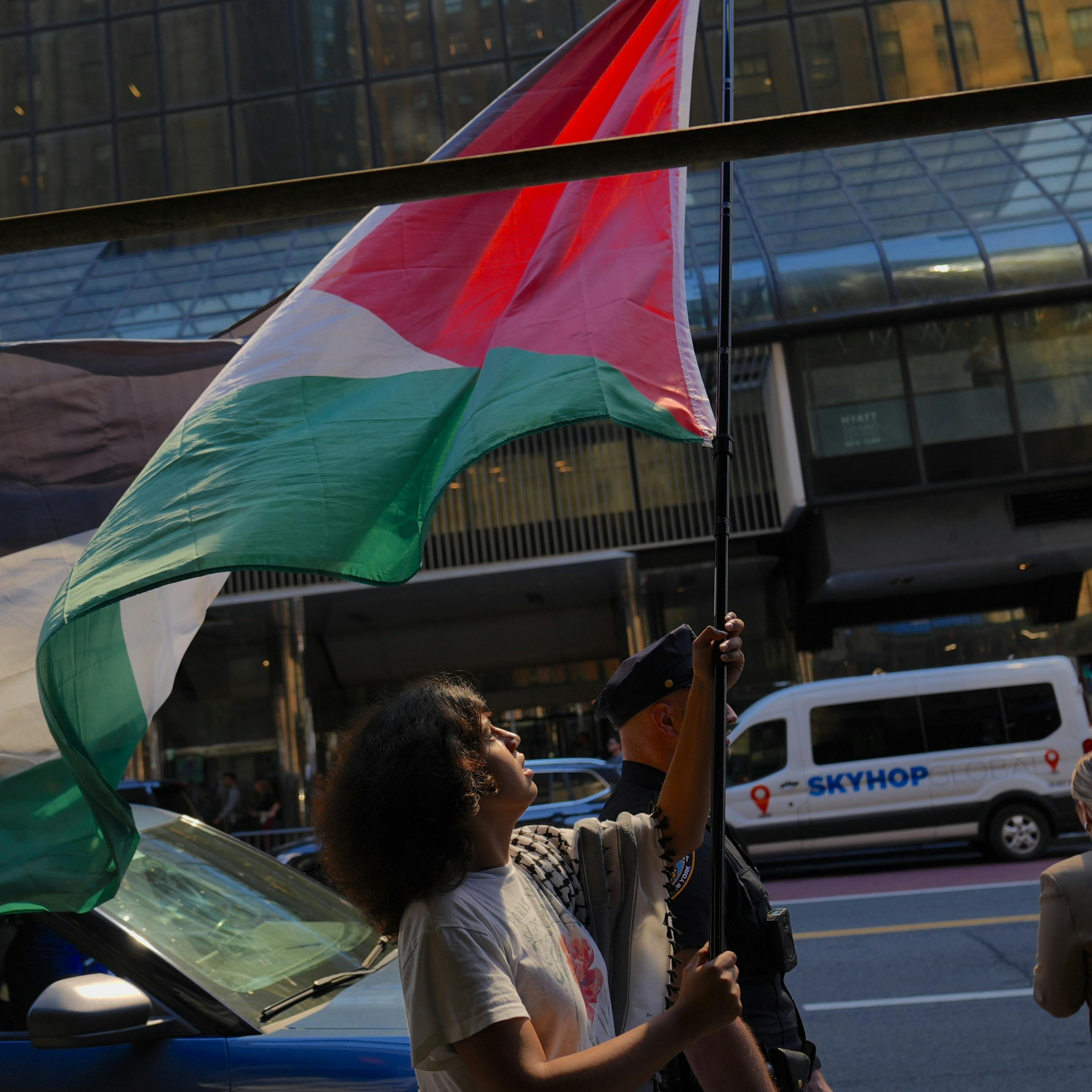
Today, Explained
A Palestinian state
00:26:01
As Israel continues pushing into Gaza, a growing number of world leaders are saying they now recognize statehood for Palestine.
Loading summary
Transcript50 lines
- [00:01]
Noel King
Gaza City is one of the most densely populated areas in the densely populated Gaza Strip, the city's home now to more than a million people. Last week, Israel launched a new ground offensive into Gaza City. Israeli officials say the long expected operation started early Tuesday and will proceed gradually.
- [00:19]
Josh Keating
With the expectation of fighting up to.
- [00:22]
Noel King
3,000 Hamas militants still believed to be there.
- [00:25]
Sponsor/Announcer
We spoke to one person. He'd been pulling a cart loaded with all his family's possessions for more than 12 hours, which pushing through these horrendous.
- [00:32]
Amir Thibon
Conditions, we are seeing an unprecedented humanitarian disaster that could be easily avoided. It's not feasible to move 1 million people from Gaza City to the south.
- [00:42]
Noel King
Civilians there are faced with a choice, stay or go. Either call can be deadly. The incursion could also be deadly for the Israeli hostages held by Hamas, at least some of whom are believed to be in Gaza City. So why did Israel make this choice? Coming up on TODAY Explained Support for.
- [01:00]
Sponsor/Announcer
The show today comes from Anthropic, the team behind Claude Today's news moves fast, but the most important stories deserve deeper thinking. Whether you're trying to understand the implications of a policy change or connecting dots across breaking stories, Claude, your new AI collaborator, can help you go beyond the headlines. Claude doesn't just summarize the news. It helps you explore the context, analyze the patterns, and think through what it all means together. Try Claude for free@Claude AI Todayexplained this.
- [01:29]
Message is brought to you by Apple Card. Each Apple product, like the iPhone, is thoughtfully designed by skilled designers. The titanium Apple Card is no different. It's laser etched, has no numbers, and it earns you daily cash on everything you buy, including 3% back on everything at Apple. Apply for Apple Card on your iPhone in minutes, subject to credit approval. Apple Card is issued by Goldman Sachs Bank USA Salt Lake City Branch terms and more@applecard.com.
- [02:08]
Noel King
This is today Explained.
- [02:12]
Amir Thibon
I'm Amir Thibon. I'm a journalist with the Israeli newspaper Haaretz and author of the book the Gates of Gaza, which was published exactly a year ago and details my own family's story of October 7th and the history of the Israeli Palestinian conflict.
- [02:28]
Noel King
If the ground incursion in Gaza City is deadly for both civilians and potentially the hostages, why is the IDF undertaking it? What's the objective in Gaza City?
- [02:39]
Amir Thibon
That's a great question. Because the leadership of the IDF was against this decision. This was a decision ordered by the Prime Minister against the very strong objections of the chief of staff of the Israeli military, Lieutenant General Eyal Zamir. He warned that what we're going to do there is endanger the hostages, lose many of our soldiers, get Israel entangled in very problematic actions from the international legal point of view, and at the end of the day, not fully defeat Hamas.
- [03:17]
Noel King
So this ground offensive, not a clear answer to what the objective is. It puts the hostages, as you've said, in danger. What does it mean for Palestinian civilians living in Gaza City?
- [03:28]
Amir Thibon
I would say that until now, about half of the population in Gaza City has left. But I'll share with you a story that I heard from a friend who used to live in Gaza and still has family there. And she contacted me last week and she said, look, my family is there every day. They and their neighbors are receiving messages from the Israeli military that they have to evacuate. And what they're telling the Israeli officers who are contacting them is, we don't have anywhere to go. We can't find any apartment, anywhere to stay in the southern parts of Gaza. Gaza City, just to be clear, is more in the northern part of the Gaza Strip. And so they're saying, we don't have anywhere to go. It's either take a risk, stay at home and maybe die in your home, or go and live in the street, sleep in a tent somewhere, which carries its own risks at this point. And even the question of safety is not clear if you go and do that, because there have also been bombardments and fighting episodes in areas where you have many of those refugees. So for them, they're looking at this like a nothing left to lose kind of situation. And as far as I know, the family of this friend of mine, so far they have remained in Gaza City simply because they don't see anywhere else they can go. You know, this is the kind of gamble with people's lives that we're talking about right now.
- [05:00]
Noel King
How do the families of the remaining hostages feel about this incursion, knowing what is at stake for their loved ones?
- [05:07]
Amir Thibon
First of all, when we talk about the hostages and their families, for me, it's very personal, because a good friend of mine, Omri Miran from my community, from Kibbutz Nachal Oz, a small Israeli kibbutz right next to the Gaza Strip. He was kidnapped on October 7 in front of the eyes of his two young daughters, who are the same age as my daughters, they saw their father taken away by armed terrorists. And we know that he is alive. He's been able to survive everything that happened over the last 23 months. But now the military told his family in very clear words, we can't say 100% that this will not endanger him, this expansion of the war. And the same message has been passed to all of the families of the 20 remaining living hostages in Gaza. And there are also about 28 hostages who are believed to be dead, but their families are still fighting to get their bodies back so they can be buried properly in Israel. And they have also received a message that nobody knows what could happen as the war is now expanded. Their biggest fear is that their loved ones will be buried forever under the rubble and never to be found. And so what you're seeing right now is many of the families of the hostages protesting against this expansion of the war against the Gaza City operation. We just had here in Israel, one of our most important holidays, Rosh Hashanah, the Jewish New Year. And on the eve of this holiday, you had hundreds of people, including families of the hostages and, by the way, including my own family, who chose to. I'm not going to say celebrate, because there was nothing to celebrate there, but chose to commemorate this holiday in a dinner in front of the prime minister's residence in Jerusalem, pleading with him to reverse this disastrous decision and not to risk their loved ones and to stop this before it's too late. And that's very unusual. You know, Israel has protests all the time and demonstrations, and we pride ourselves on being the only democracy in the region. But I don't remember a huge protest like this on the eve of Rosh Hashanah, which is such a holy and, you know, religious kind of day. It shows you how desperate people are.
- [07:36]
Noel King
You've covered diplomacy, and I want to ask you about what we're seeing in the U.S. president Trump, as you know, was at the UN General assembly meeting in New York yesterday. He said two things of note.
- [07:47]
Donald Trump
We have to stop the war in Gaza immediately. We have to stop it. We have to get it done. We have to negotiate immediately, have to negotiate peace. We got to get the hostages back.
- [07:57]
Noel King
What is your thinking on what matters to Trump at this point and what role does the US have to play at this point?
- [08:08]
Amir Thibon
President Trump is the only man in the world who can stop this war. And all it takes is one phone call from him to Prime Minister Netanyahu. It is that simple. Until he does that, I'm very pessimistic that anything will change. And I'll explain why. But it will require two minutes from the listeners.
- [08:27]
Josh Keating
Sure.
- [08:28]
Amir Thibon
In January 2025, right around the time that President Trump entered the White House, a deal was signed to basically end the war in Gaza. It was a deal with two phases. Phase number one included the release of 33 Israeli hostages from the hands of Hamas in return for a gradual but not full Israeli withdrawal from parts of Gaza and the release of about 1,000 Palestinian prisoners. And this was executed by both sides, implemented successfully. And while the deal was signed in President Biden's last days in the White House, everybody gave most of the credit to President Trump. Because what motivated Netanyahu to accept that agreement back then in January was fear of angering and alienating Trump before the new president's entry into the White House. Now, once the first phase was completed, we were supposed to enter the second phase of the deal. And that included the release of all the remaining hostages and a completion of Israel's withdrawal from Gaza. Instead of continuing into the second phase. Netanyahu chose on March 18 to renew the war. And at the time, he told President Trump he needs just a few more weeks, just a few more weeks to finish off Hamas and force them to sign a better deal. From his point of view, what exactly that better deal looked like, we don't know. But he said, if I apply military pressure on them, we can get a better deal than the one signed in January. Noel, those several weeks have now turned into more than six months. During this period, and I'm speaking now from an Israeli point of view, six months, we've lost more than 60 Israeli soldiers. Our country has become isolated on the world stage like never before. And only one hostage, only one living hostage returned during this entire time. So what many Israelis are asking themselves is when will President Trump realize, when will. That the promise of just a few more weeks was delusional at best. And that meanwhile things are only deteriorating and getting worse. And that with one phone call, he can tell Netanyahu, let's go back to March, let's go back to the deal that was on the table that you already signed and begin implementing phase two. All the hostages come home and the war ends. And I think until President Trump does that, we are not going to see any good news come out of, come out of this part of the world.
- [11:15]
Noel King
Amir T. He writes for Haaretz. The Gates of Gaza is his book. Coming up. A cascade of Western nations have said in the last week or so that they will recognize Palestinian statehood. This is raising again the prospect of a two state solution. Stay tuned.
- [11:51]
Sponsor/Announcer
Support for the program today comes from Shopify. When you're creating your own business, you have to juggle a lot of roles. Marketing, sales, outreach, design. Shopify can simplify all of that. Shopify is the commerce platform behind millions of businesses around the world and according to the company, percent of all e commerce in the US from household names like Mattel and Gymshark to brands just getting started like maybe I don't know yours. They say they have hundreds of ready to use templates to help design your brand style. And they say they can make marketing easier by creating email and social media campaigns so you can connect with customers wherever they be scrolling. Shopify also has AI tools created for commerce they say can help you create product descriptions, generate discount codes and more. You can turn your big business idea into reality with Shopify on your side. You can sign up for your $1 per month trial and start selling today at shopify.com explained. You can go to shopify.com explained that shopify.com explained does anyone have a cash register handy? Support for Day Explained comes from Found Running a business is hard enough. Your finances shouldn't feel like a second full time job gross. Every hour lost to receipts and tax prep is an hour you could be spending where it counts most with your customers. Found is a business banking platform that says they can let you effortlessly track expenses, manage invoices and prepare for taxes all in one place. They say they can also help you uncover tax write offs. Fun and free up valuable time. Funner time that you can put towards chasing new opportunities and focusing on the work you love the most. Fun. And they say other small businesses are loving Found too. They say one user said Found is going to save me so much headache. It makes everything so much easier. Expenses, income, profits, taxes, invoices even. And Found says they have 30,000 five star reviews just like that one. You can open a Found account for free at F O u N D Com. Found is a financial technology company, not a bank. Banking services are provided. Piermont Bank Member fdic. You don't have to put this one off. You can join thousands of small business owners who have streamlined their finances with Found. Support for Today Explained comes from Anthropic, the team behind Claude. Every entrepreneur knows that moment when breaking news hits and you're thinking what does this actually mean for my business? New regulations drop, markets shift, geopolitical events unfold and suddenly you need to understand not just what happened, but how it connects to everything. El Claude by Anthropic is an AI collaborator that can help you work through information in real time. You can upload docs, regulatory filings or multiple news sources to help you see the bigger picture. Need to verify claims or research background context? Claude searches current sources and provides citations you can check. It works through complex news stories step by step, asking questions that reveal deeper meanings and connections others miss. See why the world's best problem solvers choose Claude as their thinking partner and try Claude for free@cl Claude.AI today explained. This is Today Explained.
- [15:31]
Noel King
I'm Noel King. In the last week or so, the uk, Canada, Australia, Portugal and others have joined France in recognizing a Palestinian state. Josh Keating has been writing about this. He covers foreign policy and national security for Vox.
- [15:48]
Josh Keating
Well, yeah, I mean, it's been a remarkable wave, about 10 countries. This is why I declare that today. France recognizes the state of Palestine.
- [15:59]
Amir Thibon
The United Kingdom formally recognizes the state of Palestine.
- [16:05]
Josh Keating
Canada recognizes the state of Palestine. In terms of what it actually does for the people on the ground in Palestine, or in Israel, for that matter, it doesn't change much. You know, these territories are still under Israeli military occupation. Palestine is not going to be a UN member so long as the US Has a veto on the Security Council. The Security Council has to approve any new members. But what I think it does show is just how the politics around this issue are really shifting. You know, I'd invite listeners to sort of look at. You can find a map on Wikipedia or other sites that show which countries currently recognize Palestine. And there used to be a big blank spot over Western Europe that was a holdout. Those were countries that, like the US did not recognize Palestine. And now that map's being increasingly filled in. So it's not only that Israel is getting more isolated on the US on the world stage, say it's the US that's also getting isolated on the world stage. And I think that that's really an indication of where the politics on this issue are headed.
- [17:16]
Noel King
Why is recognition happening now like this week?
- [17:20]
Josh Keating
Well, I think it's clearly a response to the scenes we're seeing out of Gaza and a frustration in the international community that, you know, this war is happening and they haven't been able to end it. Recognizing a Palestinian state today is the only way to provide a political solution to a situation which has to stop. And I think that, you know, particularly the governments in Western Europe, you know, of places like Britain, France, you know, and earlier we saw places like Norway and Ireland like they are. Those governments are under heavy pressure from their populations to do more to take a step pro Palestine. Protesters declared a global day of civil.
- [18:02]
Sponsor/Announcer
Disobedience and blocked traffic on o' Connell Bridge.
- [18:06]
Amir Thibon
A sea of people from all of Belgium and neighboring countries flooded the main streets of Brussels. As far as the eyes could See.
- [18:14]
Josh Keating
Some protesters said they blamed Western governments for complicity in war crimes against Palestinians. And so, you know, I think that, you know, I have heard, you know, experts on the UN call this fantasy diplomacy. People have called it virtue signaling that, you know, this is something that's not actually going to put much real pressure on Israel, but it's a way of showing that they're doing something. You know, I think from what I've heard from French officials, they see it as a way to, you know, sketch out a future vision for what a resolution to this conflict will look like. From what they say, that there's no way out of this conflict without presenting some kind of alternative as some kind of light at the end of the tunnel for the Palestinian people. You know, the government of Israel and the Trump administration would counter that, you know, they see this as just a reward for Hamas, saying that, you know, this is basically giving a Reward for the October 7th attacks.
- [19:19]
Donald Trump
Now, as if to encourage continued conflict, some of this body is seeking to unilaterally recognize a Palestinian state. The rewards would be too great for Hamas terrorists for their atrocities. This would be a reward for these horrible atrocities.
- [19:39]
Noel King
How is Israel responding to these recognitions of statehood?
- [19:44]
Josh Keating
Well, negatively, I would say that we're hearing more calls in Israel to formally annex Palestinian territory. In response to these recogn, you have some members of the Netanyahu government talking openly about annexing parts of Gaza now. But I think really, actually the place to watch is the West Bank. There's been an active debate in Israel for years about annexing at least parts of the West Bank. And like, the more extreme ends is they could annex all of what's called Area C, which is the 60% of the west bank that's currently under Israeli military control. You know, I think the thing of doing that is it would basically, it's the only contiguous part of the west bank, and so it would reduce Palestinian territory to a few little sort of islands. You know, people call them Bantustans, going back to the apartheid South Africa. And so, you know, this would be a basically a way of kind of burying the prospect of Palestinian statehood permanently doing this.
- [20:54]
Noel King
And how is the US Responding?
- [20:57]
Josh Keating
The US Is opposed to unilateral recognition of a Palestinian state. And that, I should say, is not just the Trump administration position. That's been a consistent U.S. position from Democratic and Republican administrations. When it comes to annexation, things are a little less clear. You have members of the Trump administration, including the ambassador to Israel, Mike Huckabee, who are sort of open Annexationists who say they should never be a Palestinian state, that, you know, this is rightfully Israeli territory.
- [21:31]
Amir Thibon
I think the question is, what does that Palestinian state look like? Where is it?
- [21:35]
Donald Trump
Where is it going to be?
- [21:37]
Amir Thibon
Does it have to be in Judea and Samaria?
- [21:40]
Donald Trump
Does it need to be somewhere different? Does it need.
- [21:42]
Josh Keating
I think President Trump's been a little more vague on this view. He said he's not wedded to the idea of a two state solution. He's certainly not as committed to it as Republican and Democratic administrations have been, at least rhetorically in the past. But I think his views on that are a little less clear. And I think what's interesting to me is one of the signature foreign policy accomplishments of the first Trump administration was the Abraham Accords.
- [22:10]
Donald Trump
Together, these agreements will serve as the foundation for a comprehensive peace across the entire region. Something which nobody thought was possible, certainly not in this day and age, maybe.
- [22:22]
Josh Keating
In these normalization deals between Israel and several Arab countries, notably the United Arab Emirates. And Trump had expressed hopes that Saudi Arabia, kind of the big kahuna in the neighborhood, could be brought into these accords as well. I think annexation would put any hope of that out of reach. And we've even seen the UAE government saying they might even suspend their membership in the, or the participation in the Abraham Accords if Israel went ahead with this. So, you know, when Israel talks about annexation, it's not just an Israeli issue. It's also potentially putting what Trump sees as one of his signature diplomatic accomplishments, one of the things he would point to as evidence for why he deserves a Nobel Peace Prize. It would put that in jeopardy. So, you know, it's interesting, we've seen Trump at times in the past push back on some of some Israeli policies. So I think the messaging out of Washington isn't really clear on that yet.
- [23:31]
Noel King
Let's talk a little bit more about the two state solution. So we've got lots of world leaders at the UN General assembly in New York this week, and the idea of a two state solution is coming back up. Who's discussing it and what would this mean?
- [23:45]
Josh Keating
Right. So the longstanding kind of consensus position, both in the US Government and most Western governments is that a two state solution would come as a result of a negotiated settlement between the Israeli and Palestinian governments. So that's been the position. What's different now is these governments are unilaterally recognizing a Palestinian state in the absence of a negotiated solution. And I think that that's a response to the fact that there just doesn't seem to be any realistic prospect in the near term of a negotiated two state solution between Israel and Palestine. The idea frankly looks fanciful at the moment. So I think that's why we're seeing this move from several countries to kind of unilaterally recognize a Palestinian state now. And I should say there's a bill in the Senate, a resolution urging the Trump administration to recognize Palestine. Trump obviously is not going to do that. And I think you would have had a hard time getting even that prior to the war in Gaza.
- [24:52]
Noel King
Where does all of this leave Palestine and Israel?
- [24:56]
Josh Keating
You know, so it was interesting to hear a speech Netanyahu gave last week where he said basically that Israel is just going to have to get used to being isolated on the world stage. He said that they're going to have to be super Sparta in addition to Athens. And he said they might have to have an economy with autarkic characteristics. So self sufficient, basically. And so this doesn't sound like a government that is interested in caving to international pressure. And I think what we're seeing is the price of cooperation with Israel is just getting so high for some of these countries, both because of the furious public reaction to the images we're seeing out of Gaza and because the airstrikes that Israel has carried out in places like Yemen, Lebanon and even more consequently a few weeks ago in Qatar, which is a major regional economy, a place that hosts a U.S. military base. I think Israel is just seen as sort of destabilizing in the region. So I think it's, you know, if they continue on this course, it is kind of precluding this sort of deeper path toward deeper regional integration, toward a more friendly, peaceful coexistence with its neighbors, which they seem to be on a few years ago. And I think, you know, Netanyahu has shown that's a sacrifice he's willing to make. If the price of better relations with their neighbors is a negotiated end to the war in Gaza, if it's tangible steps towards a two state solution, that's not a price he's willing to pay.
- [26:41]
Noel King
That was vox's Josh Keating. You can find more analysis from Josh in his piece Turning Point or Political Theater? The big push for Palestinian statehood. Extension explained. That's@vox.com Today's show was produced by Kelly Wessinger and Denise Guerra with an assist from Ariana Espuru. Aminah Elsadi is our editor. Laura Bullard and Abishai Artsy Checked the facts. Adrian Lilly and Patrick Boyd engineered and I'm Noelle King. It's Today Explained. If you like Today Explained you should consider becoming a VOX member. VOX members get perks including ad free versions of this show. Who could ask for anything more really? But there is more unlimited readingox.com a member exclusive newsletter and I'm told so much more. You'll also be supporting our work. We cannot make Today Explained without VOX members. Sign up now and you'll get more than 30% off an annual membership. This is the sale folks. Go to Vox.com members to join. Sam.