Loading summary
Transcript98 lines
- [00:01]
Sean Ramis
Big Monday in America. Amy Klobuchar kicked things off by subtweeting the incoming President.
- [00:07]
Andrew Prokop
So as we inaugurate a new president.
- [00:11]
Nicole Naraya
And Vice president, let us remember that the power of those in this room.
- [00:18]
Vivek Ramaswamy
Comes from the people.
- [00:20]
Sean Ramis
President Trump was surrounded by his best tech bros, one of whom would later in the day do a few Sig heils.
- [00:27]
Vivek Ramaswamy
Thank you.
- [00:29]
Sean Ramis
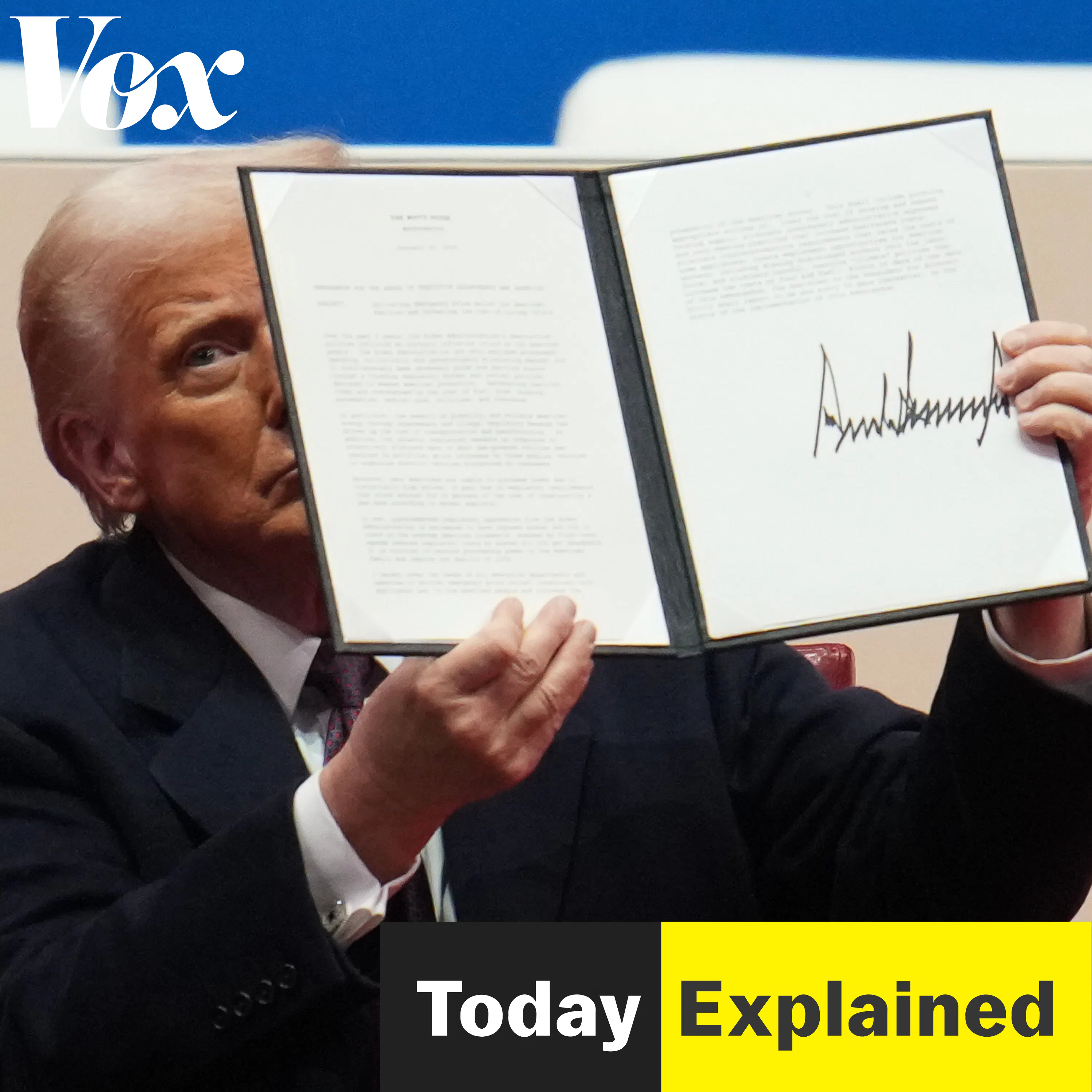
After the speeches, the flags were raised at the White House in the Capitol Building. RIP RIP Jimmy Carter. Thank you fellow citizens, and farewell. And the President signed a bunch of executive orders. First at the arena.
- [00:43]
Vivek Ramaswamy
Could you imagine Biden doing this? I don't think so.
- [00:47]
Sean Ramis
And then back at the White House.
- [00:48]
Vivek Ramaswamy
What is withdrawing from the World Health Organization, sir? Ooh, that's a big one.
- [00:54]
Sean Ramis
Back in Executive action on today explained.
- [01:00]
Nicole Naraya
Thumbtack presents the ins and outs of.
- [01:03]
Sean Ramis
Caring for your home. Out uncertainty, self doubt, stressing about not knowing where to start. In plans and guides that make it easy to get home projects done. Out word art. Sorry.
- [01:20]
Nicole Naraya
Live laugh lovers in knowing what to do, when to do it and who to hire.
- [01:26]
Sean Ramis
Start caring for your home with confidence.
- [01:29]
Nicole Naraya
Download Thumbtack today.
- [01:33]
Andrew Prokop
This episode is brought to you by Shopify. Upgrade your business with Shopify, home of the number one checkout on the planet. Shop pay boosts conversions up to 50%, meaning fewer carts going abandoned and more sales going cha ching. So if you're into growing your business, get a commerce platform that's ready to sell wherever your customers are. Visit shopify.com to upgrade your selling today. Bing, bing bing bong bong bong bong bing.
- [02:00]
Sean Ramis
Today explained Sean Ramis room here on January 21, the day after many executive orders signed by our once and once again President Donald Trump. Andrew Prokop, senior political correspondent at Vox, is here to help us work through them. And Andrew, what did we learn yesterday?
- [02:20]
Nicole Naraya
We learned that Trump is really going for it. He's coming out of the gate with an extremely aggressive, dubiously legal agenda on many fronts, most notably immigration, but other issues as well. And then I think we also learn some other things, which is that on certain issues, he may not be exactly sure himself what he's going to do.
- [02:46]
Sean Ramis
Fun. Okay, let's start with their big swings. Where did they focus their day one attention?
- [02:52]
Nicole Naraya
So probably the big headline from the day was Trump's massive, wide ranging pardon of the January 6th rioters. And this is something, you know, everyone knew Trump was going to do something like this. It had been discussed at length. But only a few days before Trump's inauguration, Vice President J.D. vance went on TV and said that if you committed violence on that day, obviously you shouldn't be pardoned. And there's a little bit of a gray area. Trump does not share that opinion, evidently, and he went far more aggressive.
- [03:32]
Sean Ramis
First, we have a list of pardons and commutations relating to events that occurred on January 6, 2021.
- [03:38]
Vivek Ramaswamy
Okay, and how many people is this? I think this order will apply to approximately 1500 people s. So this is January 6th.
- [03:47]
Nicole Naraya
What he did was that he just separated everyone into one of two groups. First, he singled out 14 people who had been members of far right groups, the Proud Boys and the Oath Keepers, who were really actively plotting and were convicted of seditious conspiracy. For those guys, he didn't give them a full pardon, but he did commute their sentences and free them from prison. If they were in prison, then the other group is everyone else who was involved in other crimes. At the Capitol on that day, Trump said, you are fully parted. So this is really a full blown Trump endorsement and defense of the violence at the Capitol on January 6, 2021. His defenders always said, oh, he didn't really mean for that to happen. Now he's making it unmistakably clear he thought that was good, and those people are good, and he is going to protect them from any consequences.
- [04:47]
Sean Ramis
Okay, so pardoning everyone from the January 6th incident, you know, predictable or surprising, depending on your perspective. There was a whole lot of other stuff he did, including on immigration, which I want to get to eventually. But in the meantime, tell us about some of the other themes of day one.
- [05:06]
Nicole Naraya
Well, energy and climate and the environment was a very big theme. Trump really came out of the gate hot on energy as well.
- [05:16]
Vivek Ramaswamy
That is why today I will also declare a national energy emergency. We will drill, baby, drill.
- [05:26]
Nicole Naraya
He withdrew the US from the Paris climate agreement.
- [05:30]
Sean Ramis
The next item here is the withdrawal.
- [05:32]
Andrew Prokop
From the Paris Climate treaty.
- [05:36]
Nicole Naraya
He issued a pretty sweeping executive order calling for the rollback of a bunch of Biden administration policies, including what Trump calls the electric vehicle mandate. Not really a mandate, but, you know, certain fuel efficiency standards that would ease the transition to electric vehicles. Trump said, nope, that's going away.
- [05:58]
Vivek Ramaswamy
We will be a rich nation again, and it is that liquid gold under our feet that will help to do it. With my actions today, we will end the green New Deal, and we will.
- [06:11]
Nicole Naraya
Put a halt on wind energy permitting.
- [06:15]
Vivek Ramaswamy
So we have more oil and gas than any country in the world, and we're going to use it. We're not going to do the wind thing. Wind, big, ugly windmills.
- [06:26]
Nicole Naraya
He also opened up lots of new areas of Alaska to new fossil fuel production and wants to go from there. So Trump wants to deprioritize climate change, boost fossil fuel production and make new projects of any kind really easier to build.
- [06:44]
Sean Ramis
Okay. He also made a bunch of changes to how the government works.
- [06:48]
Nicole Naraya
It seemed like yes. So one of Trump and the people around him's long running regrets thoughts about how things went wrong in their first term is that they believe that the federal civil service bureaucracy was two anti Trump, was disobedient, insubordinate, did not want to implement his policies and that that's why they failed in a lot of what they tried to do last time around. So they have been cooking up ideas for years about how to get, in their view, better control of this bureaucracy, which mainly amounts to making more positions political jobs that are easier to hire without going through the civil service projects and making it easier to fire existing civil servants, either by reclassifying them as political jobs or just just taking their protections away. So Trump issued a series of orders that that get at different parts of this.
- [07:52]
Sean Ramis
Sir, the next item as you announced.
- [07:54]
Vivek Ramaswamy
In your speech is a requirement that federal workers return to full time in person work immed.
- [08:03]
Nicole Naraya
We didn't really see, you know, mass firings yet. There were a few firings reported heads of immigration court systems. But this is, I think laying the groundwork. It's a signal that they're very serious about this idea and that they really do intend on kind of taking a wrecking ball to the federal civil service as we know it.
- [08:23]
Sean Ramis
One, one high profile firing. You forgot to mention Andrew Vivek Ramaswamy yes.
- [08:29]
Nicole Naraya
RIP Vivek.
- [08:30]
Sean Ramis
The reality is many people are annoyed by my rise and believe that we knew immigration orders were coming. Andrew and come they did tell us about what Trump tried to do on day one to overhaul our immigration system.
- [08:46]
Nicole Naraya
I think the Trump team has the clearest idea of what they want to do on immigration than any other issue. This is one where Deputy White House Chief of Staff slash Homeland Security Advisor Stephen Miller is very clearly calling the shots and shooting for the moon.
- [09:05]
Vivek Ramaswamy
All illegal entry will immediately be halted and we will begin the process of returning millions and millions of criminal aliens back to the places from which they came.
- [09:18]
Nicole Naraya
He is in addition to restoring various policies from the first Trump administration, such as suspending refugee admissions that remain in Mexico policy which has migrants have to stay in Mexico while their claims are being adjudicated, he also went much further in really aggressive and sweeping assertions of federal authority. He declared that there was still a public health emergency, even though the pandemic is long kind of over or accepted as a part of life, depending on who you ask. But basically using that as an excuse to start, like, totally ignoring US Asylum.
- [10:00]
Vivek Ramaswamy
Law and I will send troops to the southern border to repel the disastrous invasion of our country.
- [10:08]
Nicole Naraya
He said he would now order the military to make defending the borders part of their main mission, something that has not been done before. And he also issued an order which he claimed would suspend birthright citizenship, which is the constitutional protected right of any child born in America to be an American citizen. His team said, actually, we are not going to respect this anymore. If both of a child's parents either are not US Citizens or lawful permanent residents, they will not be citizens anymore. And so that applies to undocumented immigrants, but it also applies to visa holders, H1B visa holders, or student visa holders who have a child while in America. Their children will not be American citizens unless one of the parents of the child is a U.S. citizen or lawful permanent resident. This seems clearly unconstitutional. It's already been the subject of a lawsuit by the aclu, and many of Trump's other immigration orders and other orders will. Will be the subject of lawsuits headed to the courts. And, you know, we'll see what happens with those. Whether this conservative Supreme Court stands up to Donald Trump and tries to enforce the rule of law, or whether they are not so inclined to rein him in.
- [11:38]
Sean Ramis
Did he signal that he is going to need congressional support for any of these major initiatives, especially on immigration, or did he signal that he wants to go it alone? Both. Something in the middle.
- [11:50]
Nicole Naraya
He didn't really suggest anything. There is a border security bill under discussion in Congress, so he wants more money for the border, et cetera. But he did not make requests of Congress a main priority of this first day. It was all about executive power and trying to claim powers to make these vast changes through his own authority and no one else's.
- [12:21]
Sean Ramis
While the president was busy giving speeches and signing executive orders, Congress was voting on stuff, too, including a big immigration bill with Trump's fingerprints all over it. That's up next on Today Explained. Support for Today Explained comes from Deleteme. You may not realize it, but your personal information is a commodity for data brokers. And in the wrong hands, this can lead to identity theft, phishing. Not the good kind, harassment and annoying spam calls. But Delete Me says they can help you better protect your privacy and your data. And you know who's tried delete me. Claire White from Vox has tried Delete Me.
- [13:15]
Nicole Naraya
The Delete Me reports are incredibly thorough and they also include all of the personal information of yours that is exposed.
- [13:22]
Andrew Prokop
Which I find to be quite helpful. It makes me feel a lot safer online knowing that my information is very.
- [13:29]
Nicole Naraya
Secure and not easily accessible.
- [13:31]
Sean Ramis
You can take control of your data and keep your private life private by signing up for Deleteme now at a special discount for our listeners today. Get 20% off your Delete Me plan when you go to JoinDeleteMe.com today and use the promo code today at Checkout to get 20% off. You can go to JoinDeleteMe.com today and enter the promo code today at checkout. That's joindeleteme.com today code today. Support for Today Explained comes from Greenlight. If you're a parent, and I know a lot of you are, you might have some big plans for the New Year on what to teach your kids. Maybe it's riding a bike or learning how to swim, but one of those life lessons this year could be how to spend and save money. Greenlight is a debit card and money app made for families. Parents can send money to their kids and keep an eye on kids spending and saving, while kids and teens can build money, confidence and lifelong financial literary skills. Our colleague here at Vox, Oda Sham, has tried Greenlight.
- [14:34]
Andrew Prokop
My kids enjoy using Greenlight. They like the freedom that it gives them to not have to carry money, not have to count change, like where they know, okay, if this is $5, I have $10 in my account. I have enough to cover. And like this way, it's not like they go to the gas station and they're scrounging in their book bags for like pennies and quarters, trying to scramble to make enough money to pay for a pack of candy.
- [14:59]
Sean Ramis
You can sign up for Greenlight Today@Greenlight.com TodayExplained. That's Greenlight.com TodayExplained to try Greenlight Today. Greenlight.com explained support for the show comes from Hydro. Say hi. Maybe your New Year's resolution was to start hitting the gym again. Then you actually went to a gym. And the chaos and the crowds and the smells. They didn't say smells. That's just me. Reminded you why you stopped going to begin with. Well, this year you can get an immersive full body workout all from the comfort of your own home. With the Hydro rower. All you'll have to smell is yourself. No matter where you are in your rowing journey, whether you're prepping to join the rowing team or just want to grab a quick workout. Hydro wants to meet you where you are. Their exercises combine both strength and cardio to give you an efficient full body workout. You can kick off the new year with a full body workout all from the comfort of your own home with Hydro. Head over to hydro.com and use code explain to save up to $475 off your hydro. That's H Y-R-O-W.com, code explained to save up to $475 hydro.com code explained.
- [16:31]
Vivek Ramaswamy
The Golden Age of America begins right now.
- [16:34]
Sean Ramis
On explained Nicole Naraya, Senior Politics writer at Vox. Nicole, tell us about the Lake and Riley Act.
- [16:41]
Andrew Prokop
So I think on its face a lot of people might agree with its aims, which is to crack down on unauthorized immigration, particularly among people who have committed crimes.
- [16:52]
Vivek Ramaswamy
Lake and Riley's horrific murder should have never happened. She should still be with us today. And if she was, as Senator Britt pointed out, she'd be turning 23 tomorrow.
- [17:04]
Andrew Prokop
The individual responsible was arrested not once.
- [17:07]
Vivek Ramaswamy
But twice, but was released by authorities in New York before an ICE detention.
- [17:13]
Andrew Prokop
But this is really bad policy, and I'm not saying that in a partisan sense, but it really does not address the underlying issues with the US Immigration system. If you actually look at the nitty gritty of what's in it, there are two major prongs to this. One, it would create a mandatory detention requirement for undocumented immigrants accused of committing nonviolent crimes, mostly related to theft.
- [17:37]
Sean Ramis
The Lake and Raleigh act requires ICE.
- [17:39]
Vivek Ramaswamy
To detain illegal aliens who commit theft and shoplifting in every city.
- [17:43]
Andrew Prokop
The accused part of this is really important because they haven't been convicted. They may not have been subject to sort of due process in the process of being accused. They could be accused not just in the U.S. but in another country. Potentially that can lead to a whole host of problems that immigrant advocates have identified.
- [18:01]
Vivek Ramaswamy
This bill is so broadly drafted that it would compel law enforcement to put a mandatory detention on you heard it an 11 year old immigrant in New York accused of stealing a soda from a gas station.
- [18:22]
Andrew Prokop
But then moving on to the other part of the bill is this mechanism that would allow state attorneys general to sue the federal government to basically enforce the provisions of the bill, but also related to policies on visas and on detention. Basically it would lead to the courts getting gummed up and allow states a lot more say than they historically have had in terms of federal immigration policy. There are reasons why that's Bad, including the fact that there are reasons for sort of a unified federal policy and around immigration and the fact that a lot of these states don't necessarily have the expertise to be able to deal with immigration enforcement and also foreign policy, because this is actually, you know, a matter of relations potentially with Mexico, with China. This could lead to a lot of sticky situations in the courts.
- [19:11]
Sean Ramis
How much does this legislation cost?
- [19:14]
Andrew Prokop
Yeah, so I think that's a major problem with this bill is that, first of all, if you're going to require that every undocumented immigrant accused of theft related crimes can be detained, it's going to cost a lot of money to detain those people.
- [19:27]
Vivek Ramaswamy
ICE would need actually more than three times the current number of detention beds, a 265% increase for this bill. It would need to execute 80 removal flights a week, almost double its current capacity.
- [19:43]
Andrew Prokop
The new estimate from ICE is that the bill would cost $83 billion over the next three years if implemented on that basis. A lot of Democrats have severe doubts about it. Like, where is that money going to come from?
- [19:54]
Vivek Ramaswamy
We are now talking up to $83.
- [19:56]
Nicole Naraya
Billion for this legislation over the first.
- [19:59]
Vivek Ramaswamy
Three years to implement it. That's more than the annual budget for the entire Department of Homeland Security.
- [20:06]
Andrew Prokop
And not only that, I think beyond cost, there's a question of priorities for detaining certain immigrants. So right now, as it stands under the Biden administration policy, they made a concerted effort to detain only people who were accused of violent crimes or who had a flight risk or who had recently come into the country. There's a reason for that in that U.S. immigration enforcement has limited resources to carry out its mission. And there's a question of should ICE really be prioritizing these people who might have been, I don't know. An example that an immigration attorney raised to me is a mother who was stealing baby formula. Are we going to be locking that person up? And also then raise the question of who's gonna take care of her child? And obviously that's a sympathetic case, but that person would have to be detained under the Lake and Riley Act.
- [20:58]
Sean Ramis
I'm sure there are a lot of Republicans in this country, Nicole, who would say yes, if an undocumented immigrant comes into this country and then steals baby formula, yes, that mother should be detained. What's more interesting, I suppose here is that there are a lot of Democrats also voting in support of this act and saying, yeah, sure, go for it. How did Congress vote on the Lake and Riley Act?
- [21:24]
Andrew Prokop
So the first version passed the House Pretty easily, with the support of 48 Democratic House members. And then last night, the Senate passed their version of it with 12 Democrats voting in support. And now it goes to the House again for a final vote, and then to President Trump's desk.
- [21:41]
Vivek Ramaswamy
The Senate has passed the Lake and Riley Bill 6435, that required a number of Democrats to vote with it.
- [21:48]
Andrew Prokop
You know, I think there's an impulse among moderate Democrats in particular, to support this bill, partially because of the political fight we saw play out in 2024 around this. They're reflecting their constituents to some degree and reacting to that and hoping to address the border crisis. But I think what's been lost in this narrative is that in trying to show that the Democratic Party is sort of a party that embraces law enforcement, they have abandoned the larger picture of what the problems in our immigration system actually are. And I think this bill is, in many ways, sort of a distraction from those.
- [22:21]
Sean Ramis
When you talk about the political realities of 2024 that might be driving Democrats to vote for legislation like this, what are we talking about exactly? Are we talking about just the fact that the Democrats kind of got shellacked or something else?
- [22:35]
Andrew Prokop
Yeah, I think there are a few things that have changed in the last few years in terms of the immigration debate in this country, and I think one of them was a very successful Republican campaign to send migrants who are arriving on the border to blue cities.
- [22:51]
Vivek Ramaswamy
Since the summer, our city's Office of Immigrant affairs and the Office of Emergency Management have been gearing up for the potential arrival of asylum seekers via unplanned and uncoordinated bus routes from Southern states. As we have seen in cities like New York and Washington, D.C. you know.
- [23:07]
Andrew Prokop
In places like Philly, for example, and in New York, you know, we have Eric Adams talking about the city unable to sort of absorb these migrant populations and the stress that it's putting on local resources there in a way that they had never had to deal with that before.
- [23:21]
Vivek Ramaswamy
This issue will destroy New York City. Destroy New York city. We're getting 10,000 migrants a month.
- [23:32]
Andrew Prokop
I really think it made the problem real for Democrats in a way that it hadn't been before. They then played into sort of this Republican narrative about chaos at the border. Like, I think, also the reality of the border change. There are now people not just coming from Mexico and Central America, but also from all over the world. We're talking about, you know, China and Ukraine, people who are arriving at the southern border, and the resources there just don't exist to process those people, and that is a big problem. But I think Democrats have reacted to that by embracing sort of Trumpian and more right wing immigration policies. So I really do think that we've seen a shift in terms of the way that Democrats are talking about immigration in the last four years.
- [24:15]
Sean Ramis
How many more Lake and Riley acts do Republicans have up their sleeves? I mean, this one was making its way through Congress before Donald Trump even took the oath of office on Monday. How many more chances do Republicans get to tweak our immigration system?
- [24:32]
Andrew Prokop
Well, I think that's sort of a matter of how many more chances do Democrats give them because we really just didn't see that much pushback to this bill in a way that's kind of baffling, given where Democrats were four years ago. Do as much as we can to.
- [24:47]
Nicole Naraya
Make immigrants welcome in America, to make.
- [24:50]
Vivek Ramaswamy
Sure that America integrates immigrants into our.
- [24:54]
Nicole Naraya
System of government, and we'll keep fighting to get as bold and strong a bill as we can.
- [24:58]
Andrew Prokop
And, you know, I think we did see once it got to the Senate for debate, that some Democrats were then suddenly raising objections to it and some of the sort of potential overreach of, especially the provision around allowing state attorneys general to sue and the problems that.
- [25:13]
Vivek Ramaswamy
Would arise if every state and county and city, Mr. President, were to enforce its own immigration laws. And that's why the Constitution.
- [25:21]
Andrew Prokop
But, you know, that didn't really go anywhere at that point. The ball was already rolling. The bill had momentum. But they're also facing the next four years of Trump and trying to at least feign an interest in working with him in Congress.
- [25:35]
Sean Ramis
And it's a tough path for Democrats because they were just in power for four years. And the American people very much want to see a change not just in who's sitting in the White House, but in how we deal with immigration in this country.
- [25:50]
Andrew Prokop
Yes, we're now seeing anti immigrant polling at their worst since the post 911 era, according to Gallup. So there has been this major change in public sentiment. I think there is a question in my mind about when we start seeing Trump roll out these aspects of his immigration platform, like mass deportations or ending birthright citizenship. Are those kinds of policies that are going to be very invasive in terms of American life? You might see people being rounded up at their workplaces and their homes. Are those kinds of policies going to create a political change among voters? Are they going to react the same way that they might have during the family separation crisis when they saw kids in cages in the Mylar blankets at the border in these temporary facilities or when the travel ban was rolled out in the first week of Trump's first term. All of those things did create a lot of backlash among Americans. And I just don't know if that will still exists this time around. And I think that's also part of a broader question I have around sort of liberal resistance. Does it exist anymore? I don't know. I think, like, a lot of them have sort of laid down their mantle here.
- [27:02]
Sean Ramis
Nicole and Urrea Vox. You can read her and andrew@vox.com shoutouts to Daniela Diaz at Politico for her help with today's show, too. Peter Valenon Rosen and Amanda Llewellyn produced Aminah Al Saadi edited Laura Bullard in Victoria Chamberlain kept us Accurate and Robin Byers and Andrea Christensdotcher mix this episode of Today expl.