← Today, Explained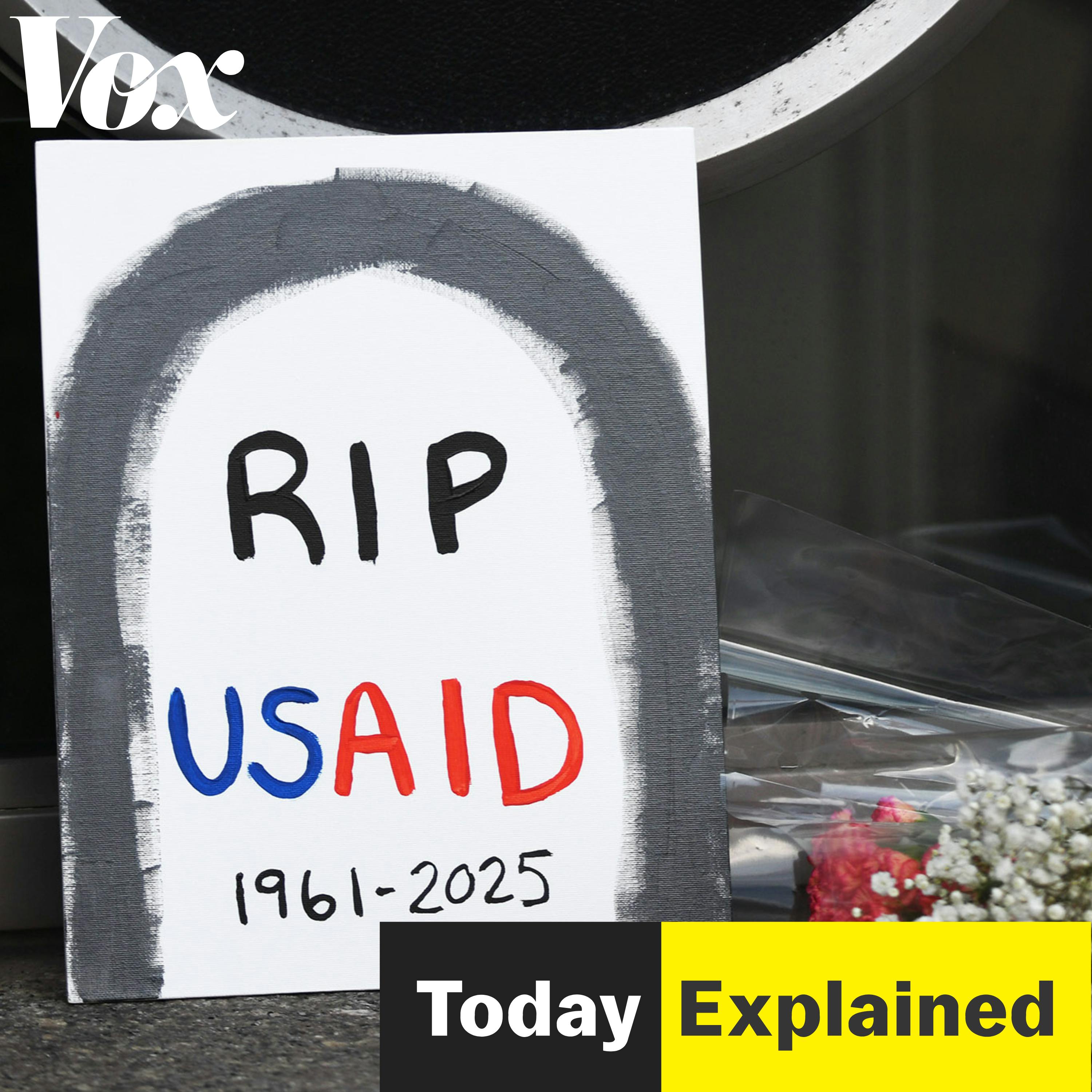
Today, Explained
DOGE-y behavior
00:27:24
Elon Musk promised to feed "USAID into the wood chipper." The way he's dismantling the agency provides a roadmap for the administration moving forward.
Loading summary
Transcript45 lines
- [00:02]
Andrew Natsios
It was way back in 1961 that John F. Kennedy, uncle of fluoride, established USAID.
- [00:09]
Preet Bharara
The people who are opposed to aid should realize that this is a very powerful source of strength for us.
- [00:18]
Andrew Natsios
Its motto from the American people and the American people gave a lot hundreds of billions for removing landmines in Vietnam, combating Ebola outbreaks in Africa, reconstructing Iraq and Afghanistan. More recently, humanitarian support in Ukraine and Gaza, and all for less than 1% of the federal budget. But if you go to USAID's website today, all you see is blank space, just a wall of white without the explicit authority to do so. The President has gone and dismantled the agency. We're going to ask a guy who used to run it what a world without USAID looks like on Today Explained.
- [01:00]
Dylan Matthews
This isn't your grandpa's finance podcast. It's Vivian to your rich BFF and host of the Net Worth and Chill podcast. This is money talk that's actually fun, actually relatable, and will actually make you money. I'm breaking down investments, side hustles and wealth strategies. No boring spreadsheets, just real talk that'll have you leveling up your financial game with amazing guests like Glenda Baker.
- [01:21]
Elon Musk
There's never been any house that I've.
- [01:22]
Dylan Matthews
Sold in the last 32 years that's not worth more today than it was the day that I sold it. This is a money podcast that you'll actually want to listen to. Follow Net Worth and Chill. Wherever you listen to podcasts, your bank account will thank you later.
- [01:37]
Andrew Natsios
Are we shaping AI or is AI shaping us? There's a number of existential risks that confront human beings. I think AI just being developed reduces the overall existential risk characteristics. I'm Preet Bharara and this week Reid Hoffman, entrepreneur, investor and author of Super Agency. What could possibly go right with our AI future, joins me on my podcast, Stay Tuned with Preet. The episode is out now. Search and Follow Stay Tuned with Preet. Wherever you get your podcasts.
- [02:16]
Elon Musk
You'Re listening.
- [02:17]
Andrew Natsios
To Today Explained Andrew Natsios served as deputy chief of staff for George H.W. bush. And then when H.W. bush's son became president, Natsios got to run USAID for several years. We asked him what he makes of all the USAID R A M A.
- [02:38]
Preet Bharara
Well, I'm appalled by all of this stuff because it's damaging the foreign affairs apparatus of the U.S. government. And this is just beginning. They're going after the CIA, the FBI. We have people all over the world that are very sympathetic because they know the American system because they used to work for us in high positions of power. The training ground for AI for the developing world were our scholarship programs and the Foreign Service nationals who worked on the staff. All of that is being wiped out now. The Chinese, by the way, during the Cold War, we used to give 20,000 scholarships a year to people who get their Master's degree and PhDs in the US a lot of countries like South Korea and Taiwan. Those PhDs ran the country for 30 years. And they're all very pro American. There's a reason for it, because they went to the United States to get their education. That was 20,000. They've cut the budget back and now it's getting wiped out. Guess who does 40,000 scholarships a year? The Chinese government does to promising students. So the Chinese now are taking over the world order and there's no way of countering it because they're shutting down the agency that works on this.
- [03:55]
Andrew Natsios
Can you help us understand what exactly happens around the world when presidential administration in the United States comes in and says, we, we are cutting USAID off immediately, effective immediately. What does that mean for people around the planet?
- [04:15]
Preet Bharara
We are 40. The international humanitarian response System. And famine, civil wars and natural disasters like earthquakes, 40% of it is USAID. And our response capacity is enormous. That's all collapsed completely. We used to send out DART teams whenever there's an emergency. DART team is a disaster Assistance Response Team. We can send them out in 48 hours. All gone. All the infrastructure is gone. Now some people are saying, oh, no. The State Department said they're merging all this in State. You cannot train someone in two months to do this stuff. Half the UN system will shut down in the emergency because we are the funders of it. So what's going to happen now is refugee camps and idp. Internally displaced camps are already depopulating because there's no food. There's no service is left. People are going to starve to death if they just sit there. And I'll tell you what's going to happen. There's going to be mass movements of population toward Europe and toward the United States. They think they have a problem with border security now. They haven't seen anything yet. There is a mess at the border. There is absolutely no question. We need to deal with that. Fentanyl is coming across. That's a real issue. But you know, we cannot stop the movement into the United States without dealing with the rest of the world. It can't be done. And if you leave the rest of the world and think we can build a wall around the United States that's going to protect us from this chaos. You're living in a fantasy world.
- [05:48]
Andrew Natsios
I just want to get something clear from you. Are people going to die because of this political decision?
- [05:55]
Preet Bharara
Absolutely, indisputably they are going to die. And it's not going to be a small number. Now, usually in a famine. I've been to famines. In the Somali famine, which was horrendous in 1991, 92, I watched children die right in front of me. So it is seared into my mind. I was just in Rwanda just after the Rwandan genocide. The Americans, you know, we've been a little insulated from this. We've never had a famine in the United States. I mean, people said, oh, some of the pilgrims died of starvation in 1620 during that winter. That's not a famine. Famines are when thousands of people die in a certain geographic area and it takes two or three years to stop it. Now, one of the things that's disturbing me, which shows what the either ignorance or they're doing it deliberately. I don't know and I don't want to judge. I think it's ignorance. The Famine early Warning system is the driver of a lot of what we do. In the emergency area of food security, what is is a predictive model. We take aerial photographs every day from satellites all over the world. In the food insecure areas, we compare the color on the ground from one year to the next. So in the first week of June, if the ground is green one year and brown the next, we assume there's been a crop failure that is not sufficient to tell what's happening on the ground. So we send teams in. There's a vast network of people who work with aid that actually don't work for us. They work with us. These are local people and they're economists, they're food experts, and they go in and find out what's going on the ground. That system now, they shut down. Well, basically, it's like driving a car with no steering wheel. The fuse system is the steering wheel. So you have a car full of food, it can't get where it's going because there's no steering wheel. And I've raised this repeatedly. They're not interested.
- [08:01]
Andrew Natsios
There's incredible optics of having the richest man in the history of our human race boasting about feeding USAID to a wood chipper. We know the sitting president thinks that this agency is helping a lot of, you know, quote, unquote, Shithole countries. And yet Marco Rubio is the one who's like most in front of this decision. And there I feel like there are disingenuous arguments being made that, you know, the whole agency is, is insubordinate. It's gone rogue. When I think just in the previous administration he was begging Joe Biden to increase funding to usaid.
- [08:40]
Preet Bharara
Both parties support aid, but now with the President and the base, the base has changed. Our base. I'm from a working class family, so I'm not criticizing working people. My grandparents were poor mill workers, $9 a week. My grandfather was illiterate in Greek and in English. But we did well, we did well over time. Okay, so these people are not into this. We've lost the upper middle class. The business community is not Republican anymore. And so the base of the party is not really into what's going on in the world. So they thought they could do this with no political consequences. They're making bizarre stuff up. They had a thing that $50 million has been spent on condoms in Gaza. Well, number one, no money has been sent on condoms in Gaza. Two, the president said it was $100 million. Nick Kristof said, well, we did the calculation. $100 million would buy 3 billion condoms for 1 million Palestinian men. Which is obviously utterly ridiculous.
- [09:46]
Andrew Natsios
You worked for both George W. Bush and his father. No one would consider you a raging liberal. Help us understand where this political divide came from on usaid. Why is it currently a source of conservative ire?
- [10:04]
Preet Bharara
It's low hanging fruit. And the people who are gonna be affected are in the developing world and, and they don't vote. They're poor people and they don't vote. And so it's easy to dismiss them. And they wanted to make an example of us. They wanted to make an example so they can go out now and go after other federal departments and agencies. Instead of dealing with the entitlement program, they're going after the infrastructure of the federal government. I think we're over regulated in terms of regulations, all agencies and departments. But there's a thoughtful way of doing that, a giant sledgehammer to smash the government. You do incremental changes. You don't do with a sledgehammer and retire 10,000 people and shut down agencies and programs. The first thoughtful thing any administrator does, left or right, is what are the unintended consequences of any action we take. I always did that in any program. They are not only doing that, they don't care. And that's the thing that's extremely dangerous here. There's going to be a catastrophe caused which we can't predict.
- [11:21]
Andrew Natsios
Andrew Natsios He's a professor at the Bush School of Government and Public Service at Texas A and M University in College Station, Texas. President Trump and Vice President Musk are just getting started. What we can learn from USAID when we're back on TODAY Explained. Support for Today Explained comes from Attentive Marketers need the right tools not just to get their message out there, but to make sure it's effective. And for that, you might want to try Attentive. Attentive is the sms, an email marketing platform that was designed to help brands build and connect with their ideal audience. Not just their audience, but their ideal audience. Attentive helps marketers create unique messages for every subscriber, transforming the consumer shopping experience and maximizing marketing performance. So here's how it works. Attentive's Advanced AI Fun learns what subscribers actually want based on their real time interactions with your brand. That helps them customize the content, tone and timing of every message so they always resonate. For messages that perform and result that transform, check out Attentive. You can visit attentive.com todayexplained to get started. Support for todayexplained comes from Vanta Santa that season's over. It's Vanta time, y'all. Vanta says that trust isn't just earned, it's demanded. Whether you're a startup founder navigating your first audit, or a seasoned security professional selling your GRC program that stands for Governance, Risk and Compliance. And I am grateful for the reminder. Proving your commitment to security can be critical, but it can also be complex. That is where Vanta comes in. Vanta says that businesses use their services to establish trust by automating compliance needs across 35 frameworks like SoC2 and ISO 27001. They can help centralized security workflows, complete questionnaires up to five times faster, and proactively manage vendor risk for a limited time. Our audience gets $1,000 off vanta@vanta.com explained. That's V A N T A dot com explained for $1,000 off vanta clause is coming to town. Foreign.
- [14:16]
Elon Musk
For Today Explained comes from Select Quote how often do you think about life insurance? It's a weird question and Select Quote gets that. They say they're not interested in offering one size fits all policies. Instead, their licensed insurance agents will work to tailor a term life insurance policy for your individual needs, according to Select Quote data. Select Quote has helped over 2 million customers find over $700 billion in coverage since 1985. Their licensed insurance can help you find a term life policy in as little as 15 minutes. And they say you don't need to worry about getting coverage with a pre existing health condition because Select Quote partners with carriers that provide policies for a variety of health conditions or if you don't have any major health issues, they also work with carriers that can get you same day coverage, no medical exam required. You can get the right term life insurance for you for less@SelectQuote.com explained. You can go to SelectQuote.com explained today to get started. What's that? That's SelectQuote.com explained.
- [15:32]
Andrew Natsios
Today. Explained is back. Sean Ramsford, I'm here with Dylan Matthews from Vox who writes for our Future Perfect section. Dylan, we just spoke with Profess Andrew Natsios, administrator of USAID during the last Bush administration. He said he was appalled to see what's happening to this agency. Why is removing this agency and targeting foreign aid such a top priority for this Trump administration?
- [15:59]
Dylan Matthews
So I don't know fully what's in the hearts of the Trump administration, but what I can say is that the last time around they proposed very serious cuts to foreign aid. None of them passed Congress, but this was a very consistent proposal. During Trump's first term, we were paying.
- [16:14]
Preet Bharara
Them tremendous amounts of money and we're not paying them anymore because they haven't done a thing for us.
- [16:20]
Dylan Matthews
I think also it's an easy target, strong people coming in and finding the weakest part of the federal government and throwing it against a wall to make an example out of it.
- [16:32]
Andrew Natsios
And are they making an example out of it so that they can do more of this kind of dismantling of federal agencies?
- [16:40]
Dylan Matthews
I think we're starting to see that as a pattern that they're going to try to play out, and we don't really know how far it's going to go yet. But already I've heard reports about Doge being in the building at the Social Security Administration, at the treasury, famously mucking with payments at the General Services Administration, which controls the physical buildings that a lot of the government is housed in. They've started working at the Department of Health and Human Services on Medicare and Medicaid, which is a huge, huge chunk of federal government payments. So I think it's fair to say that this is something they want to do across the entire federal government. And in fact, when they were criticized because foreign aid is such a trivial share of the overall federal budget, the defense was yeah, it's small, but like, wait till you'll see where, where we get going. So it's definitely not just about usaid. This is, this is a broader plan they have.
- [17:34]
Andrew Natsios
You wrote recently for Vox.com that Doge and Trump are kind of establishing a three step playbook here for messing with the federal bureaucracy. The civil service, the government run us through the three steps.
- [17:49]
Dylan Matthews
So I think the first step, and this is the thing that started on January 20, as soon as Trump was inaugurated, is pulling funding. So the first thing they did was announce that they wanted a 90 day freeze on all grants, contracts, anything related to foreign aid.
- [18:03]
Preet Bharara
Usaid, run by radical lunatics, and we're getting them out and then we'll make a decision.
- [18:10]
Dylan Matthews
If you've got an apple, it's got.
- [18:12]
Preet Bharara
A worm in it, maybe you can take the worm out.
- [18:13]
Dylan Matthews
But if you've got actually just a.
- [18:14]
Preet Bharara
Ball of worms, it's hopeless. And USAID is a ball of worms.
- [18:20]
Dylan Matthews
I just really want to underline that they can't do this. This is money that was appropriated by Congress legally. The President does not have the power to stop funding that was, was authorized and mandated by Congress, but they did it. And even though there have been court rulings against them doing this, in general, there haven't been specific USAID rulings, but there have been rulings about this general power. They do not appear to have stopped. Step two is polling, staffing. And so if you were trying to implement, say a delivery of food to Sudan in the middle of their civil war and possible famine, it's possible the person doing that is an actual federal employee. It's just as possible that that person was an institutional support contractor and they largely got furloughed by their organizations and were out of the building. Then they started in on people who were actually in the civil and foreign service who directly work for the government and were important in running USAID the Monday after the inauguration. So a week after inauguration, Trump or Trump's representatives within the aid infrastructure put about 60 people at the very top level of the civil and foreign service on administrative leave. It's like trying to run a middle school if you've put the principal and all the vice principals on leave. And so you're in a situation of pretty serious disarray to start with. And then the people who would have walked you through that situation are gone. And that's, I think, when people realize this isn't just sort of a temporary funding freeze, this is like a serious effort to dismantle this agency.
- [19:59]
Andrew Natsios
Okay, so Step one, pull the funding. Step two, pull the staffing. Step three.
- [20:05]
Dylan Matthews
So I think a very important part of this has just been instilling a culture of fear. One question I've had throughout this is, like, why aren't the contractors suing? And I think part of why that hasn't happened is that people are terrified that if you make yourself a problem in this moment, not only are you going to lose these contracts, you're never going to be a government contractor ever again. And not just at usaid, but across the government. And similarly, I think there was a very serious attempt to instill fear within the building. The stated purpose for putting the senior staff on administrative leave was that they were supposedly sabotaging the president's executive order. And that was sort of like putting a head on a spike. Moment of, if you try to sort of go against these executive orders because you think they're illegal or that they're going to get people killed, we're still willing to throw them on administrative leave and throw the agency into chaos. So what makes you think we won't do that to you, too?
- [21:08]
Andrew Natsios
Where did this playbook come from? Are they making it up as they go along? Because certainly we've never seen something quite like this in our federal bureaucracy.
- [21:16]
Dylan Matthews
We've never seen something quite like this. I think it's a synthesis of a lot of ideas that you separately heard about on the campaign trail and that people who are now prominent in the Trump administration have been speaking about for a very long time. So one is impoundment. This is the idea that when the Congress says, we want you to spend $45 billion on foreign aid, the president can choose to spend less of that if he wants.
- [21:40]
Preet Bharara
For 200 years, under our system of government, it was undisputed that the president had the constitutional power to stop unnecessary spending through what is known as impoundment.
- [21:53]
Dylan Matthews
This is more or less a crank theory that the Supreme Court unanimously ruled was not a thing and not constitutionally permissible. In the 1970s, when Richard Nixon tried to do it, USAID was a test case for can we impound things and get away with it? And I think there was a sense of a lot of people in the Trump administration that in the first term, they were frustrated again and again by what they called the deep state, which is just federal civil servants who are apolitical and are responsible for saying when something is illegal or goes against existing regulation, and were often a thorn in Trump's side. And so I think they spent the four years out of power thinking a lot about how to dismantle that element of the civil service once they got back. And usaid, I think, is one interesting illustration of how that works.
- [22:50]
Andrew Natsios
Okay, Elon Musk is out there saying there is gross waste in usaid. Some of the claims he's making are completely made up, complete fabrications. Like these millions of dollars on condoms for Palestinians.
- [23:05]
Preet Bharara
In that process, we identified and stopped $50 million being sent to Gaza to buy condoms for Hamas.
- [23:16]
Andrew Natsios
However, do they have a point that this agency was out of control and was wasting money, was wasting US Taxpayer dollars?
- [23:25]
Dylan Matthews
In part because I think foreign aid is an incredibly important government function. I think it's important to spend every dollar as effectively as you can. And this has been a shared goal of USAID administrators during the Obama years. Trump's first USAID administrator, a guy named Mark Green, who is a former congressman from Wisconsin under Samantha Power, who was Biden's. There's been just broad bipartisan agreement that not enough programs are grounded in high quality evidence, like randomized control trials, that there's too much overhead with private contractors, that more programs should be run locally by specific countries rather than by Western contractors coming in. I think they've made a lot of progress on that. It's not perfect, but they launched sections like Development Innovation Ventures, which is a small unit within USAID that functions kind of like a venture capital fund and moves really fast and scales up sort of pilot programs. They've done a lot to make it easier to apply for support in languages other than English, or if you don't have government connections and don't know the magic words to say in your grant application. What I think is particularly dangerous about this moment is that Trump has taken usaid, which used to be this very bipartisan thing where there was a broad bipartisan consensus that it's good, it needs to be reformed. We should do the following things to reform it. It'll take a while, but it's an important process. He's taking it from something that everyone from like Lindsey Graham to every Democrat in Congress could agree on and made it a hyper partisan political issue. That's really, really bad. When things have bipartisan consensus, they tend to get funded no matter what. When they are hyper partisan, it fluctuates a lot. And whether a kid in Kenya can get anti HIV drugs depends on an election half a world away. It's a really grim situation to be in, however the agency ends up at the end of this battle. Elon Musk said something about how it was finding the toughest guy in the prison yard and beating him up on your first day. The musk idea really got under my skin because it's evocative, because it's so much the opposite of what happened. This is like going up to the guy in a wheelchair in the prison yard and pushing him out of his wheelchair and for no good reason. This does not meaningfully change our deficit situation. Any of the like grants that they thought were dumb, sure, cancel those grants, but they like, left people who are on HIV drug trials completely abandoned, cut off from drugs. There's no reason for that. It's just cruel.
- [26:32]
Andrew Natsios
Dylan Matthews, senior correspondent@vox.com, his latest is titled the Worst Thing Trump has Done so Far. Guess what it's about. Miles Bryan and Devin Schwartz produced the program today. Jolie Myers edited them, Laura Bullard kept it legit, and Andrea Christensdotter handled the mix. It's today Expl. Sarah.