Loading summary
Transcript73 lines
- [00:01]
Sean Ramisviram
President Trump and his people appear to be hard at work on a new nuclear deal with Iran.
- [00:06]
Donald Trump
Because if we can settle it with a very strong document, very strong with inspections and no trust, I don't trust anybody.
- [00:16]
Sean Ramisviram
They gotta make a new one because Donald Trump tore up the old one the last time he was president. But I digress. The point of such a deal would be to make the Middle east, and thus the world, a safer place, one where we'd have to worry a little less about nuclear war. But at the same time, Donald Trump is trying to realize his dreams of a golden dome.
- [00:37]
Donald Trump
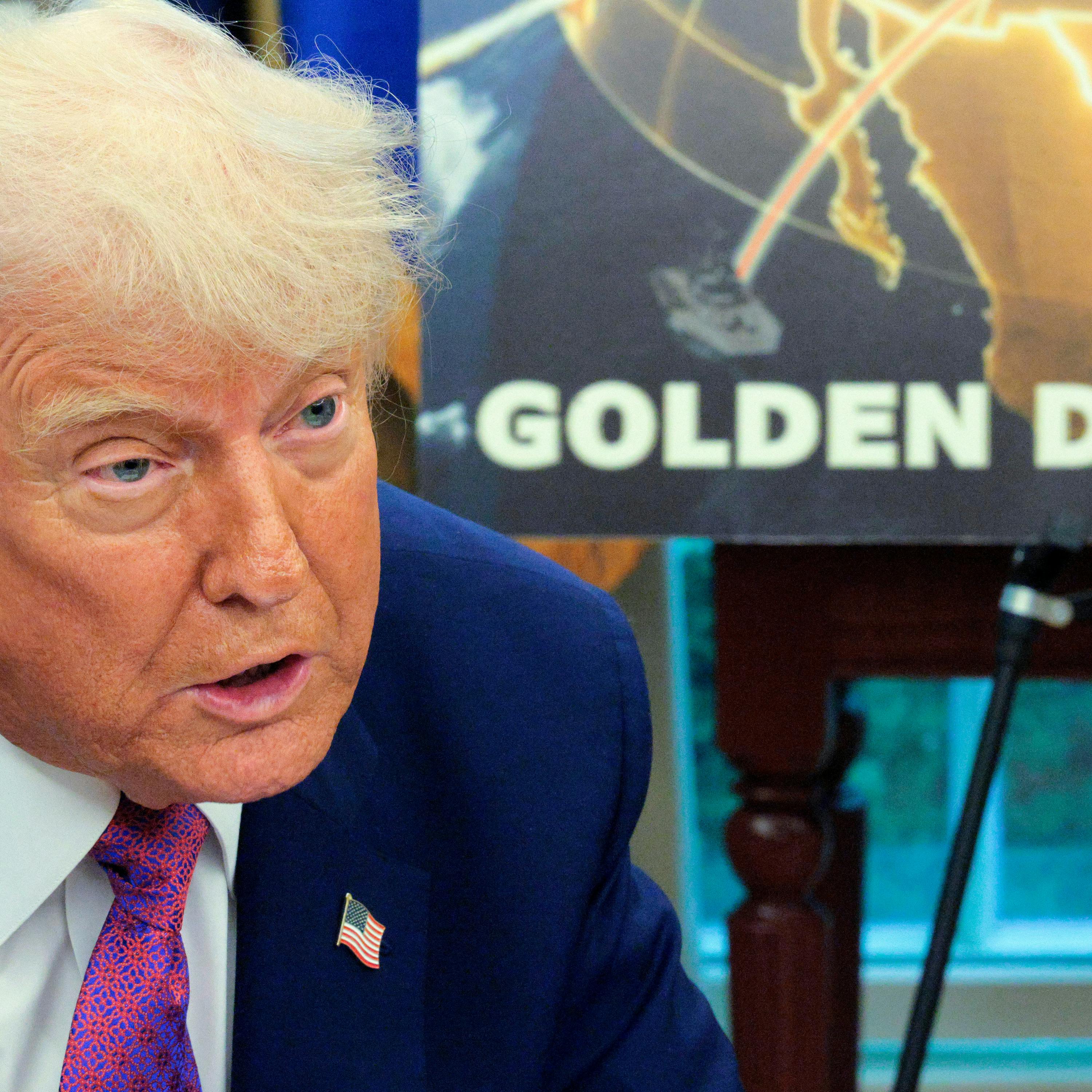
We're building the Golden Dome Missile Defense Shield.
- [00:40]
Sean Ramisviram
A Golden Dome missile defense shield would, in theory, protect the United States from nuclear war, but it turns out it might also make us more vulnerable. We're gonna tell you how and today expl Quick favor Before we get started here at Today Explained. We are planning for the future of the show and we want to hear from you to figure out how we can make our show even better for you. Visit voxmedia.comsurvey to give us your feedback. We want it voxmedia.comsurvey thank you.
- [01:19]
Audrey Decker
Support for this show comes from WhatsApp, the personal chat on WhatsApp is a place where you share everything from the mundane connections to to the memories that mean everything. It's a place that can truly feel like it's your own. And WhatsApp makes sure everything stays protected from outside eyes, even theirs. No one, not even WhatsApp, can see or hear your personal messages. That includes personal calls, plus any documents, photos or media that you share in your personal chat. WhatsApp message privately with everyone. Visit WhatsApp.com privacy to learn more.
- [01:59]
Pete Hegseth
It's an interesting time for business Trade policies are in flux and cash flows are tighter than ever. You need total visibility into what's happening under the hood of your company, and you need it all in one place. NetSuite by Oracle is an AI powered business management suite that brings accounting, financial management, inventory and HR into one centralized location. If your revenues are at least in the seven figure, download the free ebook Navigating Global Trade 3 Insights for Leaders at netsuite.com Vox that's netsuite.com Vox.
- [02:43]
Donald Trump
The golden age of America begins right now on Explained.
- [02:48]
Sean Ramisviram
Audrey Decker is a reporter for Defense One. Defense One covers the future of national security. So lately Audrey's been writing about the Golden Dome.
- [03:00]
Ankit Panda
A beautiful golden dome.
- [03:02]
Sean Ramisviram
Is it also beautiful like the bill?
- [03:06]
Ankit Panda
Well, we don't know what it's going to look like yet, but initially it was called Iron Dome, which is after Israel's Iron Dome system, essentially that protects that country from incoming missiles. But Iron Dome was copyrighted, so Trump renamed it to Golden Dome.
- [03:26]
Donald Trump
Once fully constructed, the Golden Dome will be capable of intercepting missiles even if they are launched from other sides of the world and even if they are launched from space.
- [03:37]
Sean Ramisviram
Okay, how long has Donald Trump been cooking up this Golden Dome?
- [03:40]
Ankit Panda
So he first put out the executive order in January when he put out a host of different executive orders. But this is actually an idea that dates all the way back to the Reagan administration. What if free people could live secure.
- [03:54]
Donald Trump
In the knowledge that their security did.
- [03:56]
Ankit Panda
Not rest upon the threat of instant.
- [03:58]
Suzanne
US Retaliation to deter a Soviet attack?
- [04:01]
Ankit Panda
It didn't happen back then, but technology's evolved. People say, we can do this now. And so he put out this executive order in January, basically outlining his desire to have a missile shield that can protect the country from threats. So that's everything from hypersonic weapons to nuclear armed missiles. But it's definitely different for the US Because Israel, you know, is the size of New Jersey. So scaling this shield to cover the entire US Would be much more complex and expensive than Israel's system. But we know as of now, initial planning, it's going to be probably different layers with sensors to essentially detect and track missiles and then interceptors to essentially shoot them down. And some of that stuff we already have in development. And then other aspects of it, we're going to have to completely develop new programs. So it's a really big undertaking for the dod.
- [05:09]
Sean Ramisviram
And you said expensive? How expensive?
- [05:11]
Ankit Panda
President Trump and Pete Hegseth, the Defense secretary, had a press briefing on Golden Dome two weeks ago, and Trump said he it will be $175 billion.
- [05:25]
Donald Trump
It should be fully operational before the end of my term. So we'll have it done in about three years.
- [05:31]
Ankit Panda
But the 175 billion figure, we don't really know exactly where he's getting that from because that's a lot less than some experts were guessing. Some experts were guessing, you know, it would cost in the trillions to do this. So the three year number that he also put out is quite aggressive. Some defense officials have said, you know, this would likely take in closer to seven years. So people are hesitant to read into, you know, specific cost figures, but it'll be a lot of money.
- [06:04]
Sean Ramisviram
How real is this thing that Donald Trump's talking about? Because he's also talking about, like, how Joe Biden might actually be a robot or whatever. Is this something he's talking about or is this something he's talking about?
- [06:19]
Ankit Panda
So if you talk to defense officials and experts, they say that this is doable, essentially, like we can build the sensors and other technology to get a better picture of the missiles that are coming towards the US but the part that may be impossible is essentially like the flagship part of this is space based interceptors. So basically that's an interceptor in space that could shoot down a missile within the first minute or so of launch, which is called the boost phase. But the physics of hitting a missile at boost phase from space is really hard, and they have to be in the right place at the right time, because you don't know where it's coming and you don't know where it's going. So you're gonna need thousands of these things, which drives up an expense putting all of them there in space, because China has, you know, hundreds of ICBMs, which are intercontinental ballistic missiles, nuclear missiles. So it's, it's not that feasible, really.
- [07:31]
Sean Ramisviram
Help me understand how exactly the United States is defending itself from these potential airborne attacks now and how that would change with a so called Golden Dome.
- [07:44]
Ankit Panda
So right now we don't really have a way to defend against nukes. I mean, nobody does. We are fielding some interceptor systems that are based on the ground in like Alaska, for example, to shoot down incoming missiles. But we don't really have a comprehensive way to defend against a broad range of threats, which is what Golden Dome is supposed to do. But it's built like that for a reason, essentially because the way the US and other countries have essentially like approached deterrence is based on mutually assured destruction, which means if an adversary strikes, we'd hit them back. And that devastating blow will prevent nuclear aggression. But the idea for Golden Dome is to build a system that would have the ability to stop that first strike. So not only would we stop the first strike, we would retaliate, probably. So the US theoretically would have the ability to launch a nuclear strike without fearing retaliation from that country, because we have built a system around the US to protect it. So that completely changes the existing deterrence framework.
- [09:05]
Sean Ramisviram
How are our greatest adversaries? I guess still Russia and of course China, responding to Donald Trump's interest in a Golden Dome.
- [09:16]
Ankit Panda
Oh, they're not happy about it. They've already put out statements saying that the US is basically encouraging an arms race and we're weaponizing space.
- [09:28]
Suzanne
The US Presses ahead with a Golden Dome system and deploys space based weapons, continually expands its military buildup, and stokes an arms race in outer Space.
- [09:40]
Ankit Panda
You know, the U.S. u.S. Officials have said Russia and China are also weaponizing space.
- [09:45]
Suzanne
And so, yes, they are advancing capabilities to destroy space, which is why we need to build resilience. It's why we created the Space Force.
- [09:54]
Ankit Panda
But it's. It's interesting because some of this could be rhetoric in a way, because this isn't the first time that this idea has surfaced. Like, it originates all the way back to the Reagan administration. And Reagan used that program, the Strategic Defense Initiative, which is what it was called back then, for leverage, essentially, while negotiating with the Soviet Union. So Trump could be using this program. Could be rhetoric or some negotiating tactic.
- [10:23]
Sean Ramisviram
Okay, so this may be a negotiating tactic. This may be real. In the meantime, are we going ahead and trying to realize this Golden Dome?
- [10:37]
Ankit Panda
Yes. So essentially, the White House says it's picked an architecture for what this will look like. They haven't released any details about what the architecture is going to look like, but we know they're going to need to buy sensors, interceptors, command and control systems to basically connect all of it. So they are going ahead with it. They have an industry days later this month, which is essentially where they just talk to defense companies about, hey, what can we buy from you? What can you develop now that could be ready in a few years? And obviously, industry, the defense companies are very excited about this prospect because it's a very large amount of money, and everyone wants a piece of this now because in four years after Trump's not president, this initiative could be very well canceled. So we see some of the defense primes, the big ones like Lockheed, going after it. I mean, Lockheed, you know, set up a whole website for Golden Dome, Watchtower.
- [11:37]
Suzanne
This is Looking Glass. We have a missile launch detection.
- [11:40]
Ankit Panda
They put out a promo trailer for Golden Dome, confirm target and initiate interceptor launch. And then also we see, you know, SpaceX could get a big piece of it.
- [11:52]
Suzanne
I mean, my mind is a storm.
- [11:54]
Ankit Panda
But yeah, so everyone does want a slice of the pie right now, because we don't know what's going to happen to the effort after Trump is out of office, whether it's canceled or not. But, yeah, it is going ahead, and we'll see some more details probably when the full budget comes out later this month.
- [12:14]
Sean Ramisviram
Okay. But in the meantime, Donald Trump has succeeded in potentially upending decades of nuclear armistice.
- [12:25]
Ankit Panda
Yep. Yes, indeed he has.
- [12:30]
Sean Ramisviram
We just leave it there. Yep.
- [12:33]
Ankit Panda
Yeah. And it's interesting because you talk to some defense officials about this, just, you know, you know, on background or whatnot, and a lot of people do say we need more missile defense. Like we need more. We need the ability to shoot down, you know, incoming threats to the homeland. But this is a completely different calculus because we're talking about potentially thousands of interceptors in space just revolving around the earth essentially that could be able to take down any missile at any time. So it's a completely different calculus than anybody you know, has ever tried to execute before. And it's a massive project. I mean, we're talking about the United States. So there's still a bunch of details that need to be worked out. But yeah, I mean, as of now, everyone's read into it. Everyone's tied in.
- [13:35]
Sean Ramisviram
You can read audrey decker@defense1.com A new nuclear Age when we are back on TODAY Explained.
- [13:44]
Suzanne
Foreign.
- [13:55]
Denise Guerra
Support for TODAY Explained comes from Betterment. Learning how to invest is one way to set up future you for success. But have you seen the markets lately? If you ever find that investing has started to feel like a second job, you can turn to Betterment for a little work Life balance. It's the automated investing and savings app that says they handle the work so you don't have to. Betterment builds and manages your portfolio and says it can help you with daily savings and spending and long term financial needs. They say they want to make it easy for you to invest for what matters. Their automated tools are meant to simplify the complex and put your money to work optimizing day after day. You can take time to rest and recharge because while your money doesn't need a work life balance, girl, you do. You can make your money hustle with Betterment. Get started@betterment.com that's B E T T E R ment com. Investing involves risk. Performance is not guaranteed avoiding your unfinished.
- [14:49]
Devin Schwartz
Home projects because you're not sure where to start. Thumbtack knows homes so you don't have to don't know the difference between matte, paint, finish and satin or what that clunking sound from your dryer is. With thumbtack, you don't have to be a home pro. You just have to hire one. You can hire top rated pros, see price estimates and read reviews all on the app. Download Today.
- [15:13]
Jolie Myers
Support for the show comes from Mercury. What if banking did more? Because to you, it's more than an invoice. It's your hard work becoming revenue. It's more than a wire, it's payroll for your team. It's more than a deposit. It's landing your fundraise. The truth is, banking can do more. Mercury brings all the ways you use money into a single product that feels extraordinary to use. Visit mercury.com to join over 200,000 entrepreneurs who use mercury to do more for their business. Mercury banking that does more.
- [15:54]
Denise Guerra
Increase its.
- [15:55]
Suzanne
Nuclear Arsenal Suzanne It's Nuclear Arsenal Nuclear Arsenal Today Explained so I'm Ankit Panda. I am the Stanton Senior Fellow in the Nuclear Policy Program at the Carnegie Endowment for International Peace in Washington, D.C. and the author of the recent book the New Nuclear Age at the Precipice.
- [16:15]
Sean Ramisviram
Of Armageddon Are we at the precipice of Armageddon?
- [16:18]
Suzanne
Hopefully not just yet, but nuclear weapons are unfortunately back at the center of international politics, in my opinion, after a roughly 30 year period of sitting somewhere in the background. So that's bad news. But there are ways, of course, to avert the worst outcomes. And that's kind of where the book ends. But it walks the reader through why things have gotten worse and the ways in which they're getting worse.
- [16:39]
Sean Ramisviram
Does the Golden Dome increase the tensions that you are writing about in your book?
- [16:45]
Suzanne
I think so, and I think the reason for that is often not clear, especially to sort of lay people, because who among us wouldn't want to be protected from missile attacks, right? That sounds like a very intuitive thing to want. I certainly don't want to get blown up. But turns out that that desire to be protected from missile attacks clashes with what we call nuclear deterrence, which I think most people are familiar with. You know, most folks have heard the term mutually assured destruction. They have something of an idea of why since 1945 we haven't lived in a world with nuclear wars, thankfully. And that reason is because of this idea that you and the other guy, if you both have nuclear weapons and you have the ability to hit each other, you're not going to start a nuclear war because there's really nothing to be gained. You might sort of throw punches underneath the nuclear shadow, as we just saw India and Pakistan do just a few weeks ago last month in early May. But when you add missile defense into this picture, things start looking really strange because that ability to throw punches at each other, nuclear punches for one guy, starts to look very different if the other guy has missile defense systems. The last thing I'll say on Golden Dome is that what's really different about the missile defense conversation now compared to the last 30 years, is it's not just us in the United States that are leading on missile defense, which really was the case in the 90s and the 2000s. The Russians and the Chinese were, you Know, the Russians were recovering from the collapse of the Soviet Union and in a very bad economic and social position in many ways, China was still developing. Today, Russia and China actually have some pretty capable missile defense capabilities that we are worried about. Right. And I just raised this because I think listeners need to understand that if tomorrow, you know, Xi Jinping gives a speech where he says, I'm going to build a, I don't know, jade dome for China right here. Pick your precious, precious material. We would not like that at all because we have a nuclear modernization program in this country where we're making assumptions about what our missiles are going to need to do until, you know, essentially the end of the 21st century. And if China builds, you know, a jade dome or whatever, that is going to ruin our day. So all of this, I think has really sort of fallen off the agenda in Washington because everybody's thinking, you know, oh, these tech bros are going to figure out a great kind of space based interceptor and we're going to launch it for pennies. And you know, Reagan's Star wars vision is actually going to manifest this time. I think there's a lot more that you have to sort of bring into the conversation to reason about this golden dome in a more fulsome way.
- [19:06]
Sean Ramisviram
I guess when people are thinking about being on the precipice of Armageddon when it comes to nuclear arms, they would think about the United States and Russia and China and maybe even North Korea. But you mentioned that India and Pakistan were recently taking shots at each other.
- [19:21]
Donald Trump
India firing missiles into Pakistani controlled territory overnight, reportedly killing at least 26 people in what Pakistani leaders are calling an act of war.
- [19:30]
Sean Ramisviram
Remember, it went further into Pakistani territory than at any point since 1971. And the reporting indicates that some of its strikes went close to one of Pakistan's nuclear command centers.
- [19:43]
Pete Hegseth
President Trump announcing a short time ago, the two nations have agreed to a quote, full and immediate ceasefire following, quote, a long night of talks mediated by the United States.
- [19:53]
Sean Ramisviram
Tell us what happened there in greater detail.
- [19:56]
Suzanne
What happened between India and Pakistan is really interesting because it's actually the first crisis I would argue between the two South Asian nuclear armed neighbors of this new nuclear age. What do I mean by that? The Indians used, you know, both the Indians and the Pakistanis used a number of new military technologies that they haven't really used against each other in the past. So drones precise air power at SC to really kind of expand, at least from the Indian perspective, the space for throwing punches beneath the nuclear shadow. So my assessment now it's been about almost four weeks. You know, at the time I was sort of watching things play out live. I was quite concerned. It looked like things could really get out of control between the two countries because of that essential nature of the fog of war that sort of contributes to this idea that escalation might not be controllable. They were able to walk away, but we have to, of course, now pay attention to these new dynamics in South Asia. And what I often say is that it's very easy to sleep on India and Pakistan until they have a crisis, because we don't think of them, at least in the United States, as being a nuclear problem at the forefront. You know, we're thinking about North Korea, China and Russia for good reasons. But as we just got a reminder just in the last month, India and Pakistan are still. Are still here, and they still have nukes. And the dynamics are getting really interesting.
- [21:15]
Sean Ramisviram
So on one hand, you've got the United States sort of intervening between India and Pakistan to de escalate.
- [21:21]
Donald Trump
I said, fellas, come on, let's make a deal.
- [21:23]
Sean Ramisviram
On the other hand, you've got the United States pitching a golden dome to the world, which we're saying here is escalating tensions.
- [21:32]
Donald Trump
Golden dome, missile defense shield. That's something we want.
- [21:35]
Sean Ramisviram
Is anyone out there just broadly trying to de escalate all of these tensions around the world?
- [21:41]
Suzanne
Well, look, I mean, I think you're pointing out something really important, which is that there's just so much incoherence around what this administration is doing on nuclear risks. Like, I was really worried when the India, Pakistan thing started, that this might be the first Crisis since essentially 1990. That is terrifying. But of course, that didn't happen in the end because it was sort of a moment of baptism by fire. You could say for these America Firsters who realized, well, yeah, you could say America first. But turns out a nuclear war, no matter where it occurs, even if it's on the other side of the planet, has implications for US Interests. And then you have Donald Trump talking about denuclearization. You know, he said nuclear weapons are too expensive.
- [22:17]
Donald Trump
We're all spending a lot of money that we could be spending on other things that are actually hopefully much more productive.
- [22:23]
Suzanne
He's proposed that Russia, China, the United States get rid of half of their nuclear weapons or all of their nuclear weapons.
- [22:28]
Donald Trump
Be great if everybody would get rid of their nuclear weapons.
- [22:32]
Suzanne
And you can see why that's totally at odds with what the golden dome incentivizes. It incentivizes a buildup But Trump wants denuclearization. But at the core of your question is, of course, arms control. Right, which is this tool that we've relied on for decades, about 50 years. Now with Russia, we are coming to the end of what might be a 50 year period of continuous arms control of some form with the Russians on strategic forces. On February 5, 2026, the last remaining treaty that applies numerical limits on the number of so called strategic nuclear weapons, the big ones that go across the planet, that will expire and there is no option to extend that treaty. So nobody is particularly optimistic about arms control today. But the point that I make is that if we are to continue surviving as a species, we will have to think about this tool because our mutual interests as adversaries, US Russia, US China, US North Korea, compel us in this direction.
- [23:32]
Sean Ramisviram
Okay, so you're saying we're in a new nuclear age where things are getting tense and treaties are sort of falling off. There doesn't seem to be just like, vibes here. There doesn't seem to be the same level of like, fear, you know, amongst say, the American population that we may all go down in some sort of nuclear holocaust that there may have been during the Cold War. I feel like more people I talk to are afraid of what AI is going to do or climate change. Why is that? Why isn't there the sort of, you know, associated fear of nuclear war that you may have seen in the 1970s or 80s?
- [24:24]
Suzanne
Yeah, look, I mean, I think it's lived experience, right? Like, I'm a millennial. I'm in my 30s, and the world I grew up in, I don't know about you, was not a world where I had to really worry about nuclear war. Most people my age, you know, that were interested in national security care about counterterrorism. You know, the 911 attacks were really the formative experience that many people, at least in the millennial generation, had for reasoning about national security issues. And then, as you said later, climate change, now artificial intelligence, which is very front and center and visible. If you were a Gen Xer growing up in the 80s, you know, many of my good friends are in that cohort. They tell stories about, you know, some of their first memories about fear. And like, you know, we don't want children to live in a world where they have to think about death. But if you were like, you know, an elementary schooler in the 80s doing duck and cover exercises, you thought about death. And that is really, really formative for a generation of people. Right? And look, I mean, our national leaders and lawmakers largely are older to include, you know, the current president, the former president. You know, I always think it's incredible that Joe Biden was 19 when the Cuban Missile crisis happened. But at the same time, I do think for younger generations, for millennials and Gen Z, there is a strong need to understand, not to sort of run around with your hair on fire, but to understand the reasons why nuclear weapons are now coming back into the forefront of politics and why for the rest of our lives, potentially, you know, we're all going to live in a world where these risks become a lot more visible before they're once again tamed. Because the alternative to not taming these risks, of course, is Armageddon. Right. So that gives you a pretty strong incentive as a citizen and hopefully as national leaders to take these risks seriously.
- [26:21]
Sean Ramisviram
Ankit Panda, as you know, is the author of the New Nuclear Age at the Precipice of Armageddon. Sounds scary. Denise Guerra and Devin Schwartz made our show today. Jolie Myers edited, Miles Bryan was on fax. Andrea Christenstaucher and Patrick Boyd were on the mix. I'm Sean Ramisviram. I was on the mic for today, explained Sam.