Loading summary
Transcript90 lines
- [00:01]
Sean Ramaswaram
Basically everyone except Israeli Prime Minister Benjamin Netanyahu appears to be gravely concerned about starvation in Gaza. More than 100 aid organizations like Doctors Without Borders and Oxfam just signed a letter saying that restrictions, delays and fragmentation under Israel's total siege have created chaos, starvation and death. 30ish countries, including a bunch of Israel's own allies, have issued a statement condemning the drip feeding of aid and the inhumane killing of civilians, including children seeking to meet their most basic needs of water and food. Even President Trump is balking. Here's a bit of what he said on Monday from Scotland.
- [00:48]
Johnny Moore
We have to help on a humanitarian.
- [00:50]
Sean Ramaswaram
Basis before we do anything. We have to get the kids fed. Gaza's breaking point on Today explained.
- [01:00]
Johnny Moore
You have five new messages.
- [01:02]
Anat Peled
Hey Carl, it's Jen from Finance. Could you submit your expenses this week? Hey Carl, Happy Friday. It's Jen, Finance. Just need those receipts today. Me again, Carl, really need those receipts like last week. Please just tell me where they are. Are you by your desk right now?
- [01:18]
Sean Ramaswaram
Finance teams, you shouldn't be chasing down Carl or anyone else with ramp. Expenses are sent with a text and reminders happen automatically. Switch your business to ramp.com and love finance. Again, support for this show comes from Robinhood. Wouldn't it be great to manage your portfolio on one platform? With Robinhood, not only can you trade individual stocks and ETFs, you can also seamlessly buy and sell crypto at low costs. Trade all in one place. Get started now on Robinhood Trading. Crypto involves significant risk. Crypto trading is offered through an account with Robinhood Crypto llc. Robinhood Crypto is licensed to engage in virtual currency business activity by the New.
- [01:58]
Anat Peled
York State Department of Financial Services.
- [01:59]
Sean Ramaswaram
Crypto held through Robinhood Crypto is not FDIC insured or sipc. Protected investing involves risk, including loss of principal. Securities trading is offered through an account with Robinhood Financial LLC member sipic, a registered broker dealer.
- [02:19]
Anat Peled
You're listening to TODAY Explained. My name is Anat Peled and I'm a reporter for the Wall Street Journal based in Tel Aviv, covering the war.
- [02:28]
Sean Ramaswaram
And it seems like this war has reached maybe yet another breaking point in just the past few days. Can you tell us what's going on?
- [02:37]
Anat Peled
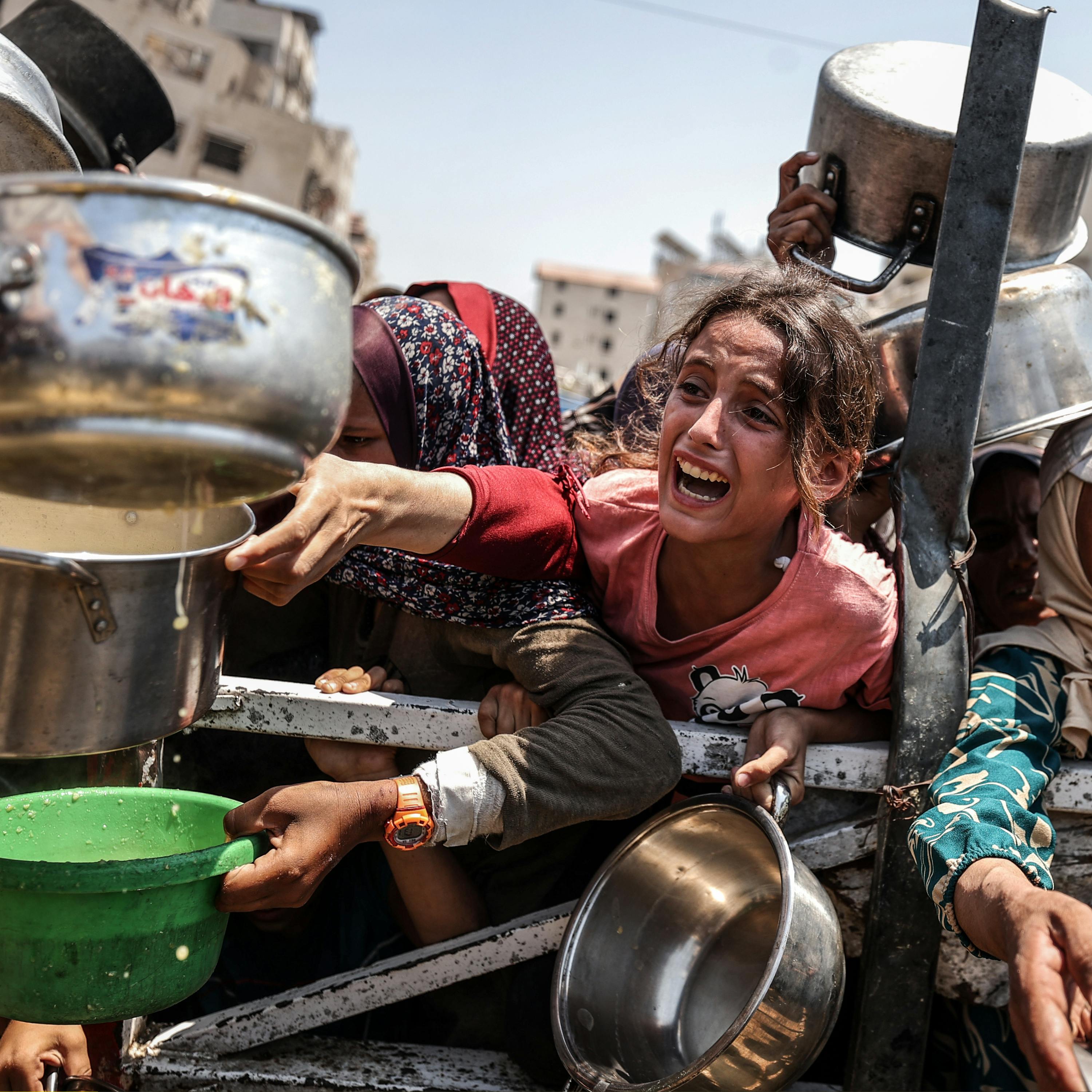
Definitely. So we're seeing a dire hunger crisis, starvation in the Strip, and this has just caused international condemnation. We're seeing a lot of countries. We saw a group of almost 30 countries speaking out against it, and we saw over 100 humanitari and charity groups talking about it. And what this caused was a lot of pressure on Israel in the past few days. And on Saturday it actually had to up the aid as a result of this pressure. They're saying a few things will happen. They're saying that they're going to reintroduce airdrops, which are a very expensive form of aid distribution. That actually is not the most effective. You can get a lot more aid through aid trucks on ground routes. And they're saying they're going to have these pauses in the fighting so that people can get to the aid safely. And they're saying they're facilitating more aid to come in from the un. The starvation that we're seeing inside the Gaza Strip is a result of two things and that is the first, that Israel basically stopped any aid, fuel or medicine from coming into the Strip after, you know, a January ceasefire fell apart. And that just caused a really horrible situation in terms of food security. And then when it ended that, it launched a new controversial program along with the U.S. it's an Israeli, American backed program to basically totally reshape how aid is going to enter Gaza. And that did not work.
- [04:17]
Sean Ramaswaram
And that program, of course is the Gaza Humanitarian foundation we've talked about on the show before. We're gonna talk about it much more today. But before we do, can you just tell us how dire things have become? I mean, people have been hungry in Gaza throughout this war, but it feels like things have become far more deadly in the past few weeks. There's reporting that one in five children is malnourished and that dozens so far at least have died.
- [04:44]
Anat Peled
Yeah, the situation is, I think, the worst we've seen since the start of the war. And you see that, I think in the images, the videos that are all over the news. And you see a lot more desperation.
- [04:56]
Sean Ramaswaram
We've had enough of starvation and oppression, enough of staying in the streets like dogs, where no one looks at us, where we can't find anything for our children to eat or drink. Nohan Salha's five month old daughter is one of 30 children here suffering from malnutrition. I can't do anything for her. She says it's a really hard thing for a mother to feel like this.
- [05:18]
Johnny Moore
It's indescribable.
- [05:20]
Anat Peled
We've also seen other scenes in Gaza, you know, where, you know, UN trucks are coming in and people just storm them because they're so. They're hungry, they're desperate. So the scenes are just horrible. We entered the death trap near the tanks and we saw the soldiers and.
- [05:39]
Sean Ramaswaram
They shot at us, they shot us.
- [05:40]
Anat Peled
With flares and bullets. Look at the young men. All the bags of flour have blood on them.
- [05:45]
Sean Ramaswaram
Listen, we are bringing this for our children.
- [05:48]
Johnny Moore
It gets overcrowded. It's like an ocean of people coming and waiting for aid. Crowded, chaotic and dangerous as there is ongoing heavy shooting by machine guns.
- [05:57]
Sean Ramaswaram
And of course, adding to the sense of chaos and anarchy in Gaza around aid or just around the entire situation is the fact that something like a thousand Palestinians have died trying to get aid. And your team at the Wall Street Journal has been doing on the ground reporting on, on what exactly is going on at these aid sites through this Gaza Humanitarian Foundation. Can you tell us what you've seen there?
- [06:24]
Anat Peled
Yeah. So basically, Israel launched this controversial new program, Israeli, American backed, a little more than two months ago. Our reporting shows that it was meant to eventually replace a system that has been in place since the start of the war. And that is basically, you know, aid trucks coming in from the UN mostly and aid organizations. And they were going to around 400, you know, aid distribution sites across Gaza. And Israel has claimed over the war that Hamas has been taking over control of aid. And specifically, it argues, UN aid.
- [07:00]
Sean Ramaswaram
Hamas robs, steals this humanitarian aid and then accuses Israel of not supplying it.
- [07:07]
Anat Peled
Israel for a long time, we know, starting as, you know, as early as December 2023, there were meetings about this, decided try to completely change the way aid goes in by basically privatizing it. So it brought in private American contractors and a new foundation was launched called the Gaza Humanitarian Foundation. And so it set up four aid sites to replace hundreds of sites. My colleague Dov Lieber, who I reported a piece on this last week, we basically got access through an army embedded to go see how the distribution goes. And so basically what my colleague saw and, you know, he took videos and he's shown me that, and we describe it in the article.
- [07:53]
Johnny Moore
About an hour, I watched people walk around 2km from their homes in Khan.
- [07:57]
Sean Ramaswaram
Yunis or in Marwassi tent camp near.
- [08:00]
Anat Peled
The seaside and gather outside the 8 distribution site. And so my colleagues, at the height of a makeshift military installation, and he could see this pool of people growing.
- [08:13]
Sean Ramaswaram
But it was clear that already the.
- [08:15]
Anat Peled
Crowd knew the site was getting rowdy, even if people were walking to it slowly and calm. And then suddenly, an instant, you know, this rush began and men broke through the security line.
- [08:26]
Sean Ramaswaram
All hell broke loose very, very fast. Suddenly everyone began sprinting towards the aid distribution site, running as fast as they could. And everybody, as quickly as they could, grabbed the boxes of aid.
- [08:38]
Anat Peled
We could hear what sounded like the sound of semi automatic gunfire and basically within 15 minutes all the food was gone. It was this mad dash.
- [08:48]
Sean Ramaswaram
The moment people recognize that order has broken down, they move as quickly as.
- [08:54]
Anat Peled
They can to get any aid. Because what they don't know is if.
- [08:57]
Sean Ramaswaram
This site will be open tomorrow or the next day.
- [09:00]
Anat Peled
They don't know if this is the.
- [09:01]
Sean Ramaswaram
Last box of aid that they'll be.
- [09:02]
Anat Peled
Getting for some time. And you know, while there were no casualties reported from that site that day, the next day on July 16, a Wednesday, at least 20 people were trampled to death at the same exact site. And GHF said that its security contractors had pepper sprayed people rushing that day. So, you know, it did not go very smoothly.
- [09:29]
Sean Ramaswaram
Who's doing the shooting at these sites? You guys were there. You have video. What did you see?
- [09:36]
Anat Peled
Yeah, so our reporting shows that it's Israeli troops that have been firing what they call warning shots at Palestinians trying to come to these aid sites. And basically the army has acknowledged that. But I was able to speak to a reservist, so an Israeli military soldier who was stationed in southern Gaza, and he told me that he saw the troops opening these warning shots which could be in the air and towards the knees, but also at times were just directed at the crowds. If forces thought they were in danger, the people were coming too close to them. And he saw that even happen to a group that was carrying white flags, Palestinians carrying white flags. So Palestinian authorities say that hundreds of Palestinians have been killed from IDF fire. And the Israeli military acknowledges that it has fired towards crowds, but it claims that the numbers are inflated.
- [10:33]
Sean Ramaswaram
It's so hard for people to wrap their heads around the fact that in this situation where people are so desperate they can't even survive trying to get food. And you mentioned that the whole reason for the Gaza Humanitarian foundation being introduced to this war was these allegations that Hamas was stealing food from the United nations, from the United States. Reuters reported just Friday. I believe that USAID stated that while Hamas may have stolen food at some point, they weren't stealing anything from the United States. And I think there's been further reporting that there's been no significant theft from the United Nations. Was the Gaza Humanitarian foundation ever needed in this situation in the first place? Why are they there?
- [11:22]
Anat Peled
I mean, it depends who you're asking. The Israelis would argue that it is needed at least, you know, publicly. We should say that there has been a major issue with looting of trucks, including UN trucks. Gunmen have been doing that throughout the war. It's really hard to tell who's doing the looting? Our reporting has shown that Hamas has stolen some aid, but it's hard to know if they were stealing was it specifically more UN aid or other kind of aid. Publicly, Israel is still arguing that this solution is needed and is saying that it works, although it's clear to a lot of people that it's not working. And even the goal of getting the aid out of Hamas's hands, there is no screening at these sites. It's just a mad rush, first come, first serve. And they don't know who's coming to these sites. So that's also another factor. We still need to see what's going to happen to GHF going forward because one of Hamas's, you know, major demands in the ongoing ceasefire negotiations is actually to, you know, get rid of GHF and have the UN go back to the old UN backed system. And you know, right now we still don't have a ceasefire. We don't know what will happen before this. You know, GHF and Israel have been talking about expanding and getting more opening more GHF sites, but that wouldn't seem possible if the ceasefire is reached.
- [12:56]
Sean Ramaswaram
Anat Peled and her colleague Dov Lieber wrote a big story about the dire aid situation in Gaza titled why Israel's Chaotic New Food Program in Gaza has Turned so Deadly. You can find it@WSJ.com guess who's in charge of the Gaza Humanitarian Foundation? The answer is either not what you'd expect or exactly what you'd expect. We'll have it when we return. On Today explained.
- [13:43]
Anat Peled
Support for today's show comes from GiveWell. Perhaps you've heard about these cuts to foreign aid. Perhaps you even heard about them. On today explained. GiveWell is a nonprofit research organization that says for the last 18 years they've helped guide more than 130,000 donors and two and a half billion of their dollars to highly cost effective aid. GiveWell does not claim to have all the answers, but they do say their researchers are analyzing the effect of cuts to USAID in real time and sharing what they've learned with everyone for free through research updates, grant write ups and candid conversations on podcasts. GiveWell says they've already committed to tens of millions of dollars in response to this year's cuts and that their researchers are working to forecast, find and fund other cost effective needs. For trusted evidence backed insights into this evolving situation and information on how you can help, follow along@givewell.org USAID.
- [14:43]
Sean Ramaswaram
Avoiding your unfinished home projects because you're not sure where to start. Thumbtack knows homes, so you don't have to don't know the difference between matte, paint, finish and satin or what that clunking sound from your dryer is. With Thumbtack, you don't have to be a home pro, you just have to hire one. You can hire top rated pros, see price estimates and read reviews all on the app. Download Today.
- [15:08]
Anat Peled
This episode is brought to you by JCPenney. And if you've been to JCPenney recently, yes, JCPenney, you'll know it's becoming the way to find good clothes for prices.
- [15:19]
Johnny Moore
That still make sense.
- [15:20]
Sean Ramaswaram
They've got hidden gems for everyone and.
- [15:22]
Anat Peled
Every budget with deals and rewards that actually make a dent. If you already shop JCPenney, you feel like you know a secret. But if not, it's time to ask. Wait, am I sleeping on JCPenney?
- [15:34]
Sean Ramaswaram
Shopjcpenney.com, yes, JCPenney. Sean RamasForum Today explained the Gaza Humanitarian foundation is at the center of this starvation story and just about every story about people being shot and even killed while trying to get aid. So we wanted to figure out who's in charge. We asked Arno Rosenfeld from the Forward, the largest Jewish news outfit here in the United States. He said it wasn't someone with deep experience in humanitarian aid. It's a guy with deep experience in public relations.
- [16:19]
Johnny Moore
Yeah. So Johnny Moore is an evangelical leader with a long history in Republican politics. He graduated from Liberty University and then worked in communications for them for a number of years.
- [16:31]
Sean Ramaswaram
At Liberty University, we have welcomed God, who authored all knowledge into the educational process. God is not an exile to this campus. God is in the heart of this campus.
- [16:43]
Johnny Moore
That's a university founded by Jerry Falwell, like a sort of big evangelical Mecca in the country. And then he went from that into basically pr. And so he was running a boutique PR firm that got acquired recently by a larger firm. And they do work for both, like Marriott Hotels and also Focus on the Family. So it's not exclusively sort of conservative religious causes, but it includes that. And then he's had various roles in the government. So he was an evangelical advisor to President Trump during his first campaign, you know, prayed with Trump in the White House.
- [17:15]
Sean Ramaswaram
Prayed with Trump. Didn't know Trump was a big prayer.
- [17:18]
Johnny Moore
Well, you know, he's surrounded himself with these leaders.
- [17:21]
Sean Ramaswaram
You know, someone asked me not long ago, you know, is it true that, you know, an evangelical is in the White House like every week or every day or something? And my Answer was, you know, maybe like a dozen times a day, you.
- [17:34]
Johnny Moore
Know, And Liberty was, I think, a big part of burnishing his conservative evangelical bona fides during that first race.
- [17:40]
Sean Ramaswaram
Two Corinthians, right?
- [17:42]
Johnny Moore
Two Corinthians, 3, 17.
- [17:44]
Sean Ramaswaram
That's the whole ball game. Where the spirit of the Lord, right?
- [17:49]
Anat Peled
Where the spirit of the Lord is, there is Liberty, and here there is.
- [17:53]
Sean Ramaswaram
Liberty College, but Liberty University. But it is so true.
- [18:00]
Johnny Moore
So he has a long history there, and then he's held various posts in the government. He was on the committee that the US has to sort of promote religious freedom around the world. So he's traveled around the world to defend the religious liberty of Muslims in China and different groups in different countries in the Middle East.
- [18:17]
Sean Ramaswaram
The world is safer because of this administration's policies. It is unprecedented when it comes to religious freedom.
- [18:22]
Johnny Moore
So he's had long ties to the Trump administration, and now he is in this new role as a humanitarian.
- [18:28]
Sean Ramaswaram
Right. Everything makes sense up until. And now he's in this new role as a humanitarian because as you're saying here, he's basically a PR guy. How does he go from PR flak in the Trump administration to in charge of maybe one of the most humanitarian missions on the planet?
- [18:48]
Johnny Moore
You know, the Gaza Humanitarian foundation is a very strange entity, but the sort of most direct answer to your question is he has a lot long history of supporting Israel, of traveling to Israel.
- [19:00]
Sean Ramaswaram
Israel has impacted me far, far more than almost anything else. I almost can't think of my life inseparable from Israel.
- [19:06]
Johnny Moore
In some ways, he's deep into the world of Christian Zionism. Of course, a lot of Israel's strongest supporters in the United States are evangelical Christians. And so he comes out of that world and has these ties. And I think for a variety of reasons, when they were looking for someone to take over this organization after the executive director stepped down, just before they started operations, they brought him in to, I think, burnish its reputation. He's been on a big media tour, so he's leaning into his sort of PR expertise in this new role.
- [19:35]
Sean Ramaswaram
What's he saying on his big media tour?
- [19:38]
Johnny Moore
You know, his argument is basically that the Gaza Humanitarian foundation is the victim of a series or a variety of conspiracy theories.
- [19:48]
Sean Ramaswaram
Despite what you may read in the press and the criticism that you hear from the United nations and other institutions, what we're doing has actually been unbelievably effective, and so effective that Hamas itself is not happy about it.
- [20:05]
Johnny Moore
So the Gaza Humanitarian foundation is a victim of a conspiracy promoted by the United nations, which wants to sort of hoard all of the aid and the glory for delivering food for themselves.
- [20:16]
Sean Ramaswaram
And so it seems to us that the United nations is basically saying either UNRWA can do everything UNRWA did before and UNRWA is the only coordinating mechanism. It's UNRWA or the people of Gaza starve.
- [20:30]
Johnny Moore
And also on the part of Hamas, which is promoting. He's sort of claiming that Hamas is on their own PR tour and has sort of snookered all of these reporters around the world into repeating lies about the humanitarian situation in Gaza.
- [20:42]
Sean Ramaswaram
Hamas has intentionally harmed Gazans in order to allege that it was the IDF or that it was GHF in order to disincentivize people from coming to our aid distribution sites to fuel their disinformation narrative.
- [20:58]
Johnny Moore
So basically, GHF is doing great work. They're doing the most Christian thing possible, in his words, feeding people.
- [21:05]
Sean Ramaswaram
There's nothing more Christian than feeding people.
- [21:07]
Johnny Moore
And unfortunately, the basically entire international aid community, at the behest of the UN and perhaps also Hamas just has it in for them, and it's very unfair. But they're not going to let that stop them from doing the Lord's work.
- [21:20]
Sean Ramaswaram
What does he have to say about all the dead Palestinians?
- [21:25]
Johnny Moore
The dead Palestinians as a result of starvation or as a result of being shot while trying to get food from his organization?
- [21:32]
Sean Ramaswaram
The second one.
- [21:34]
Johnny Moore
So his argument is, again, it's very tragic. They never want anyone to lose their lives. He said that they complain often to the IDF when the IDF shoots at people queuing for aid. He says the IDF has taken responsibility for those incidents. He says Hamas has also attacked GHF employees and Palestinians trying to get aid from JHF and that Hamas has not taken responsibility from that. He also said that more people are being killed trying to get UN And World Food Program aid than have been killed trying to get his organization's aid. It depends a little bit how you parse the statistics. I don't think that's true, but that's what he's been saying in these kind of public appearances.
- [22:16]
Sean Ramaswaram
Is he convincing anyone?
- [22:20]
Johnny Moore
So I think that one of the things that's important to understand about his role and really about what I think the Gaza Humanitarian foundation is intended to do, is that there is a segment of Israel supporters in the United States that live in a little bit of an alternate reality. And I think his job is to convince those people that Israel and that the United States is not responsible for Palestinian civilians starving in Gaza. So, for example, the piece that I wrote was about him addressing the American Jewish Congress.
- [22:50]
Sean Ramaswaram
Thank you so much for having me today. And I just want to begin by saying that I join all of you in also waiting for the return of the hostages.
- [23:01]
Johnny Moore
And his argument to them was basically, yes, there is a humanitarian crisis. We're doing everything in our power. The United States and Israel are doing the right thing. Unfortunately, you know, all these other aid groups are just letting food rot. So I think it's a fairly persuasive. You know, he's a charismatic guy. He's good at talking to these audiences. So I do think it's a convincing message for that audience. It's just a very specific audience.
- [23:29]
Sean Ramaswaram
Does it tell us something, though, that this is the kind of person that was put at the top of this operation, that it wasn't someone with deep experience in aid, but instead someone. Someone who would sort of fight the PR war around the effort?
- [23:43]
Johnny Moore
It's another good question, because Cindy McCain, you know, John McCain's widow, runs the World Food Program. So it's not totally unprecedented to have people who have a sort of public profile and political connections sort of in these figurehead roles atop humanitarian organizations. But Cindy McCain, after a lot of pressure, has become increasingly critical of the Israeli government. So I think, yes, the fact that they put someone in that role who. It's not just that he has these political connections or that he doesn't have deep expertise in humanitarian aid, but he's specifically defending. His job is basically to defend the United States and Israel, which is really just incredibly unusual. It's not anything that I've seen an aid organization do in the past. Certainly sometimes they speak out politically here or there, but they're not typically primarily promoting what almost seems like a political agenda. And that's a lot of what we've seen Johnny Moore do, even as he insists that politics are the worst possible thing for humanitarian aid and he doesn't want anything to do with them. You know, he's certainly playing a certain political function. I really do think that there is a need for someone like Johnny Moore to reassure. You know, a lot of Israel's supporters in the United States are liberal. They do care about civilians in Gaza, and they're very alarmed by what they're seeing in the news about starvation in Gaza. And so I think those people desperately want to be reassured that Israel, you know, that the Jewish state that they support is not responsible for mass starvation and civilian suffering in Gaza. And he's presented a very compelling narrative to them. And so I think that's a lot of the role that he's playing right now and I think that he's playing it well.
- [25:33]
Sean Ramaswaram
You can read Arno Rosenfeld@forward.com we reached out to the Gaza Humanitarian foundation for comment on the show today and here's what they had to say. They operate independently and have pushed for more aid and cooperation from the United Nations. They said that with more cooperation they could open more sites to distribute aid and that there have been crowd crushes and tramplings at aid sites run by the UN as well as their spokesperson told us that the Gaza Humanitarian foundation is also pushing the IDF for safety improvements. Avishayarts who produced our show today, Jolie Meyers edited, Rebecca Ibarra and Aminah Al Saadi checked the facts. Andrea Christensdotter and Patrick Boyd mixed this episode of Today explained.
- [26:24]
Johnny Moore
Sackages by Expedia. You were made to occasionally take the hard route to the top of the Eiffel Tower. We were made to easily bundle your trip Expedia made to travel flight inclusive packages are atoll protected.