← Today, Explained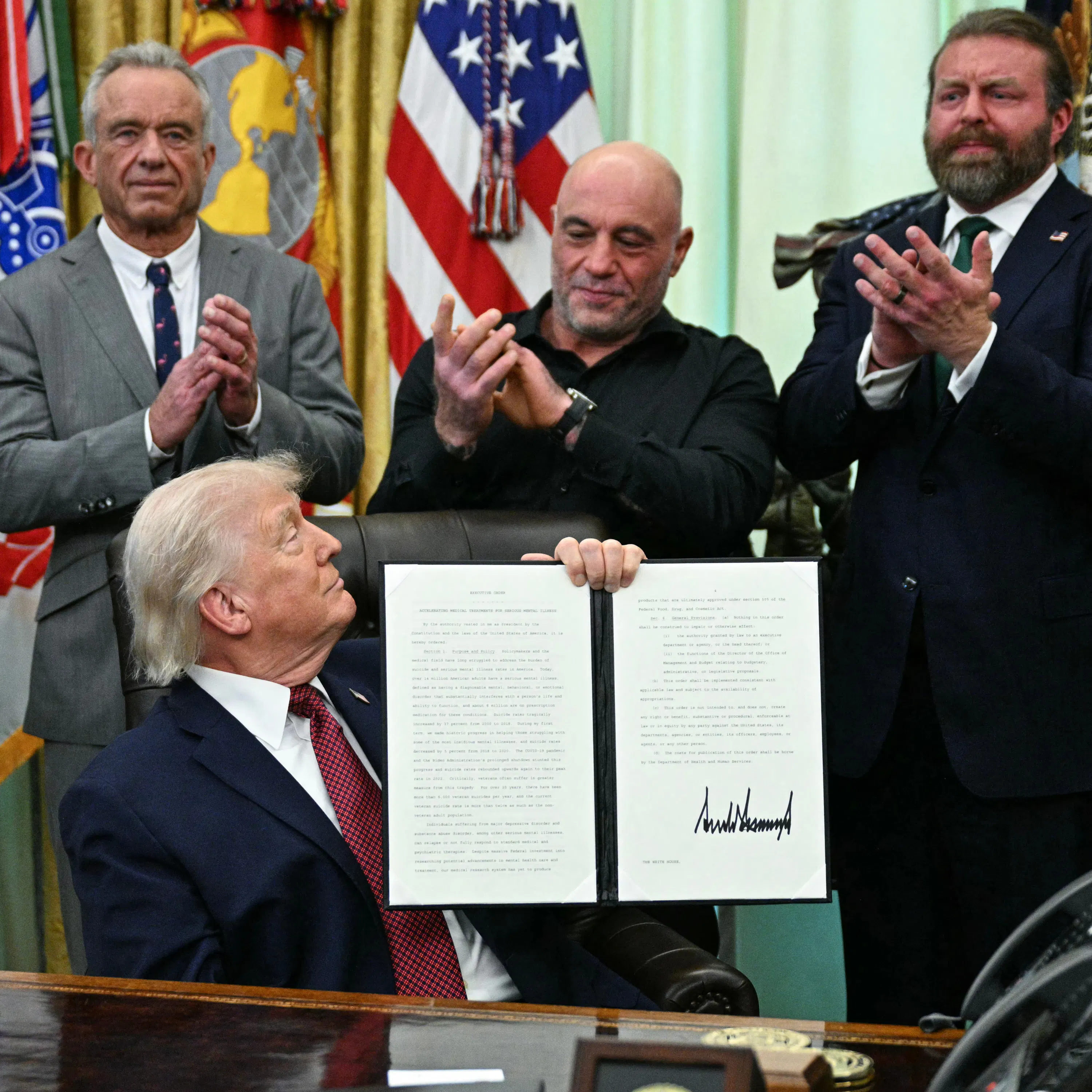
Today, Explained
How the right embraced psychedelics
00:25:50
The MAGA right is enthusiastically embracing a potent psychedelic called ibogaine. Its the new counter-counter-culture.
Loading summary
Transcript78 lines
- [00:04]
Jonathan Hill
The Trump administration is all in on legalizing a psychedelic drug called ibogaine, and it is a major trip.
- [00:12]
Maytha Busby
He was like the ultimate ass kicking.
- [00:15]
Veteran or Psychedelic Advocate
It was miserable, like I was throwing up.
- [00:17]
Jonathan Hill
It's classified as a Schedule 1 drug, which means it's illegal on the federal level. But a couple studies show it may be able to treat opioid addiction, and some researchers are hopeful that it can help with ptsd. That's got the attention of President Trump and a certain popular podcaster, which means I began having a moment today on the show how the right got into psychedelics and the story of how they're pushing the Trump administration to legalize them. Strap in. We're going on a trip.
- [01:00]
Adobe Acrobat Advertiser
Adobe Acrobat, your team's home base. Collaborate within a shared PDF space. You've got your docs, your plans, your specs, and then invite the crew to build what's next. Talk up the teamwork. They think that this design could be a contender. When somebody wonders what's the next steps, AI helps you finish the rest. Bolts are tight now. Your plan's refined. Run a smoother business.
- [01:23]
Maytha Busby
When you're all aligned, do that with Acrobat.
- [01:27]
Adobe Acrobat Advertiser
Learn more@adobe.com DothatWithACrypton.
- [01:31]
Prime Video Advertiser
This episode is brought to you by Prime Obsession is in session. And this summer, Prime Originals have everything you want. Steamy romances, irresistible love stories, and the book to screen favorites you've already read twice off campus. Elle every year after the Love Hypothesis, Sterling Point and more. Slow burns, second chances, chemistry you can feel through the screen. Your next obsession is waiting. Watch only on Prime.
- [02:05]
Jonathan Hill
It's Today Explained. I'm Jonathan Hill, sitting in. Maytha Busby is a journalist who covers drug policy. He's also British, so he says ibogaine in a classier way than those of us on this side of the pond. Recently, he's been writing about the shifting attitudes on psychedelic drug policy in the US and one of the biggest shifts is coming from the President.
- [02:26]
Maytha Busby
Well, you know, he's famously never smoked a cigarette, had a drink, certainly not had a trip. So, you know, in the Oval Office the other week, he's kind of joking about taking ibigaine.
- [02:38]
Adobe Acrobat Advertiser
I'll take whatever it takes.
- [02:42]
Veteran or Psychedelic Advocate
I don't have time to be depressed.
- [02:44]
Maytha Busby
And there's a lot of bravado there. But, you know, this ibigaine is an incredibly potent psychedelic. It famously gives people sort of recalls of every traumatic moment in their life. So, you know, I'm sure we'd all love to see Trump subject himself to that sort of experience.
- [03:00]
Jonathan Hill
What is ibogaine?
- [03:02]
Maytha Busby
So it's like a extracted molecule from a West African Gabonese, specifically root bark from a shrub. And basically it became known as being able to rid opioid addicts, heroin addicts, of withdrawal symptoms, you know, in one trip.
- [03:26]
Jonathan Hill
Ibogaine has now entered the mainstream conversation with the Trump administration, talking about legalizing certain psychedelics. How'd we get here?
- [03:36]
Maytha Busby
Yeah, I mean, psychedelics obviously long belonged to the cultural left, the counterculture.
- [03:44]
Veteran or Psychedelic Advocate
We would all like to be able to live an uncluttered life, a simple life, a good life, you know, and, like, think about moving the whole human race ahead a step. And one of the ways of. Of achieving that being is through drugs.
- [03:58]
Maytha Busby
But it seems now there's almost like a counter counterculture with these sort of, you know, right wing, sort of conservative, mostly Christian, former, you know, Special Forces fighters, soldiers in the U.S. army that, you know, suffering from really debilitating conditions from PTSD and tbi. And they've basically figured out that ibogaine and indeed other psychedelics provides them the relief that can. Conventional medicines don't.
- [04:29]
Jonathan Hill
Okay. There's been a flurry of activity in this last month around psychedelics, and it had to do with, you know, who I consider the political kingmaker of the moment, and that's Joe Rogan. How is Joe Rogan involved in the policy making here?
- [04:45]
Maytha Busby
I mean, so he's had figures on his podcast since it began, right? Talking about psychedelics.
- [04:51]
Sponsor Representative
Rick Doblin, who is the. The head of maps, or Multidisciplinary association for Psychedelic Studies.
- [04:57]
Maytha Busby
You know, original sort of brocast dude. Aubrey Marcus.
- [05:02]
Sponsor Representative
What's going on?
- [05:02]
Maytha Busby
What's going on in your shirt?
- [05:03]
Sponsor Representative
What is that? Got a lot going on there. It's like a penguin with shark teeth. This is my homage to Albert Hoffman in the creation of lsd.
- [05:10]
Veteran or Psychedelic Advocate
Oh, wow.
- [05:11]
Maytha Busby
All through till today. And he's had the former Texas governor and Trump's first energy secretary, Rick Perry, on his podcast twice, along with a Kentucky lawyer and ibogaine advocate named Brian Hubbard, who sort of sounds like a Christian Southern revival.
- [05:30]
Veteran or Psychedelic Advocate
Every human being has stardust running through their blood. And the movement that Governor Perry and I are leading is one that aims to recognize the reality of that human
- [05:42]
Maytha Busby
divinity, and always quotes his favorite passage out of Isaiah.
- [05:47]
Veteran or Psychedelic Advocate
And we will crawl the last mile to deliver good tidings unto the meek, to bind up the brokenhearted, to proclaim liberty to the captives and the opening of the prison to them that are bound.
- [06:02]
Maytha Busby
And so Joe Rogan had this unlikely duo who have Both done IB again and are waxing lyrical about the benefits. He had them both on his podcast like three weeks before the executive order and they basically said, look Joe, we need to make this happen. So Joe texts Donald Trump and apparently Donald Trump responds almost instantaneously saying, sounds good. Do you want FDA approval?
- [06:27]
Jonathan Hill
That's all it takes, allegedly.
- [06:29]
Maytha Busby
I mean, you know, they are accelerating the processes. And if you do see, you know, this kind of cast of guys behind Trump, you know, there's a real cast of personalities like perhaps we've never seen before.
- [06:42]
Jonathan Hill
This all culminates with Joe Rogan actually going to the White House to attend the signing of an executive order about psychedelics. What's in that executive order?
- [06:51]
Maytha Busby
Well, I mean, the thing about executive order is it's sort of shouting into the wind a bit, but there is this money to go into the research side. And let's not forget These are Schedule 1 drugs ever since Richard Nixon, a fellow Republican, declares the war on drugs. And really this is the biggest green light yet for potentially multibillion dollar industry. I mean, it had like five or six prongs. One of the main ones is that now under right to try laws that Trump introduced in his first term to allow basically end of life patients to try experimental drugs that will be extended to psychedelics so long as the DEA don't kind of try and obstruct that process. There's 50 million for psychedelic research, most of which it seems are going to support state led initiatives to investigate ibogaine and allow a sort of US first human trial. And also it's accelerating the path to a potential approval for psychedelic drugs. And a week after three candidates that had just submitted their data got sort of fast tracked potential approval so their applications would be considered more quickly. So that would open the floodgates more widely to research.
- [08:16]
Jonathan Hill
Do you expect the FDA to say, this is great, go ahead, use psychedelic drugs, they will help you. What can we expect from regulators on this?
- [08:25]
Maytha Busby
Yeah, I think that it's quite likely really within this presidency, you know, to see several, you know, psychedelic drugs approved now, which is, you know, a huge, a huge development really. I mean, Joe Biden, there was talk about him setting up a federal task force and helping stuff along there. And you know, he didn't seem to put any political will behind it. So, you know, Trump has really kind of sees the mantle here and he's sort of surfing the zeitgeist as, as he weirdly seems to be able to on, you know, certain topics, all the while sort of outraging and, you know, provoking us along the way.
- [09:05]
Jonathan Hill
There does seem to be some dissonance here, though. I mean, you mentioned Nixon before. The GOP traditionally was all about the war on drugs.
- [09:14]
Veteran or Psychedelic Advocate
America's public enemy number one in the United States is drug abuse.
- [09:20]
Jonathan Hill
They are bombing boats in South America over drugs. What is up with this switch up?
- [09:25]
Maytha Busby
Yeah, I mean, cocaine use in the US Is actually going down quite significantly. So the whole thing with, you know, bombing these fishermen boats is just, you know, crazy and completely illegal. But, you know, it is a geopolitical tool. I don't. I don't think they really care about kind of minimal cocaine imports. They wanted regime change in Venezuela. And, you know, for decades, drugs, the specter of drugs has been a useful straw man to get involved in Latin America. There's a lot of dissonance. I think that broadly, though, we're seeing the war on drugs coming to an end little by little, even despite the rhetoric here and there. And I think this is a significant threshold moment. Trump's always been kind of outside the Republican Party, sort of establishment to some extent, compared to some other figures, previous presidents. It's not like it's been some sort of, like, topsy turvy issue. The Democrats, when they've come in, there's been piecemeal changes. I mean, Joe Biden himself introduced the laws when he was a senator to make the punishments for crack cocaine, which is obviously more likely used by people of color.
- [10:40]
Veteran or Psychedelic Advocate
If you have a piece of crack cocaine, no bigger than this quarter that I'm holding in my hand, one quarter of one dollar. We passed a law, through the leadership of Senator Thurmond and myself and others, a law that says if you're caught with that, you go to jail for five years.
- [11:04]
Maytha Busby
You know, the penalty is like 30 times more stringent than for powder cocaine, which is used more often than white people. So I think that there's been a. It's been a bipartisan issue, really, the war on drugs.
- [11:17]
Jonathan Hill
Do we know who's using psychedelics? You mentioned that demographic breakdown. Do we have any. Any idea about this class of drugs?
- [11:25]
Maytha Busby
I think, you know, that the interesting thing with psychedelics now, as opposed to maybe 10, 15 years ago, is that sort of, you know, they've crossed the political divide. I think that, you know, a lot of people from unexpected segments of society are getting turned on because, you know, they are seeing, you know, broadly the benefits, even while there are serious risks, especially with ibogaine.
- [11:54]
Jonathan Hill
So there was only one drug named in that executive order, and it was Ibogaine why the Veterans?
- [12:02]
Maytha Busby
You know, these stories from veterans about the transformative effects of ibogaine have been really difficult to refute politically. 22 veterans on average are committing suicide in the US every day. And Trump in the Oval Office when he signed the order said, Since 9
- [12:19]
Veteran or Psychedelic Advocate
11, we've lost over 21 times more veteran lives to suicide than on the battlefields.
- [12:28]
Maytha Busby
There's so many congressmen and senators who are veterans themselves. There was a study from Stanford a couple of years ago that looked at 30x Special Forces and, you know, found that a dose of ibogaine reduced all of their traumatic brain injury significantly. But, you know, we shouldn't be under any illusions. This is a seriously potent and dangerous psychedelic when, you know, used improperly. And there's been a whole spate of deaths. Indeed, the deaths are probably underreported because the drug sort of disrupts the QT interval in the heart and can lead in some cases to fatal cardiac arrest.
- [13:22]
Jonathan Hill
Coming up, we sit in the passenger seat for an ibogaine trip.
- [13:40]
Sponsor Representative
Support for the program today comes from Found. Any small business owner can tell you that managing your finances can get chaotic fast. A bank account here, QuickBooks there, plus taxes and invoicing tools layered on top. Before long, you're juggling costly software, falling behind on your books, and unsure where your business really stands. That's where Found says they can help. Found says they can cut through the clutter by bringing everyone into one platform. Banking, bookkeeping, invoicing and taxes all in one place. That means no more paying for multiple subscriptions or dealing with outdated, clunky tools. Found even says that you can send invoices for free and pay contractors, all from a single app. Foundation says that they're built to help you take back control your business finances so you can focus on what you actually love running your business. You can take back control your business. Today you can open a Found account for free@found.com that's f o u n d.com found is a financial technology company, not a bank. Banking services are provided by lead bank member fdic. You can join the hundreds of thousands who've already streamlined their finances with Foundation. Support for the show comes from Chime. Banking can sometimes feel like you're playing a game of dodgeball.
- [14:50]
Veteran or Psychedelic Advocate
Love dodgeball.
- [14:51]
Sponsor Representative
Doing everything in your power to not get hit with overdraft fees, minimum balance requirements and monthly fees. Don't love that Chime wants to help. They say that they're approaching things differently and changing the way people bank. Chime says they are offering you the most rewarding fee Free Banking Banking built for you. Why pay to get your own money? They're not looking to charge you overdraft and or monthly fees and they have thousands of fee free ATMs for you. Built for you. Not the 1%. Take that 1%. Chime members can even benefit from up to $1,150 in annual rewards. Fee free plus direct deposit unlocks the Most Rewarding Way to Bank at Chime, Chime says they're not just smarter banking, they're the most rewarding way to bank. You can join the millions who are already banking free free today. It just takes a few minutes to sign up. Head to chime.comexplained that's chime.comexplained Chime is
- [15:42]
Carrington College Advertiser
a financial technology company, not a bank. Banking services and the secured Chime Visa credit card are provided by the Bancorp Bank NA or Stride bank na. Optional services and products may have fees or charges. See chime.com feesinfo terms apply. Limited time only. Must open the new account and complete qualifying activities to earn rewards. Advertised annual percentage yield with Chime plus status only. Otherwise 1% APY applies. No minimum balance required. Chime card on time Payment history may have a positive impact on your credit score. Results may vary. See chime.com for details on applicable terms.
- [16:06]
Sponsor Representative
Support for the show today comes from Vanta. If you're a business owner, you may have noticed a shift recently. Risk and regulation are increasing, but before they sign anything, customers now expect clear proof of security. Building that trust is essential to closing deals. And that's what we're all about, closing deals. But it's also complex, expensive and time consuming. Vanta says they can automate that process to bring compliance, risk and customer Trust together on one AI powered platform. So whether you're prepping for a SoC2 and who isn't, or running an enterprise GRC program, I know a lot of you are. Vanta keeps you secure and keeps your deals moving. This helps companies get compliant fast and remain compliant in the future, opening doors to huge growth opportunities opportunities and freeing up your valuable time. You can get started@vanta.com explained. That is V A N T A dot com explained. Vanta.com explained.
- [17:21]
Jonathan Hill
You're listening to Today, explained Maytha. You've taken Ibogaine. What led you to that moment?
- [17:30]
Maytha Busby
So you know, I don't think I'd necessarily do it again. Oh I mean it was a different period in my life, I guess. Like doing it for journalism in a way. Right. It was four years ago. I guess there was an element of curiosity and I figured it could make for quite a compelling story. It was at the time, like more professional ibogaine clinics were opening up and, you know, I had like a source for another story who was just opening a clinic. So he reached out to me and at the time I hadn't really heard anything about it. And he was telling me that it can, yeah, wipe out addiction. And for people having, you know, crazy withdrawal symptoms, right, like if they don't take their opioid, they're like keeling over, they're super sick. And he was just sort of telling me the kind of miraculous effects of it. And I wanted to see it for myself and I was curious to experience it for myself. So I go down to this clinic in Cancun. The doctor comes in and he gives me like nine capsules of this, you know, root bark extract and gives a long spiel about how lucky we are. And, and, you know, what an amazing journey we're going to have. And really it was a kind of white knuckle ride. Like it's intensely dissociative. So I had all sorts of kind of fantastical visions. And yeah, I think the key thing for me was like, not to sound too woo, but it really connected me to my parents and the gift of life, really. And so, yeah, luckily I was to.
- [19:07]
Veteran or Psychedelic Advocate
Able.
- [19:07]
Maytha Busby
Able to convey that to my father before he passed away. So.
- [19:10]
Jonathan Hill
Wow.
- [19:10]
Maytha Busby
You know, but the crazy thing was is that a guy who arrived on my penultimate day and he was like, you know, he just relapsed after a few years clean. But yeah, he. And he dies after his ibigain trip at the same clinic. So I mean, that's part of the reason I might not do it again. Right.
- [19:31]
Jonathan Hill
How long was your trip?
- [19:33]
Maytha Busby
It's like 12 hours. And you know, you're fully like wired up. Like, I had the IV in like heart rate monitor, like on my chest and my fingers. I mean, I think they actually gave me a relatively mild dose. I think they actually were in some ways like risk averse. Although, you know, not. Not so much that they couldn't avoid a death shortly after their opening. But yeah, then it kind of, you know, winds down, but you literally can't stand up for like three or four hours. They call it like on the floor.
- [20:03]
Jonathan Hill
Oh my. Okay, so what is ibogaine then? You know, I've heard of magic mushrooms. They're mushrooms. What is ibogaine? Where does that come from?
- [20:14]
Maytha Busby
So, I mean, originally there's a whole tradition around its Use in Gabon, there's a religion, Bwiti, that you know, is hundreds of years old. I mean, exactly how old is unclear. I think they only do like one big like iboga trip. It's like a coming of age ritual in the beginning of someone's life and then after that, you know, they don't take such a huge dose again. And then in the early 20th century, French chemists were researching a depression drug and yeah, they extracted ibogaine. And yeah, decades later, Howard Lotsoff takes ibogaine by accident. Basically he was a heroin addict and in New York and realizes that he has no withdrawal symptoms. And then so he sets about on this crusade, a decades long crusade to get ibogaine to addicts.
- [21:11]
Jonathan Hill
So there's a lot of talk about ibogaine in particular when it comes to mental health. Do we know that it helps with mental health issues?
- [21:21]
Maytha Busby
Well, the research is in its early days. It really is. There's been a few observational studies mostly for PTSD and traumatic brain injury. And obviously you've got this, you know, long and storied use in Gabon. So yeah, it's difficult to say from a scientific perspective with much certainty. Obviously this administration are putting a lot of onus on kind of stories, right? Like if they say it works, it must work. But yeah, clearly it needs, you know, a huge amount more research. But it's difficult because it's been in, in Schedule 1 and you know, the other psychedelics have maybe found, you know, simpler passage towards, you know, getting approvals for studies. But even ibogaine, you know, has been repeatedly blocked because of these cardiac risks that I mentioned.
- [22:18]
Jonathan Hill
I was reading up on ibogaine and I saw that it's kind of behind other psychedelics when it comes to solid research. Why is that?
- [22:27]
Maytha Busby
Well, basically, I guess when Howard Lotsoft was trying to, you know, get it through in the 80s, there were, there were deaths happening in the underground and so they didn't, they didn't get the approvals. And you know, because the sort of people that really want to do ibogaine are, you know, people suffering from some of the most extreme afflictions possible. So they're coming into it in quite a fragile state quite often. And I guess, you know, to ensure the study, it also might be quite expensive. You know, this is a parallel but promising drug and we had decades of the war on drugs and stigmatization and obviously some of the, the, you know, the scare stories, let's say about lsd, for example, are and were true. Right. Like if you do a Huge amount of lsd. It might send you crazy or unearth, you know, craziness that you've got lurking inside of you. So, you know, this isn't for the faint hearted and should be done in a, you know, sensible fashion. And we don't really have any sort of, you know, prevailing or kind of guiding wisdom really in society. So, you know, it has kind of been the blind leading the blind. And it seems like their efforts are finally, you know, seeing some success.
- [24:01]
Jonathan Hill
What have ibogaine advocates told you about the drug and what it's done for them?
- [24:08]
Maytha Busby
I mean, one of the. There was a couple of, well, several people behind Trump when he made the announcement, who he got them to share their stories.
- [24:18]
Veteran or Psychedelic Advocate
It fixed my demonic relationship with alcohol. It saved my life and then it saved my wife. So every day is a blessing. His treatment saved my life as well. And so many fellow veterans helped me get off opiates, stop using a nerve stimulator. I hadn't planted sleep for the first time in over 10 years. It absolutely changed my life for the better. I went through a lot of the programs that the veterans are going through and I always kind of felt like I was a victim coming out of the program. When I came out of this, I felt like I had gotten my life back. That was five years ago, not too long ago.
- [24:47]
Jonathan Hill
I was in physical therapy and I would get dry needling through it. That's when they take the needle, put it in the muscle, jiggle it around. And I would always joke with my physical therapist, oh my gosh, this is going to be the thing that fixes me. This is going to fix all of my problems. Everything's going to be better. This is going to be the thing that like, fixes me. And I think people are seeking that from psychedelics. Is, is this the solution for a lot of people? Is this the thing that's going to fix them?
- [25:19]
Maytha Busby
I mean, I'm not seeking to be any sort of psychedelic Pied Piper and clearly there's a huge placebo effect, like across the board, like with any sort of drug. I think, though, as I said, these veteran stories are very difficult to refute when they've tried every possible treatment option and found no relief. And then they've done this and it has indeed given them relief. But, you know, for many other people, they don't necessarily find lasting relief. I interviewed this one lady for the Guardian a couple of years ago who has, you know, a serious form of anorexia and one MDMA trip she said had given her a 10 year remission. But then she since relapsed. And although she regularly does psychedelic therapy, she's still suffering from anorexia. You know, so this isn't a panacea, but there's a lot we don't know. And actually, I think that psychedelics are kind of a, you know, portal into some sort of spirit realm. People report these visions of, like, entities sometimes, you know, seemingly demonic or with some sort of malevolent intent. And if you do kind of listen to the indigenous thought leaders, you know, about what they think all of that represents, it really does boggle the mind. So I think that there's a lot, you know, we can learn in the west from, you know, indigenous understandings of psychedelics, you know, to ensure, you know, we don't have a bad trip.
- [27:04]
Jonathan Hill
If the Trump administration actually legalizes ibogaine, there may be more trips ahead. May the Busby is a journalist covering drug policy. This episode was produced by Kelly Wessinger with an assist from Danielle Hewitt. It was edited by Miranda Kennedy along with Jolie Meyers. Fact Checked by Gabriel Donatov and engineered by David Tadashore and Bridger Dunnigan. I'm Jonathan Hill and this is Today Explained.
- [27:54]
Carrington College Advertiser
Your next chapter in healthcare starts at Carrington College's School of Nursing in Portland. Join us for our open house on Tuesday, January 13th from 4 to 7pm you'll tour our campus, see live demos, meet instructors and learn about our Associate Degree in Nursing program that prepares you to become a registered nurse. Take the first step toward your nursing career. Save your spot now at Carrington. Edu Events. For information on program outcomes, visit carrington.
- [28:22]
Jonathan Hill
Edu Sci FI.