Loading summary
Transcript90 lines
- [00:04]
Tracy Alloway
Capitalism.
- [00:06]
Noel King
Two years ago on Today Explained from Vox, we ran a series on Americans deep and growing frustration with capitalism. Everything comes with a price, even peace of mind. We wrestled with this long standing idea that there is no alternative to capitalism where many people still land. But recently a leader has come along and he has begun to question our system.
- [00:29]
Bhaskar Sunkara
I don't think that we should have billionaires.
- [00:31]
Noel King
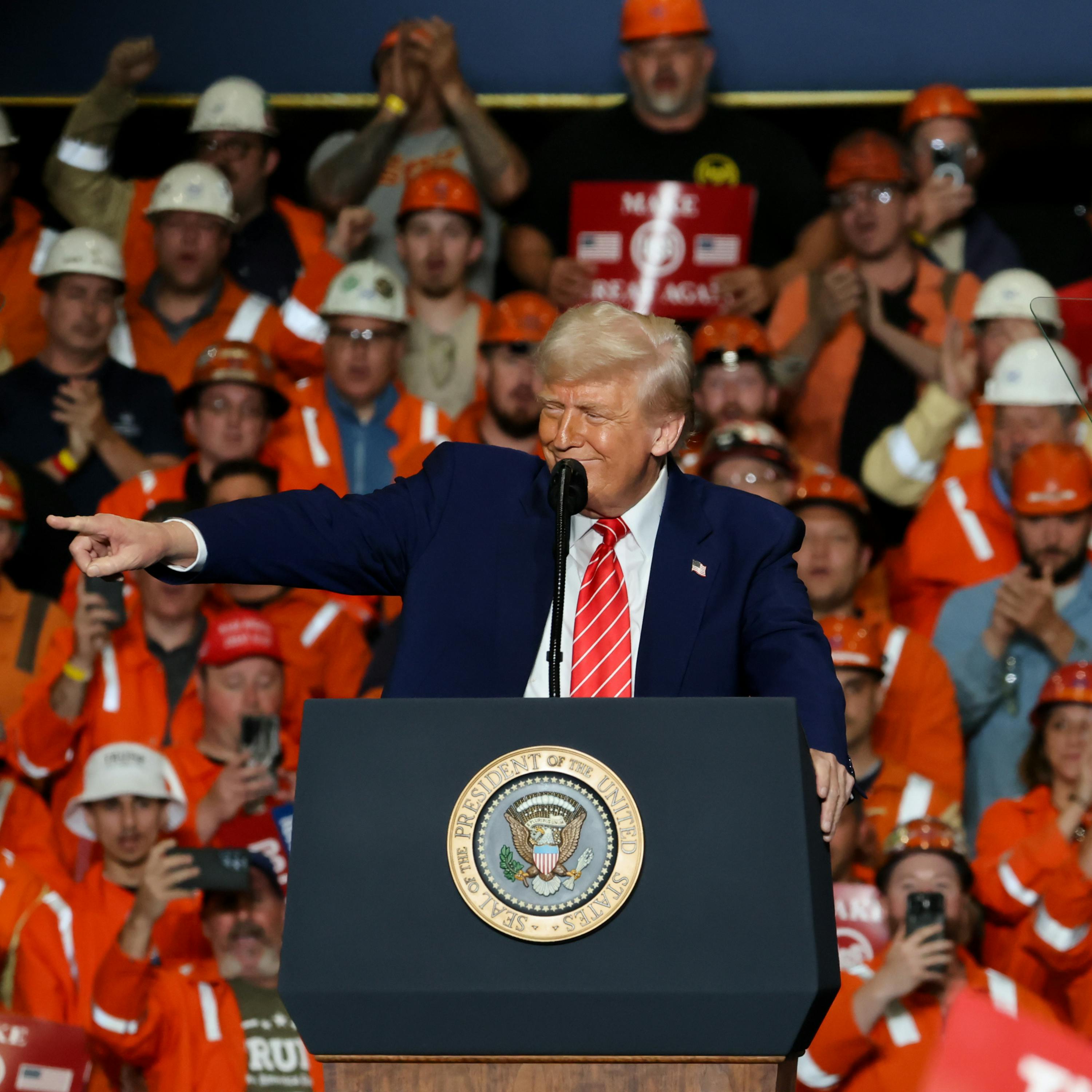
No, it's not Zoran, it's Trump. President Trump is making some of the most unfree market anti capitalist moves in recent memory, such as rating companies based on how loyal they are to his big beautiful bill. Or talking about taking a 10% share in Intel. Everything's computer or pressuring Coke to change its formula even though people like current Coke and happily pay green American dollars for it. Coming up, are we even still capitalist? Support comes from ServiceNow. We're for people doing the fulfilling work they actually want to do. That's why this ad was written and read by a real person and not AI. You know what people don't want to do? Boring, busy work. Now with AI agents built into the ServiceNow platform, you can automate millions of repetitive tasks in every corner of your business, it, HR and more. So your people can focus on the.
- [01:23]
Tracy Alloway
Work that they want to do.
- [01:24]
Noel King
That's putting AI agents to work for people. It's your turn. Visit servicenow.com support for this show comes from Robinhood. Wouldn't it be great to manage your portfolio on one platform? With Robinhood, not only can you trade individual stocks and ETFs, you can also seamlessly buy and sell crypto at low costs.
- [01:45]
Bhaskar Sunkara
Trade all in one place. Get started now on Robinhood Trading.
- [01:49]
Noel King
Crypto involves significant risk.
- [01:51]
Bhaskar Sunkara
Crypto trading is offered through an account.
- [01:52]
Noel King
With Robinhood Crypto llc.
- [01:55]
Tracy Alloway
Robinhood Crypto is licensed to engage in.
- [01:56]
Noel King
Virtual currency business activity by the New York State Department of Financial Services. Crypto held through Robinhood. Crypto is not FDIC insured or SIPIC Protected Investing involves risk including loss of principal. Securities trading is offered through an account with Robinhood Financial LLC member sipic, a registered broker dealer. Everyone's talking about capitalism.
- [02:22]
Tracy Alloway
Well, my name is Tracy Alloway. I am the co host of the Odd Lots podcast over at Bloomberg, one of my favorites.
- [02:28]
Noel King
All right, we're going to talk today about the ways in which President Trump is intervening in the US Economy and we're going to ask you, is this still capitalism? But before we get there, let's define the term. What is capitalism traditionally meant in the United States?
- [02:44]
Tracy Alloway
This is a seemingly simple question, but I think it's quite loaded in many ways, because people have this sense of, you know, classic free market capitalism. And it's one those things where everyone has a sort of different sense of what that actually means. I think there are some hallmarks around capitalism that we can look for. So things like private ownership of production. You know, the government typically doesn't own big industries or have state owned enterprises. You have things like market allocation of resources. So in a free market, buyers and sellers come together and decide what exactly they want, and that decision actually leads to allocation of resources. In something that is not so capitalist, you would have more intervention from the government. What I would say, though, is that a pure free market capitalist economy is probably something that has only ever existed in like an economist's textbook, because for most of history, there has always been a role for government to have in the economy. I would just caution free market capitalism. You kind of know it when you see it, but also once you start digging in, you realize that actually no one's really talking about the same thing here. Everyone has a different sense of it.
- [04:03]
Noel King
So it is like porn.
- [04:06]
Tracy Alloway
You said it, not me.
- [04:08]
Noel King
All right, so let's talk about the ways in which President Trump seems to be breaking with the tradition. The thing that we know when we see. So one of the big examples is inserting the government into the business, the actual business of a preeminent American chip maker. What is going on with Nvidia?
- [04:27]
Tracy Alloway
Yeah, so this is a really interesting thing. So Trump has basically directly, it seems, negotiated with Nvidia and is basically saying, if you want to export advanced AI chips to China, you know, a country that for all intents and purposes, America really seems to treat as an enemy economically, even though it is its biggest trading partner. But if you want to sell those advanced chips to China, you are going to have to give the US government 15% of your revenue. And I said, if I'm going to.
- [04:59]
Noel King
Do that, I want you to pay.
- [05:00]
Bhaskar Sunkara
Us as a country something, because I'm.
- [05:02]
Tracy Alloway
Giving you a release, that kind of revenue sharing agreement for market access that is pretty unusual when it comes to U.S. industrial policy or U.S. economic policy. And it really does look like a pretty dramatic expansion, I would say, of the leverage that presidents have over corporate transactions. And you can imagine, and we've seen it already, that in the future, big US Tech companies are going to have to take that kind of agreement into account when they're formulating their future business plans in a way that they didn't have to before. Right. Like, this is pretty new.
- [05:42]
Noel King
There's also something afoot that has had even responsible people talking about nationalization or nationalizing a company. And that is what Trump is doing in the US Steel industry. What's going on there?
- [05:56]
Tracy Alloway
This one is really interesting because this one you can kind of draw a direct connection between what the US Is doing now under the Trump administration and what China has been doing for some years now. So the US has basically said the government is going to take a stake in the steel company in or in US Steel in order to get this transaction done. And it's something called a golden share concept.
- [06:21]
Bhaskar Sunkara
We have a golden share which I control.
- [06:25]
Tracy Alloway
And basically it gives the US Government a lot of corporate control when it comes to decisions that are made for the company. So, you know, things like where are they going to move production or where are they going to be headquartered, stuff like that, that gives you total control.
- [06:40]
Bhaskar Sunkara
It's 51% ownership by Americans.
- [06:43]
Tracy Alloway
And the reason it's such an interesting parallel with China is because the golden share concept has existed in China's sort of call it state guided economy for many, many years now. This is something that is very, very normal in China and not necessarily normal in the US until very recently.
- [07:04]
Noel King
So some of these flew by me in an academic sense and I was like, oh, that's very interesting. And I would like to read a few more articles and sort of make up my mind. But there was one that I kind of can't get over personally. And it is when everyone was expecting that prices would go up because of tariffs. And President Trump just kind of came out and told CEOs like, don't you dare raise prices. Truth, Social, Walmart and China, they should, as is said, eat the tariffs and not charge value customers anything. I'll be watching and so will your customers.
- [07:44]
Tracy Alloway
Well, I think I would say the jury is still out on whether that tactic will work or not.
- [07:50]
Noel King
It's that he is that he tried it.
- [07:52]
Tracy Alloway
Totally, totally. But I will say it's not like you've, you've never seen politicians come out and say like please don't price gouge in an emergency that that does exist. But the fact that, you know, it's kind of an emergency of Trump's own making in this instance. So he unveiled the tariffs. Then he says what he doesn't want is companies raising their prices in order to offset the cost of those tariffs. That seems pretty circular. And you're right that I guess the level of involvement of the Trump administration in the seems to be growing and in that sense is quite new.
- [08:28]
Noel King
Some Number of very, very smart commentators, including one Tracy Alloway, have pointed out that some of this is reminiscent of how capitalism works in China. What, what do you mean when you say that?
- [08:42]
Tracy Alloway
So this is what I, I find so fascinating about our current moment in economic history. All of us growing up for the past, you know, 30 or 40 years, we were always told that China was going to basically America, right? We're going to see America American style, shopping malls and free market capitalism, and the country was going to open its market to outside investment and all of that.
- [09:08]
Noel King
The case for trade is just not monetary, but moral. Economic freedom creates habits of liberty, and habits of liberty create expectations of democracy. There are no guarantees, but there are good examples. From Chile to Taiwan, trade freely with China.
- [09:29]
Tracy Alloway
And time is on our side. And instead, what we've sort of seen is that the US Is moving closer to China in a number of ways. And I don't want to say this is exclusively a Trump administration phenomenon, because the truth is it's not. You know, the first Trump administration started some of this when it unveiled its first set of tariffs against China. But those were continued by the Biden administration. And the Biden administration, in many ways took on a much more active industrial policy role after the pandemic.
- [10:02]
Bhaskar Sunkara
Folks, we need to make these chips here in America to bring down everyday cost and create good paying American jobs.
- [10:11]
Tracy Alloway
And I think this is really key to understanding what's happening right now. You have a moment in time where you have all of these big things that are happening. There are all these choke points in our economic system that free market capitalism hasn't recently seemed very good at solving. And so that's one of the reasons we've seen governments in the US and also elsewhere in the world kind of step in and say, actually we need to intervene here. We need to think about building out capacity, we need to think about supply. And because China is one of the countries that has been doing this for arguably the longest time, China really becomes like kind of the role model for how you build out that additional capacity. From that perspective, it's not necessarily surprising that the US Is starting to look more like China in the sense that the government is becoming much more active in encouraging certain parts of the economy that it wants to see well, or certain areas that it wants to discourage. But it's still a very big departure from, I think, what everyone kind of expected to see just 10 or 20 years ago.
- [11:21]
Noel King
Why does it feel wrong? Is it, is there anything actually wrong with that?
- [11:27]
Tracy Alloway
So China, again, is a very useful example of this. And it is true that in the States, if someone talks about, you know, state intervention in the free market economy, people tend to have a knee jerk reaction which is, oh, this sounds really bad. This sounds like communism and all of that. There are problems with having such an active role of the government. And in China, the number one problem has been that you tend to get overproduction. Right.
- [11:56]
Noel King
China has the ability to produce roughly twice as many cars as it sells at home each year. In Hangzhou, we came across hundreds of new EVs stored out in the open, many of them waiting to be sold.
- [12:09]
Bhaskar Sunkara
Solar panels, electric vehicles and the batteries that power them.
- [12:15]
Noel King
China alone is producing more than 100% of global demand for these products, flooding.
- [12:20]
Bhaskar Sunkara
Markets, undermining competition, putting at risk livelihoods and businesses around the world.
- [12:26]
Tracy Alloway
And this is one of the interesting things about the Chinese economy. You know, we are used to nowadays talking about China as an economic powerhouse in many ways. But if you look at the Chinese stock market, stock market has like gone sideways basically for 20 years now. And one of the reasons is because you have a lot of companies who are making stuff but aren't necessarily doing so at a profit. There's an overproduction issue. And so I think that's what people are kind of worried about. They're worried that we're going to create industries that end up being wasteful, that produce too much, that sort of lead to a distortion of incentives. You know, maybe everyone decides to get into industry X because the government is supporting it, but we should have been looking at industry Y instead.
- [13:21]
Noel King
Tracy Alloway, she co hosts the Odd Lots podcast. It's very good. Coming up, what does a leading socialist think about President Trump's recent moves? Which leading socialists did they get? So run support for today explained comes from Mint Mobile, the company that's like, in this economy. Mint Mobile says they can give you the coverage and the speed that you're used to, but Mint Mobile is cheaper, says Mint Mobile. Right now, Mint mobile is offering three months of unlimited premium wireless service for $15 a month. All their plans, I'm told, come with high speed 5G data, that unlimited talk and text that you do know so well. You can also bring your own phone and your own phone number and all those contacts to your new plan. You can get this new customer offer and a three month unlimited wireless plan for just 15 bucks a month@mintmobile.com explained. That's mintmobile.com explained. Upfront payment of $45 required. That is equivalent to 15 bucks a month for three months. This is a limited time. New customer offer for the first three months only. Speeds may be slow above 35 gigabytes on that unlimited plan. Taxes and fees are extra. Guys cement Mobile for details.
- [14:45]
Bhaskar Sunkara
Support for the show comes from Bombas and today they want to talk to you about socks because it's summer and maybe it's a time when you realize that your socks are just not up to the challenges of warm weather. If I'm being real, I don't wear socks in the summer. But you know, follow your bliss. They're talking about like running marathons and I don't do that either. So maybe you need socks and Bombas has some. And Nisha Chital, our colleague here at Vox has tried the socks from Bombas.
- [15:15]
Noel King
I do have a pair of the Bombas no show socks. Those are really great for wearing with things like ballet flats or loafers and they really, you know, they stick onto your feet.
- [15:26]
Tracy Alloway
Well.
- [15:26]
Noel King
A lot of other no show socks will, will kind of slip off your feet throughout the day, but the Bombas ones really stay on well, which I.
- [15:34]
Tracy Alloway
Really like and appreciate.
- [15:34]
Noel King
When you're wearing something like ballet flats.
- [15:37]
Bhaskar Sunkara
You can head over to bombas.com and use the code explained for 20% off your first purchase. That's B O M B A S.com code explained at checkout bombus.com and use the code explained.
- [15:56]
Noel King
Support for TODAY explained comes from NPR's Life Kit. Life doesn't come with an instruction manual and yet every day you're making choices, some small, some life altering, that shape your path. Life Kit brings you real stories, expert insights and clear, actionable advice so you can approach those decision making moments with confidence. You'll find episodes that deal with relationships, finances, parenting, health and career challenges. Get some perspective and a step by step game plan that you can put into practice. Let me tell you something. Life kit is NPR's wildest show. Recent episodes include I'm jealous of my girlfriend's dog, Should I break up with her? How can I cook with my kids and not freak out that they're very sloppy because their motor skills are a mess? How to take a good picture if you're not photogenic, and how often do I have to bathe? What else do you really need to know about NPR's Life Kit? Check it out. Go looking for an episode that applies to you. You can listen now to the Life Kit podcast from npr. You're listening to TODAY Explained. I'm Noel King Bhaskar Sinkara is not Zohran Mamdani. He is Many other things, though. He's the president of the Nation magazine. He's the founding editor of Jacobin. He's so Sochi that he actually conceived of Jacobin whilst in college, famously a time for good ideas. But then he went out and he made it real very cool. Jacobin, if you don't know it, is a magazine dedicated to making socialist ideas accessible. All right, Bhaskar, this first question I'm going to ask you, I'm not going to use, use any proper nouns at all. You're just going to give me your thoughts. What do you think about the state, the government, getting involved in private industry?
- [17:42]
Bhaskar Sunkara
Yeah, so obviously as a socialist, I start from the principle that private industry should be subject to more democratic control and oversight. I don't think that the state should run every aspect of the economy. You know, I'm a market socialist. I think markets are useful as a coordinating mechanism for much of our economic life. But I also think there needs to be clear rules of the game. There needs to be moments where we say, okay, in this case, the state is going to uniformly step in, not just to regulate, but to actively shape the economy's development.
- [18:19]
Noel King
Okay, so now we're going to put the proper nouns in. President Trump is taking a stake in an important American industry, the steel industry. He's inserting the US Government into an important company, Nvidia. He's gotten other foreign countries to commit like more than a trillion dollars in investment to the United States. And he says that he personally will direct the investment. Now you have seen that old school free market capitalists such as those at the Wall Street Journal are freaking out about this. Is capitalism dead? Is it in trouble?
- [18:52]
Bhaskar Sunkara
You know, I wish it was dead for a variety of reasons. Like I said before, I think it's perfectly legitimate for the state to intervene in private enterprise in the U.S. i think we often frame the free market as, you know, conservative ideal and state intervention as a socialist ideal. But history shows it's really a lot more complicated than that. So in the 20th century, you had right wing authoritarian governments in places like South Korea and Taiwan using really heavy state direction.
- [19:24]
Tracy Alloway
In 1987, the government supported the creation.
- [19:28]
Bhaskar Sunkara
Of Taiwan semiconductor manufacturing company tsmc, which.
- [19:34]
Tracy Alloway
Would go on to become the world's.
- [19:35]
Bhaskar Sunkara
Largest dedicated independent semiconductor foundry in South Korea.
- [19:40]
Noel King
While companies like Hyundai, Samsung, lg, Lotte.
- [19:43]
Bhaskar Sunkara
And Kumo have been private enterprises since.
- [19:45]
Noel King
Their inception, they were hand selected by.
- [19:47]
Bhaskar Sunkara
The government to receive special protections and privileges. They used our tariffs, our subsidies, credit allocation, and they built out globally competitive industries and they lifted their countries out of poverty. You know, they did a lot of horrible, you know, things, you know, against political rights and labor rights and so on, but they did that to their Credit. In the U.S. we sometimes just knee jerk, just say, okay, more state intervention means that's more socialist. So, you know, for me, the real question is, is what we're doing coherent? Does it make sense? My worry with Trump's approach, and just knowing Trump, like many Americans, I feel like at this point we've seen him so much, we know him at a very personal level. My worry with Trump's approach is that it looks more like ad hoc favoritism and punishing some industries and subsidizing other industries at a whim and less like a long term plan.
- [20:40]
Noel King
Where do you stand on the tariffs?
- [20:43]
Bhaskar Sunkara
I have a lot of the same concerns. I, I think that there's really a place for tariff in the toolkit of creating a viable economy. I think there's a place for protecting certain industries as part of a wider plan. I really appreciate that Trump in his first term actually put on the table the toolkit of tariffs and talking about industrial policy. I didn't agree with how he executed those tariffs in his first term, but I think it paved the way to Joe Biden much more successfully being able to wield industrial policy. And at a time when other countries like Germany were losing hundreds of thousands of manufacturing jobs, the US Was gaining hundreds of thousands of manufacturing jobs. So I think there's definitely a place for it. But in this particular case, I just can't see the long term plan behind Trump's use of tariffs. And I really worry that it will make the US in the long run a poorer country. And that won't be good for any sort of egalitarian politics.
- [21:50]
Noel King
The thing Joe Biden was never willing to do was to call companies and say, don't you dare raise prices on Americans. This is one of those things that, again with Trump, if you are working class and you hear that the President has called a corporation or telegraphed to a corporation, the tariffs may be pushing up the cost of goods, but you are not going to raise them on American citizens. It's appealing. It's a little strong man, but it's appealing. Right.
- [22:16]
Bhaskar Sunkara
I'm not impressed because I don't think it's sustainable.
- [22:20]
Noel King
Huh.
- [22:23]
Bhaskar Sunkara
And also, I think Trump was able to get away with this stuff or has been able to, partially because he is a right wing president who came in with a lot of goodwill from business, or at least initially, he delivered huge tax Cuts for them for the wealthy at least, and capital at least. Until recently, I think trusted him. I don't think the markets would have been nearly as tolerant if it was President Bernie Sanders trying the same thing. You know, it's very clear to people that he's trying to rig the game to reward friends and punish enemies. And because of that, you know, CEOs like Apple's Tim can cook, you know, feel like they have to play along and stay on his, his good side. And that's behind the very, like, awkward and kind of embarrassing and to some level, like, gauche like gift giving of, you know, you go visit the sovereign, so you better come with this kind of big, gaudy gift. It was designed by US Marine Corps corporal, a horror, one that works at Apple now.
- [23:23]
Tracy Alloway
He's done well, designed it for you and the base.
- [23:29]
Noel King
Hans krong.
- [23:32]
Bhaskar Sunkara
And it's 24 Karat Galloway. And the irony is that, you know, a lot of the American right has spent decades railing against left wing, you know, in their mind, strongmen, you know, leaders governing in this fashion. And yet Trump is really mimicking the worst of that style, your side of things.
- [23:54]
Noel King
Socialism has found a very shiny new avatar in Zohra Mamdani in New York. And you'll be aware that some people who like to maybe think too much have said Trump and Mamdani have more in common than we realize. They want a strong state. They want a state that intervenes on behalf of who they say their constituency is. Right. With Trump, it may be on any given day with Mom Donna, he's been pretty consistent. You don't like what Trump is doing. Where do you stand on Zohrand?
- [24:23]
Bhaskar Sunkara
I love Zoram Hamdani. I love him so much that I almost refuse to say more about my love for him because I don't want to alienate people. I think that at a more fundamental level, what they're doing just seems to me to be polar opposites. So Trump is redistributing wealth from the bottom to the top of the economy, and he's doing this through the extension of the tax cuts for the rich, through cuts to the public sector and cuts to social programs like Medicaid. Someone like Zoram Hamdani, it seems to me, you know, obviously, given the limited constraints of what he can do as mayor of a single city, wants to tax the wealthy more. I don't think that we should have billionaires. He wants to invest more in public goods. I'm Zahran Mamdani, and as mayor, I will Create a network of city owned grocery stores.
- [25:13]
Tracy Alloway
It's like a public option for produce.
- [25:15]
Bhaskar Sunkara
And he wants to raise the floor for working people through, you know, encouraging higher wages and trying to find ways to lower lower rents.
- [25:24]
Tracy Alloway
I'm freezing your rent as the next.
- [25:26]
Bhaskar Sunkara
Mayor of New York City.
- [25:30]
Noel King
So we know. I imagine you have rubbed your hands in glee looking at the polling that shows us that Americans are frustrated with capitalism. Really frustrated with it, young people in particular giving up on it. We did a whole four part series about this. Whether you like him or not, President Trump is doing an uncapitalism. Zorran Mamdani would like to do an un capitalism. Do you think we're at a point where the left and the right are converging on America with socialist characteristics?
- [26:02]
Bhaskar Sunkara
I love being contrarian. I would love to tell you, love to tell you that Trump's action is bringing us closer to being a socialist country. I'm a socialist.
- [26:14]
Tracy Alloway
Democratic socialism.
- [26:16]
Bhaskar Sunkara
My wife is more of a mainstream liberal.
- [26:18]
Noel King
Come on.
- [26:19]
Bhaskar Sunkara
They're also Zoran fan and she will occasionally, maybe two, three months after the fact, listen to my podcast appearances and get very angry at my contrarianism. But in this case, I honestly believe, I'm not trying to just save myself from a battle in December, but I honestly believe that Trump is taking us further away from my vision of a good society and further away from any vision of a socialist society. And I think in part because he's deploying legitimate tools of economic policy, like I said, like tariffs, like industrial policy, but in such a chaotic, self serving way, I think he's gonna create a backlash that makes it harder for the left to use them in the future as well.
- [27:04]
Noel King
You sound like a depressive more than a contrarian. But. But you made your point and I appreciate it. Thank you so much, Bhaskar.
- [27:11]
Bhaskar Sunkara
Thanks so much for having me.
- [27:16]
Tracy Alloway
Foreign.
- [27:23]
Noel King
Of the nation, also the founder of Jacobin. Thank you to the Wall Street Journal's Greg ip who wrote America with Socialist characteristics. Miles Bryan produced today's episode. Jolie Myers edited Patrick Boyd and how Andrea Christian's daughter too. Laura Bullard is both. I'm Noel King. It's today.