Loading summary
Transcript58 lines
- [00:01]
Sean Ramis
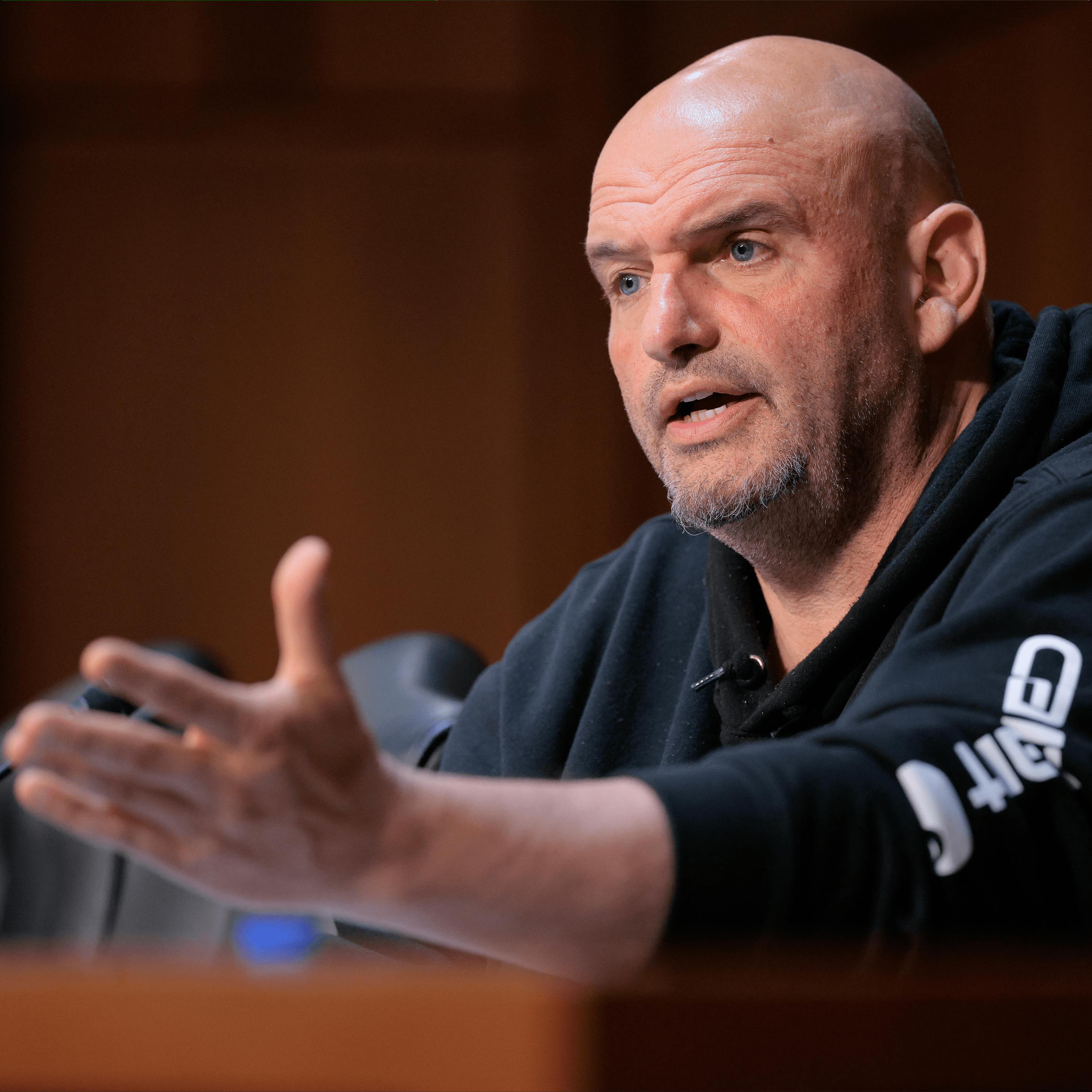
Senator John Fetterman is not like his colleagues. Oh yeah, for starters, he wears a hoodie and gym shorts to work in Congress. But he's also a Democrat who went down to Mar a Lago to meet with Donald Trump before he reentered office back in January. He's bucked most of his party on the war in Gaza, saying his support of Israel and Benjamin Netanyahu was unconditional. He went on the Joe Rogan experience to bro down.
- [00:28]
John Fetterman
And then the whole nation just had like a meltdown. Like, oh my God, the Senate, it's on fire because I dress like a slob.
- [00:35]
Sean Ramis
And then there is health issues.
- [00:37]
Ben Terrace
The man who got a lot of credit, rightfully so, for bringing his mental health struggles to the fore to kind of destigmatizing depression and mental health issues in politics may be struggling more than he had let on.
- [00:54]
Sean Ramis
We're gonna ask if John Fetterman is okay on Today Explained.
- [01:00]
HubSpot
Support for Today explained comes from HubSpot. HubSpot asks, Remember when you signed up for a software that promised to transform everything for your business and then six months went by and nothing happened? HubSpot says they're proving that you don't have to wait for roi, thanks to Breeze, their suite of AI tools. Breeze agents automate tasks that would normally take up your whole day, I'm told creating marketing content, finding sales leads, handling customer service tickets. So much more. Meanwhile, Breeze co pilot works alongside you like a brilliant colleague who always has the right answer and never needs a break. With HubSpot, the company says companies are cutting sales cycles in half and saving hours each week on work. Visit HubSpot.comai to get started today.
- [01:43]
Adobe Express
In every company, there's a whole system of decision makers, challenges and strategies shaping the future of business at every level. That's why we're running a special three part Decoder Thursday series looking at how some of the biggest companies in the world are adapting, innovating and rethinking their playbooks. We're asking enterprise leaders about some of the toughest questions they're facing today, revealing the tensions, risks and breakthroughs happening behind closed doors. Check out Decoder wherever you get your podcasts.
- [02:09]
Ben Terrace
This special series from the Verge is presented by Adobe Express.
- [02:20]
Sean Ramis
Today, explained Sean Ramis Forum here with Ben Terrace, D.C. correspondent for New York Magazine. Ben just wrote a big profile of John Fetterman that made a lot of noise because it revealed that his health struggles may be far graver than people previously thought. We started back in 2023, around the time Fetterman checked into Walter Reed Medical center in Maryland.
- [02:44]
Ben Terrace
He has a difficult moment at a retreat for Democrats at the Library of Congress. He's supposed to be the talk of the town, and everybody wants to talk to him and get to know him, but he's sitting quietly in a corner, drinking Coke and not talking to anybody. Staff gets an alert a short time later from somebody who saw him walking in the almost into traffic, almost getting hit by a car, and they rush to find him. They find him wandering around Capitol Hill, and they bring him to George Washington, where they decide that he is severely dehydrated, not having another stroke, which was the big worry. And they prescribe him with medication for depression. And they think, okay, maybe he's going to be on the right track here. But a week later, he is having a meeting with Senator Sherrod Brown. These are two guys who should get along great. A couple of purple state Democrats who I think I write in the piece, are more comfortable in union halls than in the halls of Congress. These are kind of working man type senators. At least that's how they present themselves. But the meeting is very weird, and Fetterman is drawn into himself. He's speaking so quietly that hardly anybody can hear him. The meeting kind of ends uncomfortably, and staff notices that Fetterman is now starting to walk in what one person describes as figure eights out in the hallway, kind of looking over his shoulder as if he's being followed by some sort of shadowy figure. And that's when they call a doctor and they all decide this is time to get him to Walter Reed. This is serious.
- [04:20]
Devin Schwartz
Tonight, Pennsylvania Senator John Fetterman is getting.
- [04:23]
HubSpot
Treatment for clinical depression.
- [04:25]
Ben Terrace
Fetterman's office says he checked himself into Walter Reed Medical Center. They say the senator experienced depression on and off through his life, but it recently became severe.
- [04:34]
Devin Schwartz
We only know what they're telling us so far.
- [04:36]
Ben Terrace
You know, Many neurologists say it is.
- [04:38]
Devin Schwartz
Common for stroke survivors to suffer from major depression.
- [04:42]
Ben Terrace
And Walter Reed is really tough. He gets there and he's experiencing these kind of delusions early on while he's there. He's worried that if he takes a bed at the hospital, he might get arrested. He tells doctors that he thinks his family is wearing a wire. He has this belief all of a sudden that he has to break out of his room because there's a political rally happening in the lobby of Walter Reed and he has to get there. At this point, doctors are a little worried about what's going on. And over the course of his time at the Hospital, they change his medication, his mental health struggles go into remission. He starts taking visitors, starts doing the job from there. And when he comes out, he's the best he's been in a really long time.
- [05:25]
John Fetterman
You know, my aspiration is to take my son to the restaurant that we were supposed to go during his birthday but couldn't because I had checked myself in for depression and being the kind of dad, the kind of husband and the kind of senator that Pennsylvania deserves. You know, that's truly, that's what my aspiration is.
- [05:51]
Sean Ramis
How long does that last?
- [05:53]
Ben Terrace
He's in the hospital for six weeks. He gets out and for. I mean, look, the thing about mental health struggles is you can have good days and you can have bad days, you can have good weeks, you can have bad weeks. It's impossible to pinpoint exactly when things were good and bad because it could be good in the morning and bad in the afternoon. But staff I talked to said the first months that he's back are great. I mean, he's diving into the job. He's getting a lot of rightful credit for the work he's doing with mental health.
- [06:25]
John Fetterman
This isn't a matter who's tough or who's not. Big men, you know, you know, you're not too macho, you know, it's no big deal. It's like you're the only person you're really going to hurt more than anyone else is. You're actually your family.
- [06:39]
Ben Terrace
I mean, honestly, people believe, and it makes sense to me that he could have saved lives. Right. When somebody like him, a, a politician who's, you know, at the top of his career, a high functioning type, a type job, can admit that they're going through something, it gives permission for a lot of people to think, oh, maybe I'm going through something, maybe I should reach out for help.
- [07:00]
John Fetterman
It's a privilege and it's a duty to talk about this because I want everybody. You know, you have an enormous platform. I want anyone who's listening to this that sees this. If you are suffering from depression, please get help. Please get help. Because it works. It works.
- [07:17]
Ben Terrace
And so it's great for a while, but it's around that time that things in the office start to kind of go south.
- [07:25]
Sean Ramis
It feels like October 7, 2023 is a big turning point for the senator.
- [07:32]
Ben Terrace
Yeah, I mean, it certainly is. He had talked about Israel in the past and said that he was a pro Israel guy, which was a pretty standard Democratic position for a very long time. But after October 7, he makes it like his issue in a way that it never had been before.
- [07:49]
John Fetterman
And I want to be very clear. I thought what Israel chose to do about blowing up the pagers and then walkie talkies and then after targeting and eliminating membership and leadership of Hezbollah, I absolutely support that. In fact, if anything, I love it.
- [08:06]
Ben Terrace
And I think it threw some people for a loop. Staff got upset. Former staff got upset. Also, as I report in the piece, his wife Giselle, was very upset one time coming into the office crying, saying that, you know, they're bombing refugee camps. How can he support this? He responds that that's all propaganda. And this kind of heightened tension that's happening in American politics as a whole, but especially in this office, I think just kind of derailed it. Just derailed things for him and his staff in a way that made it very difficult to be working for him.
- [08:45]
Sean Ramis
Yeah, I mean, I guess we should assume that senators clash with their staff all the time. But through your reporting, did this feel exceptional?
- [08:54]
Ben Terrace
Yeah, it felt exceptional. So when John Fetterman leaves Walter Reed, he's kind of given a bunch of things he has to do to stay on his recovery plan. Right. Obviously, he has to stay on his medication. He needs to hydrate. He needs to get exercise. The doctors also say you should probably stay off social media.
- [09:12]
John Fetterman
I've never noticed anyone to believe that their health, their mental health has been supported by spending any kind of time on social media. And if they do, I'd love to meet that person. You know who that is.
- [09:25]
Ben Terrace
Federman himself has said in interviews that social media was an accelerant for his depression. And I think that this moment, as he becomes kind of a top talker on Israel and Palestine, is drawing him back into social media. There's one really kind of key moment early on where he puts up a tweet. And, I mean, it's a complicated backstory, but it's basically like he was upset that there were protesters that were protesting hummus that was made in Israel, but in his mind, were not concerned enough with the sexual assault that was happening on Israelis by Hamas. And he puts up a tweet with Drake, kind of, you know, that somehow is supposed to be indicative of this, and the staff kind of freaks out because it feels very offensive. It feels like it's making light of sexual assault. A bunch of women staffers in the office talk to senior staff trying to get it taken down. Fetterman holds his ground for a long time, and he says anybody who doesn't like this tweet is welcome to quit. Eventually, he does take it down. But this kind of roiling of the staff, this. This wading into very difficult conversations in via meme, it just feels like the office is like. It's not. It doesn't handle it very well.
- [10:48]
Sean Ramis
Does it feel like these clashes are more about, you know, personality and having a healthy workplace, or are they ultimately about his being fit to serve in the United States Senate?
- [11:02]
Ben Terrace
Yeah. So nobody I spoke to for this story would say that every single issue that they have with John Fetterman is because of his mental health issues. They would not say every single position that he's taking and the way that he's talking about them is because of his mental health struggles. But the issue that they have is it became harder and harder to tell which was. Right. It was harder and harder to tell which was something that John Fetterman was speaking out about because he was going through a hard time and which were issues that he just believed in his core and always has been. And also it's about how he spoke about these issues. Right. It's one thing for John Fetterman to be pro Israel. Lots of Democrats are pro Israel. Chuck Schumer is pro Israel. But what a lot of staffers told me is the way that he started talking about Israel, the way that he would put himself in. Into these fights and would be on social media and almost seemed to kind of relish being him against the world. Somebody in a text I saw said that John Fetterman against the world is his comfortable place. That kind of mentality just started to feel untenable and felt like this is not just an issue of us having a difference of policy beliefs. It's about us worrying that he's taking things too far.
- [12:34]
Sean Ramis
Ben is gonna sit down with John Fetterman when we are back on Today Explained.
- [12:52]
Ben Terrace
Foreign.
- [12:56]
HubSpot
For today. Explained comes from Select Quote. Do you have life insurance or have you been avoiding it because you don't want to be flooded with questions about premiums and payments and just exactly what is covered? This process seems confusing to a lot of people. Select Quote wants to change that and make it a little bit easier so you can finally just get it done. According to Select Quote data, Select Quote has helped over 2 million customers find over $700 billion in coverage since 1919 85. They can help you find a term life policy in as little as 15 minutes. And they say you don't need to worry about getting coverage with a pre existing health condition because Select Quote partners with carriers that provide policies for a variety of health conditions. Or if you don't have any major health issues, you probably get same day coverage. No medical exam required. According to Select Quote, you can get the right term life insurance for you for less@selectquote.com explained. You can go to selectquote.com explained today to get started. What's that? That's selectquote.com explained.
- [13:59]
Rakuten
Are you still quoting 30 year old movies? Have you said cool beans in the past 90 days? Do you think Discover isn't widely accepted? If this sounds like you, you're stuck in the past. Discover is accepted at 99% of places that take credit cards nationwide and every time you make a purchase with your card, you automatically earn cash back. Welcome to the now it pays to Discover. Learn more@discover.com credit card based on the February 2024 Nielsen report are you ready to rock?
- [14:30]
Select Quote
Big Savings Rakuten's Big Give Week is a limited time festival of savings. Just 8 days of epic deals. Earn 15% cash back at Ray Ban, LEGO, Adidas and more. Big Give Week is only once a year and the cashback rates are through the roof. Plus your cash back gets sent directly to your PayPal so you'll feel even better about your purchase. Join for free today and get a $20 welcome bonus. Hurry. Big give week ends May 12th and there won't be an encore. Go to rakuten.com or download the Rakuten app.
- [14:59]
HubSpot
He wears cargo shorts and car.
- [15:06]
Sean Ramis
Today Explained is back with Ben Terrace from New York Magazine. Ben, you met with Senator Fetterman for this piece you wrote. Tell us how that meeting went.
- [15:15]
Ben Terrace
Well, it was sort of a tale of two meetings in a way. When I get there at first, it's great. You know, Federman and I have this history. When I reported on him back in 2018, he told me that I was one of the few reporters who really got him at the time. And so he was excited to talk to me and I was excited to talk to him. I mean, he's an interesting guy. And so at first, before getting into kind of the difficult parts of my reporting, I wanted to just give him the opportunity to, to talk about things, to talk about his place in the Democratic Party, about what it was like for him to go visit Mar A Lago to meet with Donald Trump to talk about what Democrats were getting right and getting wrong. And he was kind of the old Fetterman in a way, right? I mean, he still struggles with his auditory processing. He still kind of struggles with getting sentences out exactly how he wants them to. But it's a lot better than it used to be. And he was, you know, very lucid and very excited to talk through all this stuff. And it went well. You know, as we're talking, I'm the kind of reporter who doesn't want to hide the ball for too long, right? Like, I wanted to make sure he had the opportunity to talk about things before it got contentious. And I knew it might get contentious, and so I kind of ease into talking about health stuff. The day before, sitting down with him, he had written a piece for the New York Times about taking the weight loss drug Mounjaro. And he writes in that piece that he was feeling better than he'd ever felt before. You know, his mind was crisper and clearer than ever before, and he never felt better. And so I kind of use that as a gateway to talk about medication and about, you know, health issues. And I start by saying, listen, I understand that mental health struggles are a lifelong struggle. You know, there's going to be ups and downs. Can you tell me about that? And very quickly, he pushes back against even that idea that it's a lifelong struggle. He basically says, look, before the stroke, I wasn't depressed. I wasn't a guy who was joy, joy, joy, joy all the time. But, you know, it was kind of a freak thing that happened. A combination of the stroke of the election, of exhaustion, all these things led to this one moment that made him go to Walter Reed. And after Walter Reed, he said that he's basically better. And that was a little surprising to me. I mean, you know, I've talked to a lot of people in my life in various capacities who've dealt with mental health issues. And, you know, it is a struggle. And you kind of expect a politician to talk about that instead of just saying, like, you know, it's a magical fix. So that was a little surprising. And I pushed him on it a little to say, well, listen, I've talked to a number of your staff members, mostly former, who are worried about you. They're worried that maybe you're not on your recovery plan like you should be. They're also worried that maybe you're not taking your medication and that the medication is serious and that you're on a bad path. Can you speak to that? And at that moment, the tenor of the conversation shifts kind of dramatically. I don't think he was really expecting that. And, you know, he denies it. He says it's all disgruntled staff who have a grudge, and he won't really answer. Kind of the Central part of the question, which is, are you on your recovery plan? Are you doing okay? It just becomes kind of a response to, who are these people? These are people who are mad at me for my Israel, Palestine position, for example, or have other reasons to have a grudge. But there's basically no truth to what they're saying.
- [18:47]
Sean Ramis
One of Ben's sources for his piece was a guy named Adam Gentleson, a former Fetterman chief of staff who was previously in a similar role with Senator Harry Reid. But also Adam's a friend of Ben's. We asked him if that complicated his reporting at all, if he was worried about Adam's own agenda.
- [19:06]
Ben Terrace
Yeah, of course. I mean, you know, whistleblowers, and this is basically a whistleblower type story, always have some. You know, there's always a variety of reasons why people are willing to blow the whistle. It can be because they're genuinely worried about the person that they're blowing the whistle about, or they're genuinely worried about what will happen if they don't say anything. There's also political reasons to do it. There's also personal reasons. And so I think that, sure, Adam probably had lots of reasons why he was willing to speak out now when he wasn't willing to speak out before. But for me, I wasn't about to just take Adam at his word, whether he's a friend of mine or a source I just met. As a journalist, my job is never to just hear one side of a story and then run with it. And so I talked to so many people for this story, so many people who don't even appear in the story. And so Adam can be the kind of catalyst to send me off on an investigation. But if I found out that Adam was wrong, if I found out that nobody believed what Adam believed, then that would have all made it into the story. My number one goal when being a journalist is to tell a true story. And to do that, you have to talk to just so many people and you have to go through so much documentation. I'm relying on text messages, I'm relying on first hand accounts, I'm relying on emails. I'm relying on stuff I learned from the doctors and from documentation from the hospital. To call it like a one source story, which is kind of where Fetterman has landed, is just completely ridiculous, honestly. And I encourage people to read the story so they can see how much sourcing is actually there.
- [20:52]
Sean Ramis
Right. So Senator Fetterman's reaction to your piece is it's a one source hit piece.
- [21:00]
John Fetterman
It was a hit piece, a one source hit piece, and on some anonymous sources. So there's nothing new.
- [21:08]
Sean Ramis
You talked. It sounds like dozens and dozens of people. Did they all tell the same story?
- [21:12]
Ben Terrace
You know, everyone's got their own experience, right? And everybody sees things through their own eyes. And so, no, not everybody had the same exact experience. And what I worked really hard to do was try to include as many experiences as I can to paint as complicated and nuanced a story as this one deserves. You know, one of the things that people talk about working for John Fetterman is that he sees a lot of things in black and white, that that's kind of how he goes about doing the job. You know, there's and bad and there's good and evil, and it's a black and white world. I don't see things in black and white, and I don't see his story in black and white. This is a story filled with lots of gray area. And the only way to fully capture that is to try to get as many perspectives as possible.
- [21:58]
Sean Ramis
And yet the feeling you're left with after you read your piece is that this individual may be unfit to. To serve in the United States Senate. What was the reaction to your piece when you published it?
- [22:13]
Ben Terrace
People with various views on politics, you know, wrote to me to say that they were worried about him as a person. There were people who felt like this was a hit piece because he has become a controversial figure in Democratic politics, and they believe that this is just a story to try to take him out of, you know, take him off the Democratic team, because he's no longer a team player. Certainly not my intention. My intention was just, like I said, write a true story about a difficult subject. And there were people who kind of came down in between. And so I'd say the real response to this is it's gotten a lot of people talking.
- [22:50]
Sean Ramis
What would it mean for the Democrats if they lost John Fetterman?
- [22:54]
Ben Terrace
He has said that he is committed to finishing out his term. There doesn't seem to be a lot of movement from Democratic leadership to push him out. Why would they? I mean, he's, you know, he's one of theirs. And Republicans aren't pushing him out because, a, they don't believe in cancel culture. And, you know, there's that. And also, Fetterman is sort of a Democratic figure that has become popular on the right. He's a regular fixture on Fox, and Republicans have actually come to his defense, you know, in some ways, even more vociferously than Democrats. So I'm not so sure they will be losing him. But if they were to, it could leave kind of a vacuum in the Democratic Party for that type of Democrat, the type of heterodox Democrat who's willing to punch left, who may lose a lot of support from the base but may find a new audience, who could become Democratic, the kind of Democratic senator who can go on Joe Rogan and chop it up with him or who can appeal to these kind of run down Braddock like towns all across America. I mean, he does have a kind of appeal that a lot of Democrats lack. And so losing him could be a loss in that way.
- [24:04]
Sean Ramis
So despite what you reveal in your reporting, it doesn't sound like there's a huge clamoring for this politician to step down. And yet in the days following your reporting, we hear of a union meeting that he participates in that goes south. What happened there?
- [24:25]
Ben Terrace
Yeah, so this was some great reporting by the Associated Press. And what they found is that the day before my story came out in New York Magazine, Fetterman was having a meeting with teachers union and it very quickly kind of went off the rails. And what they reported is that he slammed his hands down on the desk and would say things like, why is everybody mad at me? Why is everybody mad at me? Why does everybody hate me? And got kind of repetitive and the meeting had to be ended quickly and a member of Fetterman's staff started crying afterwards and was comforted by the teachers union. You know, it's just another example of kind of a difficult moment in his office.
- [25:07]
Sean Ramis
And if he stays in office, do we just assume we'll continue to hear stories like this?
- [25:11]
Ben Terrace
I would not be surprised if there were more and more stories like this. The Philadelphia Inquirer had a piece about how staff is worried that he's not up for the job. There's been a piece in Politico about how he doesn't have a lot of allies in the Democratic Party. So he's kind of on an island of his own making. A lot of politicians have been able to withstand difficult news cycles knowing that eventually everybody's attention is going to go elsewhere. And in American politics today, people's attention is going all over the map, all over the place, all the time.
- [25:43]
Sean Ramis
Ben Terris his big Fetterman John is titled the Hidden Struggle of John Fetterman. Read and subscribe@nymag.com we reached out to Senator Fetterman's office to ask if they had any additional comment on Ben's reporting on our show, but apparently they did not. Devin Schwartz made the show today with help from Gabriel Birthday and Aminah Al Saadi. We were mixed by Patrick Boyd and Matthew Billy and fact checked by Laura Bullard. Andrea Christen's daughter took the day off for reasons everyone here at Today Explained wishes her the happiest of reasons.
- [26:39]
Devin Schwartz
Nobody knows your customers better than your team, so give them the power to make standout content with Adobe Express. Brand kits make following design rules a breeze, and Adobe quality templates make it easy to create pro looking flyers, social posts, presentations and more. You don't have to be a designer to edit campaigns, resize ads and translate content. Anyone can in a click and collaboration tools put feedback right where you need it. See how you can turn your team into a content machine with Adobe Express, a quick and easy app to create on brand content. Learn more@adobe.com Express Business.