← Today, Explained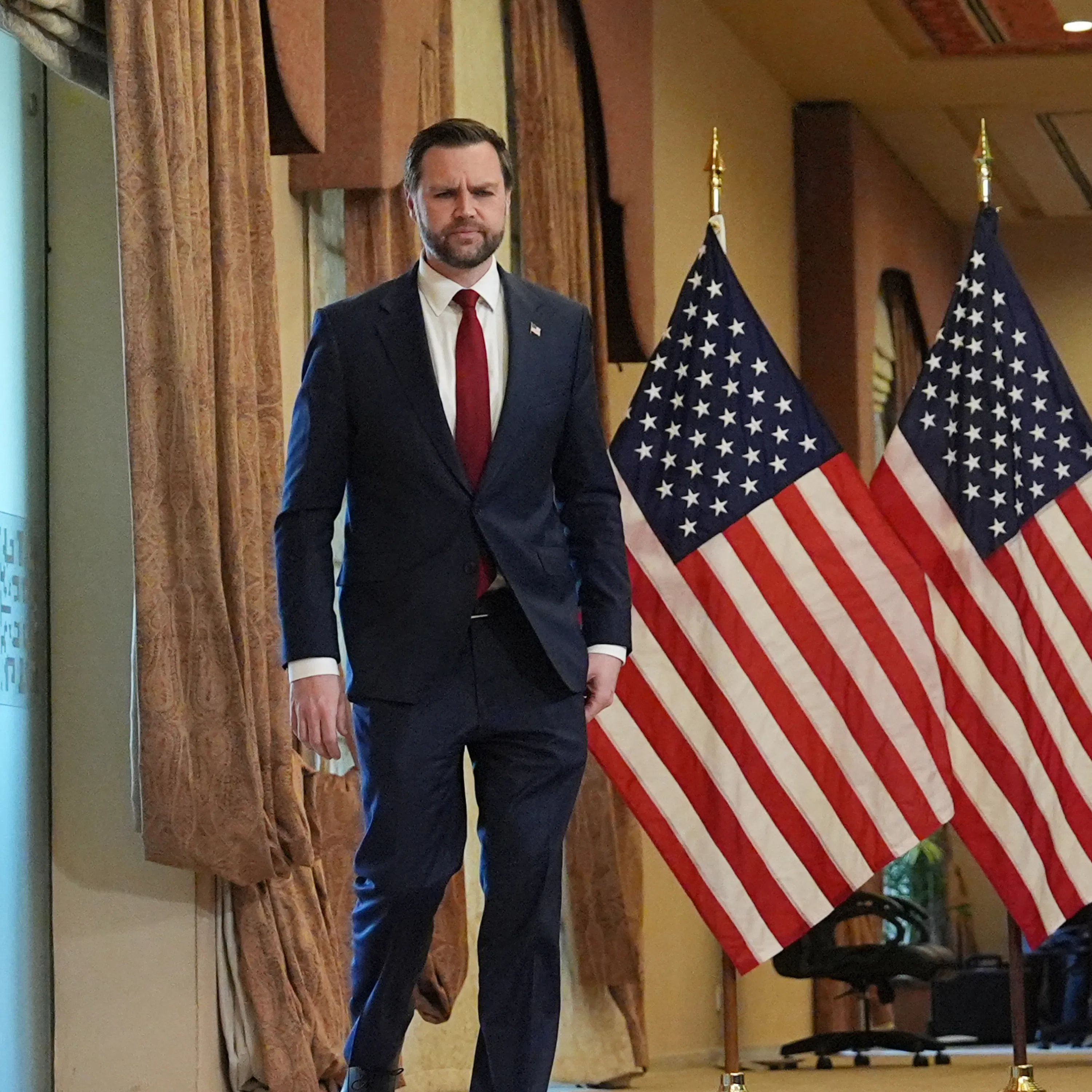
Today, Explained
No deal
00:26:06
Trump sent his vice president, son-in-law, and an old business buddy to negotiate an end to the war in Iran. The war...is still going.
Loading summary
Transcript71 lines
- [00:01]
Noel King
The US did not get a deal with Iran this weekend.
- [00:04]
J.D. Vance
The bad news is that we have not reached an agreement. And I think that's bad news for Iran much more than it's bad news for the United States of America.
- [00:11]
Noel King
The bad news for Iran is an American blockade, effective as of this morning of the Strait of Hormuz, so that
- [00:18]
John Finer
Iran will not be able to sell
- [00:19]
Noel King
oil, which Iran, you may recall, is also blockading. Fox asked Trump about the consequences.
- [00:26]
Unidentified Interviewer
Is this going to be enough to
- [00:27]
Noel King
lower the price of oil and gas, sir?
- [00:30]
John Finer
Well, it's going to be eventually it's going to be lowered. No, it might not happen initially, but it's going to, it's going to go down.
- [00:36]
Noel King
Oil is up over $100 a barrel today. Coming up on Today explained the art of no deal.
- [01:00]
Dave Lawler
What should we make of the Iran war ceasefire announcement and where do things go from here?
- [01:06]
Jake Sullivan
If anything has surprised me over the last 24 hours, it's that Iran agreed to a ceasefire, and particularly that Iran agreed to a ceasefire after that outrageous message that President Trump put out.
- [01:18]
Dave Lawler
I'm Jake Sullivan.
- [01:19]
Jake Sullivan
And I'm John Finer and we're the hosts of the Long Game, a weekly national security podcast.
- [01:24]
Dave Lawler
This week we break down the latest news on Iran and share our net assessment of where things stand for the
- [01:29]
Jake Sullivan
US the episode's out now. Search for and follow the Long Game wherever you get your podcasts.
- [01:36]
Megan Rapinoe
Megan Rapinoe here. This week on A Touch More, we're bringing you our live show in Phoenix with WNBA four time champion Chelsea Gray and the Naismith coach of the year, Shay Ralph. Together we talk about the NCAA semifinals, the crazy activity in the transfer portal, and of course, the final matchup for the NCAA champ. Check out the latest episode of A Touch More wherever you get your podcasts and on YouTube.
- [02:03]
Ambassador Wendy Sherman
This is today Explained.
- [02:08]
Dave Lawler
I'm Dave Lawler. I'm the national Security editor at Axios.
- [02:11]
Noel King
All right, so J.D. vance was the lead negotiator for the U.S. some classic good pictures of J.D. vance came out of this, if little else. How did Vance do? What's the consensus?
- [02:24]
Dave Lawler
So so hard to say how he did inside the room. I think the fact that he put his hand up for this assignment is interesting. We reported that Vance personally told Trump that he wanted to be involved in the Iran diplomacy. He was one of the more skeptical voices inside the administration about this war to begin with. And the Iranians actually made clear that they preferred to deal with him than Steve Witkoff and Jared Kushner, who led the two previous Rounds of negotiations which ended in Iran being bombed. Right. So not a great track record for, from the Iranian perspective on dealing with those guys. We didn't get a deal from Vance. He certainly was brief in his public statements after the talk. I think it was a three minute press conference.
- [03:07]
J.D. Vance
We leave here with a very simple proposal, a method of understanding. That is our final and best offer. We'll see if the Iranians accept it. Thank you.
- [03:17]
Dave Lawler
So we don't have a lot of color in terms of what he was like inside the room. The Iranians have suggested they felt like they were making headway in the talks until the US Moved the goalpost. That's their characterization. Vance also said that he spoke to Trump a half dozen times, at least over the course of those 21 hours. They also spoke to Secretary Rubio, Secretary Bessant. So he was making calls back to Washington to check in, which suggests that this didn't go nowhere.
- [03:46]
Vanta Representative
Right.
- [03:46]
Dave Lawler
I mean, if nothing was moving in the talks, you wouldn't have to keep checking in with the stakeholders back in Washington, or in Trump's case, in Miami, I should say.
- [03:54]
Ambassador Wendy Sherman
Vice President J.D. vance and his delegation were engaged in 21 hours of high stakes negotiations with Iran. President Trump flew to Miami to enjoy the UFC light heavyweight championship fight.
- [04:07]
Jake Sullivan
With us in the building tonight, the 45th and now 47th president of the United States of America, Donald J. Trump.
- [04:21]
Dave Lawler
So, you know, Vance is still in charge of this operation. It's not over. Both sides have suggested that negotiations could resume at some future date. We have no reason to expect it won't be Vance in the room. And this is really by far the biggest assignment of his political career. Making peace with Iran is, is a pretty big thing for the Vice President to take on and somebody who clearly has ambitions beyond the vice presidency. This will be quite a big test for him.
- [04:50]
John Finer
Yes.
- [04:50]
Noel King
And so the question really is why him, like President Trump could have picked any number of people, including some who have expertise in Iran, although there are fewer in his administration than there were in the past. But why Vance?
- [05:05]
Dave Lawler
Yeah, so a couple different reasons for that. One is that Steve Witkoff has had this file for a while. He and Vance get along quite well. We have some reporting that he suggested that Vance. Vance be the one to take over if it wasn't going to be him. Again, Vance did tell Trump that he wanted to be involved in the diplomacy here. And, you know, I think part of it is that the Iranians don't trust this administration at all, but they have more reason to distrust some other people other than J.D. vance.
- [05:35]
Noel King
Right.
- [05:35]
Dave Lawler
Even Secretary Rubio. It's interesting that the Secretary of State is not personally involved in these face to face talks, but he has a history as an Iran hawk. Vance does not. Now, he has stuck quite close to the President in everything he's done over the course of, you know, his almost, I guess, a little over a year now in the Vice Presidency.
- [05:55]
J.D. Vance
I think what this Board of Peace represents is a recognition that if you actually have a President of the United States and a team that's committed to diplomacy, it can actually work. Do you think that it's respectful to come to the Oval Office of the United States of America and attack the administration that is trying to protect, trying to prevent the destruction of your country?
- [06:14]
Dave Lawler
So you're not gonna see him publicly break with Trump and say the President wants to bomb you, but I actually think we should make peace. You know, he'll. He'll keep up the party line, but it's an interesting dynamic that he was one of the more skeptical voices about doing this whole thing in the first place, and now he's the one in charge of making peace.
- [06:34]
Noel King
All right, so there were two other names above the fold alongside Vance's. You mentioned Steve Witkoff and Jared Kushner. Let's start Witkoff. What was he doing there?
- [06:46]
Dave Lawler
Yeah, so Witkoff is a longtime friend of Trump's. They have some shared history in terms of the fact that they have built a lot of golf courses and luxury properties. They go back a long ways. They're both in the developer game. And Witkoff, in Trump's view, is a deal maker. He certainly didn't come in with any particular expertise on Gaza, on Ukraine, on Iran. And yet Trump gave him all three. You know, he. It's a mixed track record up to now. They did get a ceasefire in Gaza, although there's been issues on the back end, as you would expect. I suppose.
- [07:19]
Jake Sullivan
Tonight we celebrate something extraordinary, a moment
- [07:23]
John Finer
that many thought was impossible.
- [07:26]
Dave Lawler
He's certainly taking criticism for how he handled Ukraine. That is an area where there's not been a lot of progress and where he has been accused by some of the more skeptical voices of the President's approach of. Of being too willing to believe what Vladimir Putin was putting on the table, too sympathetic to the Russian perspective.
- [07:45]
John Finer
Witkov truly shamed himself by acting like a total dupe, a Putin fanboy.
- [07:50]
Dave Lawler
Of course, he would deny that. Trump would deny that. And now on Iran, he led two rounds of nuclear talks with the Iranians. One last year, one earlier this year in the Immediate lead up to the bombing campaign. Neither of those have produced a deal, though Witkoff, you know, he does have a very sunny, optimistic demeanor when he talks about these things. It always seems like a deal is right around the corner, or at least that he believes a deal is right around the corner. That has not happened on Iran, it hasn't happened on Ukraine. But I'm not sure his optimism is entirely diminished that he can play some role in getting to a resolution here.
- [08:28]
Noel King
And then he went to Jared, if I may, Jared Kushner. Jared Kushner. What is his deal? What is he good at? Why is he at the table?
- [08:38]
Dave Lawler
So President Trump thinks very highly of his son in law, Jared Kushner. I think he thinks he's, oh, what a smart kid. He said that publicly. He said it privately.
- [08:46]
John Finer
Where is Jared? Is he here? By the way, I'd love to introduce. He did such a great job on Middle east peace. You see what we're doing there? Middle east peace, where is he?
- [08:56]
Dave Lawler
He was actively involved, officially involved in Trump 1.0. He was responsible for negotiating the Abraham Accords, but also had a whole number of files. He was sort of the minister for everything. If there was something that he thought he could move the ball on, he basically had the president's blessing to get in there and do it. This time around, he has no official government role, but kind of a similar set of parameters where he does seem to have the President's blessing to speak on behalf of Trump and to try to make these international negotiations happen. So he has worked side by side with Witkoff on these negotiations, and it's an interesting sort of buddy act. They have occasionally done briefings with reporters on these things. And Witkoff is sort of sets the mood a little bit, talks in broad strokes about how it's all going, usually, as I said, pretty optimistic. And then Kushner is a little bit more in the details. He, I think, has, has studied up to some degree on, on these issues. Not to say Wycuff hasn't, but he does. You know, he has some level of technical understanding and knowledge of the various issues which he's being tasked to negotiate now that the war is over. If you want to integrate Israel with the broader Middle east, you have to find a way to help the Palestinian people thrive and do better. One of the things that is valuable for Jared, even if you're negotiating with him, you can be pretty confident that this guy has the ear and has the confidence of the president. Right. You're not negotiating with the junior undersecretary for something or other where you, you don't know if they can deliver what they say at the table. I think Kushner clearly has a close relationship with his father in law and is able to speak credibly on behalf of the President of the United States.
- [10:43]
Noel King
Are Kushner and Witkoff proving to be good at diplomacy?
- [10:50]
Dave Lawler
I think, you know, if you were going to make a case for, let's say, for Kushner, you would say, you know, he, he is a realist in terms of what can actually be achieved. He doesn't try to strike these broad Kumbaya bargains in terms of Gaza. They did get a ceasefire there. It hasn't lived up to, you know, their sort of grander ambitions so far for what the region would look like after a ceasefire was achieved. But, you know, he did get an agreement there. Working with Witkoff, the critics, and in particular of, of Witkoff, he has been accused of sort of freelancing, like going in not with a clear plan. He showed up in Moscow once, famously without his own interpreter and had to use an interpreter from the Kremlin, basically, which, you know, drew some, some eyebrow raising. That's not typically how, you know, diplomacy is often quite by the book, Right. If you're, if you're operating out of the State Department, you know, there is a way that you do these things and Witkoff does it differently. Kushner to some degree does it differently. Witcuff flies around in his private plane. You know, it's just the whole thing is very Trump style diplomacy. And yet, you know, they would say, has it really worked that well the way that everybody else has done diplomacy? You know, like, give us a shot to do it our way. So we're a year in. They've had a lot of, I mean, I don't even know if you count up one thing. You cannot accuse these guys, particularly Witkoff, of being, is lazy or lacking the energy for this job. They've had weekends where Kushner has hosted the Russians and the Ukrainians and the various parties to the Gaza negotiations at the same weekend at his golf course and just gone meeting to meeting, meeting to meeting all weekend long. You know, they really do have, seem to have a bit of a relish for doing this. Witkoff seems to enjoy it to some degree. But whether ultimately we'll look back on the Trump administration and say these were the two right guys to be doing this, maybe it's too early for us to say.
- [13:03]
Noel King
All right, so what happens next? Are there more talks? Does the ceasefire keep ceasing.
- [13:09]
Dave Lawler
I think the question is, does either party feel like enough progress was made or enough sort of trust was developed in that first round of talks that they think we can get there? Or do they feel like this was proof that the other side can't be trusted and we just have to keep going along, escalating potentially militarily until we get to a point where it's clearer how the war is going to end. But if the Iranians don't move, do we just keep doing this for weeks and weeks? It's possible, but I don't think it's anybody's preferred outcome.
- [13:55]
Noel King
That was Dave Lawler of Axios coming up. Making a deal with Iran is very, very, very hard. We're going to talk to the last person to pull it off. Support for Tay Explain comes from Chime Perhaps you think all banking apps are the same Chime says there's so much more than just a banking app and they want to make banking for everyday people more possible. How? By removing overdraft fees, minimum balance requirements, monthly fees, your everyday spending could deliver tangible rewards and a clear path toward your financial goals. Chime has products like MyPay, which can give you access to up to 500 of your paycheck anytime. They say you can earn up to 3% APY on your savings. That is nearly eight times more than what traditional banks offer. And if you get stuck, Chime says they have you covered with five star USA Today rated customer service real live human beings available 247 Chime is not just smarter banking. It is the most rewarding way to bank. You can join the millions of people who are already banking fee free today. It just takes a few minutes. Head to chime.comexplained that is chime.comexplained Chime
- [15:12]
Unidentified Interviewer
is a financial technology company, not a bank. Banking services and the secured Chime Visa credit card are provided by the Bancorp Bank NA or Stride bank na. Optional services and products may have fees or charges. See chime.com feesinfo terms apply. Limited time only. Must open the new account and complete QU qualifying activities to earn rewards. Advertised annual percentage yield with Chime plus status only. Otherwise 1% APY applies. No minimum balance required. Chime card on time. Payment history may have a positive impact on your credit score. Results may vary. See chime.com for details on applicable terms.
- [15:35]
Vanta Representative
Support for the show today comes from Vanta. If you're a business owner, you may have noticed a shift recently. Risk and regulation are increasing, but before they sign anything, customers now expect clear proof of security. Building that trust is essential to closing deals, and that's what we're all about, closing deals. But it's also complex, expensive and time consuming. Vanta says they can automate that process to bring compliance, risk and customer Trust together on one AI powered platform. So whether you're prepping for a SoC2 and who isn't, or running an enterprise GRC program, I know a lot of you are. Vanta keeps you secure and keeps your deals moving. This helps companies get compliant fast and remain compliant in the future, opening doors to huge growth opportunities and freeing up your valuable time. You can get started@vanta.com explained that is V A N T A dot com explained vanta.com explained
- [16:40]
Jake Sullivan
foreign.
- [16:46]
Noel King
Comes from Rippling. Lots of apps call themselves all in one platforms. Despite that, Rippling says you're probably still using more than one of them to run your business. Rippling says they can help you simplify once and for all. Rippling is a united platform for global hr, payroll, IT and finance. With Rippling, they say workflows that normally bounce between several tools and departments actually just do happen in one place automatically. Let's say you have an employee getting promoted. Rippling says you can use their platform to update their payroll taxes, manage any new app permissions, ship them a laptop, issue a new corporate card, assign trainings. You can run all of your hr, IT and finance operations as one, or pick and choose what your business needs. So if you or your company want to run the backbone of your business on one unified platform with people at the center, you can go to rippling.com explain and sign up today. That's R-I P P L-I-N-Com explain to sign up. This is Today Explained. I'm Noel King with Ambassador Wendy Sherman. Quasi retired former Deputy Secretary of State led the team that in 2015 got a nuclear deal with Iran.
- [17:55]
Ambassador Wendy Sherman
We said they could only have so many kilograms of a stockpile, not enough for a nuclear weapon, that there would be extensive monitoring and verification by the International Atomic Energy Agency and other countries would begin to be able to do commerce inside of Iran. The US still had an embargo, but that would put our European colleagues on the ground in Iran and we hoped over time that might open up channels to work on several other issues as well. And we knew at the time if we could not make a deal then we might find ourselves in military conflict and it would be terrible. All of the things that have happened now we knew would happen.
- [18:42]
Noel King
All right, so to take listeners back in time, just A little bit after the deal is signed in 2015, President Trump comes into office, and he essentially tosses it out. He says, I'm going to create something better. Now, to this day, he hasn't. And now there is a new war standing in the way of a new deal deal around Iran's nuclear program. What do you think it would take for the US to get a new deal with Iran?
- [19:06]
Ambassador Wendy Sherman
Right now, it really depends on what the objectives are for the President of the United States and for Iran. Right now, what President Trump has said is he wants to make sure Iran doesn't have a nuclear weapon. He wants to make sure they don't have missiles or the development of missiles that could reach the United States that could bring a nuclear weapon our way. He wants to open the Strait Hormuz. He wants to stop Iran from funding proxies like Hezbollah and Hamas, the Houthis in Yemen, because he thinks they are create a risk for Israel, who is our ally, and create a risk for all of the countries in the Gulf region. That's a lot of things to want. Iran, on the other hand, now sees that it has control of the Strait of Hormuz, and so they're looking to maintain that leverage because it allows them to project power in the region. They want to ensure that they maintain a right to enrichment. The United States does not believe countries have a right to enrichment, and they want to be able to continue to have relationships with Hezbollah and Hamas and the Houthis. So there's a big gap. And it's sort of curious because the negotiation team on our side is quite small. The negotiation team on their side includes people like Abbas Arachi, who was my counterpart during the 2015 negotiations, and he's now the foreign minister, and he knows every single detail of that deal.
- [20:52]
Noel King
Okay, so there are no easy answers to the question, how do you get this done?
- [20:57]
Ambassador Wendy Sherman
No.
- [20:58]
Noel King
All right, so let's go back in time and talk about how you did get it done. As you say today, Iran has some real serious leverage. It has the Strait of Hormuz and the ability to close it, and we know that it will act on that. Back when you were negotiating with Iran, were there moments, looking back, when you thought, this is just not going to happen, we're just not going to get this done?
- [21:23]
Ambassador Wendy Sherman
Absolutely. There were many points along the way where I said to my counterparts, if you can't do it, you can't do it. We'll just see where we go from here. We thought we were very close to a set of parameters. That means Sort of a framework for doing the final details of the deal. And the Supreme Leader at the time gave a speech and set out a whole new set of parameters, and I think surprised even his foreign minister. And we had to figure out how we could get from where we were, which we thought was on our way to a deal, to now consider what the Supreme Leader had publicly said.
- [22:09]
Noel King
We know, in part because President Trump articulated this early and often, that there were some Americans who thought we could have gotten a better deal with Iran. What do you hear as the main complaint, and what do you say to those critics?
- [22:25]
Ambassador Wendy Sherman
So the critics say that the strongest part of the deal only lasted for 15 years.
- [22:34]
Noel King
Hmm.
- [22:36]
Ambassador Wendy Sherman
They wanted it to last forever. Now, we argued that it gave us what is called a one year breakout timeline, so that we would have a year if somehow we discovered Iran was cheating, which we thought was highly unlikely to do something about it. And I think some critics, like what we have seen in the past couple of months, wanted to go to war. They thought they could create a regime change. We constantly said to the United States Congress, if we risk war, it could close the Strait of Hormuz, it could increase the gas prices, it could take down the international economy. It could mean the lives of our military and enormous cost to our economy and to American citizens.
- [23:34]
Noel King
Are the right people at the negotiation table?
- [23:38]
Ambassador Wendy Sherman
Well, I find it difficult to believe that Vice President Vance, Steve Witkoff, and Jared Kushner can be successful in two weeks. I fully suspect that the negotiations will continue beyond two weeks if they get any traction at all. And I think part of the reason the Vice President is there is because Steve Witkoff and Jared Kushner. Jared Kushner, who has no formal role in the government, they don't have credibility with Iran because twice before when they were negotiating with Iran, we attacked. And it's hard to believe that someone's gonna keep negotiating with you if two other times they've attacked in the midst of negotiations.
- [24:32]
Noel King
Iran's current demands, if the US Agrees to them, would put Iran in better shape than they were before the war. Lifting of sanctions. They're asking for control of the Strait of Hormuz. They're asking for. The US Pulls out of its Middle Eastern bases. They're asking for. I don't hear you saying that the US came out weaker after the 2015 deal. Is there a risk this time around that that's exactly what happens? The US Comes out weaker and Iran comes out stronger?
- [25:02]
Ambassador Wendy Sherman
I think it's very hard to be that reductive on both counts. There are parts of Iran that are weaker. There's no doubt. They don't have the navy they once had. They don't have the missile programs they once had. They don't have the nuclear programs they once have. They can rebuild all of that. And if they get millions of dollars in tolls and sanctions relief from the United States, they will be able to rebuild all that capacity faster. But in the moment, they have been set back. The United States definitely, in my view, has been set back. We have just spent billions of dollars. We have reduced our inventory of weapons that we may need for other theaters. We have undermined our alliances. We have put Russia and China in stronger positions. We have removed sanctions, oil sanctions from Russia and oil sanctions from Iran already putting money in their coffers, giving Russia more money so they can prosecute their horrible war, an illegal war against Ukraine. I could go on and on about the challenges and of course, two really important things. All of this has cost everyday average Americans much more out of their pocketbooks. And Iranian citizens who do want freedom, the original reason why President Trump said he would, quote, unquote, have their backs, have been completely forgotten in this process. The regime in place in Iran now is more hardline than the one before, if you can believe it, even more hardline and may decide it must have a nuclear weapon in order to deter future attacks. And if Iran decides it wants a nuclear weapon and we'll go for a nuclear weapon, I can assure you many other countries, even some of our closest friends around the world, will think they need a nuclear weapon as well.
- [27:29]
Noel King
Ambassador Wendy Sherman. Kelly Wessinger produced today's show. Jolie Myers edited. Patrick Boyd and David Tadashore are our engineers. And Gabriel Donatov checks the facts. I'm Noel King. It's today explained.
- [27:53]
Ambassador Wendy Sherman
Sam.