← Today, Explained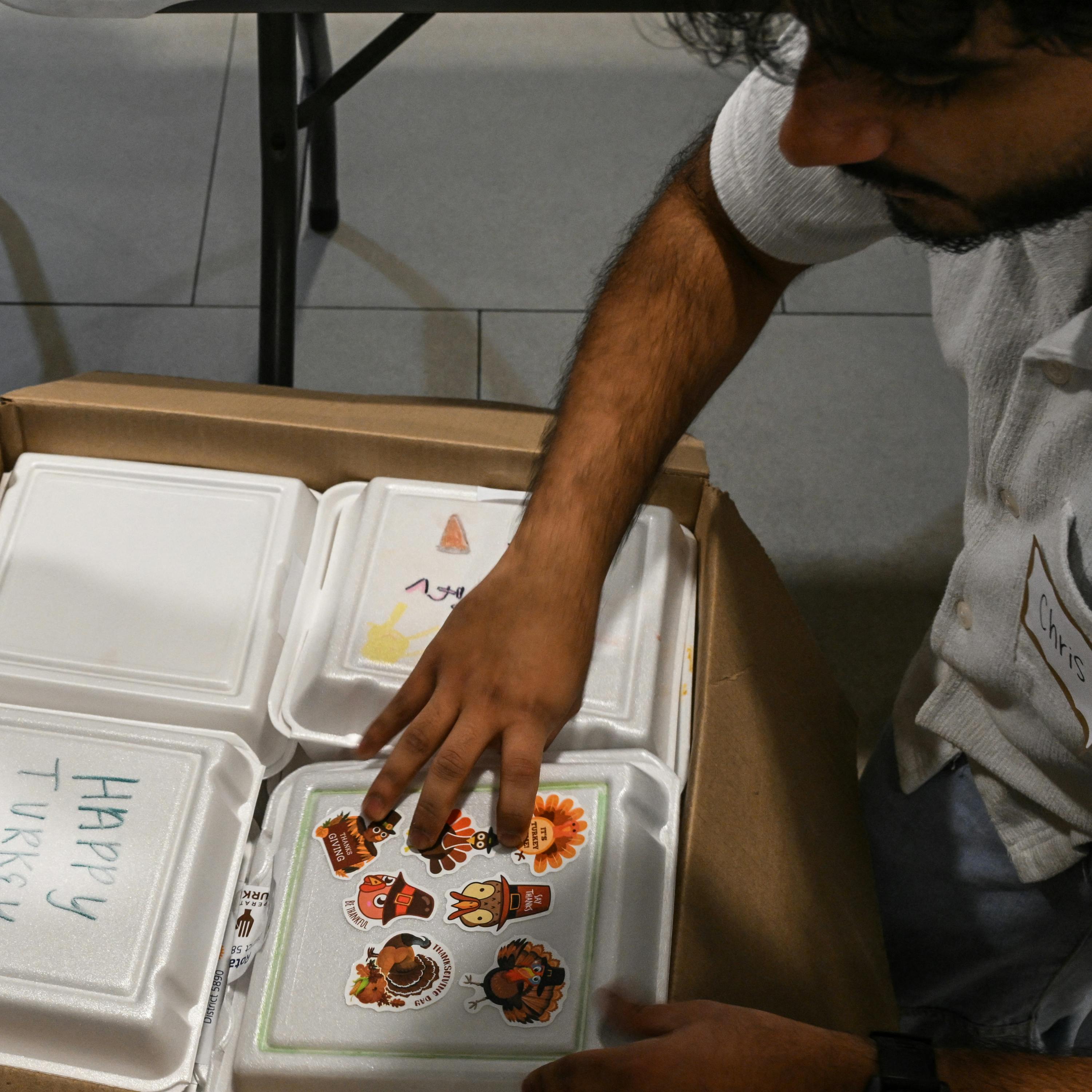
Today, Explained
No one will save us but ourselves
00:30:17
When crises hit, neighbors turn to mutual aid.
Loading summary
Transcript102 lines
- [00:01]
A
Hi, this is Bella Freud. I'm the host of Fashion Neurosis. This week on the show, Esther Perel.
- [00:08]
B
Is on my couch. Erotic recovery is part of trauma healing.
- [00:13]
A
God, that's interesting.
- [00:15]
B
It's not the reward at the end.
- [00:17]
A
Yeah.
- [00:18]
B
That's the difference.
- [00:19]
A
And I think we both come together around that construct. Yeah. Find fashion neurosis on YouTube or wherever you get your podcasts. I got in the water in the very early morning, before the sun had risen and the water was pitch black. I started swimming, and I felt the water hollowing out around me and felt like something really big was swimming below. I'm Phoebe Judge, and this is Love, a show about the surprising things that love can make us do. More than 100 episodes available now on this Is Love.
- [01:04]
C
When I am able to pause and think about what world I want to.
- [01:08]
A
Live in, this is it, right? Always look for the helpers. But it's all revolved around building a.
- [01:16]
B
Stronger sense of community. I've been thinking a lot about my neighbors lately. What it means to help them, what it means to be in community with them. We spend so much time online talking to strangers, but how are the people down the street doing? I've asked myself this question a lot lately, but it first entered the back of my mind around the beginning of the coronavirus pandemic, when groups sprang up across the country to help people who were sick or who were caring for others. Here in D.C. where I live, I saw so many listservs pop up, People offering to grab groceries for neighbors or to give away masks that they made. And even though the needs have changed since 2020, there are groups all around the country that are still going strong. Neighbors helping to meet the needs of neighbors. Rather than relying on government assistance or charity, this type of help is known as mutual aid. I'm Jonquan Hill. This is Explain it to Me from Vox. And this week we talk to folks around the country who are engaging in this work right now.
- [02:35]
D
Mutual aid is not just another form of aid. It embodies a political analysis and a purpose, which is, you know, to say that every person should have the ability to meet their potential, whatever that is. I'm Devon Curtis, and I live in Chapel Hill, North Carolina. Working, organizing with Triangle Mutual Aid. So we like to make a home for people to come and say, I like to fix people's cars. So, okay, so now we have a car repair circle where people teach each other how to fix cars. There's a bike repair circle where people like to do that.
- [03:17]
C
I think all of us, all of us are just like aunties on the block here. And so we just are always looking out for our kupuna, which means elder, on our block in our neighborhoods. Nicole Yukonen and I am part of Maui Rapid Response on Maui, Hawaii. Mutual aid for us works because we're out in the streets, we're out in the houses, we're listening and observing our neighborhood. And we see that auntie or tutu has not left her house in a week and we're gonna go knock and ask if she's okay.
- [04:00]
E
We have, you know, a team that is responsible for the food mutual aid, we have a team that's responsible for transportation mutual aid, we have a team that's responsible, you know, the patrol staff we provided at my son's school, rent support for more than 145 families.
- [04:19]
A
ICE out.
- [04:20]
B
ICE out. ICE. Minneapolis Public Schools have canceled classes for.
- [04:25]
A
The next two days.
- [04:26]
D
The teachers union says this comes after.
- [04:29]
B
ICE showed up to the campus of.
- [04:31]
D
One of their Minneapolis schools.
- [04:33]
E
My name is Shannon Gibney and I live in south Minneapolis. And the name of the group that I organize mutual aid with and through is Minneapolis Families for Public Schools.
- [04:47]
D
Obviously there was a lot of stuff going on in 2020. We made little wash stations before we knew that masks were the important things. And then we helped distribute masks like other people did. We also had a fund for service worker people that lost their jobs in the pandemic and distributed about $80,000 in the community. And then Hurricane Helene hit western North Carolina.
- [05:11]
B
In Hurricane Helene's wake, devastation and destruction.
- [05:14]
A
Stretching as far as the can see. The western city of Asheville in particular has been devastated with flooded roads and loss of power, essentially cutting the city off from any outside aid.
- [05:26]
D
We snapped into sort of disaster relief mode. So we got a donated warehouse space and we put out collection boxes at grocery stores and coffee shops and bike shops and everything all around town. Sent tons of material up to the mountains, collected funding to help pay for expenses, buy generators, do stuff like that.
- [05:53]
A
From here in Maui, where we have just learned that this is now the deadliest wildfire in modern US History.
- [05:59]
D
Hundreds of people are still missing.
- [06:01]
A
Search and rescue teams are going door.
- [06:02]
D
To door looking for survivors.
- [06:05]
C
The fire was the most horrific thing all of us have experienced in our lives. And the way the community responded after, I think is what so many of us are dreaming of the world we want to be living in. We were able to actually create a bus system. One of the tour buses that normally is, you know, driving tourists around, came to Us and said, what do you need? And we were like, actually, like, people would call in and say, okay, we have extra. A pallet extra of these diapers. And somebody would call in and say, oh, I need diapers. And we would just put that on the bus system that also carried people from hub to hub.
- [06:48]
E
It's just everyday people, you know, it's just people who are retired. They have a couple hours in the afternoon, so they're gonna do patrols. And it's people who are, you know, like, you know, real estate agents driving around, like, commuting, trying to track how ice is moving and alert neighbors when things are not safe.
- [07:14]
C
This summer, we were getting notification that there was a major tsunami coming our way. We had 30 people that already knew, like, where they are supposed to go and notify the unhoused across the island. But as I was evacuating, these guys that I've been serving sandwiches to for 10 years are like, hey, Nicole, what are you doing? You're driving the wrong way. You're supposed to be up the mountain. And like, they're telling me how and where to evacuate. All these crises that we've had over the past five years that have just rapidly increased in their severity and how much they come at us has resulted in us having a really effective way to notify so that even the most vulnerable have a chance to even make a choice to do something.
- [08:12]
D
There were a number of people who just truly came alive in that moment where they had never been in a place where the assumption was, yes, the assumption is, yes, you have permission to do whatever needs to be done to help other people. And it was enormously freeing to people.
- [08:33]
E
This is the time when I have been the most proud to say that I'm a Minnesotan, actually, as a black woman, because I feel that the kind of Faustian deal that this administration has kind of thrust upon us is like, you know, especially with the deaths of legal observers Renee Goode and Alex Preddy. Like, well, you can either have your life or you can have your humanity. Your humanity being the fact that we are all interconnected and that we all belong to each other, and therefore we're all responsible for each other. You can have your life or your humanity. And what Minnesotans have said very clearly, emphatically, is, we will take our humanity every time.
- [09:33]
B
Coming up, the rise of mutual aid and its challenges.
- [09:42]
A
Megan Rapinoe here. This week on a Touch More, the one and only Flaje Johnson joins us.
- [09:48]
E
To talk about leveling up for the wnba.
- [09:50]
A
Managing nil money and how she's nurturing her music career. We're also taking a closer look at why participation in girls sports is declining. Surprising, we know. And we're giving some love to Valentine's Day and what it's like dating a pro athlete and who's the best athlete.
- [10:08]
B
Couple of all time.
- [10:10]
A
Check out the latest episode of A Touch More wherever you get your podcasts and on YouTube.
- [10:20]
B
Hi, everyone.
- [10:21]
C
This week on on with Karis Fisher, I'm joined by the iconic actor and activist Jane Fonda.
- [10:25]
A
You've heard of her.
- [10:26]
C
Jane and I talked about her roots as an activist dating back to the 19 when she was protesting the Vietnam War to her ongoing fight for climate, free speech and ultimately our democracy. Here's a taste of what she had to say.
- [10:40]
B
Hope is very different than optimism. You know, optimism is everything's gonna be fine and you don't do anything about it. Hope is a muscle. Hope is when you fight, hope can be rage filled. Breaking down the door with a battering ram.
- [11:00]
C
This is a wonderful conversation. I am privileged to be able to talk to people like this. Jane Fonda is the bomb. She just is. She's always been that way. She remains that way.
- [11:09]
A
She will go down in history as that.
- [11:11]
C
You can listen to wherever you get your podcasts and search for us too on YouTube and be sure to follow on with Kara Swisher for more.
- [11:22]
A
My name's Louise and I live in Red Hook, Brooklyn and I am part of Red Hook Mutual Aid. I think in 2020 there was. I had all this energy, so the phone line made a lot of sense to connect with the community in a safe way. I would say we just built a lot of relationships that felt worth maintaining over the last six years.
- [11:45]
B
This is explained it to me. I'm jq. We've heard from people who are finding ways to help their communities. But how does mutual aid work exactly? I asked Thalia Beatty. She's a reporter at the Associated Press who covers nonprofits and philanthrop.
- [12:01]
A
I mean, it's a thing people have been doing forever, you know, everywhere. It's neighbors helping neighbors and meeting their needs, drawing on resources that they have in their community. It can be anything from people handing out food, putting on item exchanges where, you know, you basically bring a bunch of stuff together and give it back out for free. Today you might call someone who's, you know, walking a child to school or bringing them back home because their parents, you know, are scared to leave their home for because of immigration raids. You know, you could call that mutual aid. It really. It's a huge range of practices that might fall under this umbrella.
- [12:43]
B
What is the difference between mutual aid and philanthropy and charity?
- [12:49]
A
Like, what's the difference here among, like, a group of mutual aid networks? They see a big difference between what they're doing in their communities and what nonprofits and formal funders are doing. Like, one of the mantras of mutual aid is solidarity, not charity. And what they're getting at there is that they see themselves as taking actions that meet their own needs and the needs of their neighbors. And a lot of these groups try to eliminate any kind of hierarchy that might exist in the organizing. There's nothing. An executive director. Instead, people make decisions, you know, with some sort of consensus. You know, many of these groups are also not organized or incorporated as formal nonprofits. You know, giving money to a mutual aid network, you know, won't give you necessarily a tax deduction if they're not an incorporated nonprofit. So. So those are some of the differences.
- [13:44]
B
Okay, have we seen an increase in mutual aid? Like, how is that. How do you quantify that kind of thing?
- [13:51]
A
Yeah, I mean, I have not been able to find any kind of authoritative survey of mutual aid networks, but in speaking with organizers of mutual aid, I think anecdotally, we can say often these kinds of practices really pick up in times of crisis. So in 2020, there was a big uptick in mutual aid organizing around the pandemic. And as our schools and our jobs and sort of our daily life shut down, people got together to try to make sure their neighbors and the people they care about were taken care of. We started with, I think, all the other mutual aid groups in New York in 2020. We started as a phone line, taking incoming calls from our zip code for people in need of whatever they could ask for, information they could ask for, a COVID test. We wanted to specifically support houseless people who we noticed weren't getting any resources from the government during the pandemic. Like, they weren't even getting information. So we made pamphlets for them of what was going on, and we handed out food and supplies. If you're watching and, you know, hearing the news, you might feel like you really want to take steps to respond to any number of things that people are struggling with. I mean, in the fall, the government shutdown meant that many people were not going to access their SNAP benefits. So you saw, like, a real concerted effort to hand out food, like, make food available to people. Community fridges are popping up in neighborhoods.
- [15:30]
E
Across Salt Lake City.
- [15:31]
A
Local buy nothing Facebook groups Where neighbors exchanged spare items for free, have become an unexpected hub for community members to lend a hand. And I think that's one of the things that some of these organizers speak about, is that participating in mutual aid can feel very empowering. You can immediately see the difference that you're making in people's lives. And, like, they will encourage other people to really take action without, like, worrying too much about, like, are you going to do this tomorrow or are you going to have enough? Like, you can set out a table with food on it and people will take it. And that that's enough right now is sort of recognizing that you can do something. And it also doesn't have to be the total solution to the problem.
- [16:20]
B
Can you talk about maybe some recent examples of ways mutual aid has filled in the gaps where government assistance has not?
- [16:29]
A
Definitely after natural disasters, you'll see, like, a huge range of mutual aid practices, whether it's a wildfire or a hurricane. There's a beautiful example down in New Orleans of a. What they called a community power map, where initially it was, you know, I think, run by a volunteer group that allowed people to identify if they had power still in their home. And so you could go there to their porch and plug in your devices. I mean, I think that's like a. Yeah, a great example of the way that mutual aid is. It's really solving your problem as well as your neighbor's problem at the same time.
- [17:09]
B
Okay, what are some of the challenges for mutual aid groups compared to, I don't know, the more traditional ways of giving?
- [17:15]
A
I mean, if you are collecting money for anything. Yeah. Mutual aid groups need to think a little bit about how they're doing that, because if someone just gets $10,000 into their Venmo account, that can look like income and taxable income. So you also want to think about, like, the privacy and security of the people you're involved with. Like, if you are bringing food to people who are scared to go outside because of their immigration status and you have their addresses, you should think really carefully about where you're storing that information and who has access to it. I think the power of these networks is that they can respond very fast and be very nimble and change their operations and, you know, really also operates very locally and be very accountable to the people that they're trying to serve. But you are also doing it without a lawyer. And, you know, I think people need to balance their sort of appetite for risk. But, I mean, these organizers also find a lot of meaning and benefit from. From organizing like this.
- [18:26]
B
You know, a lot of these groups ramped up during the pandemic, and then there were snap cuts and natural disasters. Do you think these compounding crises are contributing to that increase in mutual aid? Is it the world we live in now that's kind of, I don't know, making people draw together a little bit more?
- [18:48]
A
You know, these are the kinds of practices that people have been doing forever. And whether it's in immigrant communities, whether it was in the black American community, really, I just. Yeah, I would really say that mutual aid is not new. It just might have, like, a new visibility in this moment. And many people do things like this and they don't think of it as mutual aid. Like, as I was doing this reporting, you know, many people have never heard that phrase together, but do they have a practice of checking on their neighbors and, you know, doing some sort of, like, care work in their community? Yes, there is an increase in participation in mutual aid groups right now. At the same time, we should not see this as a novel phenomenon.
- [19:36]
B
So these networks aren't new, but how'd they come to be in the first place? And when did we see mutual aid really start to take off? That's next.
- [19:56]
E
This week on Net worth and Chill.
- [19:57]
A
We'Re joined by Victoria Garrick Brown, former.
- [19:59]
E
Division 1 athlete turned body positivity advocate.
- [20:02]
A
Entrepreneur who's dismantling the lies we've been sold about our worth. From battling eating disorders as a student athlete to building a platform that's reached millions. Victoria's journey as a masterclass in turning personal pain into purpose and profit. She opens up about the real financial cost of chasing beauty standards, why the skinny girl industrial complex is designed to.
- [20:21]
E
Keep us broke and insecure, and how she's built a business around authentic self worth without selling out her values. We dive deep into the economics of body image, the influencer money game, and.
- [20:32]
A
What it actually costs to love yourself in a world that profits from your insecurities.
- [20:36]
E
Listen wherever you get your podcasts or watch on YouTube.com YourRichBFF.
- [20:42]
A
Hi, my name is Jasmine Araujo and I am part of the Southern Solidarity Grassroots Network. We were really seeing that these conditions were caused by the capitalist society that we're in. And so we began doing trainings that helped us become similar or more like the Black Panthers party. We were teaching ourselves black radical thought.
- [21:10]
B
It's explained it to me. Humans have been helping each other out as long as we've been around, but how did we get the formalized networks known as mutual aid? Tyisha Maddox is an associate professor at Fordham University. She wrote a book called A Home Away From Mutual Aid, Political Activism and Caribbean American Identity.
- [21:31]
F
So I would say in the African American communities, particularly those in antebellum society, we have examples of mutual aid. In the north, there were free black societies that participated in mutual aid around schools for free people or the formerly enslaved. So there were free African societies that were founded as early as the 1700s in places like Philadelphia and in New.
- [21:57]
A
York.
- [22:00]
F
In the late 19th century. We see immigrant groups such as the Chinese and Jewish communities. And in all of these groups we see this idea of providing health and examples of like life insurance for each other, particularly workers comp, when workers comp was not a thing. And so if you got sick on the job and you couldn't go to work, they provided a portion of your wages to you. For many people who come as immigrants, they come usually by themselves and are single. And so they provided family and connection for immigrants who are in a new city, in a new country, oftentimes by themselves. And so they provided this network. Another really important function of these mutual aids and that we see across many of the groups, particularly in the US in the Chinese, Caribbean and Jewish groups are collective fun in which members paid into. And so in the Caribbean communities, they were called susus.
- [23:02]
D
And.
- [23:02]
F
And what they were were rotating credit practices. And so everyone put in a certain amount of money and then you had a chance to take out that money to use for small loans, for household expenses and mortgages or their rent or just to survive. And so these associations were really important for these kinds of like financial as well as moral support for immigrant group.
- [23:29]
B
Yeah. When we look to history, do we see a rise in mutual aid? And if we do, do we also see it kind of fall back?
- [23:36]
F
Yeah, I think we see a rise, particularly in the period that I study. I look at the early 20th century. So the groups that I look at, I follow from 1890 to 1940. And we see the numbers of mutual aid expand exponentially in this period, particularly before World War II. And then we kind of see a weaning back of mutual aid. Once we of government institutions that are being implemented, I think that takes away the need for some of the groups, but not all of them. And so many of them persist after these early groups.
- [24:14]
B
Where do we start to see mutual aid appear? Next.
- [24:19]
F
We see mutual aid, I would say the ideology of mutual aid being applied in many of the social movements that we see in the 50s and the 60s particularly. I think one of the most popular examples Would be that of the black panther party.
- [24:38]
B
We want housing, we want clothing, we.
- [24:41]
A
Want education, we want justice, and we want peace.
- [24:47]
F
The black panthers were not a mutual aid group, but they definitely practiced many of the ideals of mutual aid in terms of, there was like a free ambulance program. They had free clothing and shoes.
- [25:01]
A
They were talking about taking care of.
- [25:03]
C
The seniors in the community.
- [25:06]
A
In some cases, they were providing childcare.
- [25:09]
B
And free medical centers were in the making.
- [25:13]
F
They provided a free breakfast program in schools for children.
- [25:16]
C
And we hoped that people would begin to wonder, well, if the black panthers.
- [25:20]
B
Can feed a few children, then the.
- [25:22]
A
United States government, you know, with all.
- [25:24]
C
Their wealth, why aren't they feeding more children?
- [25:27]
F
And so we see many of the ideologies of mutual aid in, I would say, the social justice movements in the 1950s and 1960s and 70s and so on. I think many of the more modern social justice movements have all had an aspect of mutual aid as part of them.
- [25:49]
B
Are there differences in the way mutual aid functions now versus the way it functioned in the past?
- [25:55]
F
I would say the major difference is the way in which the groups are connected. So as opposed to being based on where you're from. So even with the Chinese immigrant mutual aid groups, they were often based on ethnicity. Right. Where in China were your family members from? Whereas the groups that have formed in more recent years tend to be community or neighborhood based, and they have not necessarily known each other. They don't have as long of a history. But I think the ideals are the same in having this horizontal looking within the group and helping members of the group out for things that they need in order to keep going. There's also this desire for political and social change for the group itself.
- [26:46]
B
What do you think draws people to mutual aid in this particular moment that we're in now?
- [26:52]
F
I think this sense of no one is gonna save us but ourselves, and we have to be responsible for our communities, Particularly when we don't see the government stepping in to fill these needs of the group. So, for instance, there was a reduction rate in fema assistance. And so when hurricanes hit, and we're waiting on the government to come and step in and provide aid, and the government doesn't come, what do you do? And I think this just reliance on ourselves has increased, Particularly when we saw, for instance, during 2020, when the government didn't have a plan for people and how we were gonna care for each other, but we saw many of our neighbors passing, many of our neighbors in need. And so this is when communities, I think, step in and I think that shows, like, the goodness in human nature in that people were not gonna just let their neighbors and their community members suffer or perish because the government hadn't stepped in. And so you step in for yourselves.
- [28:01]
B
You know, if someone is listening to this and they're like, okay, I'm part of a community, like, I have neighbors. I just. I wanna be a better neighbor. I wanna help out. I want to participate in this. Where does someone even begin?
- [28:15]
F
I think there are a lot of resources, and I would start with trying to see if there are mutual aid groups that are in your neighborhood or in your community, because in many cases, there actually are. And so you don't have to reinvent the wheel. You look to the examples of older groups who are already there enjoying those. And if there aren't, then you take it upon yourself to try to start the groups, get together with a few of your neighbors, pool some resources and see what are the needs of your community, and then start by trying to fill those needs in the ways that you can.
- [28:57]
B
That's it for this week. We're working on an upcoming show about Attention Deficit Hyperactivity Disorder, or adhd. Do you have ADHD and how has it affected your life? How do you feel about the way people talk about ADHD? Give us a call at 1-800-618-8545 or email us@askvoxox.com and if you're a regular listener of this podcast, you can help us by becoming a VOX member. Members get a ton of free perks like listening to this podcast and other VOX podcasts ad free. Go to Vox.com members to learn more. This episode was produced by Danielle Hewitt. It was edited by Avishai Artsy, Fact Checked by Melissa Hirsch and engineered by David Tadashore. Our executive producer is Miranda Kennedy. Special thanks to Joanna Solotarov, Shasha Leonard, Arlene Arevalo, and all the mutual aid organizers around the country who talked to us for this episode. I'm your host, Jonquin Hill. Thank you so much for listening. I'll talk to you soon.
- [30:02]
D
Bye.