← Today, Explained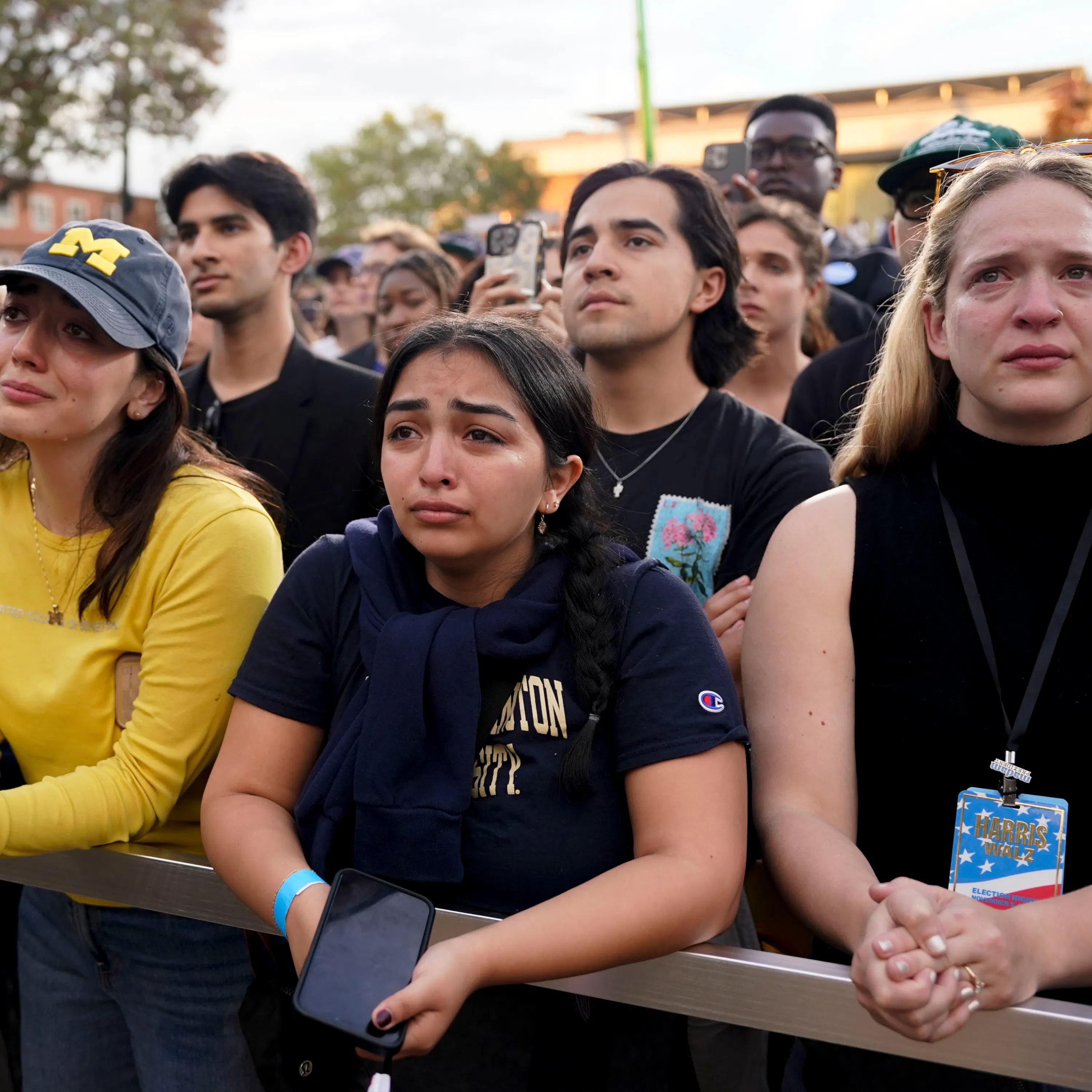
Today, Explained
Pin the fail on the donkey
00:27:27
Democrats lost big on Election Day: the presidency, the Senate, and maybe the House too. Vox's Eric Levitz explains what went wrong, and political strategist Jeff Weaver imagines what comes next for the party.
Loading summary
Transcript76 lines
- [00:01]
Noel King
Kamala Harris gave her concession speech at Howard University yesterday. So I sent Shawn down to ask her supporters two questions.
- [00:07]
Shawn
What do you think went wrong last night?
- [00:09]
Noel King
Everything.
- [00:11]
Jeff Weaver
I don't think anything went wrong. I think that Donald Trump represents what America values and I think that sucks.
- [00:17]
Noel King
I think a lot of things went wrong, but not necessarily just last night.
- [00:20]
Eric Levitz
This Gaza war, she really didn't have a lot of time.
- [00:23]
Noel King
There's a lot more unity on the Republican side of things.
- [00:25]
Eric Levitz
You know, Biden was not physically and.
- [00:28]
Jeff Weaver
Emotionally and mentally up to his desk.
- [00:30]
Eric Levitz
Democrat voter turnout. I just think our male voters let us down.
- [00:33]
Shawn
Where do you think the Democratic Party needs to go from here?
- [00:35]
Eric Levitz
More engagement. I mean, I think Democrats need to inform themselves better of the stakes, clear, concise stances on policy.
- [00:43]
Noel King
We need to find the people because we're the ones who help people. He's not the one who helps people. And I think we need to become a little bit when they go low, we need to go under the ground.
- [00:53]
Shawn
We're going to pose those same two questions to two people who have been thinking a lot about the Democrats on.
- [00:58]
Unknown
Today Explained Amgen, a leading biotechnology company needed a global financial company to facilitate funding and acquisition to broaden Amgen's therapeutic reach, expand its pipeline and accelerate bringing new and innovative medicines to patients in need globally. They found that partner in Citi, whose seamlessly connected banking markets and services businesses can advise, finance and close deals around the world. Learn more@citi.com clientstories.
- [01:31]
Eric Levitz
Support for this show comes from Polestar. Polestar is an electric performance car brand that is focused on innovation for both cutting edge technology and design and their all electric SUV. Polestar 3 is for those unwilling to compromise. For those who believe they shouldn't have to choose between the spacious comfort of an SUV and the agile handling of a sports car. For those who need an intuitive infotainment system and a dashboard designed with minimalism in mind. Polestar 3 is for for drivers who won't settle for anything less. Book a Test Drive for Polestar 3@Polestar.com.
- [02:05]
Shawn
And you may ask yourself, well, how did I get here?
- [02:10]
Eric Levitz
Letting the tears go.
- [02:13]
Noel King
This is today, explained Eric Levitz.
- [02:16]
Shawn
You're a senior correspondent at Vox, covering politics and policy. We know Kamala Harris lost. The whole world noticed. But how bad a night was Tuesday for Democrats across the board?
- [02:29]
Eric Levitz
It was not good, Sean. You know, not only did Harris lose, you know, pretty substantially in the Electoral college, but it looks like Donald Trump is going to win the popular vote for the first time and in the Senate. As of this recording, it looks like Republicans will have at least 53 Senate seats, possibly 54. The House is not decided yet, but Dave Wasserman of the Cook Political Report, who is pretty prominent on social media as a prognosticator of election results based on partial returns, says that he sees many more paths for Republicans to get a majority at this point than Democrats. So this, this obviously is not what Democrats were hoping for.
- [03:17]
Shawn
Democrats did poorly across the board. You're saying who did they do poorly with?
- [03:24]
Eric Levitz
Yeah, so the data that we have right now tells a pretty clear and interesting story. So according to The Associated Press's VoteCast, a survey that measures kind of how different demographics voted on Election Day, it's more sophisticated than an exit poll. Trump's margin with non college educated voters went from being 4 points above the Democratic nominee in 2020 to 12 points above the Democratic nominee in 2024. Meanwhile, Harris actually mostly held her ground with college educated voters. She was about a point below Biden then among white voters. Harris's margin also basically about as well with white voters as Biden did four years ago. The problem was that her margins with black and Latino voters really went down substantially. So in 2020, Biden won the Black vote by a margin of 91% to 8%. Harris won it, according to AP Vocast, 83% to 15%.
- [04:21]
What people have seen is that they mistreat him day in, day out, but he's still fighting for the American people. Black men look at that and they're like, man, if he can go through that, maybe he's saying the truth.
- [04:34]
Among Latinos, Biden wins 63 to 35% in 2020. Four years later, Harris is winning that 56 to 44.
- [04:43]
Jeff Weaver
We got little barbershops, man, that, you know, the economy hurt them, you know, little store owners that the economy hurt them. We need to.
- [04:51]
Eric Levitz
So these really large declines with non college educated voters, black voters and Hispanic voters are what ultimately leads the Democrats from going from a narrow electoral majority, Electoral College majority with Biden to Harris loss.
- [05:12]
Shawn
Why do Democrats have such a bad night? Eric?
- [05:15]
Eric Levitz
I think there are a lot of different factors. And right now, the way that I've been organizing them in my mind is to kind of think of two broad buckets. One, you know, a set of explanations that adds up to something that is relatively optimistic for the Democrats going forward, and another that adds up to a sort of pessimistic or nightmare scenario for what this means for the Democratic Party and its future.
- [05:46]
Shawn
Okay, quite the spectrum there, quite the Gamut we're running. Let's start with your optimistic case because it doesn't seem like a lot of people share that view right now. How do you think this was? Just not that bad a night for Democrats and more of like a, an unfavorable cycle kind of issue.
- [06:04]
Eric Levitz
Basically, if you look across industrial democracies worldwide, parties that have held power have all been doing really badly. Basically, if you happen to draw the long straw of being on the throne when the bill for Covid came due in the form of inflation, you were not very well liked by your voters. When inflation hit, you saw ruling parties in Britain.
- [06:34]
And as Big Ben strikes 10, the.
- [06:37]
Exit poll is predicting a Labor landslide in Germany, in Austria, in Japan, shocker of a result over in Japan. Markets continuing to digest obviously what took place over the weekend in Italy.
- [06:51]
Italy is on course to cementing a.
- [06:53]
Shawn
Historic election result, electing its most right.
- [06:56]
Eric Levitz
Wing government since World War II.
- [06:58]
Almost every country either lose seats in their parliaments or just lose power altogether. And so from this perspective, this is just really unfortunate timing. Almost nothing the party could do. In fact, Democrats came closer to retaining power than a lot of these parties. And so maybe the fact that even this was a close race, given what they were up against, maybe that says something, you know, somewhat positive about the party's overall health. So that's one factor that you can put in the optimistic bucket. You know, you combine that with the kind of extraordinary circumstance of, for the first leg of the general election, having a rhetorically incompetent octogenarian president who really can't form sentences, reliably making the case for your party, that's not a good situation to be in.
- [07:52]
Come on, come on, folks.
- [07:54]
And it's not a situation that you would expect the party to be in again. And then finally, I think, and perhaps the most important factor, frankly, for most of the past eight years, Donald Trump has been the cause of and solution to all of life's problems for the Democratic Party, right? Like it's the backlash to his governance in 2018 that brings the blue wave. It's his unpopularity that helps Biden win in 2020. And if Trump does what he says, he's about to do a lot of really unpopular, disruptive things. So you might think that just fundamentally, Trump is going to generate enough backlash over the next four years. The Democrats are going to be okay by 2028, just through the electorate's distaste for what they've just signed up for.
- [08:44]
Shawn
Okay? So in short, the optimism comes from the fact that Joe Biden wasn't the best president and Donald Trump will probably be a bad president. Tell me about the pessimistic case.
- [08:58]
Eric Levitz
Yes, that case really rests on the demographic trends that I talked about earlier. So the two big ones were Democrats losing ground with non college educated voters and losing ground with non white voters. Now those are two things that obviously I think to an extent were influenced by the factors I listed just a second ago. Inflation, Kamala Harris's imperfections, et cetera. These things definitely mattered. But the fact that it took this pattern, there's another way of reading it, which is that this was a trend that was already happening before 2024. These trends are potentially rooted in something a lot deeper and harder to fix than just disadvantages based on this particular election cycle. Put that all together and then just consider what is it going to look like when Republicans nominate someone who is not Donald Trump? In other words, someone who is not so blatantly vulgar, anti intellectual, disrespectful of democracy. It's hard to imagine that the next Republican nominee is going to be more offensive to college educated voters than the current one. And at the same time, they're probably not going to be as openly racist either. And so it just seems like that Republican nominee could on the one hand, gain back some of the party's losses with college educated voters while continuing to build on its gains with these conservative leaning non white voters.
- [10:28]
Shawn
Okay, so you've given us an optimistic case, you've given us a pessimistic case. When do you think it is exactly the Democrats are gonna sit down and figure out how much they need to change? Is that already happening? Is that gonna happen in two years? It feels like Biden waited too long to figure out how the party needed to change this time around.
- [10:49]
Eric Levitz
I don't think we're gonna know for sure until 2028, frankly, because we're not gonna know until then what our politics looks like when Donald Trump is not at the very center of it. His conquest of the GOP has been the dominant story of politics for most of the last eight years and arguably triggered these major shifts in the coalition. So until Republicans put up their new standard bearer, their first new one in 12 years, and we see how the electorate reacts to that in polls, we're not really going to know how much of the Democrats problem was and wasn't Trump, how much of it was related to factors that were a one off in 2024 versus these deep structural trends. That said, what we do know right now is that Democrats do not have a coalition that makes it easy for them to compete for control of the U.S. senate. Right now they are looking at being down, I think at least six seats in that body, and it's very hard to see how they regain a majority even in the next couple cycles. Or at least it's going to be an uphill fight. Because to do that, they're going to have to win seats in more than one race in places that Biden and Harris lost. That's a really big problem for the party. And so I think that would make the argument for we need to figure out some way to make our coalition broader. We need to find a way to appeal to a wider variety of of Americans.
- [12:28]
Shawn
Read eric levitz@vox.com Bernie would have won this.
- [12:35]
Noel King
We'll be wild.
- [12:47]
Eric Levitz
Support for the show comes from Polestar Innovation is at the heart of every Polestar car and their SUV. Polestar 3 is no different from the intuitive infotainment system to its head turning design. Polestar 3 is for drivers unwilling to compromise. That means merging a spacious, comfortable interior with the torque and handling of a sports car. Now you can go from 0 to 60 in as little as 4.8 seconds and get an EPA estimated range of up to 315 miles per charge. Polestar 3 even allows the driver to optimize the powertrain between performance and range mode, depending on your drive's needs. Experience an uncluttered dashboard showing you everything you want to know and nothing you don't. The innovation doesn't stop there because you can just have Google turn on your favorite podcast and be immersed in 3D sound by Bowers and Wilkins. Polestar has put in the time designing and refining Polestar 3, and that means the time you spend in it will be the best time of your day. Book a test drive@polestar.com.
- [13:50]
Noel King
Support for today explained comes from Indeed. When you want to focus on making meaningful matches instead of endlessly scrolling through resumes. Indeed says it's more than just a job search engine. It's a comprehensive hiring platform that they say is visited by over 350 million people around the world every month. Indeed also says their advanced matching engine is built from a vast network of over 140 million qualifications, so it's always learning your hiring preferences to help you find the right candidate faster. Indeed's platform allows you to efficiently manage the entire hiring process, interviews, screening, messaging, all from within the platform. Listeners of this show can get a $75 sponsored job credit to get your jobs more visibility at indeed. You can go to indeed.comtodayexplained right now and see you heard about Indeed on this podcast, Indeed.com explained terms and conditions do apply. Need to hire you need indeed.com explain.
- [14:57]
Unknown
Think about those businesses that grew their sales beyond their forecasts. Companies like Momofuku or feastables by MrBeast or even a legacy business like Mattel. When you think about them, sure you think about a product with demand, a focused brand and influence driven marketing. But part of their secret is actually the business behind the scenes, as in the business that makes selling and buying simple. And for millions of companies, that business is Shopify. Nobody does selling better than Shopify, home of the number one checkout on the planet. With their shop Pay feature, they can boost conversions up to 50%, meaning way less carts going abandoned and way more sales going. So if you're into growing your business, you want a commerce platform that's ready to sell wherever your customers are scrolling or strolling, whether that's on the web, in your store and everywhere in between. Because businesses that sell more sell on Shopify. Sign up for your $1 per month trial period at shopify.com voxbusiness all lowercase go to shopify.com Vox Business to upgrade your selling today. Shopify.com Vox Business.
- [16:12]
Shawn
This is today explained.
- [16:16]
Noel King
Late yesterday as Kamala Harris was conceding, Senator Bernie Sanders of Vermont, who won his race on Tuesday, released a damning statement about the Democratic Party. Democrats led by big money interests and well paid consultants abandoned the working class, he wrote. And now the working class has abandoned the Democrats. Oh, so we called up Jeff Weaver. He's a political consultant and he is a long, long time associate of Senator Sanders.
- [16:44]
Jeff Weaver
I was started my political life as Bernie Sanders driver back in 1986 after having having been expelled from Boston University for anti apartheid protesting. I came to Washington with him in 1990 when he won his election to Congress. I served in his congressional office. I ran his Senate campaign in 2006. I was the Senate Chief of staff for a couple years. I left to start my comic book business and he called me back in 2015 to run his presidential campaign and I have not been able to escape politics since.
- [17:17]
Noel King
What were you thinking on Tuesday night as it became clear that Kamala Harris was likely not going to win?
- [17:22]
Jeff Weaver
You know, people talking about Kamala Harris and you know she did not win obviously. But this should not be laid at the feet of Kamala Harris, whose feet should be laid at we lost the Senate. Looks like we're not going to regain the House. This is a much deeper systemic problem than Kamala Harris running or not running a great campaign. You know, there are some really deep seated problems with the Democratic Party's relationship with voters and particularly working class voters. It used to be white working class voters, but now increasingly it's voters of color. And if we keep doing the same thing we've been doing, we're going to be in the permanent minority.
- [17:59]
Noel King
What are those problems, Jeff?
- [18:01]
Jeff Weaver
Yeah, well, look, this party was the dominant party in America for 30 years when it was the champion of economic populism that came out of the New Deal. And when it started to abandon that, you know, it lost faith with working class people. Bill Clinton is really started this with, you know, NAFTA and most favored nation status for China, you know, going after poor people with his welfare reform bill which caused, you know, some people in administration to even quit. And you know, since then, neoliberal politics, which has really hurt working class people in this country with, you know, open trade, free trade and other pro business policies. You know, the Democratic Party is no longer seen as the party of the working man. And shockingly, the Republican Party has become the party of working class people. And that's a very distressing. So we have got to get back to our roots in many ways on economics and we've got to put those front and center and be unabashed and full throated about whose side we are on. Mark Cuban should not be the face, the poster boy for the Democratic Party. His bad face for the Democratic Party and then on the social and cultural issues. When I first came to Washington with Bernie Sanders back in 1990, there were quite a few pro life Democrats in the Congress. They were economically populous but they happened to be pro life for one reason or another. There were anti gun control Democrats, there were pro gun control Republicans. You know, these issues have all become part of the partisan makeup of our country. Now if you're a Democrat, you have to be pro choice. You have to be for this or that. If you're a Republican, you have to follow the orthodoxy and that particular party. And we need to get back to more of a position, I think of social libertarianism in the party. The party is, you know, there's a lot of word checking and virtue signaling in the Democratic Party which is off putting to a lot of regular people. You know, there's a lot of, you know, college sociology terms that get now made it their way into lexicon and they're there for a lot of people. They're off putting.
- [19:58]
Noel King
All right, let's Dig in to what you mean by economic populism, because Kamala Harris tried a version of appealing to a middle and working class right.
- [20:08]
Jeff Weaver
Yes.
- [20:08]
Noel King
She had plans to help homebuyers. She had plans to give parents tax credits. She had plans to cap prescription drug prices. She had plans to raise the minimum wage. Those seem like populist measures to me. Why didn't they seem like that to voters?
- [20:22]
Jeff Weaver
Well, because she'd been part of an administration which had not taken inflation seriously enough. I mean, and by that, I mean in their messaging, I do think the administration was working to bring down inflation. But when you talk to people in the administration or you saw them on a cable news show and you said the economy is not doing great, you were hit with a barrage of admittedly rosy macroeconomic numbers. But because of the gross income and wealth inequality in America, those numbers are meaningless to many, many people whose lives are not reflected in those numbers. The fact that Mark Cuban makes three times more money is not helping an autoworker in Michigan who's making less money. The average wages of working people in this country, the average worker in this country is making less in real dollars than they did 50 years ago. And that's not Kamala Harris fault, but it is the Democratic Party's fault. Donald Trump offers a narrative for why things are the way they are and why you may be doing well or not doing well. It's a false narrative about immigrants and social wokeness. But the Democrats don't have a counter narrative. You know, if you listen to the president, that Joe Biden, you know, there's good Republicans, business is good, labor is good, the Congress is good, and somehow bad things happen to good people. Well, that's not satisfactory. You need to have a counterbalancing narrative which explains what is really happening in people's lives, which is wealth and income is being shuttled to the top in this country. Corporate elites, you know, are looting the bank accounts of American consumers. And until you were willing to say that and to say you were on the side of working people against those forces, you were going to continue to have these results. You know, the truth is, without Covid, you know, Trump might have won reelection. So, you know, what everybody viewed as a reputation of Trump in 2020 may just have been a flight to some kind of safety or normalcy that people wanted in Joe Biden because of COVID But without Covid, I think people. There was a populist trend in America. You saw it in 2016 on the Democratic side with Bernie Sanders, so left Populism you saw a right faux, it's a faux populism, but a faux populism with a Donald Trump on the right. And that instinct has not gone away. You know, Covid interrupted it. But you know, the people understand that there are many institutions and powerful actors who are against them, against their interests. And until you were willing to stand up and point fingers and say who that is, you were going to be unsuccessful. You know, Star wars is not a good movie without Darth Vader. And your story has to have a villain.
- [22:55]
Noel King
The Democrats did have a villain. They had Donald Trump. What did I miss?
- [22:58]
Jeff Weaver
What happened was Donald Trump had been president. You know, Donald Trump, because he was erratic as a president, really didn't accomplish all that much, frankly, you know, a horrendous tax bill. But beyond that, his legislative accomplishments were relatively minor. I think you're going to see a very different and concerted effort by forces of reaction in this country to try to capitalize on his reelection to do many of the things that they were unable to do in the first go round. So it could be much more problematic. But people said, look, we had Donald Trump, we still have a democracy even though Donald Trump was president for four years. But you know, price of eggs are, you know, crazy high. Everything's high, interest rates are high. And it wasn't that way when Donald Trump is there. So, you know, we'll put up with his antics and that's the price they're willing to pay to have a bit more economic security. And you know, I bristle when I hear, you know, some in the party call it economic anxiety, like it's some kind of neurosis. The people are really doing well but they just don't understand it. They're not doing well.
- [24:01]
Noel King
So what do the Democrats do about that? How do they re engage Americans who say we are not doing well, you haven't done anything for us and we have thrown you bums out. What's the next step here?
- [24:12]
Jeff Weaver
Well, the next step is to retool the agenda, retool the messaging. You know, that's a very high level that is very clear and full throated around economically populist issues and against a corporate elite inside the party. There needs, I mean that's a whole, you know, we can have a four hour program on what has to happen within the party.
- [24:30]
Noel King
Give me the top line.
- [24:31]
Jeff Weaver
Look, you need to bring new voices into the Democratic Party. The Democratic Party needs to democratize itself. Whenever the Democratic Party moves away from democracy, when they take the Democratic out of Democratic Party they get kicked in the teeth. The people who are least competent to make decisions about where this country should go and what the messaging should be are Democratic Party insiders in Washington, D.C. those people could not get elected anywhere other than in a Democratic Party. And of course, many of them are actually appointed by the president. They're not even elected. Those folks are completely out of touch and unreliable. And you know, we need some new blood in the Democratic Party. We need to democratize the party so that these new voices actually have a role. That's what we need to do.
- [25:14]
Noel King
You worked with Bernie Sanders for a long time.
- [25:16]
Jeff Weaver
I did.
- [25:16]
Noel King
Bernie Sanders is an older gentleman in many ways. Bernie Sanders did change the conversation in this country. But he is in his 80s, if I'm not mistaken.
- [25:25]
Eric Levitz
Yes.
- [25:26]
Noel King
Do the Democrats need a next Bernie Sanders or 100 of them?
- [25:31]
Jeff Weaver
Well, yes, 100 would be good. If we had 435, we could have one in every house district. But look, I'm a person who believes that leaders don't make history. History makes leaders. You know, we'll have an open Democratic primary process next time and there will be people on that stage who will be articulating different visions for going forward and a decision will be made about which way the party should go in 2024. We circumvented that process and we saw the result. You know, now we will have people, there will be people articulating an economic populist approach to politics that I think would be very popular with working class people.
- [26:21]
Noel King
Jeff Weaver is Bernie Sanders former driver and then later his advisor Miles Bryan.
- [26:27]
Shawn
And Hadi Mwagdi made our show today.
- [26:29]
Noel King
Matthew Collette edited, Laura Bullard and Amanda Llewelyn fact checked.
- [26:32]
Shawn
We were mixed by Andrea Christian's daughter and Rob Byers and hosted by Noel King. And.
- [27:25]
Unknown
Support for this podcast comes from Stripe. Stripe is a payments and billing platform supporting millions of businesses around the world including companies like Uber, BMW and DoorDash. Stripe has helped countless startups and established companies alike reach their growth targets, make progress on their missions and reach more customers globally. The platform offers a suite of specialized features and tools to fast track growth like Stripe billing which makes it easy to handle subscription based charges, invoicing and all recurring revenue management needs. You can learn how Stripe helps companies of all sizes make progress@swepe.com that's stripe.com to learn more stripe make progress.