Loading summary
Transcript73 lines
- [00:02]
Sean Ramisforum
Donald Trump re entered office about six months ago, and since then we've covered a lot of immigration stories on Today Explained. We've done deportations to a concentration camp in El Salvador, as many as possible. We've done deportations to Gitmo.
- [00:17]
Donald Trump
Most people don't even know about it.
- [00:19]
Sean Ramisforum
We've done people being turned away at points of entry into airports.
- [00:23]
Donald Trump
We don't want them.
- [00:24]
Sean Ramisforum
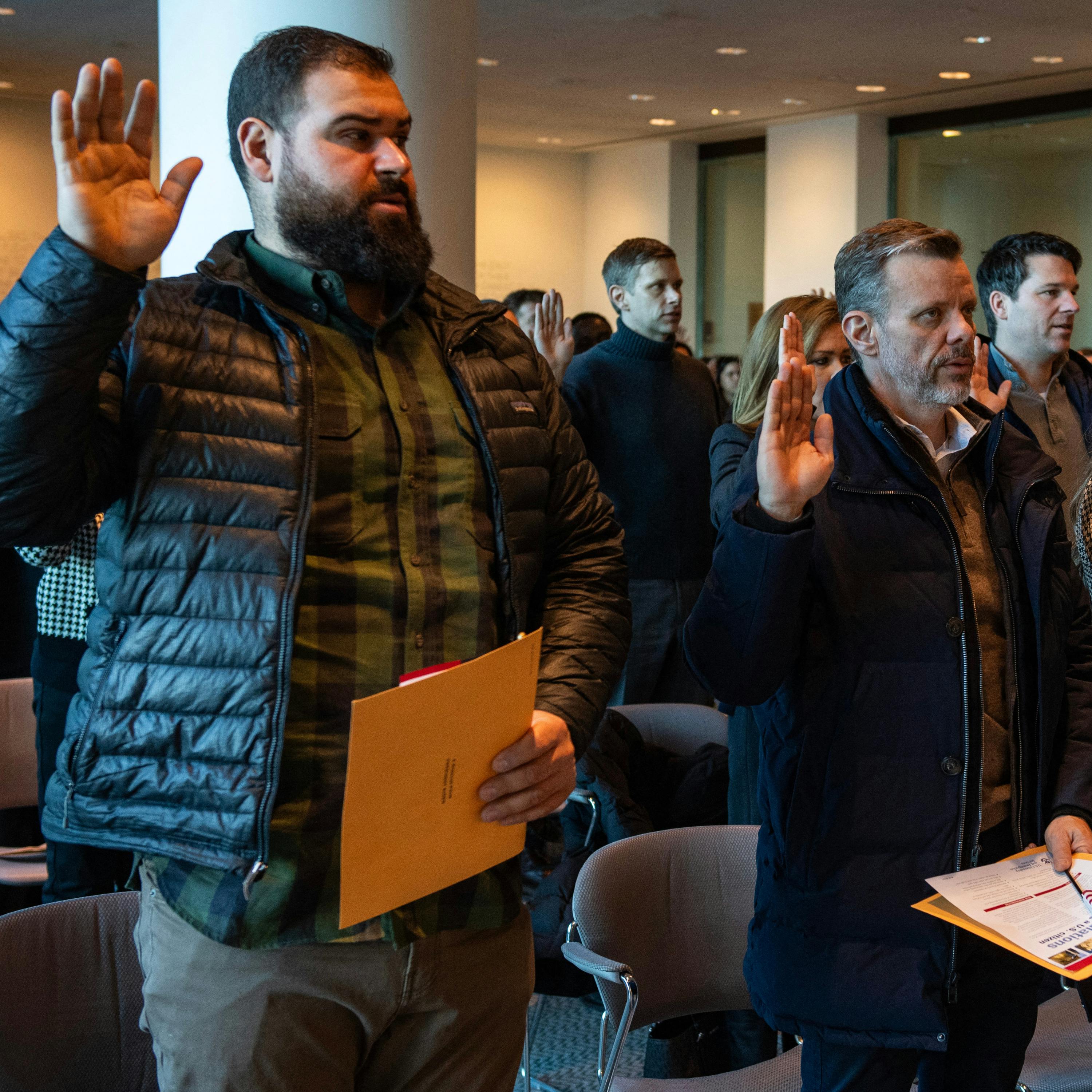
But today we're gonna do a different one, one that doesn't get as much attention. Today we're gonna talk about Den revoking U.S. citizenship from people who weren't born here but are on paper, Americans with the paper to prove it.
- [00:41]
Donald Trump
They're old to our country. Many of them were born in our country. I think we ought to get them the hell out of here, too. You want to know the truth? So maybe that'll be the next job that we'll work on together.
- [01:00]
Nicole Naraya
Support for Today explained comes from WhatsApp. Nobody likes having someone look over their shoulder when they're texting or listening in on their personal calls or peeking at their note to self. You deserve privacy in person and digitally. And WhatsApp gets that by design. No one, not even WhatsApp can see or hear your personal messages except the person you send them to. If someone tries to take a peek, all they'll see is gibberish. And that includes WhatsApp themselves. WhatsApp message privately with everyone. Visit WhatsApp.com to learn more.
- [01:43]
Sean Ramisforum
Nicole Naray is a senior politics reporter at Vox, and she wrote about a recent Department of Justice memo on denaturalization.
- [01:51]
Amanda Frost
So, yeah, the DOJ put out this memo essentially saying that it would try to strip citizenship from people who had, quote, unquote, illegally procured American citizenship, either because they made misrepresentation on their citizenship application, because they were ineligible for citizenship at the time they applied, or because they committed crimes that warranted stripping them of citizenship.
- [02:13]
Nicole Naraya
But it goes further, encouraging action even against those who haven't been convicted, just charged with a crime. And the DOJ is also giving US Attorneys wider discretion on when to pursue denaturalization, that it would permit the division to denaturalize for just about anything.
- [02:31]
Amanda Frost
And they do actually have the power to do this, but it's historically been very rarely exercised. And the DOJ is making sort of a concerted effort here to expand its use. But it is like, you know, part of this broader immigration strategy, as you alluded to, that we've been seeing coming out of the second Trump administration, which has really been about spreading Fear among people living here who were not born in the US Whether or not they're US Citizens. And denaturalization is just one of many tactics here.
- [03:00]
Sean Ramisforum
And Donald Trump has made some high profile threats to denaturalize various Americans. I think New York mayoral candidate Mamdani comes to mind. And also electric car magnate Elon Musk.
- [03:20]
Amanda Frost
Yes, Both have been some targets that Trump has identified. So Elon Musk, as you mentioned, is South African, became a US citizen in 2002 after his very public falling out with Trump. Trump sort of made suggestions that he could be denaturalized.
- [03:36]
Donald Trump
He's upset that he's losing his EV mandate, and except, you know, he's very upset about things, but, you know, he could lose a lot more than that, I should tell you right now.
- [03:46]
Amanda Frost
And same with Madani. He's from Uganda, became a citizen in 2018.
- [03:50]
Mamdani
Donald Trump said that I should be arrested, he said that I should be deported, he said that I should be denaturalized. And he said those things about me. Someone who stands to be the first immigrant mayor of this city and generations, someone who would also be the first Muslim and the first South Asian mayor in this city's history.
- [04:15]
Amanda Frost
In his case, the denaturalization push seems less about sort of retribution and more directly linked to his criticism of the war in Gaza and also his opposition to ICE raids. You know, we saw Rudy Giuliani, who's now at the dhs, question whether Mamdani is a loyal American. As a result of that.
- [04:34]
Mamdani
Do you really see him as an enemy of America?
- [04:37]
Sean Ramisforum
Do I see him as an enemy of America? What he's saying, my personal.
- [04:41]
Rudy Giuliani
Yes, you're damn right. I guess.
- [04:45]
Amanda Frost
So they are some of those targets.
- [04:47]
Sean Ramisforum
But are those more just like empty threats? Whereas in the background, this is something his administration is actually pursuing in much lower profile cases.
- [04:58]
Amanda Frost
So I think these ones are clearly politically motivated and irresponsible in that sense, because it is sort of broadening the universe of people who feel like they might be targeted for denaturalization. But when it actually comes to the numbers and to the cases that we've seen the DOJ publicize, we saw recently that they shared that they had successfully denaturalized someone who shared child pornography prior to obtaining citizenship and who also didn't disclose that crime on his citizenship application, that's not necessarily an unusual application of the federal government's denaturalization power. But it's not clear if Trump is going beyond the typical use cases just yet. And this memo does suggest that they would, but it's hard to say whether that's sort of materially coming to fruition.
- [05:49]
Sean Ramisforum
Okay, so you said this is something the Trump administration, the doj, can do, and it's been done in the past, though not a lot. How does it work?
- [06:00]
Amanda Frost
There is a process associated here that has to play out before a judge, but there are some due process concerns associated with it. So especially given that the Trump administration, administration is pursuing civil proceedings here, that's important because defendants won't get an attorney, and the burden of proof on the government's part is a lot lower than it would be in criminal court. But, you know, as I said, it's been sort of very rarely exercised. And that's because the legal grounds for denaturalization are really narrow under current law. On the one hand, you can be denaturalized if you commit human rights violations like war crimes and acts of terrorism. I don't think many people would disagree with those use cases. You can also be stripped of citizenship if you weren't eligible for citizenship at the time you applied. And there can be a number of reasons you can be found ineligible. For example, you lied on your citizenship application. You didn't complete the mandatory five year permanent residency beforehand. You can also be considered ineligible if you did not exhibit good moral character or you were not, quote, attached to the principles of the Constitution of the United States. Those last two provisions in particular are kind of worrying because they can be interpreted pretty broadly. It's like, what does good moral character really mean? And I think that's where the Trump administration has some potential wiggle room to expand the use cases for denaturalization. You know, in the DOJ memo, we did see them say that they wanted to prioritize people who pose a potential danger to national security. And that's concerning, given the way that this administration has already tried to invoke national security grounds to deport people who are voicing political opinions. It doesn't like.
- [07:43]
Sean Ramisforum
Is it already happening, or is it something that's going to happen?
- [07:47]
Amanda Frost
So this memo came out in June. It's still very early and hard to tell, but we do know from the first Trump administration it was a priority of White House advisor Stephen Miller.
- [07:58]
Sean Ramisforum
Murderous migrant mobs.
- [08:00]
Amanda Frost
So the DOJ launched this new section focused on denaturalization and investigated about 700,000 naturalized citizens that resulted in 160 active denaturalization cases, which was more than under any modern president. But it's not clear ultimately how many people were denaturalized.
- [08:19]
Sean Ramisforum
Should we Also anticipate legal challenges here, as we've seen in any number of this administration's immigration initiatives.
- [08:27]
Amanda Frost
Yeah, of course. I mean, I think it depends how sloppy they are. Right. If, indeed Trump is pursuing cases against his political enemies simply because they're rubbing him the wrong way, then, yeah, I think there's a big question as to whether that's going to actually hold up in court. It's also. So if he's going to go after people for just paperwork errors that clearly aren't malicious representations, that would also be pretty legally egregious. Or at least that's what the Supreme Court said in this 2017 case that a lot of people are citing as sort of precedent here. But I think also whenever we're talking about this question of whether is that legal when it comes to this administration, we also have to remember that there is a conservative majority on the Supreme Court that is helping Trump enact his agenda and has proved pretty willing to step on some precedents in order to do so.
- [09:22]
Sean Ramisforum
What happens to someone after they've been denaturalized asking for a naturalized citizen?
- [09:28]
Amanda Frost
I know, yeah. So I think in most cases, we're dealing with people who have committed crimes that would then make them deportable. But if someone was found to be ineligible for citizenship for some other reason, then they might just revert back to a green card and stay on that status. Or if it was then found that they didn't meet the original criteria for a green card, they could also potentially be deportable. But it can also get tricky when US Citizenship is the only citizenship they have. So let's say they were born somewhere else and relinquished their other citizenship and then became an American citizen.
- [10:00]
Sean Ramisforum
I mean, there's something like 25 million naturalized citizens in this country. They're our friends. They're our family. There are a lot of people. Should they be scared right now that this president sees this as. As a tool more so than any president in modern history?
- [10:24]
Amanda Frost
Yeah. You know, I've been kind of grappling with this question throughout Trump's second term, and I'm always hesitant to catastrophize too much because there's so much we don't know about how the administration is going to implement this memo. And the legal authority that the administration has here is quite narrow. But at the same time, you know, the administration is pushing the bounds of what many people who have been working on immigrant rights for many years thought possible. And the goal of all of that is fear. I hate to give in to that, because I am. You know, many of my family members are immigrants, and I'm deeply invested in it. But I am fearful for what happens in our country now, and I think many naturalized citizens are too.
- [11:15]
Sean Ramisforum
Nicole Naraya Vox but not for long. She's off to law school next semester, and we wish her all the best in that first year, which apparently is a doozy. When we're back on Today, explain the long, ugly history of denaturalization in the United States. Also a doozy.
- [11:51]
Nicole Naraya
Support for Today explained comes from WhatsApp. WhatsApp is committed to keeping users personal chats safe. The things you want most to keep private are indeed kept private, even from WhatsApp. Maybe it's where you message in character memes to your Dungeons and Dragons group, or it's where you share a detailed itinerary with your coworker who's planning a vacation in your home state. From everyday moments of connection to relationship milestones, WhatsApp is your go to for secure and private messaging. And that's because privacy is core to their design. That means no one, not even WhatsApp, can see or hear your personal messages. The only people who see your messages are the people you send them to. Whether it's personal calls, documents, photos, or media that you share in your personal chat. No one's listening in. Not even WhatsApp, because all WhatsApp sees of your personal messages is gibberish. Your personal Messages stay yours. WhatsApp message privately with everyone. Visit WhatsApp.com privacy to learn more.
- [13:07]
Professor TANEY
So Amanda Frost and Professor of Law at the University of Virginia, I'm the author of you Are Not Citizenship Stripping From Dred Scott to the Dreamers and.
- [13:19]
Sean Ramisforum
The title of your book to me implies that denaturalization isn't exactly a novel concept.
- [13:27]
Professor TANEY
No, it's not. And the idea of taking away citizenship generally, even of the native born, is not a novel concept. And it started with Dred Scott.
- [13:35]
Sean Ramisforum
Oh yay, oh yay, oh yay.
- [13:37]
Professor TANEY
Dred Scott was a decision issued by the U.S. supreme Court in 1857. That was obviously just a few years before the start of the Civil War. The nation was riven by the question of slavery and also by the question of the status of non white people in the United States. And Chief Justice TANEY for the U.S. supreme Court was clear in his answer. He said no person of color could ever be a citizen of the United States, whether that person was free or enslaved. And of course our nation rejected that in the Civil War and the Reconstruction Amendments that followed. But denaturalization was not the focus of that decision. That came later. So one of the first major efforts at denaturalization came in 1907 with the expatriation act, where Congress enacted legislation that said that among other things, that all women US Citizen women, whether born in the United States or naturalized, all those citizen women who married a non citizen automatically lost their citizenship upon marriage. And the idea is you could only have one citizenship, and that citizenship was the citizenship of the husband. And in fact, the US Citizen men who married non citizen women, those women automatically became citizens. So it was this idea that you could not have an independent legal identity or existence as a woman aside from that of your husband. And there was also a sense of, and if you choose to marry a non citizen, then maybe we don't want you. And that came up in some legislative debates where the argument was basically, well, why don't you marry one of our good old American boys? And if you don't, then you lose your right to claim or to state that you're an American to have that identity.
- [15:21]
Sean Ramisforum
Was it controversial at the time? Did it, did it rile people up?
- [15:25]
Professor TANEY
Certainly was controversial with some groups of people. It became a focus of activism by women who were fighting for the right to vote. So just to remind listeners, US Citizen women got the right to vote in the Constitution in 1920, but there was a long lead up to that. And so there were women fighting for the right to vote in California. And one of these women, Ethel McKenzie, who was born in the United States and then married a Scottish man, she fought successfully for the right of women to vote in the state of California. And then she herself couldn't vote because the government said, well, you married a non citizen, you've lost your citizenship. She took a case up to the U.S. supreme Court, and the U.S. supreme Court ruled unanimously against her. Then she and her compatriots fought this in Congress and tried to get Congress to change the legislation so that US Citizen women who married non citizens wouldn't lose their citizenship. They were laughed at in these hearings. And I think the date was around 1917. 18. But here's the great moral of the story. After US citizen women got the right to vote in 1920, suddenly Congress changed its tune. Aha. Yeah. So that power to vote enabled women to successfully get that legislation rewritten and amended so that US Citizen women who married non citizens didn't automatically lose their citizenship and the right to vote.
- [16:43]
Sean Ramisforum
So there were surely some women who were born in this country were, were American citizens for much of their lives. Married some guy from some other country, lost their citizenship, and then gained it back in the early 1920s.
- [16:56]
Professor TANEY
Oh, yes, absolutely. Including a woman who served in Congress.
- [17:00]
Rudy Giuliani
In Ivy covered St. James Church. America's first woman diplomat, Mrs. Ruth Bryan Owen, daughter of William Jennings Bryan, is married to Captain Berla Roda of the Danish Royal Lifeguards.
- [17:11]
Professor TANEY
You know, being America, this also got caught up in race. So Congress amended the law to say, okay, if you're a US Citizen woman and you marry a non citizen who's a white person, you keep your citizenship. But if you marry a non citizen who is not, quote, eligible to naturalize, then you continue to lose your citizenship.
- [17:30]
Sean Ramisforum
Wow.
- [17:31]
Professor TANEY
That's because Asians, Arabs, and other racial groups were not permitted to naturalize. That eventually changed. And it changed with the help of a woman who was elected to Congress who herself had lost her citizenship and regained it. And she fought to end the last vestiges of that both racist and sexist law for all U.S. citizen women.
- [17:51]
Sean Ramisforum
Okay, so that's one chapter of denaturalization. What's the second, third, fourth? How many chapters are there before we get to the one that we're in right now?
- [17:59]
Professor TANEY
Yeah, so Congress eventually started to embrace in the 20th century, various different bases for denaturalizing people who had gained their citizenship through naturalization. And Congress began to say, well, if you're a naturalized citizen, but it appears that you don't have allegiance to the United States or engage in activities that seem antithetical to American values, then we're going to claim that we never should have naturalized you, that you lied when you pledged your oath of allegiance to the United States and the Constitution, and we will take away your citizenship. So that happened throughout the 20th century. A scholar named Patrick Vail, who's researched this deeply, said about 22,000 people lost their citizenship and many based on their political speech or their membership in the Communist Party or affiliation with communism.
- [18:47]
Sean Ramisforum
And we're talking about Red scare, we're talking about McCarthyism, we're talking about the Cold War. Was it controversial to strip citizenship from communists at the time?
- [18:57]
Professor TANEY
So, yes, it was debated, Right? And so, of course, some people embraced it. Some people viewed Communism as a true threat to the United States.
- [19:06]
Rudy Giuliani
One communist on the faculty of one university is one Communist too many.
- [19:13]
Professor TANEY
The citizens who support communism from our country, they're going to infiltrate our country and support communist ideals and lead to a communist revolution.
- [19:22]
Rudy Giuliani
Even if there are only one communist in the State Department, that would still be one communist too many.
- [19:28]
Professor TANEY
And I should add, it Wasn't just every member of the Communist Party or anyone who had shown some interest or affiliation with communism who was denaturalized. It was the subset of naturalized citizens who'd done that and then were causing trouble. So we're labor leaders following arraignment.
- [19:43]
Rudy Giuliani
Women defendants, including Elizabeth Gurley Flynn, Claudia Jones awaiting deportation proceedings, were fighting for.
- [19:49]
Professor TANEY
Various rights for workers in particular. Those individuals were the ones the government targeted for removal.
- [19:55]
Rudy Giuliani
As the crackdown on suspected subversives gathers moment.
- [20:02]
Sean Ramisforum
And we eventually get over McCarthy and have a little bit less of a red scare, does that also coincide with sort of the tapering off of all this denaturalization stuff?
- [20:16]
Professor TANEY
I think it was a combination, as it always is, of society shifting and realizing, the general public realizing that communism may not have been the threat they viewed it originally. The United States growing in power post World War II. And then we also have the Supreme Court showing some concerns about the use and overuse of denaturalization. And finally, that led up to a Supreme court decision in 1967 called Afrim vs. Rusk, in which the Supreme Court attempted to put an end to denaturalization.
- [20:51]
Sean Ramisforum
What was the story in that case? Who's Afrayim?
- [20:54]
Professor TANEY
He was someone who was living in Israel, and the question was whether his participation in Israeli politics meant that he should be someone who should lose their citizenship under the statutes that existed at the time. And he fought this in court, as did many before him who had attempted to be denaturalized, some successfully, some not. And that case, which reached the Supreme Court in 1967, the court said, you know, looking back at this history, we are realizing that we cannot give the government the power to take away citizenship based on the fact that it doesn't like the speech or activities of its members. But then in a footnote, the court said, but of course, you can lose your citizenship if you gain citizenship, if you naturalize through fraud or through error, which is what the statute provides. So that remained a basis for denaturalizing people. And a few people every year were denaturalized, mostly very serious war criminals, such as, you know, Nazi concentration camp guards and leaders who had lied about their past when they gained U.S. citizenship. And it was 10, 11 people on average per year, right up until the first Trump administration, when denaturalization was ramped up. And the goal was, let's use this as an immigration enforcement tool and denaturalize far more people.
- [22:11]
Sean Ramisforum
After going through the history we just went through, after writing the book that you wrote and seeing that this tool, you know, sort of waxes and wanes in popularity over the decades and even centuries. Does that, I don't know, bring you some level of comfort or something that, oh, history is just repeating itself, it's just echoing and we'll live to see another day?
- [22:38]
Professor TANEY
Definitely no level of comfort with the situation. It more reminds me that the battles that you fought in the past are never fully in the past and have to be refought every generation or so. I mean, I should remind listeners that of course we also had Japanese immigrants and native born Japanese Americans who were incarcerated during World War II because of fear, because of a sense that they could not possibly be loyal. That was what the government said. And in fact there was a coercive effort to force or at least pressure these people who are kept in these internment camps in the United States to abandon their citizenship, to give up their citizenship, which some did under that coercive pressure of being imprisoned and being afraid. And so they regained it, but only through legal battles that followed from World War II. And of course the government eventually apologized and gave reparations to those people.
- [23:38]
Rudy Giuliani
This brief picture is actually the prologue to a story that is yet to be told.
- [23:43]
Professor TANEY
And so I guess that's just a reminder. We do seem to periodically do this out of fear, out of distrust, out of a sense that some people are not truly American.
- [23:50]
Rudy Giuliani
It will be fully told only when circumstances permit the loyal American citizens once again to enjoy the freedom we in this country cherish and when the disloyal, we hope, have left this country for.
- [24:04]
Professor TANEY
Good and we have to keep fighting the battles of Dredge Scott again and again and again.
- [24:18]
Sean Ramisforum
Amanda Frost is a professor of immigration and citizenship law at the University of Virginia in Charlottesville. Her book, once Again, is yous Are Not Citizenship Stripping From Dred Scott to the Dreamers. Check it out. Denise Guerra made the show. Jolie Myers edited Laura Bullard Fact Checked Andrea Christensdottir and Patrick Boyd Mixed I am Sean Ramisforum It's TODAY Explained.
- [25:11]
Nicole Naraya
Support for Today explained comes from WhatsApp. Whether it's memes or a vacation itinerary or a heartfelt voice message, your private messages are just that, private. They're yours and no one else's. WhatsApp understands that, which is why it's a core component of the app's design. No one, not even WhatsApp, can see or hear your personal messages. That includes personal calls, plus any documents, photos or media that you share in your personal chat. WhatsApp makes sure your personal messages stay yours. WhatsApp message privately with everyone. Visit WhatsApp.com privacy to learn more.