← Today, Explained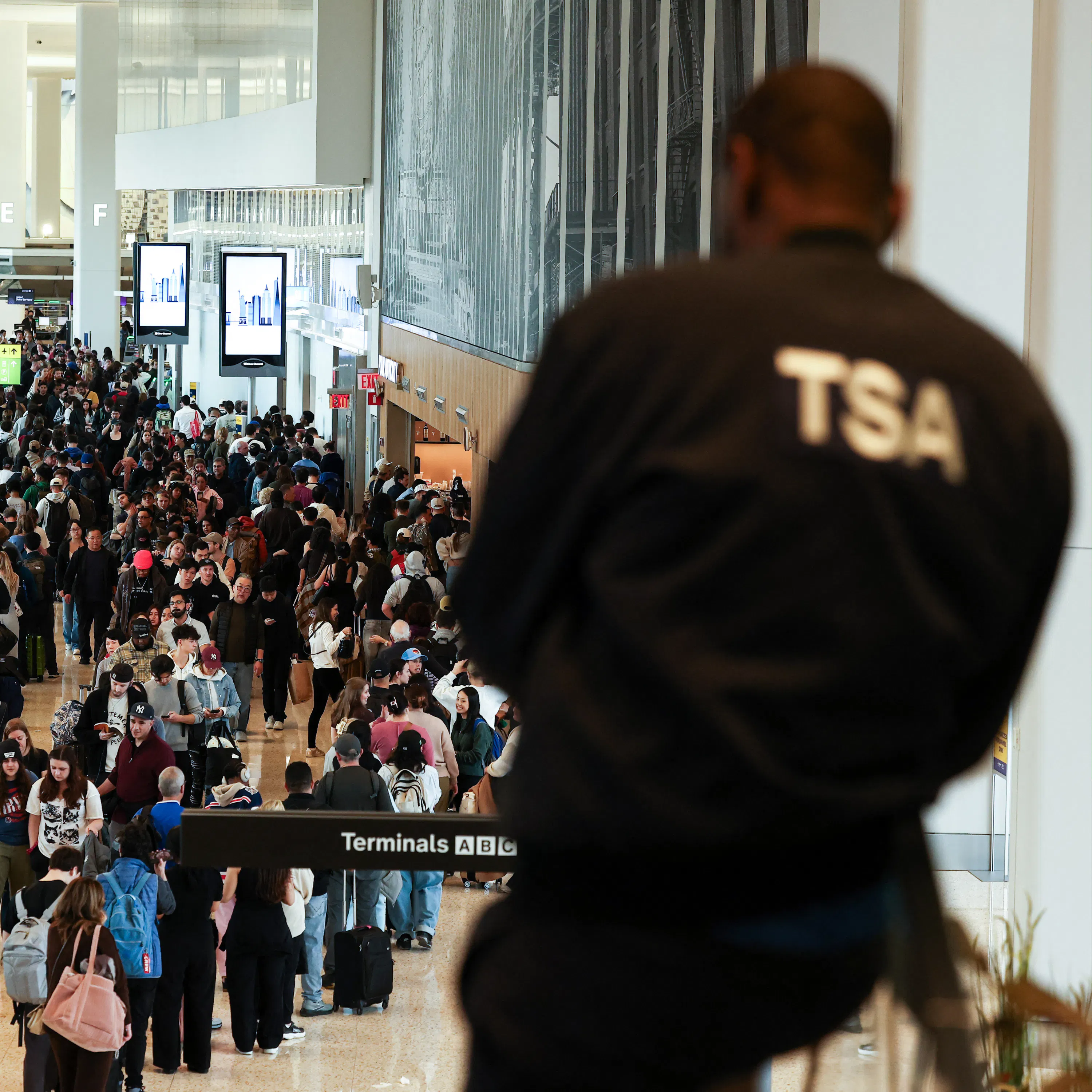
Today, Explained
Should we privatize TSA?
00:26:05
The US government shutdown has left TSA workers unpaid, airports a hot mess, and a lot of people wondering if it's time to privatize airport security.
Loading summary
Transcript86 lines
- [00:01]
A
By this point, you've surely heard that we're living through the longest government shutdown in United States history. It's the reason for all the chaos at our airports. Democrats don't want to give ICE any more money. The President has shown little to no interest in negotiating. But then ahead of the Easter recess, the President said he'd find a way to pay TSA agents. So all of a sudden, maybe the shutdown was sort of bunk. Early Friday morning, the Senate was also busy. They unanimously pass a funding deal, then they take off for their two week recess. But then far right Republicans in the House hated it because it still didn't fund ice. So they reject it, pass a version that funds ice, and then they take off for their two week recess. Fixes nothing. Around this time, TMZ enters the chat, posts a call out for photos of lawmakers vacationing at our expense. While we have to suffer through airport chaos pretty quickly. They get a shot of Lindsey Graham at Disney World. You might remember Lindsey from helping kick off the war in Iran. The latest news is that TSA agents got their back pay at some point today, but we're still not sure if they're gonna get regular paychecks moving forward. So we're gonna check in with a TSA agent on today. Explained from Vox. Protein is now at Starbucks and it's never tasted so good.
- [01:04]
B
You can add protein cold foam to your favorite drink or try one of our new protein lattes or Matcha.
- [01:10]
A
Try it today at Starbucks.
- [01:16]
C
Get in the game with the college branded Venmo debit card. Wreck your team with every tap and earn up to 5% cash back with Venmo Stash, a new rewards program from Venmo. No monthly fee, no minimum balance, just school pride and spending power. Get in the game and sign up for the Venmo debit card@venmo.com collegecard. The Venmo MasterCard is issued by the Bancorp Bank. NA Select Schools available. Venmo stash terms and exclusions apply at venmo me stashterms max $100 cash back per month.
- [01:54]
D
My name is Tatiana Finley. I am the American Federation of Government Employees Local 556 Fair Practice Coordinator that represent transportation security officers from Central Florida all the way to the Panhandle.
- [02:12]
A
Wow.
- [02:12]
D
I am also a TSA officer.
- [02:14]
B
Perfect.
- [02:15]
A
So it seems like you're a good person to talk to in this moment where there's a lot of people frustrated with what's going on with the tsa. And of course TSA agents Must be wildly frustrated. How long have you been a TSA officer?
- [02:27]
D
I'm almost at 22 years.
- [02:31]
A
Wow. Wow, that's a long time.
- [02:34]
D
Correct.
- [02:36]
A
And what made you want to be a TSA officer? Why'd you join?
- [02:40]
D
I remember when 911 happened, I used to work at the airport in one of the food joints and I was supposed to report to work on the day that 911 happened. Of course we got there, we got turned away. I was just, I had just turned 17 when 911 happened. And I'm like, well, what's another way of serving my country without actually joining the military? And this was my answer. So I ended up growing up there and a lot of the people that, you know, were part of my class ended up shaping sort of, you know, who I am today. You know, I really proud of my job and I was in the whole, you know, this is a stable job. It's a federal job. Not everybody can have a federal job. This is just a stepping stone. And so here we are still almost 22 years later.
- [03:45]
A
Okay, so you like the stability when you start, do you remember your first government shutdown?
- [03:52]
D
Yes.
- [03:53]
A
When was it?
- [03:54]
D
It was 2013.
- [03:56]
A
Did it change how you felt about the stability of your job?
- [04:02]
D
It didn't because it was very short lived. But you know, things have changed since then. And then we didn't experience another shutdown until 2019, actually, end of 2018. 2019, that was a little bit longer. At that time, I had already met my now husband and we were living together. We're both working for the agency and we're like, oh, there is no income coming in.
- [04:32]
A
So what started as a fun office romance turned into something kind of scary.
- [04:37]
D
Correct.
- [04:40]
A
This shutdown that we're still in as we're speaking right now on Monday morning is the longest in TSA history. What's been the hardest part for you and your family? Presuming that you and your husband both still work for tsa obviously, right?
- [04:57]
D
Yes, yes, yes. It feels so help, like I felt helpless in certain situations where I've heard of my officers talking about, you know, not having electricity and having children at home, facing eviction, not having life saving medication. And it angers me because then I'm like, no one should have to face this, not when they're employed.
- [05:29]
A
Are you and your family facing stuff like that too?
- [05:33]
D
Thankfully, we haven't yet. Shutdowns kind of have become a cycle. It's become a norm now. It's. Do we also have to prepare for another shutdown in October? If appropriations were to pass at any given time now, Right. In October, our fiscal year ends, do we need to prepare for another shutdown then? I have heard of officers saying, listen, this is no longer a stable job for me. Whether I am a single parent home and not able to make ends meet because we don't know when my paycheck is going to come, or they're being sole caregivers of their household and they depend on their salary to be able to provide care for their family members. They're like, if this continues, I don't see myself lasting long.
- [06:40]
C
Yeah.
- [06:40]
A
What kind of a toll does this take on you mentally to have to go through this over and over again? So much uncertainty.
- [06:48]
D
It's gotten to the point where in my head, like, sometimes. Sometimes days feel harder than others. I can say that. For me, especially on those days when things are hard, I'm like, you know, I can only deal with one thing at a time. And, you know, today's not the end of the world. So we still have tomorrow and see where things go.
- [07:17]
A
That's hopeful.
- [07:18]
C
Yeah.
- [07:20]
D
Because otherwise, I mean, if I allowed the helplessness to take over, I wouldn't get out of bed. Right. And that is not an option.
- [07:34]
A
It sounds like somehow you're an optimist in all of this. Would you consider yourself an optimist?
- [07:41]
D
I have to be. I have to be for the sake of my officers. I have to be because, you know, I signed up when I signed up for the union. I signed up to be an advocate. And you cannot be a pessimist if you're gonna try to be an advocate. You cannot be like, the world's coming to an end.
- [08:01]
A
It sounds like at your level, this is just about doing a good job, like serving your country, serving your community, and honest work. And yet here in Washington, D.C. the way they've treated TSA agents, the whole thing is extremely political. And I wonder, when these shutdowns happen, it's all about the perception of who's being blamed. That's what politicians are paying attention to. And I wonder, who do you and your colleagues blame? Do you blame Democrats for holding out in this shutdown? Do you blame Republicans for wanting to give ICE a blank check? Do you blame the president for being the president?
- [08:42]
D
I think that elected officials have been put in place to represent us as a whole. And it is their job to make sure that they do what they signed up for. Just like I swore an oath 20, almost 22 years ago to go and do what I got to do, which is exactly what we've been doing right. We've been showing up to work with no pay. It is their job to go and do what they gotta do. I don't think at this point it falls on any one party. It's everyone there. They are using our workforce as a bargaining chip and it is 100% time for them to stop their little tantrum because it is affecting the federal officers, it is affecting any agency that has gone unpaid.
- [09:46]
A
And you think, who's throwing the little tantrum? Exactly.
- [09:49]
D
It's all of them at this point.
- [09:50]
A
All of them?
- [09:51]
D
All of them.
- [09:53]
A
You're equal opportunity when it comes to blame.
- [09:56]
D
Absolutely.
- [10:11]
A
The mess at our airports has some people going full libertarian on the tsa, privatized airport security, and we're back on Today Explained. Foreign.
- [10:42]
C
Comes From Built Rewards if you got to pay rent, you might as well get rewarded for paying rent, says Built. And you can with Build. Build is a loyalty program for renters that rewards you monthly with points and exclusive benefits in your neighborhood. With Built, they say every rent payment earns you points that you can put toward flights, hotels, lift ride, so much more. And now it's not just for renters. Built says that members can earn points on their mortgage payments too. Plus, Built says you can unlock exclusive, exclusive benefits with more than 45,000 restaurants, fitness studios, pharmacies and other neighborhood partners. You can redeem built points for built home delivery services, gift cards at over 120 brands. And they even say that you can use those points on your student loan balances. Basically, paying rent or your mortgage can feel a whole lot better. With Built, you can join the loyalty program for renters@joinbuilt.com explained. That's J O I N B I L T.com explained. Make sure to use our URL so they know we sent you. Support for Today Explained comes from American Giant. Perhaps it's time for a new favorite hoodie. According to American Giant, perhaps the most dependable piece of clothing in your wardrobe. If you're looking for a new hoodie, you might look toward American Giant. According to Slate magazine, it's the greatest hoodie ever made. In quotes, they say they obsess over every detail in designing it, from cotton to zipper. And it's not just hoodies. All of their apparel is made to be super comfortable and last for years. Our colleague Andrew Meldasek has worn their pants.
- [12:13]
A
American Giant just sent me a pair
- [12:15]
B
of their roughneck pant.
- [12:16]
A
The material is great. It's made up of a cotton canvas and it's one of those types of pants where you can just wear it
- [12:22]
B
while really doing anything. Going for a quick hike outdoors, go
- [12:25]
A
to the movies or even Friday night date night. They just look really nice.
- [12:30]
C
Stay ready for anything with the American giant classic full zip and save 20% off your first order@american-giant.com when you use code explained at checkout. That's 20% off off your first order@american.g code explained. Support for Today explained comes from Bombas. Perhaps you want to get in shape this year. Bombas wants to tell you about the all new Bombas sport socks engineered with sport specific comfort for running, golf, hiking, skiing, snowboarding and all sport. Meanwhile, for the loungers among us, Bombas has non sport footwear available. But Bombas doesn't just offer sport and non sport socks. They also offer super soft base layers that they claim will have you rethinking your whole wardrobe. Underwear, T shirts, flexible, breathable, buttery smooth, Premium everyday. Go to they say you won't want to leave the house without here's Nisha Chital. I've been wearing Bombas for several years now. I have seen several pairs. My whole family loves to wear Bombas. I have several pairs of Bombas ankle socks and I have some no show socks as well that are great for things like loafers and ballet flats. For every item you purchase, Bombas says an essential clothing item is donated to someone facing housing insecurity. One purchased, one donated. Over 150 million donations and counting, I'm told. You can go to bombas.comexplained and use code explained for 20% off your first purchase. That's B O-M-B-A-S.com Explore Explain code explained at checkout.
- [14:11]
A
I'm TS motherfucking A. We handle shit.
- [14:17]
B
That's what we do.
- [14:20]
A
Consider this situation today Explained. Darrell Campbell writes about aviation for the Verge, and most recently he wrote about privatizing airport security, which it turns out it's a thing we already do.
- [14:33]
B
So it's probably airports that you don't fly a lot to unless you're taking the super budget airlines or unless you fly out of San Francisco and Kansas City. But There are about 20 airports in the US that take part in what's called the Screening Partnership Program, or spp. And that basically means that they hire a private company to do all of the exact same things that TSA officers do. So the ID checks, the the pat downs, the scans, they do it to the TSA standard, but they actually staff them with private security contractors.
- [15:05]
A
Okay, and you mentioned San Francisco and Kansas two Spots with different politics. Does that mean that this is not like your typical conservative libertarian approach?
- [15:18]
B
Privatize it.
- [15:19]
A
Privatize it. Privatize everything.
- [15:20]
B
Yeah, it's really just based on whether the municipality or whichever is the controlling entity of the airport wants to do it. So TSA officially doesn't object if a company wants to come in and privatize it, but for the most part they don't because PSA is kind of an out of the box solution.
- [15:36]
A
And there is a political component to this, I imagine, because TSA privatization was is a stated goal of the infamous Project 2025. So is this something that breaks down on the, you know, ideological left right spectrum?
- [15:55]
B
Project 2025 really doesn't like the Department of Homeland Security. They say it was an overreach government authority, a vast expansion of the bureaucratic state. And, you know, if you've been through TSA in the last 20 years, you probably find some truth in that, that it is kind of this expansion of powers and intrusive ways that doesn't really do a ton to actually keep people safe. That being said, if you look at what Project 2025 actually says about TSA, it's pretty small.
- [16:25]
C
It says the Transportation Security Administration, TSA be privatized right there, Project 2025. Until it is privatized, TSA should be treated as a national security provider and its workforce should be de unionized immediately. This is the recommendation of the Heritage foundation in chapter five, page 134 of their mandate for leadership, better known as Project 2025.
- [16:57]
B
So it's like one bullet point on the overall section about the DHS and then about a page and a half of stuff and it really just amounts to libertarian bonafides about privatization is great. It saves money, it creates a better solution, and kind of the devil is in the details with that sort of thing. You could get a good security company, but you might not. And so it's not this magic bullet that's going to solve everyone's problems with the tsa.
- [17:22]
A
Much like air travel itself, TSA hasn't always been with us. It's a gift we got after 9 11. So we asked Darrell what airport security looked like in a time before TSA.
- [17:34]
B
So in 1998, let's say, which is, I think the first memory that I have of flying, I went to the airport and you could actually go up to the gate and meet people without a boarding pass, but you still had to pass through a medical detector, you still had to put your purse or your backpack or whatever through A scanner, but it was pretty in non invasive, pretty low touch, really. The goal was to prevent the kind of armed hijackings that were common prior to 9 11, which is where people would, you know, take a plane and fly it to Cuba or that sort of thing. So everybody wasn't really doing it to the same standard. So infamously, the private security company in Boston's Logan Airport let some of the 911 hijackers on board with knives and with things that they really weren't supposed to have or they didn't think to look at that might have been caught in other areas of the country. So the TSA came in, they federalized everything, and more importantly, they federalized the standards.
- [18:33]
C
No knives, including plastic knives, on board airlines. Only ticketed passengers will be allowed past the metal detectors. Higher standards for security personnel as well. And there will be more federal air
- [18:46]
B
marshals at large airports.
- [18:47]
D
And a new team of federal security managers, supervisors, law enforcement officers and screeners will ensure all passengers and carry on bags are inspected thoroughly and effectively.
- [19:03]
A
Okay, so TSA, clearly bureaucratic, but I mean, we haven't had a 911 in this country at least, you know, since 9 11. How good a job has TSA done? I mean, I guess they're there to prevent us from bringing explosives and weapons onto planes. Do we have data that suggests how good they are at making sure that doesn't happen?
- [19:27]
B
Yeah, you'll also recall that we had zero 9 11s before 9 11. So under the previous security regime.
- [19:32]
A
Touche.
- [19:33]
B
So that's not the best data point, but they actually do have these what they call Red Team challenges where they send federal officers with fake weapons and fake bombs through there. Most recently, the ones that have been publicized didn't make the DHS and TSA look great. They said they had between like an 80 and a 95% failure rate.
- [19:53]
A
Excuse me. Yeah, so 95%.
- [19:55]
B
Yeah. Which is shocking to me because you think, you know, an X ray, you could find a gun in there really easily. And you hear about this all the time that, you know, TSA is finding. So I live in Texas. This happens a lot. TSA does find guns that people try to bring through, but they're still letting them through and onto airplanes at a rate that is kind of alarming when you consider that's their job.
- [20:20]
A
Do other countries have privatized airport security or do they do it the way we do it?
- [20:25]
B
There's a couple different models, and there really isn't a one size fits all opportunity. So there are some countries in Europe that have 100 federalized security regimes. Some of them do the privatization. Canada is probably the closest example to the US where it is still primarily federalized, but they do have a couple of airports that have private security. And there was actually a recent scandal at the Calgary airport in Manitoba. And you'll have to correct me on that if I'm. If I got the wrong.
- [20:56]
A
I think it's Alberta.
- [20:57]
B
I'm sorry. Okay, sorry. Calgary, Alberta. They had a company called Paladin Security take over the airport security in 2024. And a lot of contractors came back and said, hey, not only are they severely understaffing us, they're also not letting us take bathroom breaks or have water on the line. And that's both causing unhappiness in general, but also it's meaning that a lot of people are calling out. And Calgary actually had one of Canada's worst TSA equivalent security lines of like 30 to 40 minutes being standard when the rest of Canada was about 10 to 15 minutes. And so that's just something that you can pretty easily point to, that privatization isn't this magical answer that's going to solve everything.
- [21:43]
A
Okay, so, yeah, what are the drawbacks, potentially in the United States, if we did this at scale, the devil is
- [21:52]
B
really in the details. And what worries me specifically about doing this under the Trump administration is they've shown, number one, a pretty strong disregard for the details, and number two, this kind of cronyism where they'll give the contract to their friends or someone within the Trump family or someone who just happens to have a connection to Mar A Lago. And that doesn't mean it's a fair contract bidding process or even they're getting the. The best possible answer. It's just whoever has the president's ear or whoever can get a line into them. And that usually means that you're getting a lot of bloat, a lot of inefficiency and a lack quality. Which perversely, is exactly the thing that privatization proponents point to as the problems that get solved by doing it.
- [22:37]
A
But at the same time, as you said when we started out here, San Francisco does this. That's gotta be one of the biggest airports in the country. I thought top 10, but I just looked it up and my preliminary research suggests top 15. It's number 13, I think, maybe. But if they're doing it and it's working for them and we're having this crisis for the past few weeks, does it not suggest to more of our major airports in the country that there's another way to just figure it out yourself and not even wait for the
- [23:07]
B
federal government on principle. I don't hate the idea of TSA privatization, but the way that the debate gets framed almost locks us into this false choice that you can either accept the status quo or you can accept privatization. There are workarounds. Probably the easiest one would be just to protect that line of funding that pays TSA office so that when the government gets shut down, they still get paid. It's conceptually easy to do. They did it for ice. Why can't you do it for tsa? And they do it because it's a useful political football and it's a useful way to lock people into this idea that this is the only alternative. It's pretty clear that, you know, someone got the memo from the Heritage foundation because all of these right leaning publications, not just Fox News, but some other think tanks, have been blogging pretty extensively for the past couple weeks about privatization is the only way. This is exactly why we're pro privatization because they see the political environment as receptive to it. And this is the third shutdown in six months. So people will have it very fresh in their memory that if they pay attention to nothing else about airport security and the FAA and airplane crashes, the average person's experience is going to be closer to I had to wait for three hours. So TSA is terrible then. Oh, there's a lot of nuance to the vagaries of budgeting.
- [24:31]
A
Is this just pie in the sky though? Like, is there any likelihood this happens? It feels like, I mean the one time we saw a dramatic shift in how our airport security was run was after 9 11. Does it take a 911 to hit reset and go back to the drawing board?
- [24:46]
B
I mean, it's not a terrible question. It did take that to really relook at airport security. But if you think about the experience of these TSA workers, you know, they've had these three shutdowns in the last six months and the high call out rates suggest to me that they are starting to think about alternatives. And so maybe the crisis is these TSA workers, you know, being so vocal about how unhappy they are that it forces people to actually pay attention for a change. I do think there's, it feels like there's something tangibly different about the public willingness to pay attention to this particular shutdown that wasn't there two or three ago specifically because now people are understanding, okay, this doesn't have to happen. It didn't happen for the 20 years prior to the Trump administration. Now something is going on and it's tied to the politics of what's happening today. And maybe that's what it's going to take to really rally politicians around it, even if Trump himself wants to keep using this as a political football.
- [25:58]
A
Darrell Campbell is the author of Fatal why the Managerial Class Loses Control of Software. We want to know how Tatiana, our TSA agent from earlier in the show, felt about privatization of her job. Do you want to guess?
- [26:11]
D
I understood the idea of privatization, but I was not aware of all the things that came with it. And at the end of the day, it comes down to someone who wants to gain a contract. It's bidding to pay less. They're not bidding to pay more, they're bidding to pay less. In order for me as the owner or CEO of that private company to fit a profit, I have to make cuts. And what am I going to cut? Is it going to be the background checks? Am I not going to vet the people enough? Am I not going to have enough people because I can't afford? Am I going to cut their salaries? Am I going to cut their benefits? Am I going to just the cut quality of individual? At the end of the day, that puts the traveling public at risk.
- [27:16]
A
So she's not crazy about the idea. Danielle Hewitt produced our show today. Aminah Al Saadi is flying later this week. Thoughts and prayers are being accepted. Patrick Boyd, David Tadashore and Andrea Lopez Crusado are grounded for now. I'm Sean Ramis. For him, this is today explained Sam.