Loading summary
Transcript100 lines
- [00:02]
Noel King
Good morning, everyone. Good morning. Good morning. Relax, relax, relax. I've just got In Texas officials are facing hard questions about why so many people were in the path of floods that inundated parts of Kerr county this weekend.
- [00:17]
Dominic Anthony Walsh
Y' all Ready? As of 8:30 this morning, we recovered.
- [00:21]
Andrew Friedman
75 deceased bodies here in Kerr county.
- [00:24]
Dominic Anthony Walsh
Including 48 adults and 27 children.
- [00:28]
Noel King
Many of the victims were children because that area is home to a bunch of Someone told me that when they.
- [00:35]
Dominic Anthony Walsh
Were walking around campgrounds that they saw that Cabin five, their wall had fallen.
- [00:42]
Noel King
Over and my door flooded away. What went so wrong here? Did the weather alert system fail? Did cuts to the National Weather Service leave critical jobs unstaffed? We've got some answers coming up on TODAY explained. Support for TODAY EXPLAINED comes from Addeo. Addeo is an AI native customer relationship management platform that Addio says is built for the next era of companies. A powerful data structure adapts to your business model, sinks in all your contacts in minutes, and enriches your business with actionable data. Addeo says it also allows you to create those email sequences, those real time reports, those powerful automations which they claim can help you build what matters most, your company. You can go to adeo.comtodayexplained to get 15% off your first year. That's a T T I O.com todayexplained.
- [01:39]
Dominic Anthony Walsh
Introducing the new Dell AI PC.
- [01:42]
Noel King
Powered by the Intel Core Ultra processor, it helps do your busy work for you so you can fast forward through editing images, designing presentations, generating code, debugging code, summarizing meeting notes, finding files, managing your schedule, responding to Jim's long emails, leaving all the time in the world for the things you actually want to do.
- [02:00]
Dominic Anthony Walsh
No offense, Jim. Get a new Dell AI PC starting at $699.99@dell.com AI PC.
- [02:22]
Noel King
You'Re listening to TODAY Explained.
- [02:24]
Dominic Anthony Walsh
DOMINIC.
- [02:24]
Andrew Friedman
I'm Dominic Anthony Walsh. I'm a senior reporter with Houston Public Media, the NPR station in Houston.
- [02:32]
Noel King
It seems like the big story now is the search for people who are still missing. Where do things stand there?
- [02:40]
Andrew Friedman
Yeah. So we know how many children were at some of the popular summer camps. For example, camp mystic had 750 kids. The majority are accounted for, but but we don't know exactly how many people were camping along the river. So officials have been reluctant to estimate the total number of missing people. They said over the weekend that more than 850 had been rescued. And first responders, of course, have discovered dozens of bodies. Officials are holding out hope that they'll still Find people alive. But I mean, they're really hoping against hope. It's been, as we're Speaking, more than 72 hours since the flooding. At some point this will turn from search and rescue to recovery.
- [03:24]
Noel King
What does search and rescue actually look like for people who, who aren't there? What, what is happening on the ground?
- [03:32]
Andrew Friedman
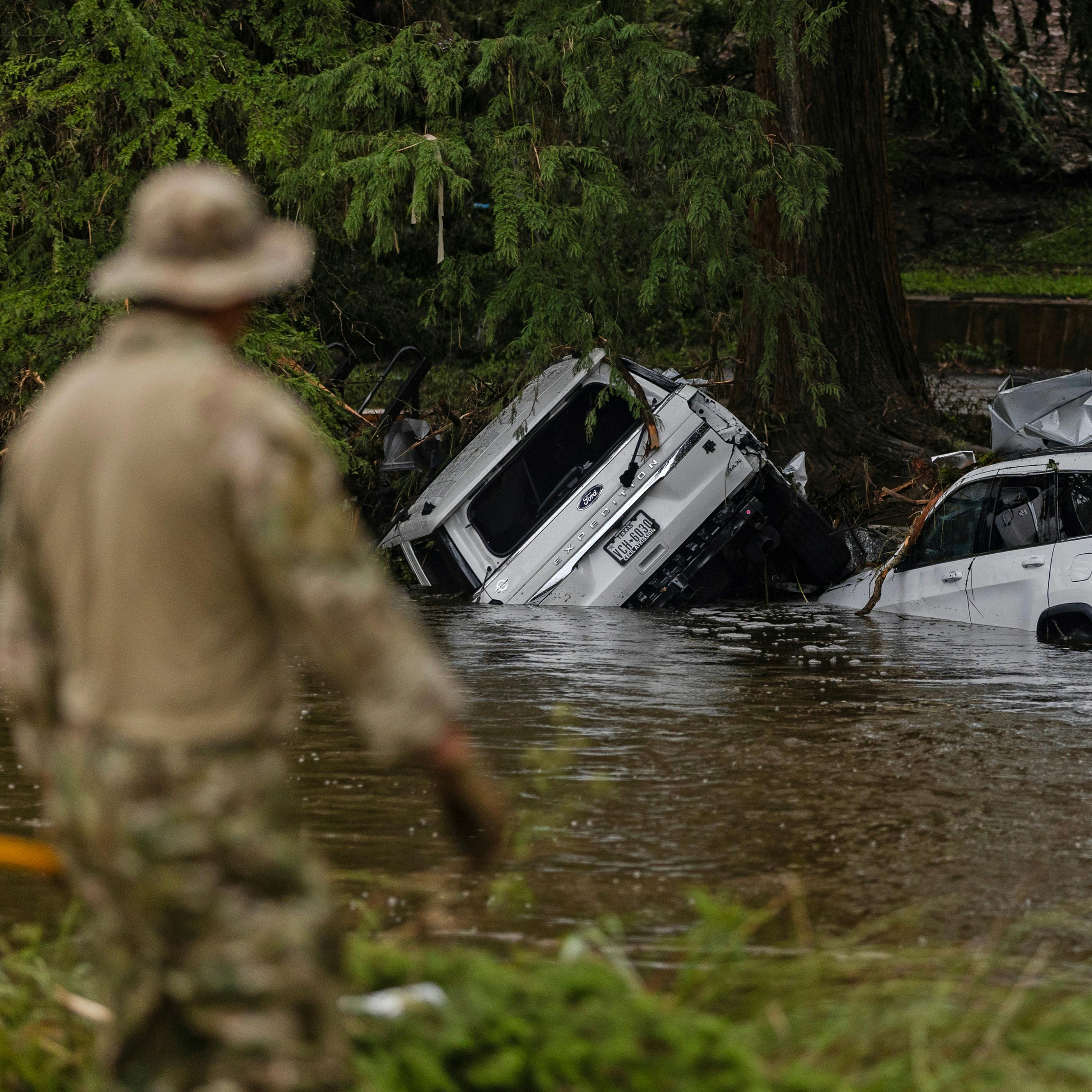
Yeah, I mean, so if you drive or walk along the Guadalupe river, you will see and hear helicopters flying overhead, swift water rescue boats behind trucks loading into the river. So people on foot, people in boat, people in helicopters. Authorities also have drones in the air. So a lot of activity on the ground.
- [03:54]
Noel King
So you have, from what I'm seeing, you have official first responders, but you also have people looking for their family members.
- [04:01]
Andrew Friedman
Yes. And local authorities have asked people to not self deploy. Yeah, understandably. Some people are very anxious to find their loved ones. So we absolutely have seen people just walking along the river. It gets dangerous. We had a flash flood warning in effect last night and authorities have basically said that folks self deploying complicates their work and they have encouraged people to not do that.
- [04:29]
Dominic Anthony Walsh
It's not that we think we don't need any help.
- [04:31]
Noel King
It's that we want to make sure.
- [04:33]
Andrew Friedman
Everyone helping is doing the job that.
- [04:35]
Dominic Anthony Walsh
We need, where we need it and.
- [04:36]
Noel King
When we need it.
- [04:37]
Dominic Anthony Walsh
And we have the ability to communicate with them.
- [04:39]
Noel King
What is the latest on these children from Camp mystic who are missing? These girls?
- [04:45]
Andrew Friedman
Right. There were 750 girls at this nearly century old summer camp right on the river. Camp mystic this Morning confirmed that 27 campers and counselors have been found dead. The camp director, Dick Eastland, was found dead on Saturday, reportedly near the bodies of three girls. Initially they were saying 27 people were missing. That statement this morning says 27 people were dead. So the majority of them at this point are accounted for.
- [05:16]
Noel King
Hmm. Let's go back to the early hours of July 4, when the flooding started. What, what were the warnings like? What advance notice did people get?
- [05:31]
Andrew Friedman
Yeah, the timeline starts as early as Wednesday. That's when the state's Emergency Management division mobilized Swiftwater rescue teams in anticipation of flooding. On Thursday afternoon, the National Weather Service issued a flood watch, which is essentially warning that a flood is possible. That was followed by a flood warning just after midnight. So saying that flood floods are happening and after 5am it announced a flash flood emergency, the highest alert level. The Washington Post looked at federal logs of emergency alerts and it turns out the local government did not issue its first Amber Alert style warning until Sunday. So two days after the Flooding. Questions remain about why that wait happened. And the actual timeline of the flooding was just so fast. Between 4 and 6 in the morning, the Guadalupe river rose as much as 30ft in most segments. That rise happened in less than an hour. That affected homes along the river, where residents were shocked awake by the flood waters. This is a popular area for camping, and it was a holiday. So the flooding washed campers and RVs. Trees were pulled from their roots, cars swept downstream, along with an undetermined number of people. And the consistent theme I heard from folks was that they just did not have warning. They did not know this was coming until the flood waters hit them.
- [07:00]
Noel King
We lost everything, but we have our lives. It was very difficult to get out of the house. We couldn't push the door open with all the water that just came within five minutes. And my neighbor up the hill helped my husband with a rope around his waist. He has Parkinson's. And like many of us, we lost everything inside the home. But we have our lives. In terms of where the warnings come from, who is actually pushing those alerts? Is it the national weather service? Is it the local government? If I. If I were there and my phone was to sound an alarm, who would it come from?
- [07:50]
Andrew Friedman
There are two levels of responsibility, the national weather service and the local government. The national weather service did send alerts in the middle of the night, but according to an analysis by the Washington Post, the local government didn't send any alerts until Sunday. So, significantly after the floodwaters hit, residents I spoke with said they didn't know what was coming until the floodwaters reached their homes. And of course, campers along the river didn't know until they were swept away.
- [08:23]
Noel King
You've been out in the field talking to people who live in this area, including, you know, people who are looking for family members. What. What do you feel like you're hearing again and again? What's sticking with you?
- [08:36]
Andrew Friedman
So as soon as I got into town, my first stop was the reunification centers and the supply depots. They were together. The reunification centers were also serving as supply depots. And I spoke with folks dropping off supplies, like resident Marissa Baldwin and her son Hudson. They were pulling a cart full of blankets and towels to a supply depot.
- [08:59]
Noel King
Yeah, right now we have blankets and towels. We dropped off non perishable food earlier.
- [09:04]
Andrew Friedman
I heard from them and from other residents time and time again that the small towns along the Guadalupe river form a tight community. And so the scale of this destruction hits especially hard.
- [09:16]
Noel King
So everyone knows someone that's been affected. We have friends that are missing, friends that were recovered last night. So everyone's just doing what they can.
- [09:29]
Andrew Friedman
Kerr county is home to just over 50,000 people. So everyone knows everyone. I also spent some time on Sunday in a little neighborhood called Bumblebee Hills.
- [09:39]
Noel King
We have about 20 homes here at Bumblebee, and they're all devastated but one house, which is up on the hill. He was a refugee to everyone around here.
- [09:50]
Andrew Friedman
When I stopped by, residents and volunteers were scooping out mud and ruined possessions from their homes.
- [09:57]
Noel King
We did not have flood insurance, and they said they would not cover. Not one thing.
- [10:02]
Andrew Friedman
Folks are still in shock. They're still processing what happened, especially the people who know people who are missing, the people who, you know, lost their homes or had their homes damaged by the floods. The mood is somber. Folks are grateful. You know, I heard over and over again, even from the folks who lost their homes, that they're lucky to be alive. Not everybody is alive. You know, I've been living in Houston since 2021, and we saw three major weather disasters last year. Each time, the community came together, and I saw that same spirit in Kerr County. I actually found another man from Houston who felt the same way. My name is Donnie Mosier. I'm from Houston, who was trapped in his Airbnb without food or water. Local residents took him in. He said, look, y' all need coffee and you need food. And he gave us directions to his house and said, be there at noon.
- [11:00]
Dominic Anthony Walsh
We're eating. And.
- [11:01]
Andrew Friedman
And he said it reminds him of the way Houstonians come together after hurricanes. This is an incredibly, incredibly sad situation.
- [11:09]
Dominic Anthony Walsh
But the way people just kind of.
- [11:11]
Andrew Friedman
Took us in and helped us, and it just made us part of their family is.
- [11:15]
Dominic Anthony Walsh
It's just amazing.
- [11:16]
Andrew Friedman
So even though there's this somber mood, there's also this community spirit. People are coming together.
- [11:26]
Noel King
Dominic Anthony Walsh is a senior reporter with Houston Public Media. Dominic, thanks so much for your time.
- [11:31]
Andrew Friedman
Thank you, Noel.
- [11:36]
Noel King
You can find Dominic's work@houstonpublicmedia.org they're doing some great reporting. Coming up, did President Trump's cuts to the federal workforce play a part in this disaster? We're going to talk to a reporter who's been doing some digging.
- [11:49]
Andrew Friedman
Foreign.
- [12:07]
Noel King
Support for today's show comes from Fireflies AI. And if you're wondering if that's AI, yeah, it is Fireflies AI say that.
- [12:19]
Dominic Anthony Walsh
Over 500,000 companies are already using Fireflies.
- [12:22]
Noel King
To turn their meetings into action.
- [12:24]
Dominic Anthony Walsh
They offer powerful collaboration tools like real.
- [12:28]
Noel King
Time and up to date web search directly in your meetings. Shareable sound bites, timestamped notes, and bookmarks.
- [12:34]
Dominic Anthony Walsh
That highlight important moments in meetings.
- [12:37]
Noel King
And Fireflies integrates with the tools you.
- [12:40]
Dominic Anthony Walsh
And your team already rely on, like.
- [12:42]
Noel King
Zoom, Google, Meet, Slack, Asana, and your Cross am. And right now when you sign up for a yearly Firefly subscription, you get your first two months free. You can just go to Fireflies AI Explained. That's right, two months free, they say.
- [13:01]
Dominic Anthony Walsh
When you go to Fireflies AI Explained.
- [13:05]
Noel King
That's Fireflies AI Explained. Support for Today Explained comes from Deleteme. Deleteme says they can make it easy, quick and safe to remove your personal data online at this perilous time. They send you regular personalized privacy reports showing what info they found, where they found it, what they removed. Sounds like great gossip. Our colleague Claire White has actually used Delete Me. Here's what Claire has to say. The Delete Me dashboard is super user friendly. All I had to do was log in, complete a quick survey including a bit of my information, and they did the rest. They have predetermined list of all of the sites that seem unsafe and all of the places where your information could be hiding in plain sight. They send continuous privacy reports that include all of the websites that they've scanned, which has been great. You can take control of your data and keep your private life private by signing up for Delete Me now at a special discount for our listeners. Today. You can get 20% off your delete me plan when you go to JoinDeleteMe.com today and use promo code today at checkout. The only way to get 20% off is to go to JoinDeleteMe.com today and enter code today at checkout. Check out what is that? That's joinedeleteme.com today code today support for today explained comes from Upwork. Upwork believes that building a business comes with a lot of roadblocks, both financial and logistical. I would not know. I've not built a business, but Upwork wants to help you make things easier. Upwork says it is a hiring platform designed for the modern playbook you can find. You can hire, you can pay extra expert freelancers on Upwork, and they say they deliver results from day one. It's built for businesses that are on tight budgets and fast timelines. There are no subscriptions, they say, or upfront fees and you only pay when you hire. If you've never tried, Upwork says Upwork now might be the perfect time because they're giving our listeners a $200 credit after spending $1,000 in the first 30 days. $200 you can put toward hiring and paying your next freelancer. Perhaps you need design help, AI automation, admin, support, marketing, whatever. So much more you can go to upwork.comsave right now. That's upwork.comsave to get a $200 credit towards hiring and paying your next freelancer to help grow your business. That's up. W o r k.com Save Upwork.com Save this offer is only valid June 24 through August 5, 2025. This is today Explained. I'm Noel King. The mandate of the National Weather Service is a simple one to protect people and property. And right now that agency, which has been subject to cuts by the Trump administration, is taking a lot of flack.
- [16:00]
Andrew Friedman
Did Trump's cuts to the National Weather Service caused a situation in Texas? Here's what the tell us so far.
- [16:09]
Noel King
The state's emergency management chief says the amount of rain that fell was never in the weather service's forecasts. What happened? Andrew Friedman, a senior reporter covering weather and climate for cnn, has been banging the phones trying to figure out who, if anyone, dropped the ball.
- [16:25]
Dominic Anthony Walsh
In this instance, there were two weather forecast offices that were involved. But the idea behind that is that these are meteorologists who are embedded in these communities, come to know these communities and the idiosyncrasies of their weather and are better able to warn for inclement weather than, say, somebody just forecasting out of Washington, D.C. or somewhere else.
- [16:54]
Noel King
So we're talking about two offices in Texas, and what do we know about them? Were they fully staffed?
- [17:00]
Dominic Anthony Walsh
The term that I would use is they were adequately staffed. They were staffed to the extent that most offices would be staffed overnight during the night of the horrible, tragic flooding. They each are missing some employees. In the case of the Austin, San Antonio office, they're missing a warning coordination meteorologist and a science and operations officer. Both of those positions were opened up because people took early retirement under the Trump administration's program to try to get people to reduce the size of the federal government. Then the office in San Angelo, Texas, is missing a meteorologist in charge. That's the top meteorologist for the office. These staff cuts in those two particular offices do not seem to have had a major impact or even a very clear impact on the way the weather service performed during this event.
- [18:13]
Noel King
What I think I'm hearing from you, Andrew, is that your reporting does not seem to suggest at this point that the disaster in Texas was caused by the Trump administration cuts. Am I hearing that right?
- [18:25]
Dominic Anthony Walsh
You are hearing that right. The missing Warning coordination meteorologist in the Austin office. That's the biggest question because that position is somebody who interacts with emergency managers who are then responsible for warning the community. But when I've talked to sources, they basically are saying it probably did not affect the timeliness of the warnings. The tone of the warnings, which ratcheted up very quickly, as well as how early they caught on to this event possibly taking place.
- [19:11]
Noel King
Do we know why that top meteorologist position in San Angelo was unfilled?
- [19:18]
Dominic Anthony Walsh
I don't know specifically offhand. However, there are offices around the country that are without their meteorologist in charge. The National Weather Service lost about 600 people. They did get hit hard by Doge cuts.
- [19:40]
Noel King
Federal workers who were not let go said the afternoon layoffs included meteorologists who do crucial local forecasts in National Weather Service offices across the country. It is truly the backbone of all weather forecasting in this country. Every living former NWS director is warning potential funding cuts could lead to needless loss of life.
- [20:02]
Dominic Anthony Walsh
What's happened with these cuts is they're losing the most experienced people. The people who are near retirement age are taking these packages and are leaving. And then you have to train up people who are coming in and they don't have the same level of experience. But again, when one looks at the warnings that were issued when they were issued, there isn't really a smoking gun there. But there is one point that's really important here. Because the cuts have been so deep around the country. This is a question that's going to come up at every single disaster that takes place. Because the meteorologists that I've been talking to in the broader community are basically telling me this doesn't seem to be the event that vacancies caused a tragedy. But mark my words, that will happen at some point if this isn't addressed.
- [21:14]
Noel King
What are your sources worried about?
- [21:16]
Dominic Anthony Walsh
They're concerned about hurricane season. This event actually was the remnants of Tropical Storm Barrie and that rained out over inland Texas. We also just had Tropical Storm Chantal that made landfall in South Carolina and is causing flooding today and caused flooding over the weekend. So it's just this sense in the community that they're really stretched thin that people are working longer shifts. People are working six day weeks.
- [21:53]
Andrew Friedman
We are generating kind of a Swiss cheese weather service. We have holes throughout the weather service.
- [21:59]
Noel King
Now that are not well thought out.
- [22:01]
Dominic Anthony Walsh
It is not an ideal situation. And people are worried that there is going to be a time when they miss something. But this doesn't seem to have been it.
- [22:13]
Noel King
When that time comes when a disaster hits. FEMA is often there to pick up the pieces. To help clear up the wreckage. The Trump administration has also made cuts to fema. Do we know how broad those are?
- [22:29]
Dominic Anthony Walsh
Yeah, the cuts to FEMA from reporting done by my colleagues really are quite broad. They really are quite deep. The administration has talked about getting rid of FEMA after the hurricane season.
- [22:47]
Andrew Friedman
FEMA's turned out to be a disaster.
- [22:49]
Noel King
But I think we're gonna recommend that FEMA go away.
- [22:52]
Dominic Anthony Walsh
However, they pretty much kind of stopped that process as hurricane season came upon.
- [23:00]
Andrew Friedman
Are you still planning to phase out fema?
- [23:04]
Dominic Anthony Walsh
Well, FEMA is something we can talk.
- [23:07]
Noel King
About later, but right now they're busy working, so we'll leave it at that.
- [23:12]
Dominic Anthony Walsh
So FEMA is active in Texas, but they lost a lot of experienced staff. They have a shortage of the people that go out to immediately respond and immediately offer help.
- [23:29]
Noel King
The Federal Emergency Management Agency is losing a fifth of its staff. We're talking about 1,000 permanent full time workers that are expected to take the voluntary buyouts. These are, of course, part of doge's latest staff reductions.
- [23:42]
Dominic Anthony Walsh
I worry a lot about how thin the situation is and the ability to get information across during what could be a very active season.
- [23:54]
Noel King
These cuts are being made to the National Weather Service, fema, in the name of cost savings. This will save the federal government money. Does this actually save money?
- [24:03]
Dominic Anthony Walsh
You know, that's a very good question. I don't know that I can answer that conclusively here. I can tell you, though, that there are enormous economic benefits to accurate weather forecasts. Studies have shown savings of billions of dollars with more accurate hurricane track forecasts. For example, if you look at the proposals that the administration has put forward for the 2026 budget, they want to actually close every single weather and climate lab that we have in this country. So the people who are working on improving flash flood forecasts, the people who are working on improving hurricane forecasts forecasts and doing the research that would then lead to the forecast capabilities of tomorrow would be out of a job if that budget were enacted as proposed.
- [25:11]
Noel King
All right, so your reporting suggests that staffing cuts are not the cause of the disaster in Texas. But I wonder if you have spoken to people inside the Trump administration who are now going to have to grapple with what occurred with a popular narrative that says the Trump administration did this by cutting jobs. Do you think in some way this, this tragic event makes this real for the Trump administration?
- [25:41]
Dominic Anthony Walsh
I think there is an element of that. You actually saw the administration pushing back on social media over the weekend saying the mainstream media is lying to people by saying it's not due to these cuts.
- [25:56]
Noel King
HSGOV the mainstream media is deliberately lying about the events leading up to the.
- [26:02]
Andrew Friedman
Catastrophic flooding in Texas.
- [26:05]
Noel King
The National Weather Service executed timely, precise forecasting and warnings despite unprecedented rainfall overwhelming.
- [26:13]
Dominic Anthony Walsh
The region when the mainstream media, myself included, all we're doing is asking the questions that need to be asked and then coming to the conclusion almost universally that the cuts probably were not a significant contributor to this event. The real problem that I think most weather experts have been pointing to is the so called last mile problem, which is what happened between the times when the weather service push the button to set off emergency alerts on people's phones. Did they get these warnings? Was there any type of a warning system? What was cell phone coverage like? Okay, what was the wording of the warning and did it give people actionable information of what to do? But yes, this makes it real for the administration. This makes it an accountability issue. And like I said, I think that's going to keep happening the more you have weather related disasters.
- [27:31]
Noel King
Andrew Friedman is a senior reporter covering climate and weather for cnn. Andrew, thank you so much for your time.
- [27:36]
Dominic Anthony Walsh
Thank you for having me.
- [27:41]
Noel King
Denise Guerra and Peter Balanon Rosen produced today's show. Jolie Meyers edited. Patrick Boyd and Andrea Christian's daughter are our engineers Miles Bryan and Gabrielle Bur. Check the Facts today. I'm Noel King. It's TODAY Explained. Support for the show comes from Mercury. It's the fintech that brings all the ways you use money into a single extraordinary product. Now you can quickly and easily send money, pay bills, create and send invoices, issue reimbursements to your team and more without having to toggle between a dozen apps and services. Visit mercury.com to apply in 10 minutes or less. Mercury Banking that does more Mercury is a financial technology company, not a bank. Banking services provided through Choice Financial Group, Column NA and Evolve bank and trust members FDIC Nobody knows your customers better than your team, so give them the power to make standout content with Adobe Express. Brand kits make following design rules a breeze and Adobe quality templates make it easy to create pro looking flyers, social posts, presentations and more. You don't have to be a designer to edit campaigns, resize ads and translate content. Anyone can in a click and collaboration tools put feedback right where you need it. See how you can turn your team into a content machine with Adobe Express, the quick and easy app to create on brand content. Learn more at Adobe. Com Express Business.