← Today, Explained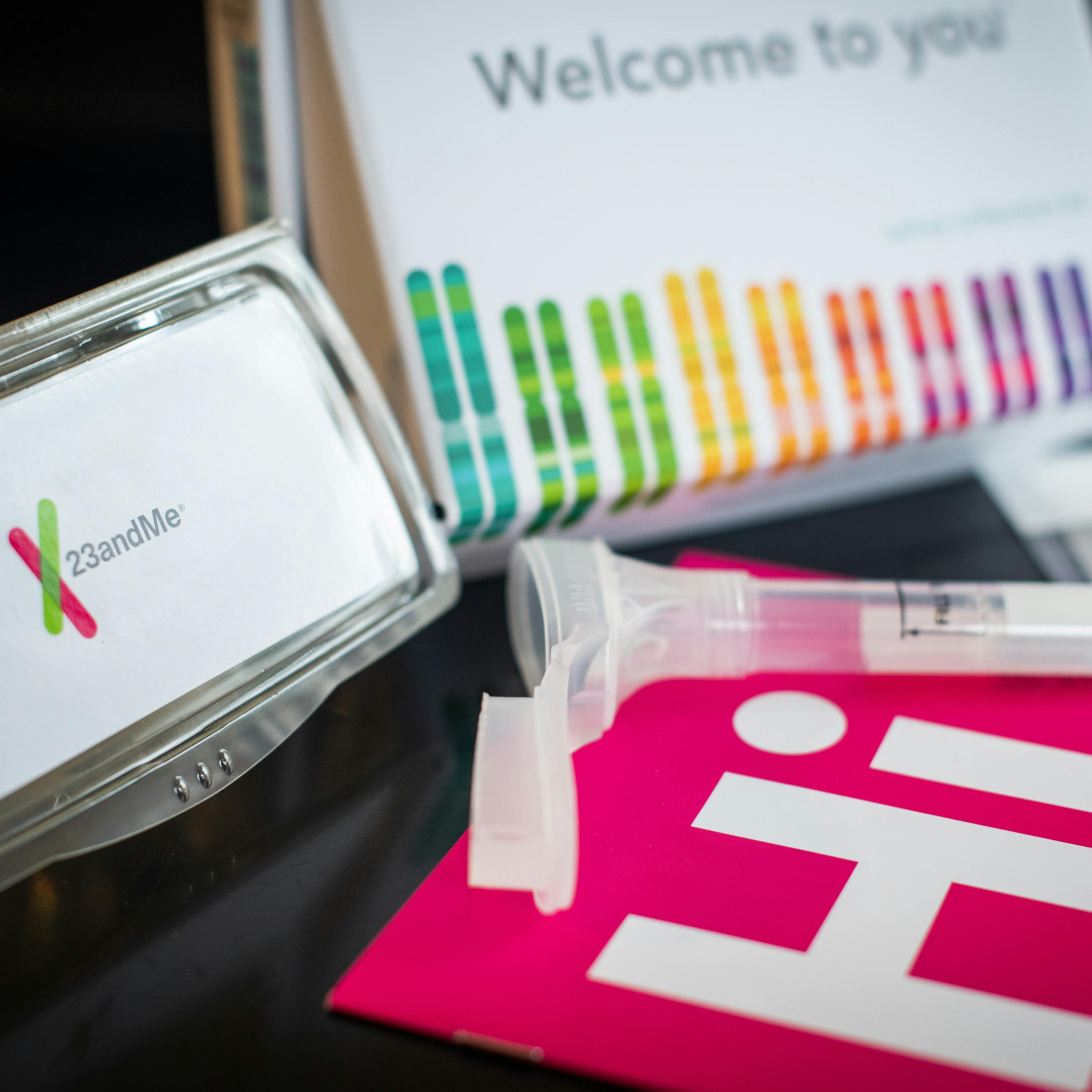
Today, Explained
The drama and trauma of 23andMe
00:32:45
With the at-home DNA testing company 23andMe filing for bankruptcy, what happens to all the data millions of Americans handed over? And how should you approach the family you've found through sites like these?
Loading summary
Transcript101 lines
- [00:01]
Adobe Marketing Representative
As marketing channels have multiplied, the demand for content has skyrocketed. But everyone can make content that's on brand and stands out. With Adobe Express, you don't have to be a designer to generate images, rewrite text, and create effects. That's the beauty of generative AI that's commercially safe. Teams all across your business will be psyched to collaborate and create amazing presentations, videos, social posts, flyers, and more. Meet Adobe Express, the quick and easy app to create on brand content. Learn more@adobe.com Adobe Express Business.
- [00:37]
Debbie
Hi, this is Debbie, your blinds.com design consultant.
- [00:40]
Adobe Marketing Representative
Oh, wow, a real person.
- [00:42]
Debbie
Yep. I am here to help you with everything from selecting the perfect window treatments to.
- [00:46]
Hannah
Well, I've got a complicated project.
- [00:48]
Debbie
Oh, not a problem. I can even schedule a professional measure and install. We can also send you samples fast and free.
- [00:54]
Jon Glenhill
Hmm.
- [00:55]
Hannah
I just might have to do more. Oh, okay. So the first room we're looking at is for guests.
- [00:59]
Blinds.com Advertiser
Shop blinds.com now and save up to 40% sitewide.
- [01:03]
Debbie
Blinds.com rules and restrictions may apply.
- [01:08]
Hannah
There's this whole part of me that I'm connected to that I just don't really know anything about.
- [01:12]
Emily Mullen
Is your genetic information really private?
- [01:15]
Libby Copeland
DNA is not destiny. But man, is there something to be.
- [01:18]
Debbie
Said for the power of genetics?
- [01:19]
Libby Copeland
Right.
- [01:25]
Jon Glenhill
This is. Explain it to me. I'm Jon Glenhill. Each week we answer the questions that matter to you most, like what our weird economic outlook could mean for you. But sometimes we get a question that's way more personal than that.
- [01:39]
Hannah
Hey, it's Hannah. My question is, how do you find a lost relative?
- [01:46]
Jon Glenhill
That definitely got my antenna up. So we gave her a call. It turns out she was looking for her dad.
- [01:53]
Hannah
I always knew my dad was out there somewhere.
- [01:56]
Jon Glenhill
When she first reached out to us, she'd never met him.
- [02:00]
Hannah
So I was raised by my mom. She was a single mom. It was pretty much just us two for a lot of my childhood. For a while, we lived with my grandparents, my aunt, uncle, and a couple of cousins. I knew my dad was out there somewhere, but I never really gave too much thought about it. Cause I did have like a pretty full. Just like, home life, I guess.
- [02:20]
Jon Glenhill
What did you know about your dad growing up? Did you know him at all?
- [02:24]
Hannah
I only had like one memory of him. Honestly. I think I was 6. And I was riding my bicycle outside and he drove down the street and I didn't know who he was. And he said, hey, Hannah. My mom was like, that's your dad. Come inside. And that was kind of the first time she kind of told me the story. She kind of just explained it to me that, you know, they were young when they had me and they had a lot of differences and she just thought she was making the right decision to kind of do it on her own. But she never intended for it to be like a permanent thing, that I would never know him.
- [02:58]
Jon Glenhill
How did you feel about that growing up? I mean, knowing that you had your dad out there but not really having that relationship with him?
- [03:06]
Hannah
It always kind of felt like a mystery. And I think it's kind of a funny feeling to feel like there's this mystery about yourself. Like, I don't quite look like my mom's side of the family. I have curly hair, I have like different color eyes. So I always kind of just wondered like, hm, who do I really look like if I don't look like my mom's family? I knew my dad is from the Dominican Republic. So I always like, you know, just growing up in New York City, such a vibrant culture here, and I'm like, wow, I wonder, like I just have questions like, where in doctor is my family from? Just questions about that. And the other thing I knew is that I had two half brothers for my dad. So just one wondering like, wow, what are my brothers? Like, what it would be like to have siblings or just, yeah, wondering about them.
- [03:51]
Jon Glenhill
When you were growing up, did you look for your dad at all?
- [03:54]
Hannah
Yeah. So, you know, I came of age along with social media, I guess. So once Facebook came out, that was probably one of the first things I did, was like, I'm gonna look up my dad's name. There's a lot of people with his name. So that didn't really take me anywhere.
- [04:09]
Jon Glenhill
So you emailed us and before this conversation, you and I had a shorter convers and you told me that I.
- [04:18]
Hannah
Actually recently found him.
- [04:20]
Jon Glenhill
What?
- [04:21]
Hannah
Yeah, I know, it's insane. Since I sent him.
- [04:24]
Jon Glenhill
Tell us what happened. How did you find him?
- [04:26]
Hannah
Yeah, so I have a cousin on my mom's side. She's been telling me I should go on ancestry.com for a very long time. So she was like, it would be perfect for you because you have this whole side of your family you don't know anything about. I didn't do the DNA testing just yet. Cause there was just like a lot of public records. So I was like, let me start with that. His name came up on a lot of different things in a lot of different places. But it took a couple of days of just kind of like looking through stuff until I found an address with his name in Brooklyn. And then I texted the address to my mom, and I was like, by any chance, does this look familiar? And she said, yes.
- [05:03]
Jon Glenhill
So you found this address? How close was it?
- [05:07]
Hannah
So that was the crazy thing. I live in Brooklyn. I grew up in Brooklyn. And the address was essentially, like, the other side of, like, the train line I grew up on. So when I first talked to him and he asked how I found him, I told him about the address, and he was like, I've never moved. I've been here this whole time. Which blew me away. Cause I'm like, he's been on the other side of the train. Literally. I really did not think. I'm like, this is probably an old address and a phone. Old phone number, but what do I have to lose? But to my surprise, I called, and it was my dad.
- [05:41]
Jon Glenhill
Oh, my gosh. How did that call go?
- [05:43]
Hannah
It was insane. I did this all while I was at work, which was probably not the best idea. So I was just, like, in my office. And then, you know, like, at first when I called, I think he thought I was, like, a bill collector. Like, who is this? Like, I think you have the wrong number. And he hung up on me. And I was like, okay, try that again later. Maybe I do have the wrong number. Whatever. But then the number called me back, and then he was like, wait, what did you say your name was? And I said my name again. And then there was a pause, and he was like, well, yeah, I'm your dad. It was so emotional for me. I was in shock, but also felt really relieved. Like I was saying before, just this huge mystery about myself. And it really felt like, just so much closure in that one moment of, wow. Like, he. He exists. He's there. He's a person. I'm talking to him.
- [06:32]
Jon Glenhill
Have y' all met in person at all?
- [06:34]
Hannah
We did. We did meet up. We took some time. We kind of. After that initial call, we both, I think, needed to process it. But we did, and we went to lunch. And it was me, him, and my younger brother that I didn't know I had until finding my dad. So, wow. It was great. And it was surprisingly kind of normal. Like, it really. I was. Obviously, we had a lot of just, like, catching up to do or just kind of getting to know each other. And there's something about, like, seeing my eyes, like, on my dad's face and, like, my brother's curly hair. And it was just like, all this. All this time that I was like, who do I look like or you know, just that question was kind of like answered and it gave me a real sense of peace, which was just awesome.
- [07:20]
Jon Glenhill
Okay, so originally you wrote us to ask, how do you find a long lost relative, but you found not just one, but five others. In addition, how can we help you now? What are some things we can explain for you?
- [07:36]
Hannah
Yeah, I think it's so funny because it's like my question has evolved. I never gave much thought to, like, okay, so now what? Like, I found him, I guess kind of just like any advice on how to navigate, like, getting to know a parent or a lost relative, like, as an adult. Also, like, how to approach, like, my siblings. Cause I don't know who knows about me and who doesn't. So I want to, like, not necessarily uproot their lives, just kind of how I can approach wanting to get to know them, but respect to, like, their situation. And then I'm also thinking about my mom's family too. You know, they are my family. They raised me. I don't want them to feel like I'm, you know, trying to build this relationship and like, replace them. So kind of making sure that, you know, they understand, like, why I'm doing this rather than like, I'm, you know, I don't know, just like finding a new family to kind of like, replace them.
- [08:40]
Jon Glenhill
We gotta take a break, but when we come back, why there's controversy around finding family members.
- [08:55]
Terry Gross
Support for Today Explained comes from Fresh Air from npr. Terry Gross, the host of Fresh Air, pushes public figures to reveal personal motivations behind extraordinary lives. I didn't write that. NPR didn't write that. Former President Barack Obama wrote that. He is a fan. Fresh Air is an award winning podcast hosted by Terry Gross and Tanya Mosley. They've interviewed Jeremy Strong, Selena Gomez, Supreme Court Justice Ketanji Brown Jackson, Billie Eilish, so many more. One episode I will never forget is where Terry is interviewing Jay Z and she asks him why so many hip hop artists grab their crotches like cover up their junk when they perform.
- [09:32]
Jon Glenhill
It is.
- [09:33]
Terry Gross
It is an amazing question, but hear me, it is actually an even more amazing answer from jz. Google that one. Fresh Air has an enormous archive and with Fresh Air plus you can get curated lists of interviews spun forward for the issues of today. With Fresh Air, you can stay in the loop and dive deep into conversations on culture, crotches, news and other issues. You can tune in Fresh Air from NPR tv, hear some of the most insightful interviews anywhere. Wherever you get your podcasts.
- [10:05]
Lowe's Advertiser
Lowe's knows a thriving yard starts with quality care. Right now get Miracle grow 3/4 cubic foot all purpose garden soil for just $2. Was $4.58. Plus get a free Select EGO 56 volt trimmer or blower with the purchase of a Select EGO 56 volt mower. The best yard starts with the best deals. Lowes we help you Save. Valid through 514. Excludes Alaska and Hawaii. Selection varies by location while supplies last.
- [10:38]
Jon Glenhill
We're back. If you've used at home DNA tests to find out where your family's from or your genetic information, you might have some questions right about now, especially around privacy because 23andMe, one of the companies behind these at home tests, has filed for bankruptcy. I called up Emily Mullen who covers biotech for Wired. I asked her to start by walking us through the history of these at home DNA tests.
- [11:02]
Emily Mullen
Yeah, so we're going to go back actually a couple decades. So there was something called the Human Genome Project that was completed in 2003.
- [11:13]
John Glenhill
More than 1,000 researchers across six nations have revealed nearly all 3 billion letters of our miraculous genetic code. I congratulate all of you on this stunning and humbling achievement.
- [11:26]
Emily Mullen
And this was the culmination of 13 years of research to sequence the entire human genome.
- [11:33]
John Glenhill
Without a doubt, this is the most important, most wondrous map ever produced by humankind.
- [11:40]
Emily Mullen
So, you know, your DNA is made up of these bases. The Human Genome project was an effort to spell out all of those letters end to end. And I think that really sparked this excitement in the field of genetics and the idea that genetics is going to explain everything about Everybody.
- [12:01]
Jon Glenhill
Okay, so 23andMe wasn't the only, you know, at home DNA testing site that we had. There's also Ancestry.com and there are others. But now I want to stick with 23andMe. So originally this company was huge. It was gigantic. You could walk into Target or Walmart and see a whole wall of tests. Like, what? What happened?
- [12:24]
Emily Mullen
Yeah. So 23andMe was founded just a few years after the Human Genome project was completed in 2006. And the company initially offered a retail DNA test for $1,000 for ancestry and some health information. 23andMe actually threw a spit party where attendees, while they were dancing and drinking spit into tubes, submitted their. They submitted their DNA samples for testing. And the price point really dropped over the years to the point where these tests became much more accessible to the average person.
- [13:05]
Jon Glenhill
Okay. We spoke with a listener named Hannah and she used ancestry.com to find her father. But it turns out she didn't even need to use her DNA. There was information already there. Is that common? How much of our DNA is already on these sites?
- [13:23]
Emily Mullen
So, yeah, a lot of Americans have taken these tests, and in particular, a lot of white Americans. Something like one in five Americans have taken a consumer DNA test. So it's a lot of people. And there was a study that came out a while back showing that it will be possible to identify almost 90% of Americans with European history through their cousins in genetic genealogy databases. So what that means is that even if you personally haven't taken a DNA test, somebody in your family or extended family probably has and you could be identified in that way.
- [14:10]
Jon Glenhill
So Fast Forward and 23andMe's declared bankruptcy. What exactly happened? How'd we get there?
- [14:18]
Emily Mullen
Yeah. So despite selling a lot of tests over the years, this might come as a surprise for listeners to learn, but 23andMe has never been profitable. They never figured out how to really monetize the data.
- [14:33]
Jon Glenhill
Oh, wow. So what can you do if you've submitted your DNA to 23andMe, but you're like, wait, what's going to happen to my data? Is it going to go to, like, TBD company?
- [14:44]
Emily Mullen
Right. So that's the big question, is what happens to all this data now? For now, 23andMe says its existing consumer privacy policies remain in place and the company has not changed how it manages or protects the consumer data. If the company comes under new ownership, they could revise those privacy policies for new customers and new data collection. But if you're one of those people who previously opted into your data being used for research purposes, and you haven't logged into 23andMe since you've taken a test and you've sort of forgotten about it. Okay, well, your data could likely be used by whoever the new owner is for these purposes. So if you have used 23andMe in the past and you want to change the way your data is being used, you can absolutely still go and do that right now.
- [15:40]
Jon Glenhill
Yeah. Like, how do you delete that data?
- [15:42]
Emily Mullen
Yeah. So when you log into 23andMe's website, you go to Settings in your profile. Then you can scroll to 23andMe data and click View. At this point, if you want to, you are able to download a copy of your genetic information so that you have that moving forward. Then you can scroll to delete data and click permanently delete data. You can also ask 23andMe to destroy the biological sample it used to extract your DNA data. If you previously authorized the company to keep it.
- [16:18]
Jon Glenhill
Yeah, this seems so sticky because there aren't really federal laws protecting genetic data. Are there any safeguards out there? Maybe on like a different level, a state level something? Is there anything out there?
- [16:31]
Emily Mullen
So HIPAA is the Health Information Privacy act that we often hear about that protects information only when we're talking about health entities sharing data with each other. So in this case, 23andMe is a company that sells genetic testing kits. They're not a health entity. So HIPAA does not protect your genetic information in this case. There are a couple states like California that do have more stringent protections, but there is no federal law that protects information collected in this way.
- [17:16]
Jon Glenhill
So the market for genetic data testing was really booming at one point. What happens next? Is this going to go away?
- [17:25]
Emily Mullen
I think we're seeing consumer DNA testing fizzle out, at least in its current form. I think people are much more aware of the privacy risks now than when these tests first came out. So I think there's been an erosion of trust with these companies for at least a couple of years now. And again, for the people who went to these companies to get that ancestry information or learn about a relative, perhaps they were adopted, that sort of thing, a lot of those people have already taken these tests at this point.
- [18:08]
Jon Glenhill
Okay, so now you've got what you need to reach out to the family you didn't previously know you had. How do you go about doing that, though? That's next.
- [18:30]
Debbie
Pms, pregnancy, menopause, being a woman is a lot. Ollie supports you and yours with expert solutions for every age and life stage. They just launched two new products exclusively at Walmart. Period Hero combats bloat, mood swings and more during PMS and balance perimeno to support hormonal balance, mood and metabolism during perimenopause. Grab yours@ollie.com Ollie these statements have not been evaluated by the Food and Drug Administration. This product is not intended to diagnose, treat, cure, or prevent any disease.
- [18:59]
Blinds.com Advertiser
Sixteen years from today, Greg Gerstner will finally land the perfect cannonball. Epic splash. Unsuspecting friends. A work of art. Only possible because Greg is already meeting all these same people at AARP volunteer and community events that keep him active and involved and help make sure his happiness lives as long as he does. That's why the younger you are, the more you need AARP. Learn more@aarp.org local.
- [19:36]
Jon Glenhill
We'Re back. It's explain it to me. And Libby Copeland's book Lost Family looks at how DNA technology has impacted families. I wanted to know what got her so interested in this.
- [19:47]
Libby Copeland
Honestly, this whole question around the distinction between biological and non biological family and roots and identity, it's everything to me. You know, I think it's so intrinsically connected to sort of existential questions around how we're formed in who we are and how much is free will and how we get to decide what to be.
- [20:12]
Jon Glenhill
Has this changed the way you think about family for yourself?
- [20:15]
Libby Copeland
Yes, definitely. I mean, spending so much time talking to people who don't have a genetic connection to the families that they were raised in, it's really interesting to hear just how much the pull of that genetic family has over you. We also, in our family family were able to connect with ancestors in Sweden and then we traveled there and were able to like connect with a modern day second cousin of my dad going back a hundred and something years from when, you know, our relative had emigrated. And that to me made the world seem so much smaller and so much more intimate. And it made history feel present to me. It made, it made me feel like the past wasn't over.
- [21:02]
Jon Glenhill
You know, if someone's taken one of these at home DNA tests and they realize they have a family member, how should they go about trying to connect with them?
- [21:11]
Libby Copeland
It's often easy to start with the person you're finding there on the relatives list just because they're the immediate connection. But if you're finding a half sibling, and you know that's because you share a father in common, a lot of search angels will recommend that you start with the father first. So there's this whole world of genetic genealogists and search angels who have dedicated their lives, sometimes for pay, sometimes on a volunteer basis, to help someone find their family. So very often people are advised to start with sort of the person at the center of it because they're very often wanting to sort of have agency over their own narrative. And connecting with that person first can be a respectful way to start if you're able to make a connection with that person.
- [22:00]
Jon Glenhill
And what's the proper way to go about this? You know, do you show up on their doorstep? Do you DM them on Instagram? Do you write a letter? Like what, what do you do?
- [22:08]
Libby Copeland
When I was writing the Lost Family, I talked to people who did do that, who did show up on someone's doorstep or make a phone call. And it can be quite challenging and disruptive. So you want to sort of do it on the terms that allow the other person as much control as possible. Just in this situation, very often There's a kind of a disconnect of knowledge. Right. And so very often the best possible way is to write a letter. And when you're writing a letter, the tone of that letter is, you know, something that you want to think really carefully about because there's different ways you could go. You could sort of flood the person with a lot of emotional connection right away because you feel like you already know them or you feel like you are so eager to get to know them. And a lot of search angels that I've talked to and interviewed will say, like, don't do that. Right. But you could share a little about yourself, share a little bit about what you're looking for. And then if there's something concrete that you could ask for, like, I would love to see some photographs of my grandparents, you could start small and build a relationship from there. But you're not saying right away, hey, want to have Thanksgiving together?
- [23:16]
Jon Glenhill
So I want to ask you something about the caller who sparked this episode. Her name's Hannah, and she found her dad on ancestry.com and she found out she has five siblings. What approach would you suggest in that kind of situation?
- [23:34]
Libby Copeland
So I've found that very often in a family, there's somebody who is willing to serve as more of an ambassador. For instance, there might be one sibling that she's connected with who's open to getting to know her. And very often that person can act as a conduit to the rest of those siblings. And sometimes it's really sped up. Like if you just met someone after a few months of, like texting and talking on the phone, you might not decide to take a trip to Austin with them, but you might if they're your long lost half sibling. Right?
- [24:05]
Jon Glenhill
Yeah.
- [24:05]
Libby Copeland
And because there is often an intimacy and such a desire and willingness to be close on the part of both people. So it is often much more speeded up than other relationships because there's this sense that you're making up for lost time.
- [24:20]
Jon Glenhill
I think there's also this question of, you know, how do I ask my dad, like, why didn't you ever come see me without, like, scaring them or coming off too intense? You know, like, you want to build this relationship and not. Yeah. How do you, how do you approach that?
- [24:33]
Libby Copeland
You know, it takes a really long time to build a relationship where somebody can explain something like that. I interviewed a woman who, she was adopted. She wasn't told she was adopted. She didn't find out till she'd had some life altering surgery that it turned out she might not have needed if she'd known her full medical history.
- [24:49]
John Glenhill
Wow.
- [24:50]
Libby Copeland
When she finally did find out the identity of her biological father, she reached out to him a number of ways. He was not terribly responsive. And then she finally called and got him on the phone, and he was so dismissive, he could not at all give her what she wanted. He would not even confirm that he knew for sure that she was his daughter, that he'd even dated her mother.
- [25:13]
Jon Glenhill
Wow.
- [25:14]
Libby Copeland
And the facts were right there on the screen. So she knew it was him. She cried a lot when we spoke, and it was because she had these questions that could not be answered. The biological mother had passed away a few months before she discovered her identity.
- [25:27]
Jon Glenhill
Wow.
- [25:28]
Libby Copeland
And the real question she wanted to ask her biological mom was, did you ever look for me? Did you ever think about me? I mean. But it very much matters what the secret is. That is the heart of your own identity story. Because the nature of that can alter people's willingness to embrace that you exist.
- [25:48]
Jon Glenhill
I guess there's the question of, what do you do with that? But I think it's also a question of what are people looking for when they're looking to connect with new family. You know, are you trying to figure out, like, oh, where did I get my eyes? Are you trying to figure out, where did I get my personality? Are you trying to figure out genetic health? Like, all of it?
- [26:06]
Libby Copeland
Right. I want to see someone else whose face looks like mine. I want to see someone else whose eyes look like mine. I want to have the experience of looking and seeing myself the way I see myself in a mirror in somebody else. And if you are adopted, you may never have had that experience. It's profound.
- [26:27]
Jon Glenhill
I also wonder how much we should make of the similarities we see in family that's found when it comes to personality traits. You know, I guess it's that nature versus nurture question.
- [26:39]
Libby Copeland
Absolutely. The danger of the promise of DNA testing when it's used like this can be that we interpret it in a really sort of simplistic way, right. That we think, okay, DNA is destiny. But then on the other hand, you know, those of us who've grown up in, like, the. Like, the birth family that we were born into, like, it's. It can be hard for those of us to appreciate what it feels like to live in the absence of that and what it feels like to, like, have someone understand you almost, like, on, like, a gut level, because. Because they share something with you that is so deep and rooted and that maybe we don't Fully understand and completely explain at this point through science.
- [27:27]
Jon Glenhill
Yeah. Libby, in all of this talk of found family, we haven't really talked about managing the existing family. You have.
- [27:36]
Libby Copeland
Yeah.
- [27:37]
Jon Glenhill
How do people juggle that desire to find out about new family members without unintentionally hurting or alienating the people who have been there for them all along?
- [27:50]
Libby Copeland
I talked to a lot of people who were seekers, and some managed to do this really well. And the people who described it best, see, said that it's incredibly reductive to think about this as like a nature versus nurture thing. Right. So you can have your daddy, and your dad tucked you in at night and he sang you songs and he put you to bed and he was there and he, like, fathered you and he still fathers you. And that's your dad. Right. There's another man out there, though, and to him you owe half your genetic data and he's your biological father, and we don't have the language for that. Like, our. Our actual language has not caught up with this technological era that we're in of consumer DNA testing. And so people who've successfully navigated it have managed to maintain those relationships with, say, their dad and say, like, you still matter to me so much. You'll always be my dad. I just. I also want to know about, you know, where half my DNA came from. And that depends a lot on their relationship with their existing parents, whether they can manage that, do you think, at.
- [28:57]
Jon Glenhill
Home, DNA tests have been a net positive?
- [29:00]
Libby Copeland
People, I think, are just starting to understand the degree to which this is all governed by business contracts, not by federal regulation. And that means that a company that takes your data is going to do what is best for the company, and that may not be what's best for your data. So, I mean, do I think it can be used in a positive way if it's maybe better regulated in other places? Absolutely. And my own family's success story of, like, finding relatives both in Sweden and in Ukraine, which is amazing on my Jewish side, like, it, you know, could make me cry. Just like, thinking about the way. The way in which the past is not lost to us. The power of this information in my cells and the idea that I can connect with my own history, that I can see it written out, that I can trace it in the lives and faces of other people who look like me. Mind blowing. Okay, but if it's not regulated, if it's not controlled, it's starting to scare me quite a bit more than it used to, I have to say. I'VE deleted my data from a number of places that it used to be.
- [30:08]
Jon Glenhill
That was Libby Copeland. Thanks, Libby. Also thanks to Emily Mullen and to Hannah for telling us her story. If you have questions you want us to explore, give us a call. Right now, we're working on a show about recession pop and other recession indicators. What questions do you have about how to measure the scale of what's on our economic horizon? That's 1-800-618-8545. This episode was produced by Hadi Miwagdi. It was edited by our executive producer, Miranda Kennedy. Fact checking by Melissa Hirsch. Engineering by Brandon McFarlane and Patrick Boyd. I'm your host, John Glen Hill. Thank you so much for listening. Talk to you soon.
- [30:50]
Libby Copeland
Bye.