← Today, Explained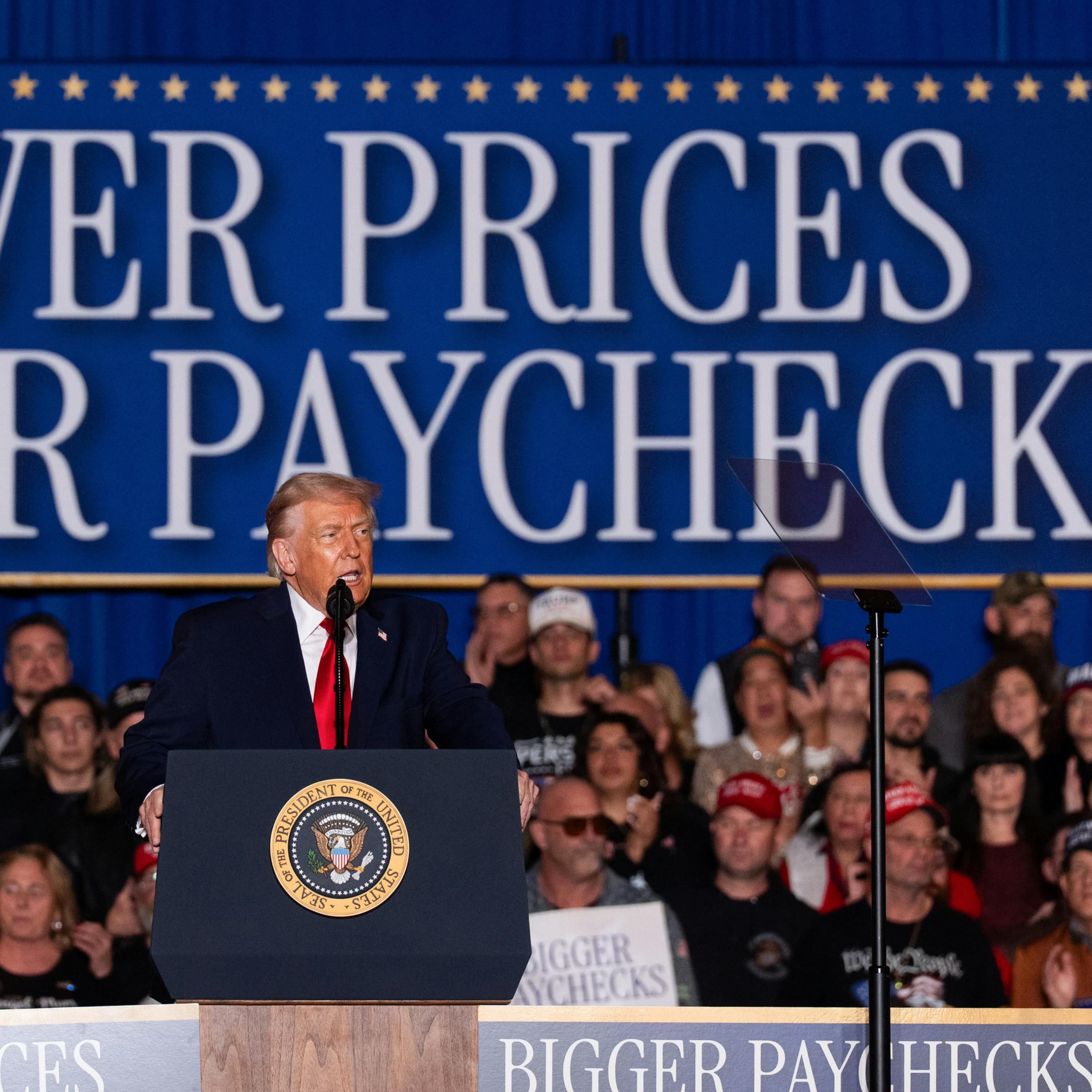
Today, Explained
The ¯\_(ツ)_/¯ economy
00:25:45
Trump calls the idea of “affordability” a hoax. Nonetheless, he pressured the Fed to fix it. It's just one example of Trump prizing loyalty over economic expertise.
Loading summary
Transcript95 lines
- [00:01]
Noel King
President Trump has taken flak recently for not appearing to get that Americans think life is too expensive. At a rally in Pennsylvania on Tuesday that was supposed to be about the economy, he made fun of Joe Biden.
- [00:14]
Neil Irwin
What state? What state is it? It's Pennsylvania.
- [00:17]
Noel King
Oh, he ranted about immigration. He reminisced. He returned to old chestnuts.
- [00:23]
Neil Irwin
You don't need $37 for your daughter. Two or three is nice, but he.
- [00:27]
Noel King
Offered little in the way of acknowledgment.
- [00:29]
Neil Irwin
They say affordability and everyone says, oh, that must mean Trump has high prices. No, our prices are coming down tremendously.
- [00:40]
Noel King
When he's not denying the problem, Trump is often pinning the blame on his favorite target, the Federal Reserve, for not cutting interest rates. Trump has always dismissed technocrats. In his second term, he's relying more on instincts than experts, and it is starting to damage his presidency. That's coming up on Today Explained.
- [01:00]
Sponsor/Advertisement Voice
What do walking 10,000 steps every day, eating five servings of fruits and veggies, and getting eight hours of sleep have in common? They're all healthy choices. But do all healthier choices really pay off with prescription plans from CVS Caremark? They do their plan designs give your members more choice, which gives your members more ways to get on, stay on and manage their meds. And that helps your business control your costs because healthier members are better for business. Go to CMK Co Access to learn more about helping your members stay adherent. That's CMK coacss. Support for this show comes from Amazon Ads. Every business owner has been there. You put a significant amount of money into an ad buy and then wonder did those ads actually have an effect? Luckily, there's Omni Channel Metrics. Omni Metrics from Amazon Ads Omnichannel Metrics helps advertisers understand how their Amazon ads campaigns drive sales both on and beyond Amazon. While campaigns are still mid flight, whether customers buy on Amazon or at a brick and mortar store, you'll understand the full impact of your campaigns. Head to advertising.Amazon.com to learn more. That's advertising.Amazon.com.
- [02:26]
Andrew Prokop
This is TODAY Explained.
- [02:28]
Neil Irwin
This is.
- [02:29]
Noel King
You're listening to Today Explain Today Explain.
- [02:34]
Neil Irwin
I'm Neil Irwin. I'm the chief economic correspondent at Axios.
- [02:38]
Noel King
Yesterday, before the Fed made its decision on interest rates, it seemed like a lot of people were watching very carefully, including people who are not normally interested in particularly interested in what the Fed does. What were the stakes yesterday?
- [02:52]
Neil Irwin
Well, the big question has been how much do you cut interest rates? You know, the Fed, when inflation was was roaring. They raised interest rates a lot, up to almost five and a half percent. And then they've been kind of steadily bringing them back down. And what we have is this moment where there's still high inflation, there's tariffs coming through the system, the economy looks a little shaky, the job market looks a little shaky. The President is hammering the Fed every other day to cut rates, cut rates, cut rates. And the challenge for Jay Powell and the Federal Reserve is do we do it? Do we do a third interest rate cut this year? And does that give consumers and businesses some from these high interest rates of the last few years?
- [03:26]
Noel King
All right, so tell me what the Fed did yesterday and why you think they did it.
- [03:29]
Neil Irwin
Good afternoon. My colleagues and I remain squarely focused on achieving our dual mandate goals of maximum employment and stable prices for the benefit of the American people.
- [03:41]
So they lowered their, their target interest rate. This is kind of the baseline interest rate that, that affects rates across the economy by a quarter percentage point. That was the third quarter point cut this year. They did another percentage point of cuts last year. So, you know, all in all, we're down 1 1/3% from where things were back during the great inflation. And you know, what they did is the reason they did it is because they see some evidence that the job market is starting to crack a little bit.
- [04:05]
I think you can say that the labor market has continued to cool gradually, maybe just a touch more gradually than we thought.
- [04:14]
And they think that even to the degree inflation is a problem, it's a temporary problem.
- [04:18]
A reasonable base case is that the effects of tariffs on inflation will be relatively short lived. Effectively a one time shift in the price level.
- [04:26]
This tariff pass through is going to come and go and affect prices in a one time way, not in an ongoing inflationary way. And therefore they think it's time to lower the dial, make interest rates a little lower, and therefore help the economy along as the job market stumbles.
- [04:41]
Noel King
There were three Fed governors yesterday who voted against the cut. Who are they and why did they dissent?
- [04:47]
Neil Irwin
There's two sides to this. One dissenter was Stephen Miron, who's a governor appointed by President Trump just a couple of months ago. He wants even more rate cuts. So he has embraced the Trump line that rates seem to be a lot lower, that the economy can, can really benefit from it, and it won't cause an inflation problem.
- [05:06]
Andrew Prokop
Given my rather more sanguine outlook on inflation than some of the other members of the committee, I don't see a reason for keeping policy as restrictive for a long period of time as we are.
- [05:14]
Neil Irwin
So he wanted to cut interest rates a half percentage point, go more aggressively than the rest of his colleagues did. The two dissenters on the other side were Chicago Fed President Austan Goolsbee, Kansas City Fed President Jeff Schmidt. They both wanted to leave rates where they are. They think that inflation is still too much of a problem, that they're playing with fire if they cut rates now and, and ignore the kind of elevated inflation that we keep having year after year after year.
- [05:37]
I am uneasy with front loading rate cuts. I do believe rates will come down, but in a way rates should come down with inflation. If we're just counting on that to go away because it's transitory, that makes me uneasy.
- [05:54]
There are also some shadow dissenters. Hmm, what do I mean by that? So, so the Fed releases these projections four times a year, and it include, includes dots on what each official thinks the rates ought to be over the next couple of years. And if you count up those dots, and people like me have a lot of fun counting up these dots one by one, there were actually six officials out of the 19 who thought it would make sense to leave interest rates where they are. That means that in addition to the two people who actually dissented, there's probably four more officials who in their heart kind of wanted to dissent, maybe didn't have a vote this cycle. And so there is some real disagreement within this committee of what interest rates ought to look like right now.
- [06:29]
Noel King
Let's go back to Myron for a second and what he represents. So he's a Trump guy. He wanted a bigger rate cut. Trump, as you know, has been yelling at the Fed to cut rates since he took office. Sometimes very loudly. He's threatened Jay Powell.
- [06:43]
Neil Irwin
I'll be honest, I'd love to fire his ass. He should be fine. Guy's grossly incompetent.
- [06:49]
Noel King
Will yesterday's cut make him a little happy? A lot happy. Does it get us part of the way toward what he wants?
- [06:55]
Neil Irwin
You know, I feel like a thing we've seen with President Trump is he, he will never take the win. You know, he, he wants rates a lot lower and, and he's getting them. He's gotten three rate cuts this year, but it's still not enough. He was just yesterday, just in the last, you know, since the meeting has, he's been saying that rates should be cut much more.
- [07:13]
He did a rather, I would say a rather small number that could have been doubled, at least double.
- [07:21]
You know, that said, because of these dissents and shadow dissents that we talked about. I think it's going to be a hard slog to pers these officials that in a time of 3% inflation, which is still higher than they want, that there should be significantly cheaper money.
- [07:34]
Noel King
Questions are emerging, I'll say, in the passive tense, about whether the President really understands the affordability crisis in America. Right.
- [07:41]
Neil Irwin
They have a new word. You know, they always have a hoax. The new word is affordability.
- [07:46]
Noel King
Polls show that voters think everything is too expensive, the cost of living is too expensive, and the administration has not done enough to help them. Trump, when confronted with that, has a tendency to say, everything's fine, you're getting.
- [08:00]
Neil Irwin
Lower prices, bigger paychecks, or it's the Fed's fault, the head of the Federal Reserve is a stiff, the Fed needs.
- [08:10]
Noel King
To lower interest rates, and we'll, we'll all be good. Does Trump have a point here? Is the Fed standing in the way of affordability?
- [08:19]
Neil Irwin
So here's the central problem, and this is a disconnect between the way economists think of these policy levers and the way laymen and kind of ordinary people do. So if, if you're the Fed, you think that the way you preserve affordability, the way you keep inflation low, is by raising interest rates or keeping rates high. That's how you keep aggregate demand in check. That's how you keep inflation from becoming a problem. Back in 2022, when inflation took off, they raised rates a lot to try and bring it back down, and it worked. Now, to ordinary people, higher interest rates are part of the affordability crisis. Right. So higher mortgage rates, higher auto loan rates, those are things that make life more expensive. So to you, what the Fed thinks they're doing to help affordability, help inflation, is actually making affordability worse. And, you know, I think the President views it through kind of that lens in the same way that a lot of, you know, a lot of normal civilians do. And it creates a real disconnect between what the Fed thinks it needs to do to, to help on affordability, keep inflation in check, and what. What's perceived by, by everybody out there.
- [09:17]
Noel King
All right, so Jay Powell's term as Fed chair is up next spring. Trump has turned the process of finding replacement into a little bit. Who is the favorite at this point?
- [09:28]
Neil Irwin
Yeah, it really has become a reality show. It's kind of a cliche, but it's, it's cliche is true. You know, it's accurate. You know, allegedly there are five, maybe down to four finalists, but it looks pretty clear the President is strongly leaning toward Kevin Hassett, his White House economic adviser, to be the next Fed chair.
- [09:45]
Andrew Prokop
I am really the happiest person ever when the President said I could come and be the director of the National Economic Council.
- [09:50]
Neil Irwin
It's a dream job and coming here.
- [09:52]
Andrew Prokop
Every day is a blast.
- [09:53]
Neil Irwin
So Kevin Hassett is the director of the White House National Economic Council. He worked for President Trump in his first term as Council of Economic Advisers chair. So this is somebody who the President has a long standing relationship with and somebody who goes on TV and speaks the administration's line quite a lot.
- [10:08]
Andrew Prokop
Trumponomics works and Bidenomics doesn't. And so we've got lots of good news to report to the American people.
- [10:14]
Neil Irwin
You know, he's worked at think tanks in kind of conservative policy circles. So, you know, he's a credible candidate for this job. This is not some, you know, complete crank. At the same time, you know, he is somebody who has become very political and has really made it his, his centerpiece of his job in the last last 10 months to, to be somebody who's out there speaking on behalf of, defending, arguing on behalf of the President in a way that he's, he's just, he is more politically intertwined with the President than we've seen in recent Fed chair appointments.
- [10:45]
Noel King
What are the stakes of having a Fed chair who's very loyal to the President, to a president like Trump?
- [10:51]
Neil Irwin
So the real question is, you know, look, the Fed is set up to have all these levels of independence. So the governors are appointed for 14 year terms, they cut across presidential administrations, they, the Reserve bank presidents around the country have their own weird selection process through which they're selected. So it's meant to be insulated from day to day politics. The question is, would Kevin Hassett or whoever ends up being the next Fed chair be more directly responsive to what the White House wants, what the President wants, than has been the modern norm? And you know, where that rubber hits the road is let's say we have an inflation problem a year or two from now. Does Fed chair Hassett or whoever ends up in that job, are they willing to do what it takes to raise interest rates to try and bring inflation down the way the Fed did in 2022, the way the Fed did in the early 1980s? And you know, that's something that no president wants to see. They don't want to see higher interest rates. They don't want to see the economy kind of choked off by the Fed. At the same time, the reason the Fed has this independence is so that they will be willing to do that, to do whatever it takes to keep inflation in check. Will a Chair Hassett or whoever it ends up being be willing to do that?
- [11:58]
Noel King
Will he or won't he? We're going to keep our third eye open. Neil Irwin is the chief economics correspondent for Axios. Coming up, why American Presidents Don't Listen to Economists Anymore.
- [12:18]
Sponsor/Advertisement Voice
What do walking 10,000 steps every day, eating five servings of fruits and veggies, and getting eight hours of sleep have in common? They're all healthy choices. But do all healthier choices really pay off with prescription plans from CVS Caremark? They do. Their plan designs give your members more choice, which gives your members more ways to get on, stay on and manage their meds. And that helps your business control your costs because healthier members are better for business. Go to CMK Co Access to learn more about helping your members stay adherent. That's CMK Co Access.
- [13:00]
Noel King
Marshall's buyers are hustling hard to get amazing new gifts into stores right up to the last minute. Like a designer perfume for that friend who never RSVP'd but wish list topping toys for her kids who came too. Belgian chocolates for the neighbor, a cozy scarf for your boss and a wool jacket for your husband that you definitely did not almost forget. Marshalls. We get the deals, you get the good stuff. Even at the last minute. Phew. Find a Marshall's near you. Teenagers have been mystifying adults for a long time.
- [13:33]
Neil Irwin
Why can't he act his age? Why doesn't he grow up?
- [13:37]
Noel King
And we don't have definitive answers for you about why teenagers are the way that they are. But we do have some scientists who are asking really interesting questions. They asked me if I smoked once and I was like, I'm nine. That's this week on Unexplainable all the weird, wonderful ways researchers are trying to figure out what's going on inside teens heads.
- [14:03]
Andrew Prokop
Teenagers, Am I right?
- [14:05]
Neil Irwin
So we're taking a look and it looks like it's about today explained. I'm not aware of that. Yeah, it just came out. Yeah, I haven't heard that from anybody.
- [14:17]
Noel King
I'm Noel King. VOX senior correspondent Andrew Prokop has been writing for Vox about how from MAGA to Mamdani, America's political class and stopped listening to economists.
- [14:30]
Andrew Prokop
So I think to understand what changed here, we have to go back to how economists gain this special status in the first place. They rise to prominence and politicians view them as useful and important when it seems that their ideas and their knowledge is useful to at solving political and policy problems. So back in the 1930s, the Keynesians, they managed to help guide us out of the Great Depression and then to basically shape the post war world. The Keynesian economists advocated increased government spending and intervention as a way to get the country out of that recession. And they helped President Roosevelt, in his view, solve the problem that the country was facing.
- [15:27]
Neil Irwin
Our greatest primary task is to put people to work. This is no unsolvable problem. If we face it wisely and courageously, it can be accomplished in part by direct recruiting by the government itself.
- [15:49]
Andrew Prokop
Decades later, in the 1970s, the Keynesian's ideas were struggling with the challenges the country was facing then. High inflation, high unemployment, people who want.
- [15:59]
Neil Irwin
To work but can't find jobs are part of today's other bad economic news. Inflation has cost us dearly in the last year. One hidden cost is to our sense of freedom. If you think it was tough to make ends meet in 1974, wait till you hear about 1975.
- [16:16]
Andrew Prokop
So we got a new class of economic economist advisors who rose, the neoliberals. They argued that it was often the case that government was getting in the way of economic growth and prosperity, and that the solution was often for government to do less, to deregulate, to cut taxes.
- [16:39]
Neil Irwin
Inflation is made in Washington because only Washington can create money. What produces it is too much government spending and too much government creation of money and nothing else.
- [16:50]
Andrew Prokop
So the neoliberals seem to really have cracked the code for a while. Money politicians in both parties really did kind of gravitate towards this analysis, which seemed to be effective to many in producing economic prosperity throughout, you know, the Reagan administration.
- [17:13]
Neil Irwin
When I sign this bill into law, America will have the lowest marginal tax rates and the most modern tax code among major industrialized nations.
- [17:22]
Andrew Prokop
The Clinton administration.
- [17:24]
Neil Irwin
In a few moments, I will sign the North American Free Trade act into law. NAFTA will tear down trade barriers between our three nations.
- [17:33]
Andrew Prokop
The beginning of George W. Bush's administration.
- [17:36]
Neil Irwin
I think we ought to focus our efforts on three great forces for economic growth. Free markets, free trade, and free people.
- [17:45]
Andrew Prokop
And really the core idea of neoliberalism was that markets know best, that the state, when it tries to interfere with markets, is highly likely to screw things up. The Great recession then happens at the end of George W. Bush's administration, leading into Barack Obama's.
- [18:09]
Neil Irwin
We are in the midst of a serious financial cris and the federal government is responding with decisive action.
- [18:15]
Noel King
Now it's official, we are in a recession. Wall street is clearly worried. The dow plunged nearly 680 points today, or 7.7%.
- [18:24]
Andrew Prokop
Barack Obama continues to rely to great extent on the economist establishment in crafting his response to the Great Recession. He very much believed this worldview, that economists did have special knowledge of some kind that he wanted to have considered in policymaking. And so it was really the post Obama years when economists were gradually and in some cases suddenly pushed from the lofty perch that they held.
- [19:00]
Noel King
All right, so they're pushed from their lofty perch. And at what point do they, like, hit the ground? Like, when would you say this hits peak? We don't respect economists anymore.
- [19:13]
Andrew Prokop
Well, what happens next is kind of two different processes unfolding in each of the two major parties that have some similarities but are also kind of fundamentally different. On the Republican side, it's really pretty simple. Donald Trump wins the primary.
- [19:32]
Neil Irwin
This has been an amazing evening already. We've won five major states, and it looks like we could win six or seven, seven or eight or nine.
- [19:43]
Andrew Prokop
And once he wins, much of the previous Republican establishment is going to be on its way out. He has no interest in them. The party is increasingly steered by his own preferences, and he has no use for highfalutin academic debates arguing big picture principles and economic models in front of him. And while there are certain economists who do hold prominent positions in the Trump administration, they generally hold those positions if and only if they are saying what Donald Trump wants to do.
- [20:24]
Neil Irwin
Anyway, I have to say that President.
- [20:27]
Trump has been right on this. Nation after nation, trade negotiator after trade negotiator. Trump has normalized the idea of a 15 to 20% tariff.
- [20:38]
Andrew Prokop
Donald Trump is not interested in the wisdom of economists. Donald Trump is interested in whether economists can lend their imprimatur and expertise to his own policy agenda that he wants to implement. On the Democratic side, there is a bit of a different story. The Democratic side's confidence in the economic neoliberal establishment was increasingly shaken by this progressive challenge from the left that we saw with Bernie Sanders, that we saw with the rise of Elizabeth Warren, but also by Trump's 2016 win in and of itself, that really shook the party's confidence that their economic policy was on the right track. There was a lot of focus on who had been left behind from trade. Why had Democrats lost the Rust Belt?
- [21:32]
Neil Irwin
And I think what you saw in this election here is white working people in these rural areas seeing that someone actually was articulating the fact that they had become disenfranchised, and that's why they gravitated toward Trump.
- [21:49]
Andrew Prokop
Some people argued that this was really about culture and about immigration and that it didn't really have that much to do with economics at all. But others argued that Democrats economic policies had gotten out of touch with the working class and too kind of beholden too this kind of neoliberal view of the world. Eventually, Joe Biden wins. And he is similar to Donald Trump in some ways in that he also has very little use for high minded academic debates playing out in front of him. I interviewed Jason Furman, a Harvard economist who worked in the Obama administration, and he told me that but President Obama would typically start meetings by having the policy people talk and then the political people would then weigh in after and it would become more of a freeform discussion after that. But in his experience then Vice President Biden didn't do anything similar to that. Often politics or the demands of interest groups kind of came first. And there wasn't really the same elevation of wonky economic debates among economists.
- [23:04]
Noel King
There have always been jokes about economists. Things like these are people who can be wrong half the time and still keep their jobs. Like the skepticism is nothing new. And in a lot of ways that, you know, fair points have been made about what economists actually bring to the table. But here we are in 2025 and we've got a crisis of affordability. We've got interest rates that are a lot higher than most people would like. We've got inflation that's higher than a lot of people would like. Do you think what this year and this time is proving is that the economists actually were the ones holding us back from the brink in some sense?
- [23:48]
Andrew Prokop
Yeah. It's really interesting. In the 2010s, there was the left critics and the right critics of economists. But now people are positively nostalgic for the economy of the late 2010s. Of course, what then happened was the pandemic inflation war in Ukraine producing a new series of problems in the 2000s. And the economists argue that, you know, if people had listened to us a little more, if Joe Biden had listened to us when we were warning about inflation in early 2021, then perhaps we wouldn't have sunk to this pretty bad place where the public is just absolutely furious about affordability and high prices. That wrecked Biden's popularity, wrecked Democrats 2024 chances, and now are imperiling Trump's own popularity as well. The problem is that now that we are in 2025 and facing the problems of 2025, economists don't really have a consensus. Quick fix to the mess that we're in. You know, they don't really have a superior quick fix alternative they're proposing. And, and if they don't, then the political system is going to turn to the people who are offering those quick fixes.
- [25:23]
Noel King
That was Vox's Andrew Procop. Miles Bryan and Dustin DeSoto produced today's show. Jolie Myers is our editor. Laura Bullard checked the facts and Patrick Boyd engineered the rest of our team. Hadi Moagdi, Amina El Saadi, Danielle Hewitt, Kelly Wessinger, Ariana Espudu, David Tadashore, Peter Balan On Rosen, Avishai Artsy, Miranda Kennedy, Estad Herndon and Sean Ramas firm. We use music by Breakmaster Cylinder. I'm Noel King Today Explained is distributed by wnyc. The show is a part of the Vox Media Podcast Network podcast.voxmedia.com you can listen ad free by joining our membership program. Vox.com members to join.
- [26:27]
Sponsor/Advertisement Voice
Support for this show comes from Odoo. Running a business is hard enough, so why make it harder with a dozen.
- [26:33]
Andrew Prokop
Different apps that don't talk to each other?
- [26:36]
Sponsor/Advertisement Voice
Introducing Odoo. It's the only business software you'll ever need. It's an all in one fully integrated platform that makes your work easier.
- [26:45]
Neil Irwin
CRM, accounting, inventory, E commerce, and more.
- [26:48]
Sponsor/Advertisement Voice
And the best part? Odoo replaces multiple expensive platforms for a.
- [26:53]
Andrew Prokop
Fraction of the cost.
- [26:54]
Sponsor/Advertisement Voice
That's why over thousands of businesses have made the switch.
- [26:57]
Andrew Prokop
So why not you try Odoo for.
- [27:00]
Sponsor/Advertisement Voice
Free@Odoo.Com, that's o d o o.com.
- [27:07]
Neil Irwin
The holidays mean more travel, more shopping, more time online and more personal info in more places that could expose you more to identity theft. But Lifelock monitors millions of data points per second. If your identity is stolen, our US based restoration specialists will fix it, guaranteed your money back. Don't face drained accounts, fraudulent loans or financial financial losses alone. Get more holiday fun and less holiday worry with Lifelock. Save up to 40 your first year. Visit lifelock.com podcast terms apply.