Loading summary
Transcript77 lines
- [00:01]
Estad Herndon
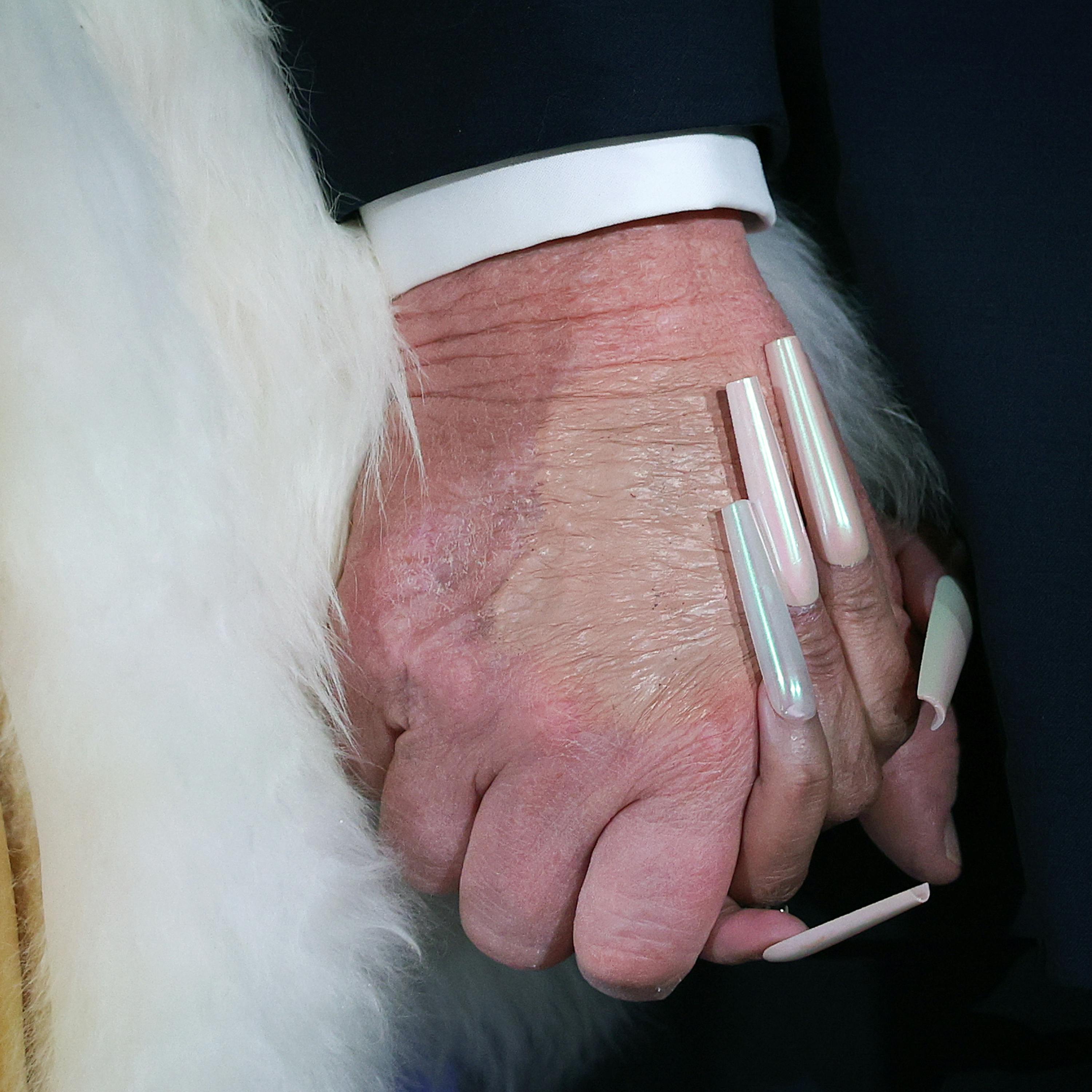
Okay, Quick question for President Trump. You good, bro? Donald Trump, as everyone now knows, has this weird thing going on with his hand.
- [00:09]
Ben Terris
Nicki Minaj in a white fur coat holding President Donald Trump's discolored hand. In the past, the US President has appeared to fall asleep multiple times during Oval Office announcements and Cabinet meetings. Trump's cankles.
- [00:22]
Sponsor/Announcer
The White House revealed the president got.
- [00:24]
Ben Terris
A recent checkup after noticing swelling in his lower legs.
- [00:28]
Estad Herndon
Well, he is almost 80. How's his brain doing?
- [00:31]
Unidentified Guest/Interjector
Stock market took the first dip yesterday because of Iceland.
- [00:35]
Estad Herndon
I think he meant Greenland because they.
- [00:37]
Unidentified Guest/Interjector
Want to keep those people that are lying on the floor. They want to keep those people in Minnesota, but they really don't.
- [00:44]
Estad Herndon
Huh? The president says he's never been healthier of mind and body, but is he? A look at the evidence and why the evidence matters. Coming up on Today Explained.
- [01:01]
Sponsor/Announcer
What do walking 10,000 steps every day, eating five servings of fruits and veggies, and getting eight hours of sleep have in common? They're all healthy choices. But do all healthier choices really pay off with prescription plans from CVS Caremark? They do. Their plan designs give your members more choice, which gives your members more ways to get on, stay on and manage their meds. And that helps your business control your costs because healthier members are better for business. Go to CMK CO Access to learn more about helping your members stay adherent. That's CMK coacss. What do walking 10,000 steps every day, eating five servings of fruits and veggies, and getting eight hours of sleep have in common? They're all healthy choices. But do all healthier choices really pay off with prescription plans from CVS Caremark? They do. Their plan designs give your members more choice, which gives your members more ways to get on, stay on and manage their meds. And that helps your business control your costs because healthier members are better for business. Go to CMK CO Access to learn more about helping your members stay adherent. That's CMK Co accession.
- [02:25]
Ben Terris
Mr. President, do you have any reaction to Today Explain being named the best news show? Wow.
- [02:32]
Unidentified Guest/Interjector
I didn't know that. I just. You're telling me now for the first time.
- [02:36]
Ben Terris
My name is Ben Terris. I am the Washington correspondent for New York magazine and I cover Washington. So lots of politics for me.
- [02:43]
Estad Herndon
One thing I love about your work is that you always seem to take on reporting targets that maybe other folks seem to be avoiding or kind of things that aren't necessarily directly in front of us.
- [02:52]
Ben Terris
And.
- [02:53]
Estad Herndon
And that's no different than what you did in your latest piece in which you took a look at Donald Trump's health. Now, I'm gonna ask, like, what was the catalyst for this piece?
- [03:02]
Ben Terris
So last year, at the end of the year, I was talking with my editors about what are some of the big questions in Washington that people have? And one of the biggest ones is just, is Donald Trump? Okay, we've all been watching him for years now, but especially in the last year, there's been more questions about him, right? His health, the bruising on his hands, the swollen cankles, the falling asleep in meetings, even more rambling than normal when he gives speeches and press conferences.
- [03:32]
Unidentified Guest/Interjector
I said to my mother, mom, she would be always there for me. She said, son, you could be a professional baseball player. I said, thanks, Mom.
- [03:42]
Ben Terris
And before sitting down with him, you know, I'd been reading some books by members of his family. I talked to his niece, Mary Trump. Mary Trump says sometimes when she looks at Donald Trump, you know, speaking in the public square, she sees flashes of her grandfather when he had dementia, Alzheimer's. I don't know if he has it or not, but I wanted to ask him about it. And so he started saying, my father was so healthy, he had no problems. His heart couldn't be stopped. He did have one problem, though, Trump told me, and he said late in life, he had. What's the word for it? And he pointed to his head and Caroline Levitt, the press secretary, sitting next to me, and she kind of rescued him in that moment and said, Alzheimer's. And he said, yeah, yeah, he had an Alzheimer's thing. Well, I don't have it. And, you know, when somebody forgets the word Alzheimer's, you have to kind of pause and wonder what's going on there. Do I think he has Alzheimer's? I have no idea. I'm not a doctor. I would never pretend to be a doctor. But this is a guy who says that his memory is impeccable. I think Marco Rubio told me that Donald Trump's memory is unparalleled. And then you see moments like that, and you're like, okay, well, maybe it is paralleled.
- [04:52]
Estad Herndon
Yeah, I mean, it has definitely bubbled up more and more, even in his first year back in office. Like, what are the concerns with Trump's health that you uncover?
- [05:01]
Ben Terris
Well, I mean, the story I set out to write about was to figure out whether he's healthy or not, and it kind of ended up being a story about whether the government is healthy or not. You know, there's kind of an infection that has spread throughout Trump's inner circle, where everybody who talks about him talks about him in the kind of craziest, most North Korean type, dear leader way, where instead of just saying, you know, he's healthy for an almost 80 year old, he's slowing down a little bit, but, you know, he's doing pretty well. He's certainly healthy enough to be president. People talk about him in these terms that are just completely outrageous. You know, superhuman, kind of the healthiest man alive. You know, he told me he was healthier than he's been, than he was 40 years ago.
- [05:42]
Marco Rubio
He can work harder and he has a better memory and he has more stamina and has more energy than undoing normal mortal. Deputy Chief of Staff Stephen Miller told me the headline of your story should be the Superhuman President, New York Magazine, January 2026.
- [05:58]
Ben Terris
You know, I didn't get any smoking gun that he's about to die or suffering from Alzheimer's. I mean, you know, there's certain things in the reporting where, you know, you might raise an eyebrow and think, hmm, like, you know, is he as okay as he says he is? But I certainly don't believe that he's the healthiest man alive. I mean, the guy doesn't exercise, he doesn't eat well, because no matter who.
- [06:21]
Unidentified Guest/Interjector
You are, everyone loves something at McDonald's. There's always something to have. I like the fish.
- [06:28]
Ben Terris
You know, he drinks, you know, enough Diet Coke to fill a football stadium, and, you know, you just can't quite trust the people around him. And I felt like the story I published said a lot about Trump's America, not just Trump's health.
- [06:42]
Estad Herndon
Yeah, yeah. I want to ask about the hand, the bruised hand that you mentioned earlier, which is obviously been a spark for some of these concerns. Did you get any answers on what that is coming from or just the level of severity? I mean, it looks bad.
- [07:01]
Ben Terris
Yeah. I mean, I've been kind of on bruise watch myself. And when I got to the Oval Office for my interview, we shook hands. He had a really soft, warm hand, which was surprising. But on the back, it was very dry, a big kind of rhino hide like bruise on the back. And I asked him about it, and I asked the doctors about it. And what he claims is that he is on an aspirin regimen on a much higher dose than even his doctors want him to be on. And he says he's on aspirin because he wants, quote, thin blood. He doesn't want thick blood, he wants thin blood. And because he takes so Much aspirin. He bruises very easily. The doctors confirmed this is what's going on. He says because he bruises easily and because he shakes just a ton of hands, he's always bruising. You know, there's always these big burly men with sausage like fingers who are crying. They're so happy to see him, who just want to shake his hand and squeeze it. And so he says that's why he bruises. He has these cuts on the back of his hands often. He claims that's from women's fingernails and rings. Can I prove that's exactly why he has these bruises on the back of his hand? No, but it's certainly an outlandish and kind of silly explanation for, you know, why he's got the bruises he has.
- [08:14]
Estad Herndon
Well, I'm gonna ask also about that White House meeting. You know, this could be a sensitive topic, talking to the President about his health, about speculations around his kind of decaying or possibly decaying health.
- [08:25]
Unidentified Guest/Interjector
Did.
- [08:26]
Estad Herndon
Did this interview come easy? Did the White House invite you? Like, I'm curious of some of the logistics to how open they were to this discussion of his health.
- [08:35]
Ben Terris
It honestly came about easier than I expected. Look, I went into the White House early in my process, and I was transparent about what I wanted to write about. I didn't pretend that I wanted to talk to the President about anything else. I didn't pretend that I wanted to talk to his inner circle about other things. I said, look, there's a big question about the president's health. Lots of people think they have the answer. The Internet all believes they know. You know, half the Internet thinks he's gonna die tomorrow.
- [09:00]
Estad Herndon
Trump is dying.
- [09:01]
Ben Terris
I think he's gonna be around for six to eight months, tops. The other half of the Internet thinks he's gonna live forever. And I want to clarify the picture. And there's not a lot of people who really know the answer. There's Donald Trump, there's his inner circle, there's his doctors, and they made a lot of people available. It was kind of surprising. Before I got to talk to Donald Trump. It was not clear I was going to get to talk to Donald Trump. But before I talked to him, you know, they made time for me to go to the White House and sit down with Marco Rubio. He's got, like, 40 jobs, and he's, you know, took time out of his busy day to sit with me in Caroline Levitt's office and talk to me about how the President was, quote, too healthy. You know, he was, like, telling these stories that kind of. He was debasing himself in a way. Like, when I ride on Air Force One, I need to take a nap, and so I hide in a blanket. I wrap myself like a mummy covering my head.
- [09:50]
Marco Rubio
And I do that because I know that at some point on the flight, he's going to emerge from the cabin and start prowling the hallways to see who is awake. I want him to think it's a staffer who fell asleep. I don't want him to see his secretary of state sleeping on a couch and think, oh, this guy is weak.
- [10:06]
Ben Terris
And so I kind of went on this journey around Washington talking to people who work with the president, who just wanted to build him up like the most impressive, powerful man with the best health that they'd ever been around in their life.
- [10:19]
Estad Herndon
Did it feel as bizarre as it reads as it kind of sounds?
- [10:22]
Ben Terris
Yeah. I mean, it was the most bizarre reporting experience of my life. I mean, like, without a doubt, the whole thing felt like a series of plays that were put on just for me, where everybody was kind of acting and playing a part, and my job was to watch them and keep them talking. Right. Like, I didn't. I knew I wasn't gonna get to the bottom of Donald Trump's health by talking to Marco Rubio, but by talking to him and by talking to Trump's inner circle, I could kind of get to the bottom of how the White House operates. And so I was just watching, you know, this. This whole thing unfold just for me in real time. Yeah. I mean, we've all seen Donald Trump at his cabinet secretary meetings, where for three hours, they go around the table praising him.
- [11:01]
Estad Herndon
You are fixing everything with your policies. You have changed America and created the golden age.
- [11:07]
Ben Terris
We'. Operate. But to have it done kind of on an individual scale was a very surreal experience for me.
- [11:14]
Estad Herndon
You talk about Trump's health, but he famously has a very unhealthy diet. I mean, I love McDonald's, and that man's got me beat. He can't be eating things that RFK.
- [11:23]
Sponsor/Announcer
Jr approves of to make America healthy again.
- [11:26]
Estad Herndon
Like, how did he talk about his diet? And how is this perfect picture of health even possible considering the amount of Diet Cokes he consumes?
- [11:37]
Ben Terris
So a lot of people around him talked to me about his diet, and they called it, you know, horrendous. You know, a senior aide who said that they don't think that they've ever seen him eat a vegetable. Right. He admits this. He admits that he's not a picture of healthy Eating or healthy, Exercising. Right. There's been reporting in the past about how he sort of believes the human body is like a battery that has a finite amount of energy. So he doesn't want to use up his energy, but, like, he believes that nothing matters more than genetics. And. And, you know, the thing about Donald Trump that we have to remember is he is in the Oval Office in this moment. He's the white. He's the President of the United States. And he said this to me. He's like, why would I change anything? We're in the Oval Office right now. Like, why would I change my diet? Why would I change the way I exercise? Why would I change the way I operate as a person? Because everything I've ever done has got me to this moment where he says, he's a healthy guy and he's the most powerful person in the world. He is not gonna change. He wants people to change for him.
- [12:35]
Estad Herndon
Mm. We've heard what Trump said. We've heard what folks around him have said. I want to also expressly ask, like, what did the doctor say? What did his doctors tell you about his health? And should we buy what they're selling?
- [12:48]
Ben Terris
I mean, the doctors. I mean, the doctors were, like I said, part of this play put on just for me. When I. When I showed up to the Oval Office, they were holding pieces of paper that said talking points on the top of it, right? So they had things they wanted to get through. Were those talking points accurate? I don't know, but they definitely wanted to say them. They told me that he was as healthy as he says he is. One of them said that they did an EKG of his heart and he appears to be a 64 year old or a 65 year old, according to the AI data that they found. At the end of my interview, Caroline Levitt turns to one of the doctors and says, oh, you worked for the Obamas, didn't you? And as soon as she said that, I was like, oh, well, I got just the question to ask here. And so I asked the doctor, well, who's healthier? President Obama or President Trump? And Trump is sitting right there staring across the desk at the doctors, making direct eye contact. And without any hesitation, the doctor says, oh, President Trump.
- [13:58]
Estad Herndon
Coming up, anyone else feeling at least a little bit of deja vu?
- [14:14]
Sponsor/Announcer
Support for Today explained comes from Prolon. Prolon says when it comes to making habits stick, it helps to have a plan. Prolon says their five day, five fasting, mimicking diet is a real plan. It's apparently a plant based nutrition program that they say nourishes the body while keeping it in a fasting state. According to Prolon, Prolon is based on more than two decades of research developed with USC's Longevity Institute. They say they send you everything you need to stick to the plan.
- [14:41]
Claire White
Here's Claire White Prolon is a really great reset to make sure you're getting stuff that you actually need in your diet and it made me feel really refreshed and rejuvenated for the new year. I was glad to have this kind of kickstart to healthy eating habits in January and beyond.
- [14:56]
Sponsor/Announcer
If you're ready for a reset for a limited time, Prolon is offering our listeners 15% off plus a $40 bonus gift. When you subscribe to their five day program, you can go to prolonlife.com explained. That's P-R-O-L-O-N-L-I-F E.com explained to claim a 15% discount and a bonus gift, prolon.com explained. Support for Today Explained comes from upwork upwork says scaling a business well means having the right expertise at the right time. Upwork says they can help growing teams quickly, bring in specialized freelancers so you can move faster and take your business to the next level. It is a one stop platform to find, hire and pay expert freelancers across web and software development, data and analytics, marketing, business operations. So much more. They help you grow your business by giving you fast access to specialized talent across 125 plus categories so you can fill skill gaps and launch projects faster. You can browse profiles, review past work and get help scoping the role so you can hire with confidence and get started quickly. With Business plus you can access the top 1% of talent on Upwork and with AI powered shortlisting you can get matched to the right freelancer in under six hours. You can visit Upwork.com right now to post your job for free and connect with top talent ready to help your business grow. That's up w o r k.com Upwork.com. Support for Today Explained comes from Shopify. Starting a new business has never been easy, says Shopify. But without the right tools it can feel almost impossible. Perhaps Shopify can set you up for success. Shopify is a commerce platform used by millions of businesses around the world. They say they can help you tackle important tasks, inventory, payments, analytics. So much more. No need to save multiple websites or try to figure out what platform is hosting the tool that you need. Everything is all in one place making your life easier and your business operations smoother. Let Shopify be your commerce expert. With world class expertise in everything from managing inventory to international shipping to processing returns and beyond, you can get started with your own design studio. With hundreds of ready to use templates, Shopify helps you build a beautiful online store that matches your brand style. It's time to turn those what ifs into With Shopify today, you can sign up for your $1 per month trial and start selling today. @shopify.com explained. Go to shopify.com explained.
- [17:20]
Estad Herndon
What's that?
- [17:20]
Sponsor/Announcer
That's shopify.com explained.
- [17:27]
Ben Terris
This is Today Explained.
- [17:29]
Estad Herndon
I'm Estad Herndon and we're back with Ben Teres of New York Magazine. There has been some historic skittishness around reporting around the President's health. I remember when I was doing about how the electorate felt that Biden was too old for a second term, how controversial some of that stuff was.
- [17:46]
Unidentified Guest/Interjector
It's a huge mistake.
- [17:47]
Ben Terris
They're not doctors. They don't know whether Biden is physically capable of carrying out a second term or not.
- [17:53]
Estad Herndon
I was wondering, did you experience any of that skittishness when it came to reporting on Trump?
- [17:58]
Ben Terris
I think the fact that we went through the Biden era has made reporting on this topic easier in a way. I mean, it's still difficult because you can't get to the bottom of it. But it made people more willing to talk. Maybe it made journalists more willing to kind of go for these stories, for editors to assign them, because we went through this period of time with Biden where he aged in front of all of our eyes and people were too skittish in some ways to write about it. And now there's a correction to that. And so I think there has been more of a focus on Trump's age than there might have been if we didn't just go through the Biden era.
- [18:38]
Estad Herndon
I'm curious, though, for you as someone riding on it, does that comparison feel fair? I mean, Biden of course, may have physically looked different, but there was a lot of Democrats who were arguing that he was still kind of incapacity to do the job, that we didn't even see some of the things we see from Trump on a daily basis. What do you think it is about Trump that allows his health concerns to maybe exist as a side offering where Biden seems so front and center?
- [19:07]
Ben Terris
I think it's definitely fair to draw some comparisons, if for no other reason than they're both old. Right? I mean, Donald Trump is about to be 80 years old. Just by dint of that fact, It's a worthwhile story to cover.
- [19:18]
Sponsor/Announcer
Yeah.
- [19:19]
Ben Terris
But, yeah, there's definitely differences between the two of them. One reason I think that Trump is able to, you know, kind of quote unquote, get away with some things that could be signs of aging is that they could also just be signs of Donald Trump being Donald Trump. Right. He has been a kind of chaotic figure for a long time. He's got this rambling way of talking. He says unhinged, outrageous stuff.
- [19:42]
Unidentified Guest/Interjector
The windmills are driving the whales crazy.
- [19:45]
Ben Terris
Obviously, he did that 15 years ago. He does that now. Are there differences in the way that he communicates between now and then? Sure, of course. But it's not as stark as if. And when Biden starts to, you know, show signs of deteriorating. Right. Because Biden was a such a serious guy who kind of spoke in your traditional politician way that as soon as there was slippage, you could notice it a lot easier. And so I think Donald Trump makes it a little bit harder because it's really hard to know when he's being just regular Donald Trump or where he's being Donald Trump with, I don't know, a health issue.
- [20:23]
Estad Herndon
But I also want to ask about something that does seem similar from this moment of Trump and Biden's previous presidency, which is that the president and their aides basically kept telling you not to believe your own eyes. And in this instance, you have Trump dozing off in meetings and aides saying, oh, that was just his thinking pose.
- [20:42]
Marco Rubio
When I asked about whether Trump was catching Z's during those heavy lidded moments on camera, Rubio scoffed. It's a listening mechanism, he said.
- [20:51]
Estad Herndon
Like for you as a reporter, like, how did you react when you heard that? And how did that make the reporting of the story? Maybe more difficult.
- [21:00]
Ben Terris
In some ways it made it more difficult just because it's hard to trust people if they're telling you things that you just can't believe. Right. In other ways, it made the reporting of the story easier because I could just lay it out and the readers could see what I've seen, and they could see what they've seen and then see how it's described by the Trump administration. And without me even having to kind of characterize it, they could say, well, that doesn't feel like what I saw. You know, one thing that did not make it into the story. I'll talk about it with you for the first time. This is a little exclusive.
- [21:31]
Sponsor/Announcer
All right.
- [21:32]
Ben Terris
I did talk to some people from Biden's White House for this story. I mean, they, you know, we're all in background. They didn't want to put their name out there, obviously, but one person was telling me that, you know, this all, watching this happen did kind of feel similar to them. I have a quote in front of me here I can read, which is, I think there's a world where we denied it so much, and he's talking about Biden's, you know, health issues, where we denied it so much that there was a delta between what people were seeing and hearing, and that led to distrust. I think the denial of the thing people are seeing, you just can't get away with that anymore. I think they're making the same kind of mistake in backing themselves into the same kind of corner that we were in.
- [22:10]
Estad Herndon
Yeah, I mean, that is a hugely important takeaway I took from the piece is the wrestling with the question of trust. I mean, I also read in the piece that Trump was threatening to sue you if he didn't like your story. What was the status of that? What was the reaction from the White House when it came out?
- [22:28]
Ben Terris
You know, muted reaction. I think they just don't care that much about certain stories. Right. Like, they care a lot about the picture that accompanies an article in a magazine. They care a lot about TV news, and they care a lot about, I don't know, any reporting that says Trump is not doing well. And so I have not been sued. New York magazine has not been sued, thankfully. Yeah, I mean, you know, it was the first thing Trump said to me. And so I think he was sort of trying to, I don't know, warn me in a way. But it's also a threat that he issues a lot. And so, I mean, I guess you gotta take these things seriously. I did not think that we were gonna get sued. And hopefully that remains the case.
- [23:11]
Estad Herndon
You know, part of Trump's broader success, and maybe even his appeal is that he can get his followers to kind of believe his own version of reality. I hear this in talking to Trump supporters all the time. I wanted to know, like, do you think this strategy on this issue of his health is actually working for him? Like, what's your sense of whether the public believes the story they're putting out in regards to Trump's picture of health?
- [23:35]
Ben Terris
I think it's like, a lot of issues for Trump these days, which is, yeah, he's got a base of support that's gonna believe everything. And then there's this group between his supporters and his detractors, sort of this middle ground of people who are trying to figure it out, who are gonna be less convinced by this. And part of the story that I wrote here for New York magazine is that Donald Trump does seem to be losing his ability to control his story. His poll numbers are not what he wants them to be. The midterms are trending in the wrong direction. The immigration story is not even going the way he wants to go. And that was kind of a top issue for him. And the way that he tries to control the narrative, so to speak, of his health is. Is sort of akin to how he's trying to control everything. And I just feel like he's sort of losing some of that control. And this happens, right? This happens to presidents. This is why they become lame ducks. It's just happening a little earlier for Trump than is traditional for a president. You know, he's been referred to as a lame duck by pundits already, and that doesn't normally happen until the third year of a presidency.
- [24:35]
Estad Herndon
Yeah. I mean, there does seem to be a sense, whether it's via approval rating or in just some of the general vibes in the air, that maybe the kind of narrative setting power of Trump has diminished faster in this second term and maybe even faster because of some of his own actions. And honestly, it kind of reminds me of the. You know, it could be the same questions of health that dog Biden, maybe as a speaker, as a leader, he's just increasingly less trusted. Do you think that there is enough info or things that can come out there that moves one side or the other? Or is this just our new Internet age? Like, we get speculation about a president's health and, and, and the two camps kind of decide where they are, and that feels kind of rigid.
- [25:17]
Ben Terris
I've always sort of felt that the two camps are never going to be moved. Right. But. But those camps might be smaller than you or I or, you know, normal people believe them to be. These are the people who go on to X or Threads or Blue sky or. Or whatever, and, you know, are kind of screaming their opinions out for everybody to hear. It's going to be really hard to move somebody who thinks that Donald Trump has a catheter under his pants, that he's actually doing fine, and it's gonna be really somebody who thinks Donald Trump's gonna live forever, that actually the bruising on his hand is an indication that maybe he's not as healthy as he says he is. But there's just a lot of people who don't live in that world who, you know, probably see things with their own eyes and are able to make more informed opinions than people who have brain worms for being on the Internet too much. As I was reporting this story, it kind of occurred to me that the health of the president and the health of the presidency are inextricably linked, Right? Which is to say that, like, as long as people think Donald Trump is weak, he will become weak. And as long as people think that Donald Trump is strong, he will become strong. I think that's why he's pushing so hard on the health story, to appear as strong as possible, because that will make him, he hopes, stronger. And so I think the thing to watch is just how is he able to control this story or any stories, you know, stories coming out of Minneapolis? You know, clearly he doesn't have as much control over how people are viewing what's happening in Minnesota as he wants to. Otherwise he could just keep claiming everything out there is a success, but instead there's been a shakeup and there's talking about, they're talking about a drawdown of ice forces out there. If you can watch Donald Trump and see his ability wax or wane to control stories, I think you're gonna have a pretty good sense of how strong his presidency.
- [27:14]
Estad Herndon
Ben Terrace is a D.C. correspondent for New York Magazine. Find all of his reporting@nymag.com Today's show was produced by Kelly Wezinger, edited by Jolie Myers. Fact checked by Andrea Lopez Cruzado, engineered by Patrick Boyd and David Tadashore. I'm Esteed Herdin. This is Today explained.
- [27:37]
Ben Terris
Sam.