← Today, Explained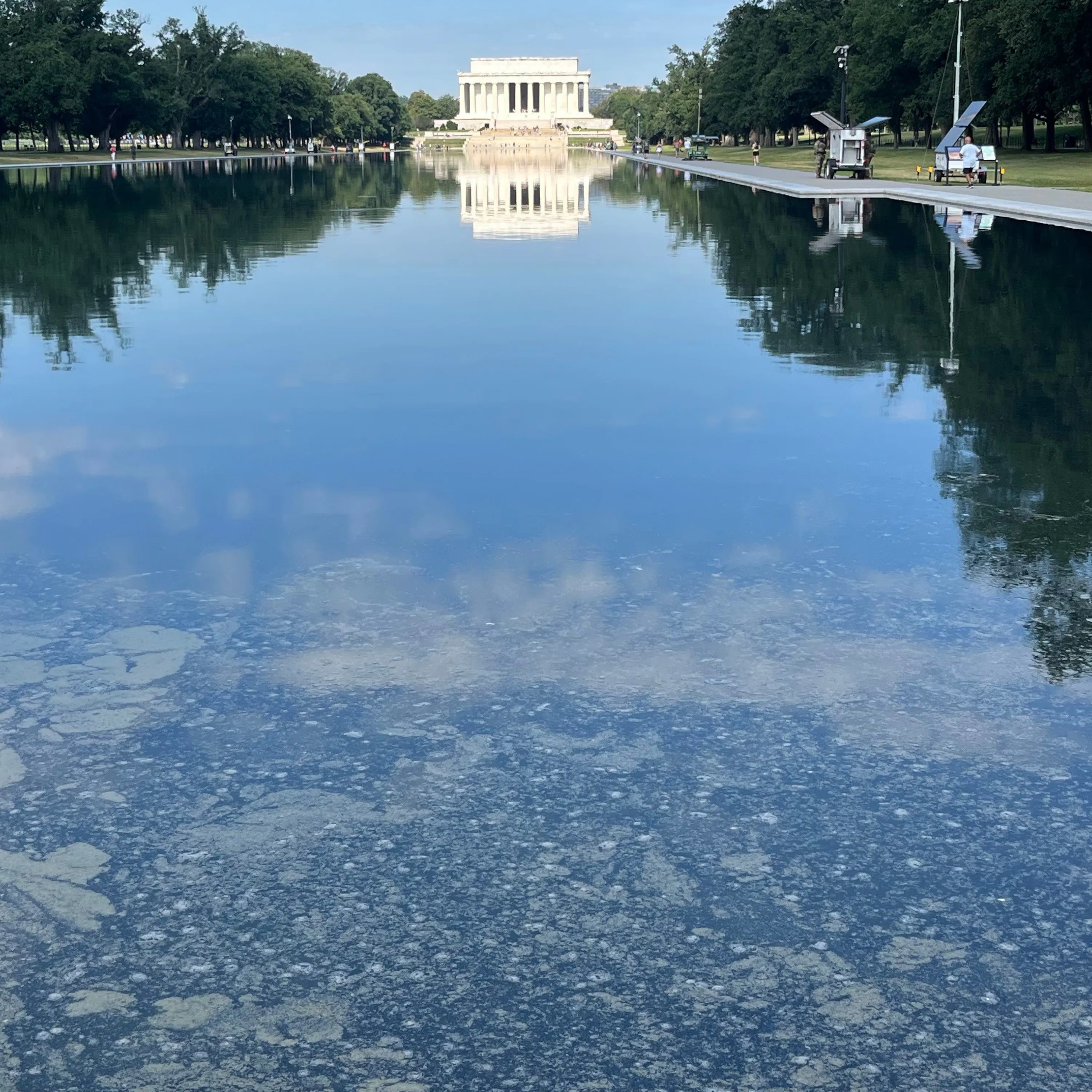
Today, Explained
The Reflecting Pool fiasco
00:26:06
Donald Trump famously came to Washington, DC to “drain the swamp,” but he may have inadvertently created one.
Loading summary
Transcript117 lines
- [00:02]
A
Sean Ramasvoor I'm out here on the National Mall, about halfway between the World War II and Lincoln memorials, which is to say I am standing next to our reflecting pool and I'd like to take a moment, just sit right there, talk about how it isn't just nominally a reflecting pool. I've lived here for about a decade, and just about anytime you come out here, you'll see people in a state of quiet contemplation. I think that's because you know, it's a quiet place. It's, it's open, it's free. It's free for you in the winter to try and test your luck skating the reflecting pool in your sneakers or in the summer. I've seen people take a little dip in sometimes intentionally, sometimes unintentionally. As you know, as of late, it's felt a lot less free out here at the reflecting pool. And we're going to get into it on Today Explained from Vox. Support for this show today comes from Anthropic, the team behind Claude. Claude is the AI for minds that don't stop at good enough. It's the collaborator that actually understands your entire workflow and thinks with you whether you're debugging code at midnight or strategizing your next business move. Claude extends your thinking to tackle the problems that matter with deep research. Claude's research capabilities go way deeper than basic web search, comprehensive research, reliable analysis with proper citations, turning hours of research into minutes for problems worth solving. You can get started with Claude at Claude AI todayexplained. That's Claude AI todayexplained.
- [01:38]
B
We all do it. You have a night for yourself, but don't like the sound of the silence, so you turn on the TV just for the ambiance. It's a little trick that helps you feel like you've got company and aren't alone. And other insurers, well, they may make you feel alone, but when you switch to geico, you've got claims reps available around the clock. So whenever you need, you'll have people around to help. And let's turn on the washing machine just for good measure. Isn't that soothing?
- [02:05]
C
It feels good to have support. It feels good to geico.
- [02:10]
A
I'm green and it'll do fine
- [02:15]
D
today.
- [02:16]
C
Explained.
- [02:17]
E
I'm Christina Cotterucci. I'm a senior writer at Slate.
- [02:20]
A
What is it about the reflecting pool that has captured not only, I think, national but international attention?
- [02:28]
E
That stretch of federal land between the Washington Monument and the Lincoln Memorial is maybe you Know, the most iconic American property that we have, it's between two monuments representing two of our greatest and beloved presidents. You know, it's the site of MLK's
- [02:45]
A
I have a Dream speech.
- [02:47]
E
It's the thing that you have to go to whenever you visit DC whether that's on an 8th grade field trip or, you know, I met some people down there who were there for work conferences. It's sort of the place where tourists gather more than any other.
- [02:59]
A
It's like where Forrest Gump and Jenny are reunited and where Spider man goes on his field trip.
- [03:08]
E
My friends are up there.
- [03:09]
B
What?
- [03:10]
C
Don't worry, ma'.
- [03:10]
A
Am. Everything's going to be okay.
- [03:11]
E
Yes, more to the point, of all of Trump's, know, D.C. renovations, besides maybe the part of the White House that he tore down, it's the most recognizable thing to people who don't live in
- [03:21]
A
D.C. well, let's talk about how this all got started. Was there a problem that needed to be addressed to begin with?
- [03:28]
E
Yes and no. So when I first heard that Trump was painting the reflecting pool blue, you know, and this is like a bright blue, like, I want to say, the color of Sonic the Hedgehog, he said American flag blue.
- [03:44]
D
And so you can't do better than that.
- [03:46]
E
Although, you know, having been down there, I would say it's a little more turquoise. But that's beside the point. The fact is, the reflecting pool has been plagued by leaks and algae for decades, you know, maybe even since its construction. And so Trump is not the first president to try to fix that. And Barack Obama, you know, spent $35 million installing a new water filtration and treatment facility. New steel reinforced foundation, a new filtration system that pumps water from the Potomac Tidal Basin. And pretty much on time, pretty much on budget, the new pool opened.
- [04:23]
F
But less than a month later, the famous pool of water is full of algae.
- [04:28]
E
The algae blooms are endemic to this large pool of stagnant water sitting in the D.C. sun.
- [04:35]
A
The smell was terrible.
- [04:37]
E
It smells like wet dog down here.
- [04:38]
A
You know, waste from the geese, plus all the feathers and everything else that came off of them, plus the algae.
- [04:45]
E
There's also the fact that it's created with slabs of concrete that, you know, expand and contract with shifting temperatures, maybe freeze in the wintertime. You know, under the water, it leaks millions of gallons of water a year. And so, yes, there are things about the reflecting pool that should be repaired and that previous presidents have tried and failed to repair. But was the color of it one of them?
- [05:08]
G
No,
- [05:10]
A
it's not that easy. The ingredient. Okay, so Trump is like 50, 50 on solid footing here to go in and fix the reflecting pool. I guess a project like this starts with who's going to do the work. And there is some controversy there, right?
- [05:31]
E
Oh, absolutely. So normally the federal government would seek offers from multiple different contractors to see who could do the work most efficiently, cost effectively, and you know best. Instead, Trump handpicked two different vendors to award contracts to.
- [05:49]
D
I said, my pool guy, I said, take a look at it. And he said, well, sir, we can do it.
- [05:55]
E
One was for over $14 million, the other one for more than a million. These were no bid contracts, which means that there were no other contractors submitting plans for how they would do the job.
- [06:06]
D
Every time I do a development, they do swimming pools. I know more about swimming pools. I said, why can't we put the wonderful material, which is thick, pasty, beautiful like rubber, but industrial strength. Why can't we use it? And let's pick the color blue from the American flag, which is what we did.
- [06:25]
E
One of the contractors was based in Virginia. Trump said someone who had done work on his Virginia golf course and, and done some pools there, and this was for the waterproofing, you know, blue sealant on the bottom of the pool. President Trump originally promised that his hand picked, no bid contractor charge $1.8 million for this repair and paint job.
- [06:45]
F
But federal records show the Interior Department
- [06:47]
E
is now planning to pay that contractor,
- [06:49]
F
Atlantic Industrial Coatings, more than seven times that.
- [06:52]
E
The other one was a company in
- [06:55]
A
Ohio called get this, Greenwater Services. Greenwater Services received a one million plus dollar no bid contract to help install the water filtration systems inside the Lincoln
- [07:09]
E
Memorial Reflecting Pool, the owner of which was a major Trump donor and who Trump had actually called out from the stage of a big event for being such a big supporter.
- [07:17]
D
JJ Caffaro from Florida and from Cleveland. He's a man who made a lot of money in Cleveland, does a good job and a fantastic man. $50,000. JJ thank you.
- [07:28]
E
Who owns a property next to Mar
- [07:29]
A
A Lago and who are we kidding? Looks like a cartoon villain.
- [07:32]
E
Oh, my God, absolutely. He's like, he has the perfect little mustache, you know, a double breasted herringbone J in every photo that news reports are using, which I'm honestly kind of jealous of.
- [07:45]
A
I mean, why does this guy look
- [07:46]
C
like if Hitler decided he was going to be a used car salesman, why does he look like the Penguin from Batman? I mean, this guy looks like the
- [07:52]
A
CEO villain in an 80s movie. Who's coming into a town in order
- [07:55]
C
to knock down a children's playground, it's like Donnie Brasco got stung by a bee.
- [07:59]
E
But all of which is to say this was not done on the up and up in the way that the federal government typically engages in these projects.
- [08:08]
A
Where do the problems begin once they break ground?
- [08:14]
E
So it started when they finished, you know, the. The sealant on the bottom and painting it blue, and they refilled it with water, and almost immediately, like, within a week, it was home to the largest algae bloom in at least five years, according to a Washington Post analysis. We were trying to look at the new American Flag Blue, and we can't see.
- [08:38]
F
She is doing good today, honey. So what do you think about the
- [08:42]
E
reflecting pole behind you?
- [08:43]
F
How does it look? Not good? No, it's not good. I mean, it looks. It looks green.
- [08:49]
E
It was hilarious to see Trump calling this thing American Flag Blue because it was actually bright green.
- [08:54]
D
Everybody's looking at that reflecting pool. They can't believe it reflects. We used a dark blue. It's called American Flag Blue, I wanted to call it.
- [09:03]
E
People who opposed President Trump really jumped on that failure because it was something you could really see with your own two eyes. It actually reminded me of the debate over his inauguration crowds, where, you know, he was like, there were more people than have ever been on the National Mall.
- [09:16]
A
This was the largest audience to ever witness an inauguration period.
- [09:20]
E
And then there were actually pictures from above where you're like, no, the National Mall was not even half full.
- [09:24]
A
Sean Spicer, our press secretary, gave alternative facts.
- [09:29]
E
Then that precious blue paint that Trump had spent, you know, nearly $15 million of taxpayer money resealing started peeling up from the edges.
- [09:41]
C
This is just a loose flap of what appears to be that sealant down here in the water, just flapping like that. There have been tourists coming along, tearing off pieces to take as souvenirs.
- [09:51]
F
Check this out.
- [09:52]
E
That American Flag Blue color that the President picked out is now peeling off with chunks of paint floating in the water.
- [10:03]
A
And then people show up to gawk at that. And then all of a sudden, we're having people being arrested on the National Mall.
- [10:09]
E
Yeah, this is. This is where it really turns. You know, it would be farcical if people weren't actually being criminalized for this, but, you know, people were reaching into this putrid water, picking pieces of the pool's lining out of the water, then were arrested by park police for vandalizing federal property.
- [10:31]
A
Obviously, the President is now saying vandals were cutting up the lining of the Reflecting pool.
- [10:40]
D
Probably a box cutter or a knife of some kind.
- [10:43]
A
Is there any evidence of that? No.
- [10:46]
E
I mean, this has really taken the shape of just about every controversy around President Trump's failures, where his supporters immediately jumped to conspiracy theories.
- [10:57]
D
Somebody said they might have put fertilizer. They did something to create the.
- [11:00]
E
So people were saying that some bureaucrats had put fertilizer in the pool to make the algae bloom.
- [11:07]
D
They went in there with. With a knife.
- [11:09]
E
President Trump was saying, yeah, that someone had come in with a box cutter and cut a 350 foot gash down the reflecting pool. I mean, look, I saw this thing peeling up like skin peeling off of a sunburn. It's. It's an absolutely absurd claim.
- [11:24]
A
Do we know what actually caused the peeling? If not a guy with. With box cutters?
- [11:31]
E
It could be the hydrogen peroxide that workers poured into the pool to try to kill the algae. Could be part of. Could be, you know, that the surface was improperly prepared before the sealant was sprayed onto it. It could have also been that water is coming up beneath it. Because one of the things that does need to be repaired at the reflecting pool is all of these leaky seams between the slabs of concrete. By the way, after the administration supposedly fix leaks, Trump's motorcade drove across it.
- [12:03]
D
Go. Beep.
- [12:04]
E
Which might have put too much weight on it and damaged the newly repaired seals between the seams. But what I can tell you is that, you know, it wasn't coming off in small flakes like paint chips. It was peeling off in sheets. Because it's almost like a plasticky coating.
- [12:22]
A
It feels like they should have known that they needed to do a good job here. It just feels like there were going to be a lot of eyes on this project and, like, they didn't do a very good job. Why the heck not?
- [12:34]
E
I mean, I can only speculate, but what I know of the Trump administration and of President Trump's demeanor is that they're not motivated by taking slow and deliberative steps toward doing a good job. They're motivated by easy wins, by big, flashy aesthetic moments, and by an extreme, almost delusional confidence that, you know, President Trump alone can fix things and by extreme deference to him. So if Trump said, I want this guy to paint my reflecting pool and I want it done in two weeks, anyone actually responsible for getting that done is like, sir, yes, sir. You know, they're not going to be like, well, you know, actually, we should take a few months to seek out competing bids and. And have the nation's best engineers do research on how we can repair this in an enduring way. I think he probably also didn't care if it if it failed again in a couple weeks, as long as it lasted through his big rally and through July 4th. You know, he's not one who cares about what comes after him. This is his property. He doesn't think of it as a public space that he needs to steward with an enduring competence.
- [14:00]
A
You can read Christina@slate.com when we're back on Today Explained, our buddy Benji is going to tell us how reflecting pool algae became Trump's biggest problem with a body of water since the Strait of Hormuz.
- [14:25]
F
Support for Today Explained comes from Framer if your team wants a website that looks and feels handcrafted but is still fast to ship, Framer is built for that. You design on a visual canvas with responsive layouts, hosting and a CMS built in so the work is production ready. From day one. Agents work alongside you to draft pages and polish sections and you review and publish what goes live. Framer is the pro site builder for creators, teams and businesses that want a professional site and care enough to get every detail right. Agents solve the gap between AI generated ideas and production ready website work. The agent works in the same place where the real site is designed, managed, reviewed and published. It stays on the canvas, stays editable and can be published when the team is ready. Agents in Framer work alongside teams to streamline collaboration on the same canvas, build custom code components, create and manage CMS content, optimize SEO settings and ship everything all in one place. Learn how you can get more out of your site from a Framer specialist or get started building for free today@framer.com explained for 30% off a Framer Pro annual plan. That's framer.com explained for 30 percent off framer.com explained rules and restrictions may apply. Support for Today explained comes from AG1. Between summer travel and spontaneous plans, it's normal if you're not 100% consistent with your usual routines this season. But there's one simple thing you can add to your mornings to help cover your bases. AG1AG1 is a Daily health drink with a multivitamin, pre and probiotics, superfoods and antioxidants. All of that in one scoop and eight ounces of water. The next gen formula includes more than 75 ingredients. AG1 put this formula to the test in multiple clinical trials, they say, and found internally that it supports gut health and fills common nutrient gaps. Here's Claire white.
- [16:16]
E
Drinking my athletic greens has just become totally routine in my day. It keeps me energized, it keeps me hydrated. And I really like getting so much of the nutritional benefits just right there in one drink without having to take a ton of supplements or change my diet in any crazy ways.
- [16:32]
F
Life happens. So AG1 can help you keep one thing consistent. You can go to drinkag1.com explain to get a free morning person hat and free AG1 flavor sampler in your welcome kit with your first AG1 subscription, which is an $82 value. That's drinkag1.com explained.
- [16:53]
A
Support for the show today comes from Anthropic. In case you were wondering who's behind Claude, that's Anthropic. Claude is the AI for mind that Don't Stop it. Good enough. Is that you? It's the collaborator that actually understands your entire workflow and thinks with you. Have you been looking for that? Whether you're debugging code at midnight or strategizing your next business move, Claude extends your thinking to tackle the problems that matter with deep research. Claude's research capabilities go way deeper than basic web search. Comprehensive, reliable analysis with proper citations. Turning hours of research into minutes. We love a proper citation, don't we? Plus, you can connect Claude to your professional tools like GitHub, Jira, HubSpot, Notion, Google Workspace, and watch it become your command center with context from all your work. That means Claude has context from your calendar, emails, and all of your Go to tools for problems worth solving. Get started with Claude at Claude AI todayexplained. That's Claude AI todayexplained. When green is all there is to be. It could make you wonder why. But why Wonder why wonder Today Explain is back. Christina's gone, but we now got Benji Jones here. He's a senior correspondent at Vox who writes about the environment and biodiversity and this week, algae. And you called up a bunch of scientists to better understand the algae situation. Were the scientists eager to talk about algae?
- [18:33]
C
Yeah, it was kind of amazing. Usually it is difficult to get ahold of people really quickly, but in this case, basically everyone. I reached out to, all these limnologists or phytocologists, people who study lakes and algae, were super eager to talk. I think this is like they're having a moment right now.
- [18:50]
A
This is their Super Bowl. It is. How did they help you understand the situation in our nation's foremost reflecting pool?
- [18:57]
C
Well, they told me a lot about algae, probably more than I've ever known. So what is algae? Algae is Not a plant, but it does photosynthesize, and so it needs a lot of sunlight. It also likes a lot of warmth and stagnant water. And so when you think about that, and then you look at the reflecting pool, which is this large, has a large surface area, it's super shallow, and it's by design meant to not be very turbulent. It is like literally a heaven for algae. So it is. You couldn't design a better place for algae, essentially.
- [19:31]
A
And that in particular is not Donald Trump's fault because he did not invent the reflecting pool.
- [19:36]
C
No. And it's been plagued by algal blooms in the past. I mean, also, just to be clear, algae blooms are not an unusual phenomenon. Algae is everywhere. The kind of algae that was in the reflecting pool is a very common kind of green algae. So, like, it is not surprising to see algae in a water body. What was surprising is that in contrast to this kind of mission by President Trump, his administration, to get this pool crystal clear with a blue bottom before July 4th, you have something you're going
- [20:04]
D
to be very proud of, and it'll last for 50 to 100 years before you have to do anything with it.
- [20:11]
C
Right after they refilled this pool with clean water, it just ballooned with algae and turned this pea soup green.
- [20:18]
D
Not even a week later, it's already completely gre. It's Mexican flag green.
- [20:24]
C
The first thing we noticed was that it was green.
- [20:26]
A
Would you want to swim in that water?
- [20:28]
B
No.
- [20:28]
C
It has cleared up substantially since that initial bloom, which was about a week ago now. But then the question is like, all right, so the reflecting pool is prone to algae, but why did that bloom happen just after it was refilled? Just after this renovation? And so algae doesn't just need sunlight and warmth, both of which are very common in the summer. It also needs nutrients. So nutrients are incredibly important when you think about what causes an algal bloom. And by nutrients, I really mean nitrogen and phosphorus. So those are the same elements that we use to fertilize our crops. Those are what feed algae. Then the question is, okay, where did those nutrients come from? And this is an interesting part of the story to me, because in the past, the reflecting pool has been filled either with water from the tidal basin, which is this man made reservoir that's connected to the Potomac. The Potomac is not known for being super clean, so it does have nutrient pollution in it. But the reflecting pool can also be filled with DC water. So water from the city system, which is essentially what ends up in our taps in D.C. and in this case, they filled the reflecting pool with DC Water, according to the Department of the Interior, which manages the Park Service, which manages this pool. And then my question was, okay, where are the nutrients for this algae coming from if they're filling the pool with DC water? And what scientists told me is that DC actually adds a form of phosphorus to its water supply, because when you add phosphorus, it can prevent the leaching of heavy metals from pipes into the water supply. So it essentially creates like a coating on the interior of pipes. And so the city purposefully adds some phosphorus to its water. And that phosphorus can act as a nutrient for the algae. So even if you're literally like turning on a tap and filling the pool with clean water, there is already some food for algae to grow. And so because they filled this pool all at once, there was nutrients available, there was sunlight, there was warmth. And they painted the bottom of the pool this darker color so that might absorb some more light, some more warmth. That is what scientists say created this sort of sudden bloom of algae. The government officials tried to solve this problem in a couple different ways. One way was dumping bottles of hydrogen peroxide in it, which maybe sounds worse than it is. That's actually like a fairly common way to clean up a water body with algae, and it's not toxic. And then they also used this technology called like nanobubble technology. And because the pool has become a lot clearer, it's possible that some of that has worked. But the challenge when you're killing off any kind of algae in the beginning of trying to treat a bloom is that it's going to kill a bunch of those organisms. When those organisms die, their nutrients in their bodies get, gets released into the water, which then creates a supply of food for the algae that is still living there. And so it can sort of create another bloom cycle when you have a die off of some of the algae. So if you don't hit everything at once with a pretty high dose of chemicals, it's very easy to see these recurring blooms. And beyond that, the one issue that scientists told me in terms of how do you actually get to a place where you have an algae free pool? You need to deal with the nutrients and it doesn't seem like there has been really a solution there so far. Like the administration doesn't seem to have treated the water going into the pool for nutrients, like taking out the phosphorus and the nitrogen. And then there needs to be ongoing nutrient removal if you don't want to see a bloom return.
- [24:01]
A
Did you ask any of your scientists about that. Like, what could the Trump administration be doing right now to actually win this war they're waging against algae?
- [24:12]
C
Yeah. I mean, I would not want to go head to head with algae because this stuff is, like, it's impressive. Honestly. Algae is like. It's been around for billions of years. It's like one of the early organisms on our planet. It knows how to survive, and it grows so quickly. But, like, these algae, they're microscopic algae, and they're unicellular. It's literally a single cell, and they can divide, like, several times in a single day. And if you have hundreds or thousands of cells that just, like, exponentially can grow. So that's why you can see a bloom so quickly. But I will say the person who was like, yeah, I could get it done. Ashley Baer, she works for a water treatment company. This is very much in our wheelhouse, and I kind of trust her. I think she could get it done. She was like, look, this is not that different than any swimming pool. Yes, it's like more surface area to water depth ratio, whatever. But if you wanted to take, like, a pretty robust chemical approach, you could do that. Like, you could blast the whole thing with chlorine, and it would be clear. I think the downside of that is that chlorine smells bad and it kills everything. And unless you're continuously monitoring, it's not gonna. That treatment is not gonna last. But one approach is just to sort of blast it with chemicals in a way that the Trump administration has not done. So that's one option is like, more of a chemical approach, and then you'd want to monitor it over time. But then I talked to one researcher, Alan Wilson at Auburn University in Alabama, and he's like, he's algae expert. He works in fish ponds, which often have algae problems because you're putting a bunch of food in them for the catfish. And this guy was basically like, look, you could also take a more natural approach to trying to solve the algae problem by introducing other organisms that eat algae, like zooplankton. So these are like micro crustaceans, essentially, like sea monkeys. Like, they look a lot like sea monkeys, but they live in freshwater. And those micro crustaceans do eat algae. So his point was that, look, you could actually, like, lean into the way that ecosystems and food chains work. You could introduce, like, a natural predator, if you will, of algae into the pool, and over a longer period of time, that could help maintain a low amount of algae, because they would be eating it all up. But I don't think that is the approach the Trump administration is going to take.
- [26:32]
A
Should we just let the algae live, Benji?
- [26:36]
C
I mean, come on, Sean. It's American flag blue, not green.
- [26:40]
A
It's American algae.
- [26:41]
C
It's grown American grown algae.
- [26:43]
A
We should be proud of it. We should celebrate it.
- [26:46]
C
It is the base of the food chain. Lots of stuff eats it. It produces oxygen, like it is essential in the environment. And some of the scientists I talked to were like, maybe we should just go all in on like bringing back nature to this reflecting pool. Like make it a, make it an actual swamp. And dirty. Well, by some definitions, dirty water or algae filled water can still reflect a building. And so I don't know how much it matters if there's algae in it or not, because when I look at
- [27:13]
A
it, I'll still be able to think my reflective thoughts.
- [27:16]
C
Yeah, exactly. The most important part of it.
- [27:29]
A
That was Benji Jones from the Yellow website. Peter Balin on Rosen, Hadi Mwagdi, Amna Al Saadi, Gabriel Donatoff, Patrick Boyd and David Tadashore are his colleagues and they all made this installment of Today Explained. I'm green and it'll do fine and it's beautiful and I think it's what I want to be.
- [28:21]
B
We've all been there. You pop into the shop for five minutes and all of a sudden you've forgotten where you parked.
- [28:26]
D
Car. Car.
- [28:29]
B
Unfortunately, that lost feeling is what it's like trying to manage your policy with other insurers here.
- [28:34]
C
Car. Come out, come out, wherever you are, please.
- [28:38]
B
With Geico, you can use the app to easily manage all your policies in one place.
- [28:43]
A
Did this parking lot have a waterfall?
- [28:45]
B
I think you've wandered too far, mate.
- [28:47]
C
It feels good to find what you're looking for. It feels good to Geico.
- [28:51]
G
Support for this show comes from Vetch Pet Insurance. Do you have a pet? Every six seconds, a pet owner in the US gets hit with a vet bill of over $1,000. And it's almost always an unwelcome surprise. That's where Fetch pet insurance comes in. Fetch is the most complete pet insurance. Get paid back up to 90% of vet bills. You can use any vet in the US and Canada. All vets are in network. Go to fetchpet.comsave right now for your free quote. That's fetchpet.comsave.