← Today, Explained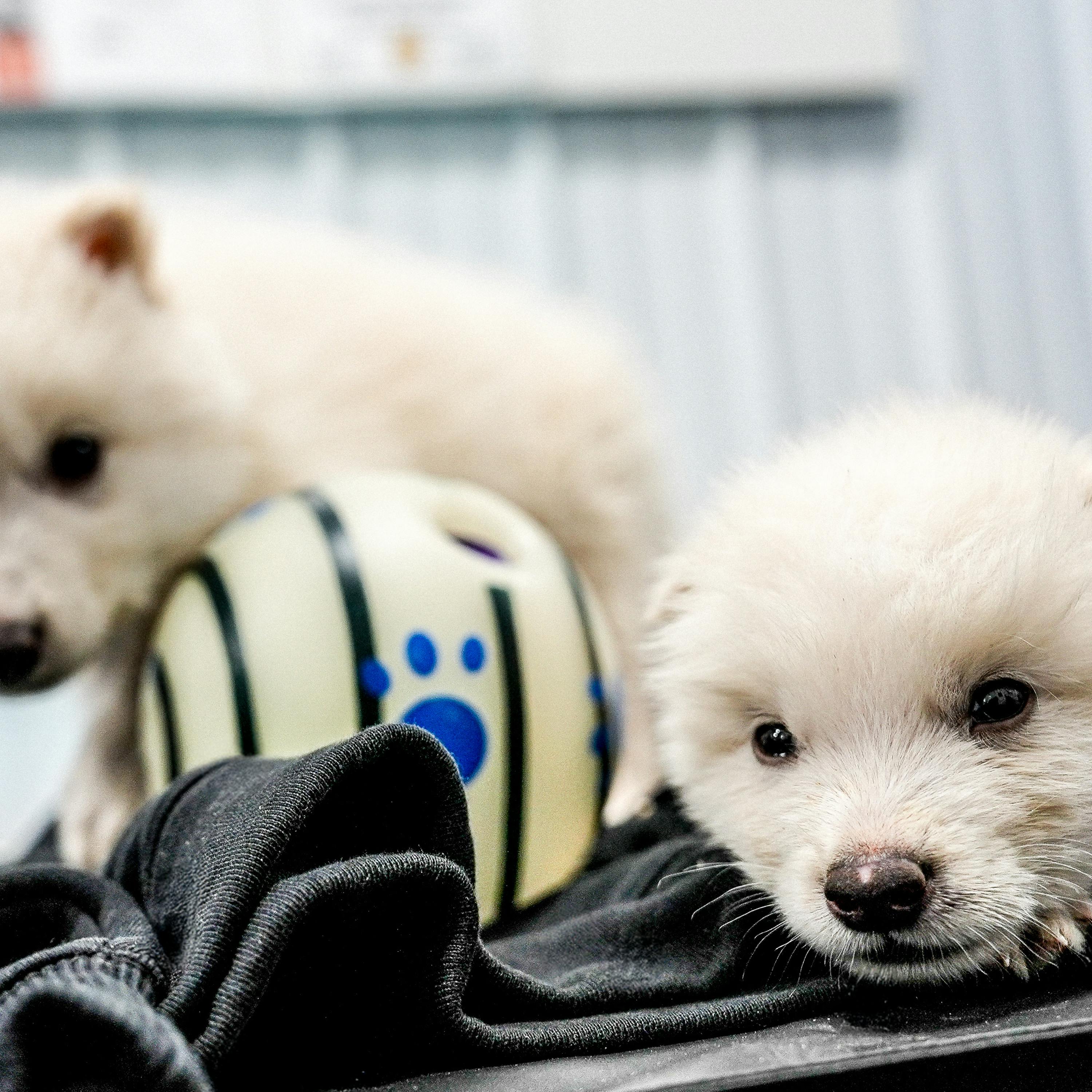
Today, Explained
The startup that cried dire wolf
00:28:00
Colossal says it's brought the dire wolf back from extinction — but the accuracy of that claim and the ethics of de-extinction are in question.
Loading summary
Transcript64 lines
- [00:04]
Host
Direwolves not just a thing from Game of Thrones, not just Jon Snow's best friend. Dire wolves walked the Americas for millennia up until about 14,000 years ago when maybe their primary food source dried up or humans hunted them to extinction. No one was taking notes. But we know they were a bit bigger than gray wolves. They ate a lot of meat and their bite could crush bones. And now we know that apparently Dire WOL back, a startup called Colossal says they've brought these pups back from extinction. They say they've got three of them. But are these dire wolves they brought back actually dire wolves? And whether they are or aren't, should we be trying to bring dire wolves back? Like why we are going to ask on Today Explained.
- [00:59]
Sponsor Voice
Support for this show comes from Sophos. With Sophos, no matter your business's size, you get enterprise grade cybersecurity technology and real world expertise. Always in sync, always in your corner. Sophos native AI technologies evolve with every threat and their experts are ready 24 7, 365 with their managed detection and response services to stop threats before they strike. And you can manage all your security alerts, configurations and other security products through the Sophos central platform. Don't sacrifice your peace of mind to grow your business. Learn more@sophos.com Ryan Reynolds here from Mint Mobile with a message for everyone Paying big wireless way too much. Please, for the love of everything good in this world, stop with Mint. You can get premium wireless for just $15 a month. Of course if you enjoy overpaying. No judgments. But that's weird. Okay, one judgment. Anyway, give it a try@mintmobile.com Switch upfront.
- [02:01]
Advertiser Voice
Payment of $45 for 3 month plan equivalent to $15 per month required intro rate first 3 months only, then full price plan options available, taxes and fees extra. See full terms@mintmobile.com this is today explained.
- [02:20]
Host
Not a lot of people have seen these dire wolves that have come back from extinction up close and personal. Like DT Max from the New Yorker is one of the few who has.
- [02:30]
DT Max
Okay, so first of all we just gotta get this out there. We either have to put dire wolves in quotes or we have to give them a name. Like, I don't know, we could do anything.
- [02:39]
Host
Like how about diet Direwolves?
- [02:42]
DT Max
Yes, exactly. These so called direwolves were created by extracting DNA from a 72,000 year old Direwolf inner ear bone and a 13,000 year old Dire wolf tooth.
- [02:54]
Sponsor Voice
They determine its closest living relative is the gray wolf.
- [02:57]
Host
So then they made 20 edits to.
- [02:59]
DT Max
Gray wolf DNA to include those dire wolf specific genes.
- [03:03]
Advertiser Voice
That animal looks like a dire wolf, it will behave like a dire wolf, and it is a dire wolf. This is insane. Actually, these are not dire wolves by any definition.
- [03:16]
DT Max
But the other point is it doesn't really matter when you're seeing them because, you know, you're seeing something, you know, that's absolutely amazing. I mean, you're seeing something that Lily. So these two bright white wolves, I did not see them where they live. I saw them where they were brought to be seen, which was far, far away.
- [03:34]
Host
And you can't tell us where that was, but it's somewhere in the northern United States. I've read.
- [03:39]
DT Max
Yeah, look, I do hold bigger secrets as a journalist, but I'm not supposed to tell you where. But so what happens? Okay, so there. So first of all, I see a couple of people I know from the reporting on the piece. I see George Church, who looks as much like Gandalf as any human being on this planet who holds tenure. And I also see Ben Lamb, the guy who founded the project. Looks a lot like it's John Lee Snow. Right. The point is, like, it's a perfect setup. And then there are these two bright white teenage wolves. So, you know, even any wolf is impressive. So it's not. I mean, I have actually seen wolves before for another article, strangely enough. So a wolf carries its own weird kind of authority with it. But these, they do look different. And again, I'm not an animal morphologist, so, you know, I've been told pale, but they're white. And they're. They're like celebrities. I mean, there's no other way, you know, there's no other way to describe it that they're. They're delightfully, blissfully heedless of how much, like, money and effort has gone into the creation of them. They're basically, you know, they're in this enclosure. They doing little things wolves do and dogs sometimes do. One pees the other roles in it. But, you know, they're majestic. They are going about their quasi meta direwolf existence. Blissful disregard for any controversy about what you want to call them or blissful disregard of whether they should have been brought back in the first place.
- [05:12]
Host
Tell us more about this company that brought back the diet direwolf version that you saw.
- [05:19]
DT Max
It's called We could do this All Day.
- [05:22]
Host
It's called Colossal. It's run by a dude named Ben Lam. Who is he? What is he trying to do here?
- [05:28]
DT Max
So, I mean, Ben Lamb is kind of amazing. I am pretty much in awe of Ben Lamb. Here's a guy who's maybe 40 something. He's already had like four or five successes by which he started up four or five companies, and they were bought out by larger companies, which is kind of what you want to do when you're a startup guy. And then, you know, one day he meets a guy named George Church. Church being the Gandalf of our earlier narrative, if that survives. And Church is a Harvard professor, a guy who's gotten a million patents and loves to do deep thinking. He's a big kind of what if guy. Like, what if we were to bring back the Neanderthals? And then the press goes, ah. And then George Church goes, I was just considering it. I was just thinking about it. You guys, calm down. So George Church and Ben get together and they basically, what Ben says is, if you had all the money in the world, George, what would you bring back? What would you want to do with your time? And George says, I'd bring back the woolly mammoth. Sick.
- [06:33]
Host
I mean, I don't know if it's responsible, but it sounds cool, Right?
- [06:37]
DT Max
Right, exactly. And, you know, they get together. It's like, let's put on a show. Right? And, you know, this being Ben Lamb, super talented, perfectly adapted, modern entrepreneur, and he raises money, basically. I don't know the details. I think he raises money with a phone call because he's got a great second idea. And his second idea is, while we learn how to de. Extinct these animals, we're gonna learn an awful lot of interesting biomedical tech and that we could sell. That's where we make our money. We're not gonna make our money. He's very, very firm on this. There will be no Jurassic Park. We will not display these. Let's check back in in five years. But we will spin off the biotech. And the biotech is honestly probably worth even more than what is Disney World charged now or Disneyland for now?
- [07:28]
Host
Hundreds. Hundreds.
- [07:30]
DT Max
All right, so maybe I take that back. Maybe the better business is displaying them.
- [07:35]
Host
How much money have they raised to do this? And how much is this company that they're running colossal worth at this point?
- [07:43]
DT Max
All right, so they've now raised over $400 million. And their valuation, which is a kind of complicated metric involving what shares are worth, is over $10 billion, which puts it at the size level of Moderna. They've had an insane, insane first few years.
- [08:01]
Host
And I ask you this not because, like Paris Hilton or Peter Jackson, I'm planning on investing in this company, but because I wanted to establish that people are taking these people seriously. And now that we've established that, do us a favor and tell us just how hard it is to do what this company says it wants to do.
- [08:25]
DT Max
The dire wolf, you know, is not. Let me just get this out there for everybody. The dire wolf is not. There's a difference between being extinct for 40 million years and being extinct for 14,000 years. They both sound like a long time to us, but, you know, it's just not comparable. So you can get, you can get. I can't get, you can't get. But Beth Shapiro could get viable ancient DNA. Now, what you do with that DNA is you read the genetic sequences and then you recreate them, right? And you're going to put that DNA in the cells, and the cells are going to replicate, and you're going to have an animal. Ultimately, once you put in an embryo and then implanted in a womb, you're going to have an animal that has those genes being acted on. That makes it sound like you or I could probably do it with just a little bit of help. But it's not that easy because there are problems, you know, at every step of the way. And it's a little bit like if I describe to you how to hit a home run, you'd be like, yeah, okay, there's the force and there's the counterforce and there's the angle of the swing. But most people don't hit home runs.
- [09:36]
Host
You mentioned someone named Beth Shapiro, who's now, I think, one of the leading scientists over at Colossal, and someone like Beth Shapiro comes from, I believe, UC Santa Cruz out in California, where she was doing versions of this kind of work, if not trying to, you know, revive the woolly mammoth. Can Colossal work faster than your, I don't know, typical elite university lab?
- [10:07]
DT Max
Yeah, I mean, I don't think you can get that much money going at a university lab without a fair amount of grant writing. I mean, grant writing is slow, and getting funded is slow. There's a guy named Lova Dahlin, who's a Swedish woolly mammoth guy, and I think he made a really good point in my piece that nobody's really picked up on. And I think it's about the money, which he said the people who invested in this company weren't going to give, I'm paraphrasing him, $100 million to the world Wildlife Fund. Like, you know, they're tech people. They probably would have bought bitcoin with it otherwise. Like this. You know, Peter Jackson said that owning, being a part of Colossal is as much fun as movie making.
- [10:48]
Sponsor Voice
I. I could do that.
- [10:53]
DT Max
You know, I think that kind of tells you something. I don't think if they'd been doing this in Beth Shapiro's old lab at the University of California, Santa Cruz, he'd have thought it was as much fun, you know, as moviemaking. I mean, I give. I give Colossal a lot of credit, and Ben Lamb in particular, a lot of credit for meeting people where they actually are. I mean, I as. All I can say is a journalist, someone who writes about people. I have written about conservation, other times, other places. I am not opposed to the idea that if you're ever actually going to turn around this massive environmental disaster that is the present, you really got to meet people. You know, you gotta meet people where they are.
- [11:32]
Host
To bring this back to where we started DT with Romulus and Remus, these two diet dire wolves. What happens to them?
- [11:42]
DT Max
You love that.
- [11:42]
Host
I do. I'm gonna stick with it. What happens to them? Where do they go?
- [11:47]
DT Max
You know, never say never, but I think they're expected to live out their lives. I think a wolf gets the same 15 years. I think that a smaller dog gets. Live out their lives and, you know, they will not be. They will not hunt. They will be given, like. I don't know if you've ever been to a zoo and seen what they feed the. The lions and tigers. They feed them like something they would have hunted, but they didn't hunt it. Like, just oozing, bleeding, massive amounts of meat. And I think that's. That's what the direwolves are going to get. But they're. But they're not planning to breed them, which I don't entirely understand. That. Colossal talks a lot about, like, reintroducing some of their animals into the ecosystem to do environmental good. I don't think the dire wolf was conceived by them with that as a possibility. First of all, I mean, people don't want dire wolves in their backyard.
- [12:40]
Host
When you realize that these diet wolves would just die out. Did that bum you out? What did you make of that?
- [12:46]
DT Max
Yes. Yes, I did. It was a. It was absolutely. You know, there were a number of sad moments in reporting this piece. I mean, first of all, you have to kind of come to grips with the immensity of the damage that humans have done and for how long we've been doing it, because the dire wolf is essentially driven extinct mostly by human activity, you know, 14,000 years ago. But I don't know when you realize that this whole thing is kind of to show we can. Yeah, it becomes sad because wasn't isn't one of the reasons that we used to drive animals extinct because we could, because there was money in it. And isn't it kind of weird that we're now de extincting an animal, you know, kind of because we now have this, this technology that can reopen the door that we see. We thought that we had absolutely and and, you know, incontrovertibly closed before. So the whole thing leaves you a little bit blue.
- [13:54]
Host
DT Max read his profile of the Direwolves over at newyorker.com the ethics of de extinction when today explained is back.
- [14:09]
Advertiser Voice
Weight loss. It needs to be fast and sustainable. Noom GLP1 starts at just $149 and ships to your do in seven days. Take it from Clayvoisier, who lost 35 pounds on Noom.
- [14:22]
Host
It's a psychological thing, too. They're definitely teaching how to live a better, healthier lifestyle. Noom is teaching me the habits so.
- [14:29]
Sponsor Voice
I do not have to be on weight loss meds forever.
- [14:31]
Advertiser Voice
Don't believe it. Take it from Lauren, who lost 22 pounds on Noom. If I come off of the GLP1, it's not going to automatically make my weight. Yo, yo back. I'm going to have good skills and know what to do to take care of myself. $149 GLP1s. Now that's Noom Smart. The Smart way to lose weight. Get started with Noom GLP1@noom.com Real Noom users compensated to provide their story. Individual results may vary. Not all customers will medically qualify for prescription medications. Compounded medications are not reviewed by the FDA for safety, efficacy, or quality. Fox Creative this is advertiser content from Verizon Business.
- [15:12]
Host
Hey, Vinny, you know, the draft isn't the only thing happening this April. Yep, Verizon small business days are back. Now through the 27th, it's the perfect time to level up your business with the latest tech.
- [15:23]
Advertiser Voice
They've got experts ready to give you.
- [15:25]
Host
Personalized advice and some great deals just for you and your business. So if you've got a small business, you need to get in on Verizon small business days.
- [15:33]
DT Max
And the best part, the experts are right in your neighborhood, ready to help.
- [15:37]
Host
Whenever you need them. Because just like in the draft, having the right team makes all the difference.
- [15:42]
DT Max
Exactly.
- [15:43]
Host
So don't miss out on this.
- [15:44]
DT Max
Book your appointment today.
- [15:46]
Advertiser Voice
Verizon small business days are happening now through April 27th. Call 1-800-483-4428 or visit verizon.comsmallbusiness for more info. What are you waiting for? Kabza here how does someone go from reality TV fame to prison to multi millionaire business owner? This week on Net Worth Chill. I'm talking to Mike the Situation Sorrentino, who skyrocketed to fame on Jersey Shore, earning millions before it all came crashing down. Tax evasion, prison time, addiction battles. Mike is rebuilding his wealth with purpose and helping the people and communities that lifted him up during his darkest days. I believe that you are the writer, director and producer of your life and if you want a better outcome, then you need to make it. So listen wherever you get your podcast or watch on YouTube.com YourRichBFF.
- [16:55]
Sponsor Voice
You'Re listening to TODAY Explained. I'm Robert Klitzman. I'm a professor of psychiatry and director of the online and in person Master's of Bioethics programs at Columbia University and the author of Designing Babies How Technology Is Changing the Ways We Create Children.
- [17:15]
Host
And when we look at these diet dire wolves in the northern United States somewhere by way of colossal, do we feel more good or bad?
- [17:24]
Sponsor Voice
I think there is a lot of excitement. It's definitely cool to bring back extinct species, but there's a lot of questions we have about where these animals will live, what their lives will be like, why we're doing this, what the long term view or vision is. And a lot of that depends on how the technology is then used and what happens.
- [17:45]
Host
Well, let's talk about to start with, what do you think of the ethics of the process by which these dire wolves have come to be? Obviously, let's just think about whatever animal it was that birthed these dire wolves. Not a dire wolf, I assume.
- [18:01]
Sponsor Voice
Right. So there's a few issues that come up. One is where making a bunch of dogs pregnant to produce them. And I have concerns about the dire wolves. But more importantly, the company has said that its longer term plan is to produce or reproduce or to create a woolly mammoth. And with that, there are even bigger concerns because that you'd have to take elephants, you'd have to get many elephants, female elephants, anesthesize them. You'd have to stick probes up their vagina to extract eggs. You'd have to then get many elephants pregnant. Hopefully some will not miscarry, some will miscarry. Then you'll have to do C sections on the elephants to get the woolly mammoths out. So that's going to be very cumbersome, and it's going to hurt a lot of elephants. So dire wolves, we have three of them that were created, and I should say they're not really dire wolves, they're gray wolves that have had about 15 of their genes change. So of 80 potential genes that could be changed, they've changed 15. And when we're mucking around with nature and changing genes, mistakes get made. Genes have multiple functions that we don't always know about. So for instance, five of the genes at Colossal was going to change because they were in dire wolves, but not in gray wolves. The researchers decided not to change because these genes would create deafness and blindness in the dire wolf. So we don't always know when we're altering genes what the effects are going to be. Genes have multiple effects. About five years ago, Dr. He Jiankui in China genetically engineered three children. He took the embryos and he wanted to disable a gene called the CCR5 gene to prevent HIV from getting in the cells because he was going to work with HIV positive father. But in disabling that gene, other viruses are more likely to enter the cell. So West Nile virus is more likely to enter the cell. So you may disable a gene because you want one thing or put a mutation in or change a gene because you want one thing, but other things may happen. So these wolves may end up having other kinds of medical problems. These are big animals. They're 150 pounds. Colossal has them on about three square miles, whereas normally they usually live in areas between 50 and 1,000 square miles. So we're keeping them at a very constricted space. They're at risk of other diseases. So I'm concerned about their welfare.
- [20:39]
Host
So it sounds like you have a host of concerns. And throughout listening to you describe many of them, I hear the potential for death lurking at every corner. Which is, I guess an irony of this process known as de extinction, is that it sounds like you sure gotta kill a lot of animals to get to the point of bringing back an animal that, as we heard from Dt earlier, might end up simply just dying off again, which I guess gets to the point of cruelty. Where is the regulation when it comes to this process of de extinction?
- [21:22]
Sponsor Voice
Well, there are no regulations and that that could create problems. So there have been guidelines that were developed before we actually had any extinct animals to look at. There was one animal, a goat, in the Pyrenees, the mountains between Spain and France, that was brought back and lived for 10 minutes. So the guidelines we have aren't very Good. And we don't really have any. We have no government regulations on this. And in fact, the Trump's. President Trump's Secretary of the Interior, Doug Borgum, came out the other day and said it's great that Colossus is doing this, because now we don't have to worry about driving other animals into extinction.
- [22:03]
DT Max
If we're going to be in anguish about, about, about losing a species. And now we have an opportunity to bring them back. I mean, pick your favorite species and call up Colossal. And instead of, you know, raising money to get animals on the endangered species, let's figure out a way to get them off. And this is one tool in creating biodiversity, what it can do for everybody.
- [22:22]
Sponsor Voice
Let him go. We don't need regulations, was his point. To protect animals, we can just. Any animal that disappears, we'll just clone it back. And I think a lot of the company, colossal, is worth $10 billion. It'd be great if we can help animals that are on the verge of extinction and help them survive, given that we are losing, as Colossal says, we're losing a lot of animals every year and we will be losing more partly due to climate change. Let's work on protecting those animals that are still here and have a place to live.
- [22:54]
Host
We've talked about a lot of the risks here, a lot of the drawbacks. I want to talk about some of the potential benefits. Do you see some good there? If we do indeed get some medical or scientific breakthroughs out of this company's work? I mean, there's been talk of rebalancing habitats, fixing mutations and endangered pink pigeons, vaccinating elephants against herpes, sharpening our tools for fighting diseases. There's apparently some potential there.
- [23:25]
Sponsor Voice
So unfortunately, at the moment, President Trump has been cutting back hugely on research at nih, and the National Institutes of Health has funded immense amounts of research that have led to immense human benefit, partly because it's been available for, in the public domain. Research is published, which this company hasn't published many of its key findings. So you could argue that there is a greater need to a focus public dollars on this, on research which are now being drastically cut back. And secondly, a question is whether or not the prime aim here is to help nature help endangered species or to make money. Right. And if I think, as DT wrote in his piece, the company only plans to create maybe three or five dire wolves, what's the point? Is it to develop science that they can then sell, or is it to create these animals which create huge publicity? And this has been the Front cover of Time magazine. It's been on every major news network, it's been in every major newspaper. They're trying, as I understand, to raise more money. So this gives them great profile. We're going to bring back these five animals, but is it to help nature or is it to raise more money? And this is sort of the poster child for them, the woolly mammoth too, which is your long range goal. They say, well, it could lead to meat and fur and tusks and they may decrease global warming by tamping down permafrost. Well, there's decreasing amounts of tundra, icy tundra for them to live, to have an industry of mammoth fur and meat, you need a lot of these animals and we don't have the space for them. Maybe Russian Siberia somewhere does. Good luck with that. The Russians aren't exactly our best buddies at the moment. And even if these animals do, wherever they walk, press down snow, the snow's going to melt further because of climate change. So you're not getting at the source of climate change. So I'm not sure how much the end result is going to be actually helping animals versus making money.
- [25:38]
Host
Dr. Klitzman, I thought of one silver lining in all of this. If what you're saying is true, someone still cares about being on the COVID of Time magazine.
- [25:47]
Sponsor Voice
You mean that we still have magazines? And I should say, I realize I'm coming across as very negative. I don't mean to come across as negative. I think that science is very important. I think given decreasing amounts of money for science it would be great as we as a society could spend it where it's going to lead to the most bang for the buck. We're at the cusp of for instance, new vaccines, all kinds of new vaccine research that NIH was about to start is now ending. I think that near term or low hanging fruit is there that we can invest in that will be able to help millions of people.
- [26:36]
Host
Dr. Robert Klitzman, Columbia University. Dr. Devin Schwartz made our show today. He was edited by Jolie Myers, fact checked by Laura Bullard and mixed by Andrea Christin's daughter and Patrick Boyd. My name's Sean Ramisvirum. The show is today explained.