← Today, Explained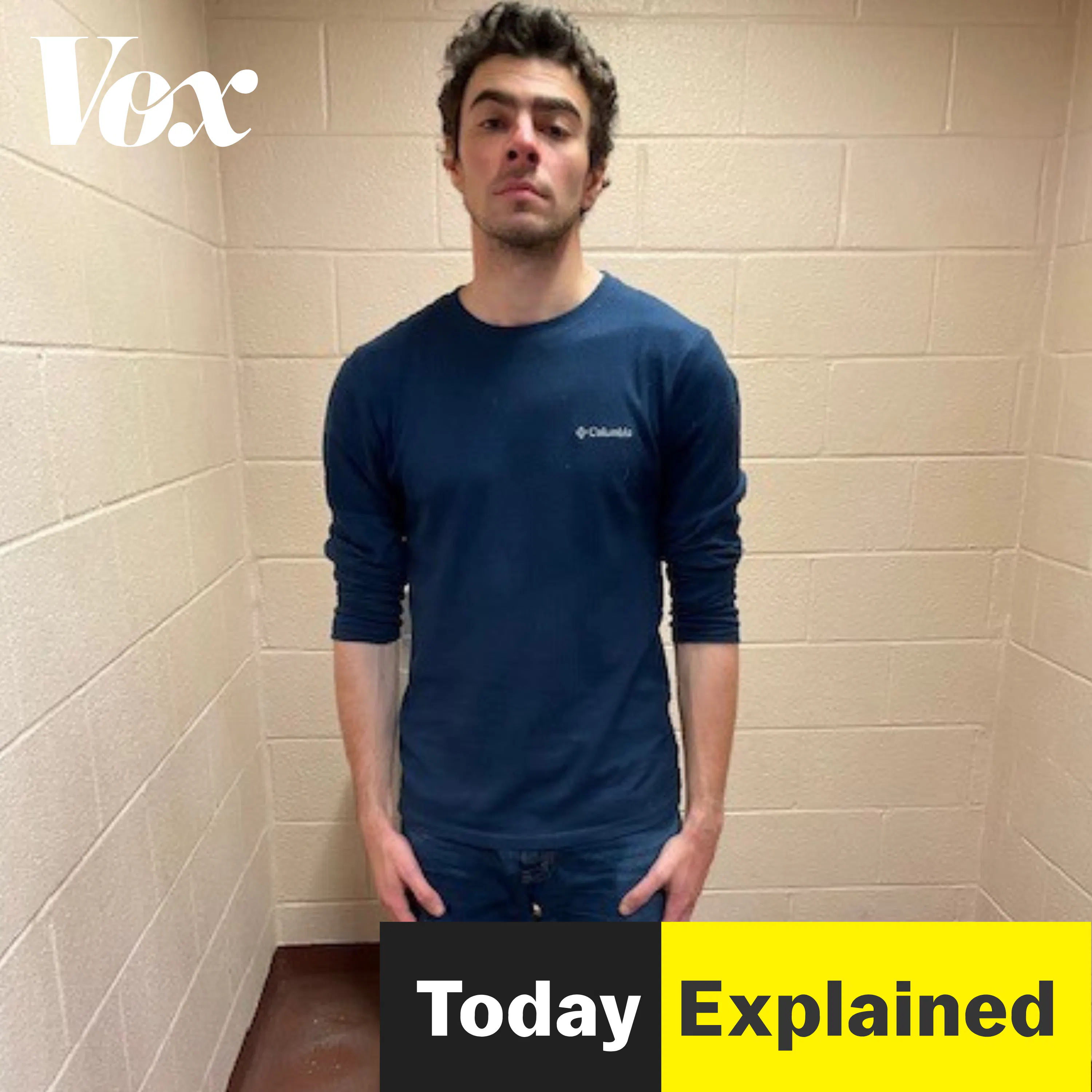
Today, Explained
The UnitedHealth CEO shooting
00:27:24
Gothamist’s Brittany Kriegstein explains who police just arrested. STAT News’s Bob Herman explains the anger resonating against UnitedHealthcare.
Loading summary
Transcript55 lines
- [00:01]
Sean Romesfer
On Wednesday of last week, a man was shot in the United States. But this was not your average shooting. Almost immediately people were celebrating his death. And not just the people you'd expect. There were moms on Facebook making jokes about it. There were several of those horny copypasta text messages circulating around. There was a United Healthcare shooter lookalike contest over the weekend in Manhattan. At least one person got a tattoo of the suspect. On Monday, Luigi Mangione got arrested. And then things really got nuts. He went from a few dozen Twitter followers to 300,000 overnight. People are thirsting for his six pack. Luigi Mangione is brat the McDonald's where he was arrested has been review bombed. People are saying there are rats behind the counter. People are saying Popeyes employees would have helped him get rid of the gun. Someone's got some explaining to do and it's us. It's today, explained.
- [01:02]
Claire White
Amazon Q Business is the Generative AI Assistant from aws because business can be slow, like wading through the mud. But Amazon Q helps streamline work so tasks like summarizing monthly results can be done in no time. Learn what Amazon Q Business can do for you@aws.com learnmore that's aws.com learnmore.
- [01:30]
Bob Herman
Support.
- [01:30]
Brittany Krigstein
For the show comes from Alex Partners in business, disruption brings not only challenges but opportunities at pivotal moments of change. Alex Partners is the consulting firm chief executives can rely on. With clarity, direction and above all, implementation. Alex Partners can be a steady hand for your business when decisive leadership is vital. You can discover insights and learn how to convert digital disruption into revenue growth by reading Alex Partners latest technology industry Insights available at www.alexpartners.com Vox that's www.alixpartners.com Vox in the face of disruption, businesses trust Alex Partners to get straight to the point and deliver results when it really matters.
- [02:23]
Sean Romesfer
Today, explained Sean Romesfer. I'm here with Brittany Krigstein from Gotham at WNYC in New York. She's been covering the shooting since pretty.
- [02:32]
Brittany Krigstein
Much the second it happened, from the second it happened. The second we got a notification about somebody being shot in Midtown. Of course we were on high alert because I cover gun violence consistently across the entire city. People don't often get shot in Midtown. The precinct where this happened has not had a shooting at all this year.
- [02:53]
Sean Romesfer
We pretty quickly got video footage of the shooting of this execution. What did that video footage reveal?
- [03:02]
Brittany Krigstein
So the video basically shows a masked man in a hoodie. Really hard to make out who it could be, who just very Calmly waits and then fires several shots within close range of. Now we know as Brian Thompson, who sort of appears in the video startled, he. He stumbles away. He was hit, officials said, in the calf and also in the back. And so he did have a second to sort of turn around and face a shooter who calmly seemed to clear a jam in his gun and continue firing. There was a bystander right there when it all happened who ran away, but the shooter wasn't interested in that person. They were going for Thompson. The shooter escaped through a nearby alleyway. Again, this is Midtown Manhattan, but at 6:45 in the morning, there weren't too many people around. He runs through this alleyway, according to officials. He then jumps on a. On an E bike and starts pedaling north to Central Park. And that's basically the last place he was seen for some time. We know he ditched his backpack there, which officials later found, and found that it only contained some Monopoly money. And then he apparently jumped in a taxi. He was caught on surveillance video heading uptown even further to the Port Authority bus station on 179th street and Broadway. And officials basically lost track of him after that. From what we know of the investigation.
- [04:38]
Sean Romesfer
And we saw footage of, you know, the NYPD searching Central park, and people didn't seem very impressed with that footage. A lot of people were mocking the NYPD over the weekend, guys.
- [04:50]
Brittany Krigstein
I have not stopped laughing all morning about the backpack in Central Park. He left it for them to find on purpose. And they're so bad at their jobs that it still took them days to find it. All right, look, it's been five days. You guys really don't have anything. We've tried it all, sir. We even put our Patagonias on in Central park and put our hands through the bushes a little bit.
- [05:10]
Sean Romesfer
Was anything holding this search up?
- [05:13]
Brittany Krigstein
Well, it's really hard to say, obviously, with the vastness of Manhattan and the feeling that this person could have gone anywhere, not just Manhattan, in all of New York City. Now, as somebody who covers gun violence day in and day out in New York City, I can confirm that it usually does take a couple days to find people, even when the cases are pretty cut and dry, even when police say that they know exactly who they're looking for. So I know that there's a very high threshold of evidence that the DAs need in order to bring charges and the police need in order to request search warrants and things like that. Surveillance video canvassing takes a long time. This person obviously did as well as he could to shield himself, hide his face. We have that one picture of him smiling in the hostel. That really sort of seemed to accelerate the investigation because it was a really good picture of his face. But other than that, police didn't have a ton to go on. Of course, DNA evidence takes a long time. They say he discarded a cup at Starbucks. These things all take time, so it's hard to say. But of course, given the gravity of this case, it does feel surprising that it took so long to find him and that the NYPD wasn't involved actually in catching him. When it came down to it, this was just a bystander, a local person, an employee at a McDonald's in Pennsylvania.
- [06:47]
Sean Romesfer
Yeah. Tell us about what happened there. How was the shooter finally caught?
- [06:52]
Brittany Krigstein
Earlier this morning in Altoona, Pennsylvania, members of the Altoona Police Department arrested Luigi Mangione, a 26 year old male on firearms charges. So apparently he was sitting and eating at this McDonald's in Altoona, Pennsylvania. That's about 230 some odd miles away from New York City. And he was there typing away on a laptop, wearing a beanie and a medical mask. And an employee recognized him based on the photos that police had circulated now, photos that seemingly have gone around the country and back again. And this person called the local authorities who came. Responding officers questioned the suspect who was acting suspiciously and was carrying multiple fraudulent IDs as well as a US passport. When they asked him about whether he'd been in New York City, he actually went silent and started shaking, according to court documents. And that was pretty significant to them that, you know, he had something to hide. They took him in for questioning. They found a 3D printed ghost gun which was consistent with the gun that was used to shoot Thompson. Additionally, officers recovered a handwritten document that speaks to both his motivation and mindset.
- [08:07]
Sean Romesfer
What do we know about a possible motive here, Brittany?
- [08:11]
Brittany Krigstein
There is a lot to pull from. Obviously, with the, with the amount of attention this case has generated, the social media spheres are just exploding with different kinds of theories. One interesting thing about Mangione is that he did have pretty open and exposed social media accounts. In a lot of the cases where you have somebody who plans to do something like this, they lock down their social media. They don't want anybody knowing anything about their lives. He almost seems to have been in the opposite mentality. There are photos he posted of an X ray of what appears to be his own back with some pretty serious looking pins in it. And it's been reported by several outlets in talking to his family members and old friends that he had a pretty serious back surgery maybe a few months ago. And after that sort of fell off the face of the earth, people say it drove him crazy. We don't exactly know what his interaction was with United Healthcare at time. We don't know exactly what was written in that manifesto besides ill will towards corporate America. That's what police have shared with us so far. So again, there's just a lot of speculation going on, but he comes from a very well connected family in Maryland. He went to a really good prep school. He graduated the University of Pennsylvania. He was high school valedictorian. So I think people at this time are really struggling to see the connection between his upbring and then whatever drove him to allegedly plan this attack.
- [09:53]
Sean Romesfer
What's Luigi Mangione been charged with?
- [09:57]
Brittany Krigstein
So in Pennsylvania, he's been charged with gun possession. And in New York, charges dropped late Monday night from the Manhattan DA's office charging him with murder in the second degree, which is basically just murder with intent to kill somebody. Three counts of gun possession and also possession of a forged instrument, which could relate to those fake IDs. And he will be extradited at some point. It's hard to say exactly when. That all depends if the judge in Pennsylvania decides to waive an extradition hearing or not. But that could happen within the next couple days.
- [10:33]
Sean Romesfer
In the days before this killer was caught, there were corners of this country where he was a folk hero fighting for the poor, the disadvantaged against this healthcare behemoth. But then they catch this guy and it turns out he's like this Ivy League, you know, scion from Maryland who's got like all sorts of money and means. Does that sort of flip the narrative a little bit?
- [11:04]
Brittany Krigstein
I think it could. People are just trying to digest, like I said, what was that connection? Why did he jump from this upbringing? Maybe it would make more sense if he, you know, was poor and disadvantaged and was struggling to afford basic, basic medical care for his family. But it just doesn't seem like that was necessarily the case given his upbringing, given his education. I will just say I cover murders for a living. I have never seen, and I've covered murders of people who are very unpopular. I have never seen such glorification of somebody who has allegedly committed a violent act against somebody else. I just have not seen anything like this. And it's really been eye opening. Jokes aside, memes aside, people have been sharing their own struggles with health insurance and deep struggles, surgeries, illnesses, and they're using this incident as a platform to really express a lot of those pent up feelings. And that has been a real moment of reckoning, I think across the country about the systems that we have here for taking care of ourselves and each other. And it just goes to show that no matter what social status you're from, somebody with money, with means, with education had a real serious problem seemingly with health insurance. So in that sense it's been a strange uniting force. Whether or not you agree with a lot of the things being said, it's just been a real reckoning with the health insurance system and people are hoping something will change.
- [13:02]
Sean Romesfer
Brittany Krigstein covers crime for gothamist and wnycgothemist.com when we're back on Today Explained, we're going to talk about UnitedHealth Care and why so many people hate them.
- [13:32]
Claire White
Support for Today Explained comes from Quince for that special feeling when you give someone a gift that they wouldn't necessarily get for themselves and they love it. Quince this holiday season, Quince wants to help you treat your loved ones to everyday luxury at affordable prices. Quince says they're known for Mongolian cashmere sweaters from just $50 and all other quince items are priced 50 to 80% less than similar brands and you can find year round gifts 14 carat jewelry, Italian leather handbags, European linen sheet sets too. Plus Quint says they only work with factories that use safe, ethical and responsible manufacturing practices. Claire White works at Vox. Here's what she thinks about Quince.
- [14:12]
Bob Herman
The Mongolian cashmere sweater I received from.
- [14:14]
Brittany Krigstein
Quince feels like it will be a piece that will be in my closet forever.
- [14:20]
Bob Herman
The quality is amazing, the texture is.
- [14:22]
Brittany Krigstein
Great, it's not itchy or scratchy, and it's the perfect weight of a sweater.
- [14:28]
Claire White
You can give the gift of luxury this holiday season without the luxury price tag. Go to quince.com explain for 365 day returns plus free shipping on your order. That's Q u n c e.com explain to get free shipping and 365 day returns, Quince.com explained.
- [14:48]
Support for this show comes from DraftKings Golden Nugget online Casino invites you to turn the cold gold transform your winter moments into winning ones with all your favorite slots like Icy Wilds and more, plus other casino games. And now you can enjoy the special seasonal rewards all winter long. Whether you're spinning reels or doubling down, make this a season to celebrate new players can use code todayexplained and have your first deposit matched up to $1,000 in casino bonus funds. Just opt in and make a minimum deposit of just 5 or more today on Golden Nugget Online Casino and complete the playthrough requirement.
- [15:23]
Sean Romesfer
Gambling problem.
- [15:24]
Claire White
Call 1-800- GAMBLER please play responsibly. 21 and over physically present in Michigan, New Jersey, Pennsylvania and West Virginia. Only Boyd in Ontario one per new customer receive deposit match on first deposit after opt in up to $1,000 in non withdrawable casino bonus funds that require 10 time playthrough at different contribution rates on select games terms@goldennuggetcasino.com welcome.
- [15:49]
Sean Romesfer
Support for Today Explained comes from Found. You've met Lost Now Found. There is a lot that goes into running your own business, especially the finances. You have to keep track of your business, bank account, your expense tracking, invoicing, contractor payments, tax planning. I'll stop there, but they tell me the list keeps going. The last thing you want is to have to toggle between a bunch of separate apps and services to stay on top of it all. I can relate to that. I'm toggling all day. That's where Found wants to help. Found is business banking designed for small business owners just like you. Found lets you manage your financial tasks effortlessly. And here's the key part. All in one easy to use app. You can try Found for free@found.com explained. You can sign up for Found for free today at fou. Found is a financial technology company, not a bank. Banking services are provided by Piermont bank member fdic. Found's core features are free. They also offer an optional paid product, Found Plus.
- [17:05]
Claire White
You're listening to Today Explained.
- [17:08]
Bob Herman
My name is Bob Herman. I'm a reporter at StatNews. I cover the business of healthcare. So hospitals, health insurance, all types of providers, anything where the money flows in healthcare.
- [17:19]
Sean Romesfer
We reached out to Bob because Bob knows UnitedHealthcare.
- [17:23]
Bob Herman
UnitedHealthcare is just one part of this massive company called UnitedHealth Group. And we've had a whole series this year called Healthcare's Colossus that's looked at this massive company, kind of how it has its tentacles everywhere. A lot of people recognize it for UnitedHealthcare, this insurance company. It's just, you know, everyone hates an insurance company, but people don't recognize all the other components that it owns. It owns a ton of medical practices. It either employs or is affiliated with 1 out of every 10 doctors in the country. And I don't think everybody fully recognizes just how large and involved this company is outside of health insurance. It is not just a health insurance company. That's what it's most known for. That's why it's often reviled. But it is everywhere else. And I think people need to recognize, especially on the medical group side, the physician side, they play a major role there.
- [18:24]
Sean Romesfer
Almost immediately, people were celebrating this homicide. What was your reaction to that?
- [18:32]
Bob Herman
Yeah, the reactions were pretty morbid, pretty grim. You know, the dancing on the. On the death of somebody was just pretty vile. But anyone who covers healthcare knows that people are fed up with the system. This is not new. This has been going on for decades. Even when the Affordable Care act or Obamacare came into play 15 years ago, people still hated the system, and it's just persisted since then. So people's frustrations have been bubbling under the surface for so long. So to say you were surprised by all of the reactions then, I think maybe you had your head buried in the sand a little bit.
- [19:14]
Sean Romesfer
We asked you here, Bob, to better understand why people would be so mad at United Healthcare specifically. So before we talk about what this company does, that that might upset people, can you just tell us about the company generally?
- [19:30]
Bob Herman
So UnitedHealthcare is the largest health insurance company in America. They cover more people than anyone. That includes Medicare Advantage, Medicaid, Obamacare, and all the different types of employer plans out there. And there's a lot which I imagine.
- [19:46]
Sean Romesfer
Makes them pretty powerful in this market.
- [19:49]
Bob Herman
Yeah. Now, a lot of healthcare dynamics are local. You know, the fights that often occur between health insurers and providers like hospitals and doctors. It's all about who has market share in a specific area. So United might not always have the biggest market share in a given area, but nationally, they are very powerful. They are very profitable. There's no way getting around them in pretty much any market. They exist almost everywhere in some capacity.
- [20:17]
Sean Romesfer
And what do they do with that power? How do they throw it around?
- [20:20]
Bob Herman
If you have a United Healthcare plan, you want them to negotiate better rates for you. That's their primary function. And so they use some of that heft to try and drive better deals with hospitals and doctors and other types of facilities. They're also an insurance company, and they happen to deny or delay claims as well as an insurance company. The easiest way to make money is to make sure you're paying out fewer dollars. Now, there are laws in place, especially a federal law, that says, you know, you have to spend a certain amount of your premium dollars on care for people. You just have to do it. But insurers have an incentive to stay as close to those thresholds as possible. They don't want to have to pay out more than they absolutely have to.
- [21:10]
Sean Romesfer
You just, of course, used one of the operative words in this story, because as we found out, the shooter had inscribed three words on his bullets. Deny and then also defend and depose. Is this company known for its denials?
- [21:26]
Bob Herman
I think every health insurance company out there is known for their denials to some degree. Specific rates of denials are tough to come by, but insurers, especially the for profit ones that sell on the stock market, they have an incentive to deny care. You know, there have been so many issues with denials over the years. And my colleague Casey Ross and I reported on a big one within Medicare Advantage, and that's the program for older adults. And United Healthcare is the biggest in Medicare Advantage. And they, over the past several years, they've been using algorithmic prediction, predictive tools, and artificial intelligence to basically ramp up denials, specifically in post acute care. And that's the care that somebody gets when they leave the hospital. So especially on that side of the coin, post acute care denials have been a very big issue for United.
- [22:19]
Sean Romesfer
What exactly does that mean, Bob? That they're using algorithms and AI to deny Medicare Advantage. How do they do that?
- [22:27]
Bob Herman
Yeah, so let's say someone goes to the hospital, and then the hospital says, okay, you know, you're ready for physical therapy, occupational therapy, speech therapy, let's send you to a rehab facility, a nursing home. So a person will go there and they'll start their physical therapy. And behind the scenes, UnitedHealthcare has used a tool called Navi Health. And there's an algorithm within the company that basically looks at the patient's demographics, how sick they are, their history, and tries to come up with some kind of prediction of how much time they'll need in that nursing home. Let's say it's 16 days. That's what the algorithm says. After 16 days, you should be good. Now, if it's used as a guide, that's fine, but in many cases, I mean, we found documents that said that United told their case managers, you have to stick to the algorithm. And that's where it becomes a problem. Because if you're saying this algorithm spits out 16 days for somebody and they're not ready to go home on the 16th day if they can't even go to the bathroom themselves, if they still can't walk around, but the algorithm says, time to ship them out, that's where it's a problem, and that's what's happened. And then families are left with a decision of do I pay out of pocket to stay at this nursing home to get the care that my mom or dad or grandparent needs, or do I take them home with me and then risk having them fall or get hurt again and have to go back to the hospital or worse? So that's. That's how the algorithms play in those types of situations.
- [24:03]
Sean Romesfer
And people know this is happening and they're mad about it.
- [24:06]
Bob Herman
On the Medicare Advantage side, most people actually don't. They're not aware as much on this because the algorithm happens behind the scenes. It's not like families are getting a sheet of paper saying, hey, our algorithm says, you have this much time here. They really don't find out about this until the nursing home says, hey, your insurance is up and we have to kick you out. Now, the denials are very front and center in other insurance plans where they say, like, oh, I need this back surgery or I need this prescription. And then United will come along with maybe a prior authorization which just says, hey, Doctor, fill out more paperwork to make sure that this person needs this procedure or needs this drug. And then maybe they'll come back with a denial then that says, you're not, like, we're not going to cover this procedure or this prescription drug. That's where it's most front and center for people. That's where I think a lot of the outrage comes from. There's just those widespread kind of delays and denials there. And anyone can appeal any denial, but it is such an arduous process. If you're sick or injured, that's not something you want to be doing. And you might not have family to help you out either. So it is very clearly a problem.
- [25:20]
Sean Romesfer
And is this like a United Healthcare problem or is this a systemic problem? It feels like a systemic problem. So does United Healthcare get an inordinate amount of heat just because it's the biggest or.
- [25:38]
Bob Herman
Yeah, I think that's right. This is systemic. This is not isolated to just United Healthcare. United Healthcare gets the most criticism and heat for this because they are the largest. I mean, they're just a very common provider for any workplace plan. But, I mean, there are other large insurers. This is the, you know, very common thing. Cigna, Aetna, all the Blue Cross Blue Shield plans, Humana. This is. This is just how US Health insurance works. This is a systemic issue. This is especially for the insurance companies that they're on the stock market. They have a duty to make money for shareholders. And one of the ways that they do that is by making sure that they pay out fewer claims. It's just part of it. The most watched number in every earnings call for an insurer is called the medical loss ratio. That's a number that says this is how much money of our premiums that we spend on medical care. And lower is better if it's higher than expected. Wall street freaks out. So I think that kind of tells you a lot.
- [26:55]
Sean Romesfer
You can read Bob Herman@StatNews.com Miles Bryan and Hadi Mawagdi produced our show today with help from Peter Balan Rosen. They were edited by Matthew Collette and fact checked by Laura Bullard and mixed by Rob Byers and Patrick Patrick Boyd. This is Today Explained.
- [27:47]
Claire White
Amazon Q Business is the Generative AI Assistant from AWS because business can be slow, like wading through the mud. But Amazon Q helps streamline work so tasks like summarizing monthly results can be done in no time. Learn what Amazon Q Business can do for you@aws.com learnmore that's aws.com learnmore.
- [28:16]
Bob Herman
Support.
- [28:16]
Claire White
For this podcast comes from Stripe. Stripe is a payments and billing platform supporting millions of businesses around the world, including companies like Uber, BMW and Doordash. Stripe has helped countless startups and established companies alike reach their growth targets, make progress on their missions, and reach more customers globally. The platform offers a suite of specialized features and tools to fast track growth like Stripe Billing, which makes it easy to handle subscription based charges, invoicing and all recurring revenue management needs. You can learn how Stripe helps companies of all sizes make progress@swepe.com that's stripe.com to learn more. Stripe Make Progress.