← Today, Explained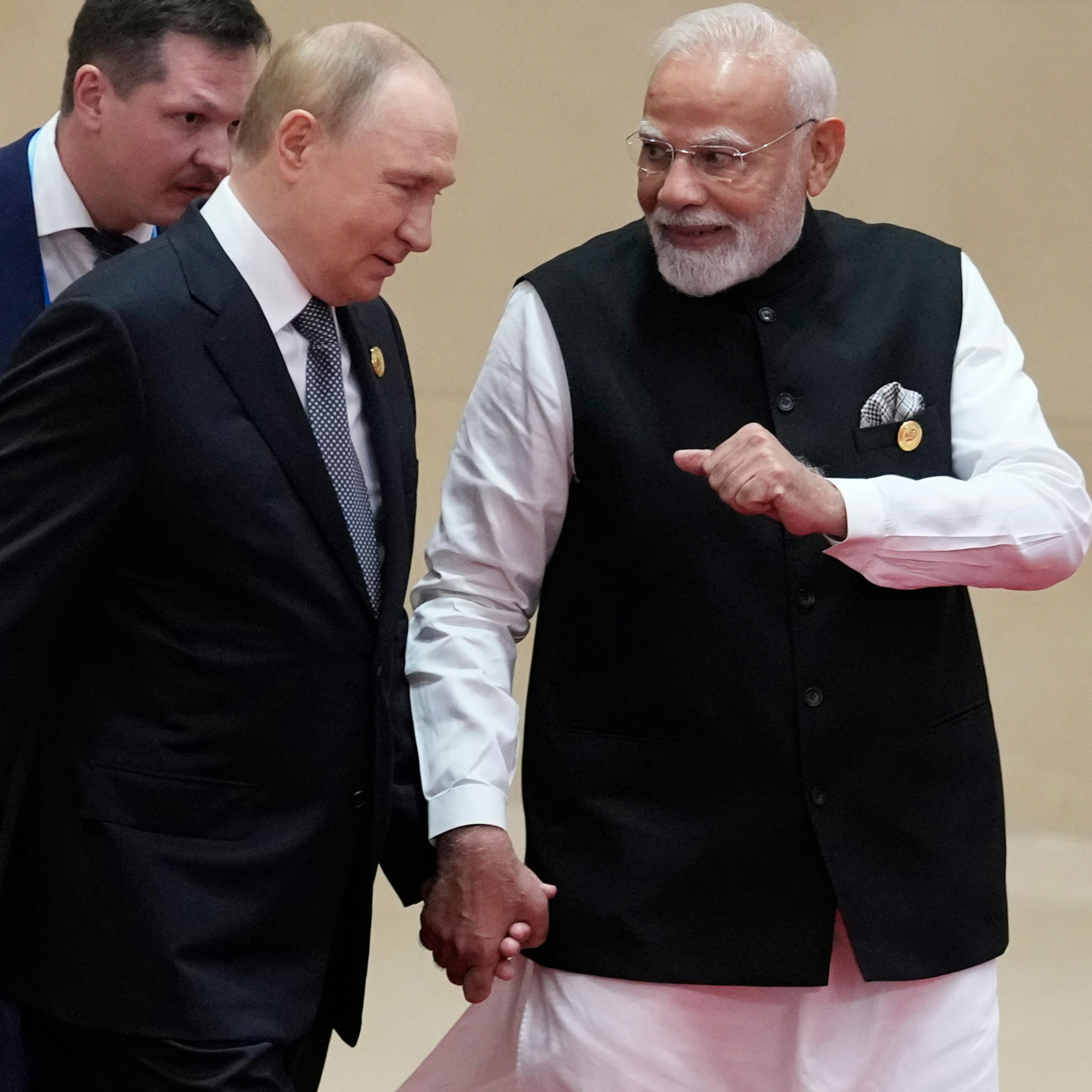
Today, Explained
Trump and Modi’s broken bromance
00:25:56
India’s prime minister was so tight with Donald Trump that they held hands during public appearances. But the two strongmen are on the outs, and Narendra Modi has found a new hand to hold.
Loading summary
Transcript105 lines
- [00:01]
Host
Just under six years ago, then President Donald Trump hosted Indian Prime Minister Narendra Modi at a big old rally in Houston.
- [00:10]
Donald Trump
Prime Minister Modi and I have come to Houston to celebrate everything that unites America and India.
- [00:16]
Host
Maybe the most memorable thing about the event, at least for me personally, was the two world leaders holding hands as they walked the rally floor.
- [00:24]
Donald Trump
Look at those hands. Are they small hands?
- [00:26]
Host
Fast forward six years. Trump's back in charge here and Modi's still in charge there. But the bromance is on the rocks.
- [00:34]
Donald Trump
I always say tariffs is the most beautiful word to me in the dictionary.
- [00:37]
Host
And Modi is hanging out with Xi Jinping and Vladimir Putin this week. And no, say it ain't so. He's holding hands with Vladimir. Holding hands at one point, Vladimir Putin and Narendra Modi were Is the President of the United States gonna be okay On Today Explained from Vox Support for.
- [01:01]
Sponsor/Advertisement Voice
Today Explained comes from the FIFA World Cup. Of all things, The FIFA World Cup 26 is coming to North America next summer. It is the ultimate celebration of sports and culture. You can get closer to the beautiful game with a hospitality package closer to the action, the best seats, the best suites, closer to match day and that world class food and that world class entertainment. Close closer to the experience of a lifetime. Book a hospitality package@fifaworldcup.com Hospitality support for.
- [01:32]
This show comes from Strawberry Me. Be honest, are you happy with your job or are you stuck in one you've outgrown or never wanted in the first place? Sure, you can probably list the reasons for staying, but are they actually just excuses for not leaving? Let a career coach from Strawberry Me help you get unstuck. Don't discover the benefits of having a dedicated career coach in your corner. Go to Strawberry Me Unstuck to claim a special offer.
- [02:06]
Sidhanan Dhume
Tumsun Rahi Ho AJ Vyakya hi, you're.
- [02:11]
Podcast Narrator
Listening to Today Explained.
- [02:15]
Host
Sidanan Dhume is a fellow, specifically a fellow at the American Enterprise Institute. We started with why it matters that the United States and India get along in the first place.
- [02:27]
Sidhanan Dhume
I mean, well, it matters for a few reasons. The first is that maintaining a good relationship with India has been a central part of American strategy in the Indo Pacific for at least 25 years. And the reasons for that are obvious. India is the most populous nation in the world. It is currently the world's fifth largest economy. It's predicted to be the third largest economy at market exchange rates by 2028. It has the world's second largest military, and it has a large and disputed boundary with China. So for all those reasons, it's also democratic.
- [03:02]
Host
Biggest democracy in the world.
- [03:03]
Sidhanan Dhume
Correct. And so for all those reasons, the US has worked hard, particularly over the last 25 years, to have India lean towards the US rather than lean towards China. And I think the US strategy has. Has been quite successful. But now, of course, it's all up in the air.
- [03:24]
Host
And before we talk about how it all ended up in the air, let's talk about how good it used to be, even between the two leaders who are now breaking up.
- [03:37]
Sidhanan Dhume
So Trump and Modi had quite a bromance in the first Trump administration. You know, to start with, I think both of them, you know, many people saw them as having striking commonalities. Both are populous, both were disliked by and dislike their traditional elites and their traditional mainstream media.
- [04:02]
Josh Keating
Indian Prime Minister Narendra Modi has never.
- [04:04]
Sidhanan Dhume
Really given a press conference to Indian media.
- [04:06]
Donald Trump
And there was cnn, it was the New York Times, and they're both disgusting, disgusting, really horrible groups of people.
- [04:14]
Sidhanan Dhume
Both had a habit of appealing directly to the masses in an unmediated way.
- [04:31]
Donald Trump
And we are going to make America great again.
- [04:40]
Sidhanan Dhume
And so in some ways, they were, you know, they were. They were similar characters. And Modi really went out of his way to woo Trump. He and Trump held this rally together in Texas called the Howdy Modi Rally.
- [04:54]
Host
India.
- [04:56]
Sidhanan Dhume
Has a true friend in White House.
- [05:03]
Host
Is that where they held hands? They held hands at that one, right?
- [05:05]
Sidhanan Dhume
They've held hands in more than one place. But, yeah, that's the one where Modi, Modi, Modi. Modi grabbed Trump by the hand and took him, like, you know, on a tour of the stadium. And then Modi invited Trump to Ahmedabad, which is in Gujarat, which is Modi's home state. And there in this giant cricket stadium, they had another rally called Namaste Trump to welcome Trump to India.
- [05:32]
Donald Trump
The life of Prime Minister Modi underscores the limitless promise of this great nation. He started out by his father's side as a Chihuahua, a tea seller.
- [05:50]
Sidhanan Dhume
I believe there were something like 100,000 people at that rally. And then before the 2020 election, Modi all but endorsed Trump, which is very unusual for a foreign leader, certainly for an Indian leader to do. And obviously, Trump lost. But the Biden folks were very gracious about it, and they kind of ignored it and pretended it didn't happen.
- [06:10]
Host
Nice.
- [06:10]
Sidhanan Dhume
And then when Trump was reelected, Modi was one of the first foreign leaders to visit. He. He visited the White House in February, and he said that Maga plus Mega Mega Maga plus Meaga, which is make India great again, equals mega. And so, you know, the bromance seemed to be going really well, and now suddenly it's not.
- [06:43]
Host
Tell us how that happened, what caused the breakup, if it is indeed that?
- [06:49]
Sidhanan Dhume
A couple of things happened. I think. The first is that in February when Modi visited, there was an announcement that the US and India were working towards a trade deal and that they wanted to more than double trade to $500 billion. And so the Indians thought that they had a bit of an inside track in terms of getting a trade deal.
- [07:09]
Donald Trump
We're very close to a deal with India where they open it up. Indonesia.
- [07:13]
Sidhanan Dhume
Reports back here in India suggest the Modi government is keen on securing a trade deal, but will keep national interest as priority. That obviously has not happened.
- [07:23]
Josh Keating
Is the deal with India finalized?
- [07:26]
Donald Trump
No, it's not.
- [07:27]
Josh Keating
Okay.
- [07:27]
Sidhanan Dhume
So the second thing, and I think this is the more important thing that went wrong, was that there was a brief military conflict between India and Pakistan in May.
- [07:36]
Sponsor/Advertisement Voice
These are two nuclear powers and there are many people concerned that they will go to war.
- [07:42]
Sidhanan Dhume
Perhaps you do end up in a world where the idea of throwing punches between nuclear armed neighbors and nuclear armed adversaries is no longer as unthinkable. And at the end of the four days before Modi could say anything or announce anything to his own people, to his own country, Trump suddenly put out a truth on truth social, announcing a ceasefire and taking credit for it. Truth social.
- [08:11]
Host
After a long night of talks mediated by the United States, I am pleased.
- [08:15]
Josh Keating
To announce that India and Pakistan have.
- [08:18]
Host
Agreed to a full and immediate ceasefire.
- [08:21]
Sidhanan Dhume
So that was an embarrassment for Modi. India insists that it was their decision decided between them and Pakistan. The Pakistanis, who can't believe their good fortune, have stepped up by nominating Trump for Nobel Peace Prize.
- [08:36]
Donald Trump
Thank you very much. This I didn't know.
- [08:39]
Sidhanan Dhume
And so, as a result of all of this, Trump appears to be quite miffed with India and quite pleased with Pakistan. The Indians are miffed with Trump. And now it's all become much more complicated because Trump has not only. Not only applied 25% regular, what they call reciprocal sanctions in the lingo of this administration, but he's also slapped on an additional 25%, which he in fact refers to as sanctions, in retaliation, supposedly for the fact that India buys lots of oil from Russia and it really is going to hurt the Indian economy. So, you know, so that's really how the bromance has melted down.
- [09:21]
Host
I have to ask, hearing your timeline Is India in a trade war with the United States right now? Because essentially, they impeded Trump's efforts to get a Nobel Peace Prize.
- [09:30]
Sidhanan Dhume
That is at least partly and in my view, a large part of the explanation. Yes.
- [09:36]
Host
Wow.
- [09:37]
Sidhanan Dhume
Wow.
- [09:37]
Josh Keating
If true.
- [09:42]
Sidhanan Dhume
I made this point in a Wall Street Journal column where I said that, look, there's still room for a grand bargain. But on a more serious note, if they're not able to come to an agreement, and if this continues, I do think public opinion in India is in danger of turning against the US In a way that it really hasn't for a long time.
- [10:05]
Host
And is that bad for India, too?
- [10:07]
Sidhanan Dhume
Oh, for sure. I mean, put yourself in India's shoes, right? They have this enormous neighbor, China. They have a disputed border. The Chinese lay claims to chunks of territory that the Indians regard as India, and vice versa. And so this means that India faces China, which is technologically more advanced, which has an economy about five times larger than India's. There was a border clash in 2020 in which 20 Indian soldiers lost their lives. But essentially, India is moving to mend relations with China, but it recognizes that fundamentally, it has a very deep problem with China that stretches back decades.
- [10:57]
Host
But they did just have a splashy little summit altogether.
- [11:02]
Josh Keating
In Beijing, President Xi Jinping rolled out the red carpet for a security summit.
- [11:07]
Host
With Vladimir Putin and Prime Minister Modi laughing and holding hands.
- [11:11]
Sidhanan Dhume
It is also saying that the era.
- [11:13]
Host
Of one or two countries calling all the shots should end and must end. Instead of great powers issuing ultimatums, China wants dialogue over division, cooperation over zero sum games. Is India and Modi now trying to signal that things could be on the mend with China in light of what's going on with the United States?
- [11:37]
Sponsor/Advertisement Voice
Sushant?
- [11:38]
Sidhanan Dhume
My view is that Modi. This was Modi's first visit to China in seven years, by the way, because, you know, after that border clash in 2020, visits basically were put on ice. So it's a big deal that Modi went to China for the first time in seven years. But my view is that he would probably have attended the summit either way. The SCO or the Shanghai Cooperation Organization, this is organization in which both China, Russia are members, so is India, and India normally does attend these summits. But what is different and what I think is fair to attribute to Trump's actions is just the very purposeful way in which Modi went around tweeting his photos with Putin and Xi and just, I mean, India played it up far more. So I would say, to sum up, that India was in any case trying to mend its relationship with China. But what Trump has done is really made that a much more urgent priority for the Indians than it was before he started this tariff war.
- [12:53]
Host
Sadanan Dahumay He's a columnist at the Wall Street Journal. We're heading to the Anti America Summit when we're back on Today Explained.
- [13:18]
Sponsor/Advertisement Voice
Support for today's show comes from Vanta if your mind can be blown by compliance automation, let Vanta blow your mind, says Vanta. Vanta is a trust management platform that says they help businesses automate security and compliance. Demonstrating trust to customers and prospects is critical to closing deals. I wouldn't know that's according to Vanta. But it can also be costly and complicated. Vanta says they help companies of all sizes, large, small, medium get compliant fast and stay that way with industry leading AI automation and that continuous monitoring you do know so well. So whether you're a startup tackling your first step SOC2 or ISO 27001 or an enterprise managing vendor risk, Vanta says their trust management platform makes it quicker, easier and more scalable. Vanta also says they help you complete security questionnaires up to five times faster, which could help you win those bigger deals sooner. You can visit vanta.com explain to sign up for a free demo today. That's V A N T A dot.
- [14:22]
Host
Com.
- [14:28]
Podcast Narrator
Support for this show comes from Robinhood. Wouldn't it be great to manage your portfolio on one platform? With Robinhood, not only can you trade individual stocks and ETFs, you can also seamlessly buy and sell crypto at low costs. Trade all in one place. Get started now on Robinhood Trading. Crypto involves significant risk. Crypto trading is offered through an account with Robinhood Crypto llc. Robinhood Crypto is licensed to engage in virtual currency business activity by the New York State Department of Financial Services. Crypto held through Robinhood Crypto is not FDIC insured or civic protected. Investing involves risk including loss of principal. Securities trading is offered through an account with Robinhood Financial LLC MemberCIPIC, a registered broker dealer.
- [15:13]
AI Agent Voice
Every day, millions of customers engage with AI agents like me. We resolve queries fast, we work 247 and we're helpful, knowledgeable and empathetic. We're built to be the voice of the brands we serve. Sierra is the platform for building better, more human customer experiences with AI. No hold music, no generic answers, no frustration. Visit Sierra AI to learn more.
- [15:50]
Josh Keating
You are listening to Today Explained.
- [15:55]
Host
We've got Josh Keating here. He covers the world and foreign policy as a Senior correspondent here at Vox. Josh, we spoke a little bit about this summit in the first half of the show, but we wanted to sit you down to speak a little bit more about it. Putin, Xi Jinping, Narendra Modi. Was this like an anti American summit? Was that the theme?
- [16:22]
Josh Keating
I mean, it might seem that way. And you know, the speech that Xi Jinping gave earlier this week definitely had a lot of not so veiled references to overturning the American led order.
- [16:40]
Sidhanan Dhume
We should advocate for an equal and.
- [16:41]
Donald Trump
Orderly multipolar world and a universally beneficial and inclusive economic globalization and make the global governance system more just and equitable.
- [16:53]
Josh Keating
A lot of talk about hegemony and bullying on the world stage. And it's pretty clear who he's talking about when he said that China needs.
- [17:01]
Donald Trump
Us much more than we need them.
- [17:03]
Josh Keating
There are two parts here. I mean, there's a meeting of the Shanghai Cooperation Organization, which is this kind of loose Chinese led economic and security grouping. We steadily promoted law enforcement and security cooperation, properly managed and settled differences, unequivocally opposed external interference and maintained peace and stability in the region. And then there's a big parade to mark the 80th anniversary of the end of World War II that also doubles as a kind of trade show for China to show off its most advanced military hardware and weaponry.
- [17:44]
Sponsor/Advertisement Voice
This was the largest military parade that China has ever held. We're seeing hypersonic missiles, nuclear missiles, stealth fighters, drones, drones, the list goes on.
- [17:56]
Josh Keating
So in both senses, this is kind of a message aimed at Washington.
- [18:03]
Host
Looking at the coverage of this event, it felt, felt like a photo op. I guess a lot of these kinds of summits often feel like photo ops. But you're saying that there was like a deeper purpose and even a pitch being made to the developing world?
- [18:18]
Josh Keating
I think so. I think that if you look at the remarks Xi made, he was against protectionism. So I think there's a message to countries that China, this rising power, is giving a message of stability, is giving a message like we're not going to interfere with you. You can count on not every four years this country's policy is going to radically change. It's not we're going to slap these punitive tariffs on you unless you do what we say. So I think that's definitely the pitch they're making, that they're a sort of more reliable, responsible actor on the world stage than that other superpower that will not be named.
- [18:58]
Host
The one that India's kind of in a fight with, the one that Russia's kind of in A fight with the one that China's kind of in a fight with?
- [19:05]
Josh Keating
Yeah, well, I mean, it's. It makes sense that India is the country people are focusing on the most. I mean, India and China have had a pretty fraught relationship themselves over the last few years, and.
- [19:16]
Host
Right.
- [19:17]
Josh Keating
India has really been very concerned about becoming too economically dependent on China about China's information influence. Like, people don't remember India banned TikTok years before that was even, like, a topic of discussion in the US and, you know, the US has spent years, you know, to a large extent, under the first Trump administration when relations were better.
- [19:38]
Donald Trump
I look forward to working with you, Mr. Prime Minister, to create jobs in our countries, to grow our economies, and to create a trading relationship that is fair and reciprocal.
- [19:51]
Josh Keating
And then continuing under Biden, promoting ties with India and deepening ties with India as a means to sort of have a counterweight to China, to have another major economic power in Asia that's in America's orbit that can kind of balance Beijing's growing clout.
- [20:08]
Donald Trump
If the United States and India became closer friends and partners, then the world will be a safer place.
- [20:14]
Josh Keating
And the Biden administration did that in the face of a lot of criticism from the Democratic Party. People were, you know, upset with the human rights record of Modi's India and all that work that's been done over these those two administrations has kind of been thrown aside because the Trump administration has other priorities. So, you know, it's not really a surprise to see India kind of hedging, kind of looking to improve its relationship with China. So at least it's not in a feud with two different superpowers at the same time, one of which is right on its borders.
- [20:45]
Host
And what does Russia want in all of this?
- [20:47]
Josh Keating
There's this sort of idea that was very prevalent in sort of Washington policy circles in the last couple of years that there was this, like, axis of authoritarians. You know, somebody called it crinks. China, Russia, India, North Korea.
- [21:01]
Host
It's a axis of authoritarians, an axis of autocrats, an axis of anti Americanism. And the goal is really simple.
- [21:09]
Sidhanan Dhume
It's to destroy global American leadership and.
- [21:12]
Host
Sever our alliances and partnerships.
- [21:15]
Josh Keating
These four countries were sort of forming a coherent unit, an axis.
- [21:20]
Donald Trump
India, you're the biggest democracy in the world. Act like one side with the democracies.
- [21:26]
Host
You'Re getting in bed with the authoritarians.
- [21:27]
Josh Keating
And I think that, you know, China is obviously the kind of senior partner, you know, the one with the most clout among these four countries. But, you know, it's been the kind of war in Ukraine that I think has really kind of driven it forward. I mean, since that war began and Russia's faced heavy Western sanctions, lost customers for its exports in the West. You know, it's been selling an awful lot of oil to China and to India primarily. It's been dependent on China very heavily for imports of consumer goods, of electronics on the battlefield. It's dependent now on munitions and even soldiers from North Korea, on drones from Iran. So I think that you have seen these four countries be kind of driven closer together. These are four countries that have very different ideologies, of course. But, you know, there is an alliance of convenience that's sort of driven by the fact that all four are like under heavy US Sanctions.
- [22:28]
Host
And if you think about how the United States might counter such a sphere of influence, you kind of think about something like NATO, right, or the group of seven or the group of 10. But Donald Trump doesn't seem to be into those alliances terribly. How is he planning on countering what's happening in the east this week?
- [22:53]
Josh Keating
Yeah, I mean, it's funny, like some of the coverage of Xi Jinping's remarks talks about, you know, how he's pushing back against the Western led political order and groups like NATO and the eu. But like, you know, who else doesn't like those institutions? Donald Trump. From whatever else you can say about Donald Trump, I don't think like a Cold War mentality really describes the way he sees the world. To put it crudely. The foreign policy blob in Washington, the kind of bipartisan and somewhat hawkish national security consensus has seen it is that we have no choice but to sort of take on these countries all at once. Russia, China, North Korea, Iran, and in fact that these are all linked, that we have to beat Russia and Ukraine because that will send a message to China that it can't get away with invading Taiwan. For instance, like message you here. Trump clearly has a sense that you can deal with these countries separately. One concrete thing that actually did come out this week was they've inked this new agreement on a pipeline deal called the power of Siberia 2, which is going to bring natural gas from Siberia to China. And this is something Russia's been desperate for for a long time. You know, basically this is the gas they used to sell to Europe. Now they can sell it to China. You know, China has been reluctant to sign on to this deal. They don't like being too dependent on Russia for their energy sources. And so this was something people like me always used to point to saying, you know, actually, you know, we shouldn't say that. Russia and China are so close. There's still like some wariness in the relationship. Some of that wariness seems to be disappearing. These are two countries embracing each other to an extent I think we haven't seen before and really are being kind of pushed together. And, you know, I think sort of benefiting from a global perception that like, it's the US that's unreliable in acting is kind of like a bully on the world stage, you know. One of the funnier moments of the summit was this like hot mic moment that happened on Wednesday where Xi Jinping and Putin were sort of walking along. I think Kim Jong Un was standing next to them and they were both talking about how, like, they're both 72 years old and we're talking about how like, with modern technology and like organ transplants, maybe we can live to 150.
- [25:17]
Host
Just a couple old guys talking about living forever.
- [25:20]
Josh Keating
To me it indicates like a certain level of like long term thinking. Like these are guys who like to think beyond four year election cycles. They're planning the next 70 years of their rule.
- [25:31]
Host
So I wonder if Trump wants to get in on that organ donation stuff. Maybe that's what he was doing all weekend.
- [25:37]
Josh Keating
Oh, man, it was very funny. Like the, the message he wrote, he was like, congratulate Xi Jinping. And he said, say hello to Vladimir Putin and Kim Jong Un for me. Like, as you plot against us. Like very. It was very funny. Trump tweet in a way that it was sort of like complimenting them and dissing them and seeming like he kind of wanted to be there too. All at the same time.
- [26:03]
Host
We laugh because if we did laugh, we would cry. Josh Keating, thank you so much.
- [26:07]
Josh Keating
Thanks for having me. Anytime.
- [26:14]
Host
Josh writes for Vox Vox.com Devin Schwartz and Hadi Mwagdi produced the show today. Jolie Myers edited with Laura Bullard on the fact check. David Tadashore mixed the show all by himself and we thank him for his service to the Today Explained projects.