Loading summary
Transcript86 lines
- [00:01]
Host
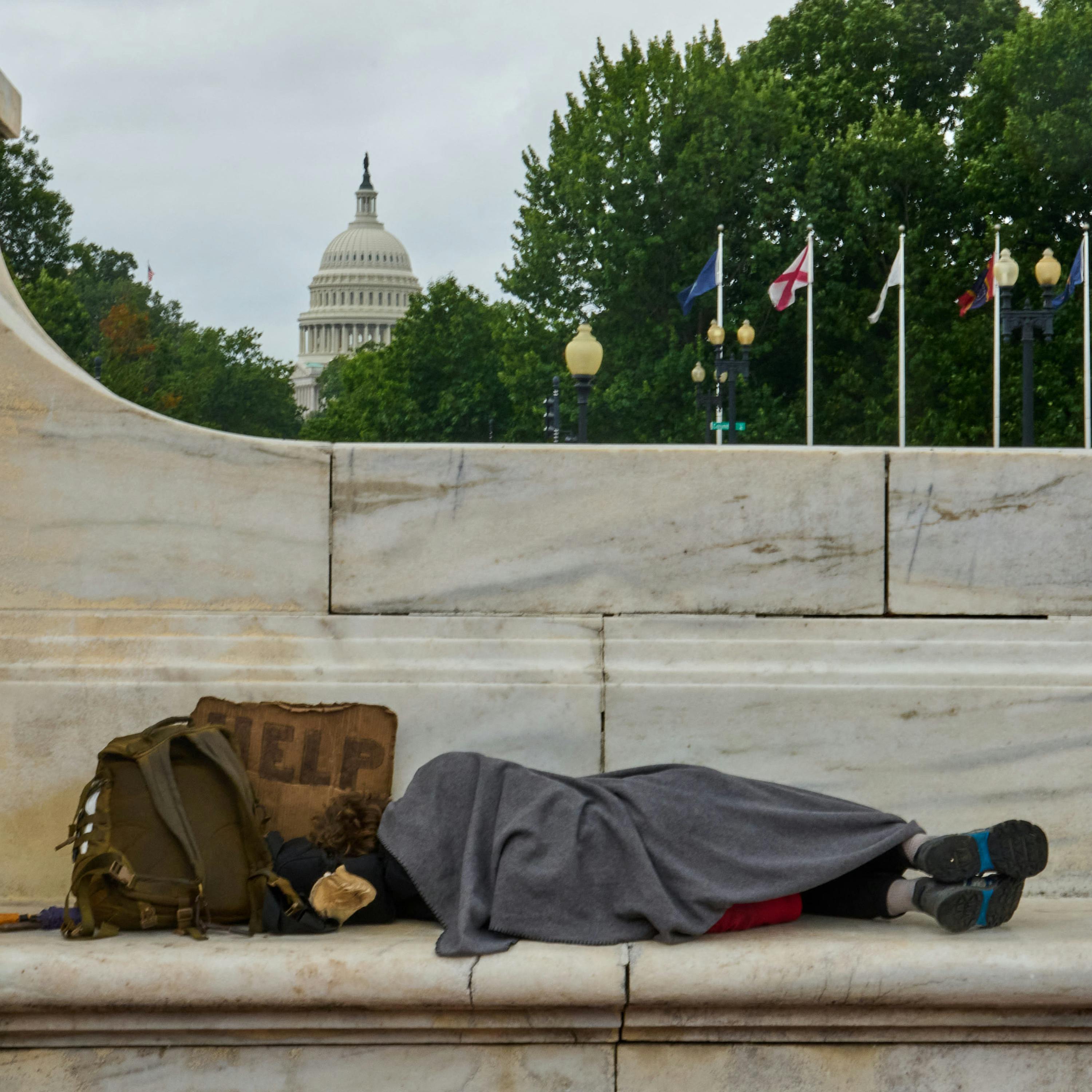
The takeover of Washington D.C. by the President Donald Trump continues this week. We got ICE officers detaining delivery drivers across the city. We got federal police officers from multiple agencies, including the FBI, dealing with a drunk woman in Dupont Circle. And on Wednesday morning, a 14 ton mine resistant military vehicle crashed into a car in Capitol Hill. A civilian basically got t boned by a tank. But somewhere in the background, the President of the United States is also trying to evict D.C. s homeless population. This has long been an obsession of his.
- [00:39]
Kyle Swenson
We can't let homeless stay in the middle of our magnificent parks, under the Washington Monument and other places. We're going to clean up Washington D.C. and we're going to make it a crime free zone. There's not going to be any crime. We're going to have laws, but we're going to have to take it over.
- [00:54]
Host
We're going to evaluate the job he's doing with the Unhoused on today explained from Vox.
- [01:00]
Alex Barnard
Avoiding your unfinished home projects.
- [01:02]
Host
Because you're not sure where to start. Thumbtack knows homes, so you don't have to don't know the difference between matte paint finish and satin or what that clunking sound from your dryer is.
- [01:14]
Alex Barnard
With thumbtack, you don't have to be.
- [01:16]
Host
A home pro, you just have to hire one. You can hire top rated pros, see price estimates and read reviews all on the app Download today.
- [01:26]
Alex Barnard
Hey everybody, it's Andy Roddick, host of Serve podcast for your fix on all things tennis. US Open's coming up and we're covering it on our show. Can someone knock off Alcaraz and Sinner? Can Coco Gauff win her second US Open title? Can Wiatek win her second Grand Slam title in a row? Can Sabalenka break through and win her Grand Slam in 2025? You can watch our coverage of the U.S. open on YouTube or listen wherever you get your podcast brought to you in part by Amazon prime.
- [01:57]
Kyle Swenson
Wow. Washington D.C.
- [02:02]
Host
Today, explained Sean Ramis from here with Kyle Swenson, who reports on DC for WaPo. We asked him to help us understand what this administration's been up to as it concerns people without homes in our nation's capital.
- [02:16]
Kyle Swenson
Really. Beginning on Thursday night was the first night where there was a concerted effort to move through the city through places where homeless people had typically gathered where they were tents. Under the direction of the federal government, D.C. police led the clearing of homeless encampments.
- [02:32]
Alex Barnard
The White House says that people who do not lead could be thrown in.
- [02:35]
Kyle Swenson
Jail and what we're seeing is an increase of homeless encampment removals.
- [02:40]
Alex Barnard
We're just people, we're normal people out.
- [02:42]
Kyle Swenson
Here working, trying to do well. I remember the passage of, as you have done unto the least of these, you have done unto me. And the idea that he's targeting us and persecuting us feels wrong to me. Now, whether those have produced arrests at this point, we're still trying to figure that out. We don't know.
- [03:05]
Host
Do we know where people went or is this part of the mystery here?
- [03:10]
Kyle Swenson
We don't necessarily know where they went. I've spoken to a few people who were living out there. A couple of them have just moved on to different parts of the city. A couple just went in the woods. Honestly, they just are now trying to get more out of sight and get out of the kind of laser focus of authorities, which is understandable. And the city has increased its shelter capacity. This is also something we're trying to kind of lock down. It's still in flux, but a lot of people don't want to go into shelter for a lot of, like, understandable reasons. When you kind of get down in the nitty gritty, they maybe don't feel safe in a shelter. They maybe have too much stuff. You know, there's a two bag rule. When you go into a shelter, you can take two bags in. So if your whole life is packed up in six bags, maybe you don't want to go into a shelter. Some people with animals, some people with health conditions, if they're going in and out of medical treatments, like dialysis every day, like, they maybe don't feel like they have the flexibility in a shelter where you have to be in by a certain time. So a lot of people are very skeptical of the shelter system and that's why they kind of remain on the street.
- [04:24]
Host
So if people are indeed just heading into the woods, it isn't like this is a problem that's been solved because the second the tension is released or the focus drifts elsewhere, we can assume people are just going to come right back to the services and the neighborhoods that are familiar and we're working for them. Can you give us a sense of the like, at least the recent history around this issue in a city like.
- [04:50]
Kyle Swenson
Washington, D.C. yeah, I mean, one of the things about Trump's kind of like picture and the rhetoric around this is that the city he's kind of talking about doesn't seem like the city right now in terms of homelessness. It seems like post pandemic. I think anybody who was here would note there were large encampments all over the city of homeless people. If you came up from the Dupont metro, it was Dupont Circle was ringed with tents.
- [05:14]
Alex Barnard
From Scott Circle to Dupont Circle, GW.
- [05:17]
Host
To Georgetown, homeless encampments are now nestled.
- [05:20]
Alex Barnard
Across our nation's capital. McPherson Square, five minutes from the White House, was the District's largest encampment. Many residents say they feel the world has turned its back on them.
- [05:31]
Kyle Swenson
Now, the city, Mayor Bowser's administration, you know, they have been very active on this issue. They have both included services going out to people. They have opened up the number of vouchers for people who get long term housing.
- [05:46]
Alex Barnard
And we open smaller service and bridge centers across all eight wards. We open the new 801e shelter for men. We open the city's first LGBTQ shelter.
- [05:59]
Kyle Swenson
But they also have cleared encampments pretty regularly. So the city has been on it. They've been moving people off these big encampments right now. Like, there is a list of encampment clearings that the city schedules. They post it, they try to go through a protocol where they reach out immediately with social workers and people to offer services to people living in that area. But, like, last week, I went to a lot of the places that were lined up on upcoming sweeps, and there was just nobody there. Like, the idea that there's tent Cities in Washington, D.C. right now is just not accurate compared to, like, other cities that you see out west and stuff like that. And so when President Trump talks about these large encampments that are kind of like, despoiling the city, he's kind of talking about something that doesn't exist in the city anymore, as far as we can tell. And as far as the city can tell, we still have homeless people 100%. This is a major American city. We saw big spikes over the past two years. And then this year, during the census of homeless individuals, people unhoused, we saw a drop by about 9%. So that's actually a pretty significant victory for the city. Mayor Bowser's administration, you know, is very correct to take credit for that. They've made a lot of inroads and outreach. But then a lot of what we're seeing is also, like, in the counties surrounding D.C. like Montgomery, the numbers have gone up. So does anyone think Donald Trump's gonna solve this? In my opinion, having covered this for a long time, this feels like a show of force in an area where a show of force isn't going to actually solve this issue. And one other thing to really point out here is that the White House is taking a stand on a particular kind of philosophical position about how to deal with homelessness.
- [07:54]
Alex Barnard
Right.
- [07:54]
Host
You've written that some of these approaches the Trump administration would like to take are influenced by this conservative think tank called the Cicero Institute. What is their philosophy? To deal with homelessness?
- [08:07]
Kyle Swenson
Right. So, as you know, Cicero is based in Texas, and they have lobbied very effectively in a lot of Republican states to pass kind of criminalization efforts.
- [08:17]
Alex Barnard
What I attempted to accomplish was a ban on illegal camping statewide.
- [08:21]
Kyle Swenson
In Kentucky, they're usually disguised as camping bans and things like that, or loitering bans, but it makes it very aggressive where police can roll up to anybody who doesn't seem to be housed or seem to be sleeping somewhere, and there's a criminal penalty to them.
- [08:35]
Alex Barnard
Have a bill in place, and basically the policeman can say, you need to move along to a designated camping area, or you need to go to a shelter or rehab, or we can take you to jail.
- [08:44]
Kyle Swenson
But the idea kind of runs against this wall because, you know, it's even hard to get a bed for, like, a detox center in this country. It's really hard to get mental health access. So they mean well. It's just their philosophy is this kind of like forcing people. They should know what's good for them. They should get into treatment. They should better themselves. Where studies have shown this other philosophy, which is now the prevailing philosophy, and it's been the prevailing philosophy for the last 20 years, which is housing first, which is if you get somebody in a house, if you get them housed to a permanent place, this is my house. I got my lock on my door, I got my keys. That actually is the first step to a person stabilizing and being like, maybe I need mental health treatment, maybe I need drug treatment. But it's the first step is just get them in their own place. It's kind of about establishing dignity, and that is a very delicate process. It's hard. There's a lot of trial and error there. But what Cicero has effectively very much so pushed in a lot of states is the opposite. It's to criminalize, to kind of use the stick rather than the carrot around these issues. And the Trump administration is very clear about where they stand on this. They very much embrace that same attitude. And housing first has even become kind of like not as much so, but in the same way, like dei. It's become kind of like one of these buzzwords that is loaded now with the significance of, like, a failed policy idea. And we're seeing the fruits of that play out in D.C. very specifically.
- [10:12]
Host
And does something called involuntary commitment also factor into this sort of stick instead of carrot approach?
- [10:20]
Kyle Swenson
Totally. I mean that is the most extreme stick that can be used. Involuntary commitment being is that you're de by law enforcement to be a danger to yourself or to the community and you literally are removed from the street for a psychiatric hold. It plays out differently in every kind of state and jurisdiction. That is the most extreme measure that can be used against homelessness. We have not seen it in D.C. so far as far as we know play out, but that is definitely something that's in the conversation here with people who want to take a harder line on the homeless.
- [11:02]
Host
You can read kyle@washingtonpost.com More on the most extreme stick that can be used to deal with homelessness and the surprising corners of this country that agree on using said stick when we're back on Today Explained.
- [11:27]
Alex Barnard
Mint is still $15 a.
- [11:28]
Kyle Swenson
Month for premium wireless and if you haven't made the switch yet, here are 15 reasons why you should.
- [11:34]
Alex Barnard
1.
- [11:35]
Kyle Swenson
It's $15 a month.
- [11:36]
Alex Barnard
2.
- [11:37]
Kyle Swenson
Seriously, it's $15 a month. 3. No big contracts.
- [11:41]
Alex Barnard
4. I use it.
- [11:42]
Kyle Swenson
5.
- [11:42]
Alex Barnard
My mom uses it. Are you playing me off?
- [11:44]
Kyle Swenson
That's what's happening, right?
- [11:46]
Alex Barnard
Okay, give it a try. @mintmobile.com Switch upfront payment of $45 for a 3 month plan, $15 per month equivalent required New customer offer first 3 months only, then full price plan options available, taxes and fees extra cement mobile.com.
- [11:58]
Kyle Swenson
Labor Day savings are happening right now.
- [12:00]
Alex Barnard
At the Home Depot.
- [12:01]
Kyle Swenson
So what are you working on? Prep for fall with our wide selection of cordless power tools that make it easy to clear your lawn starting at $79. And once the leaves are clear, keep your yard looking fresh with colorful mums that bloom all season long. Shop Labor Day Savings now through September.
- [12:21]
Alex Barnard
3Rd only at the Home Depot.
- [12:23]
Kyle Swenson
See select stores for details.
- [12:27]
Alex Barnard
Martha listens to her favorite band all the time in the car, gym, even sleeping. So when they finally went on tour, Martha bundled her flight and hotel on Expedia to see them live. She saved so much she got her.
- [12:42]
Kyle Swenson
Seat close enough to actually see and hear them.
- [12:45]
Alex Barnard
Sort of. You were made to scream from the front row. We were made to quietly save you. More Expedia made to Travel savings vary and subject to availability. Flight inclusive packages are atoll protected. So I'm Alex Barnard and I'm an assistant professor of sociology at New York University.
- [13:07]
Host
And you've written books, I'm told.
- [13:09]
Alex Barnard
Yeah, I wrote a book about California's involuntary treatment system. I joke that it's a book about Britney Spears, but it's more broadly about how conservatorship functions in California.
- [13:19]
Host
And weirdly, this figures into what's going on right now in Washington, D.C. with the unhoused population.
- [13:26]
Alex Barnard
Right. So President Trump has been just issued an executive order that's trying to change the way the US Approaches homelessness and mental illness, largely by bringing us back to a more heavy handed, coercive approach to homelessness through the mental health system combined with greater criminalization of this population.
- [13:45]
Host
And his executive order is not just about the District of Columbia.
- [13:50]
Alex Barnard
No, it's the executive order is nationwide. So it's trying to change policy really around three different issues. So first it's trying to expand the use of civil commitments. So that's involuntary mental health treatment. That's usually reserved for people who are a danger to themselves, danger to others, or unable to meet their basic needs. And he's looking to expand that. It's not totally clear how he's going to do that because that's determined by state law. But in any case, that's one of his objectives. The second is to expand the criminalization of homelessness, so increase the use of things like encampment sweeps to force people who are homeless to move along. It's not really clear where he imagines those people going, but that's certainly what they're doing in D.C. there are many.
- [14:32]
Kyle Swenson
Places that they can go and we're.
- [14:34]
Alex Barnard
Going to help them as much as you can help. And then the final piece is a really dramatic change in housing policy. So since George W. Bush, the kind of primary response we have to unsheltered homelessness, for which there's a lot of really robust evidence, is called Housing First. And we created this Housing first program in 92, and we began basically to take people from the streets into an apartment of their own.
- [14:59]
Kyle Swenson
Housing first speaks about immediate access to permanent housing. And it was adopted as federal policy for the first time under President George W. Bush.
- [15:11]
Alex Barnard
And they want to move away from that towards a system in which housing is not given, it's earned based on your participation in rehab programs or something like that.
- [15:23]
Host
I think most people are familiar with the idea of like an encampment sweep. And it's probably not surprising to people that Donald Trump's push to solve homelessness in D.C. does it have a lot to do with, like, say, building housing for poor people? But the civil commitments thing, I feel like people might not know as much about. So, so let's focus on that for a second here. What motivated the President of the United States to call for more involuntary commitments?
- [15:56]
Alex Barnard
So this is one of those things that, for whatever reason, Trump has a bit of a fixation on. So in 2018, in response to the Parkland shooting, rather than talking about gun control, he wanted to talk about bringing back asylums, bringing back, you know, large psychiatric hospitals that were really significantly downsized in the 1960s.
- [16:15]
Kyle Swenson
So we're going to be talking seriously.
- [16:17]
Alex Barnard
About opening mental health institutions again, in some cases reopening, I can tell you. So, you know, we closed those hospitals, but civil commitment never went away. Over a million Americans are subjected to some kind of involuntary psychiatric treatment per year. That often starts with a, a law enforcement officer seeing somebody in the community who's not doing well and bringing them to an ER for evaluation, and then that person can be placed in a hospital and medicated involuntarily. So that's, that's civil commitment. It's a state by state. You know, the laws for that vary by state, but it exists everywhere. And his vision is that we should, you know, ramp up civil commitments to deal with homelessness. We really don't have robust evidence that civil commitment is a good solution to homelessness. And in fact, there's some recent research that came out that suggests somebody being placed in psychiatric hospital actually may increase their risk of losing housing because they're in a psychiatric hospital, which means they're not going to their job, they're not connecting to family. If the problem leading to unsheltered homelessness was that there wasn't enough civil commitments, we would see a really different pattern of civil commitments nationwide. So Oklahoma and Utah, for example, are two states with very low levels of civil commitments and almost very little homelessness. So the story there is not that we're not forcing enough mentally ill people into treatment, is that there's a lot of cheap housing in those states. And as a result, you're not seeing the kind of unsheltered homelessness that you see in New York or California. California actually has a much higher rate of civil commitments than the national average and also is home to one half of the unsheltered homeless population.
- [17:52]
Host
I'm sorry, before we continue, did you just say that half of the nation's unsheltered people live in California?
- [17:58]
Alex Barnard
That's correct.
- [17:59]
Host
I did not know that statistic. It makes sense.
- [18:01]
Alex Barnard
But also, wow, it's a catastrophic failure. And I think that it does kind of bring disgrace upon the governments of these left leaning coastal States that, you know, despite, you know, years and years of policy conversations around this, they have not really moved the needle on homelessness.
- [18:20]
Host
I'm glad you brought up California, because I think it gets at something interesting when it comes to involuntary commitments here, which is that it isn't just like a left, right, red, blue issue in the United States. I mean, Donald Trump said this thing, signed this executive order, and then, like, I think days later, almost instantly, it felt like Eric Adams was saying, like.
- [18:42]
Alex Barnard
We'Re asking state lawmakers to extend the lifeline of involuntary commitment to those struggling with serious addiction. We have already made it easier to use involuntary commitment to help people with untreated severe mental illness get careful.
- [18:57]
Host
Mind you, Eric Adams, I guess no longer a Democrat, but who agrees with Donald Trump that we could stand to see more of these kinds of involuntary civil commitments, whatever they might be.
- [19:09]
Alex Barnard
I think Donald Trump is trying to put forward the most cruel possible version of a policy shift that actually has pretty broad support. So with some research Assistance Here at NYU, we've cataloged 1,900 bills around involuntary treatment that have been introduced in state legislatures in the last decade. And of the 10 states that introduced the most bills on this topic, nine of them voted for Democrats in the last presidential elections. Wow. So this has been largely an initiative that is coming from, you know, blue coastal states. And what we've seen is that there's been an almost a reframing of coercion as a form of compassion, that actually to be a progressive is not to let somebody die in their feces on the street, but to force that person into treatment that they can't necessarily, if.
- [19:55]
Kyle Swenson
In fact they're suicidal, if, in fact.
- [19:57]
Alex Barnard
They'Re unable to care for themselves, this.
- [19:59]
Kyle Swenson
Will allow the judge to better assess whether that person should be committed into drug treatment. When people get their meds, when people.
- [20:07]
Alex Barnard
Get support, we know we can turn people's lives around. This is eminently solvable. Governors like Gavin Newsom have also embraced encampment sweeps and other kind of criminalization measures as another way to deal with urban disorder and homelessness. So in a lot of ways, the blue states have paved the way for this executive order, which is pushing this movement towards a more institutional response to homelessness even further.
- [20:32]
Host
And is it controversial like on the left? Is it creating division in progressive circles that we need to solve this problem, and to do so, we have to do this thing that some of us find distasteful?
- [20:46]
Alex Barnard
So this has been an area that often puts civil liberties groups and disability rights groups in pretty Open conflict with other progressive, sometimes elected officials, mayors particularly, also some clinicians and a lot of families that see their loved ones not able to accept the treatment that we think they need. I think in reality, to really move forward on this policy discussion, we need to realize that people who are experiencing homelessness are a really diverse group. And for the vast majority of them, including many of them with severe mental illness, giving them an apartment is the fastest way to solve their homelessness. But there is a subset of people for whom voluntary services and, you know, independent apartment where a case manager checks you once a week, but otherwise you're left on your own. That that actually isn't going to be enough to meet those. Those individuals needs. And it's that group that now the right is really focusing on and treating as the entire homelessness population, these people who need to be coerced into treatment because they're so sick.
- [21:47]
Host
You know, you joke that your book is about Britney Spears, who of course famously had this conservatorship controversy, but is there a story that you've come across or that you tell in your book about involuntary commitment that can help people wrap their heads around the issue?
- [22:06]
Alex Barnard
One of my favorite stories, and this is a story of somebody who consented for me to tell his story. His name was Serge. He had no hands and was missing one eye as a result of an accident when he was younger and lived with schizophrenia. And he spent a decade homeless in Hollywood. And again, this is one of these people where probably thousand times a day somebody was walking by and saying, why isn't somebody doing anything for this guy? And in reality, he was being picked up by the police and either thrown in jail or taken into an ER dozens and dozens of times. And every time they'd just kick him back out. And sometimes they'd pay for an Uber to send him back to Hollywood. In the end, it was a private citizen, Kerry Morrison, who was charge of the business improvement district there, who said, what is going on here? And she actually convened a meeting of all the stakeholders, everyone who was touching on this person's case, and brought them all together and they kind of hatched a plan to get this guy into treatment longer term. And, you know, the tragic way this, this panned out was the police came, they stopped him. You know, they tried to handcuff him because that's how we take people to psychiatric hospitals. But he didn't have hands, so they had to use zip ties. And you know that she says, that's how we help people in America. In the end, he was taken to a hospital. They kind of shepherded him through the system. So he went on to a conservatorship. Once he was conserved, he was sent to a locked facility with barbed wire all around it, you know, way far out of Los Angeles where he was. He was there for months and no one even really knew. None of the people who had connection with him even knew where he was. And then eventually he. He stepped down out of that and went to live in an unlocked facility and got his ged. And when I talked to him, I said, what do you wish the system had done differently? And he said, I wish they had conserved me sooner. So that's a story that really sticks with me. It's the happy story of civil commitment, but with a lot of unnecessary pain and suffering along the way. I think in some ways states like California are at least on the right track, which is that we need in all of the above solutions. So we have to address the root causes of homelessness, which is that housing is too expensive. And when housing is too expensive, the most vulnerable people are going to be the ones who become homeless. And at the end of the day, you can put somebody in a psychiatric hospital, but if they're not going to land in an apartment at the end of it and they're going to instead go back to the street, you've just wasted a lot of money and restricted somebody's civil liberties for nothing. I do think we need a targeted use of civil commitments, a thoughtful use of civil commitments for some individuals who have been frankly abandoned so long that they're not able to. They're not able to consent to services that might be necessary to save their lives. But it wouldn't look at all like this executive order.
- [25:00]
Host
That was Alex Barnard from nyu. His book about Britney Spears is called Conservatorship Inside California's System of Coercion and Care for Mental Illness. Our program today was produced by Rebecca Ibarra and Devin Schwartz. Amina Al Saadi edited Laura Bullard Fact check Patrick Boyd and Andrea Christen's daughter mixed in an upcoming episode of Today explained. We're gonna look at how tough it is to find a job in the United States right now. Reporting suggests it's getting a lot harder. If you've had a tough time, sent out dozens and dozens of applications and heard nothing back, we want to hear from you, especially, especially if you're in, like a white collar industry that's Suddenly all about AI. Give us a call at 844-453-4448 or send a voice memo to our Philadelphia bureau Chief, Miles Bryant. Miles.brian with a Y@voxmedia.com that's Miles brianoxmedia.com He spells it with a Y. Thank you.
- [26:18]
Kyle Swenson
Sam.