← Today, Explained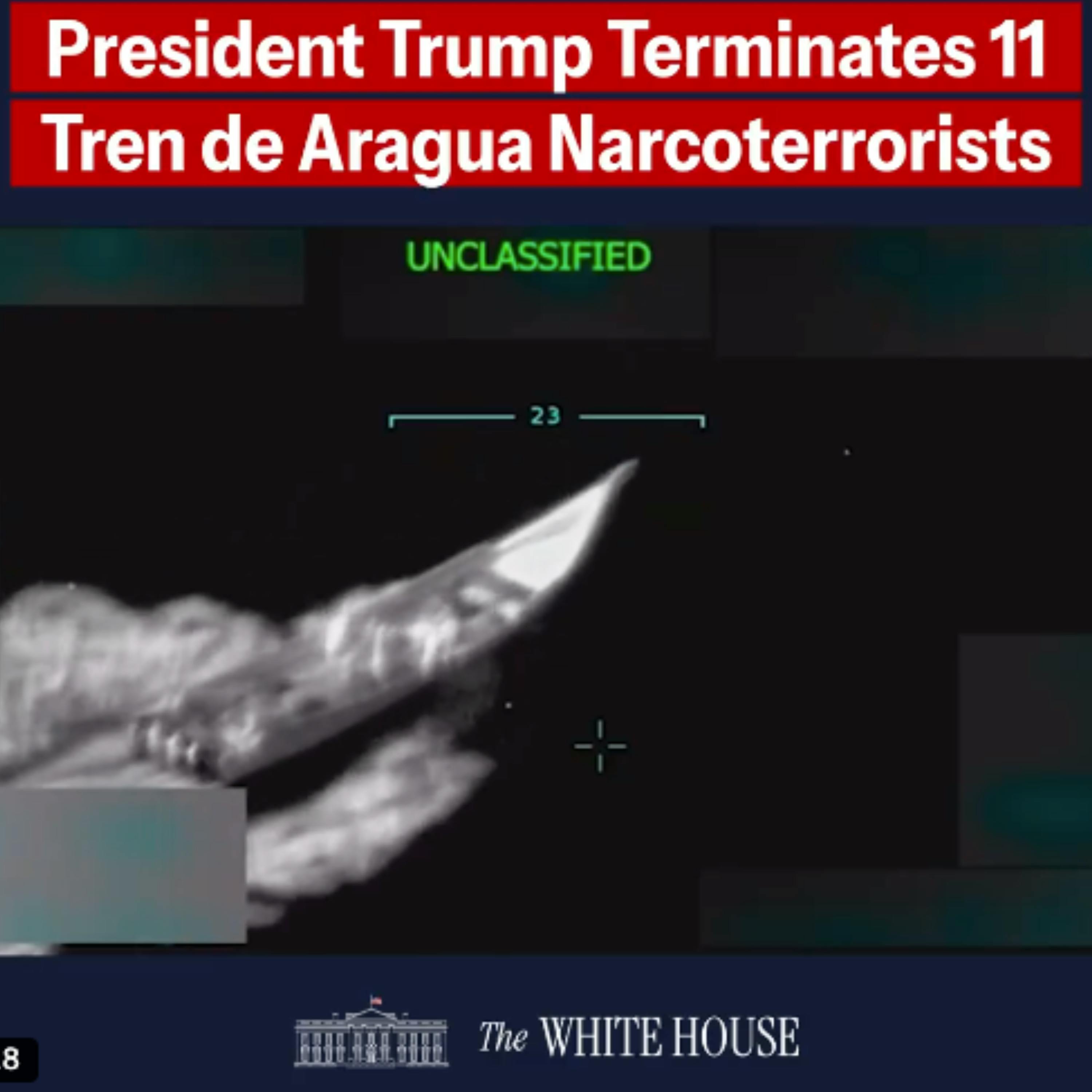
Today, Explained
Trump’s new war on drugs
00:26:18
President Donald Trump promised to crack down on illicit drugs. Then, he blew up a Venezuelan vessel in international waters.
Loading summary
Transcript96 lines
- [00:01]
Sean Rameswaram
You've probably heard by now that the President did a post over the weekend. It's an AI generated image inspired by the movie Apocalypse Now. But instead of napalming Vietnam, President Trump appears to be napalming Chicago. It's labeled Shapocalypse now because wordplay doesn't always have to be good. Senator Tammy Duckworth of Illinois responded, Take off that cavalry hat, you draft dodger.
- [00:25]
TODAY Explained Host
You didn't earn the right to wear it.
- [00:27]
Samantha Schmidt
Stolen valor at its worst.
- [00:29]
Sean Rameswaram
Some guy named Alex responded to Duckworth. I think the bigger issue here is.
- [00:34]
Alex Avigna
That he posted an image of himself napalming Chicago.
- [00:38]
Sean Rameswaram
Maybe an even bigger issue still is what the President is doing in international waters around Venezuela. That's where he actually blew up a boat he said was carrying 11 drug smugglers and their drugs. An actual act of war, A declaration legal. We're gonna ask on TODAY Explained from Vox, but it's not looking great.
- [00:59]
TODAY Explained Host
Support for TODAY explained comes from BetterHelp. Let me tell you a true story. Last weekend I got an email from a listener who wanted to discuss their problems with me, and I said, look, I don't think that this is about me personally. At least I hope it's not. Why don't you try betterhelp.com explained absolute truth. As the largest online therapy provider in the world, BetterHelp can provide access to mental health professionals with a diverse variety of expertise. Find the one with better help. The one is not me, guys. Our listeners get 10% off their first month@betterhelp.com explained. That's better. H lp.com explained avoiding your unfinished home.
- [01:43]
Sean Rameswaram
Projects because you're not sure where to start. Thumbtack knows homes, so you don't have to don't know the difference between matte paint finish and satin or what that clunking sound from your dryer is. With thumbtack, you don't have to be a home pro, you just have to hire one. You can hire top rated pros, see price estimates and read reviews all on the app. Download Today.
- [02:14]
TODAY Explained Host
Estana esculdo a hoy expulcado. You're listening to TODAY Explained.
- [02:20]
Samantha Schmidt
I'm Samantha Schmidt and I'm the Bogota bureau chief for the Washington Post.
- [02:24]
Sean Rameswaram
So you're in Latin America. What are the vibes right now? You know, several days, almost a week since the President blew up a boat off the coast of Venezuela, things are.
- [02:34]
Samantha Schmidt
Tense still, you know, even though we didn't see any major action over the weekend, there's still this feeling that anything could happen right now, particularly in Venezuela. I think ever since these warships were sent to the Caribbean, we've been waiting to see what the US Might do in the region. And this boat, I think, put everyone on high alert. It was a sort of sign that anything could happen and that the US Is willing to escalate things to a point we've never seen before.
- [03:09]
Sean Rameswaram
I know after this attack on this vessel, there were lots of unanswered questions. And now that it's been almost a week, I wonder if we have more answers. Can you tell us in as much detail as you can what happened on September 2nd?
- [03:23]
Samantha Schmidt
So we still have a lot of unanswered questions. You know, from the beginning, the Trump administration released this video.
- [03:33]
Marco Rubio
We just, over the last few minutes, literally shot out a boat, a drug carrying boat, a lot of drugs in that boat.
- [03:41]
Samantha Schmidt
Showing how this boat, which was a pretty modestly sized boat, it was not a very big boat, was speeding through the Caribbean, threw open water and suddenly it was engulfed in flames. And we're not even entirely sure who conducted the strike, but the Trump administration said that they attacked this boat, that 11 people were on board the vessel, all of them were killed. And Trump himself claims that they knew these were drug traffickers.
- [04:13]
Marco Rubio
On the volume, you had massive amounts of drugs. We have tapes of them speaking. There was massive amounts of drugs coming into our country to kill a lot of.
- [04:21]
Samantha Schmidt
But they didn't identify who the people were on the boat or any evidence that they have justifying this and proving that they were in fact drug smugglers.
- [04:31]
Marco Rubio
You see it, you see the bags of drugs all over the boat.
- [04:34]
Samantha Schmidt
There are some indications from local reporting of where in Venezuela it may have originated from, but we don't even have exact evidence of that.
- [04:47]
Marco Rubio
We have a lot of drugs pouring into our country, coming in for a long time. And we just, these came out of Venezuela and coming out very heavily from Venezuela. A lot of things are coming out of Venezuela. So we took it out.
- [05:00]
Samantha Schmidt
And Trump has said that these were members of a Venezuelan gang called Trenderagua. We don't have proof of that either yet.
- [05:07]
Marco Rubio
Trend, some of the worst gangs, some of the worst people anywhere in the world in terms of gangs.
- [05:15]
Samantha Schmidt
So there's just a lot of questions and I think some of the most revealing comments about this came from Secretary of State Marco Rubio, who said that.
- [05:25]
Alex Avigna
A drug boat was headed towards eventually the United States. And instead of interdicting it the way.
- [05:32]
Samantha Schmidt
That the US Usually does, on the.
- [05:33]
Alex Avigna
President's orders, he blew it up and it'll happen again.
- [05:37]
Samantha Schmidt
And that According to him, these were drug smugglers who presented an immediate threat to the United States. But it's not entirely clear to me what he means by that and how these specific 11 people were an immediate threat to the United States.
- [05:52]
Sean Rameswaram
And do we even know if there were 11 people on board this vessel? Because the White House said 11. You watch the video and it doesn't necessarily look like there are 11 people on board. So maybe they're like below deck, but then how big is below deck? I had questions based on the video.
- [06:09]
Samantha Schmidt
Evidence, you can't really tell. And some have raised questions about why 11 when a boat this size you wouldn't need 11 people. You know, there's questions about whether they were all drug smugglers, you know, whether some of them were drug smugglers or some of them were passengers on the boat. This is all speculation. I mean, in this region, if it did in fact leave the Venezuelan coast, where local reporting has indicated it may have left from, there is drug smuggling that goes on there. Right. And there are groups that are taking drugs to nearby Caribbean islands and to the United States. But there's also people who smuggle migrants across these waters. So it's not entirely clear, but yeah, we have not gotten that level of detail yet.
- [06:57]
Sean Rameswaram
Got it. Okay, so 11 people aside, drug smugglers aside, a boat was blown up and people died. What do we know about the legality of this move?
- [07:10]
Samantha Schmidt
So the White House has said that this was taken in defense of vital US national interests and the collective self defense of other nations.
- [07:19]
Alex Avigna
The President of the United States is going to wage war on narco terrorist organizations. This one was operating in international waters headed towards the United States to flood our country with poison. And under President Trump, those days are over.
- [07:32]
Samantha Schmidt
And that appears to be referring to this 2001 authorization for the use of military force enacted by by Congress after 9 11. And it authorizes use of force against perpetrators of the attacks, such as Al Qaeda, and to prevent, quote, future acts of international terrorism. And the White House has said that that strike was fully consistent with the law of armed conflict. But armed conflict here seems unclear. I mean, there is no armed conflict between the United States and Venezuela. We spoke with this professor of law at the University of Notre Dame, and she said that this violated international law and that the only time when you can commit a strike like this, it's to protect human life in an emergency in which you're trying to protect people whose lives are at risk immediately. And I just think that it raises a lot of questions about what the Trump administration is willing to do outside of war in international waters against people who are presumably sending drugs to the United States. But without or before providing evidence of that.
- [08:44]
Alex Avigna
Right.
- [08:44]
Sean Rameswaram
They're saying Trend Aragua is this terrorist group. Is it even legal to designate Trend Aragua as terrorists? Do we know how that works?
- [08:56]
Samantha Schmidt
This is also a question that has come up a lot because we know that Trend Aragua is a real gang.
- [09:02]
Marco Rubio
The Venezuelan prison gang, the toughest gang, they say, in the world. Known as Trendy Aragua, it has spread.
- [09:09]
Samantha Schmidt
Throughout South America and has caused a lot of damage, particularly within Venezuelan migrant diaspora communities in the region. And that they have spread and taken control of migrant routes. They extort people. They're a real gang that has caused real damage and has real capacity to expand. The Trump administration has said that they are invading the United States and that Maduro is directing this invasion.
- [09:38]
Marco Rubio
They emptied out. You don't know this, but they emptied out their prisons in Venezuela and they emptied them out into the United States of America.
- [09:45]
Samantha Schmidt
But we have also seen extensive reporting now, including in the Washington Post, that secret intelligence reports have revealed that that is not true and that it's not Maduro who is directing this gang to flood the United States and destabilize the United States, and that that is a stretch, even though there might be some low level connections between the gang and the government. This is a leap, according to our reporting.
- [10:18]
Sean Rameswaram
How much tension has this caused between the United States and Venezuela?
- [10:23]
Samantha Schmidt
Quite a bit. And, you know, this is something that Maludo has for years tried to claim in Venezuela, that it's, you know, the US Imperialist United States going after Venezuela, trying to destabilize it the way that they have tried to destabilize countries in South America for generations. And so, you know, this is really in line with his message. And he has taken advantage of it in the last few days in his speeches, you know, saying that the US Needs to back down and stop trying to pursue regime change and that Venezuela will defend its sovereignty. And he has said that he is mobilizing civilians to join these things called militias in Venezuela, which are not known to be the most highly trained, prepared troops in the country. They're often sort of seen as sort of older, retired men. But he's said that he's sending thousands of troops to the Colombian border, that he's beefing up the military presence in the country to prepare for a possible invasion. And, you know, his other allies, his other members of his government have also sent very strong messages, you know, accusing the US of extrajudicial killings with this strike, even though at the beginning they also claimed that it was AI and that it didn't actually happen. And so there's been sort of some mixed messaging on that. But things are getting tense. And a few days ago we saw that two Maduro Venezuelan government military aircraft flew near a US Navy vessel in international waters. And yeah, the Department of Defense said it was a highly provocative move designed to interfere with our counternarcotics operations and strongly advised Venezuela not to pursue any further effort to obstruct these operations. So that was a moment where things started to feel like they were really on the precipice of something. But I think there's this feeling that anything could happen.
- [12:36]
Sean Rameswaram
Samantha Schmidt, washingtonpost.com Over the weekend our Vice President, J.D. vance tweeted, killing cartel members who poison our fellow citizens is the highest and best use of our military. Someone wrote back to him, killing the citizens of another nation who are civilians without any due process is called a war crime. To which Vance wrote back, I don't give a shit what you call it. Perfectly normal behavior on a Saturday morning from our Vice President. But a lot of people were shocked down in Latin America though they've seen this one before. More on that when we're back on Today Explained.
- [13:21]
TODAY Explained Host
Support for TODAY Explained comes from Quince. Quince wants to remind you the seasons are changing again which means you might want to update your closet for some more weather appropriate garbs. Quince says they have all the elevated essentials for fall. 100% Mongolian cashmere starting at $50, washable silk tops and skirts that perfectly tailored denim that you do know so well. Quint says that all of their Items are priced 50 to 80% less than similar brands.
- [13:48]
Samantha Schmidt
Here's Nisha I got two sweaters from.
- [13:52]
TODAY Explained Host
Quint for the fall. I got the organic cotton cropped cardigan and the organic cotton Boyfriend crewneck sweater. I have seen the cardigan on social.
- [14:02]
Samantha Schmidt
Media a lot and I was looking.
- [14:05]
TODAY Explained Host
For great cardigan for the fall. I got it in a brown color and it just seems like something that will really pair well with a lot.
- [14:12]
Samantha Schmidt
Of things and work with a lot of different outfits.
- [14:14]
TODAY Explained Host
You can keep it classic and cozy this fall with long lasting staples from Quince. You can go to quince.com explain for free shipping on your order and 365 day returns. That's quite n c e dot com explorer explained. To get free shipping and 365 day returns. Quince.com explained.
- [14:35]
Sean Rameswaram
Support for the show today comes from none other than HIMS erectile dysfunction can make you feel like you aren't yourself. HIM says they can help you get back to the best version of you with personalized ED treatments that are prescribed by licensed providers, including daily meds that support more spontaneous moments. Sounds fun. HIMSS says they offer access to ED treatment options, including trusted generics that cost 95% less than brand names if prescribed. And since Hims is 100% online, you can get the care you need from the comfort of your own home. No sitting around under fluorescent lights reading a week's old magazine while you wait for an appointment. Remember magazines? You can get simple online access to personalized, Affordable care for ED, hair loss, weight loss and more by visiting hims.comexplained that's hims.comexplained for your free online visit. Hims.comexplained explained actual price will depend on product and subscription plan. Featured products include compounded drug products which the FDA does not approve or verify for safety, effectiveness or quality. Prescription required. See website for details, restrictions and important safety information.
- [15:46]
TODAY Explained Host
At New Balance, we believe if you.
- [15:48]
Samantha Schmidt
Run, you're a runner.
- [15:53]
TODAY Explained Host
However you choose to do it. Because when you're not worried about doing.
- [15:59]
Samantha Schmidt
Things the right way.
- [16:03]
TODAY Explained Host
You'Re free to discover your way. And that's what running is all about. Run your way@newbalance.com Running Mr. President, do.
- [16:17]
Sean Rameswaram
You have any reaction to Today Explain being named the best news show?
- [16:21]
Marco Rubio
Wow, I didn't know that. I just. You're telling me now for the first.
- [16:26]
Sean Rameswaram
Time, we wanted to more deeply understand what drone striking a Venezuelan boat out of the blue meant for the region. Central America, Latin America, South America, the hemisphere. To do so, it's best to look back for help. We reached out to Alex Avinha, history Professor at Arizona State University.
- [16:44]
Alex Avigna
I fear that it's not just going to be a Venezuela thing. Prior to making threats against Venezuela and organizing this, what looks like to be a Naval Expeditionary force, they were threatening Mexico for a few years Now I.
- [17:00]
Marco Rubio
Will order the Department of Defense to make appropriate use of special forces, cyber warfare and other overt and covert actions to inflict maximum damage on cartel leadership, infrastructure and operations. I will designate the major cartels as foreign terrorist organizations promising some sort of.
- [17:23]
Alex Avigna
Kinetic or covert or even drone military operation against so called drug cartels in Mexico. So I think some of the threats originally were against Mexico, but they decided to act on Venezuela first.
- [17:36]
Samantha Schmidt
Our only interest at this point is making sure that the people of Venezuela are able to determine their own destiny.
- [17:44]
Alex Avigna
Let's just go back to the mid 2010s during the Obama administration. Because that's when we have the designation of Venezuela and President Nicolas Maduro as forming some sort of national security threat.
- [17:56]
TODAY Explained Host
We're not promoting instability in Venezuela. Rather we believe respect for democratic norms and human rights is the best guarantee of Venezuela's stability.
- [18:04]
Alex Avigna
Hence our executive order. And then when we get to Trump 1, that's when they started to introduce specific drug trafficking charges against President Maduro.
- [18:13]
Samantha Schmidt
He is charged along with his co defendants with conspiracy to commit narco terrorism, conspiracy to import hundreds of tons of cocaine into the United States and related weapons offenses.
- [18:26]
Alex Avigna
So this specific chapter of Venezuela goes back to the first Trump administration in 2020, when started to go after Maduro on drug trafficking charges.
- [18:37]
Sean Rameswaram
Okay, so that's the first Trump administration. Here we are in Trump 2, Trump harder and he starts designating the cartels.
- [18:45]
Marco Rubio
As foreign terrorist organizations.
- [18:48]
Sean Rameswaram
Tell us about that move. Who gets designated that way? How much of a game changer is that?
- [18:56]
Alex Avigna
This is, in my view, this is the ultimate melding of war on terror with the war on drugs. Because now you can justify any sort of unilateral military operation or action against any of the drug trafficking organizations and gangs that are now designated as foreign terrorist organizations. So there's four or five drug trafficking organizations in Mexico who are part of this list. We have MS.13 and we have Trend Aragua, which is Venezuelan group. And now we have this De los Olis or the Cartel of the Suns. So what we really see is a treatment of drug trafficking less as a crime. And now it's like a national security threat because it's a terrorist. And once you labeled anything a terrorist, you can pretty much justify anything. And that's been like a hallmark of the U.S. led war on terror since late 2001.
- [19:48]
Sean Rameswaram
Right. We're familiar with that approach from ISIS, from al Qaeda. But has it ever been used to combat our drug problem?
- [19:58]
Alex Avigna
Not in the way that we just saw with just the taking out of a boat. This is a longer history. It goes Back to the 1980s with Ronald Reagan administration.
- [20:07]
Marco Rubio
As you know, one of the most critical duties that we faced upon taking office was controlling the influx of illegal drugs into this country.
- [20:16]
Alex Avigna
They're the ones who really started to talk about narco terrorism.
- [20:18]
Samantha Schmidt
Subcommittee on Narcotics Terrorism International Operations will come to order.
- [20:24]
Alex Avigna
Talk about drug traffickers as a national security threat.
- [20:26]
Marco Rubio
Our borders are inundated with more narcotics.
- [20:30]
Samantha Schmidt
Than at any time ever before.
- [20:31]
Alex Avigna
Narco terrorists that deserve to be treated in a way different than common criminals.
- [20:36]
Marco Rubio
A syndicate of organized criminals whose power is now reaching unparalleled heights, but they.
- [20:41]
Alex Avigna
Didn'T really act on it. If anything, that early, those early years led to a militarization of the U.S. mexico border, but it didn't lead to outright military action against individuals believed or charged to be drug traffickers. Without much of, or if any due process. It gets ramped up in, I mean, if you watch movies in the 1990s, like Clear and Present Danger is kind of like a hallmark of that kind of thinking.
- [21:06]
Marco Rubio
These drug cartels represent a clear and present danger to the national security of.
- [21:11]
Alex Avigna
The United States, a fantastical rendition of it. But it's really the war on terror with George W. Bush that you start to once again associate drug trafficking organizations with terrorist organizations like Al Qaeda, like Hezbollah.
- [21:27]
TODAY Explained Host
We must stop looking at the drug cartels today solely from a law enforcement perspective and consider designating these narco trafficking members as foreign terrorist organizations if they are providing material support and assistance to other foreign terrorist organizations.
- [21:51]
Sean Rameswaram
Trump, famously an isolationist, does taking these war on terror like tactics in our hemisphere risk prolonged conflict? Risk war, Yes.
- [22:04]
Alex Avigna
I mean, and that's what worries me the most. Right. So if they engage in military operations in Venezuela proper, then that's only going to create some of the problems that Trump says he's against, like human movement and migration and the displacement of populations who will leave Venezuela and escape to try to escape potential war. And many of those people will likely try to come here. If they do this in Mexico, it's going to be even a more direct relationship. They're supposedly our ally, our biggest trading partner. There's military to military collaboration as of right now involving counternarcotics operations. So, like, a Trump decision to attack Mexico would have disastrous consequences. And potentially one would be Mexico turns economically toward China as a way to offset US Economic power and influence. Right. Like if they start doing military operations against so called drug cartels in Mexico, then you will have human displacement and population movement and maybe even attempt to come into the United States. Honestly, like, what would make a bigger impact is to address the issue of why so many Americans, past and present, have turned to illicit narcotics. Like, what is it about the United States that has, that makes it such a huge market for illicit narcotics? And this has been a standard for more than 100 years. Like, addressing the question or the issue from that vantage point, I think could lead us to much more productive solutions than to bomb boats off the coast of Venezuela and then retroactively say, oh, that was a drug smuggling boat. Like, I don't think you can blow your way out of this because you're going to end up hurting a lot of people who have nothing to do with the trade or who just happen to live in the same communities where these drug trafficking organizations wield a lot of influence. Like, where do you, you know, who's anarco and who isn't a narco? Like, that's a blurry line in between these subjectivities or identities on the ground in certain parts of Mexico and Latin America. I will say that I think maybe Trump and a lot of the people closest to him have watched, like, the Sicario movies, and they think that real life is going to play out like the Sicario movies. I want to laugh, but I want to cry at the same time, because I just think they took Taylor Sheridan's work as nonfiction, and that's a scary proposition.
- [24:24]
Sean Rameswaram
Do these Latin American, Central American, South American nations have any recourse if Trump really decides to ramp up here? What are they going to do?
- [24:34]
Alex Avigna
I mean, I think we've seen that international law really means nothing now. The UN has lost a lot of its power in the last couple of years, a lot of its influence and authority. I think the only thing they have left to do is what someone like Simon Bolivar, the Latin American independence hero, was trying to do in the 1820s, which is to present a unified Latin America as a counterweight to the US and we've seen this. We saw the President of Colombia, Gustavo Petro, say that if Venezuela gets attacked, we essentially take that as an attack on us and we're going to back them up. So it would be interesting to see if any sort of future US attack on Venezuela will spur, like, a regional unification as a counterweight to what the US Wants to do with Venezuela and around the issue of drugs in general.
- [25:27]
Sean Rameswaram
Well, since you're a historian, how has that gone in the past? When Latin Americans band together Bolivar style to stand up to foreign intervention, does it work?
- [25:40]
Alex Avigna
There's a famous Uruguayan writer, Eduardo Galeano, who talks about how Latin America could be considered to be a series of idiot nations who were trained to dislike one another, and that prevents some sort of unity.
- [25:54]
Sean Rameswaram
Latin America is an archipelago of idiot.
- [25:57]
Alex Avigna
Countries organized for separation and trained to dislike each other. You know, part of the US Imperial strategy in Latin America is always is an old one. It's divide and conquer. But during the so called pink tide of the 2000s, when the US was busy with invading Afghanistan and Iraq, they kind of turned their attention away from Latin America. And by the time they refocused on Latin America, they saw a bunch of leftist leaders who were working together leading to, you know, former president of Venezuela Hugo Chavez going to the United nations in 2006, a day after George W. Bush had been there saying that like the devil had been here, it smells like sulfur. But it'll be interesting to see what happens because right now Latin America is pretty divided politically. But I do think that there is a ripple effect from that attack that all these governments are talking about, particularly Mexico, particularly Colombia, they're talking about this. All these Latin American countries are having non public conversations about the consequences of this bombing. They're just not very public yet.
- [27:07]
Sean Rameswaram
Alexander Avigna is an associate professor of Latin American history in the School of Historical, Philosophical and Religious Studies at Arizona State University. Go Sun Devils. Hadi Mwagdi and Peter Balanon Rosen produced today. Adrian Lilly and David Tadashore mixed. Aminah Al Saadi edited and Laura Bullard checked the facts. I'm Sean ramisvirm this is TODAY Explained.