Loading summary
Transcript83 lines
- [00:01]
Noel King
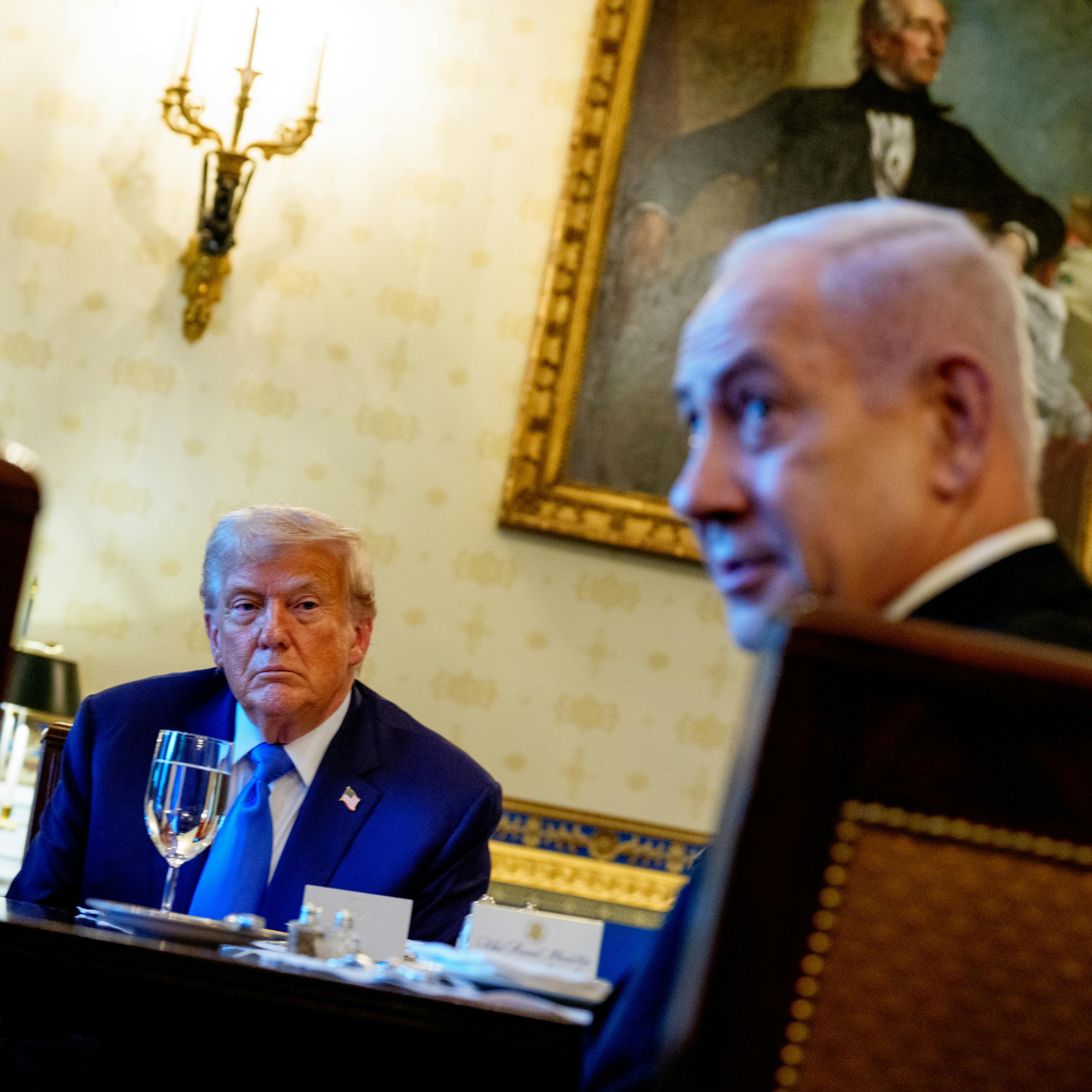
Israel's defense minister announced plans yesterday to move displaced Palestinians into a, quote, humanitarian city on the ruins of Rafah. This sounded to a lot of people like plans to create an internment camp. The war goes on. Five Israeli soldiers were killed in Gaza today. The IDF continues to fire on Palestinians who are just trying to get food. To all of this add another casualty. Irony. Israeli Prime Minister Benjamin Netanyahu had dinner at the White House last night and made this startling gesture.
- [00:35]
Donald Trump
So I want to present to you, Mr. President, the letter I sent to the Nobel Prize Committee. It's nominating you for the Peace Prize, which is well deserved and you should get it.
- [00:47]
Joe Biden
Thank you very much. This, I didn't know. Wow.
- [00:51]
Noel King
Coming up on Today explained, President Trump badly wants the Nobel Peace Prize and he thinks getting a ceasefire in Gaza will land him one.
- [01:01]
CVS Caremark Ad
Support for this show is brought to you by CVS Caremark. You know the saying less is more? Well, with CVS Caremark, it changes to more for less. With more care, more guidance and more expertise, CVS Caremark helps your plan members spend less on their prescription drugs. CVS Caremark leverages their scale to negotiate lower net costs for medications every day. And that's exactly what your members can count on from CVS Caremark more ways to maximize their benefits. Go to CMK CO Stories to learn how we help you provide the affordability, support and access your members need.
- [01:42]
Lululemon Ad
This is the way it feels to move through summer in Lululemon. Iconic aligned softness without the front seam for our smoothest look and feel ever. Summer won't know what hit it. Stretch your limits in the non stop flexibility of the new Lululemon. Align no line pant in select stores and@lululemon.com.
- [02:12]
Joe Biden
The Golden Age of America begins right now.
- [02:15]
Noel King
On explained, I'm Noel King alongside John Hudson. He's a national security reporter for the Washington Post. John, President Trump over the past 48 hours has been saying that a ceasefire deal in Gaza is close. Why do you think he's saying that?
- [02:31]
John Hudson
He's saying that because the United States is making another go at it. They have put together a ceasefire proposal that the Israelis have agreed to. Hamas has a number of objections to it. So then the Qataris and the Egyptians, the interlocutors, have worked on a bridging proposal to put it closer to something that Hamas might agree to. This deal would be a 60 day ceasefire. During that 60 day period, it would provide a sort of calm in which they'd be able to negotiate an end of the war. It's also a Time when they would release approximately 50 Israeli hostages, of which 20 are believed to be alive, 30 of them dead, but they would deliver the bodies. The sticking point has always really been whether or not this would be a permanent end to the war. Hamas does not want to give up its remaining hostages, which is pretty much its only form of leverage, if it is not going to result in a permanent end to the war. The Israelis have always wanted to hold out an option to continue to resume military action. The Israelis would like an agreement with which Hamas would agree to leave Gaza. And it's always been the firm desire of Hamas leaders to remain in Gaza, even if it means that they will lose their lives.
- [04:05]
Noel King
What you just laid out has been the case for a while now. The sticking points have been the same for a while now. What is new in July of 2025?
- [04:17]
John Hudson
What's new is that there are just new levels of desperation, both for Hamas and Palestinians who are in Gaza. The amount of food getting into Gaza is far insufficient to meet people's daily needs.
- [04:40]
Michael Koplow
We in Gaza have no flour. Every day for 24 hours, they tell.
- [04:44]
John Hudson
Us there are trucks coming, and we come and find nothing. We eat the sand. We have no food. We have no food. There is malnourishment. Children's hair are thinning out. In some cases, their teeth are falling out. They're not getting enough food, water, and medicine. I'm waiting for the crossings to open so I can be treated abroad, she says. If you look at Hamas principal backer, Iran, it has had its proxy forces decimated. Hezboll is a shell of itself. In Lebanon, the Houthis have come under attack by both the Israelis and the United States, and the leadership of Hamas has been decimated. The hope among the Trump administration is that the main factor that has changed is that Hamas is in a much weaker place. And so it may make concessions that it wasn't willing to make before. You know, from the skeptics that I've talked to, Arab diplomats who were working on this issue for nearly two years has been that while that could be the case, it may also be the case that Hamas has long ago decided that this cause, this mission that they are on is more important than any other. You know, material conditions and setbacks that they're facing. And they've. They've long ago prepared to die in Gaza if that's what they have to do.
- [06:33]
Noel King
All right, so we have this meeting between Trump and Netanyahu in D.C. a recognition maybe, that things in this war are just getting worse and worse. And worse, we also have meetings in Qatar. What's happening in Qatar and what is the United States role there?
- [06:49]
John Hudson
Yes, in Qatar you have what's called proximity talks between the Israelis and Hamas with which they're often in the same hotel but in different rooms. And you have interlocutors, you know, passing messages back and forth and trying to come up with some sort of an agreement.
- [07:10]
Lululemon Ad
A glimmer of hope for those on both sides of the conflict. As indirect negotiations on a potential ceasefire get underway in Doha, Hamas made demands.
- [07:20]
Noel King
About where the Israeli troops will redeploy to. And also they asked for guarantees about a non return to fighting at the end of the initial 60 day period.
- [07:32]
Lululemon Ad
Some of the amendments being sought by the militant group have already been dismissed by the Israeli Prime Minister as unacceptable to Israel.
- [07:40]
John Hudson
The White House announced yesterday that Steve Witkoff, President Trump's top envoy, it plans to travel to Qatar to help push along talks. The thinking is that if someone as senior as Wyckoff is going to travel there, that this must be particularly important and that there could be a place for a breakthrough. Wyckoff may actually be the President's only true sincere friend. They have known each other for many years. You know, Witkoff was the first person that Trump relied on for negotiating the first ceasefire that was achieved. Right. You know, just hours before Trump took office. That was done in part with the Biden administration. And that was what gave Trump so much confidence in Witkoff and Witkoff's abilities.
- [08:42]
Michael Koplow
Hamas has to go. They've got to leave and we're going to. The negotiation will be around that.
- [08:48]
Joe Biden
I would say physically, that's correct.
- [08:53]
Noel King
Netanyahu didn't just come into town to have dinner with President Trump. He's going to be here for a couple days in Washington. What else are you watching for on this trip?
- [09:02]
John Hudson
If there is some sort of new phrasing or some sort of new like way that the Trump administration is going to push the Israelis to form a more concrete promise that when they start negotiations, that this new deal is not going to end how others have failed, which is you start negotiations.
- [09:27]
Ira Glass
We have breaking news for you. Coming out of the Middle East. Israel and Hamas have agreed to a ceasefire and hostage deal.
- [09:34]
John Hudson
After 15 months of war, Hamas begins to release hostages.
- [09:39]
Michael Koplow
Three women have just been released by Hamas after nearly 16 months in captivity.
- [09:45]
Joe Biden
So hopefully you can hear me. There is a lot of music. There are celebrations going on here in.
- [09:51]
John Hudson
Tel Aviv and then at some point the Israelis resume military hostilities.
- [09:56]
CVS Caremark Ad
Israel's military says it is targeting Hamas with new airstrikes in the Gaza Strip.
- [10:01]
Noel King
Hamas says it means the ceasefire is over.
- [10:04]
John Hudson
That's essentially the dynamic that Hamas wants to prevent from happening. And I think without that, without more concrete promises, it's unlikely that any deal is going to happen.
- [10:19]
Noel King
Hmm. It sounds like a joke, but a ceasefire in Gaza would be an enormous achievement and President Trump would take the credit. Do you think he could get that Nobel Peace Prize?
- [10:35]
John Hudson
You know, it certainly, if he were to successfully wind down this war, it certainly would be a significant achievement. Whether or not the Nobel Committee would award it to someone like Trump, I think is a real question. And I think it's also a big question of whether or not they'd be willing to afford it to the United States, which has been a key actor in sending weapons and support to Israel. You've also had people with less than savory reputations win Nobel Peace Prizes in the past as well. So it's certainly a long held goal of the president. But anyone who successfully ends this war would likely be under consideration. But given that the killing continues and the violence has not subsided, it's too early to start thinking about, I think, nominations or acceptance speeches.
- [11:48]
Noel King
John, thanks so much for your time.
- [11:49]
John Hudson
Yeah, appreciate you guys.
- [11:51]
Noel King
John Hudson is a national security reporter for the Washington Post. Coming up next, Trump and Netanyahu. Who needs whom more?
- [12:09]
Joe Biden
Foreign.
- [12:24]
Noel King
You're earning points on everything, probably. Why not? Also on your rent. Built Rewards says they can let you earn points on your rent. There is no cost to join and you can unlock flexible points that you can transfer to hotels, airlines, rent, Lyft, so much more. When you pay your rent through bilt, you unlock two benefits. First, you earn valuable points on the rent you just paid through bilt. Second, you gain access to exclusive neighborhood benefits in your city. Extra points on dining out post workout shakes. Unique experiences available only to Built members. When you're ready to travel, they say Built Points can be converted to your favorite miles and hotel points around the world. You can start paying rent through BUILT and take advantage of your neighborhood benefits by going to joinbuilt.com explain. That's J-O-I N B I L T.com explain. Make sure to use our URL so that they know we sent you. Join Bilt.com Explain to sign up for Built Today.
- [13:25]
Ira Glass
This is Ira Glass on this American Life. Sometimes we just show up somewhere, turn on our tape recorders and see what happens.
- [13:31]
John Hudson
If you can't get seven cars in 12 days, you gotta look yourself in the mirror and say, holy, what are you kidding me?
- [13:38]
Ira Glass
Like at this car dealership trying to sell its monthly quota of cars and it is not going well.
- [13:43]
John Hudson
I just don't want one balloon to a car. Balloon the whole freaking place so it looks like a circus.
- [13:48]
Ira Glass
This is American Life. True stories. Really good ones every week. Listen wherever you get your podcasts.
- [13:55]
Kenny Beachum
What's up, y'?
- [13:55]
Joe Biden
All?
- [13:55]
Kenny Beachum
It's Kenny Beachum. The 2024, 2025 NBA season is over, but all that means for us is that the 2025 sixth season is already beginning. On Small Ball, we'll be talking about breaking news, major trades, and all the exciting developments the offseason has in store. Which teams are tearing it down, who is retooling to make a championship push, and what teams are leaving me dumbfounded by their lack of direction. Don't miss Small Ball with Kenny Beacham. New episodes drop every Friday. Available on YouTube and wherever you get your podcasts.
- [14:27]
Noel King
You are listening to today Explained Michael, why don't we start this way? Go ahead, give me your full name and tell what you do.
- [14:35]
Michael Koplow
Michael Koplow, and I am the Chief Policy Officer at Israel Policy Forum.
- [14:39]
Noel King
Donald Trump and Benjamin Netanyahu have run hot and cold on each other since Trump took office in January. At least that appears to be the case. Where do things stand between them right now?
- [14:51]
Michael Koplow
Right now, it seems that their relationship is at the high point of what's really only been six months of this term for President Trump. And we've seen ups and downs over the course of their relationship historically. But even in the past past six months, we've seen significant ups and significant downs. On the one hand, this is now Prime Minister Netanyahu's third visit to the White House in President Trump's second term. And that would indicate that these two men have a closer relationship than any other two leaders on the face of the planet. But these visits have not always been so harmonious and they've not always been so great for Prime Minister, particularly the second visit. On that second visit, Prime Minister Netanyahu seemed to be blindsided in the Oval Office in front of cameras by a number of things that President Trump said he was blindsided on tariffs where he had come to Washington ostensibly to try and remove any tariffs that President Trump was going to put on Israel. And not only was he not successful in doing so, President Trump sat in front of the cameras and, and talked about how the United states gives Israel $4 billion a year. And that's a lot of money and it should, it should basically get something in return, don't forget, we help Israel a lot.
- [16:19]
Joe Biden
You know, we give Israel $4 billion a year. That's a lot. Congratulations, by the way. That's pretty good. But we give Israel billions of dollars a year. Billions. It's one of the highest.
- [16:33]
Michael Koplow
He was also blindsided in that meeting, perhaps even more worrisome at the time on the issue.
- [16:41]
Joe Biden
We're having direct talks with Iran, and they've started. It'll go on Saturday. We have a very big meeting, and we'll see what can happen.
- [16:51]
Michael Koplow
Something that Prime Minister Netanyahu was not pleased with and was certainly opposed to. Now we know how that turned out two months later. But at the time, it was seen as a pretty significant signal that President Trump and Prime Minister Netanyahu were not on the same page.
- [17:15]
Noel King
In addition to that, in addition to the awkwardness of that second visit, during President Trump's last visit to the Middle east, he went to Saudi Arabia, he went to Qatar, he went to the uae. He made a huge production out of those visits, talking about how much he loved the region. But he didn't go to Israel. And many people interpreted that as a snub. Or was it?
- [17:38]
Michael Koplow
I don't think it was a snub. I think that he went to the region because he wanted to come home with high profile, easy, quick, visible demonstrations of US Strength and demonstrating that he could bring deals back home. Ultimately, he thinks of himself as a deal maker. And there were all sorts of trade deals and promises for investment to be found in Saudi Arabia, the UAE and Qatar. Those were not going to be found in Israel.
- [18:10]
Noel King
Hmm. All right, so he took that trip to the Middle east back in May. What's changed since then?
- [18:16]
Michael Koplow
The biggest thing that has changed is the campaign against Iran, where you had 12 days of Israeli strikes on Iranian nuclear and military facilities and personnel. And then you had the very high profile US Strike on the three Iranian nuclear sites at Fordo, Natanz and Isfahan. And in Israel, and certainly within the administration, and I share this assessment, that campaign is viewed as being incredibly successful. And unlike when President Trump traveled to the region, this is a case where Israel presents him with a big and visible win, and he's touting it as much as he can.
- [18:58]
Noel King
Okay, so Israel gives him a win on Iran. And now, as President Trump has won, he's looking for another win. On Sunday, he tells reporters that that a deal on Gaza is close.
- [19:11]
Michael Koplow
Message me on Gaza to Netanyahu.
- [19:13]
Joe Biden
I think we're close to a deal on Gaza. We could have it this week.
- [19:17]
Noel King
What do you think he's trying to telegraph. And what happens if he's wrong? Does he take it out on Netanyahu?
- [19:24]
Michael Koplow
There are two things that President Trump has consistently talked about in terms of his vision for the Middle east and what he wants to accomplish. One was preventing Iran from getting a nuclear weapon. And whether that has now been done definitively or not, President Trump is certainly treating it as if this is mission accomplished and Iran is now not going to get a nuclear weapon.
- [19:47]
Joe Biden
The one was a big one and it was deep in granite, and it was obliterated. It turned out the Atomic Energy Commission said it is obliterated.
- [19:56]
Michael Koplow
The second thing that he's consistently talked about is bringing the fighting in Gaza to an end and expanding the Abraham Accords and bringing other countries into the circle of normalization. All of which I think in his mind, is supposed to lead to the Nobel Peace Prize, which really, I think is the goal that he seems to put above almost anything else in the realm of foreign policy. And to accomplish that second one, he needs Prime Minister Netanyahu to go along with what he wants, because there is no world in which the fighting in Gaza will end unless Prime Minister Netanyahu agrees to do it. If Prime Minister Netanyahu does not go along with it, there may be consequences, and it may be that President Trump eventually moves on. I think that what we're seeing right now from Prime Minister Netanyahu is an effort to really extend the clock. And so the first part of this is a potential 60 day ceasefire in Gaza that will not bring a permanent end to the war, but will give President Trump the opening that he seeks at the moment. And if this negotiation is successful, then it also buys Prime Minister Netanyahu two months to figure out whether he wants to keep it going or whether at the end of 60 days, the fighting in Gaza will resume. And I think for. For him, he likes extending his options as much as he can. And so buying this time will be important, and it will allow him to give the president something that. That the president is really demanding from him, and that should keep the heat off, at least for a little bit.
- [21:32]
Noel King
These two men have different motivations when it comes to the Palestinian people. Netanyahu doesn't seem to care about Palestinians. He cares about Israel's security. Trump wants a deal in Gaza because he likes doing deals. Do you think that Donald Trump cares what happens to the Palestinian people?
- [21:50]
Michael Koplow
When President Trump speaks about Palestinians, certainly during this term in office, he tends to do it with a degree of empathy that we don't always see from him on other issues, we're looking at.
- [22:04]
Joe Biden
Gaza and we got to get that taken care of. A lot of people are starving. A lot of people are. There's a lot of bad things going on.
- [22:11]
Michael Koplow
It's pretty consistent when he talks about Gaza. For him to talk about the fact that Palestinians are suffering and that they.
- [22:19]
Joe Biden
Deserve better, they deserve a far better life. They deserve the chance to achieve their extraordinary potential.
- [22:27]
Michael Koplow
So we don't often hear that sort of language from Prime Minister Netanyahu and from many Israeli leaders. And the problem is that for any real resolution to Gaza, you need some sort of political vision. And President Trump often talks about how Palestinians deserve better lives and should have better lives. But it's rare to hear him talk about how he thinks they will get there politically as opposed to this just being a quality of life issue. And we saw it when he announced his Gaza Riviera plan during that first Netanyahu trip to Washington. And we saw it again even last night when President Trump got a question about two states.
- [23:14]
CVS Caremark Ad
Do you think that there can be.
- [23:15]
Lululemon Ad
A two state solution that creates an independent?
- [23:18]
Michael Koplow
And he didn't answer it. He punted it to Netanyahu.
- [23:21]
Joe Biden
I don't know. I asked maybe that question. You have the greatest man in the world to answer that age old question. Two state. Go ahead, give him your honest answer.
- [23:30]
Michael Koplow
Netanyahu made it very clear that Israel does not see a Palestinian state as part of the Israeli Palestinian political future.
- [23:41]
Donald Trump
I think Palestinians should have all the powers to govern themselves, but none of the powers should threaten us. That means that certain powers, like overall security, will always remain in our hands.
- [23:54]
Noel King
So both Trump and Netanyahu need this relationship. Trump needs Netanyahu. Netanyahu needs Trump. Who needs who more do you think.
- [24:03]
Michael Koplow
Netanyahu absolutely needs Trump more than Trump needs Netanyahu. The things that Trump wants right now from Netanyahu are things that would be nice to have. He wants to expand the Abraham Accords. He wants to have better coordination throughout the region. He wants his Nobel Prize prize. But ultimately, the United States has lots of other issues on its plate. The United States is a global superpower, whereas Israel is not. And the United States can work on all sorts of other things. Even if the Trump Netanyahu relationship turns out to be poor and the coordination turns out to not be what President Trump wants from Prime Minister Netanyahu side, the United States is indispensable. And there are all sorts of things that he wants that he has to have President Trump for. We saw this in practice with Iran, where Israel embarked on airstrikes on its own. But it was clear from the beginning that it needed the United States not only to buy into what Israel was doing, but to actually step in and act. So ultimately, Prime Minister Netanyahu cannot afford to be on President Trump's bad side. And I think that that's going to cause him some difficult choices ahead when it comes to Gaza, where there's no question that President Trump wants that war to end. Prime Minister Netanyahu also may want it to end, but he wants it to end on very specific and narrow terms. And if the two men end up crosswise on that question, Prime Minister Netanyahu really cannot afford to get into a rift with President Trump.
- [25:48]
Joe Biden
From.
- [25:50]
Noel King
Michael Kaplo of the Israel Policy Forum. Michael, thanks so much for your time.
- [25:54]
Michael Koplow
My pleasure. Thanks for having me.
- [26:02]
Noel King
Today's episode was produced by Avishai Artsy and Peter Balanon Rosen. It was edited by Miranda Kennedy and fact checked by Laura Bullard and Gabrielle Burbe. Our engineers are Andrea Christin's daughter and Patrick Boyd. I'm Noel King. It's TODAY Explained.