Loading summary
Transcript92 lines
- [00:02]
Noel King
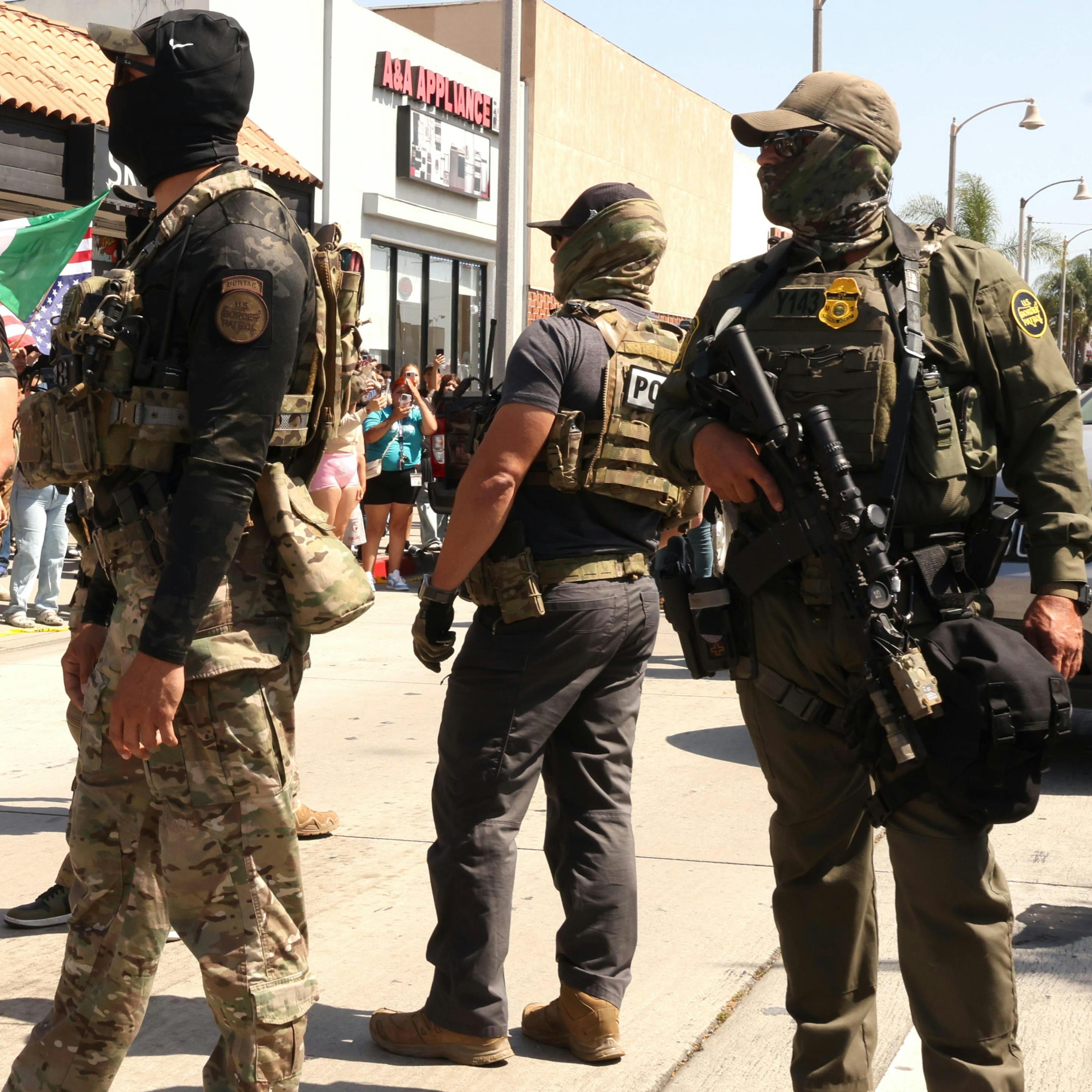
Way back in March, you might remember, a Turkish graduate student at Tufts was approached on the street by ICE agents who took her away, screaming. It was unsettling. And it was made more so by the fact that those agents were wearing masks, which people pointed out was not normal. But it is normal now. We're seeing this more and more often. Attorney General Pam Bondi was asked about it in a Senate hearing last week and she was kind of like, oh, no kidding, they're wearing masks.
- [00:28]
Philip Bump
And Senator Peters, that's the first time that issue has come to me about them.
- [00:33]
Katherine Van Arendonk
Cover.
- [00:34]
Philip Bump
You're saying that law enforcement officers, when they cover their faces.
- [00:37]
Noel King
Right. But she recovered very quickly and she remembered something.
- [00:40]
Philip Bump
They're being threatened. Their families are being threatened. You know, it's, it's again, I get that. But they have to identify themselves as.
- [00:47]
Noel King
Law enforcement, but they don't have to identify themselves and they're not. And why that concerns so many people is. Coming up on Today Explained.
- [01:00]
Katherine Van Arendonk
Marketing to small businesses. With Intuit SMB Media Labs, you can connect to millions of small businesses across new and established channels like Social Programmatic and ctv. With first party audiences, target by industry size, maturity, location and more. And connect with the companies that need you most. Do more with tailored insights from Intuit SMB Media Labs. Learn more at medialabs.intoit.com this is the way it feels to move through summer in Lululemon Iconic aligned softness. Without the front seam for our smoothest look and feel ever, Summer won't know what hit it. Stretch your limits in the non stop flexibility of the new Lululemon Align no line pant in select stores and@lululemon.com this is today Explained.
- [02:04]
Noel King
I'm Noel King with Philip Bump Phillips, an opinion columnist for the Washington Post. You've been writing about these videos that show masked agents grabbing people. Who are they? What is going on?
- [02:17]
Philip Bump
Yeah. So who they are is almost definitionally unknown because they don't identify themselves. Right. There's no reason to think they're anyone but federal law enforcement. But one of the things we've seen in the second Trump administration is that a lot of other federal agencies have been looped into these enforcement actions. So we know that a lot of them are ice, Immigration Customs Enforcement. We know too that there are other agencies that have been working with ice. But the question of who the individuals are is an outstanding one. We don't know who a lot of these individuals are, which I think is important. Right. I mean, it's not just that there's sort of A way things are done, and it's not done that way anymore. What we're seeing is a fundamental shift in the compact between the public and law enforcement. And by shielding their identities, we lose an element of that accountability beyond just ICE and the Trump administration having no interest in being held to account on this. These individuals, we don't know who they are. So when we see videos of them assaulting someone, for example, there's no way to adjudicate that. There's no way to say this person made these decisions, because we don't know who these people are, necessarily. And that's a significant shift as well.
- [03:21]
Noel King
This is making people uncomfortable. I've noticed even people who are pro deportation of undocumented immigrants. ICE Director Todd Lyons has been asked about this, and he recently said that.
- [03:31]
Philip Bump
People are out there taking photos of the names, their faces, and posting them online with death threats to their family and themselves. So I'm sorry if people are offended by them wearing masks, but I'm not going to let my officers and agents go out there and put their lives on the line and their family on the line because people don't like what immigration enforcement is.
- [03:53]
Noel King
So he's saying they're doing this because they have to. Does your reporting suggest that ICE agents who are unmasked are facing threats?
- [04:01]
Philip Bump
That is what he's saying. And he is also saying that there has been a 413 or more recently, 500% increase in the number of assaults on ICE officers. And I think it's important to recognize he's conflating three different things there. It is the case that people are trying to document who ICE is and where they are so that immigrants can be attentive to the fact that ICE may be in their neighborhoods. You know, this is something that we've seen, these sort of grassroots efforts to alert people to ICE's presence. There's a big gap between identifying where ICE is and who ICE officers are and issuing threats against them. There have been some examples of ICE officers facing threats. When I first wrote about this in May, Lyons actually wrote a response in the Washington Post, and he said, oh, well, look at this case in Texas where someone had made these threats against ice.
- [04:45]
Noel King
Now we are turning to a developing story. A North Texas man is now in custody and accused of threatening the head.
- [04:51]
Philip Bump
Of Homeland Security along with ICE agents.
- [04:54]
Katherine Van Arendonk
Federal officials say he also threatened several Republicans and even taunted the FBI to come and get him. So they did.
- [05:01]
Philip Bump
What's interesting about that case, as I wrote last week, is that in that case, the person appears to have been responding to the fact that the ICE agents were masked. He was responding to the fact the ICE agents appeared to be acting without accountability. That's no excuse for issuing threats, certainly, but it's important context. But then we get to this number, this 413% or 500% or whatever they're saying. It's. Now, they refuse to give me any sort of rationalization for where those numbers came from, but when you consider those numbers, it makes sense. It's not good, but it makes sense that if you are engaged in a lot more enforcement actions and you're encountering people and trying to, you know, physically detain them, you're going to have more instances in which officers are being struck or assaulted. And we've seen that the definition of assault that's being used here is often very loose. The City Comptroller of New York City, Brad Lander, faced potential charges of assault after he was arrested. And if you've seen the video of that encounter, it's very clear he wasn't assaulting anyone standing right here in the hallway. I asked to see the judicial warrant, but to conflate those incidents in which people who are being detained and, you know, there have been criminal charges filed for assault, but a lot of them are, for example, at ICE detention facilities where, you know, the ICE officers don't need to wear a mask because they're, you know, they're obviously ICE staff at an ICE detention facility. But to conflate those assaults and that purported increase in assaults with threats and doxxing or identification simply is not logically viable.
- [06:23]
Noel King
Is it legal for law enforcement to wear masks as they're doing so?
- [06:27]
Philip Bump
This is, it's a fascinating question, and I think people should recognize that it has long been the case that law enforcement is allowed to go undercover. We're all familiar with undercover cops, right? So there are circumstances in which people are allowed to mask their identities. And I have not seen anything which suggests they are not allowed to do this by law. We've seen some efforts to try and actually create the legislation that would mandate that they have their identities known, but none of that has passed yet. Obviously, this is still fairly early on. So we have seen, however, some instances in which law enforcement officers who normally have standards about self identification have seen those standards change. So in Florida, for example, there's an email that went out to state troopers who are participating in raids alongside ice. They were offered instructions that they did not have to maintain the standard, the uniform standard that they usually maintain. That includes having their Names. They were allowed to not display their names under uniforms when engaged in operations with ice. So we've seen some changes to standards that are aimed at anonymizing these individuals, which I think is a remarkable shift.
- [07:35]
Noel King
What might accountability look like? How might it look different if we could see an agent's face and know who they worked for?
- [07:41]
Philip Bump
Well, it depends on what the agents are doing. Right. You know, when I first reported on this, I spoke with Radley Balka, who's done long done fantastic work in this accountability space. And he pointed to an example in which there had been a DEA action that targeted the wrong house. And there were two women that lived in the house that tried to get accountability from the DEA for that. But the dea, because the agents were not identifiable in that instance, the DEA was able to keep shuffling the cards and prevent them from being able to say, hey, what happened here? And get any accountability on their own accord. That's the challenge. It's not the case that we need to know who every single ICE officer is necessarily. It is that if something happens where there needs to be accountability, there needs to be a mechanism for that accountability. And if people are shielding their identities, that mechanism becomes very, very diffic. Particularly when you have the institution itself, ICE and the administration very obviously unwilling to hold themselves to account in any way otherwise.
- [08:39]
Noel King
I wonder then if there's any evidence that being masked is changing the way that ICE agents are conducting arrests.
- [08:45]
Philip Bump
No, it's a fair question. And I think that it's very fair for Americans to assume that the understood lack of accountability, because obviously the officers are very aware that by being anonymous that they have less accountability. Whether or not that is leading to some of the, the heightened tensions that we've seen in these encounters. It may simply be the fact that because there are more encounters, we're seeing more of these incidents. But it's a very fair question to ask.
- [09:09]
Noel King
Many of the downsides are predictable. If a person wears a mask, the accountability is lowered. Are there any unexpected downsides here though?
- [09:18]
Philip Bump
Anyone can put on tactical gear, say they're ICE and go up to people and try and detain them. And we've seen instances of this.
- [09:24]
Katherine Van Arendonk
And new at 4:30, a suspect in.
- [09:26]
Philip Bump
Jail after police say he robbed a.
- [09:28]
Katherine Van Arendonk
29 year old man while impersonating an ICE agent. Philadelphia Police are looking for a man who they say dressed like a federal.
- [09:36]
Noel King
Agent to commit a crime.
- [09:39]
Philip Bump
Here he is caught on surveillance as.
- [09:41]
Noel King
He walked into an auto repair shop.
- [09:43]
Katherine Van Arendonk
Right next to a police station. He apparently shouted immigration and then zip.
- [09:48]
Noel King
Tied a woman who was working there and took off with about 1000 bucks in cash.
- [09:53]
Philip Bump
And it's hard for people to know, like, is this an ICE officer that I have to listen to or is it not? And, you know, I think everyone is worried about an occasion in which someone sees someone approaching with a firearm and responds in kind. And, you know, maybe that's a legitimate law enforcement officer, and maybe it isn't, but this is what we're setting ourselves up for. If these people are not identifiable as.
- [10:14]
Noel King
Law enforcement, and masking may be legal for the agents, but impersonating a federal law enforcement officer, is that a crime?
- [10:23]
Philip Bump
Yeah. That's bad. Don't do that. Okay, if there are two messages, don't impersonate law enforcement and don't assault law enforcement.
- [10:30]
Noel King
All right, so the Trump administration has a broad immigration strategy. How do masked agents. How does masked law enforcement fit into that broad strategy?
- [10:40]
Philip Bump
Well, I think the strategy broadly is they just want to have as many immigrants out of the country as they possibly can. We often qualify that by saying undocumented immigrants, but I don't think that holds anymore. Right. We're seeing the revocation of temporary protected status for groups, people who came to the country legally, interpreters who worked with our troops in Afghanistan. People are now facing deportation who were not only not talked about on the campaign trail, but who were presumed to be in the country, you know, by following the rules and in accordance with American law. So, so in. In. In alignment with that, we are seeing that the people who are engaged in these deportation efforts are feeling completely unbound. Right. That they feel as though they have been given a mandate to sweep up as many people as they can. And there's reporting that suggests they very literally have quotas of who they're trying to target, and that they are empowered to do that through any mechanism that they possibly can. And that's bad. That it is. It is not good to have a law enforcement body in the United States which feels as though it can act without account and sweep up as many people as possible, including citizens, including green card holders, including people who are here on legitimate visas. You know, we have seen lots of people get caught in this dragnet who by no definition deserve to. To face any threat of deportation whatsoever. But that's the challenge, and that's something that has been made very real by the Trump administration.
- [12:10]
Noel King
Philip Bump is an opinion columnist for the Washington Post. Coming up next, a TV critic who started writing about those ICE videos and those bystander videos on what she thinks they tell US.
- [12:31]
Philip Bump
Support for Today explained comes from Vanta. If I could automate 90% of one task in my life. Oh no, they are putting me on this spot. Oh, I like most of the tasks I do. What do I not like? I guess I wouldn't take the trash out. I don't like the alley behind my my house. Maybe if I had a robot I would have them go into the alley behind my house and take out the trash and then pick out some of the trash that's already in that alley because other people aren't doing their fair share in the neighborhood anyway. Vanta says they're a trust management platform that helps businesses automate up to 90%.
- [13:10]
Noel King
Of the work for in demand security.
- [13:13]
Philip Bump
Frameworks like SOC2, ISOs 27, 001, HIPAA and more. Go to vanta.com explain to meet with a Vanta expert about your business needs. That's vanta.com Explain.
- [13:32]
Katherine Van Arendonk
Marketing to small Businesses With Intuit SMB Media Labs, you can connect to millions of small businesses across new and established channels like Social Programmatic and ctv. With first party audiences, target by industry size, maturity, location and more, and connect with the companies that need you most. Do more with tailored insights from Intuit SMB Media Labs. Learn more@medialabs.into it.com this episode is brought.
- [14:05]
Philip Bump
To you by Blink, an Amazon company. Think you're ready for prime day? With up to 50% off Blink Smart Security, you will be with crisp HD video, real time alerts and two way talk, you'll know the moment your packages arrive. Save big on Blink's smart security starting at just $19.99 with the Blink Mini 2 plug in camera shop now at Amazon.com blink.
- [14:35]
Katherine Van Arendonk
You'Re listening to Today Explained. Hi, I am Katherine Vanirendonk and I am a critic at Vulture. I typically cover TV and comedy, although also write about books sometimes when the mood strikes. And one of the great things about working at Vulture and being a critic at Vulture is that you have a remit to cover basically anything that interests you. If you can get an editor interested as well. So so I also like to think of myself as just a culture critic more broadly.
- [15:07]
Noel King
So recently you talked an editor into letting you write a piece about Ice Raid videos. Why did you think it was important to write about them?
- [15:15]
Katherine Van Arendonk
This is something that I started seeing on my social media feeds earlier this year. I know lots of people did. And in the beginning of the year, actually it was one of the Vulture editors who had come to me and said hey, have you noticed this kind of ICE propaganda thing that seems to be taking over it looks a lot like reality television.
- [15:35]
Philip Bump
I'm a federal search warranty Search Apprentices. So whoever that needs to be, I need to asap.
- [15:40]
Katherine Van Arendonk
I write a lot about reality tv. I think about it in a lot of different contexts. And so we were talking about the way that ICE and DHS had started producing these videos that really capitalized on how Americans watch shows like Cops and Live pd.
- [15:57]
Philip Bump
Doors opening, one person, okay, look at your Pierre Que San Gas coming on dossier me running.
- [16:12]
Katherine Van Arendonk
And over time, what I started to notice is that there are all of these bystander videos of ICE raids that are capturing exactly the same kind of events, but that look different, notably different from how ICE propaganda presents them. And so that became a much more interesting way of thinking about what it feels like to be an American on social media, scrolling and encountering all of these videos.
- [16:40]
Noel King
What is the difference that you picked up on?
- [16:43]
Katherine Van Arendonk
There are a lot of differences that are common in most of the ICE videos. You can see the exact same thing that you would see if you were watching a bystander video. You see guys getting out of a truck and they go to collect someone and they often handcuff them or zip tie them and then lead them off into some kind of van. However, ICE videos have this sort of broad tonal range, right? Like, some of them are very straightforward. They look like new. Often they do repost local news footage of the ICE raids. An illegal alien from Guatemala charged with.
- [17:20]
Noel King
Raping a child in Massachusetts. An Ms. 13 gang member from El Salvador accused of murdering a Texas man. A Venezuelan charged with filming and selling child pornography in Michigan.
- [17:33]
Katherine Van Arendonk
These are just some of the heinous.
- [17:35]
Noel King
Migrant criminals caught because of President Donald J. Trump's leadership.
- [17:39]
Katherine Van Arendonk
But then there will also be these ones that are clearly trolling. Like they are meant to be shared by people who think that this is awesome and that this is funny.
- [17:48]
Noel King
I'm conducting surveillance for a possible arrest this morning.
- [18:01]
Katherine Van Arendonk
They will put the Cops theme music under it. There's a video that was posted by DHS about a cartel party. And they're like, we'll bring ICE next time, baby. And it's set to Vanilla Ice's Ice. Ice, Baby. You know, it's memeified. It's trolling. Obviously, bystander videos don't have any of that sort of quality to them because they are records of people being horrified.
- [18:26]
Philip Bump
Where are you taking?
- [18:30]
Noel King
It's out identifying.
- [18:31]
Katherine Van Arendonk
You have to tell us you are kidnapping them. Tell us. We are taking Them. You cannot do this. Stop. But there is this one really important difference that I have seen that holds true through all of the ICE propaganda, which is that they never post videos where there are people around standing on the streets, looking at what's happening and protesting. Almost every bystander video, often it's the person who's filming themselves.
- [19:07]
Philip Bump
No, Mommy.
- [19:09]
Katherine Van Arendonk
You guys cannot take her just because you guys want.
- [19:21]
Noel King
You act like you wouldn't have kids.
- [19:24]
Katherine Van Arendonk
Often it's other people who have, like, come out of houses or come out of businesses on the surrounding block will be standing there around all of these vehicles, around the ICE agents, and they'll be expressing how furious they are, often with all kinds of terrible words. And. And they are screaming and they are yelling and they are trying to block traffic. You, get out of here.
- [19:50]
Philip Bump
Hey, don't hurt him. You don't need to hurt him.
- [19:53]
Noel King
You know what?
- [19:54]
Katherine Van Arendonk
You were immigrant, too.
- [19:56]
Philip Bump
Your family was an immigrant, too. You.
- [19:59]
Noel King
None of you are Native.
- [20:00]
Philip Bump
None of you are Native American. You all started out as immigrants.
- [20:05]
Katherine Van Arendonk
Remember that. Rem that.
- [20:07]
Philip Bump
What part of Europe are you from?
- [20:09]
Katherine Van Arendonk
That's what never shows up in the ICE propaganda videos.
- [20:13]
Noel King
I was watching a lot of. Lot of these videos this afternoon, both the bystander and the official ones. And ICE clearly wants us. The official narrative clearly, is this is happening effortlessly.
- [20:27]
Katherine Van Arendonk
Yeah.
- [20:27]
Noel King
But then, my gosh, some of these ones that are taken in the streets, you see the fight. You see the person pushed down on the hood of a car. You see the person's kids screaming. Somebody's being dragged away. And notably, the ICE agents have their faces covered. And you think, well, if it was effortless, y' all would not be wearing masks. What do you take from the attempt to get us to think that this is really simple versus the reality?
- [20:58]
Katherine Van Arendonk
Yeah. They really seem invested in this image of deportation, where the people who are being taken away are not complaining. They are not fighting it. They seem in most ICE videos, people are led away very calmly. Nobody's weeping. It's not like there are people's family members surrounding them. There aren't children crying. But there are plenty of other ICE videos where you can see their masks. You can see that this is how they come into spaces. There's one pretty significant raid that happened at the Glen Valley Foods facility in Omaha, where the local news coverage, which was then reposted by ICE and by dhs, you can see. You can see all of their masks, and you can see the vests, and you can see how inhuman and how terrifying, frankly. All of the ICE Agents look. But you can also see what they show you in that footage that they reposted is like, calm people walking in orderly lines out of this facility. There are bystander videos of that exact same event. And they begin much earlier. They begin with people in the lunchroom crying, calling their loved ones, shouting at the ICE agents. So there's a man who's sitting down in one of the bystander videos, and an ICE agent says, we have a warrant. And the guy says, here's my bag of fuck. And, like, this is not something that ever shows up in the ICE propaganda, because they don't want you to know. They have no interest in displaying how angry people are about this.
- [22:44]
Noel King
What is the utility of those bystander videos? What are you seeing in them?
- [22:48]
Katherine Van Arendonk
I think there's a huge utility. And I was really. I did not feel this at first as I was watching more and more of these, though I was so taken with how many of the bystander videos actually don't show anything at all. Like, it will be a guy in a car, and he's driving down the block, and he has spied, spotted what are clearly ICE video, ICE trucks parked down the block.
- [23:13]
Philip Bump
Hey, where's your warren? Where's your Warren?
- [23:17]
Katherine Van Arendonk
No, you give me your badge and your name.
- [23:21]
Philip Bump
You guys have no warrant, no probable cause.
- [23:24]
Katherine Van Arendonk
Shame on you guys.
- [23:26]
Noel King
Shame on you.
- [23:28]
Katherine Van Arendonk
And it's just people trying to say, like, I don't know what this is, but I hate it. And I need everyone to be with me on it. I think are also so powerful because it is so easy to watch how effortless this kind of thing appears to be when ICE posts it, and to feel so powerless in response. And instead, when you watch all these Bystander videos, you feel like, all right, this is. At least here's a thing I can do. I can be mad about this. I can yell at those guys. Maybe I can try to block their traffic a little bit. I can tell other people about how I feel about it. And at least I will be less alone. And we will all know that, like, this is a thing that you are not alone in feeling that this is how people are responding. And you can, too.
- [24:14]
Noel King
You had to watch a lot of these videos for your piece. Is there one of them that you're having trouble forgetting?
- [24:18]
Katherine Van Arendonk
There are a lot I've been having trouble forgetting. But the one that I really struck on and sort of became the endpoint of that essay was a video that was not particularly popular yet, although it became much, much popular very shortly. And it was a bunch of roofers sitting up on a roof line. It was filmed by one of the roofers. And it's like a beautiful, brilliant day. He's in Lafayette, Louisiana. They're in the middle of building this roof. It's, like, in pieces around them. And you can see him astride the roof line. He's like, way up in the sky and he points the phone down and you can see ice agents just waiting for them on the ground. And nothing happens in that video. There's no. We don't see the results of it. And you actually can go later onto his account and see later videos. And what he says in the later videos is like, we were all okay. They didn't take any of us. But thank you all for worrying. And that has really stuck with me.
- [25:39]
Noel King
You can read Katherine Van Arendonk at Vulture. Today's show was produced by Hadi Mwagdi, Miles Bryan and Peter Balanon Rosen. It was edited by Aminah Elsadi. Andrea Christensdotter and Patrick Boyd are our engineers, and Laura Bullard and Gabrielle Burbet. Check the facts. I'm Noel King. It's today, explained.
- [26:04]
Philip Bump
Sam.