Loading summary
Transcript29 lines
- [00:00]
A
This is the Guardian. This afternoon, a horrifying mass stabbing on a London bound train.
- [00:21]
B
Are you noticing your car insurance rate creep up? Even without tickets or claims, you're not alone. That's why there's Jerry, your proactive insurance assistant. Jerry handles the legwork by comparing quotes side by side from over 50 top insurers so you can confidently hit buy. No spam calls, no hidden fees. Jerry even tracks rates and alerts you when it's best to shop. Drivers who save with Jerry could save over $1300 a year. Don't settle for higher rates. Download the Jerry app or visit Jerry. AI Acast. Today.
- [01:02]
A
The train from Doncaster was packed with people heading out on a Saturday night the day after Halloween. About an hour from London, it was suddenly clear that something terrible was unfolding.
- [01:14]
C
Guys suddenly run past going, run, run. There's a guy stabbing literally everyone, everything. At first there was a few of us kind of looking at each other like thinking, was it a joke? Like it's Halloween, I'd be pranking. And then I look at my hand and it's covered in blood. And then I look at the chair and there's blood all over the chair and I'm thinking, o, okay, this is pretty serious.
- [01:32]
A
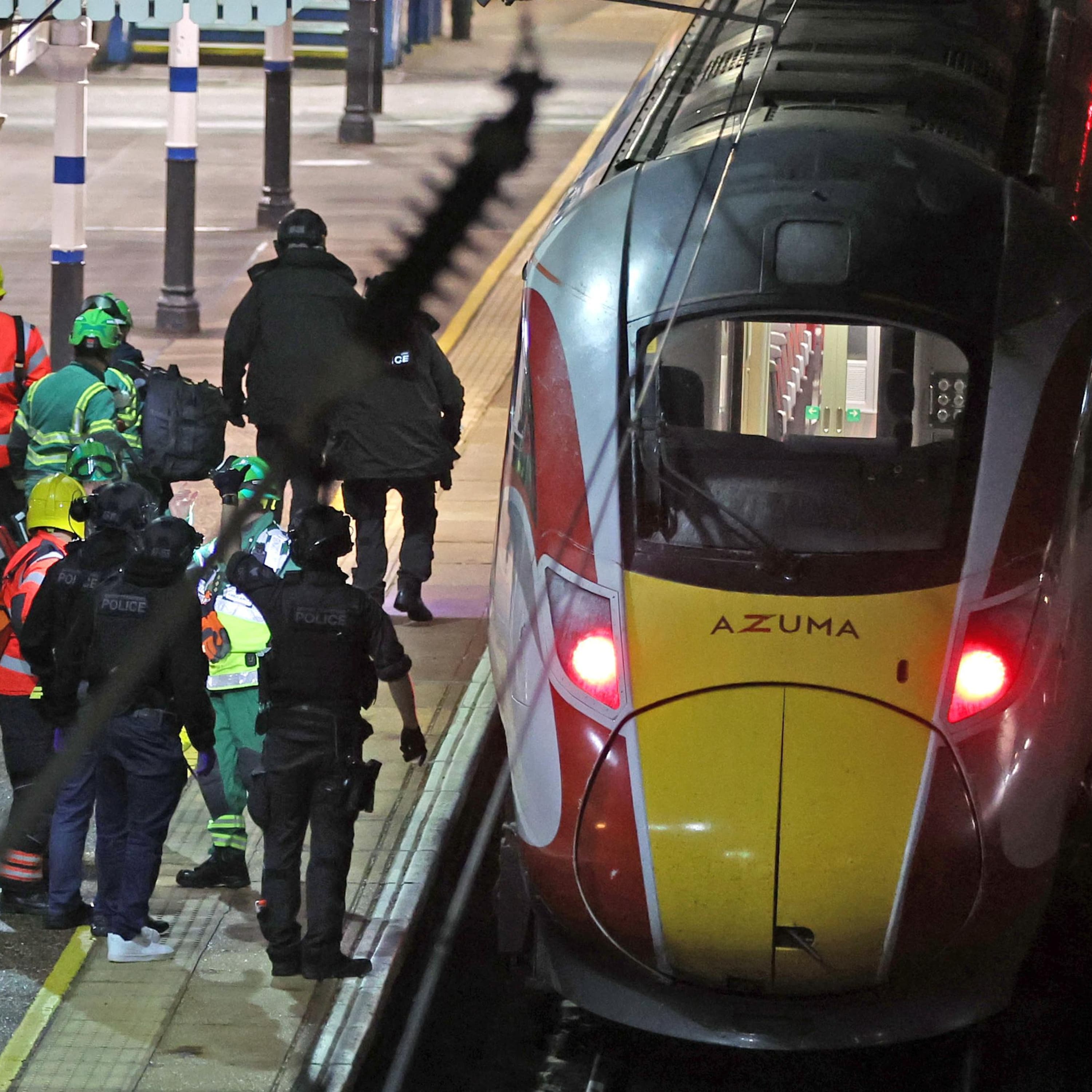
The train made an emergency stop at Huntingdon station in Cambridgeshire where emergency services were able to board and the grim reality of a mass stabbing became clear.
- [01:43]
C
Ten people are in hospital, nine with life threatening injuries after a mass stabbing on a train in Cambridgeshire on Saturday evening.
- [01:53]
A
A 32 year old man has been charged with 10 counts of attempted murder and police are investigating if he could be linked to three other knife attacks on the same weekend. From the Guardian, I'm Lucy Hoff. Today in Focus Extra what we know about the shocking knife attack on a Cambridgeshire train. Ben Quinn, you're a Guardian senior reporter and you've been in Huntingdon reporting from the scene of this terrible attack. First of all, walk me through what we know about what happened on Saturday night.
- [02:30]
C
Well, on Saturday night I think many people would have learned about it via a news flash on their phones. And this was a train which left Doncaster at around about 6.25pm it should have arrived in King's Cross two hours later. But midway through the journey something awful happened. And what we now know is that a man with a knife began stabbing people on this train. And around 10 people have been hospitalized, many of them seriously, and some were released yesterday. But it was a mass stabbing attack off a scale which we haven't seen
- [03:07]
A
for some time and presumably it's a Saturday night, the train must have been packed.
- [03:13]
C
Yeah, I mean, it was a busy liner train from Doncaster to London. Probably had that Saturday night buzz of some people going down to London for the weekend or returning from the north. Students, maybe commuters, some work. It's a very routine experience and obviously the way things are, people are just so jittery at the moment as well about events. This basically immediately was something that went viral and there was a lot of suspicions that it may have been a terrorist attack.
- [03:43]
A
So what we know is that the train was a high speed train, right, that was heading down from Doncaster. But the train driver, in very quick thinking that's been really praised by the police, diverted the train onto a slow moving line. Right. In order that it could pull up and off, could get on. What else do we know about the immediate reaction once it was clear that something horrifying was happening on board?
- [04:05]
C
Well, we know that a message was sent along the train on the Tannoj saying, we are aware of an incident happening and please keep safe. And we've had accounts from people who are on this train about the sheer panic. People began moving from one carriage to the other, trying to barricade themselves into carriages and the emergency services were alerted pretty quickly as well.
- [04:28]
A
So what was it like to be there throughout yesterday as the kind of shock of this unfolded, as the police investigation continued and as I'm sure you were talking to eyewitnesses, people who'd been on the train survived the attack.
- [04:42]
C
Yeah, I mean, Huntington is a commuter town, it's about half an hour's drive from Cambridge and basically it's a small market town. This was an unremarkable train station in the middle of the countryside. When we got there yesterday, the train was still there, it was cordoned off. Forensics were working on it, but it had a sort of eerie kind of calm, basically, which probably was divorced from the panic and the kind of unreality of the night before as well.
- [05:14]
A
We know initially on Sunday, two men were arrested, both in their 30s. One was released without charge after being questioned by police. Another has been charged and has appeared at Peterborough Magistrates Court this morning. The fact that he's been charged means that there are reporting restrictions in place. But tell me what we know about him.
- [05:34]
C
Yeah, I mean, well, we know his name is Anthony Williams, he's 32, he's from Peterborough, of no fixed abode and he didn't enter a plea. But he will be appearing on December 1st again in court and we'll learn a little bit more about his Background at that point, one of the things the police, even before his name emerged, were eager to put out was his ethnicity. He was described as a black British national as well. So we don't know very much about him other than that for the moment.
- [06:05]
A
Yeah. This is striking, isn't it? Because yesterday morning we had a press release from the British Transport police around half 10 that said two men had been arrested, one a 32 year old black British national and the other a 35 year old British national of Caribbean descent. This is new, isn't it? Why would police release details of ethnicity in this way?
- [06:28]
C
Yeah, I mean it's a new post Southport era we are in where if you cast your mind back to those terrible attacks in Southport in which three young girls were, were so brutally murdered, that became such a political issue as well as being a tragedy. And many figures, influencers on the right, on the far right, were very eager to exploit that tragedy and claim that the authorities were holding back details about the attacker. So post Southport there's just enormous pressure on the police to provide that detail.
- [07:01]
A
So to counter disinformation is the reason that this is being done?
- [07:04]
C
Yeah, the idea is to counter disinformation to prevent the sort of vacuum which would be there. And in the vacuum before the ethnicity of this man was released, people were on social media saying definitively this was an Islamist attack, this is a terror attack. And even aside from social media, you had people mainstream, quote unquote, mainstream politicians as well, suggesting something was being held back. So it's designed to counter that sort of misinformation. Whether it did or not, it's another, another matter.
- [07:33]
A
Yeah, yeah, I can imagine that mainstream politician you are thinking of there, but it is quite stark, isn't it, to receive a press release like that, effectively saying two black British men have been arrested. I mean, you can understand why this is perhaps perceived necessary to counter disinformation, but it also fuels other types of racial profiling and stigmatization, doesn't it? Especially as that second man released without charge.
- [07:55]
C
Yeah, I mean talking to, I mean colleagues, older people, people of color, were quite uncomfortable about it as well. It felt like they were being taken back to a different time in British policing as well. And indeed the local Conservative mp, Ben Obesi, Jackie, who I spoke to in Huntington yesterday with at the station, said he, he didn't like it, but he said he understood why it was necessary because in that vacuum misinformation can develop or grow legs.
- [08:25]
A
So in terms of the political reaction we've had calls for increased security on trains, on public transport, at rail stations. We've also had a call from Chris Philp, the Shadow Home Secretary, who's saying the events on Saturday in Huntingdon warrant increased use of stop and search, which we know disproportionately affects young black men. Tell me more about the political reaction to this attack.
- [08:50]
C
Yeah, so that's obviously one where the Conservatives and where the Opposition are very eager to. To leverage and make the most of the fact that, as they would see it, the government's on the back foot in law and order. So the reaction, even before we know many details about this, has been one where people are coming up with prescriptions like that, more stop and search. Maybe we need metal detectors at train stations, maybe we need armed police at train stations in greater numbers as well. But these things are coming at quite an early stage.
- [09:24]
A
And we should say that police are now investigating whether the suspect, Anthony Williams, could be linked to three other knife crime incidents around Peterborough in the 24 hours or so before the train attack. They're continuing with their investigations. But meanwhile, what other issues of security do you think this attack raises moving forward to prevent something like this from happening on trains or elsewhere again?
- [09:50]
C
Yeah, I mean, it's something which opens up perhaps even at a very, well, some might say mundane level, the operations of trains, the move towards driverless trains or maybe trains without a guard on board. I mean, one of the real stories of this has been the heroic actions of a member of staff on the train who did tackle the attacker. And actually, I think one of our colleagues, Wyntopham, Transport editor, was saying, actually it was terrible it happened, but in some ways lucky it happened on a liner train because there are so many other train companies where you wouldn't have had that guard on board. So it throws into the mix again this. This debate about driverless trains, staffing, but also, you know, in terms of the security precautions we take as a society now as well.
- [10:34]
A
Ben, thank you so much.
- [10:35]
C
You're welcome.
- [10:41]
A
That's it for this evening. This extra episode was presented by me, Lucy Hoff. It was produced by Ryan Ramgobin and Eli Block. The executive producer was Zoe Hitch. Today In Focus. We'll be back as usual tomorrow morning. Thanks for listening. This is the Guardian.