← Today in Focus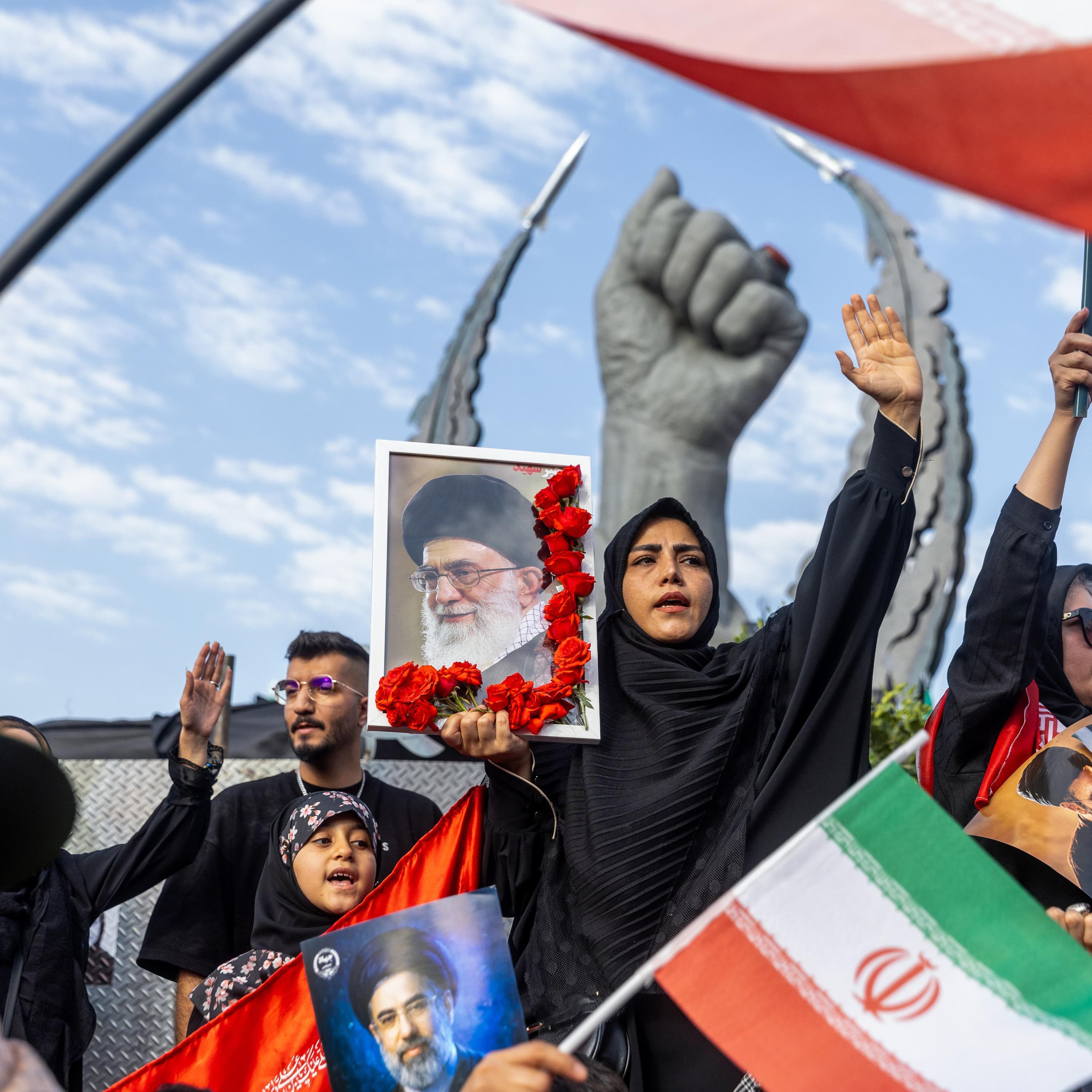
Today in Focus
Iran’s show of strength
00:32:55
Patrick Wintour reports from the funeral of Ali Khamenei as the Iranian regime puts on a show of confidence and resilience.
Loading summary
Transcript59 lines
- [00:00]
Noshi Nikbal
This is the Guardian. Today, has Iran won the war? If you look at the pictures coming from Tehran, the streets completely packed with a procession estimated anywhere between hundreds of thousands and several million people, many of them waving the Iranian flag, you would believe the official line from the Islamic Republic. This is a show of strength and defiance, proof that Iran won't be cowed.
- [00:54]
Patrick Winter
I'm just one dot on those numbers you're seeing in from helicopters. It's definitely very, very large. When I was in the mosque yesterday, it was absolutely rammed, packed and people couldn't get into the mosque. There was clearly more than 56,000 there.
- [01:14]
Noshi Nikbal
The enormous crowds have gathered for a week long funeral for Ayatollah ali Khamenei. The 86 year old had ruled as supreme leader for four decades until he and members of his family, including his daughter and grandchild, were killed in the first day of airstrikes of the US in Israel's war on Iran. In his final weeks, Khamenei presided over the killing of thousands of protesters. The country was bitterly divided. Many had hoped Trump would deliver on his promise to help them. On Thursday, Khamenei will be buried in Mashhad, the second biggest city in Iran, where he was born.
- [01:53]
Patrick Winter
It's kind of two predominant emotions you come across, one of which is incredible remorse, his death. And the second emotion is one of anger and a desire for revenge. Flag saying, kill Trump, kill the Pedo. There's a lot of Epstein island they talk about the whole time and they say he's a child molester. There's a kind of sense that they wanted to show the world that this was a message to the world, not just to themselves. One person said to me, you know, we may not have any missiles left, but we are the remaining missiles. By which they meant they are a kind of human shield for their country.
- [02:31]
Noshi Nikbal
But following a war that appears to have left the regime so confident and resilient, what exactly was achieved and what will it mean for the ceasefire deal? From the Guardian, I'm Noshi Neqbal. Today In Focus. Iran after a war, a deal and a funeral like no other. Imagine the merging of trusted intelligence into a unified experience. Imagine collaboration amongst teams and across continents.
- [03:07]
Robert Malley
Imagine an empowered ecosystem designed to deliver
- [03:10]
Noshi Nikbal
actionable insights that inspire growth and sustainability. That's the power of the Connect Industrial Intelligence platform to help you see further innovate faster accomplishments. That's the Connect effect. Learn more@thatstheconnecteffect.com. Patrick Winter, you're the Guardian's diplomatic editor and you're speaking to us from Tehran, where you're one of 300 foreign journalists invited by the regime to cover the funeral of Ayatollah Ali Khamenei. He was killed in February on the first day of the US and Israel's war in Iran. So why is the funeral only happening now?
- [03:52]
Patrick Winter
Largely because there's been a war going on and it's very difficult to conduct a war and put on a huge operation of a funeral of this kind. At the same time, it's a distraction. And secondly, I think there's a real fear, and it remains a fear that this funeral might be attacked and that if there was a gathering, a collection of all the kind of senior figures in the military, judiciary and political class all in one place, that would be what would be described as target rich environment for Israel. It was really a security reasons. It's not kind of as absolutely chaotic as say, two months ago. I think there was more confidence in the regime than there was. And I think it's been some kind of private understanding, to the extent that there could be any understanding between Iran and America that America will not only not attack this funeral, they'll make sure that Israel Tubeman ties her.
- [04:43]
Noshi Nikbal
You said that there's a lot of security around various figures of the leadership, but are they actually collectively on show? In some ways, yes.
- [04:51]
Patrick Winter
I mean, there was a complete long line of all the most senior figures in the military, the judiciary and religion and politics in front of the caskets yesterday at morning prayers, including the three sons of Ali Khomeini who have not appeared in public. And they appeared together. There had been rumors that they had been killed. There was senior figures in the IRGC who haven't been seen for weeks and months. The one exception to all this is obviously the son of Jabo, I mean, who's not attended any of these public events. And his whereabouts and health remains a mystery. He's sending out written messages quite frequently now, but whether they're genuinely from him, there's been even no audio from him. So it is slightly mysterious as to why they're holding him back so much. Obviously, the. The formal official explanation is security, but it is remarkable that almost every other single figure in Iranian public life has now appeared in public over the past 48 hours or so, and he hasn't.
- [05:59]
Noshi Nikbal
It's worth underlining, I guess, to listeners that of course, he was appointed Iran's supreme Leader after his father was assassinated, and as you said, he has suffered injuries, but to the extent of which we don't really know. And not seen, as you've said. Patrick, you've told us about the. The hundreds of thousands, potentially millions of people who arrived in Tehran for this funeral. How much interaction have you been able to have with members of the public?
- [06:23]
Patrick Winter
Absolutely free to talk to anyone, and often they want to have quite big arguments. I mean, there was one discussion with a cleric in the streets today, operating through a translator. And I don't know for the hell of it, I just started asking him about, you know, why do you still think you need to enrich uranium? What's the point of it? You know, think about all the damage it's doing to your country. He got quite heated and accused me of lying. And I just said, I'm asking questions. And we had to pull out of that conversation pitch. Almost the only conversation I've had where it's gone slightly wrong. I mean, afterwards we all shook hands and it was fine, but there were people starting to throw water and get across. There is a kind of thirst for exchange and communication. People are incredibly friendly. Just go into shops, talk to people. If I hear the words welcome to Iran again, I will go mad. They're very keen that we convey a real impression of what they regard Iran is. And there's lots of different opinions. In Tehran, you meet people who say they didn't really have a great affection for the government or for Khomeini personally, but they do feel an affection and love for their country, and that's a different emotion. And those people were out on the streets as well. I should say that just about, like, two hours ago, when I was on the march, there was a woman who, as I was walking, sort of sidled up to me wearing the full tador. And we were walking at same time. She was being very sort of surreptitious. And she said, there's still a revolution going on here. It's not over. And she said she wanted to talk more, and then she realized that I'm surrounded by handlers, and she just headed off.
- [07:54]
Noshi Nikbal
So even in the crowds, you did actually get these dissenting voices. And you would have expected that. I mean, there's thousands of them in Iran, but actually, they would have stayed away. And instead, what we see is this huge procession. Patrick, what does this show you about the strength of the Iranian regime?
- [08:11]
Patrick Winter
The media narrative from this is already that it has been a success, and that's why they've asked so many journalists to come, is because they want to show the social cohesion and the anger inside this country. But it's more a question of what the balance of forces are, political forces are within Iran, within the government, and it's quite divided. And I think the big question about the political impact of this funeral and ceremonies is whether there's going to be a feeling in the government that they are now more secure, more legitimate, and therefore that they can take a tougher line with America and with Israel and they'll be more uncompromising in the negotiations.
- [08:56]
Robert Malley
Foreign.
- [09:05]
Noshi Nikbal
Robert Malley, welcome to TODAY in focus.
- [09:07]
Robert Malley
Great being here. Thanks.
- [09:09]
Noshi Nikbal
Now, you were a lead negotiator on the 2015 Iran nuclear deal known as the Obama deal or the JCPOA, and were later named as the US's special envoy for Iran by President Biden. We've just heard from Patrick Winter, our diplomatic editor, who's out in Tehran talking to us about the scenes on the streets as people pour out for this funeral, five day funeral of Ayatollah Khamenei. Iran and the US do have the outlines of a deal. What can you tell me about what we know about it?
- [09:43]
Robert Malley
I mean, what we know about it is obviously the text itself, but in essence what it is is an agreement to reopen the Strait of Hormuz, which was something that the US was desperate to see happen for Iran to be able to sell its oil again and to in this case repatriate the funds from the sale of the oil and to agree to negotiate the rest. That's really what it is. We'll see whether the rest gets negotiated and if it's negotiated, whether a deal is achieved. But in essence, it boils down to something which is quite extraordinary when you think about it, because the Strait of Formos were open before war began. And so essentially it was a negotiation and a deal to reopen it on terms that Iran could accept and that the US was prepared to swallow. It does tell you something about the senselessness of this war, but that's where we are.
- [10:31]
Noshi Nikbal
And there's also another thing that's clearly missing, which is the nuclear issue, allegedly the very reason that the US began this war in the first place. What do you make of where that is now?
- [10:43]
Robert Malley
Well, exactly, I mean, that's the point, is that the war was supposedly purportedly waged because the nuclear threat that Iran represented because of other issues as well as we know it, was a moving target of US objectives all the way from regime change to addressing the nuclear issue. The nuclear issue is mentioned in the memorandum understanding. There's some principles that are attached to how the negotiations are supposed to be led, but there's no finality. And there's no detail and there's no assurance that the nuclear issue will be resolved in a way that's satisfactory to both sides. So the deal boils down to an agreement for economic reasons, for political reasons, to open the Strait of Hormuz and to kick those other issues a bit down the road. The negotiations on those issues are supposed to start in a week's time, but we'll have to see whether they could reach a deal or not. And the way the Memorandum of Understanding is drafted, it is very hard to see at this point how they're going to be able to bridge the gap between the two sides. And so it may well be that what you'll have in the end is a deal to reopen the Strait of Hormuz and then, at best, a series of transactions surrounding the nuclear issue that would allow Iran to make some concessions to the U.S. and in return, get greater sanctions relief.
- [11:57]
Noshi Nikbal
Well, given the lack of clarity on the nuclear issue, given the fact that the Strait of Hormuz still is under contention, something that wasn't before the war began, and given the fact that it seems to be a major strategic miscalculation on part of the US does it feel to you like this is an Iranian victory?
- [12:20]
Robert Malley
You know, I don't like this sort of arithmetic. Who won, who lost between the US And Iran, there's no doubt that given their relative expectations at the beginning of the war, Iran comes up, comes out with a stronger hand. And they could say that strategically, they withstood the strongest military in the world, combined with the strongest military in the region, that they're still standing and that they could negotiate terms that were, on paper, more favorable to them than to the United States. The reason I hesitate about talking about who won and who lost is that Iran, it's hard to paint them as a victor when you look at the enormous economic damage that they have suffered as a result of this war, and which is going to take them a very, very, very long time to recover from. And that regardless of what the sanctions relief they're being offered in the Memorandum of Understanding, none of it will compensate for the loss in human life and in material infrastructure that they've suffered. So, yes, they won relative to the U.S. you know, when the dust settles and when the Iranian people and the Iranian government and regime are going to have to look at where things stand, they're going to find it very hard, as I said, to recover economically from the damage they suffered. And so to call them victors is only a relative term in the broader sense everyone has lost from this war.
- [13:52]
Noshi Nikbal
But as a diplomat who worked on the deal that was famously dunked on by Trump and then later ripped up by his administration in 2018, know, even to a lay person, you know, it seems this current deal in its current form isn't any better. How do you compare the key differences between the two?
- [14:09]
Robert Malley
So, you know, I'd say it's really. We're in apples and oranges territory here. There's no real comparison to be made between the two. Now, one is a hundred, several hundred pages of detailed provisions on the steps that Iran would have to take to reduce its nuclear capacity to. To agree to. To very strict supervision inspections by the International Atomic Energy Agency, something that took years to negotiate, detailed sanctions relief from the US from the United nations, from Europe. The other is a page and a half of broad principles that previews what a nuclear deal might look like in very, very broad times, previews very broad and generous sanctions relief, but in essence, doesn't delve into any of them in any detail whatsoever. So they really are not. You can't really compare the two.
- [15:01]
Noshi Nikbal
And this deal has broader implications in the region. When Iran was first attacked, it retaliated by sending a barrage of missiles and drones targeting US Military bases in Bahrain, Kuwait, Saudi Arabia, the uae, Qatar, Oman. What impact has a deal had on US Gulf relations? How have those countries responded to it?
- [15:23]
Robert Malley
Broadly speaking, I think they all thought this was a terrible idea because they knew in a way that perhaps the Trump administration didn't, that Iran would respond by attacking them and by trying to affect international commerce and the passage of the Strait of Hormuz. So they knew it was going to affect them. They argued against the war, the war took place anyway, and then it was waged in a way that didn't take into account their interests at all. I just came back from a trip to the Gulf, and I can tell you they all feel at some level that the US didn't consult them about going into war and then didn't protect them from the impact of the war. The US Protected its own assets as best it could, tried to protect Israel as best it could. Gulf countries came in third. You know, Gulf countries made two wagers over the last, some of them over one wager over decades, the other one more recently. One wager was on the American security umbrella, the notion that to protect themselves against anyone, but in particular Iran, they would rely on American security guarantees. The umbrella protected some more than others and had quite a few holes in it. The other wager was More recent, which was that if we could improve our relations with Iran, try through economic means, diplomatic means, we may be able to protect ourselves from the Islamic Republic. Now, both wagers fell dramatically short, and yet coming out of this war, they're going to have to redouble both bets. Both bets failed. Both bets are the only bets they're left with. On the one hand, they don't have an alternative to American military and security protection. And on the other hand, they have no alternative to their geography, which is they are neighbors of Iran. They can't afford to be in a situation of hostility, of open hostility with Iran, given what they've just experienced. So they're going to both try to get even closer to the U.S. security wise, if possible, and try to restart conversations, dialogue with Iran. And we're seeing that including from countries like Saudi Arabia, like the United Arab Emirates.
- [17:20]
Noshi Nikbal
And then coming back to one of the points of this war which affects all those Gulf countries, which is the Strait of Hormuz. We've talked about it a little bit, but as we said, it wasn't even a point of contention before, before this war began and now has become a defining aspect. It's been closed, it's been partially reopened. There's been naval escorts, there's been a toll proposed. What is the situation on the Strait right now as it stands?
- [17:44]
Robert Malley
I mean, again, all I could go by is sort of press reports. It looks like it is reopened to some extent, but there's some, you know, obviously Iran, what Iran doesn't want, particularly now, is to give up a car that it has acquired as a result of the war. The one, from their perspective, they always are looking for means of deterring attacks. The nuclear program has one deterrent. Their missile program, their drone program. Perhaps the tool they found that is most effective and which they inherited as a result of the war, was their ability to open or shut the Strait of Hormuz and therefore hold the global economy hostage. Even since the Memorandum of understanding was reached, there have been a number of tit for tats over the Strait of Hormuz because the US Was trying to get some of the ships transiting along the Omani coast outside of Iranian control. And Iran obviously didn't want to give up that leverage, certainly in the middle of negotiations over the broader deal. So the Strait of Hormuz is living under the shadow of potential Iranian attacks to try to make sure that they maintain control and that they send the message that if they want to, they could close it again. That's their goal right now. Longer term, a number of countries are looking to see can they bypass the Strait of Hormuz so that they're less dependent on it and less subject to Iranian attacks? That's a longer term project right? Now, again, what you hear from a number of Gulf countries is they dislike to their core, the notion that Iran can assert any form of sovereignty control, any form of payment, whether it's a toll or whether it's anything else. Either way, I think they also recognize that if that's the price to pay in order to keep it open, they might swallow hard and do it, but they're going to fight as hard as they can to a prevent it, or if it occurs, to make sure that it's very limited and that whatever resources Iran derives from it are minimal and shared with other Gulf countries.
- [20:00]
Noshi Nikbal
Robert, from your long standing expertise of Iran, what do you say the impact of this deal will be to the average Iranian person? I mean, is there a chance at the crippling sanctions that have been imposed on the country for decades, some of the most severe in the world, that they could finally come to an end?
- [20:18]
Robert Malley
So you know, what Iran is getting are two things. Greater access to some of its own frozen assets, assets that have been frozen by the US when it left the deal in 2018, and the ability to sell oil at least for a period of two months, the period that has been allocated for these negotiations, which could be extended, the ability to sell this oil and to recover the proceeds from those sales. That significant amount of money, it's peanuts compared to what they lost economically. People are talking about a roughly 10% drop in their GDP as a result of the war. Hundreds of billions of dollars of cost in terms of what they've lost. In terms of infrastructure, anywhere between half a trillion and a trillion dollars. Whatever they're going to get as a result of the memorandum of understanding cannot compensate for the losses they incurred. So when I hear people complain about how much Iran is going to get out of it, I think they need to take a step back and realize that net, net Iran is coming out of this having lost tremendously. Now, yes, the Iranian people will benefit to some extent. Again, they won't recover every a fraction of what they lost if the big deal that is described in the memorandum understanding is reached. And that's a huge if, if you read the words, a lifting of all US sanctions, something that has never been contemplated by any president, whether it's Obama, Biden, anyone else, which is all sanctions lifted, primary and secondary sanctions, so that basically the economic relations between The US and Iran would be as it is between the US and any other country. It's not clear what Iran would have to do in exchange other than its nuclear concession. So it's a very strangely drafted deal, as I've said. But if that were to come to pass, if there was this grand bargain where the US would lift all its sanctions, Iran would take whatever steps it needs to take for the US to be satisfied, then of course, that would have a dramatic impact on Iran's economy. But what is on the table now is important but modest. My guess is we're not going to see this grand deal. We may even see a breakdown. But the best case scenario, the best realistic case scenario, is a series of smaller deals. Iran says we're prepared to accept inspectors in exchange for more sanctions relief. We're prepared to turn over these 450 kilograms of highly enriched uranium, 60% enriched uranium, in exchange for more sanctions relief. So you may get a series of progressively more significant nuclear deals and Iran again would benefit economically from that. But the grand bargain, that's something I think that's more in the world of dreams than of reality.
- [22:58]
Noshi Nikbal
Coming up, will this failed war torpedo Trump's chances in the midterms?
- [23:16]
Boost Mobile Advertiser
He's dribbling the ball with everything on the line. He's driving down the pitch. He's facing price hikes. It cuts past him. Carrier contracts, tries to block him. Oh, he leaves him in the dust. He's at the edge of the box. He cuts past the non stop group chat trash talk. He clears on goal. He shoots. No unlimited data for $25 a month. Forever. Visit your local Boost Mobile store today to get unlimited data with a price that never changes. Boost mobile after 30gb, customers may experience lower speeds. Customers will pay $25 a month as long as they remain active on the Boost $25 Unlimited plan.
- [23:53]
Robert Malley
England are still in the usa and so are we.
- [23:54]
Patrick Winter
Join me, Max Rushton and a host of football experts as we overanalyze every game every day at the World cup, including England's forthcoming quarter final against Norway. It's Haaland versus Gay. It's Herring versus Cod. It's Vikings versus Agonising Tragic failure. The Guardians World Cup Daily available wherever
- [24:10]
Robert Malley
you get your podcasts.
- [24:13]
Noshi Nikbal
Trump announced a $300 billion reconstruction fund for Iran without clarifying where that money would come from. What more do we know about that? And you know, how far would it go to easing any of what Iran's been through?
- [24:28]
Robert Malley
Yeah, so this is one of those promises which are way into The. Well, I don't know, way into the future. But they're more imagination than reality. Maybe it will happen, maybe not. But it's all tied to this final deal, which, as I said, is pretty unlikely to come to pass. We're not doing anything. We're not putting up money. Only if they're doing things right. If they're doing things right. If people want to invest, they can invest. But they had this 300. In theory. I think what the US had in mind was that Gulf countries would contribute to this fund because they're going to want to invest in Iran. And Iran is this country that has huge resources and a huge potential. And so it's a promise that the US can make at no expense to itself, because it's not going to, in theory, it's not going to expend any of its own money. Maybe some, but I don't think that was the thinking. But it could promise other people's money on behalf of, of a deal that those other people had no hand in shaping. None of them at this point has this idea in mind. The notion that the US in negotiation with Iran could announce that other people are going to invest again. If you need a caricature of what the Trump presidency is about, there you have it.
- [25:36]
Noshi Nikbal
And what about the argument that an injection of any kind of economic relief will effectively prove to be a lifeline for the Khamenei regime?
- [25:46]
Robert Malley
I mean, the Khamenei regime, that's Iranian Islamic Republic, has survived under tremendous economic pressure. The notion, and this is a very American. I don't know if it's a Western notion, which is if you strangle an economy hard enough long enough, then the regime will either collapse or surrender. I mean, look at Cuba, look at North Korea, look at Iran itself. It just doesn't work. It just doesn't work. I mean, that's not the way regimes think. They don't think in this arithmetic way, you know, oh, we're suffering more now. Now we're going to give up. Sometimes to the contrary, they think this shows that the US is, is determined to topple the regime.
- [26:24]
Noshi Nikbal
Desperate, even desperate.
- [26:26]
Robert Malley
And we will. If it means, you know, tightening the belts of the people over whom we rule, we will do that. But we're not going to give up. We're not going to surrender. We're not going to collapse. So you still hear people today, sort of what we call in the US the neocons or the hardliners who are saying, oh, if you just, just maintain the maximum pressure sanctions for another Few weeks, another few months, they're going to collapse. The regime is so brittle, there's no indication of it. The other point I'd make, sanctions hurt, but they tend to hurt people that the US claims it wants to help without hurting the people that says that it wants to get rid of. So if you're an Iranian leader, member of the Revolutionary Guard, member of the elite, again, you're probably not doing as well as if there were no sanctions. But you find ways of circumventing it. And then with a black market, you maybe find ways of getting out of it some profit. The people who are suffering are the middle class, the lower class, the people who, in theory, proponents of regime change are purport to help. There's a basic flaw at the heart of sanctions theory. Sanctions work when they have a very specific objective and when the target of sanctions understands that if they compromise on that objective, they could maintain the core of their interests. That's why the Obama JCPOA nuclear deal worked. They had to concede some of their nuclear advances in exchange for tangible benefit, which didn't call into question the existence of the regime. But the kind of, you know, we're going to put sanctions and then the regime will disappear. It's really a recipe for more suffering.
- [27:59]
Noshi Nikbal
And from the perspective of the average Iranian to the average American, what do you think they make of how the war has gone, of Trump's broken promises not to make big foreign interventions and the impact of it on the US's own economy?
- [28:17]
Robert Malley
So, I mean, one of the, I don't know if it's an irony, but it is true that the US economy probably suffered less than most others, even though the US was the instigator of this unlawful war. But that's, you know, maybe it's a sad reality for the rest of the world, but yes, there was a price that was paid. The price of oil, of gas went up. People saw it at the pump. I think that's one of the main motivations that President Trump had to conclude this deal is that he has midterm elections coming up in November. So I think it did send a lesson to this president and future presidents that war with Iran is certainly not what he thought it would be, which is a quick with a stroll in the park where he does the regime. Exactly. So I think they've learned that lesson and hopefully the longer term lesson is that we've now tried several things with Iran. We've tried maximum pressure sanctions, we've tried war, and we've tried diplomacy of those Three, the only one that succeeded at any point was a diplomatic path. Hopefully, that's the lesson. But in terms of the economic cost, and one of the reasons why the war went on as long as it did is that I think President Trump felt that it was more sustainable than others did, and he was prepared to bear that cost.
- [29:29]
Noshi Nikbal
Yeah. I mean, just to say, let's put the economic cost to aside for a moment. I mean, how do you think the average American understands this war? How popular is it? What's the general feeling? How much is it even on the news?
- [29:40]
Robert Malley
So no war, at least since polling has started in American history, started with as low an approval rating as this one. It was unpopular when it began, and its popularity only declined as time went on. I think for most average Americans, they just. The basic facts were staring at them in the face, and they understood that this was not a victory. And you have even some pretty conservative, hardline American commentators who said it and who said the US Lost. We should just limit those losses now and get out.
- [30:11]
Boost Mobile Advertiser
There's no future of the MAGA movement.
- [30:13]
Patrick Winter
Obviously, we're done.
- [30:15]
Noshi Nikbal
This will cause the end.
- [30:17]
Patrick Winter
Yeah, it doesn't. I mean, what is the MAGA movement Trump is defending?
- [30:19]
Robert Malley
I think that also weighed on President Trump to some extent. And there's a division within the Republican Party. You know, there's a strong MAGA wing of the party that believes this war was misbegotten from the beginning. It was a betrayal of everything that President Trump had ran on. It's against the campaign promises that we made in 2024. We're back in another foreign war that has driven inflation and driven gas prices.
- [30:45]
Noshi Nikbal
What happened to America first?
- [30:47]
Robert Malley
Exactly. This was America last. Right. This didn't at all defend the American interests, they would say, and probably exaggerate. This was Israel's war. I think it was Israel's and America's war. So that you did have a strong constituency within the Republican Party for whom this was a betrayal of the values that they thought President Trump campaigned on and stood for. And that division within the Republican Party is likely to persist.
- [31:15]
Noshi Nikbal
Robert, finally, I don't expect you to use as strong language as I might, but, I mean, from everything we've discussed, it's clear that this military campaign was a strategic failure. It actually leaves the US Accepting worse terms than it already had. Is it fair to say that there are at least moments where you must have been chewing your fist, thinking about all the work that you'd done that had just been ripped up to get to this position?
- [31:43]
Robert Malley
So, first of all, I would completely agree with your hard line. This was a strategic debacle for the United States. Again, it doesn't necessarily mean that the US that Iran is standing tall and could look at it and say we won on every front. My hope at this point is that one lesson will be learned, at least by the US side, which is we now have had three experiments in real time dealing with Iran, the jcpoa, that was President Obama. Then you had maximum pressure in the first Trump campaign. We're going to just completely cut off Iran from the world economy and see whether they surrender or collapse. And then war, which people have been dreaming of, the neocons have been dreaming of for so long. Let's just look at the track record of all three. You don't have to love the jcpoa. I think if you're an honest observer, but not everyone is and say that left both sides better off, certainly the US better off than either maximum pressure or war. I'm not sure everyone will conclude that, but I hope that most American officials or future officials will look at that track record and say, you know what, doesn't matter what your judgment is of the jcpoa. It left the US in a stronger, better position to deal with Iran than either of the other two.
- [32:56]
Noshi Nikbal
Robert, thank you so much for your time.
- [32:58]
Robert Malley
Thank you.
- [33:00]
Noshi Nikbal
That was Robert Malley, lawyer and political scientist, and the Guardian's diplomatic editor, Patrick Winter. My thanks to both of them. You can follow Patrick's reporting insideran all@theguardian.com and that's it for today. This episode was presented by me, Noshi Nikbal. It was produced by Alex Atak and Ruth Abrahams. Sound design was by Breen McNamara and the executive producer was Huma Khalili. Lucy will be back in your feeds later today with the latest. This is the Guardian.
- [33:50]
Boost Mobile Advertiser
He's dribbling the ball with everything on the line. He's driving down the pitch. He's facing price hikes and cuts past him. Carrier contracts, tries to block him. Oh, he leaves him in the dust. He's at the edge of the box. He cuts past the non stop group chat trash talk. He clears on goal. He shoots no unlimited data for $25 a month. Forever. Visit your local Boost Mobile store today to get get unlimited data with a price that never changes. Boost mobile after 30gb, customers may experience lower speeds. Customers will pay $25 a month as long as they remain active on the Boost $25 Unlimited plan.