← Today in Focus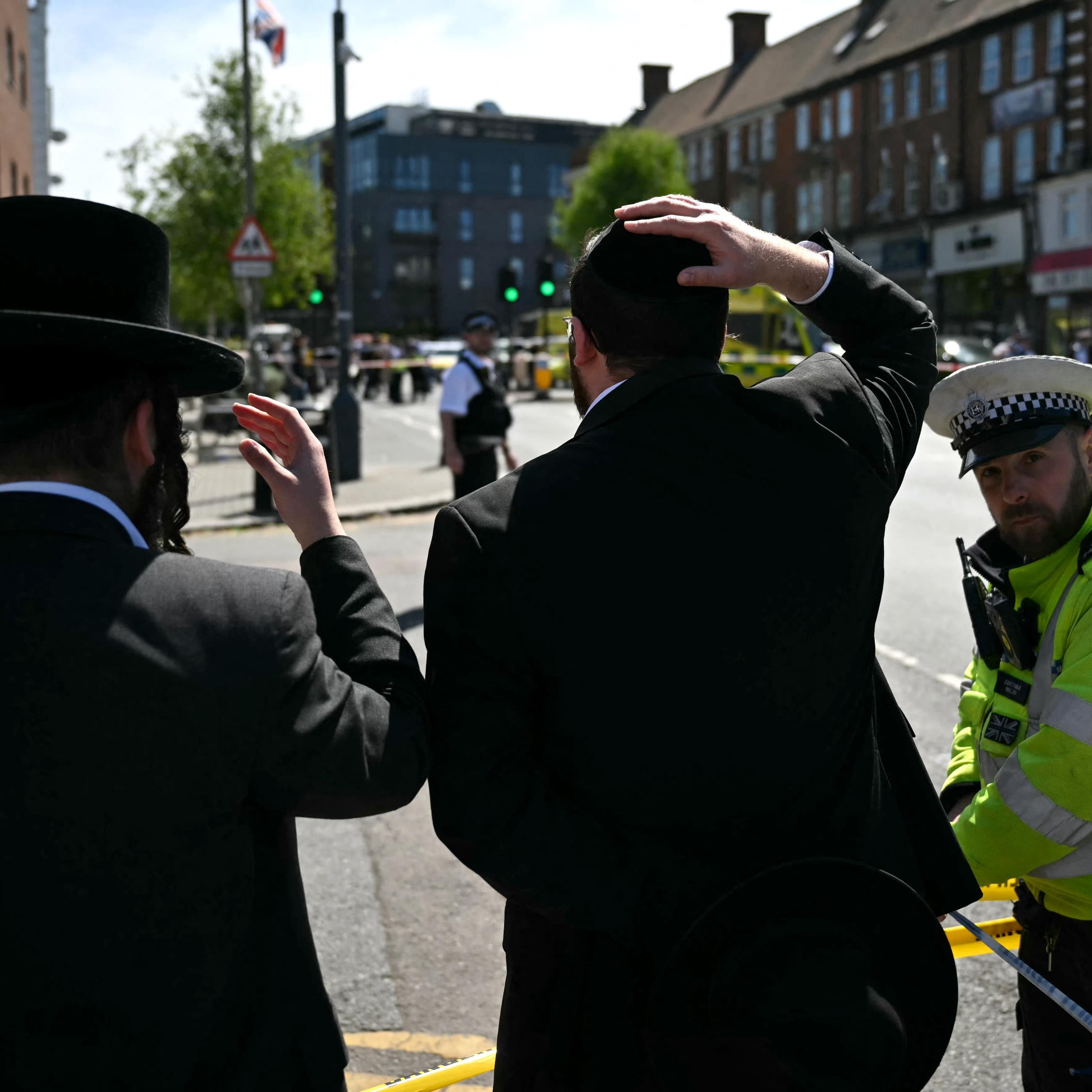
Today in Focus
‘An epidemic’: is antisemitism out of control in the UK? – The Latest
00:14:09
The stabbing of two Jewish men in Golders Green, north-west London, has become the latest in a series of antisemitic attacks. So is rising antisemitism now a national emergency? Helen Pidd is joined by columnist Rafael Behr
Loading summary
Transcript22 lines
- [00:00]
Raphael Baer
This is the Guardian.
- [00:11]
Barclays Brief Announcer
Today's markets move fast. Get the insights you need in 10 minutes with the Barclays Brief, a new podcast from Barclays Investment Bank. Through sharp dialogue and scenario based analysis, our leading experts analyze key market themes each week. So whether you're managing a portfolio or leading a business, the Barclays Brief podcast can help you make smarter decisions today. Stay sharp, stay brief. Find Barclays Brief wherever you get your podcasts.
- [00:45]
Raphael Baer
A sudden acceleration that makes the whole community feel very threatened. And people are talking quite seriously about whether it is safer for Jews to live in the uk. An attack on our Jewish community is an attack on all of us. I'm angry, I'm disgusted. The Jewish people are going to bed frightened. An idea of Jews as a threat has simmered up from a pretty small fringe up through into the mainstream of political discourse and people are acting on that feeling. It becomes a culture war front and in the middle are Jews sitting there thinking we have become a political football for you guys to kick around. And it's exhausting and it's really dispiriting.
- [01:26]
Helen Pitt
Yet another violent anti Semitic attack in the UK with two men stabbed in North London. Is rising antisemitism a national emergency? And is more security for the Jewish community really the answer from the Guardians today? In Focus, this is the latest. With me, Helen Pitt. Joining me today is Guardian columnist Raphael Bair. Thanks for being here, Raf.
- [01:46]
Raphael Baer
It's a pleasure.
- [01:47]
Helen Pitt
So Wednesday saw yet another anti Semitic terror attack in Britain, this time in Golders Green in north London. Two men were stabbed. They were aged 76 and 34, both in hospital, thankfully in a stable condition. One man is in custody, a 45 year old British man of Somali descent. And eyewitnesses said that they saw the alleged attacker chasing people out of a synagogue and attacking anybody who was visibly Jewish. It was an absolutely shocking attack that should disgust us all. But I just wonder for you, as a British Jewish man who grew up in North London, it must hit particularly hard.
- [02:23]
Raphael Baer
It's always strange when something like this happens on streets that you know and are very familiar. And last night I was messaging an old school friend to say, oh, you know that the, the street that more or less you grew up on is in the news for all the wrong reasons. And, and there's a lot of that going on. And that's always the case with any, any terror attack in any context. I think what's particularly poignant or painful about this is the, the sense that there's been a cascade, an epidemic of these things in very Rapid succession. Two synagogues have been attacked. There was the arson attack on ambulances owned by a Jewish charity, an arson attack on a memorial in Golders Green also. So that feeling of a sudden acceleration that makes the whole community feel very threatened and people are talking quite seriously about whether it is safe for Jews to live in the uk. And that conversation, when you see it happening or hear it happening around you, is depressing, frankly.
- [03:20]
Helen Pitt
And as you say, this is not a one off as well as the incidents that you mentioned. There was of the deadly attack on the Heaton Park Synagogue in Manchester, which left two men dead. And I thought it was quite interesting what the government's advisor on terrorism, Jonathan hall, had to say. He said that anti Semitism poses, quote, the biggest national security emergency that Britain has seen in almost a decade. I wonder what you make of that.
- [03:45]
Raphael Baer
I was interested in that framing of it. And the reason is I'm not sure what the underlying concept of national security emergency is there. And I'm not being sceptical, I just think it's interesting. Does he mean that what we've seen in the last few weeks is the expression of an orchestrated campaign, perhaps by a foreign government? There's been suggestions that the Iranian regime has been amplifying this stuff, driving this stuff, and therefore what we're seeing is some kind of terror program being rolled out and that's a serious emergency, which would be true. Or does he mean that over longer periods there has been a normalization and acceptance of hatred of Jews such that lots more people are in danger and that's the national security emergency, which is also a bad threat. But those are different things. Maybe he means both, but I didn't quite understand what the character of the emergency he was describing there was. It's true that lots of Jews in Britain are afraid, but it seemed to me unusual way of describing it.
- [04:45]
Helen Pitt
Yeah. And indeed, Shabana Mahmood, the Home Secretary, when she was asked about this on Thursday, said that she thought that there were sort of particular connotations of the phrase national emergency, that it kind of implies that you'd be suspending democratic, democratic processes. And she felt that we weren't there yet. But the fact that somebody like Jonathan hall was saying something so stark, I think is a sign of just how painful a period this is and just how worried Jewish people are at the moment. And not just worried, actually, but also angry. And you could see that in the crowds of people who turned out in Golders Green on Wednesday night when the Commissioner of the Met Police, Mark Rowley, appeared alongside Labour MP Sarah Sackman, who herself is Jewish. They were both heckled. And Keir Starmer convened a meeting of criminal justice agencies today. And the outcome is that the government has said that they're going to give £25 million extra to Jewish communities to keep them safe. And I just wonder if you think that extra security is really the answer for a community that is already very heavily fortified.
- [05:45]
Raphael Baer
Well, yes. Jewish schools and synagogues and Jewish cultural institutions have operated their own security for a very long time because the threat of attack has been there for decades. Obviously, more subsidy support for that from the government, I'm sure, is going to be very welcome. I do think ultimately the problem we have here is that terrorism is already very illegal. Running around with a knife stabbing people is illegal. Racially aggravated murder is illegal. This pressure that ministers are under to do something, and obviously that's a political inevitability, particularly before local elections, when the whole atmosphere is dialed up that much tighter, doesn't really get to the. I think the deeper problem here, which is that something has seems to have happened, I think very clearly has happened to my eyes, in the last few years in particular, where an idea of Jews as a threat, as an enemy, as a legitimate target for attack has simmered up from a pretty small fringe up through into the mainstream of political discourse. And people are acting on that feeling. Not sure that's a problem that money can solve. I think that's a more subtle, insidious, wider problem.
- [07:01]
Helen Pitt
Yeah. And one of the local rabbis from Golda's Green has blamed the weekly pro Palestine marches. He calls them hate marches. He says that these marches should be banned. But of course, there are hundreds of thousands of people who've attended these demonstrations who would vehemently deny that they were anti Semitic, that there's a difference between criticizing Israeli defense policy and standing up for people of Gaza and actually being an anti Semite. I wonder where you stand on. On the marches question.
- [07:29]
Raphael Baer
This really gets to the. To the crux of the problem head. Generally, I don't think banning demonstrations is the way forward historically. It's not a great way of changing the way people debate issues or changing people's minds about issues. Sometimes marches, there might be a particular security concern. There's ways of organizing them so they don't intimidate particular communities. But the underlying problem here is this very difficult, complex area where there's sort of a nexus between the relationship that a lot of Jewish people have to Israel historically, culturally, through family ties, the actions of the Israeli government Particularly in the last couple of years, some of the rhetoric and the language and the slogans that are used at these marches, and particularly, and I don't want to get too much into the semantics of this, the use of the word Zionism and Zionist in very different contexts. So that for some people, when they say they are anti Zionism or they want to eradicate Zionism, they are using a concept of that word that describes something very specific in relation to actions by the Israeli government or they might have in their heads Benjamin Netanyahu. And for an awful lot of Jews, the word Zionist describes something very different. It's about a sense of identity and the idea that there is a legitimate country called Israel, which is a national homeland for Jewish people. And the idea of eradicating that feels viscerally very threatening. So what we've got here is a sort of a gray area or a spectrum where rhetoric gets dialled up, where anger and animosity, driven by a feeling about injustice, what's happening in Palestine turns into a kind of venomous hatred, which then acquires a lot of the attributes and characteristics of a blanket overall hatred of what used to be called global Jewry and Jewish influence in the world. And suddenly you're in the realms of anti Semitic conspiracy theory. And it's not that easy to say where anyone is suddenly on that spectrum and when they suddenly cross the line. But I can tell you that a lot of Jews feel very clearly that line gets routinely crossed, especially at those demonstrations. And when they point it out, they're told that they're somehow weaponizing anti Semitism or they're trying to shut down criticism of Israel. So that, to me is absolutely the exquisite heart of this problem that has to be analysed calmly and carefully, but perhaps hasn't been understood with enough sympathy by the people who organize these marches.
- [09:48]
Helen Pitt
Right. And I wanted to ask you about remarks that were made by Zach Polanski, the leader of the Green Party, before the Golders Green attack, when he called for a conversation about what he called the perception of unsafety versus actual unsafety for Jews in Britain.
- [10:03]
Raphael Baer
Yeah, I would hope he regrets that remark when the perception of unsafety has been vindicated by the actual unsafety, which is that people are coming under attack. Zach Polanski is in a difficult position here, I think, because what seems to have happened is that the Green Party, he's. He took over the leadership of it. He took it in a very deliberate and clear direction to make it a left populist party. And at the same time we have to remember that Jeremy Corbyn's old your party movement hasn't really taken off. And I think there are a lot of people on the radical left, it used to be the radical extreme wing of the Corbynite left, of the Labour Party who were expelled from the Labour Party or who were sympathetic to that bit of the Labour left that was expelled, who are exactly in that zone that I was describing a moment ago with anti Zionism, anti Israel feeling blends seamlessly into weapons grade anti Semitism. And a lot of those people are now in the Green Party. And there are some statements that have been made by Green Party candidates in the coming elections. One candidate saying Jewish Nazis are money grubbing thieves. Another candidate saying the biggest threat to the sovereignty of every nation on this planet is Israel. And because of their occult, and they think of themselves as the chosen people, saying Moss carried out the Charlie Kirk murder, the Israelis behind Jeffrey Epstein. This is just anti Semitism. It's not really very ambiguous. And Polanski, I think he's finding himself in this awkward place now where he's suddenly, he's surfing this wave of popularity, most of which is legitimate Green or left radical feeling. But he's imported a lot of anti Semitism as well. And he doesn't know it's happened very quickly and he doesn't really know how to handle it. And he's gonna have to get a grip on it quite quickly, I think.
- [11:50]
Helen Pitt
And Zach Polanski would say that his words are being willfully misconstrued and twisted, particularly by the Labour Party, who he would say are fearful that his Green Party are going to take a lot of seats from them in the local elections. And it's not just the Labour Party and the Greens that are talking about anti Semitism. You saw Nigel Farage turning up in Golders Green on Thursday, as well as Kemi Badenoch. While he was there, Farage was calling on, he called them as well, these hate marches to be banned. And I wonder if you worry that something as horrific as this is in danger of being used for political gain.
- [12:27]
Raphael Baer
Yes, I do worry about that. And I worry in particular that, I mean, I hope this isn't the case, but I suspect that what will happen now is we'll get into this all too familiar vicious circle where what happens is there is anti Semitism often on the progressive left of politics. It's a particular blind spot, as I mentioned earlier, on the radical left of politics that is then seized by people like Nigel Farage, Kemi Badenoch on the right of politics as a reason to say, behold, look how awful the left is. These are terrible people. They endorse terrorism. And that in turn feeds back into the left, where people think, we cannot police the anti Semitism in our ranks. We cannot concede the point that this is a problem that we have, as it were, in our political family, because doing so would vindicate the accusations against us by Nigel Farage and Kemi Badenoch. And then it becomes a culture war front where on the right you've got a complex of issues which is steeped in Islamophobia, but it's also pro Israel, it's anti progressive, it's anti woke, it's that whole sort of set of issues. And then on the left you've got this impulse not to say, yes, we have a problem with anti Semitism, yes, we have to do something about this. Because doing so would be like admitting that actually the bad guys in quotes, the Nigel Farages of this world are right and they have a point about you. And for obvious political reasons, they don't want to make that concession. And then the two positions get further and further apart. It gets more and more acrimonious. And in the middle are Jews sitting there thinking, you're talking about us, not to us. And we have become, and our sensibilities and our identity has become a political football for you guys to kick around. And it's exhausting and it's really dispiriting.
- [14:08]
Helen Pitt
Yeah. I can only imagine how you feel right now, but thank you so much for taking the time to talk to us.
- [14:13]
Raphael Baer
Thanks for having me.
- [14:14]
Helen Pitt
And that's it for today. My thanks again to Raphael Baer and also to you for listening to this episode of the Latest Today In Focus is back tomorrow. The Latest is back tomorrow night. This episode was produced by Bryony Moore and Nicola Alexandru and presented by me, Helen Pitt. The senior producer was Ryan Ramgobin and the lead producer was Zoe Hitch.
- [14:37]
Raphael Baer
This is the Guardian.
- [14:47]
Barclays Brief Announcer
Today's markets move fast. Get the insights you need in 10 minutes with the Barclays Brief, a new podcast from Barclays Investment bank. Through sharp dialogue and scenario based analysis, our leading experts analyze key market themes each week. So whether you're managing a portfolio or leading a business, the Barclays Brief podcast can help you make smarter decisions today. Stay sharp, stay brief. Find Barclays Brief. Wherever you get your podcasts.