← Today in Focus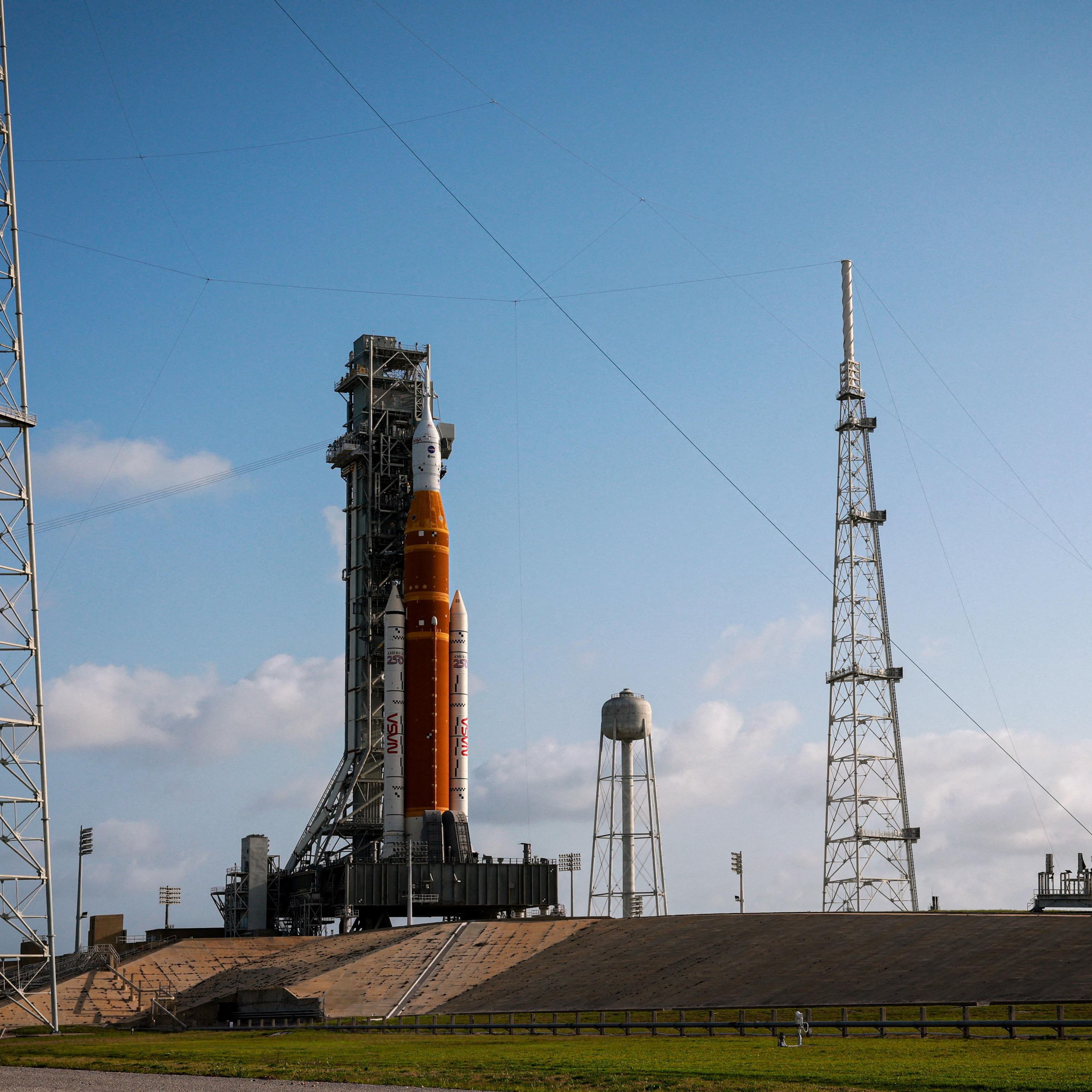
Today in Focus
Blast off! Nasa goes back to the moon
00:29:38
Astronaut Tim Peake and Guardian journalist Richard Luscombe talk through Artemis II, the first manned mission to the moon for 50 years
Loading summary
Transcript95 lines
- [00:00]
Richard Luscombe
This is the Guardian.
- [00:08]
Noshin Eqbal
Today, boldly going where no one has been before. Kind of a mission to conquer the moon.
- [00:19]
Darina, Co-founder of Quo
Hi, I'm Darina, co founder of Quo. If you run a business, you know the team that responds first wins the customer. You've probably opened your phone to a bunch of missed calls and no voicemails. Those are missed opportunities and exactly why we built Quo. Cuo is the business phone system that helps your team handle every call and text right away. Join over 90,000 businesses that win more customers with Quo. Try Quo for free at quo.comtech that's Q-U-O.com tech.
- [00:56]
Neil Armstrong (archival Apollo 11 audio)
The countdown clock will resume on my mark. Three, two, one, mark. T minus nine minutes and counting.
- [01:05]
Tim Peake
In the run up to launch. It's a really interesting period because actually things kind of come into focus as you can imagine, it's quiet for the astronauts in comparison to what life will have been or that training and preparation leading up to the mission.
- [01:21]
Launch Control / Mission Control
All right, folks, close here, so go no go for Artemis 1 launch.
- [01:28]
Noshin Eqbal
This week, NASA will blast Artemis 2 into the Florida sky and far, far beyond in a mission to send three men and the first woman to fly around the moon.
- [01:39]
NASA Official / Scientist
D minus six minutes and counting.
- [01:42]
Noshin Eqbal
It's the furthest humans will ever have gone into deep space. A mind boggling feat of human ingenuity and one that the British astronaut Tim Peake has some experience with.
- [01:54]
Tim Peake
Of course there'll be nerves, there'll be apprehension, there'll be an emotional farewell with families. But also there'll be this absolute burning desire to get on board that rocket and carry out the mission that they've been training for 1 minute, 30 seconds. For me, it was a relatively small rocket, about 50 meters. This rocket, the SLS, it's about the size of Big Ben.
- [02:25]
Launch Control / Mission Control
GC, go. Booster, go. Control, go. GNC. Go. Prop, go.
- [02:30]
Tim Peake
You know, you've got a longer elevator ride up there, there's an awful lot of fuel, they'll be sitting on top of. That rocket has got to have the ability to carry them to the moon and back. So that moment as you're kind of going up, it's all very real at that point.
- [02:46]
Noshin Eqbal
Very real, very rewarding, but so very risky.
- [02:52]
Tim Peake
You're in your spacesuit, you're waiting to get into the vehicle. You're going to be connected to it with electrical connectors, with life support system, oxygen, communications. And at that point there'll be real focus, you know, from the crew.
- [03:09]
Launch Control / Mission Control
Hydraulics, go. Pneumatics, go. Hello to go. Water, go.
- [03:14]
Tim Peake
Launches are really mixture of Emotions, and I think it would be fair to say every astronaut at some point has considered the risks involved. And so there's an element of fear, but rather it being kind of paralyzing fear. I would just describe it when you're sat on top of that rocket. It's an awareness of the risk, but far more overpowering is the excitement of. Of what you're about to do.
- [03:37]
Launch Control / Mission Control
Weather and clear to proceed. Go.
- [03:40]
Launch Announcer
Five, four, stage engine start. Three, two, one.
- [03:45]
Launch Engineer / Controller
Boosters in. Ignition.
- [03:55]
Noshin Eqbal
From the Guardian, I'm Noshin Eqbal. Today in focus, a giant leap again for the first moon mission in 50 years. Richard Luscombe. You're a reporter for the Garden US based in Miami, and you've just come back from Cape Canaveral, which I know on Florida Space coast, because you are wearing the NASA cap. And we're expecting to see a really historic mission launch there in the coming days. Clearly very exciting. What's the feeling like there?
- [04:28]
Richard Luscombe
I've been up at Cape Andaveral for the last few days and the excitement up there, you can see it everywhere. Like hotel signs have go Artemis. Two crew around. It's a really big moment there. This is the Space Coast. This is where every human who's ever launched into space from the US has gone from. This one's really special because it's the first crewed mission to the moon for more than 50 years. So around town there, all the hotels are booked out for the first launch attempt, and people that you speak to just in and around town up there, they're just really excited to see this rocket launch. Should be fabulous.
- [05:01]
Noshin Eqbal
And can you describe said rocket to me? Can you just tell me what it looked like and how close you were able to get up to it?
- [05:07]
Richard Luscombe
Yeah, I was lucky. The NASA press team took a few of us out close to the launch pad, just a few hundred meters away from the launch pad, to watch the sun rise behind it. And it's a pretty impressive vehicle. It really is. It's 98 meters tall. You have the rocket, then you have a big orange fuel tank and two massive rocket fuel boosters beside it. Probably the biggest thing I've ever seen on a launch pad at Cape Canaveral. And all the more emotional because, you know, at the top there, there's a crew capsule that's going to have humans
- [05:35]
Noshin Eqbal
in it, and that's quite a tiny sort of spaceship at the top of this huge rocket. Right. I mean, can you give me a sense of that space?
- [05:42]
Richard Luscombe
Yeah. The capsule itself, I mean, you have this massive rocket but it's mostly all fuel tank and rocket to get it there. You have the crew capsule on top. It's called the Orion crew capsule. There are four astronauts in it and it's a really small thing comparatively. It's about the size of a small camper van. It's no more than like 3 meters tall and a few more across. Everything that they're going to need for this 10 day mission is in this one small space, like the toilet they have set in the floor, a little exercise machine that they do their rowing on, and four seats, beds that fold down and go on the floor. But it really is a very small working space they have in there to share for those 10 days they'll be up there.
- [06:35]
Noshin Eqbal
Can you explain to me why this mission, Artemis 2, why in particular is it so special?
- [06:40]
Richard Luscombe
Well, the Artemis program was designed to send humans back to the moon. The last time humans were there was 1972, which was the final mission of the Apollo program. And the Apollo program was all about getting to the moon, exploring it. And just to say we could.
- [06:55]
Launch Engineer / Controller
But why, some say the moon, why choose this as our goal? We choose to go to the moon in this decade and do the other things, not because they are easy, but because they are hard. Because that goes.
- [07:12]
Richard Luscombe
But this takes it much further beyond there. It's all about that permanent presence now on the moon. So there's been this pretty intensive effort over the last few years now to get the Artemis program together into shape. So Artemis 2 is the second mission
- [07:27]
Launch Announcer
and liftoff of Artemis 1. We rise together back to the moon and beyond.
- [07:35]
Richard Luscombe
The first one, Artemis 1 was an uncrewed mission that went around the moon in 2022. Came back, it had a few issues, nothing major, but now we have Artemis 2 and then there are several missions beyond that that will build hopefully a human permanent presence on the moon's surface.
- [07:50]
Noshin Eqbal
And if that wasn't impressive enough, am I right in understanding it is the deepest into space that humans will ever have been?
- [07:58]
Richard Luscombe
It will be, if all goes well, they're gonna go several thousand miles beyond the moon and come back. This obviously is not a landing on, they don't have that capability yet. But in the Apollo missions they got to the moon. A little way beyond this one is a flyby.
- [08:12]
Launch Announcer
NASA's hoping to lift off on Wednesday, the start of a six day launch window. Artemis 2's crew will orbit the Earth twice on their first day, then head off for the moon. They won't land on it, they'll fly around its far side, pushing farther from Earth than humans ever have before. Looping back to Earth, they get, what,
- [08:31]
Richard Luscombe
3,000 miles, 4,000 miles? As close to the moon's surface as they go around the far side and come back. But, yeah, they'll be extending further beyond than anyone has ever gone before.
- [08:42]
Noshin Eqbal
Richard, if we could zoom out for a moment, could you just explain the importance of space and lunar exploration and why it matters to actually like science and research and all the rest of it down here on planet Earth? And why, to quell some people's cynicism, it isn't all just a massive waste of money. Astronauts are about to board the spacecraft Orion, a spaceship more than two decades in the making.
- [09:06]
Veteran NASA Scientist / Safety Expert
The cost, $40 billion.
- [09:10]
Richard Luscombe
Well, two things can be true here. Sure, that there's a lot of money dedicated to it, and a lot of people argue, well, don't we have enough problems here on Earth to solve? And sure, yes, we do. But there's that spirit of human exploration that sort of. Any astronaut will tell you this, that's embedded in all of us, they think this passion to explore, whether it was exploring the New World back in the 1600s or whenever, and just that passion to just find out what's there. There's a purpose. It's science and discovery. And from the Apollo missions, the kind of things just like Velcro and Teflon in cooking equipment, MRI scanners. Yeah, the list is virtually limitless of the things that space exploration has sort of achieved for humankind. The scientific advances that have been made, like weather surveillance, weather satellites, the ability to predict hurricanes and extreme weather events on Earth. And I think largely, yeah, it's that spirit of exploration, wanting to know what's there. The purpose of can we survive somewhere else, the science aspect to it, finding out what is on the moon, what is on Mars, could there be life there? Could there ever have been life there? And what's beyond all that? I think it's a natural human desire to want to know about those kind of things.
- [10:43]
Noshin Eqbal
He talked about the sort of supremacy of the space race. And I don't want to bring everything back to Donald Trump, but he does play a part in this, doesn't he? I mean, in 2017, he signed the Space Policy Directive with the intention of returning humans to the moon.
- [10:57]
NASA Official / Scientist
The directive I'm signing today will refocus America's space program on human exploration and discovery. It marks an important step in returning American astronauts to the moon for the first time since 1972.
- [11:12]
Noshin Eqbal
For long term, how does this mission and how does Trump fit into what we're seeing in the coming days.
- [11:17]
Richard Luscombe
Well, if there's one thing we know about Donald Trump, he will enjoy a flag planting moment and he's very, very keen obviously to have US footprints back on the moon. We're going back now partly because the US doesn't want China to steal a march in space. China has its own plans for a moon landing before the end of the decade and the US has suddenly real. We need to maintain our supremacy here in space. It's pretty widely felt within the US government. Beyond that, if you have that first base there, you have the access to the minerals, the ice for water on the moon and can build that human presence there first, then you have that supremacy. And it's also built into further journeys towards Mars as well. Moon is very much seen as a staging post for the ultimate goal of getting to Mars, which is still many, many years out. We don't have the capability for, for that yet. They're working on it.
- [12:08]
Noshin Eqbal
As I understand it, as is the way with space missions, it's quite a rocky road to get this launch for NASA to be at the place where it is now. I mean, can you tell me what that journey's been like?
- [12:19]
Richard Luscombe
Yeah, well, overall the Artemis program is many billions of dollars over budget, many, many years behind schedule. The original plan was to have astronauts back on the moon at the start of this decade. That didn't happen. But also remember, these are test flights as well, so things are expected to go wrong. On Artemis I, they had a problem with a heat or coming back in bits, were falling off and they had many, many months long investigation into what had happened.
- [12:44]
Veteran NASA Scientist / Safety Expert
In your view, right now, is it safe for astronauts, humans to go on this mission on Artemis 2?
- [12:52]
NASA Official / Scientist
I would say no.
- [12:53]
Veteran NASA Scientist / Safety Expert
2 veteran NASA scientists say they believe there are serious safety risks ahead of the mission's planned launch as soon as next month. Their key concern centers on the Orion spacecraft's heat shield, a system designed to protect astronauts from the extreme heat when they atmosphere.
- [13:11]
Richard Luscombe
So yeah, delays are expected. We had them earlier with this very rocket. It was originally slated to launch in February and then March. They had a problem with a helium leak on the rocket so they had to roll it back for repairs and then it's back out on the launch pad again now. And of course there's also the reputational damage to NASA as well. You may remember last year there was the ill fated Boeing Starliner mission where a capsule that was meant to go to the International Space station for a 9, 10 day mission, they had all kinds of Problems docking it there, problems with leaks on it. And the two astronauts that were meant to come back to Earth within two weeks were stuck there for nine months.
- [13:48]
Noshin Eqbal
And Splashdown Crew 9 back on Earth.
- [13:53]
Launch Announcer
Those spectacular images from off the coast of Florida tonight. Astronauts Suni Williams and Butch Wilmore are back on Earth after their eight day mission that turned into more than nine months in space.
- [14:04]
Richard Luscombe
And there was a big inquiry into that. So the delays are frustrating, but people have to be patient as well. You know, these problems are expected. They deal with them step by step and they do not fly until it's safe.
- [14:15]
Noshin Eqbal
All this stuff that we've heard about the privatization of space exploration with the likes of Bezos and Musk coming into it, it hasn't necessarily hindered things for NASA. It's actually been somewhat of a help. Is that right?
- [14:27]
Richard Luscombe
Very much so. It's fruitful partnerships. I mean, yes, Artemis is a NASA mission, but it has all kinds of international partners and all kinds of private industry partners as well. SpaceX and Blue Origin are the two big ones that sp to mind now. SpaceX operating capsules as well to the space station. And SpaceX is developing one of the landers which will get the humans to the moon. And they'll be the focus of Artemis 3, which is scheduled to launch next year. That will be a docking in lunar orbit to see how that all melds together. So this mission, Artemis 2 this week, gets the folks around the moon. Artemis 3 next year also won't touch down, but it will test those docking elements to the landers. So each mission in Artemis is a step forward towards the ultimate goal of Artemis IV, currently scheduled for 2028, which will be the first human landing on the moon since 1972.
- [15:24]
Noshin Eqbal
Quite the history that NASA and the US have with space exploration, specifically with the moon. I mean, can you remind us a little of that timeline and how many missions there have been?
- [15:36]
Richard Luscombe
Apollo was a long time ago now.
- [15:42]
Neil Armstrong (archival Apollo 11 audio)
Tranquility Base here. The Eagle has landed. Roger, Tranquility. We copy you on the ground. You got a bunch of guys about to turn blue. We're breathing again. Thanks a lot.
- [15:54]
Richard Luscombe
So the first moon landing was 1969. And that followed several years of of the Apollo program sending uncrewed missions up there and then crewed missions around the moon and culminating in that landing in July 1969.
- [16:09]
Neil Armstrong (archival Apollo 11 audio)
I'm gonna step off the land now. That's one small step for man, one giant leap for mankind.
- [16:22]
Richard Luscombe
The Apollo program lasted on the moon from 1969 to 1972, a short period of time there were six crew landings. Only 24 astronauts have ever been all the way around the moon. Only 12 of those have ever landed on the moon.
- [16:38]
Neil Armstrong (archival Apollo 11 audio)
Mrs. Houston, say again, please. Houston, we've had about. We've had a main beam
- [16:46]
Richard Luscombe
and only four of those are still alive. So it's been a long time since we've been there. When Apollo ended in 1972, it was largely financial. There was no money left, that the public's appetite had waned for the space program. The US had beaten the Soviet Union in the race to be the first to land on the moon. They'd done that. And their successive missions weren't really achieving that much more. Sure, they had a rover that drove around the moon for a bit and one of the astronauts hit a golf ball.
- [17:12]
Neil Armstrong (archival Apollo 11 audio)
I was strolling on the moon one day in the very, very month of December make when they're.
- [17:22]
Richard Luscombe
Much to my surprise, it became, I think, in some people's eyes, a little bit gimmicky and certainly very expensive. So Congress pulled the plug on that. The final three Apollo missions were canceled. And for all those years, NASA concentrated on lower Earth orbit, building the International Space Station. And we had the space shuttle program for 30 years, which, contrary to a lot of people's thoughts on, never went anywhere near the moon. It was Lower Earth orbit, 250 miles up, orbiting, and that was as far as we've got until the Artemis program has now reignited that passion to get back to the lunar surface.
- [18:09]
Noshin Eqbal
Well, Richard, let's dive specifically into this mission and what it's actually going to look like for those four astronauts who are in very small quarters, as we
- [18:19]
Richard Luscombe
said, they're going to be in a very confined space together for 10 days. They have a very strict timeline. Everything's planned out virtually down to the last minute on this mission. It's a combination of travel days and big event days. So you have launch day, day one, they fire up into Earth's orbit. They circle Earth for a few times, and at that point they're checking out the spacecraft, making sure it's working well and that they're ready for what's called the Trans Lunar injection burn, which is the big fiery burn that sends this rocket on its journey to the moon. Once they've decided to go ahead with that, there's no coming back from that. If there's a problem before that they can return to Earth, they can abort. But once they've decided and they go for the burn, that's it. They're going to the moon. No question.
- [19:09]
Noshin Eqbal
Wow.
- [19:12]
Richard Luscombe
That's day two. After they've done a few orbits and they're ready to go, they sort of press the metaphoric button and off they go. So then there's three days traveling to the moon. It's quarter of a million miles away. And they'll be doing various scientific experiments there, mostly sort of checking out the spacesuits and, and all kinds of life preservation systems they have. It's all testing discovery, making sure that everything's working well. About day five, they're close to the moon now. They start to feel the moon's gravitational pull and less of Earth's gravity, and they're pulled into that lunar orbit. And then day six out of the 10, that's the big day. That's as close as they get to the moon as they go by about 4 to 6,000 miles, as close as they'll get to the lunar surface. They'll all be there with their cameras out the windows. They have a set period of time where they can take their photographs and just watch the moon.
- [20:02]
Noshin Eqbal
I mean, you'd do it just for the selfie, wouldn't you?
- [20:04]
Richard Luscombe
Wouldn't you? Just how fantastic is that? That's for sure gonna be the highlight for those astronauts. And they've spoken about that. That's the big moment of the mission.
- [20:14]
Noshin Eqbal
Oh my God. All that training.
- [20:15]
Richard Luscombe
But absolutely for the time they go beyond and then when they're on the far side of the moon, which is looking at parts of the moon that we never see from here on Earth, they'll be out of contact for just shy of an hour. And they're the really nervous moments for mission control down on Earth. The astronauts are out of sight, out of range, out of audio contact.
- [20:37]
Noshin Eqbal
Oh, I said that's the bit where it's all. There's a bit of blackout.
- [20:40]
Richard Luscombe
It's the complete blackout. Wow, that's the blackout. And then everybody's praying and hoping for that period when it crackles back into life and they come back round again and they're back in contact again. So that's sort of day six. And then the rest of it is preparing for that journey home again, the re entry into Earth's atmosphere on the final day. Day 10 is. It will be, is the most risky part of the mission. I mentioned earlier they had problems with the heat Shield on Artemis 1. I mean, the phenomenal temperatures there, like more than 1600 degrees Celsius. They're going to be hit with on the way. So that they have to be sure that the capsule can withstand that heat as they come back through Earth's atmosphere and then they splash down in the Pacific Ocean. Some point later on day 10, three giant parachutes will deploy and the capsule will, will glide gently down to a landing on the Pacific Ocean at about 17 miles an hour. And from there, then recovery crews and helicopters will go out and rescue them and take the hatch off and the astronauts will come out again. And in the days beyond that, we can look forward to hearing from them about their experiences, what they saw, what they experienced, and how the overall success of the mission that we hope it will be can feed into the missions that are to come. So this really is a huge mission for NASA and human spaceflight as a whole.
- [22:06]
Noshin Eqbal
Richard, could you tell me something about those four astronauts, you know, the characters who have taken on this mission and who will be doing this huge journey.
- [22:15]
Richard Luscombe
Three of them are veteran space flyers, three American, three NASA astronauts, and one from the Canadian Space Agency, an astronaut called Jeremy Hansen, who's taking up some maple syrup with him from Canada as sort of a memento from his homeland into space. Of course, Christina Koch has flown before to the space station. She's planning on taking up some handwritten notes from loved ones. And Victor Glover, who's the first astronaut of color to travel to the moon and back. He's a very religious man. He'll be taking his bible with him. And then Reid Wiseman, who's the fourth member of the crew, actually, the commander is gonna be taking up a notebook and a pen, he says, so he can write down his thoughts from the journey and be able to share. Those astronauts are some of the most sort of well grounded, no pun intended, people that you could ever hope to sort of meet. Their very practical people, they're sort of very mission orientated and everything, but imbued in all of them is this sort of sense of wonder and desire to discover and explore and all that kind of thing. That's the driving force in any astronaut.
- [23:24]
Tim Peake
It's very easy to know when you're in space because the main engine cuts out and that's the massive jolting. It's the biggest jolt of the whole launch.
- [23:37]
Noshin Eqbal
Tim Peake, the British astronaut, spoke to us about what it's like to go up there.
- [23:42]
Tim Peake
You've been kind of 8 minutes and 48 seconds, traveling at over 17,500 miles per hour, doing quite high G forces. So it's a very violent experience being launched into space. And when the engine cuts out, everything gets very peaceful. Very quickly, There's suddenly very little sound. You don't Feel any motion, you feel weightless for the first time. Everything's floating in the spacecraft and you have this amazing view out the window. And that is a very sort of overwhelming but also very beautiful thing to look at. And that's the moment, you know, that you've safely made it there. When I looked out the window for the first time, we were going from day to night. We were coasting out over the Sea of Japan and then we went quite quickly into darkness. But then as soon as we did, the moon rose and it was just the most beautiful moon rise over the Pacific Ocean. And then of course, 45 minutes later, I had my first sunrise. And then I got to see Earth in all its beauty in the daylight. And it's just incredible. I mean, both sides of the planet by day and by night are utterly breathtaking.
- [24:57]
Noshin Eqbal
Over the last few weeks, Tim has been in close contact with the Artemis 2 crew.
- [25:01]
Tim Peake
I know them all really well. We're quite a close knit community. I'm close friends with all of them. I was speaking to Jeremy just on Tuesday and we know their families as well. When I was doing my spacewalk, Reid Wiseman, who's the commander, he was actually leading my spacewalk from mission Control. So he was the voice I was hearing in my, you know, headset when I was outside the space station. They're an amazing group of individuals and I've got every faith that they're going to have a, you know, a fantastic mission. I can guarantee that every single astronaut would like to be one of those four on top of that rocket. You know, a moon mission is, is phenomenal. We haven't been back for over 50 years. It's been something that we've been working for for so long. We've been enjoying low Earth orbit and long duration stays on the International Space station. But Artemis 2 represents a new era of space exploration. Breaking out of low Earth orbit once more, going back to the moon, this time in a much longer, more sustainable way. This time to look at the south pole of the moon, somewhere we've never been before, where there's water ice. This time to set up a habitation module where crews can go and live and work for months at a time on another celestial body. And this time to learn the lessons that we need to go to Mars. So this really is us, you know, building on Apollo, but embarking on the next steps of expanding humanity's presence, presence throughout the solar system.
- [26:35]
Noshin Eqbal
Coming up, what comes after Artemis 2?
- [26:50]
Tommy John Advertiser
Guys, it's no use putting it off. The best time for an Underwear Refresh is now Tommy John Underwear is designed for a perfect fit that stays put all day. There's zero chafe thanks to four times more stretch than competing brands and their innovative horizontal Quick Draw fly is a game changer. With over 30 million pairs sold, there are thousands of men out there more comfortable than you. Don't settle for less. Go to tommyjohn.com today for 25% off your first order with code comfort. That's tommyjohn.com comfort Tommy John comfort Perfected
- [27:23]
Richard Luscombe
Par le tu francais hablas espanol Parle italiano.
- [27:27]
Babbel Advertiser
If you've used Babbel, you would Babbel's conversation based technique teaches you useful words and phrases to get you speaking quickly about the things you actually talk about in the real world. With lessons handcrafted by over 200 language experts and voiced by real native speakers, Babbel is like having a private tutor in your pocket. Start speaking with Babbel today. Get up to 55% off your Babbel subscription right now at Babbel Acast spelled B-A B-B-E-L.com Acast rules and restrictions may apply.
- [28:07]
Noshin Eqbal
Richard, it seems there is a lot riding on this mission. What would success look like for Artemis 2?
- [28:12]
Richard Luscombe
Success will be when those four astronauts touch down in the Pacific Ocean on the final day of their mission, safe and sound that the spacecraft has behaved well. And once that knowledge is in, then that's a solid building block to what's to come beyond. We already knew from an announcement last month that Artemis 3, the next mission that was going to be the first lunar landing that has been pushed back to Artemis IV and Artemis 3 will be this docking in space where they test out the landing systems. So we have a timeline. Whether we're able to keep to that remains to be seen. And Artemis 2, obviously the success of that plays into that and there are all kinds of other things going on in between. Like in 2028, regardless of the landing missions, they're going to testing a nuclear reactor in space as well. There's a mission to see and that would be what would power this ultimate moon base when they get that built.
- [29:05]
Noshin Eqbal
Final question, Richard, where are you going to be on Wednesday when this rocket takes off?
- [29:11]
Richard Luscombe
All being well, I'm going to be at the press site at the Kennedy Space Center. It's a place I know very well. And at the press site you're just a few miles away. You're about as close as any human is safely allowed to be from the launch pad. And There are rocket launches every week now, sending uncrewed rocket launchers, satellites, Elon Musk, Starlight and everything. From my home in Miami, 200 miles away on a clear night, if there's a launch, I can walk out of my front yard and I can see a ball of gold racing up into the sky. And that never gets old. But I can tell you there's something really more powerful about knowing that there are human beings on a spacecraft that's lifting off from that launch pad. I always felt it at the end of those shuttle missions and. And this week's launch is going to be something extra special beyond that, knowing where they're going, knowing the history of it. It's the first time humans are going to the moon since 1972. So there's a lot of emotion, a lot of, you know, sort of power built into that moment.
- [30:09]
Noshin Eqbal
Wow. Literally beyond incredible. Richard, thank you so much for your time.
- [30:14]
Richard Luscombe
You're welcome. It's a pleasure to be with.
- [30:25]
Noshin Eqbal
That was Richard Luscombe from Guardian us. My thanks to him and of course to Tim Peake. Catch all of our Artemis coverage, including tomorrow night when insha', Allah, the thing fires off into space. Or@theguardian.com Science Weekly is also out today where they ask if there's still any point in going to the moon. Speaking to the former director general of the European Space Agency. And that's it for today. This episode was presented by me, Noshi Nikbal. It was produced by Natalie Ghtena, Tom Glasser and Guy Sufman. Sound design is by Rudy Zagadlo. The executive producer was Sammy Kent. We'll be back again this afternoon with the latest and today in focus. We'll be back with you tomorrow morning.
- [31:23]
Richard Luscombe
This is the Guardian.
- [31:37]
Babbel Advertiser
If you've used Babbel, you would. Babbel's conversation based technique teaches you useful words and phrases to get you speaking quickly about the things you actually talk about in the real world. With lessons handcrafted by over 200 language experts and voiced by real native speakers, Babbel is like having a private tutor in your pocket. Start speaking with Babbel today. Get up to 55% off your Babbel subscription right now at babbel.com acast spelled B-A B-B-E-L.com acast rules and restrictions may apply.
- [32:11]
Tommy John Advertiser
Guys, it's no use putting it off. The best time for an underwear refresh is now Tommy John. Underwear is designed for a perfect fit that stays put all day. There's zero chafe. Thanks to four times more stretch than competing brands and their innovative horizontal quickdraw fly is a game changer. With over 30 million pairs sold, there are thousands of men out there more comfortable than you. Don't settle for less. Go to tommyjohn.com today for 25% off your first order with code comfort. That's tommyjohn.comfort Tommy John Comfort Perfected Security
- [32:45]
Vanta Advertiser
and compliance done wrong is a giant headache Security and compliance done right? That's Vanta. Vanta helps you earn trust and speed up growth. No spreadsheets required. For startups low on time and resources, Vanta becomes your first security hire, using AI and automation to get you compliant fast and unblock big deals for enterprises. Vanta is your AI powered hub for compliance and risk, bringing together data from across your businesses and automating workflows so you can prove trust at any moment. Vanta scales with you at every stage. That's why top companies from startups like Cursor to enterprises like Snowflake choose Vanta do security and compliance right. Get started today@vanta.com tedaudio.