← Today in Focus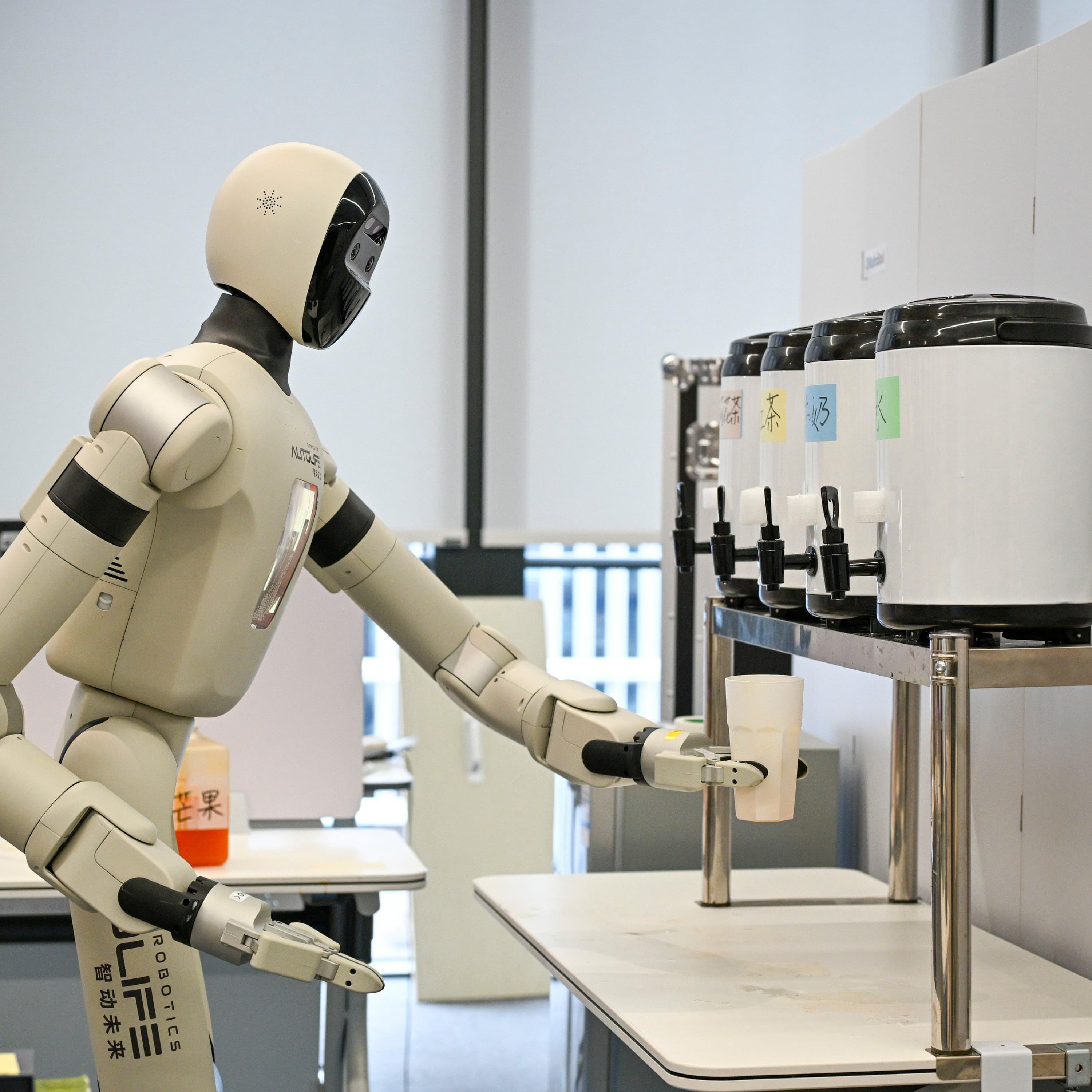
Today in Focus
China’s massive AI rollout
00:24:11
Senior China correspondent Amy Hawkins on China’s embrace of AI, from medical avatars to food delivery drones and state surveillance
Loading summary
Transcript73 lines
- [00:00]
Annie Kelly
This is the Guardian. Today. The AI doctor will see you now.
- [00:21]
Amy Hawkins
From globalization to innovation sustainability to market volatility, there's always more than one side to a story. Explore different perspectives on today's most important business and economic issues with the Flipside podcast from Barclays Investment Bank. Hear two research analysts in a lively debate and get insights from every angle.
- [00:41]
Annie Kelly
To further inform your view, listen to
- [00:43]
Amy Hawkins
the Flipside on your favorite platform. Okay, so there's a few different doctors I can speak to. So this one's Dr. Wang, who comes from a hospital in Zhejiang University Hospital, which is on China's east coast. You know, that's a very wealthy province. So imagine, you know, that's probably one of the top hospitals, I think.
- [01:09]
Annie Kelly
I'm probably not alone in consulting Dr. Google every time I get a mystery ailment. And yes, we all know we shouldn't, but when it can take weeks to get a GP appointment, asking the Internet for medical advice is just so quick and easy. But in China, you can now go straight to the top.
- [01:30]
Amy Hawkins
He, you know, so there's a little picture of him. He talks about what his specialties are, and then, you know, there's a kind of a box where you can put in, hello, Dr. Wang. You know, whatever my symptoms are, it's
- [01:41]
Annie Kelly
now just as easy to speak directly to the country's leading specialists like Dr. Wang for instant medical advice, sort of. But you're not actually talking to Dr. Wang, right?
- [01:53]
Amy Hawkins
No, no, no. It's an AI. But Dr. Wang is a real person who has consented to his likeness and his research and his data being used to train this app.
- [02:05]
Annie Kelly
Welcome to the world of AI Avatar doctors, where China's top medical experts have trained their own AI chatbots to dispense advice to millions of patients. And so what if we were going to go to Dr. Wang, what are his specialties? Like, what might be be asking him?
- [02:23]
Amy Hawkins
He is a cardiologist. He's a heart doctor.
- [02:26]
Annie Kelly
Maybe we could ask him about palpitations or something then.
- [02:29]
Amy Hawkins
Yeah, sure. So I can say I'm having chest palpitations. I'll see what he says then. He said, he says, when you have heart palpitations, does it feel as if your heartbeat suddenly starts, suddenly stops, or does it happen gradually? Does it gradually pick up speed before slowly settling down again?
- [02:49]
Annie Kelly
Okay, so he's kind of starting a real conversation with you about it.
- [02:54]
Amy Hawkins
Yeah. So I can say maybe they, they go gradually.
- [03:03]
Annie Kelly
As much of the west frets about what AI might do to our future. From AI doctors to food delivery and State surveillance. China has embraced it. Is this a glimpse of what's coming for the rest of us, whether we want it or not? From the Guardian, I'm Annie Kelly. Today on Focus, how China fell in love with AI. Amy Hawkins, you're the Guardian's China correspondent. We all know that governments across the world are engaged in this race to adopt AI as quickly as the next country. And China is at the forefront of this. But what kind of changes have you seen AI already bringing to China over the past few years?
- [03:49]
Amy Hawkins
So I think the way that AI has really changed China is just in general how enthusiastically it's been adopted across all sectors of society. So whereas in the west you hear about lots of caution and concern about AI or people resisting implementing AI in their daily life, in China, both from the grassroots level and being encouraged by the government, you're really seeing it rolled out in people's daily work. Agentic AI is really popular.
- [04:16]
Annie Kelly
It's an open source technology that allows users to create their own AI agents. Open claw lobster themed installation events have popped up around the globe, especially in China.
- [04:26]
Amy Hawkins
Autonomous driving is very advanced here. That's another type of AI. These trucks are driving on a public
- [04:33]
Annie Kelly
road without a human being behind the wheel.
- [04:37]
Amy Hawkins
Driverless transport company Pony AI was given official embodied AI, which is robotic.
- [04:42]
Annie Kelly
Meet Benny, a dripped out robot influencer, and his human livestreaming partner, number one sister. He's an Internet star.
- [04:50]
Amy Hawkins
She's saying drones being used for food deliveries, that's all racing ahead here. So it's really been enthusiastically adopted.
- [04:58]
Annie Kelly
What do drones delivering food delivery at sea actually look like? I just cannot imagine drones zooming down the street in London kind of giving you your Chinese takeaway on a Friday night.
- [05:08]
Amy Hawkins
They're actually very loud. The thing that surprised me when I went to try one out was kind of how loud the buzzing was. It sounded quite ominous. And they've been rolled out in a few cities. In Shenzhen, which is a southern city in China, which I visited last year, they have these kind of drone delivery stations. So it's not like you can just order a drone to wherever you are, but certain kind of kiosks, maybe in a park or in a public square, they also have one on the Great Wall of China, where it might be hard to otherwise get a human to deliver you your food. You can order, you know, takeaway bubble tea, kfc, whatever it is, and then a drone brings it to you in a box and it kind of deposits the box in front of you and
- [05:57]
Annie Kelly
there you go, get your KFC on the Great Wall of China.
- [05:59]
Amy Hawkins
Yeah, yeah, we can.
- [06:01]
Annie Kelly
And you know, listeners around the world will know, you know, countries are trying to get their kind of piece of the AI Boom. US and China are kind of, you know, vying to be the most dominant player. Could you tell us, where is China currently in this race?
- [06:18]
Amy Hawkins
So I think it's worth noting that actually the US China race is rhetoric that comes more from the US and from China. America is the country that started.
- [06:26]
Annie Kelly
The AI race comes as US and China are in a fight for AI supremacy, access to power.
- [06:33]
Amy Hawkins
China's ahead on patents, and then you
- [06:35]
Annie Kelly
see the US way ahead. China may have just reset the AI race.
- [06:41]
Amy Hawkins
As President of the United States, I'm here today to declare that America is going to win it. You don't really hear people in China talking about the need to beat the US in this kind of race to control the future of humanity. For China, the perspective is really how can we use AI to achieve our development goals, whether that's to increase health care coverage for the aging population, to find replacements for workers as the workforce shrinks, and these kind of things.
- [07:11]
Annie Kelly
In a primary school in Beijing, artificial intelligence has been integrated into every aspect of.
- [07:17]
Amy Hawkins
This is a warehouse of JD.com, china's answer to Amazon. It is run by robots. I mean, that said, the US has imposed controls on semiconductors that can be exported to China, namely from Nvidia, big US tech company, from the US to China. Because for the most advanced AI researching artificial general intelligence, which people see as the kind of frontier of AI, and also for advanced military applications, you really need the most powerful computing chips. I think most people agree that China is well off being as sophisticated as Nvidia is. But China doesn't want to be dependent on the US supply. So it's also been really encouraging its own companies to try and develop its own high end Chipdance, Alibaba and other giants got orders to halt testing and
- [08:06]
Annie Kelly
cancel tens of thousands of chip orders. According to the ft, China has actually
- [08:10]
Amy Hawkins
also ordered some Chinese companies to stop using Nvidia chips, even the ones that they can get hold of, because China is trying to encourage its companies not to be so dependent on the U.S. right.
- [08:20]
Annie Kelly
And so what does that homegrown industry actually look like?
- [08:24]
Amy Hawkins
Well, you see it again through. I mean the numbers are kind of huge and bamboozling, but the government recently announced that it wants to send 2 trillion RMB, which is about $300 billion, building data centers over the next five years to try and increase China's computing power. Local governments are also announcing massive funds to try and attract companies to come to their city, because every city wants to be home to the next deep sea.
- [08:49]
Annie Kelly
There's a Chinese startup that few people
- [08:51]
Amy Hawkins
had ever heard of until the past few days, and it has emerged as
- [08:56]
Annie Kelly
a real player in the AI arms race.
- [08:59]
Amy Hawkins
It's called Deep Seek, or the Next Unitree, which is a robotics company.
- [09:05]
Annie Kelly
Dancing humanoid robots took center stage on Monday during the annual China Media Group Spring Festival gala. It is China's most watched official television broadcast. These robots. You mentioned, you know, before this, this idea that when you're looking at developing this homegrown industry, that this might be a way that they're going to deal with their labor shortages. What other kinds of problems are the Chinese government hoping AI will fix for them?
- [09:39]
Amy Hawkins
Yeah, so China does have a huge population, but it's shrinking very fast despite repeated efforts to boost the birth rate. Every year, pretty much the birth rate falls to another record low. And that means that people, you know, that people of working age, that cohort of people, just get smaller and smaller every year. And at the same time, it has not only a shrinking workforce, but more people are getting older and there's fewer people to look after those old people. It puts more strain on China's healthcare system, which is already quite stretched. So China's really hoping that AI will, will help make sure that these elderly people can be looked after when there's not enough workers.
- [10:18]
Annie Kelly
And you've been reporting on how specifically AI is changing healthcare across China to deal with some of the problems you've just outlined. What have you found?
- [10:27]
Amy Hawkins
Yeah, so again, I think it comes back to this issue of how enthusiastically it's been adopted. So there's a number of kind of healthcare agent apps which are now available in China, which is basically an app you can download on your phone and it creates, has like an AI avatar of a doctor. And nearly half of China is a rural country. Some people live hours from their nearest healthcare provider or nearest big hospital. So I'm just walking up to Renji Hospital in Shanghai, which is one of the leading hospitals in the country. It's associated with Shanghai Jiao Tong University. And as with many hospitals in China, it's heaving. And a lot of people will travel from far and wide to come and see a specialist here. And so being able to instantaneously talk to someone, particularly if you're elderly, can be really helpful. It'll be a known, a real doctor, like some celebrity from the best hospitals in Beijing or Shanghai, and you can talk to an AI Avatar which have been trained on specific data from a specific doctor or a specific department. So I interviewed a doctor who was a urologist from a top Shanghai hospital. And yet he had spent actually a couple of years kind of training and refining this avatar that's based on him and to make the AI more professional. So you mean doctors should spend their time improving AI rather than seeing more patients A later time? Yeah. Yes. Yeah. Okay. They chose to do it. So you're talking to his department rather than him personally. But because of regulations and because of weather technology that they can't prescribe medicine for you or kind of go as far as a in person doctor could do. But the idea is it saves people from traveling long distances to their nearest hospital and will hopefully help the kind of increasing number of elderly people who have maybe minor but still quite challenging ailments which might not need in person care, but can help people still be able to communicate with a healthcare provider. So you mentioned that Your department sees 600,000 patients annually. I don't know if can you do. How many patients does your AI version talk to? 800,000. One woman I interviewed who used one of these apps said she also felt like when she saw a doctor in person, they were really rushed and they didn't have time to answer all her questions or would be impatient, which is very typical in China because the kind of doctor to patient ratio is not great.
- [13:06]
Annie Kelly
So these are like AI GPs then?
- [13:09]
Amy Hawkins
Yeah, basically there's a few different apps you can use, but the biggest one claims to have over 100 million users already, which is obviously massive. Yeah. And so. And people are just very willing just to try out these things and start talking to AI. You don't hear the same skepticism as much as you might in the West. In China, which is a very poor country, you know, a generation ago, technology has generally only made people's life better. And people are very enthusiastic about it. And there are people who had to walk three hours to get to school when they were a kid and now they can order a delivery to come to their house in five minutes. And so people, the kind of. The impact that technology has had on people's lives in China is really profound.
- [13:51]
Annie Kelly
And the doctor Wangs and all of these esteemed physicians who are kind of lending their avatar, you know, their faces to this tech, are they not worried that they just might be replaced by these AI avatars and become obsolete?
- [14:07]
Amy Hawkins
So I've asked them about this and the doctor I spoke to called Dr. Chi, he said at the beginning some doctors were worried about becoming obsolete or were worried about participating in these kind of app corporations. But he. I mean, obviously he's an enthusiast. He was adamant that it would merely free up doctors to do more sophisticated work. He talked a lot about the way AI is being used to process scans, something that, you know, would take humans a lot longer. I mean, that the doctors who were previously examining scans could be retrained to do more advanced research. Just like pathology doctors, radioaction doctors, like this kind of doctors. The amount of these doctors were.
- [14:58]
Annie Kelly
It's interesting, I think, that there is still, you know, a reluctance maybe in the west to share your, you know, private moments with AI. But it sounds like in China, the culture might be different. It's maybe more supportive of using AI in that way. Why do you think that is?
- [15:17]
Amy Hawkins
I mean, when it comes to things like privacy and like, you know, privacy not sharing your data with an app, it's like that ship has really sailed in China, and you don't. Although there are laws around data privacy and data sharing and so on, for most people, you're very, very used to kind of giving over all your information all the time. You know, you're constantly surveilled. There's no sense that what you say online or in messages is private. There's no, you know, encrypted messaging apps or anything like that. And that's part of what makes China so convenient, because lots of the services are very linked up. You know, your phone number or your ID number can get you access to a whole suite of services that are all very conveniently linked and tailored. And it means that, you know, wherever you are, you can get a delivery or you can get a taxi or anything like that. So on that side of things, I think it's that, you know, people aren't as concerned about sharing personal or private data. I mean, it's definitely being used by the technology companies and the companies that provide surveillance technology to enhance their abilities. You know, previously, you know, a few years ago, you might have read in the news how Chinese is facial recognition surveillance cameras to monitor everyone. But the reality was that actually, most cities and most governments couldn't afford to purchase that kind of technology. But as the price is coming down, you know, you can expect to see it be more widespread across the country.
- [16:39]
Annie Kelly
Coming up, is anyone in China opposing the AI rollout? He's dribbling the ball with everything on the line. He's driving down the pitch. He's facing price hikes. It cuts past him.
- [17:02]
Amy Hawkins
Carrier contracts, tries to block him.
- [17:03]
Annie Kelly
Oh, he leaves him in the dust. He's at the edge of the box. He cuts past the non stop group chat trash talk. He clears on goal.
- [17:09]
Amy Hawkins
He shoots
- [17:12]
Annie Kelly
unlimited data for $25 a month forever. Visit your local Boost Mobile store today to get unlimited data with a price that never changes. Boost mobile after 30gb, customers may experience lower speeds.
- [17:24]
Amy Hawkins
Customers will pay $25 a month as long as they remain active on the Boost $25 Unlimited plan.
- [17:28]
Annie Kelly
Summer smells like summer road trips, ocean breezes and long evenings under the stars. It's a feeling you want to hold onto. Restore your sense of place With Pura's new summer fragrance collection, we've captured the magic of the season in clean prem that transform your home into your favorite destination. Discover the art of sunscaping and bring the summer in. Visit pur.com to explore the collection. So Amy, it feels like from our conversation that Chinese society has, you know, pretty much embraced AI and welcomed it into their daily lives, which feels quite hard to believe. Is there anyone against it? Has there been any pushback?
- [18:16]
Amy Hawkins
I mean, there is some pushback in some quarters, particularly when it comes to jobs, I think because there's a kind of tension in China that the government sees AI as the answer to the shrinking workforce. But at the same time, a lot of young people today can't find work and there's a high unemployment rate.
- [18:31]
Annie Kelly
Official numbers point to a youth unemployment rate of around 15%, but experts say the real number is likely higher. And the data doesn't account for young people who are underemployed.
- [18:43]
Amy Hawkins
You know, more and more people are being forced into the gig economy. And you know, there's kind of a lot of discourse in China at the moment about, you know, you might work really hard, go to the best university and then when you graduate you'll probably, probably be a delivery driver. And the kind of low paid gig economy workers really prop up the economy. But there's a lack of long term secure employment for many people applied for
- [19:06]
Annie Kelly
30 or 40 jobs in the past six months. I found some work in my hometown. I worked in a supermarket and as a security guard.
- [19:15]
Amy Hawkins
And you're hearing more and more stories of people being laid off to be replaced by AI and they've kind of pushed back now against that. And people want there to be kind of stronger protections in place to stop them from being replaced by AI in their daily jobs. And something you do see nowadays with more and more young people going to temples to pray for jobs, They've tried everything. They've sent out hundreds of CVs they've done dozens of interviews and they still haven't got anything. And people are not shy of going to the gods to ask for help as well.
- [19:57]
Annie Kelly
In a country like China, with so many jobs and entry level jobs based in industries like manufacturing, which is, you know, the economic backbone of the country, that could soon be very easily replaced by either robotics or other forms of automation, how is the government responding to that need to grow its economy but also, you know, stave off mass unemployment?
- [20:19]
Amy Hawkins
The government increasingly made some comments about the need to be cautious about replacing workers with AI and urging companies not to act too quickly when it comes to kind of fully automating their workplaces. There have been a few court cases recently where people have sued their employer after they were laid off to be replaced by AI and they've won. And the government has kind of promoted these cases as a reminder to companies that replacing someone with AI is an acceptable reason to fire them. So the government's trying to kind of thread this needle of being very enthusiastic about AI and encouraging everyone to adopt it in their daily life and really talking about how it's going to make life better and how it's a technology which China is really leading on, but at the same time it wants to manage the social disruption that AI could cause. And the last thing that China wants is any kind of social unrest or, you know, discontentment.
- [21:10]
Annie Kelly
And Amy, what about the environmental impact of all of this? I mean, you've talked about, you know, communities welcoming the building of these huge data centers. We know the impact that this has on the environment and especially on things like local water sources. How are they getting around things like that, you know, those environmental concerns.
- [21:28]
Amy Hawkins
So that is obviously a really big problem in China as it is everywhere else. But China is also pushing ahead on trying to find solutions for this. I'm just walking through a very quiet park in what is called Lin Gang High Tech Zone. But the reason I'm here is to see one of China's latest high tech marvels. So it recently launched the world's first kind of commercial underwater data center off the coast of Shanghai about a month ago. And the idea is, you know, it can use sea water for its cooling. It doesn't require so much fresh water to be pumped around the surface to keep it cool. It doesn't take up land. Obviously there hasn't been that much research on the impact on marine life, but I spoke to some marine biologists and they think actually the impact will be quite limited because any heat it generates will likely be very Localized. And so, yeah, some people think that might be the answer to how to have more data centers without kind of destroying the environment. Here on the coastline, it's mainly families going for a stroll and people enjoying evening walks. And then there's a mural celebrating the hundredth anniversary of the founding of the Communist Party of China within 2021. So as with all things in China, you have cutting edge frontier technology, massive manufacturing capacity and a huge healthy dose of Communist Party politics.
- [23:23]
Annie Kelly
You're our reported there based in China. AI is undoubtedly becoming one of the big stories that you're going to cover. With all of this going on, do you feel like you've got a little glimpse into what future life might be first for Chinese people, but maybe soon for all of us?
- [23:39]
Amy Hawkins
Yeah, I mean, it's one version of the future. And you know, I have to say the kind of extreme convenience in the stream seamlessness of many technology driven things is also underpinned by a big cheap labor force. Like people are paid so low they work unbelievably grueling hours. I ordered a courier this week from a shop to deliver something to my house. I took about an hour. I paid 12 RMB, which is about £1 for a human being to bring the thing to my house. It just unbelievably cheap and you can't imagine how little this person is being paid. So I think that the apps kind of enable it and they enable this very linked up system, but it still does rely on a very cheap labor force, which it's hard to imagine that in the UK context. That said, I think people can see how advantageous AI can be. It's probably maybe people in the west are overly skeptical and people in China are not skeptical enough. But I think it is amazing to see with the right conditions in place, how much AI can empower a whole economy. It can free up people from doing kind of repetitive, menial and often dangerous work. That is a vision of the future that I think many people would welcome in China or elsewhere. It's just a question of how do we rebalance the economy to make that possible.
- [25:04]
Annie Kelly
Amy, thank you so much.
- [25:05]
Amy Hawkins
Thanks.
- [25:09]
Annie Kelly
And that's it for today. My thanks to Amy Hawkins and you can read all of her reporting@theguardian.com this episode was produced by Iver Manley and Thomas Glaser and presented by me, Annie Kelly. Sound design was by Ross Burns and the executive producers were Eli Block and Sammy Kent. We'll be back later today with the latest. This is the Guardian.