← Today in Focus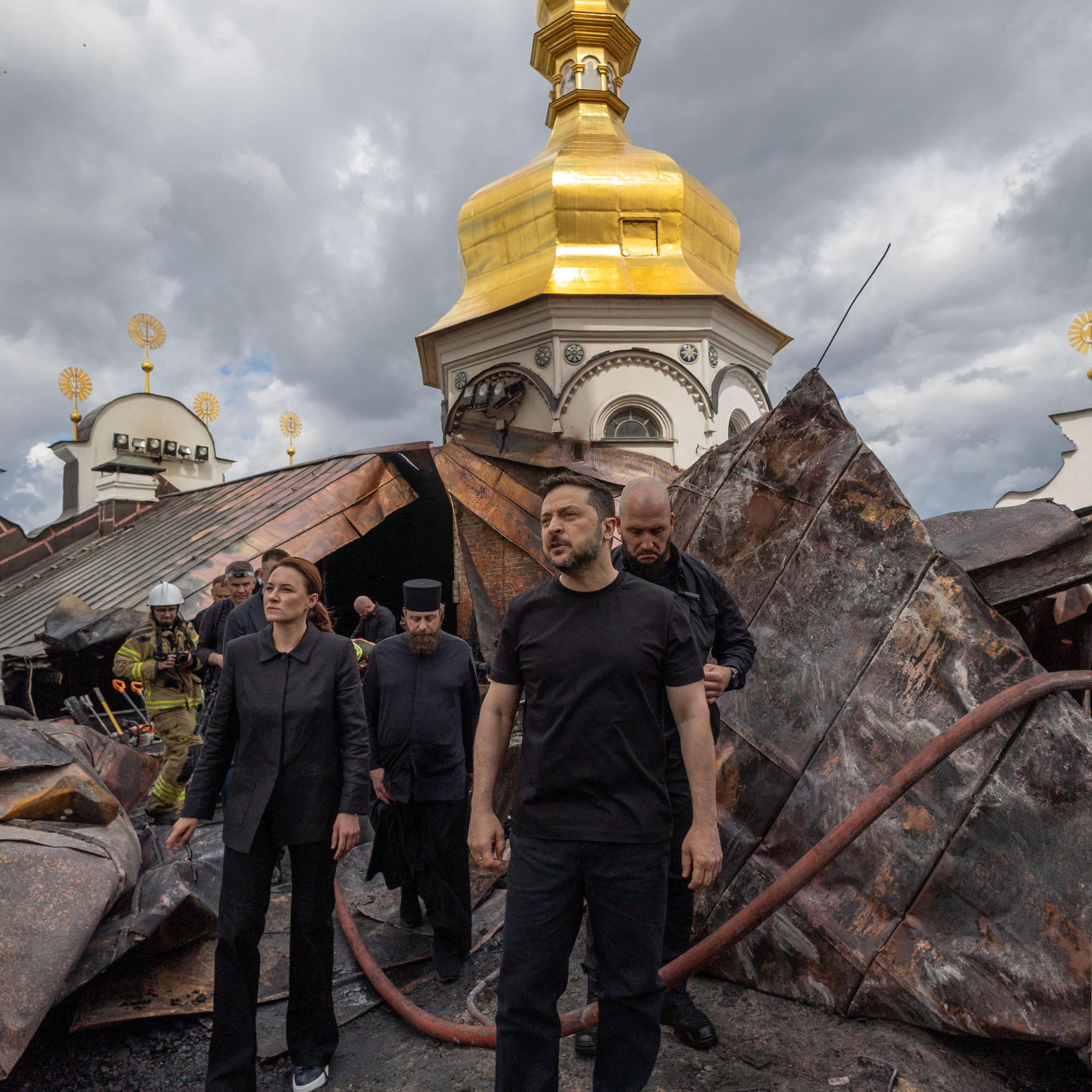
Today in Focus
Culture wars: the fight to save Ukraine’s art
00:28:23
The Guardian’s chief culture writer, Charlotte Higgins, on the citizens risking their lives to salvage Ukraine’s cultural heritage
Loading summary
Transcript57 lines
- [00:00]
Guardian Announcer
This is the Guardian.
- [00:08]
Annie Kelly
Today. The art and the artists under attack in Ukraine. Today.
- [00:18]
Guardian Announcer
INFOCUS is supported by Paramount, the Agency. All episode streaming June 21st on Paramount. In the world of espionage, truth is a moving target and every decision carries a dangerous consequence. This new mission explores what it means to live as a double agent. Twice the lies, twice the risk. The lines between ally and enemy blur like never before. And survival depends on trusting no one. Starring Michael Fassbender, Jeffrey Wright, Jodie Turner Smith and Richard Gere. Don't miss the agency. All episode streaming June 21st on Paramount Plus.
- [01:19]
Annie Kelly
Good evening.
- [01:19]
Charlotte Higgins
Here's what's happening tonight.
- [01:20]
Annie Kelly
The Soviets are saying little, but what
- [01:22]
Charlotte Higgins
is known is cause for concern. A nuclear accident has occurred a Soviet
- [01:27]
Annie Kelly
atomic plant in the Ukraine. In 1986, Reactor 4 of the Chornobyl nuclear power plant exploded. It triggered the worst nuclear accident in history.
- [01:40]
Charlotte Higgins
It's really, really hard to overstate what a huge effect that catastrophe had on Ukraine.
- [01:50]
Annie Kelly
We were recently stricken by a disaster, the Chernobyl nuclear power accident. It deeply affected the Soviet people and disturbed world opinion.
- [02:00]
Charlotte Higgins
It was one of those events that absolutely contributed to the collapse of the Soviet Union. It's a sort of foundational event in the future independent Ukraine's sense of itself.
- [02:15]
Annie Kelly
Exactly 40 years later, on 26 April this year, the Chornobyl Museum reopened in Kyiv on after going through a huge renovation to make sure it truly commemorated the impact of the disaster.
- [02:28]
Charlotte Higgins
It had transformed itself, thinking about all the people who were affected by the disaster. And that was a lot of people, because thousands of people were displaced, for example.
- [02:40]
Annie Kelly
This is Charlotte Higgins, the Guardian's chief culture writer. She was in Ukraine on a reporting trip in the south at the time of the reopening and she was planning on visiting the museum as soon as she returned to Kyiv.
- [02:52]
Charlotte Higgins
And the thing is, I never saw it.
- [02:56]
Annie Kelly
Just three weeks after the reopening, on the night of 23 May, the museum was bombed, part of a huge combined missile strike by the Russians. One of the biggest attacks on the capital so far.
- [03:08]
Charlotte Higgins
We've already seen missiles going into the city. There's also the sound of anti aircraft fire in the background there and the buzz of drones above us.
- [03:27]
Annie Kelly
Charlotte visited what was left of the building a few days later.
- [03:34]
Charlotte Higgins
I had not expected being in that destroyed museum to be quite so upsetting.
- [03:43]
Annie Kelly
And considering the fact that I've been working on the restoration project on the recent collection for the last few years, you can imagine what a powerful impact it made on me.
- [03:56]
Charlotte Higgins
The museum director was Standing in the middle of this collapsing, burnt out building, kind of clutching a brown painted earthenware jug with some patterning on it, a traditional piece of ceramic from the region where Chornobyl is.
- [04:20]
Annie Kelly
Okay. So while the rescuers were kind of digging up the ceiling between first and second floor, they found this jar from Polisa, which, as you can see on Belgium, it's like a small miracle.
- [04:34]
Charlotte Higgins
And they generally, she was actually deeply in shock. They reckoned that they were able to save 40% of the artifacts on display. Every time a museum artifact is destroyed, it means the loss of a singular object that holds memory and knowledge. And once it's gone, it's gone.
- [05:00]
Annie Kelly
Since the beginning of Russia's full scale invasion, tens of thousands of Ukrainians have lost their lives. Homes flattened, cities turned to rubble. But there's been another cost. Ukrainian culture is also under attack. Thousands of museums, galleries, historic landmarks across the country have been destroyed, destroyed or damaged. Artists, filmmakers, writers and poets have been killed. Countless works of art have been lost, and the attacks appear to be increasing. Just this week, Russia bombed one of the oldest and most precious religious sites in the center of Ukraine in what the government said was a targeted attack. From the Guardian, I'm Annie Kelly. Today in focus, the race to save Ukraine's cultural heritage. Charlotte Higgins, you're the Guardian's chief culture writer, and your book Ukrainian Art in a Time of War is out in August. Since the full scale Russian invasion of Ukraine in 2022, you have visited the country many times. And you know, you're not a war correspondent, you're a culture writer and a critic. So what keeps drawing you back to Ukraine despite the obvious danger?
- [06:18]
Charlotte Higgins
I went for the first time in October 2022 in order to write what I imagined would be one article about the way artists were reflecting and documenting the war in their work. Because I had a conviction that artists would be responding to the war in a way that would likely be more interesting and more revealing than the work of even our dear colleagues. Journalists and government reports. Surely not. And politicians. And this was going to be a super interesting aspect of the war to try to cover. People are writing extraordinary poetry. There are amazing plays being written. People are making tremendous art. All of which I'm sure is going to shape the way this war is remembered. And the stakes are extraordinarily high. I mean, this is literally life or death. And the other reason that I wanted to go originally was that it was just extremely clear that culture was implicated in the war in an incredibly clear way. That is to say that Putin has repeatedly talked about the idea that Ukraine doesn't really have a separate culture, that Ukrainians and Russians are, quote, sort of brothers, that they belong together. And he even wrote an essay about this the summer before the full scale invasion. And it's a really, a kind of. It's a denial of Ukraine as a separate identity. And you look at it through my eyes, through the doubtless prejudiced eyes of a culture writer. It just feels like a war about culture because history, language, identity are so implicated in it.
- [08:01]
Annie Kelly
And you're actually learning Ukrainian, aren't you?
- [08:04]
Charlotte Higgins
I am learning Ukrainian because I started learning Ukrainian almost as soon as I got back from my first trip because language is a part of culture. So it felt really churlish not to know any of the language. I will tell you that it's a massive struggle learning this language. But I am currently on a intensive Ukrainian course because I intend to conquer this language, even if it takes me until the next life to do so. It's very hard.
- [08:32]
Annie Kelly
So. So you were recently in the ruins of the Chernobyl Museum, obviously a really traumatic experience for those who worked there. And I think I was reading in your reporting just before the interview that you had some kind of quite startling stats that something like the Russian army had destroyed or damaged 1,723 cultural heritage sites, 2,524 cultural infrastructure sites since 2022. So, I mean, it's huge, isn't it, the scale of that destruction?
- [09:03]
Charlotte Higgins
Yeah, it's huge. And it's very. If you look at either government or, as it were, UNESCO statistics, it's kind of an ungraspable picture. But there are kind of several categories. One is those places that have come under occupation, right? So in Mariupol, for instance, at the beginning of the war, at least one museum was completely destroyed and burnt in aerial bombing as a result of, you know, fires from bombs in Kherson, for example, the museum there was emptied out as far as the Russians could manage at the end of their occupation. So truckloads of artifacts were taken into Russia. And some experts have tracked some of these artifacts from the museum in Kherson onto the Russian art market. And being in Kiev the last couple of weeks, these bombing campaigns are just relentless. It's been going on for so long, and no sooner have you recovered from one than you're waiting for the next.
- [10:09]
Annie Kelly
And, you know, you visit some of these sites afterwards. You've told us about the impact of going into the kind of smoking ruins of the Chernobyl Museum when you've been to other sites. What were people's kind of spirits like, the people that worked there, that loved those places.
- [10:27]
Charlotte Higgins
So on the same day as I went to the Chornobyl Museum, I also went to the National Museum of Fine Art, basically the National Gallery of Ukraine. It's a classic museum in that it looks like a Greek temple. It's really, really beautiful. They evacuated their collection several years ago, but inside that build, the building was just full of broken glass and rubble. And one of the chief conservators, the head of the curatorial team, and two interns who were there to do their practical art history experience, they were there with shovels, in clouds of dust, shoveling rubble into carts. And the director said to me, you know, you can be sort of mentally prepared for it, and yet you're just not really prepared for it when it happens.
- [11:27]
Annie Kelly
Charlotte, this week we saw the bombing of one of Ukraine's oldest monasteries. Can you just tell us about this monastery and why this attack is, you know, so important to people in Ukraine?
- [11:40]
Charlotte Higgins
Well, actually, Annie, I honestly thought they would never hit this particular monastery because this monastery was founded in the 11th century by monks who came from Mount Athos and founded this. What became eventually a complex, a whole complex of churches, monastery. Now it's museums, kind of cultural and religious territory. It's a spectacular group of buildings, you know, with golden domes that, you know, the sheen of them as the. As the sun rises. It's extraordinary, and it is precious throughout the Eastern Orthodox world, including in Russia. Right. Everything about it is both sort of sanctified in a religious sense, but also of huge cultural importance and huge historical importance. It was awful, really. To see the footage of flames and smoke pouring out of the Pechesk Lavra was very disturbing. The emergency services worked really hard in Kyiv, but you can't catch absolutely everything. And I think they did limit the damage, but it's just very hard to wrap one's head around the significance of these events. And it's not like the city's being destroyed in one night. It's not like the British carpets bombing Hamburg. Precisely. It's the sort of cumulative damage and the rubble and the mess and the cleaning it up and the repairing it and the trying to go on, and just hard to watch people absorbing all that into their lived lives.
- [13:14]
Annie Kelly
And in this war and in many conflicts around the world, arts and cultural sites are bombed and destroyed, sometimes deliberately. When it comes to Ukraine and the attacks by Russia, how much of this do you think is targeted?
- [13:27]
Charlotte Higgins
I think it's very hard to unravel, actually, Annie. I mean, who can look into the minds of Putin and his army chiefs and say, what were they actually aiming at? I mean, clearly sometimes they're aiming at military targets and they might hit a museum. But the fragments of shahed missiles were actually found and seen amid the wreckage of the roof of the Dormition Cathedral, which led the Ukrainian government to assert that the area was actually targeted. The Russian government claimed, by contrast, that the damage to the cathedral related to air defence, but that seems not to be the case. The result is exactly the same. Whatever the intention was, if those attacks are successful and something is obliterated and something is lost, then that's removing a layer of memory from the culture. That's a sort of irrecoverable loss then. And you have to decide whether. Whether you're going to try and rebuild it, whether you're going to try and put something else in its place or how you're going to keep the memory of it and all of these things. You know, what to do when something is destroyed. That's a kind of really live debate in Ukraine.
- [14:56]
Annie Kelly
And over the course of your many trips to Ukraine, what have you learned about what people are doing to try and save, you know, art and cultural artifacts from the front line?
- [15:05]
Charlotte Higgins
There have been extraordinary and remarkable efforts to safeguard as much as possible, but some of these efforts took place quite late in the game. If you Remember back to 2022 and the beginning of the war, Ukraine's government hadn't made any evacuation orders for museums towards the front line, for example. There are lots of reasons and political reasons for that, but that's how it was. So a lot of museums were evacuated during the full scale invasion when the bombs were already falling. So I remember going to the National Historical Museum in Kyiv and talking to the people there and they were taking objects off display when they could see Russian helicopters flying outside the windows and living in that museum for a month at the beginning of the full scale invasion to get everything down into the basement and ultimately to safety. So it's been a very mixed picture of people self organizing in a remarkable way to safeguard objects. But there are lots of things you can't do anything about. You know, if there's a beautiful 17th century wooden church in a frontline area, there's very little you can do to protect that from fire. You can't pack it up and move it.
- [16:23]
Annie Kelly
And in 2024, you met a group of citizens who were, you know, really taking this process into their own hands. Didn't you?
- [16:29]
Charlotte Higgins
Yes. So there was a group of extraordinary, ordinary people, not people who were employed by museums or by the state or by any kind of official apparatus, led by a guy called Leonid Maroschak, who risks unbelievable dangers. I mean, if you Remember back in 2022, it looked like Kyiv might fall. And so the first thing he did was he drove into Kyiv to deliver humanitarian aid to the city and then drove out with archives and artworks. When I say he drove, he actually can't drive. His brother in law drove him and his wife's mini countryman, he was taking up super important archives and artworks. There was a sort of powerhouse couple in the 1960s called Ala Horska and Viktor Zaretsky. They were both sort of dissidents and pro Ukrainian. They made unbelievably amazing work. He arranged to get their archive out, stuff like that. Amazing, amazing stuff. And then because he'd worked quite a lot in Eastern Ukraine, he realized that museums that he knew in the east were threatened. So he again, for the first few months, using this mini countryman, being driven by a friend, got stuff out. Then they graduated onto a Mercedes Sprinter, which was extraordinary. A van which was smashed by a Shahad drone in Nikopolis, I believe.
- [17:58]
Guardian Announcer
Wow.
- [17:58]
Annie Kelly
God, they really are everyday heroes.
- [18:00]
Charlotte Higgins
They are, they are. I don't use the word heroic lightly, but I do think what they did was kind of heroic.
- [18:18]
Annie Kelly
And Charlotte, you told us at the beginning of this conversation about what originally inspired you to go to Ukraine in the first place was some of the work that was being created there. So I'm really interested in how a new generation of Ukrainian artists and writers are reflecting this incredibly brutal time in
- [18:38]
Charlotte Higgins
their art now, I think, and whether this is conscious or unconscious in Ukraine, I think there is an urge to create against the destruction. You know, so many things are being rendered non existent and so many people are being rendered non existent. When I first went in 2022, the beginning of the war had, for many people, stopped them in their tracks in terms of their creativity for really super obvious reasons, like staying alive and making sure your loved ones were alive, possibly volunteering for the army or doing humanitarian work. All of these were much more pressing than getting your watercolor set out. But actually, quite quickly, writers and artists felt this urge to create documentary of one sort or another. So there were lots of diaries, there were lots of essay writing, particularly for foreign publishers and foreign press, to try and get the story out there. But from Ukrainian subjectivity, super important. Then came poetry, actually. So poetry is a form that can happen Quite quickly, you can write a poem in a trench, as was proved in the First World War and is being demonstrated over and over again now. I mean, there are extraordinary who are writing from the front lines. And poetry in 2022 felt like the form because everyone's existence had felt like they had disintegrated, exploded. Time was meaningless. Everyone was living in this sort of present moment. Language felt like it didn't hold form anymore. So poetry is a space where you can do something with that. There's a volume of poetry, Annie, for instance, called We Were Here, by a young poet called Arthur Dron, who's in his 20s and was in the army for three years. He was actually very badly injured and is now a veteran. He's not in the armed forces anymore. But his poems are really surprising if you're expecting anything. Full of machismo and ardent, furious patriotism and loathing of the enemy. His poems are beautiful, tender, tiny memorials for people he fought with and who he lost. And so the Ukrainian army is made up of Ukrainian citizens. That means that there are a lot of Ukrainian artists and writers and creative people in the army. So it's incredibly bleak in many ways. So many young talents are being killed on the front lines, and there are, you know, a fair few talents being killed as civilians behind the lines as well.
- [21:24]
Annie Kelly
And, Charlotte, you've had a really painful personal loss yourself. Your friend, the novelist and war crimes investigator Victoria Amelina, was killed in a Russian strike in 2023. What has her loss meant to you, but also to Ukraine?
- [21:40]
Charlotte Higgins
I met Victoria Amelina in October 2022. She was an extremely articulate advocate for Ukraine abroad, and she was a very significant artist in Ukraine. So her novels were very popular. So I knew her for a very brief period. But, you know, in times of great stress and in a war, you actually become friends with people rather quickly. And she's one of the reasons that I returned to Ukraine. You know, I went to Ukraine once to do one article, and then it was Victoria who pointed me in the direction of another story and said, I think you should really think about writing about this. And it was the story of another writer, Volodymyr Vakilenko, who had been killed in his village under occupation in 2022. And Victoria, as a war crimes investigator, had gone to his village and had found the diary of occupation that he had written and buried in his garden. It's an extremely sad story. And I wrote about that extremely sad story. And the day I finished writing that extremely sad story, Victoria herself was killed. I guess I pretended to be very unaffected by it for about six months because I felt that it would be unprofessional to be upset. And then six months later, I was really, really, really upset. I mean, why wouldn't you be? This incredible young woman had been killed and I went to see her grave a couple of days ago, and it's tremendously, it's tremendously sad. She had wonderful, close lifelong friends and most importantly of all, a son and a family who, you know, she's very, very dearly missed.
- [23:38]
Annie Kelly
Coming up, the Decolonization of Ukraine.
- [23:48]
Podcast Narrator
A History of the United States in 100 Objects is a brand new podcast from 99% Invisible and BBC Studios. Each week we're looking at a different object from across American history with a unique story to tell about who we've been, what we've built, and what we've allowed ourselves to forget. Some of these objects are well known, many are not. But all of them carry the story of how we got to this moment. Find A History of the United States in 100 objects on the 99% invisible feed, wherever you get your podcasts.
- [24:23]
Annie Kelly
So, Charlotte, we've talked a lot about this race to preserve and protect Ukrainian art and cultural heritage. Has there been any kind of pushback against Russian influenced art or Russian language heritage?
- [24:39]
Charlotte Higgins
Certainly there is a huge theme of decolonization in Ukraine, which has been ongoing since at least 2014, if not before. I suppose the Ukrainians see that Russia has traditionally used its culture to promote itself, they would say, as a weapon at the expense of the culture of its colonized neighbors. So you could say the same, you know, about Georgia or about Lithuania or wherever. But in Ukraine during the war, there have been laws that have come in that have suggested or mandated, I should say, the removal of, of public memorials that glorify the Russian empire and Russian imperialism in general. And previously there had been similar laws around de Sovietization. So, you know, that's when all the statues of Lenin went, long before I came to Ukraine. So one really powerful thing is that every town and village and city in Ukraine at one point had a statue of Pushkin in it, usually on a very prominent boulevard or in a beautiful park. And there was always a street called Pushkin street. And all those streets have been renamed, all the sculptures have gone. And last week I was going to have coffee with a really interesting archaeologist, as you do. I was walking down a street called Andreevsky Descent and it's lined with beautiful 19th century buildings. And one of these buildings is the Bulgakov Museum. Okay. So obviously in the uk, we absolutely love Bulgarkov, and I can't remember whether any of his novels hit the Guardian's 100 best novels, but I wouldn't be at all surprised if the Master of Margarita was on that list. However, in Ukraine, he is not so popular, despite being someone who was from Kyiv, because particularly in his novel the White Guard, he is seen as really embodying ideas of Russian imperialism, and he was tremendously against ideas of Ukrainian nationhood. So he's not the most popular writer in Ukraine right now. And as I was going for my coffee, passing his house museum, I just happened to see that a large sculpture of him that sits outside his museum was being winched onto a flatbed truck and taken away.
- [27:15]
Annie Kelly
He's out of there. And, you know, in war, when there, as you said, there is so much loss, there's so much devastation, it can be easy to overlook the destruction of cultural artifacts and institutions because of all of the horrible things happening elsewhere. Why, for you, is it important that it isn't overlooked and that we do keep reporting it?
- [27:44]
Charlotte Higgins
I mean, we look at this war through a military lens very obviously. We look at it through an economic lens also, very obviously. We look at it through a political lens, of course. But the war is also just very obviously about culture. So if we didn't look at cultural destruction or what artists are doing or the politics of language or think about Ukrainian identity, we'd just be missing a whole tranche of it. I also honestly believe that the Ukrainians are reframing forms in which people can express ideas around this kind of violence. Even in the most horrific situations, people need and want to create stuff, and they need and want to be heard and seen. There's so much going on just formally, just really new and interesting ways, where sort of documentary meets poetry meets memoir, but in ways that I haven't seen before. It's kind of exciting. It's appalling that it's having to be created. But I'm quite sure that in the future, the way this war is thought about will be seen through the way the best of these artists have remembered it, in their writing and in their poetry, in their prose, in their plays, in their art.
- [29:13]
Annie Kelly
Charlotte, thank you so much for your time today.
- [29:15]
Charlotte Higgins
Thank you, Annie. It's always a pleasure.
- [29:20]
Annie Kelly
That was Charlotte Higgins, the Guardian's chief culture writer. Her new book, Ukrainian Art in a Time of War, is available to pre order through the Guardian Bookshop. And that's it for today. This episode was produced by Ivor Manley, Guy Zelfman and Jacob Antigua and was presented by me, Annie Kelly. The sound designer is Josh and Chana and the executive producer is Eli Block. We'll be back this afternoon with the latest.
- [29:50]
Guardian Announcer
This is the Guardian.
- [30:01]
Podcast Narrator
A History of the United States in 100 Objects is a brand new podcast from 99% Invisible and BBC Studios. Each week we're looking at a different object from across American history with a unique story to tell about who we've been, what we've built, and what we've allowed ourselves to forget. Some of these objects are well known, many are not, but all of them carry the story of how we got to this moment. Find A History of the United States and 100 objects on the 99% invisible feed. Wherever you get your podcasts.