← Today in Focus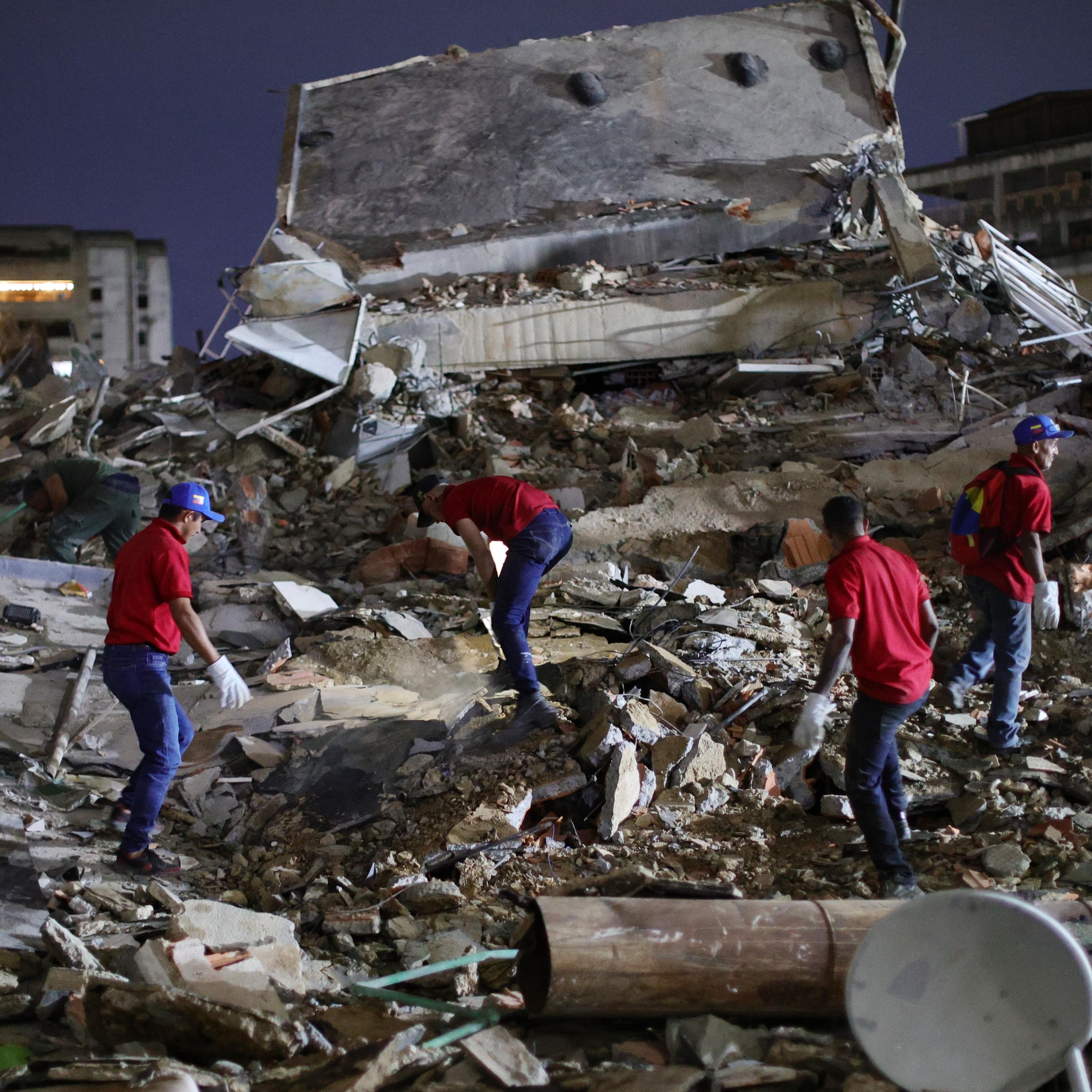
Today in Focus
Desperate search for survivors after deadly earthquakes hit Venezuela – The Latest
00:11:05
Rescue efforts are under way in Venezuela after two powerful earthquakes caused buildings to collapse and killed at least 164 people, and there are fears the death toll could rise significantly. Lucy Hough speaks to Latin America correspondent Tom Phillips
Loading summary
Transcript23 lines
- [00:00]
Lucy Hoff
This is the Guardian.
- [00:10]
Nick and Jack
Hey Yetis, this is Nick and Jack from the Best One yet podcast. Now, the last company we worked at, they used Paylocity and everything just worked. It wasn't until launching our own media business this show that we realized how rare that is. Because Paylocity is one delicious burrito of operational needs. They roll up HR for finance and it seamlessly into one delicious bite. When everything wraps together like that all at once, your workforce, your tech stack, your business, you don't need more tools, you don't even need cilantro. You need one solution. And that is why Paylocity built a single platform to connect hr, finance and IT with AI driven insights and automated workflows that simplify the complex and power what's next. Or as we call it, a delicious operational burrito. Yes, we do experience a one place for all your HCM needs besties. So start now@paylocity.com.
- [01:07]
Tom Phillips
Rescue workers and volunteers have spent the night picking through the rubble with their hands, trying to find survivors, pulling some people out of the rubble of these blocks of flats. Some people say that Venezuela has effectively been turned into a US Protectorate in the months since Maduro's capture. The Department of War is going to have to play a logistical, big logistical role here. Venezuela, of course, is reeling still from a decade plus massive economic crisis. The government is really not well equipped to respond to this kind of disaster.
- [01:34]
Lucy Hoff
From the Guardians today. In focus this is the latest. With me, Lucy Hoff. There have been two massive earthquakes that hit Venezuela last night local time near the capital city of Caracas, causing huge damage to buildings which have collapsed and sadly, massive loss to life. Tom Phillips, as our Latin America correspondent, you've been spe to people on the ground. Give us a sense of the scale of the damage.
- [02:02]
Tom Phillips
I mean, really, really disturbing scenes that we're seeing and hearing about from reporters on the ground. One of our reporters spent the night in Altamira and Los Palos Grandes, which are some very upmarket areas of Caracas. Homes of hotels, foreign embassies. I was staying there just a few weeks ago when I was in Venezuela, and at least three buildings have come crashing down. Rescue workers and volunteers have spent the night picking through the rubble with their hands, trying to find survivors, pulling some people out of the rubble of these blocks of flats. And many, many thousands of people have spent the night out on the street sleeping on pieces of cardboard or mattresses or in tents because they're too scared to go back into these fractured buildings after two such massive earthquakes.
- [02:45]
Lucy Hoff
So the Venezuelan Government has declared a state of emergency. We're speaking at about 01:00 UK time. So obviously any death toll that we're looking sadly likely to rise, but there have been warnings that we could be looking at a death toll of tens of thousands, possibly even a hundred thousand.
- [03:02]
Tom Phillips
Yeah, I think at the moment people are just trying to get a sense of what is going on on the ground. I've seen that Donald Trump has been talking about a devastating number of deaths. It really is not clear. The official death toll, as things stand, is 164, with nearly a thousand people injured. I suspect that will rise considerably, but at the moment, we just don't know. I mean, just to give you a sense on a very personal level, I've been speaking to one of our reporters this morning who is heading to the northern, one of the, one of the northern cities that is worst affected, and she told me that she's going there because her aunt has disappeared. So there are lots of people who are missing at the moment. And social media is absolutely lighting up with pictures of people young and old who have not been seen since about 6pm yesterday when that earthquake just tore through this coastal region and brought many, many big buildings crashing down.
- [03:50]
Lucy Hoff
Yes, we'll come on to the rescue efforts, but were there warnings issued? Has Venezuela experienced earthquakes of this magnitude before that would have sent alerts to people to say that this was coming?
- [04:04]
Tom Phillips
No, we don't believe there was any warning that this was coming, as you might expect. For example, in Mexico City, where you often get a few seconds or perhaps a minute warning if such a major earthquake is about to happen, people were taken. Surprise. A lot of people, I think, were tuning into the World cup football match between Brazil and Scotland. I've seen images on the Internet, people watching that game and suddenly their, their, their front room shaking all over the place and then sprinting for cover. People at the airport who are obviously waiting to get on board planes and then, and then they're in, you know, the airside in the terminal and dust starts crashing down from the ceiling and the whole structure is shaking and people are racing for cover. So it obviously has come completely out of the blue. The last major earthquake that Venezuela suffered was in 1967, and it hit a very similar region, Caracas, in the northern coast. Hundreds died then, but we just don't know how bad this is going to be at the moment.
- [04:54]
Lucy Hoff
Yeah. And there is a massive search and rescue operation at the moment as well that's involving countries overseas, neighboring countries, but also the United States. And they're trying to get access to the worst affected areas. Right. That haven't been accessible to rescuers at the time that we're speaking.
- [05:11]
Tom Phillips
That's right. I mean, one of the big problems that they're going to face is that the Simon Bolivar International Airport, which is to the north of Caracas on the coast, is located in what seems at the moment to have been the absolutely worst hit area. The, the runways are apparently are not operating. So it is going to be a struggle to get aid and humanitarian assistance in. And another problem is that Venezuela, of course, is reeling still from a decade plus massive economic crisis that has brought the country to its knees. The worst crisis outside a war zone. So the government is really not well equipped to respond to this kind of disaster. And I think it really will need international help. The question is just going to be getting that in.
- [05:49]
Lucy Hoff
Yeah. So let's talk about the United States because obviously we have spoken about the US And Venezuela in very, very different circumstances over the course of this year with the strikes on Venezuela at the start of the year and the capture, the extraordinary capture of former President Nicolas Maduro. The US does seem to be vocally supportive of Venezuela at the moment in terms of rescue efforts and has deployed people to help, hasn't it?
- [06:17]
Tom Phillips
Yeah, I mean, that's one of the ironies of this. Just a few weeks ago, I was in exactly this area, La Guaira, Katialama, along the northern coast, interviewing residents of housing estates along those coastal communities who had seen helicopters, US attack helicopters, come flying in on January 3rd when Trump ordered Maduro's abduction. And that event made some of them think of the earthquake in 1967. They woke up and their building had suddenly come under attack and the front had been ripped off it. We met this old lady who had prepared a grab bag to flee if there was another US attack. There hasn't been another US attack, but those communities have been leveled. The Naval Academy near to where we were, I've seen pictures. It's been brought down. At least four or five, maybe as many as a dozen big buildings, including hotels, have come crashing down in La Guayda. So this is right in the area that the US attacked, where it began as they made their way to Caracas to capture the president. The US is now in an unusual position because it has, some people say that Venezuela has effectively been turned into a US protectorate in the months since Maduro's capture. So what is it going to do now? Is it really going to respond to this now that it is to all intents and purposes in charge of Venezuela. It, in a way, owns this crisis and it needs to get humanitarian workers and, I don't know, possibly even some kind of military force in here to help with these rescues, perhaps, you know, similar to the way it did in 2010 when Haiti was leveled. Port Au Prince, Haiti's capital, was leveled by massive earthquake.
- [07:48]
Lucy Hoff
Yeah. So what can we read into the political statements that we've been hearing from President Del C Rodriguez, who was installed after the capture of Maduro? She has said she's grateful for US support. Is she calling for further international support? And do we know where that's coming from?
- [08:05]
Tom Phillips
Yeah, well, I mean, I mean, I suppose to be fair, she is the interim leader of Venezuela. She is a Venezuelan and I don't think it would be fair to doubt that she genuinely wants to. To see a good rescue operation and cares about her country and the people who are trapped and the survivors who still may be under the rubble. But undoubtedly, this is also an opportunity for her to show that she is in charge. She was Maduro's vice president. She came to power after he was abducted and has since struck up this partnership with the US and despite being very unpopular at home, as he was as part of his regime that had led Venezuela into this massive humanitarian economic crisis over the past few, she is keen to project an image of strength and power and control and show that she could perhaps win the elections if and when they are held in Venezuela and face off the challenge from Maria Corina Machado, the opposition leader. So I suppose she is doing everything she can now to show that she has international support and that she is responding and that the government is doing everything it can to help people.
- [09:06]
Lucy Hoff
But as you say, this huge natural disaster that seems likely to lead to a massive humanitarian catastrophe is coming off the back of decades of economic disaster, recent political turmoil. Obviously, we're dealing now with the immediate aftermath of the earthquakes, but there will be a massive effort needed to reconstruct, to rebuild. It feels like Venezuela is ill equipped perhaps, to deal with that in the longer term currently.
- [09:36]
Tom Phillips
Yeah. I mean, to give you a sense of this, nearly 8 million Venezuelans have fled their country in recent years because it has absolutely been crippled by hyperinflation, hunger, economic crisis, political repression. And many of those people, most of those people have not come back yet. So, of course, once the dust settles and once we get a sense of the scale of this, there will be political ramifications. There always are, there will be questions. Because, yeah, of course, this is a natural disaster, but natural disasters are often, in a sense, man made. The huge earthquake in 2010 in Haiti, of course it was the result of a natural phenomenon. Huge, huge, huge earthquakes. But it was also the consequence of corruption and government incompetence, poor building standards that brought all of those buildings crashing down. So there will be questions to ask about whether the government was ready to respond to this disaster, and I suspect the answer is that it is going to be woefully lacking because of the plight of Venezuela since Maduro came to power in 2013 and led his country into an absolute economic disaster.
- [10:41]
Lucy Hoff
It is a tragedy. Tom, thank you so much for your time.
- [10:44]
Tom Phillips
Thank you.
- [10:46]
Lucy Hoff
That's it for today. My huge thanks again to the Guardian's Latin America correspondent Tom Phillips. You can keep up with all his reporting and our live blog on this story over@theguardian.com and I really recommend listening to our sister podcast Stateside with Kyan Carter. As the US prepares to celebrate 250 years since its founding, Kai Wright is looking at the conflicts at the heart of the American project. Thanks for listening to this episode of the latest Today in Focus. We'll be back in your feeds as usual tomorrow morning. The latest will be back tomorrow night. This episode was presented by me, Lucy Hoff. It was produced by Leo Schick and Bryony Moore. The executive producer was Zoe Hitch.
- [11:28]
Tom Phillips
33 days, 33 episodes, no off Switch from the goals and the glory to the politics and the problems of the World Cup. If you want soccer analysis from a podcast that's been overanalyzing the game for more than 20 years, then this is it. Join me, Max Rushton and our expert team of soccer journalists every day of the tournament. Can England end 60 years of hurt, or will this be another year of falling just short? Probably World Cup Daily Listen wherever you get your podcasts or watch full episodes
- [11:52]
Lucy Hoff
on YouTube, this is the Guardian.
- [12:03]
JP Morgan Asset Management Announcer
Did you know that passive fixed income ETFs only capture about 50% of the US public bond market? But with JP Morgan Asset Management's active fixed income ETFs, we can help you capture 100% of the US public bond market and explore twice as many opportunities. Visit jpmorgan.com getactive to learn more. JP Morgan Asset Management is the brand name for the asset management business of J.P. morgan Chase Co. And its affiliates worldwide. This communication is issued by J.P. morgan Distribution Services, Inc. Member of FINRA. High interest debt is one of the toughest opponents you'll face unless you power up with a SOFI personal loan. A SOFI personal loan could repackage your bad debt into one low fixed rate monthly payment. It's even got super speed since you could get the funds as soon as the same day you sign. Visit sofi.compower to learn more. That's S-O-Fi.com p o w E R Loans originated by SOFI bank and a member FDIC. Terms and conditions apply. NMLS 696891 A History of the United States and 100 Objects is a brand new podcast from 99% Invisible and BBC Studios. Each week we're looking at a different object from across American history with a unique story to tell about who we've been, what we've built, and what we've allowed ourselves to forget. Some of these objects are well known, many are not, but all of them carry the story of how we got to this moment. Find A History of the United States and 100 objects on the 99% invisible feed. Wherever you get your podcasts.