← Today in Focus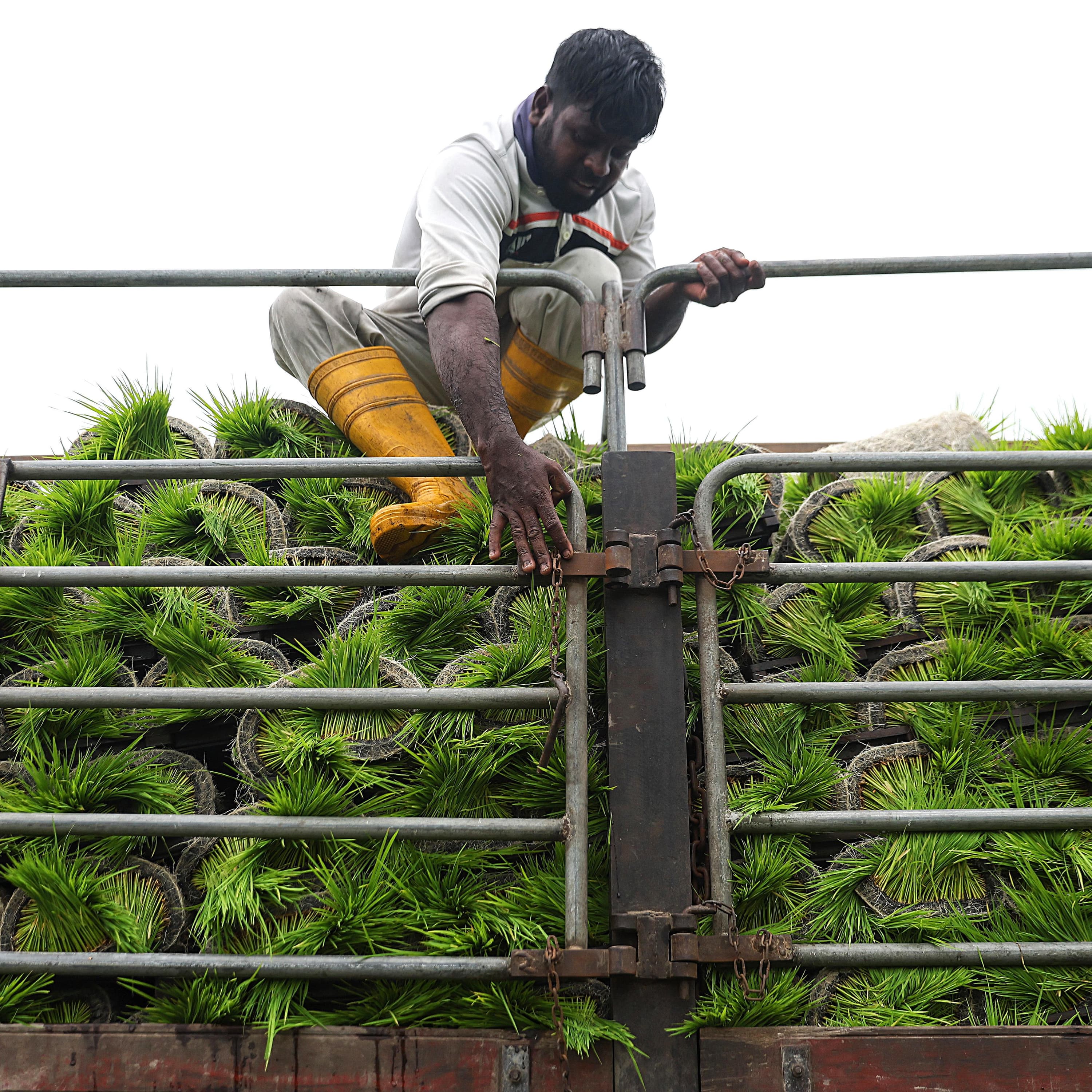
Today in Focus
George Monbiot on our fragile food system
00:28:44
The Guardian columnist speaks about why we need to tackle global food insecurity
Loading summary
Transcript57 lines
- [00:00]
A
This is the Guardian.
- [00:08]
B
Today, what the war on Iran means for the world's supply of food.
- [00:20]
C
Today's markets move fast. Get the insights you need in 10 minutes with the Barclays Brief, a new podcast from Barclays Investment Bank. Through sharp dialogue and scenario based analysis, our leading experts experts analyze key market themes each week. So whether you're managing a portfolio or leading a business, the Barclays Brief podcast can help you make smarter decisions today. Stay sharp, stay brief. Find Barclays Brief wherever you get your podcasts.
- [00:57]
B
Five weeks into a war that the US Promised it would have settled by now.
- [01:01]
A
If your children are watching, be warned. President did not use polite language.
- [01:07]
B
And President Trump is rattled.
- [01:09]
A
Quote, Tuesday will be power plant day and bridge day all wrapped up in one. In Iran, there will be nothing like it. Open the fucking straight, you crazy bastards, or you'll be living in hell. Just watch.
- [01:24]
B
The Strait of Hormuz is crucial to the world's steady supply of gas and oil. And the Iranians forcing its partial closure has sent financial markets into a tailspin. But energy is just one part of this very global story. What about food?
- [01:44]
A
So we're looking at roughly 30% of the nitrate fertiliser, roughly 20% of the phosphate fertilizer, a lot of the sulfur as well, around 50% of that.
- [01:56]
B
The Guardian columnist and campaigner Georges Monbiot is ringing the alarm bell.
- [02:02]
A
So this is a very substantial chunk of the world's fertilizer production and export is coming from the Gulf nations, principally because a lot of that is being produced from natural gas and other hydrocarbon products.
- [02:17]
B
Modern food production, the crops, the farms, requires an enormous amount of fertiliser and a good chunk of the world's supply. It comes from the Gulf, shipped out through the Strait of Hormuz.
- [02:29]
A
This is the place where we can most cheaply get fertilizers. And here are the vast container terminals through which everything is moved. You knock out part of that and the backup systems just aren't there anymore.
- [02:50]
B
As shockwaves ripple through the global food system, what can governments do to prepare? From the Guardian, I'm Noshi Nikbal. Today in focus, how the war in Iran exposed the vulnerability of our food system. George Monbiot, you're a columnist for the Guardian and you've been paying close attention to one of the biggest impacts of the U. S Israel war against Iran. In fact, it is something that you've been writing about and talking about for a very long time, food security. Can you begin by telling us what does that mean?
- [03:28]
A
There are lots of different components to food security. And there is what people call the U boat approach to food security. Oh, food security means national food self sufficiency, self reliance. But actually it is much more complicated than that. If you are totally dependent on the production within your own borders, well, one bad harvest can throw you into insecurity. And so a large part of our national food, food security, and this applies to many countries around the world, is now highly dependent on global trade. It means that if you have harvest failure in one part of the world, then the gap can be filled by production elsewhere. But beyond a certain point, it can also have an exacerbating impact where when the global food system itself becomes unstable and insecure, then it can greatly compound and insecurities in any one nation.
- [04:27]
B
And so how exactly is the war in Iran threatening food security?
- [04:32]
A
Well, there are immediate threats and there are longer term and much greater threats. And the immediate ones, for instance, is the disruption in fertilizer supplies. And the Gulf region supplies a very large proportion already. It's caused a significant rise in the price of fertilizer. This will be especially damaging to farmers in Africa who are highly dependent on fertilizer imports and in South Asia also. And so all of that will have knock on impacts on the price and the availability of food. It'll make food more expensive. Already speculation awareness of that future impact is raising the price of food. But the issue goes way, way beyond that. And what we're looking at here is a system which is kind of on a knife edge already. It's been in some respects highly successful. We have over 8 billion people on earth who are largely provided with food. Obviously there's far too much malnutrition and undernourishment worldwide. But at the same time, we don't have the vast famines that afflicted the world, for instance, in the 1960s and 1970s. And those famines which currently occur, such as in Gaza and in Sudan, are entirely caused by conflict, by genocide, by atrocities, not by an absolute shortage of food. But in order to maintain these incredibly high levels of food production, we need a great deal of inputs, lots of fertilizer, lots of trade around the world. And those are delivered through a system which has been losing some of the absolutely crucial elements of systemic resilience. And my concern, which I've been voicing for several years now, is that the global food system looks rather like the global financial system in the approach to 2008. And as in that case, once a system loses its resilience, you can't predict what what event could cause a tipping point? What event could cause that system to slide off a cliff, to collapse completely? In the end, it was the US subprime crisis which caused the very near collapse of the global financial system, requiring a bailout of trillions. It could be the Iran war which does it for the global food.
- [07:17]
B
Can we go back a couple of steps? Because I'm really intrigued by this idea that you say that the food system is already on a knife edge. Taking aside the war in Iran to a layperson myself, could you explain actually how that works and what the analogy is with the financial market?
- [07:32]
A
So there was a lot of mystery about why the global financial system almost collapsed in 2008. And there was a very interesting analysis conducted by Andy Holden, who was chief economist at the bank of England, and there was Professor Robert May, who's a very well known ecologist. And what they were saying was that it wasn't the subprime crisis which was the ultimate distal cause of the near collapse of the financial system. It was that that system, just like ecosystems when they lose crucial components of resilience, had been undermined and undermined over many years and was already prone to collapse. And all it needed was a sudden shock to knock it over the edge. And systems lose resilience partly when they lose diversity, partly when they lose redundancy, which is the spare capacity in a system. Partly when they start to synchronize, when every part of the system is doing the same thing at the same time. And that means that a shock caused in one part of the system can quickly proliferate around it. And partly when they lose the backup systems, the other ways of getting from A to and partly when they lose what's called their circuit breakers, which in this case we're talking mostly about regulatory restraints on that system. Now the really worrying thing is that the global food system has lost large amounts of all those elements of resilience. We see a great loss of diversity in terms of the corporations providing it. And there's been a massive consolidation, corporate consolidation of power. And at the same time they're all become hyper efficient. So the redundancy is reduced, the spare capacity is reduced, and they've synchronized. It's all just in time delivery. Everything is done through the same systems. It's the same container terminals with the same containers loaded onto the same boats, all incidentally going through the same choke points, like the Strait of Hormuz, like the Suez Canal, Panama Canal, Strait of Malacca, Turkish Straits, further vulnerabilities there. Regulation has been stripped away. There's almost no monitoring and enforcement. So the corporations can do pretty well exactly what they want because everything has been consolidating around a single model of production. The backup systems have fallen away as well. And every single light on the dashboard is going woo, woo, woo. This great red flashing lights now setting off all the way across it. And a systems theorist seeing that situation would say, this is a system in, in dire danger. Now, there is a fundamental difference between the food system and the financial system, and this is that the financial system in 2008 could be bailed out at vast expense. But you know, it was bailed out because you could bail out it out by issuing future money. That's what quantitative easing was. Well, you can't bail out the food system by issuing future food.
- [10:41]
B
Gosh, it is just so stark when you lay it out like that. But, George, just how bad you expect that the impact of this war will be?
- [10:49]
A
Even if we're not looking at global food system collapse already, the downstream impacts are going to be very great indeed. So if you look at Sudan, for example, where there's already famine and much wider malnourishment as well, farmers are desperately going to need fertilizer in order to get the next season's crops produced. An interruption in supply, which is entirely possible in a country like Sudan, or a great hike in the price of that fertilizer could mean that either the crops don't get planted or there is no fertilizer. And given that agriculture has become pretty well dependent on fertiliser, then the impacts within just a few months are going to be extremely severe, very, very worrying and threatening indeed. And when those are compounded by the effective collapse of global aid and the humanitarian programs which were previously stepping into the breach, well, the consequences don't bear thinking about. And so I guess what I'm talking about is that even if the global food system isn't pushed into collapse, that horror scenario that I've been discussing, the local food system can be, and this is what we've seen now several times over the past few years. Covid and Russia's invasion of Ukraine were two of the things which caused localized collapses in the food system. We're much worse off this time, or rather, people in Sudan and countries like it are much worse off because there's just no game plan for getting out of this situation.
- [12:37]
B
From what you can assess, which countries are most vulnerable to the impact of this war in terms of food production?
- [12:45]
A
There's a particular vulnerability across much of Africa because it's Very dependent on fertiliser imports and it's particularly dependent upon Gulf imports. We see a lot of imports also into India from the Gulf of fertilizer. There's a lot going to Brazil and to North America as well. But they have potentially other sources of supply. I'm especially concerned about Africa because the supply lines from elsewhere have not been established and it's highly import dependent. There are places which will do better than others, but it's for most African countries it's a very worrying situation indeed.
- [13:24]
B
George, you've explained how vulnerable food systems across the world can become to global events. You've mentioned Covid and the Ukraine war both having an impact on food security. How does the moment we're in now compare?
- [13:37]
A
It's hard to tell because it's very early days in this crazy senseless attack on Iran. But it really doesn't look good because it's hard to see what the off ramp is. There aren't even any sustained negotiations as far as we can tell. But what we're not seeing is a kind of agreement that we saw even at the height of Russia's invasion of Ukraine. Between Russia and Ukraine to allow food and fertilizer to continue to flow, none of that is in the offing. We also see this massive crunch in humanitarian aid. There's far less available than there was either during COVID or during the Russian Ukraine war. But it's also the case that as time has gone by, and I think this could be a reflection of the declining resilience of the system, we've seen a disastrous reversal in the progress that was being made on malnutrition worldwide. And hunger has been fairly steadily rising now over the past ten years or so. And we're going to see a significant rise, I'm convinced, as a result of this attack on Iran. Plus of course, all the climate shocks which are coming with ever greater frequency and severity. And you put all of those things together and even before the prospect of the system going down, if it does or not, we're going to see a great deal more human suffering. But if as a result of all the things we've been talking about, this loss of systemic resilience, we do actually see a collapse of the global food system, well, it's just unthinkable. You can't even go there. And I spend my life going there, I spend my life rolling in the excrement of humanity. That's what I do, that's my job. But this is one of those things where imagination fails. The level of Famine and death and suffering is not like anything any of us have ever experienced worldwide.
- [15:55]
B
George, if it's difficult for you to try and imagine the scenario, I mean, as you say, as someone who spends their life doing just that, you can imagine for listeners trying to work out actually, how far away is this? What's it going to look like? I mean, I wonder if, from a UK perspective, dare I even ask, in the more immediate sense, what will the impact of this particular war be and how prepared are we?
- [16:22]
A
We're better off than the majority of countries because we have a strong currency, we have relatively high buying power, but there is really no we in the United Kingdom. There are people who are very well off and very well nourished, but there's already large numbers of people in this country who are poorly nourished, who struggle to afford healthy food because healthy food is in almost all cases more expensive than unhealthy food. And the impacts on them will be greater. They will suffer immediately from food inflation, which is already beginning to kick in. As a result, the government's response has been weak. But I'm much more worried, to be honest, about what happens in this country if the global food system collapses and absolutely nothing is being done to prepare for that. We should be building our own resilience in our own country, and that means strategic food reserves for a start. Other countries do it. China does it, Norway does it, Switzerland does it, for example. Quite a few others do it.
- [17:28]
B
The UK doesn't do it.
- [17:29]
A
We don't do it at all. Or rather the government refuses to say whether it does. And instead the government is leaving it to this thing we call the market. What the market actually means in this case is a handful of huge and ruthless global multinational corporations. There's no reassurance there whatsoever. We're talking about leaving it to the oligarchs. That's basically it. The purpose of governments is to govern. We need to see government stepping in and saying, right here is the strategic threat we face.
- [17:59]
B
But, George, what would it look like for a government to properly strategize and to build up food reserves? Literally, what would it look like? And is there anything that individuals can do to insulate some of the shock that you have predicted is coming?
- [18:13]
A
So a few things the government can do straightaway is one, to actually create warehouses full of food so that if the worst comes to the worst, at least we have some breathing space. We have a few weeks where the government can make sure the population is fed while whatever happens feeds through the system. Number two, another way of preparing and making us more resilient is by pressing for a change in diet. One of the things which makes us particularly vulnerable is our very livestock dependent diet. So there's this crazy government rhetoric in this country saying, oh, we need to increase our domestic poultry production because that'll enhance our food security. Hang on a moment. There isn't any such thing. The poultry, the chickens that we produce in the UK are wholly dependent on Brazilian soy and North American maize. Livestock is an incredibly inefficient way of feeding people. It means that an awful lot more food must be channeled through the system in order for us to receive nourishment, because a lot of that food is lost when it's fed to an animal before that animal is fed to us. And it puts the system on even more of a knife edge. We would ensure that we were much less dependent on imports if we switched towards a plant based diet. And at the moment, there's absolutely nothing coming from government to encourage us to do that. There should be public information campaigns, there should be advertising. We could even contemplate a meat tax, for example, to encourage that shift. And we should be seeing much more emphasis on growing pulses with breeding programs for pulses which are well suited to our climate, but also a total backup system which operates on completely different principles, which is another really key element of resilience. So, for instance, producing microbial proteins by what's called precision fermentation, multiplying up microbes, which themselves are a very rich potential protein source.
- [20:13]
B
I mean, wait, so a lab produced protein? Are you talking so something beyond like those weird meat burgers that you can get. What are you talking about exactly?
- [20:21]
A
I'm talking about it as a raw protein source. You know, so there's some bacteria which are about 60 to 70% protein, incredibly high protein levels. You can turn it into almost anything. I was the first person outside the laboratory on earth to eat a pancake made from bacterial protein. A small flip for man.
- [20:42]
B
It's a lot, a lot to get your head around, isn't it?
- [20:44]
A
Yes.
- [20:45]
B
Time plus science equals me eating a protein pancake.
- [20:49]
A
Yeah.
- [20:55]
B
Coming up, the fixes to food insecurity that can be looked at right now.
- [21:11]
A
From globalization to innovation, sustainability to market volatility. There's always more than one side to a story. Explore different perspectives on today's most important business and economic issues with the Flipside podcast from Barclays Investment Bank. Here, two research analysts in a lively debate and get insights from every angle to further inform your view. Listen to the flip side on Your favorite platform.
- [21:36]
C
With Vrbal's last minute deals, you can save over $50 on your spring getaway. So whether it's a mountain escape with friends, a family week at the beach, or sightseeing in a new city, there's still time to get great discounts. Book your next day now. Average savings $72 select homes only.
- [22:12]
B
George, what needs to happen to make the food system more resilient?
- [22:17]
A
Well, most countries in the world are going to be to some extent dependent on imports. It's hard to avoid that. It's simply a case of mathematics that in many places now the local population is too great to be supplied by the immediate hinterland. And so what we've seen has been a great concentration into what are called super exporters and super importers. And so we have countries like the United States, Canada, Brazil, Russia, Ukraine, which have become super exporters of grain. And then we see, for instance, the whole of North Africa, much of the Middle east, to give a couple of examples, becoming super importers of grain because they don't have the fertile land, the rainfall, the conditions required to supply their populations with grain. Now, to the greatest extent possible, we need to see a diversification of those export sources. If we are highly reliant on just a small handful of exporters around the world, you need to lose only one of those exporters or need to lose only one of the routes through which those exports come. And suddenly you are looking at a lot of people thrown into food insecurity almost overnight. We also need to diversify the food itself. Around 60% of our calories are supplied by just four wheat, rice, maize and soy. We need to break up the big corporations so that we are not highly dependent also on a few corporations. You can see these vulnerabilities stacking up, can't you? And antitrust laws should be strong. Intellectual property rights should be weak. So we should not allow them to gather up all this intellectual property and say, this is ours and ours alone and no one else has got access to this huge amount of food technology and food itself because we own it and no one else can. In other words, breaking up this global monoculture of food production and food delivery which makes us so vulnerable.
- [24:25]
B
Is there as simple as countries becoming more self sufficient when it comes to food production? I mean, could the UK for instance, you know, encourage more people to eat more seasonally to eat what can be grown in the uk?
- [24:37]
A
Well, the first thing to say is that food nationalism is not the same as food security. One of the reasons why there have been Far fewer people dying in famines and there's far less malnutrition, is that we do have a global trade system and for that matter, a global aid system which brings in food from elsewhere. If there's been a local harvest failure, if you become like North Korea, for instance, totally dependent on your own production and you don't import from elsewhere, you are far more vulnerable to famine. There's a balance to be struck, and at the moment, we're not striking that balance. But, yes, we should be producing more of our own food. We should be producing a diet that is better suited to our climate.
- [25:25]
B
What do you think it would take for the UK government, if they're not already paying attention to the situation, for them to recognise that this is an absolute priority and that the system that they operate within must change?
- [25:39]
A
Well, it's a good question and to be honest, I don't know what it takes, because some of us have been banging our heads against this wall for a long time and saying, just look at what the signals are showing us. If this goes down, it's then too late. If you haven't made any preparations and the global food system collapses, well, really, you're stuck with it. You're not going to climb back up that cliff. You've just fallen off. So the time to act is now, while we still can't. But the incredible inaction, it's been intensely frustrating to me. In 2023, I gave a presentation to a parliamentary committee spelling all this out and saying this is a huge vulnerability. And they wrote, you know, a fairly good report coming out of that where they did pick up some of these points. Absolutely no impact on government policy whatsoever. It's really disturbing. You got the scientists saying something, you got the experts saying something, and no one's listening to them. Isn't that how how these catastrophe films begin?
- [26:48]
B
George, I don't want to leave listeners on a complete downer, but, you know, like all the big things that people worry about, you know, the climate, justice, you know, a lot of these decisions feel like they're left to governments and you often feel so powerless in that system. However, as individuals, having listened to this episode, what can you go away and do today to make yourself a bit more food secure?
- [27:12]
A
Well, I have to confess, I have been stockpiling food. I started doing so a few months ago when I realized just what a threat Trump posed to the global system. In fact, I talked about the potential closure of straits and canals as being one of the things that Trump was likely to cause and how that affected our food security. And so I went out and bought myself a sack of rice, a couple of sacks of flour, some slabs of tinned tomatoes, vegetable oil, a load of pulses, lots of chickpeas and several other pulses, some dried fruit. It's not really an answer. It's an answer for a few people, those who've got some space to store something, those who can afford to buy. That is not an answer. It's an answer from my family. And we've probably got two, possibly three months of food stored. But that doesn't solve the national crisis. One thing we could do is get together as communities and set up community food reserves. But it's a very difficult thing. I mean, that's a big logistical exercise. These things are much better done by
- [28:20]
B
governments, particularly when you've got food banks on the one hand.
- [28:23]
A
Yeah.
- [28:24]
B
And then having community reserve on the other. I mean, it sort of just feels incongruous.
- [28:28]
A
Well, exactly, exactly. And we need intervention. We need governments to step in and govern. But of course, you know, the great tragedy of our time is we've had 45 years of neoliberalism telling us government shouldn't govern, they should leave it all to this thing called the market, which is just economic power. So leave it to the rich people, leave it to the corporations, they'll sort it out. No, it's not in their interest. They're not the people who sort things out. It's governments that sort things out. And we need government to step in and individual efforts. I mean, I just feel selfish by having my own food stockpile, you know, and could say, well, I'm all right. I mean, it doesn't make me feel any better because everybody else isn't. And yeah, it does make sense. It does make sense, if you can, to be stockpiling now. It's quite a pro social thing to do in a weird way, because if you're hoarding before the crisis hits, then you won't be panic buying during the crisis and you won't be contributing to the acuteness of that crisis. But it's no answer. It really isn't. We just need government to step in.
- [29:35]
B
God, one can hope for that, can't they? George, thank you so much for your time.
- [29:38]
A
Thanks very much. My pleasure.
- [29:43]
B
That was George Monbiot. My thanks to him. You can read all of George's columns and follow his work@theguardian.com and that's it for today. This episode was presented by me, Noshi Nikbal. It was produced by Natalie Khtena, Tom Glasser and George Francis Lee. Sound design is by Rudy Zagadlo. The executive producer was Elizabeth Kassin. We'll be back this afternoon with the latest.
- [30:11]
A
This is the guardian foreign.
- [30:23]
C
Today's markets move fast. Get the insights you need in 10 minutes with the Barclays Brief, a new podcast from Barclays Investment Bank. Through sharp dialogue and scenario based analysis, our leading experts analyze key market themes each week. So whether you're managing a portfolio or leading a business, the Barclays Brief podcast can help you make small, smarter decisions today. Stay sharp, Stay brief. Find Barclays Brief Wherever you get your podcasts.