← Today in Focus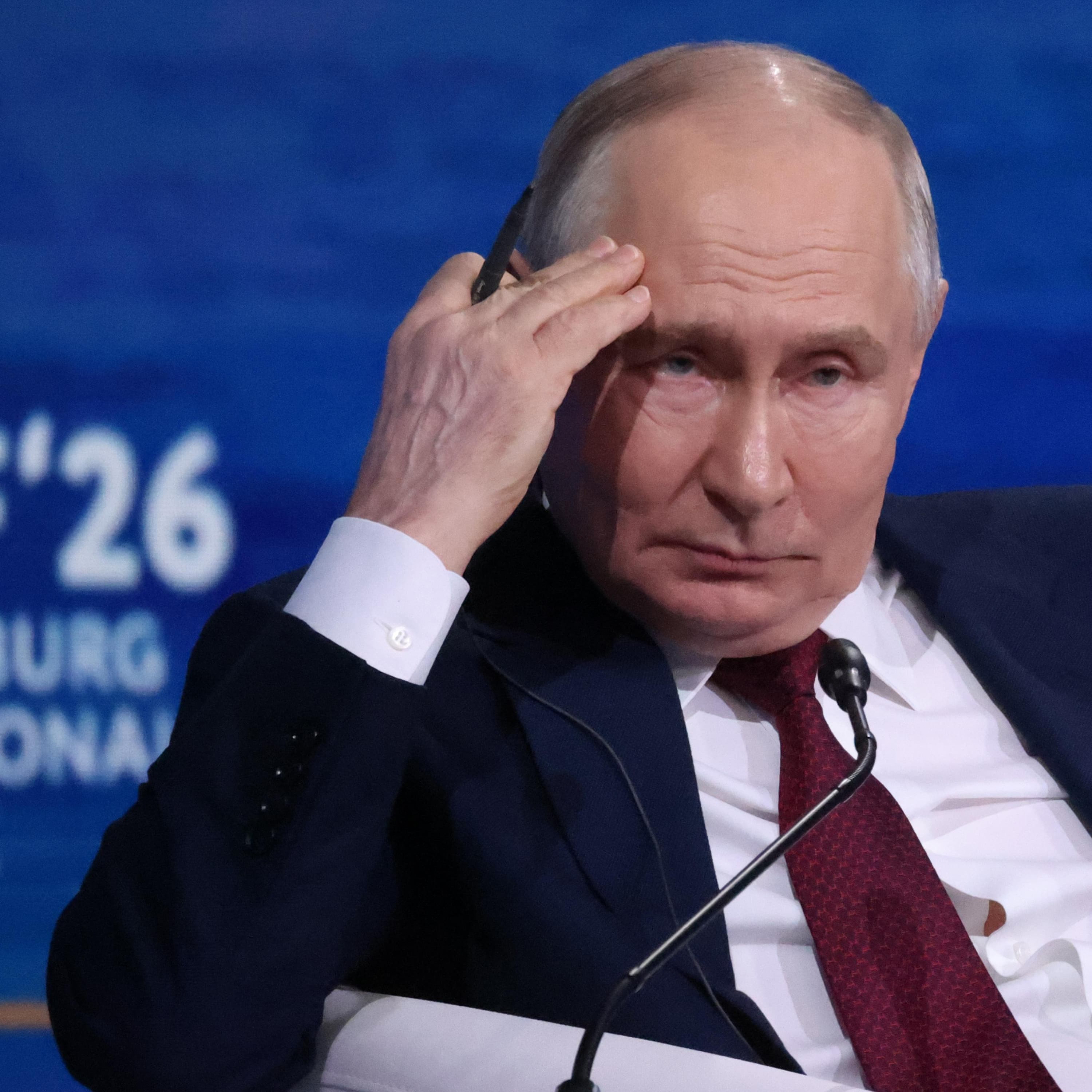
Today in Focus
‘Grandpa in a bunker’: is Putin losing control?
00:27:22
Russian affairs reporter Pjotr Sauer on Vladimir Putin’s increasing isolation – and seeming paranoia – as ordinary Russians become more restive over the toll of the war in Ukraine and a struggling economy at home
Loading summary
Transcript86 lines
- [00:00]
Piotr Sawa
This is the Guardian.
- [00:08]
Helen Pitt
Today Is Putin losing his grip on power.
- [00:17]
Paramount Plus Announcer
Today? InFocus is supported by Paramount plus the Agency. All episode streaming June 21st on Paramount. In the world of espionage, truth is a moving target, and every decision carries a dangerous consequence. This new mission explores what it means to live as a double agent. Twice the lies, twice the risk. The lines between ally and enemy blur like never before. And survival depends on trusting no one. Starring Michael Fassbender, Jeffrey Wright, Jodie Turner Smith and Richard Gere. Don't miss the Agency. All episode streaming June 21st on Paramount Plus.
- [01:27]
Piotr Sawa
So last month, the Kremlin released this curious video of Vladimir Putin, dressed casually in jeans and a jacket, walking with a bouquet of flowers in a hotel to meet his high school teacher.
- [01:40]
Helen Pitt
Piotr Saur is the Guardian's Russian affairs reporter. Decoding Kremlin propaganda is very much part of the job description.
- [01:50]
Piotr Sawa
On his way to meeting his teacher, he also made chit chat with a random passerby, Who later turned out to be someone who worked for the Russian security services.
- [02:07]
Helen Pitt
The video showed the Russian president driving himself to meet Vera Gurevich. She taught the young Putin at school number 193 in Leningrad, now St. Petersburg. She seemed delighted to see him planting kisses on his waxy cheeks before he whisked her off for dinner at the Kremlin.
- [02:25]
Piotr Sawa
So we as journalists often don't know where Putin is at any moment in time. He is extremely careful about revealing his location. We know that he has a number of offices that look identical to each other, which is meant to hide his location. Sometimes he says he's in the Kremlin, but in reality he's sort of in an office that resembles his Kremlin office, but somewhere else. And all of this is meant to prevent any possible attacks that he fears.
- [02:53]
Helen Pitt
As his war in Ukraine enters its fifth bloody year, Putin is seen increasingly rarely in public. What he thought would be a quick and easy conflict has proved anything but, costing the lives of half a million Russians and hitting the Russian economy hard. That's why this public appearance was so noteworthy.
- [03:12]
Piotr Sawa
The whole image was striking because it came amid growing reports that the Russian leader is isolated, that he's paranoid, and that he might even be fearing a coup by releasing this. This image. I think the Kremlin really tried to fight those reports and they tried to portray the Putin that many Russians have come to know over the last 26 years. A man who's comfortable with the public, who considers himself one of the.
- [03:42]
Helen Pitt
But did the Russian people still see him that way? From The Guardian. I'm Helen Pitt. Today in Focus, cracks in the Kremlin. Piotr Sawa, welcome back to Today in Focus. Great to see you.
- [04:01]
Piotr Sawa
Great to be here.
- [04:03]
Helen Pitt
So you're actually talking to us today from Armenia, and we'll talk a little bit about why you're there later on. But you're our Russia affairs correspondent. You grew up in Moscow and you lived in Russia until Putin decided to launch his full scale invasion of Ukraine. And I know that you're still in very close contact with a lot of people in Russia. How are they feeling about their lives these days?
- [04:25]
Piotr Sawa
So for the last few weeks, I've been gathering as much information as possible for several stories I wrote for the Guardian about the mood in Moscow and in Russia. And the picture I got was a country that is growing more and more tired of the war that has now entered its fifth year, both of the general population and as well as the elites.
- [04:46]
Helen Pitt
I don't know how reliable polling is in Russia, but has much research been done to try and take the temperature of the population?
- [04:54]
Piotr Sawa
Yeah, of course, polling in a deeply authoritarian country should be taken with a grain of salt. But we've seen from a number of indicators that from the beginning of this year, really, Putin's ratings have fallen, his approval has fallen. One poll showed that more and more Russians could imagine themselves joining a political protest. Another poll showed the happiness index is lowest in 14 years. But I think polling is just one indicator that we as journalists use to measure the atmosphere in Moscow. And the others are, you know, are the interviews, but also some of the outrage we've seen on social media.
- [05:36]
Helen Pitt
And how much of this outrage do you think is about the death toll in Ukraine? Last week, the head of GCHQ, a UK intelligence agency, said 500,000 Russian soldiers had been killed since the conflict began in 2022. As we remain steadfast in our support for Ukraine, Putin is going backwards on the battlefield with new intelligence showing that almost half a million Russian soldiers have been killed since the conflict began. How widely known is that in Russia itself?
- [06:13]
Piotr Sawa
Yeah, these figures are astonishing, really. More Russians have died in this war than any other wars combined except the Second World War. Giving these numbers, it's impossible for Russians to ignore this. But from the very start of the war, Russia has mobilized and recruited soldiers as much as possible away from Moscow and away from St. Petersburg. So in the countryside, the poor areas. I did a story on a village far away in the north of Russia, northeast of Russia, where 30% of all male population went to fight and Many died. So in a village like that, obviously, the war is felt very hard.
- [06:56]
Helen Pitt
Yeah. And so when they hear Putin claiming that the war is going brilliantly, they have evidence to the contrary in terms of their sons who've not returned home.
- [07:05]
Piotr Sawa
Yeah, well, we've seen that at the start of the war that I think, because Russia thought that this would be a quick war, they were prepared for sacrifices. And a lot of these men who died were glorified in state press and media, and Russia made sure to take care of the families of the fallen. So they've given wives and children of men who died enormous amounts of money. You know, these are figures that some of these men and their families have never seen before. So that helped to prevent some of the anger. But now it's going in the fifth year, and Russia is struggling to recruit soldiers as much as they did at the beginning of the war. We know that around 30,000 soldiers per month are killed or injured. And until now, Russia was able to recruit as many each month. But now we're seeing a turning point.
- [08:02]
Helen Pitt
Are we seeing now more Russians feeling emboldened to actually talk out publicly, or are they just giving anonymous comments to pollsters when they ring up?
- [08:12]
Piotr Sawa
Obviously, if you're an average Russian, you're not going to write on social media that you're against the war, and if you do, you'll be in jail the next day. But we've seen a shift among some celebrities. For example, on social media, there was this beauty blogger who's hugely popular with millions of followers called Victoria Bonya. She was a reality TV star, and she wrote this post in April. She said that the Russian president has lost touch with this population. She addressed Putin saying, you know, Russians are scared of you. And then she listed a list of grievances she had with what is going on in the country.
- [08:58]
Helen Pitt
And is she in a Gulag now or is she.
- [08:59]
Piotr Sawa
No, she actually lives in Monaco. But I think even if she was in Russia, I don't think the Russian authorities would go after her because she's a massive personality. I think going after her would reveal some sort of panic in the Kremlin. Instead, the Kremlin has tried to coerce her, but we've seen other instances. There's this huge pro war community online on Telegram, which is the Russian Facebook, WhatsApp, Twitter, and on Telegram, we've seen pro war bloggers who have been very loyal to the Kremlin, and we've seen the taboo is breaking that you can't criticize Putin. And one of these bloggers I spoke to him in March. His name was Ilya Mislaw. And he went as far as calling for Putin to be put on trial, and he called Putin a war criminal. The same day as I spoke to him, he was arrested. He was put put into a psych ward. He's since come out of the psych ward and he's toned down his criticism.
- [10:18]
Helen Pitt
Tell us about this nickname that has started to circulate about Putin.
- [10:24]
Piotr Sawa
This nickname has already been around for a while, but it's now growing in popularity, which is Dieb Bunker, which means the grandfather in a bunker. And it reflects both, obviously, Putin's time spent in bunkers away from the people, but also the fact that he's old. You know, Putin is 73. He has ruled this country for 26 years. And this nickname has specifically grown bigger because of Putin's new initiative to block the Internet as much as possible. Putin himself famously doesn't use the Internet. He doesn't have social media, unlike Trump or any Western official, really. He doesn't use a mobile phone. So he doesn't really understand what the Internet means. For millions of Russians, a massive part of the recent outrage is the blocking of the Internet, which started at the start of the war, but has intensified in recent months.
- [11:21]
Helen Pitt
And what's the sort of official justification for blocking the Internet?
- [11:26]
Piotr Sawa
So to give you some context, Russia, shortly after the full scale invasion of 2022, Russia already blocked many of the popular Western apps like Twitter, Instagram, Facebook. But Russians could live with it because they used VPNs to circumvent the blocking. And they used their alternatives like Telegram and Vkontakti. But in recent months, Russia started blocking Telegram, which every Russian I know uses for daily communication. And more recently, we've seen the government completely blocking the Internet. So if you're someone in Moscow, you wouldn't be able to order a taxi, order food, pay for services. And that led to complete shutdowns of these mega cities like Moscow and St. Petersburg, where 2 million people work as food delivery guys, taxi drivers. And the official reasoning behind this is that Russia says that it helps prevent Ukrainian drone attacks. Experts and critics don't really buy it. Ukraine has been able to continue their drone attacks. Another reason is that the Russian security services, they fear Ukrainian partisan attacks on Russian generals, on high officials. And many of these attacks are coordinated via Telegram, where Ukraine finds local collaborators on Telegram. On Tuesday, a senior Russian commander was blown up inside his car outside Moscow in what appears to be the latest of this string of assassinations against high Russian Targets. So that could be another reason. And I think the final reason is just that Russia wants to have control over the Internet and wants to be able to shut it down whenever it wants to.
- [13:12]
Helen Pitt
And how are Russians reacting to this siege really? And not being able to get online,
- [13:17]
Piotr Sawa
that has been the number one trigger this year for this anger that we've seen.
- [13:22]
Russian Citizen
I can't access my messages, phones aren't loading. Authorities want to tie everyone to the
- [13:27]
Piotr Sawa
national messenger Macs, which few people want
- [13:30]
Russian Citizen
to download and use.
- [13:34]
Piotr Sawa
In the morning, a man got lost here.
- [13:36]
Helen Pitt
He was terrified.
- [13:37]
Piotr Sawa
We showed him the way.
- [13:38]
Helen Pitt
We're all feeling anxious these days.
- [13:41]
Piotr Sawa
You know, Russian Russians have been forced to buy paper maps. Oh, wow. Some Russians have bought walkie talkies, you know, so, you know, Russia is back, really back to the 90s. Since the start of the war, Vladimir Putin made this sort of unspoken social contract with the Russian population that, you know, I'll be waging this war and I'll mostly leave the big cities out of it. You know, as an average Russian, you will be able to live the way you're used to. Maybe you won't be able to buy the Western brands that you used to, but otherwise, you know, life will still be comfortable. But now that social contract appears to be broken and that has frustrated a lot of people.
- [14:29]
Helen Pitt
And let's talk a bit about victory. A big day in the Russian calendar which was celebrated last month, which marked the Soviet Union's victory over Nazi Germany in World War II. How did that play out? Because it was a little different this year, wasn't it?
- [14:42]
Piotr Sawa
Victory Day is arguably the biggest holiday in Russia. Growing up as a kid, it was something that everyone looked forward to and believer. Putin only made it bigger and he introduced these mass military parades. Initially, Victory Day was a lot about remembrance, you know, remembrance of all the sacrifices to defeat the Nazis. But for Putin, it also became an instrument to show Russia's might and for him to project the power that he has. We've seen these mass military parades happening every year, and they continued even after the Russian full scale invasion. But this year, for the first time, Russia was forced to scale back the military parade. So there were no tanks, there were only a few jets flying around. But it was a huge embarrassment for Putin.
- [15:28]
Podcast Advertiser 1
They are worried their big day could be disrupted. So as a result, they've decided to
- [15:35]
Piotr Sawa
scale back this year's parade. I think many realize that this is hugely embarrassing, especially because when Vladimir Putin launched the full scale invasion, he thought that within a month or two they would be inside Kyiv Yeah, sure. And now we have a world where Russia actually has to scale down its own parade inside Moscow.
- [15:56]
Helen Pitt
Yeah. Because it's so frightened of Ukrainian drones, which did manage to hit Moscow last month. Right. In a pretty shocking incident for Moscow residents.
- [16:03]
Piotr Sawa
Yeah. We've seen more and more drone attacks. We've seen drone attacks last week in St. Petersburg during Putin's famous spif, which is the economic forum also dubbed the Russian Davos.
- [16:17]
Helen Pitt
Russia says its air defenses have been
- [16:20]
Paramount Plus Announcer
responding to a Ukrainian drone attack on
- [16:23]
Helen Pitt
the area around Snow Petersburg.
- [16:25]
Piotr Sawa
Guests walked into the conference hall as smoke rose above St. Petersburg. And obviously, these are symbolic attacks by Ukraine. So the drones are penetrating most cities far, far away from Ukraine.
- [16:40]
Helen Pitt
But at the same time, Putin has claimed on a number of occasions, including I think, at this Victory day parade, that the war is coming to a. Do you think he really believes that? And if so, why?
- [16:57]
Piotr Sawa
Yeah, that phrase made headlines around the world, but I think many misinterpreted what Putin was saying. Later on, he also tried to explain what he meant. And in his worldview, the war might be coming to an end, but not because he's willing to sit down and talk it out with Zelensky, but because he believes he's winning. And I think crucial thing that I hope listeners understand is in Vladimir Putin's mind, the war is going well.
- [17:31]
Helen Pitt
Right. With half a million Russian dead soldiers,
- [17:34]
Piotr Sawa
with drones flying into Russian cities every day. He believes that, and this is what I hear from people around him. He still believes that even though things are hard in Russia, things are harder in Ukraine, and that Ukraine is having bigger man shortages on the front line, and Ukraine will collapse at any moment. And we've seen Putin repeating that again and again and again, that I will not stop until I reach my military goals.
- [18:01]
Helen Pitt
Right. And is there any evidence that Russia is actually winning? Because Volodymyr Zelenskyy gave a fairly upbeat interview to our colleagues Luke Harding and Pippa Kreir this week in which he insisted that Russia was not advancing.
- [18:15]
Piotr Sawa
And Russia, we can't say that they are losing this war, but we can say that they are losing this initiative. Each day, day by day, they're losing this.
- [18:26]
Helen Pitt
And he also wrote to Putin, didn't he, last week, suggesting that they kind of meet together face to face, mano and mano, and thrash out some sort
- [18:33]
Piotr Sawa
of deal based on all the military analysis that we have at this point shows that Russia is advancing but advancing at a very, very slow rate. And if they continue advance at this slow rate, it would take them years. If not decades to capture the whole of Donbas, which is sort of the minimum that Putin wants. But there's no indication that the. That shows that Ukraine is fear facing an immediate collapse. So, you know, the question is, why does Putin think this way? You know, and I think there are different theories behind that. But, you know, it does seem like he's receiving very upbeat, rosy military reports from his commanders. There's this good example that we've seen play out in public where last year, a military commander told him in front of it was televised that Russia captured the city of Kupyansk in northern Ukraine. Kupyansk is still controlled by Ukraine. So even though this commander told Putin that we've captured Kupyansk, this was just wrong information.
- [19:53]
Helen Pitt
You've said that the mood appears to be darkening in Russia not only because of the enormous death toll, but also because of the effect that it's having on the economy. You mentioned this sort of Russian Davos that took in St. Petersburg last week. What have we learned about how the Russian economy is actually doing right now?
- [20:14]
Piotr Sawa
So the Russian economy is slowing down. I mean, that is clear. We're seeing that in statistics. But also from reports from Putin's own officials who have warned him that they can't continue spending on the military as much as they do right now. Okay.
- [20:34]
Helen Pitt
So they sometimes telling the truth, sometimes
- [20:37]
Piotr Sawa
the economic block, you know, they deal with numbers, and they're often a bit more realistic.
- [20:43]
Helen Pitt
Yeah.
- [20:43]
Piotr Sawa
You know, it's important to realize that in the first two, three years of the war, Russia's economy actually was booming. And a lot of people inside Russia were saying that they never made as much money as they did in the first two, three years of the war. I mean, I think it's a classic case of a war economy where lots of money was pushed into the economy, a lot of the reserves, so people's salaries were rising. A lot of the families of soldiers suddenly became rich because of all this money they received from their death husbands. But over the last two years, we've seen a turning point. And now when I speak to Russians, they say things are very hard, inflation is rising, and the Russian government has taxed a lot of the small and middle businesses in order to keep on spending on the war. So we're seeing a turning point, and we're seeing that it's getting much harder for an average Russian.
- [21:37]
Helen Pitt
What about the business elite in Russia, the oligarchs? They play a key role, don't they, in Putin's Russia? They're in his inner circle. Are they telling him any hard truths yet?
- [21:50]
Piotr Sawa
A few weeks ago, Putin got all the oligarchs together again and he asked them to contribute to the war.
- [21:56]
Helen Pitt
Oh, financially, Financially.
- [21:58]
Piotr Sawa
And some did, I think Together they contribute some $3 billion, which is not an insignificant sum. But privately, from the very start of the war, many of the sort of business elites were horrified by the war. But, you know, they're scared. They're scared to speak out in public. You know, I speak to some of them, they realize how bad this war is going. You know, one of them told me that there's this profound disappointment in Putin, you know, quite strong words. But again, they won't speak out in public because they're scared to lose everything they have. You know, we've seen that a few businessmen that have spoken out and have left the country, you know, their business, they've been stripped off their businesses and they've lost everything. They have one big Russian businessman who did leave. I spoke to him. His name is Oleg Tinkov and he now lives abroad. Very critical of the of Putin.
- [22:47]
Helen Pitt
He's got a cycling team, hasn't he? Tinkov?
- [22:49]
Piotr Sawa
He used to, yeah, he used to. Not anymore. But he compared it to me that the Russian businessmen and the oligarchs, they're playing Russian roulette. They just hope that they don't get hit, but their neighbor might get hit. They're just sitting out and hoping that this will end at some point.
- [23:11]
Helen Pitt
Coming up, could Putin face a coup anytime soon?
- [23:17]
Piotr Sawa
Foreign.
- [23:25]
Podcast Advertiser 1
33 days, 33 episodes no off. Switch from the goals and the glories, the politics and the problems of the World Cup. If you want football analysis from a podcast that's been overanalyzing the game for more than 20 years, this is it. Join me, Max Rushton, and our expert team of football journalists every day of the tournament. Can England end 60 years of hurt?
- [23:43]
Piotr Sawa
Probably not.
- [23:43]
Podcast Advertiser 1
Or will this be another year of falling just short? Probably. World Cup Daily. Listen wherever you get your podcasts or watch the full episodes on YouTube,
- [23:56]
Podcast Advertiser 2
Today's markets move fast. Get the insights you need in 10 minutes with the Barclays Brief, a new podcast from Barclays Investment Bank. Through sharp dialogue and scenario based analysis, our leading experts analyze key market themes each week. So whether you're managing a portfolio or leading a business, the Barclays Brief podcast can help you make smarter decisions today. Stay sharp, stay brief. Find Barclays Brief wherever you get your podcasts.
- [24:26]
Quo Business Phone System Advertiser
Running a business means juggling a lot of moving parts. And when your communication tools can't keep up, things start to slip missed calls, Slow, slow replies, scattered conversations. They're not just frustrating, they're lost opportunities and revenue left on the table. That's where quo comes in. Spelled Q U O. Quo is the number one rated business phone system on G2, trusted by over 90,000 businesses. One shared business number for calls and texts so every conversation stays visible, organized and accountable. It works from an app or computer. You can keep your existing number, add teammates and sync your CRM, letting you scale without adding complexity. And with built in AI, Quo logs calls, summarizes conversations and flags next steps. Even after hours. Stop missing customers, stop leaving revenue on the table. Try Quo free and get 20% off your first six months@quo.com tech. That's quo.com tech. No missed calls, no missed customers.
- [25:41]
Helen Pitt
Beyond Russia's borders, how are things looking for Putin? Because Russia's obviously got many interests abroad. For years it was propping up Assad in Syria, it's been helping out Iran, meddling in Armenia, the recent elections there. How would you assess what's happened to his global influence recently?
- [25:58]
Piotr Sawa
Their resources, both political and economic, have been so focused on Ukraine that they've sort of had to sacrifice their influence elsewhere. Russia was dealt a very sensitive blow in Syria where Assad, a long time ally, was overthrown and Russia wasn't really able to do anything about it. Russia has tried to prop up candidates, pro Russian candidates in Moldova where they lost, most recently in Hungary. Obviously Viktor Orban, a big ally of Putin, he lost. Cuba is being squeezed by the Trump administration. I'm now in Armenia where there were elections on Sunday and a pro Western candidate won among the losses. I think Putin will be watching the Iran war with a lot of satisfaction. I think the Iran war has shown the weakness of the us. Putin is said to be secretly supplying Iran with weapons. Obviously the Iran war has led to a spike in oil prices. So I think even though overall the picture isn't looking that good for him internationally, the Iran war is this one sort of bright spot in an incredulous perspective where actually KIA ally seems to be coming out stronger out of it.
- [27:11]
Helen Pitt
And finally you set out really convincingly how the mood in Russia is turning against Putin. But realistically, is there anyone or anything thing that is in a position to topple him or persuade him, maybe persuade him to step down after 26 years with that little break in the middle on the throne?
- [27:31]
Piotr Sawa
I think most analysts and observers agree that if there's going to be change, the change will come from the top. So from the elites at this moment We've seen no education that Putin is willing to change course because of pressure at home. You know, he told one of his economic advisors who warned him that, you know, spending more on the war is. Would be a bad idea. He said, well, then we should cut in other sectors, you know, whether it's education or health care. So for the long term, this is obviously disastrous for Russia. But Putin believes, and he's probably right, that for the next year or two, he can still spend on the war, but it will, you know, he will have to cut in other sectors. One of the more shocking sort of reports in recent weeks was cited by some media. It was a Western intelligence report, unnamed officials who said that potentially Putin's former Defense Minister, Sergei Shoigu could lead a coup against Putin. You know, everyone I talked to finds that opposition highly unlikely. Those who know Shoigu told me he's isolated, he's not very popular in the army and he's not really a likely candidate. But, you know, again, Russia can still surprise you. Three years ago, there was a march on Moscow by Yevgeny Prigozhin, a sort of Wagner mercenary leader who, you know, came close to Moscow and it was eventually stopped. But I think for any coup to happen, I think we first need to see Putin weakened, both physically, potentially, and also mentally. And right now, he still, you know, looks in control. Right now, we sort of seems to be in a stage of acceptance rather than sort of active coup planning. So, you know, I think the west should get their hopes up that there's sort of a coup happening at any moment.
- [29:15]
Helen Pitt
Piotr, thank you so much.
- [29:17]
Piotr Sawa
Thank you.
- [29:22]
Helen Pitt
That was Piotr Sauer. I really recommend the long read that he did on Putin's drop in popularity. He wrote it along with Sean Walker, another Today in Focus favourite. It's headlined, there is profound disappointment in him Mood in Russia turns against Putin. You can find it@theguardian.com and that is all for today. This episode was produced by Guy zafman and Casey McGlaw and presented by me, Helen Peard. Sound design was by Rudy Zagadlo and the executive producer was Sammy Kent. We'll be back in your feeds this afternoon with the latest.
- [29:59]
Piotr Sawa
This is the Guardian.
- [30:09]
JP Morgan Asset Management Advertiser
Did you know that passive fixed income ETFs only capture about 50% of the US public bond market? But with JP Morgan Asset Management's active fixed income ETFs, we can help you capture 100% of the US public bond market and explore twice as many opportunities. Visit jpmorgan.com getactive to learn more. JP Morgan Asset Management is the brand name for the asset management business of J.P. morgan Chase Co. And its affiliates worldwide. This communication is issued by J.P. morgan Distribution Services Incorporated, member of FINRA.
- [30:39]
SoFi Personal Loan Advertiser
High interest debt is one of the toughest opponents you'll face unless you power up with a SOFI personal loan. A SOFI personal loan could repackage your bad debt into one low fixed rate monthly pay payment. It's even got super speed since you could get the funds as soon as the same day you sign. Visit sofi.compower to learn more. That's S-O-Fi.com P-O-W-E-R loans originated by SoFi Bank NA member FDIC terms and conditions apply. NMLS 696891 A History of the United
- [31:10]
Russian Citizen
States in 100 Objects is a brand new podcast from 99 Invisible in BBC Studios. Each week we're looking at a different object from across American history with a unique story to tell about who we've been, what we've built, and what we've allowed ourselves to forget. Some of these objects are well known, many are not, but all of them carry the story of how we got to this moment. Find A History of the United States and 100 objects on the 99% invisible feed. Wherever you get your podcasts.