← Today in Focus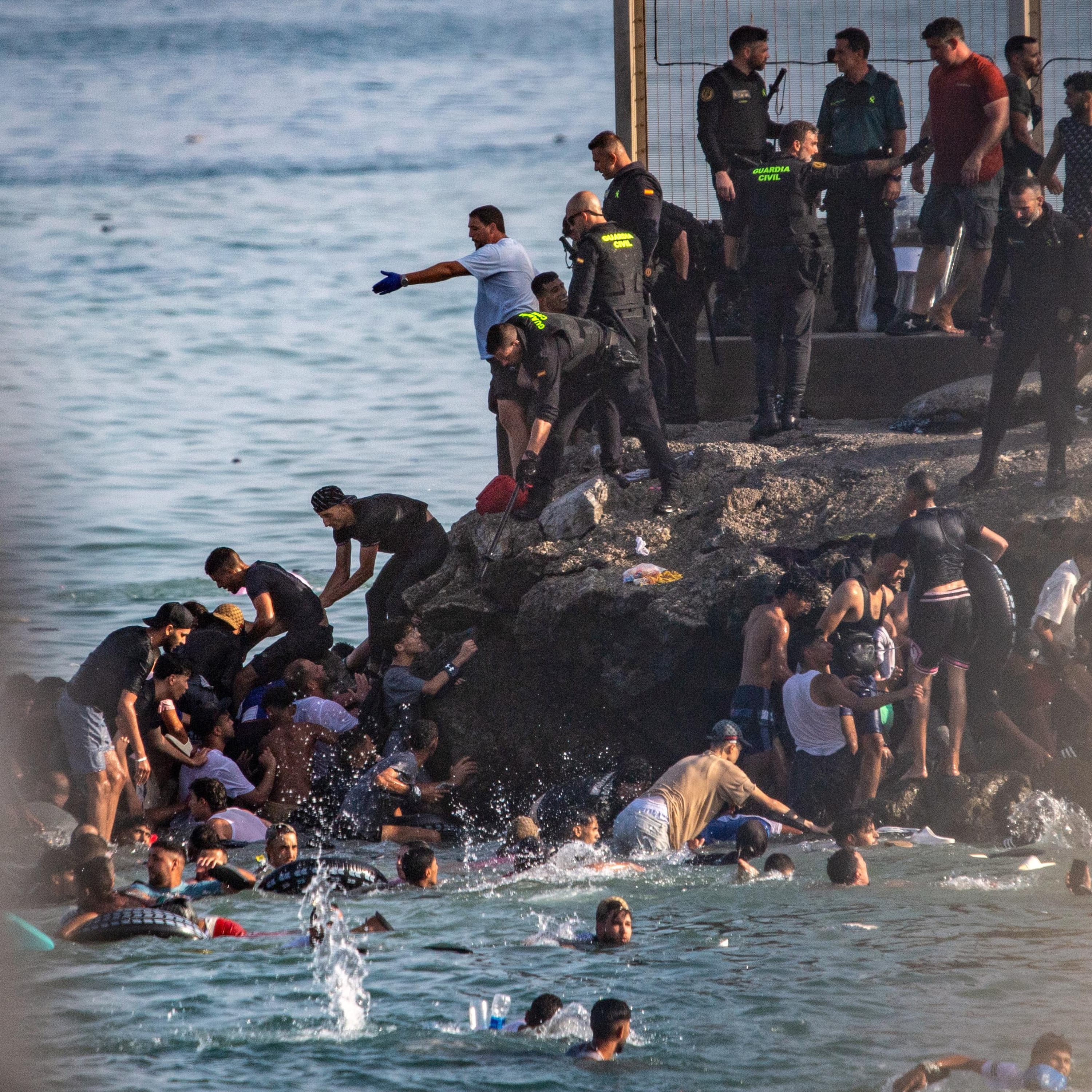
Today in Focus
How Ceuta migrant crisis exposes divisions within Europe - The Latest
00:11:26
Dozens of people died attempting to reach the Spanish enclave of Ceuta after an estimated 50,000 crossed from Morocco last week. Lucy Hough speaks to the Guardian’s European community affairs correspondent, Ashifa Kassam
Loading summary
Transcript23 lines
- [00:00]
Podcast Host
This is the Guardian. Today In Focus is supported by Paramount. This isn't the end of a fight, it's the start of one. Lioness, the critically acclaimed original series from Taylor Sheridan, is now streaming only on Paramount. In the new season, hidden networks, foreign operatives and personal betrayals collide. Meanwhile, Jo walks the line between duty and family as unseen forces circle her world, leaving her to reckon with a war that now reaches into every part of her life. Don't miss the new season of Lioness, starring Zoe Saldana and Michael Kelly, with Morgan Freeman and Nicole Kidman, now streaming only on Paramount Plus.
- [01:04]
Ashifa Qassam
And within kind of the span of about 48 hours, there was a reported 50,000 people who had entered. You have a lot of people who don't actually know how to swim. It's this incredible tragedy. In some ways, I think that's been kind of eclipsed by all the politics that have been happening around this. There was a lot of parties that seemed, seemed really eager to seize on this. But there's so much misinformation about what actually happened on the ground. All of that is kind of feeding into this, like, boiling pot from the
- [01:32]
Lucy Hoff
Guardians today In Focus, this is the latest. With me, Lucy Hoff. Well, there were tragic events when dozens of people died after thousands tried to swim from Morocco to the Spanish enclave of Sueta. Ashifa Qassam, you're our European Community affairs correspondent. Obviously, this is been a devastating thing to take place. What happened over the weekend?
- [02:00]
Ashifa Qassam
So, I mean, late last week, we started to get reports that something was happening in Ceuta, which is this kind of northern African enclave that Spain has, so this tiny little territory, about 84,000 people. And we started hearing reports of thousands of people, and soon it became tens of thousands. And just the numbers just kept going up and up. And within kind of the span of about 48 hours, there was a reported kind of 50,000 people who had entered.
- [02:25]
Lucy Hoff
Oh, my goodness.
- [02:26]
Ashifa Qassam
To take a step back to kind of paint a picture of what this is. So this is this tiny territory kind of on the tip of northern Africa that belongs to Spain, and it's next to Morocco, and it's heavily fortified. And so there's been a long history of people trying to make it around across that border, but they're often held back quite by force by Moroccans and Spanish on both sides of that border. And so it was extraordinary to start hearing that that border was, in effect, open and people were just flowing through and that people were traveling to that area of northern Morocco to then cross into Spain. It Seems like it was open for such a long time that people were able to actually kind of make their way by bus and car up there and pay people so that they could cross into Spain.
- [03:11]
Lucy Hoff
Right. So the aim was to swim to this territory in order to get into Spain and therefore into mainland Europe. The swim, how is the swim? How dangerous? Because tragically there were dozens of deaths. We're not sure of the final figure at the moment, but it was a long way and many didn't survive.
- [03:33]
Ashifa Qassam
Yeah, and I think that's kind of the crux of it. So the swim kind of, when seen from maybe northern Morocco, it doesn't look that bad because really what it is. So you've got this fence that kind of splices off Ceuta from Morocco and it appears as though you could just kind of hop in the water and swim around. The Moroccan border controls maybe about a third, 30 minute swim, but of course there's incredible currents because you're swimming kind of in the, you know, the wild sea. There's also kind of incredible depth and you have a lot of people who don't actually know how to swim. And so it, you know, 30 minutes at its fastest, but it can stretch to hours. And you know, you had kind of people of all ages throwing themselves in there. So we've heard reports of kind of 6 year olds and, you know, 55 year olds. And so you get kind of people of all abilities trying to cross. And that's what made this episode so deadly. And so as you mentioned, I mean we've had so far, I think there's a reported 72 deaths is what Spanish authorities have said. The head of Ceuta says there's that there's 88 bodies in the morgue and they expect to have a lot more people identified in the coming hours. And so it's really, it's this incredible tragedy. In some ways, I think that's been kind of eclipsed by all the politics that have been happening around this.
- [04:45]
Lucy Hoff
Yeah, and we'll talk about the politics, but obviously those deaths are a tragedy, particularly for the young and the old amongst the people trying to make that journey. What is the situation now in Soweta? Because thousands of people have been returned to Morocco, but others remain on Soweta. So there are some sort of chaotic images of people sleeping on beaches. What do we know about how things stand today?
- [05:12]
Ashifa Qassam
I mean, the exact number of people that remain isn't confirmed, but the Spanish authority said late Friday that about 48,300, so nearly everybody had been returned. But that Means that there's still probably, you know, more than 1500 people who are still in Ceuta, which is again this tiny territory. And so, I mean, just driving through, we've seen images from some of our people who are down there of people kind of clustered on the beach there or they've been hanging around the mosques and that because there are groups that come and have been feeding people because now it's been days and they've been in this tiny territory kind of on their own looking for food, for shelter and grappling with everything that they lived through. I mean, they were kind of swimming in this area where there were bodies. And some of them talk about kind of pushing across that and kind of that there were so many people on the water. And so it was kind of this desperate everyone, everyone for themselves situation. And so they're kind of grappling with the mental after effects as well as trying to survive essentially. And what comes next for them remains unclear. There are some, but not that many sub Saharan Africans who would legitimately have a claim to asylum. So they're from war torn countries. I mean, for them this has been a months long journey and they had been waiting to cross. And so it remains to be seen what will happen and how the Spanish authorities will handle that.
- [06:30]
Lucy Hoff
And what it's revealed is the tensions between the Spanish and Moroccan governments over this border. Tell us a bit about that relationship, which sounds fraught and has been for some time.
- [06:44]
Ashifa Qassam
Yeah. So for. I've been reporting from Spain for probably more than a decade now. And for me this was an immediate recall of an episode in 2021 where essentially you saw same thing, like late at night these reports started coming in. And then I remember at some point it was about 8,000 people had crossed. And what it was, what it turned out to be, we found out kind of, you know, with weeks of kind of reporting later that essentially Moroccans had just dropped the border controls. Moroccan leaders had kind of used this episode at the border to express their anger over Spain agreeing to take in a Western Sahara leader who was suffering from COVID 19.
- [07:21]
Lucy Hoff
Right.
- [07:21]
Ashifa Qassam
And so essentially you saw at that moment in 2021 that Moroccan leaders were willing to weaponize that border to really kind of push a political point onto Spain. And so for many of us in Spain who are now reporting on this again, it feels like perhaps there's a bit of that going on again.
- [07:39]
Lucy Hoff
Okay, okay. So some revived political tensions. There is also some tension within the European Union. We've had criticism from Italy towards Spain. Spain. Pedro Sanchez The Prime Minister has been critical of the European Union and their response to this. And we know that there's an urgent meeting of Interior Ministers happening tomorrow. Obviously, there have been so many efforts to better coordinate migration policy in Europe in the last few years. So will they be looking at this as a sort of new route or how it kind of exists within the existing systems that we know about, you know, Libya to Greece, for example?
- [08:25]
Ashifa Qassam
Yeah, I think what we saw play out at the EU level is a fundamental difference in how this was seen. So from the Spanish point of view, this was, in the words of Pedro Sanchez, the Prime Minister, this was an attack on Spain's territorial integrity. And so that's how they saw it. It was not a migration crisis. It has nothing to do with immigration policies. This is the Spanish view. And it really was something that was this concerted kind of move to take Spain down in that particular way. And then, of course, as you mentioned, we saw kind of Italy and Denmark frame this as this is the result of deliberate immigration decisions that have been made in Spain and kind of really almost take aim at Spain and blame Spain for this. Which for Spanish officials who had stood by when Italy was grappling with an influx of migrants in Lampedusa, or for Poland when it was grappling with an influx of migrants from Belarus, it really felt like a betrayal. And I think we're going to see those tensions come to a head tomorrow at this meeting of Interior ministers. So Spain's Foreign Minister has already said today that they're going to go there and demand solidarity from the EU because they felt, in his own words, he said, that some had fallen short. And so you really do see that there's such a fundamental difference in how this is being seen even across the eu. And you kind of wonder, what does that mean going forward for the bloc?
- [09:49]
Lucy Hoff
Absolutely. I mean, it's even having an impact here. Obviously, we are no longer a member of the European Union, but Reform UK have been using this to push a ever more hardline message on small boat crossings or illegal crossings, saying that they want the military to be deployed to stop people from making the crossing from France to the uk. Andy Burnham, our new Prime Minister, was in Dover yesterday, also pledging to bring down the number of illegal crossings. But I'm just wondering lastly how this is going down in countries which also have perhaps a large proportion of anti immigration views and whether it's being politicized in the same way there.
- [10:30]
Ashifa Qassam
One of the things that started late last week, as soon as we started hearing reports of this influx is that there was a huge surge on social media. So there was a, a lot of disinformation. There was a lot of kind of parties that seemed really eager to seize on this, to really push their own views. And so that obviously plays out kind of very strongly in countries like Italy, Germany, Poland, France, where you are seeing not only kind of this anti immigration sentiment, but this move into electoral cycles where immigration seems like it will be one of the key things that people will focus on. And so that's all being used. And it's quite interesting because so many voices are being amplified online and that are speaking to people about what's happening in Ceuta. But there's so much misinformation about what actually happened on the ground. And so all of that is kind of feeding into this like boiling pot. And I guess we'll have to see where it all leads.
- [11:21]
Lucy Hoff
Yeah, we will. Well, a tragic series of events. But Shifa, thank you so much for your time.
- [11:26]
Ashifa Qassam
Oh, you're very welcome, Lucy.
- [11:30]
Lucy Hoff
That's it for today. My huge thanks again to Ashifa Qassem, the Guardian's European Community affairs correspondent. You can keep up with all her reporting on this story over@wguardian.com and I recommend listening to today's episode of our sister podcast, Politics Weekly. Alexandra Topping and Jessica Elgot will be talking about Andy Burnham's plans for devolution as well as Reform UK's new plans to tackle small boats. Thanks for listening to this episode of the latest Today in Focus. We're back in your feeds as usual tomorrow morning. The latest will be back tomorrow night. This episode was produced by Bryony Moore and Annie Levesper. The senior producer was Ryan Ramgon. It was presented by me, Lucy Hoff.
- [12:13]
Podcast Host
This is the Guardian.
- [12:23]
Jackson Financial Announcer
This message comes from Jackson. Taxes aren't something you can only think about once a year with investments. Planning for tax day is year round. Fortunately, Jackson offers tax efficient products. Visit Jackson.com for more information on how our products can make your tax bill a little bit less painful. Jackson is short for Jackson Financial Inc. Jackson National Life Insurance Co. Lansing, Michigan and Jackson National Life Insurance Co. Of New York Purchase, New York.