← Today in Focus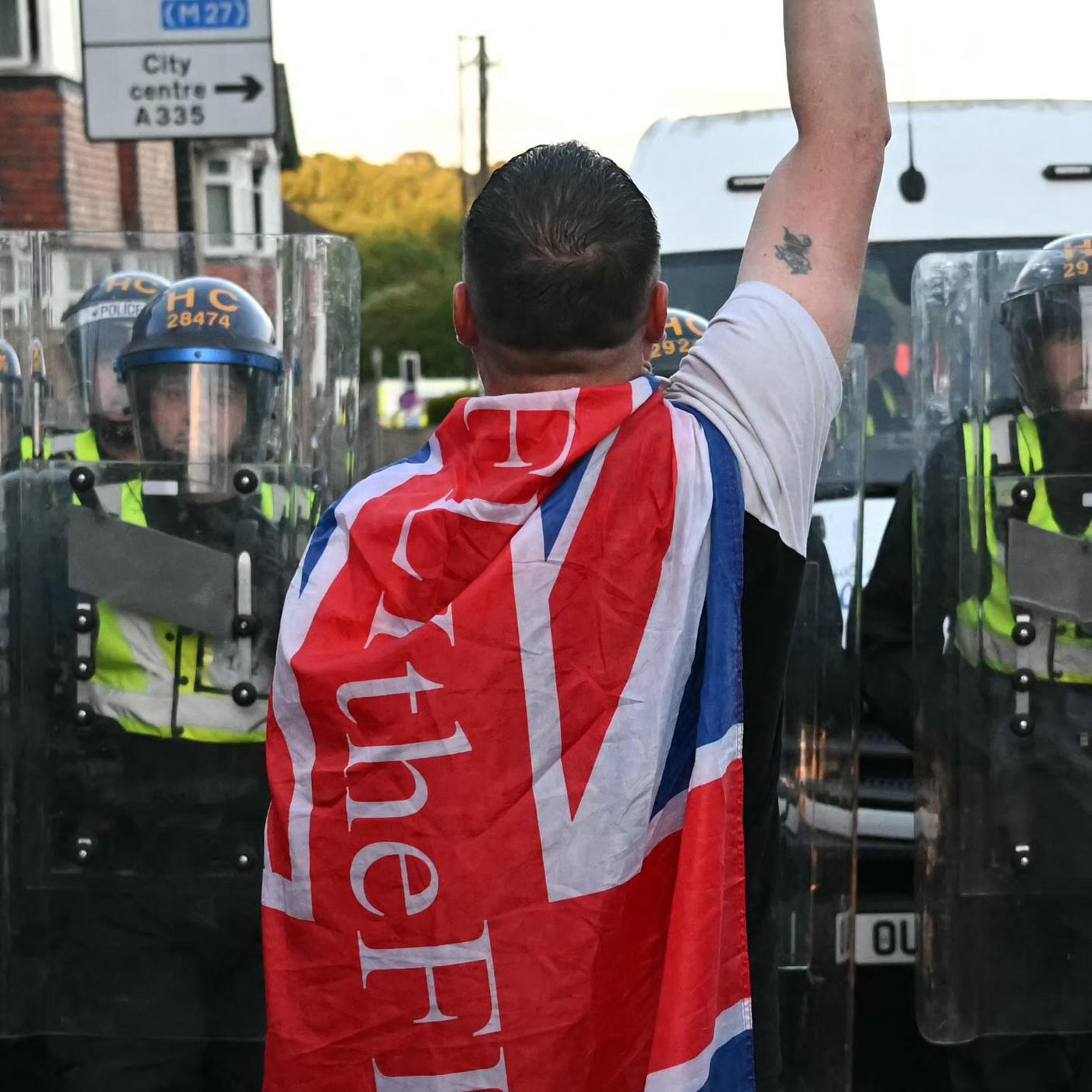
Today in Focus
How the murder of Henry Nowak is being exploited by the far right – The Latest
00:12:10
Politicians and community leaders have called for calm after violent disorder in Southampton sparked by the murder of student Henry Nowak. Lucy Hough speaks to community affairs correspondent Aamna Mohdin
Loading summary
Transcript25 lines
- [00:00]
Lucy Hoff
This is the Guardian.
- [00:10]
Nick and Jack
Hey, Yetis, this is Nick and Jack from the Best One yet podcast. Now, the last company we worked at, they used Paylocity and everything just worked. It wasn't until launching our own media business this show that we realized how rare that is. Because Paylocity is one delicious burrito of operational needs. They roll up HR for finance and it seamlessly into one delicious bite. When everything wraps together like that all at once, your workforce, your tech stack, your business, you don't need more tools, you don't even need cilantro. You need one solution. And that is why Paylocity built a single platform to connect hr, finance and IT with AI driven insights and automated workflows that simplify the complex and power what's next. Or as we call it, a delicious operational burrito. Yes, we do experience a one place for all your HCM needs besties. So start now at paylocity.com paylocity.com one.
- [01:10]
Amna Modin
People are just not leaving the house. People are telling their members of their family who wear turban not to leave the house. End this divisive practice of two tier policing. I'm really shocked that he pretends to
- [01:25]
Nick and Jack
have respect for Henry's family.
- [01:28]
Amna Modin
Something has shifted in the past two years now where they are attacking the police. We know that there are disparities in the criminal justice system. The data is very clear. The disparities are against people of color.
- [01:41]
Lucy Hoff
From the Guardians today. In Focus, this is the latest. With me, Lucy Hoff. There's been appalling riots in Southampton in the wake of the sentencing of the killer of Henry. No. A young student who was murdered in Southampton in December of last year. Amna Moden, you're our Community affairs correspondent. I mean, obviously the circumstances of this are appalling. The violence I think was triggered by the sentencing of his killer on Monday and the subsequent release of footage of the policing around that murder. I mean, the footage is horrifying. We should start there before we come on to last night's riots.
- [02:26]
Amna Modin
It's an extremely difficult video to watch. It's completely harrowing. This story, first and foremost is about the murder of an 18 year old boy. And I'm not surprised that the video has sparked so much anger. There are parallels to other deaths in custody, both in the UK and abroad. And it's quite shocking to have a teenager say over and over again that he can't breathe and that not being met with a proper response.
- [02:59]
Nick and Jack
What's happened to you? Right, you've been stabbed. Whereabouts? Don't Think you have, mate.
- [03:10]
Amna Modin
And the fact that he was handcuffed and bleeding to death has sent shockwaves across the country. I think the Prime Minister said he felt sickened watching it. Really strong language, I think, all across the political spectrum.
- [03:21]
Lucy Hoff
And Henry Novak's father, speaking after the sentencing of his son's killer, made a plea that his death not be used to stoke divisions.
- [03:32]
Amna Modin
We do not want his death to be used to create further division, hatred or tension. We want history to make our streets safer for everyone. That is why we are calling on the government to treat knife crime as the national emergency that it is.
- [03:49]
Lucy Hoff
Nonetheless, Nigel Farage called for a response of pure cold rage, which was on full display last night in Southampton in a way that I think echoed what we saw in 2024 in Southport.
- [04:02]
Amna Modin
Yeah. So he tweeted that he had a address to the nation, and I think many people tensed when they saw that. And to be honest, watching that video, it did send shivers down my spine. I speak to many minority ethnic communities, and they were bracing themselves for violence yesterday. And we did see that in Southampton. I think about a dozen police officers were attacked, a police dog was attacked. And it's just quite heartbreaking because if we go back to Henry's father's statement, he specifically said this is about knife crime and he wants the streets to be safer. He doesn't want the death of his son to be used to instigate a race war. But there are political parties, political actors that do want that. So I think we're in a really scary situation. But the thing to note is that minority ethnic communities have been braced for this since 2024. Whenever there is a case that's similar to this, where a person of color goes on to commit an horrific act of violence, many people feel like it would be used to scapegoat the entire community. I thought it was really powerful to see so many Sikh leaders come out, do press conferences immediately condemning the violence, unequivocally standing with Henry and his family. But that is now necessary in the UK to be able to continue walking safe and feel like you can be part of. Of the country, which I think is quite a dark place for us to come.
- [05:25]
Lucy Hoff
And you've been speaking to people from the Sikh community who must be feeling extremely at risk and in danger. What kinds of things have you been hearing?
- [05:34]
Amna Modin
Yeah, some people are just not leaving the house. Some people are telling their grandparents or other members of their family who wear turban not to leave the house. We've already seen incidents of people approaching Sikh men, asking them if they're wearing a kipan, that's a ceremonial sword or knife that's carried by some practitioners practicing Sikhs. There is an exemption that allows them to carry that kapan, but there are rules and regulations around it. And this comes off the back of quite heightened tensions within the Sikh community. They've had cases where a Sikh woman was raped. There have been cases of gurdwaras being attacked. Many in the Sikh community often also experience Islamophobia because people can't distinguish them from Muslims. And we had this really interesting and quite depressing statistics that came out in January that showed that about half of Sikh people in this country really feel quite fearful when they're operating outside. So it does really come at a time of really, really heightened tension. But just to add, the Sikh community has unequivocally condemned this. You know, they. They have a long and quite incredible history with Britain. That's something that they constantly kept trying to tell me. They feel very proud of their grandparents and their. And their parents kind of serving in the army. The roles that gurdwaras play. Every morning, it opens to feed people regardless of faith or their race. So that was something that they wanted to get across. And that though there will be people that try to divide our country, they will try to rise above it because, yeah, they know that we're all in it together.
- [07:06]
Nick and Jack
Yeah.
- [07:07]
Lucy Hoff
It's incredibly powerful and appalling to hear about what you're hearing from people feeling such fear, not even to leave their homes. And we're not just hearing this type of divisive language from Farage, who I guess we think of now as somewhere extraordinarily in the mainstream of British politics. But also more fringe figures like Rupert Lowe, the leader of Restore Britain, whose voice is very much amplified by Elon Musk on the Platform X. And there. There is some really extreme rhetoric. What's it like to see that type of rhetoric being shared so widely?
- [07:44]
Amna Modin
We've seen the rhetoric really shift among the far right in the past decade or so. Yeah, I would say about a decade ago, a lot of far right figures would have described themselves as civic nationalists. And that's very true of Tommy Robinson, where he said that his concern is about black people or white people or Asian people is the fear that he has of Islam or political Islam. We're now seeing a real shift now because we're seeing blood and soil nationalism. It is about white people. And we see mainstream figures say, no, you can't be British or you can't Be English if you're not white, that's different. I think for the uk, we've really not seen that kind of rhetoric from the far right since the 1970s when the national front were on the front foot.
- [08:28]
Lucy Hoff
Our colleague Ben Quinn, who's very specialized in the far right, said it's notable that recently Tommy Robinson has been using phrases like whites and non whites, where before he may have singled out, say, Muslims, given his anti Islam views, but now lumping anyone who isn't white into the same category, which I think goes to show how far that language has moved in such a deeply worrying way. Another kind of core issue to this is this idea of two teachers policing that's also being shared widely online, but was also raised by Nigel Farage in the Commons during Prime Minister's questions shortly before we're speaking now. This, this idea that is roundly rejected by the police, that white people are treated differently to ethnic minorities. Starmer, in response to that, sort of said that he did not believe that that was the case and was condemning of Farage. You know that phrase he used of pure cold rage. But what is behind this phrase, tier 2 policing? Because you've described it as a myth in some of the reporting views that I've read.
- [09:36]
Amna Modin
Yes, it is. It is a myth. The data is really quite clear that if you're a person of color, if you're black or Asian, you are far more likely to be stopped and searched by the police. You are far more likely to be charged with a crime than if you are white. You are far more likely that even if you commit the same crime as a white person to get a custodial sentence, you're far more likely to have a longer custodial sentence. So we know that there are disparities in the criminal justice system. The data is very clear. The disparities are against people of color. But in the past two years, I would say there has been this rhetoric that's been coming out from the far right that it's not true, it's the other way around. They've become very critical of what they describe as dei or as we know it, as equality, diversity and inclusion initiatives. I find it really interesting that many people are going back to the death of Stephen Lawrence, where the police were, were deemed to be institutionally racist. And then other institutions in our society also look to see whether they have an issue. That's where a lot of the data had come from. Actually, we didn't have that in the 90s or 80s. It's just something that Black and Asian people and other non white communities experienced. One of the big things that has come from the police admitting that is that they have to measure. They have to measure how many people to stop and search what the race of the person that's been stopped and searches. They have to measure what the custodial sentences are. And that data is really clear cut. So I feel like the this moment is quite similar to when we were reporting on climate change. And I think the press has a lot to answer for because we're at a place right now where we say, well, this person thinks the police is racist against white people and this person believes the police is racist against people of color. Which one's right? And then the piece or the interview doesn't mention any of the statistics or doesn't mention any of the facts. The other thing worth noting is that the majority of the people in the UK are white. The majority of the people who have deaths in custody in the UK are white. So we know that this is deaths in custody is an issue that affects white people. Nobody is denying that. We've had loads of cases where we've had atrocious treatment by the police towards white people. Sarah Everard comes to mind and of course the Hillsborough scandal. So we have had real soul searching and that should continue. But there's something quite different now because normally when that happens, the right protect the police or they say that we need to protect our police officers. Something has shifted in the past two years now where they are attacking the police and I think that's really interesting.
- [12:11]
Lucy Hoff
Yeah, well, as you said, nearly a dozen police officers harmed last night and the tragic exploitation of the murder of a young man to stoke these sorts of racial tensions. Amna, thank you so much for your time.
- [12:24]
Amna Modin
Thank you for having me.
- [12:26]
Lucy Hoff
That's it for today. My huge thanks again to Amna Modin, our community affairs correspondent. You can keep up with all her reporting and live coverage of this story over@theguardian.com thanks for listening to this episode of the latest Today in Focus. We'll be back in your feeds as usual tomorrow morning. The latest will be back tomorrow night. This episode was produced by Bryony Moore. It was presented by me, Lucy Hoff. The senior producer was Ryan Ramgoven and the lead producer was Zoe Hitch. This is the guardian
- [13:03]
Nick and Jack
foreign. This is Nick and Jack from the Best One yet podcast. Now, the last company we worked at, they used Paylocity and everything just worked. It wasn't until launching our own media business, this show that we realized how rare that is because Paylocity is one delicious burrito of operational needs. They roll up HR finance and it seamlessly into one delicious bite. When everything wraps together like that all at once, your workforce, your tech stack, your business. You don't need more tools. You don't even need sol. You need one solution. And that is why Paylocity built a single platform to connect HR finance and IT with AI driven insights and automated workflows that simplify the complex and power what's next. Or as we call it, a delicious operational burrito. Yes, we do experience a one place for all your HCM needs besties. So start now at paylocity.com 1paylocity.com O
- [13:58]
Aura Advertiser
N E Most people don't realize how much of their personal information is being bought and sold every day. Data brokers are making billions, pulling details about you from public records and the Internet, then packaging and selling it, usually without your consent. That's how your information lands in the hands of scammers, spammers, even stalkers. It's why you get endless robocalls and why ads seem to follow you everywhere. That's where Aura comes in. Aura actively removes your data from broker sites and keeps it off. They also instantly alert you if your information shows up in a breach or on the dark web. But Aura goes beyond data protection. With one app, you get a vpn, antivirus, password manager, spam, call protection, Dark web monitoring, and even up to $5 million in identity theft insurance. All backed by 24. 7 US based fraud support. Other companies might sell just credit monitoring or just a vpn. Aura gives you all of it together at the same price competitors charge for just one service. Start your free trial today@aura.com safety protect yourself now@aura.com safety.