← Today in Focus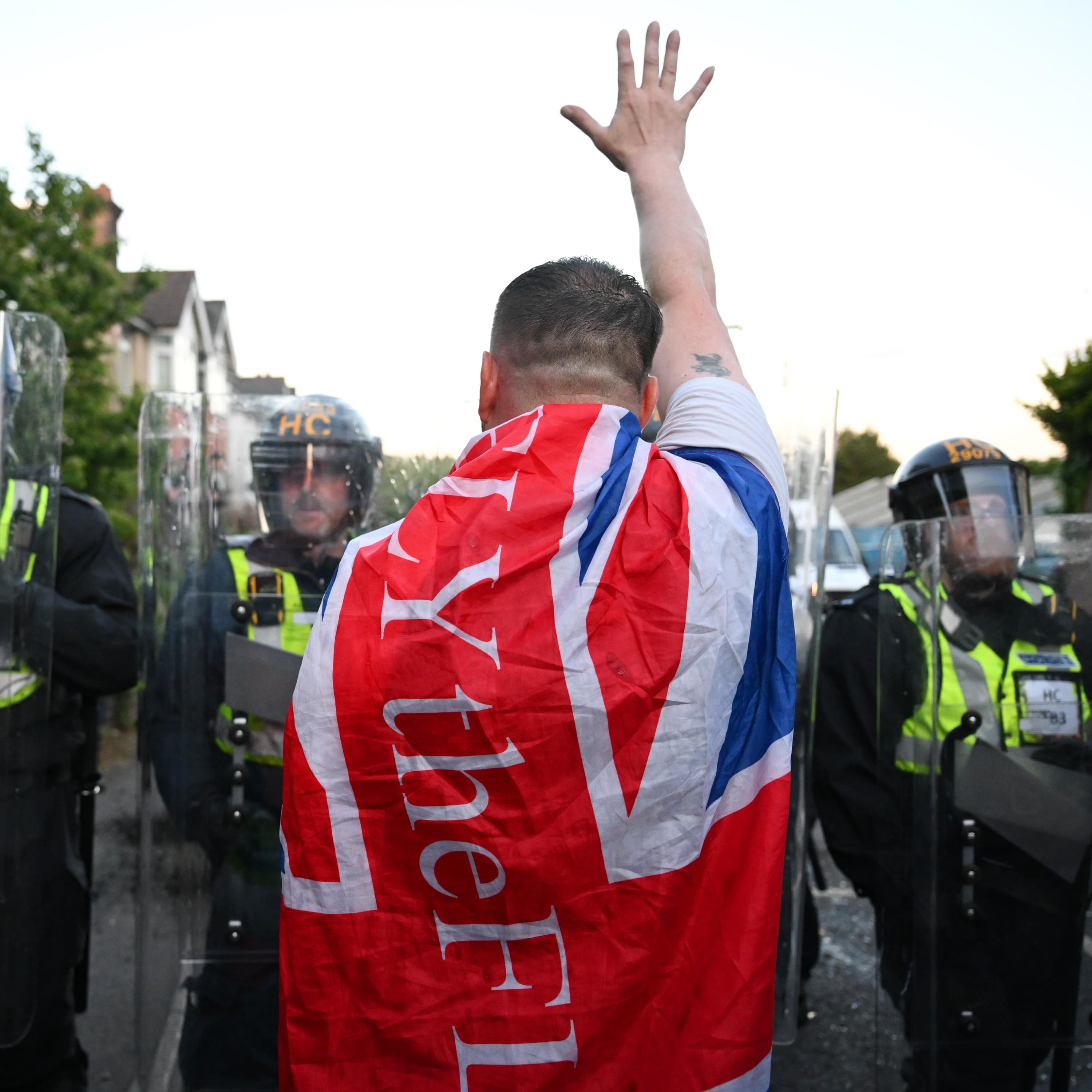
Today in Focus
How the myth of ‘two-tier policing’ took hold
00:27:32
The far-right conspiracy theory is heard everywhere from pubs to parliament and riots to talk radio. Hugh Muir and Joe Mulhall explain why
Loading summary
Transcript70 lines
- [00:00]
Annie Kelly
This is the Guardian.
- [00:08]
Host (Annie Kelly)
Today, the myth of two tier policing. Today's markets move fast. Get the insights you need in 10 minutes with the Barclays Brief, a new podcast from Barclays Investment Bank. Through sharp dialogue and scenario based analysis, our leading experts analyze key market themes each week. So whether you're managing a portfolio or leading a business, the Barclays Brief podcast can help you make smarter decisions today. Stay sharp, stay brief. Find Barclays Brief wherever you get your podcasts this week. One phrase once only heard on the fringes of the far right has been everywhere. That's two tier policing. Two tier policing, a two policing system. You must be blind in this country if you do not think that there is any form of two tier policing. It's been parroted in Parliament by Nigel Farage, on social media by Elon Musk and on the ground by far right figures such as Tommy Robinson as violent anti police protests erupted around them in Southampton. It's come after the tragedy of the death of 18 year old Henry Novak, who was stabbed by Vikram Digua and then arrested. As he lay dying, terrible mistakes were made by the police.
- [01:44]
Jo Mulhall
Henry did not die with dignity. He did not die with the care he deserved. He lost consciousness before anyone believed him.
- [01:54]
Host (Annie Kelly)
To his family, Henry's death is a warning about the dangers of knife crime. Yet since Digwa's conviction, their son's death has been shaped into something very different. With claims that it is proof because Henry was white and his assailant Asian, that white people are treated unfairly and discriminated against by the police. The government has now rushed to push back with Keir Starmer meeting with Henry's family. But is it already too late to dispel the two tier policing myth?
- [02:32]
Jo Mulhall
It feels a little bit like the genie's out the bottle, partly because many of the individuals that passionately believe this haven't necessarily rationalized themselves into it. It's very hard to rationalize them out of it with evidence or statistics or facts. It's just a feeling, it's a sense. And so once people are into these spaces, it becomes really, really hard to get them out of them.
- [02:49]
Host (Annie Kelly)
From the Guardian, I'm Annie Kelly. Today in focus, how a far right policing conspiracy took root in the uk. Hugh Muir, your executive editor in opinion at the Guardian. You have reported on race and policing extensively over the decades. This week we've seen protests on the streets of Southampton following the conviction of Vikram Digwa for the killing of Henry Novak. Tell us what happened, Annie.
- [03:23]
Annie Kelly
The most dreadful case you have. Henry Novak, he's A young man, he's 18, he's from the Trafford Hundred in Essex and he's gone to university in Southampton to study accountancy and he's basically doing what you expect undergrads to do. He's having a good time, he's making friends and on the night in question he was playing football with his friends and he was walking home. And in ways we don't completely understand, he had an encounter with Vikrandigra Tussle for a phone. But what we do know is that at some point Ricken Digran's brother called the police, said his brother had been racially abused. The police came and then they had a choice about what to do about that situation because they had Vikram Digran's brother, but also they had Henry Novak who was lying on the ground and saying quite clearly that he had been stabbed and that he was in a bad way and the choice was what to prioritise in that situation. There's a video of it really, really distressing. What's your name, mate? Huh? Because you can clearly hear Henry Noak saying, I have been stabbed. Stabbed. Right, let's get you out of there, shall we? And in an echo of that terrible case in America, George Floyd, he's also saying, I can't breathe. Grab his other arm. The police officer is says, I do not believe you, you've been stabbed. Whereabouts? Don't think you have, mate.
- [04:49]
Host (Annie Kelly)
I mean, and the video is so distressing, isn't it? So young, only 18 years old, just such a tragedy.
- [04:55]
Annie Kelly
Oh, absolutely. As I say, anyone who sent a child away to university will really feel that.
- [05:02]
Host (Annie Kelly)
And as you said, you know, the death has been very swiftly co opted by the far right and reform against the very express wishes of his family as well.
- [05:13]
Annie Kelly
That's exactly right. You have to absolutely start there. Immediately after the sentencing on Monday, Henry's father Mark said, the family will carry the grief of this for every single day. And of course that must be true. But then he also said, and then this was extraordinary of him. We do not want his death to be used to create further division, hatred or tension.
- [05:35]
Jo Mulhall
We want his story to make our streets safer for everyone. That is why we are calling on the government to treat knife crime as the national emergency that it is.
- [05:46]
Annie Kelly
And then what happened was his death was used exactly for that reason. If you look at the comments that followed immediately afterwards, Nigel Farage, he talked about a two tier culture where the rights and privileges of white people matter less than those of ethnic minorities. And he called for a reaction of what he, his words, pure cold rage. And of course, what we know is happening in politics at the moment is this kind of battle for supremacy between Nigel Farage's Reform and Rupert Lowe's Restore. And they seem to be trying to outdo each other in terms of the toxicity of their response to this. So whereas Farage called for pure cold Road, Rupert Lowe's called for Digwa to be perhaps put to death. He's called back for the return of the death penalty. And he says, quote, keeping this savage alive serves nobody. And he's called for Digwa's family to be deported. And so here you almost see that there's a. Almost an arms race in terms of those two parties on the right of the spectrum, each of them trying to gain currency and to gain advantage from what all the rest of us must see as just being an awful, awful tragedy. One that obviously needs some level of investigation, but an awful tragedy.
- [07:07]
Host (Annie Kelly)
And so frightening to hear that language as well come into Prime Minister's Question Time this week. Not something that I think would have happened even a year ago.
- [07:15]
Annie Kelly
And these things have repercussions. You can't make a direct link between what people say and what happens. But of course, what we do know is on the streets of Southampton, not so long after there was disorder on the streets, there were police officers attacked. There was, one would normally just describe as rioting. And you then have to have a discussion about the political responsibility that people have when that sort of thing has happened. The MP for Southampton Test, Satvir Khan, she was the first woman Sikh to become a government minister and she's received death threats. It really tells you that why, why you depend on politicians to lead responsibly because there was at least a chance that their word will have real world repercussions. And there's at least a chance that that's what's happened this week.
- [08:05]
Host (Annie Kelly)
Yeah, because Digwa was Sikh as well. And our colleague Amna Muddin spoke on our latest edition earlier this week just about how the Sikh community have found themselves targeted in the wake of his conviction. But the anger directed towards the police this week on the streets of Southampton and in the rhetoric of politicians as well has been intense. I mean, I think almost a dozen police officers injured in their first day of protests in Southampton.
- [08:33]
Annie Kelly
Well, this is something that predated the attack of Henry Novak. And it's basically a claim that minorities get preferential treatment in policing, I have to say. It's not a claim of which minorities that I know, I'm a minority black Britain, myself, we are not familiar with this situation where we get preferential treatment. Quite the opposite.
- [08:56]
Host (Annie Kelly)
You know, as we've talked about, it goes without saying, that video is horrifying. When you watched it, what did you make of how the police behaved?
- [09:05]
Annie Kelly
Do you know, it took me back to the discussion we had many years ago after the death of Stephen Lawrence. How much of this is because officers are treating people differently because of their race and how much of this is just sheer incompetence is bad practice? If you're a police officer and you have someone on the ground saying, I have been stabbed, then you run that to drown, don't you? You find out if someone has been stabbed. Henry Noak said he had been stabbed. He had been stabbed. He'd been stabbed five times. And yet a decision was made by that police officer that that wasn't an urgent situation. I mean, the fact is, it is not the case that Henry Novak hurled racist abuse at his attacker. But even if it was, it would still be the job of the police officer to make sure that a man lying on the ground who said he had been stabbed had not been stabbed. This is just really, really bad policing.
- [10:15]
Host (Annie Kelly)
Jo Mulholl, welcome back to Today in Focus. You, you are head of research at Hope Not Hate, the anti racist organization. And we last had you on the podcast in the summer of 2024 reporting on the riots that were sparked by the Southport attacks. When we talked to you back then, you mentioned this far right talking point of two tier policing, which again we've seen this week raised in relation to the Henry Novak case. Could you just explain where did this two tier policing phrase come from? What's the history of it?
- [10:49]
Jo Mulhall
It's become far more prominent in the last four or five years where we see figures like Tommy Robinson pushing it. But it goes back further than that. I mean, you would hear similar sort of rhetoric back in the days of the English Defence League in 2009, 10, 11, 12, where there was. Was there any sort of far right protest? Where there was a counter protest, the far right would argue that they were being unfairly policed compared to the counter protests. And now it's something that's just a key cornerstone of what the far right talk about.
- [11:14]
Host (Annie Kelly)
And the media also have picked it up, haven't they, and started using it. When do we see that happen?
- [11:18]
Jo Mulhall
Yeah, I think last year was really big for that. You know, where I think it wasn't just far right figures, this idea that there was this two tier KIA thing,
- [11:24]
Annie Kelly
or will he simply step aside and prove he has in fact been two tier Kia all along.
- [11:31]
Jo Mulhall
You know, you quite regularly find it in mainstream newspapers. It was the sort of thing you began to hear much more regularly on talk radio. Just finally, what's your sense of the notion of what Nigel Farage talks about when it comes to two tier policing? Do you think there have been displays of two tier policing?
- [11:45]
Annie Kelly
Yes, I do.
- [11:47]
Jo Mulhall
You will see this narrative of that the police have gone woke, that they're taking the knee during the Black Lives Matter period, and that they've, you know, they've gone soft. They've kind of been inculcated with this DEI policies that means that they hate white people or that they attack white people more than they do minoritized communities. I think it's become this, this something that's incorrect has become quite widely accepted.
- [12:08]
Host (Annie Kelly)
And what is it about both the Southport tragedy where, you know, little girls were attacked in a dance class, and then the awful death of Henry Novak that have allowed the far right to really compellingly push this narrative in both cases.
- [12:23]
Jo Mulhall
I think the examples are that people are really angry at what's happened. And I would argue in both cases, people are. It's acceptable to be really angry at these two horrifying events. What we've seen with Novak, you know, the footage and the content is extremely emotive. It's really, really painful. It's really, really horrible to watch. And I felt angry watching it. The problem then becomes when the far right see people's pain and they see people's anger and they see people's fear, they say, here's an example of all the things we've been saying. We've seen it again in Southampton this week where huge chunks of the far right ran down Southampton as quickly as they could to take that anger and shape it in the direction that they want.
- [13:00]
Host (Annie Kelly)
You know, it clearly is a seductive idea, this idea of this unfair two tier policing system that seems to discriminate against white people. You talk about this kind of feeling that is resonating with people outside far right movements as well, in real life, not online. Where do you think like this comes from?
- [13:24]
Jo Mulhall
There's this magma chamber of anger under British society, right, where increasingly large numbers of people just feel that the status quo is not working for them. You know, they feel like we've gone from one crisis to another. They're struggling, they feel a cost of living crisis. And all of this is building into a completely understandable sense that our politics and that our authorities and our elites aren't meeting the material needs of our communities. And when that happens, people become really distrustful of any sorts of authorities.
- [13:52]
Host (Annie Kelly)
And it's not just in the uk, is it, where this kind of idea of a two tier policing system operating here is being amplified. We've seen people outside the uk, Elon
- [14:02]
Annie Kelly
Musk, Musk again has been interfering in our politics in the last few days, trying to whip up division. That is not who we are in Britain. In Britain, we are reasonable, tolerant people. When we have a terrible case like Henry's case, Henry Novak, we react calmly, as his family have done.
- [14:21]
Host (Annie Kelly)
How are far right groups elsewhere using this story to push a narrative that's also convenient to them?
- [14:29]
Jo Mulhall
Britain plays quite an interesting role in the international far right. Sea right, Unlike when you listen to lots of international far right figures that go around, they're nationalists, they go around telling the world how great their country is. The British far right, generally speaking, go around the world saying how awful Britain is. And their argument is that Britain has fallen, that we've been conquered, and that it is an example to the rest of the world that if you don't stop immigration now, if you don't reverse Islamization now, if you don't stop communists like Keir Starmer in their language from running your country, this is what's coming to you next. Tommy Robinson's just finished a two, three month tour of America where he went around doing hundreds of podcasts just saying how dreadful England is.
- [15:06]
Annie Kelly
I think as a nation loses its culture and loses its belief in its faith, something else fills that void. And that's what we've seen in Britain. We've seen an attack on the church, attack on Christianity, attack on the family, and another value system has filled that void. Marxism, Communism, Islamism, lgbtq, all these different ideas have filled the void.
- [15:28]
Jo Mulhall
And so the Britain plays this interesting role in the international scene as this kind of canary down the coal mine. And I think that's why there's so much interest in it by people like Elon Musk, et cetera, who obviously has his own long history of perhaps not having the most interest in actually what the truth is, but actually what serves him best.
- [15:44]
Host (Annie Kelly)
Yeah, it's very British, isn't it too? This idea of everything going to the dogs all the time and the country sliding into some kind of decay. But what's also been striking and really scary is that there has been an increasingly racialized rhetoric used by the far right. And do you think, think that this is Farage's attempt to use this two tier policing issue to show that he's in step with that.
- [16:10]
Jo Mulhall
Yeah, I think it's absolutely the case. You know, I think one of the really worrying trends on the far right in the last two or three years has been this increasing or re racialization of British far right politics. It's not to say that they weren't always racist, but for much of the last 20 years they talked in very cultural terms. We're not racist, but. And that's why in a moment like this, it's not talked about in terms of police failings in their eyes, it's talked about an attack on white people, white privilege.
- [16:39]
Annie Kelly
Does Henry fucking know? It looked like he had white privilege on the floor. I heard someone say, this isn't about race, this is about race.
- [16:47]
Jo Mulhall
You know Farage's comments where he came out and said, you know, white lives matter too. In the last few days, enough of
- [16:56]
Annie Kelly
angel anti white prejudice, a promotion of the idea that white lives matter just as much as black lives.
- [17:05]
Jo Mulhall
To be talking in such overtly racial terms is something that Farage has always broadly tried to publicly keep away from is something that I don't think we would have seen from him six months ago or certainly a year or two ago. And I think that that part of our politics is shifting right into an increasingly racial direction. And he's now reflecting that.
- [17:24]
Host (Annie Kelly)
I wanted to ask you whether you felt like listening to this as an anti racism campaigner, whether you felt like this talk of two tier policing is co opting the language of anti racism campaigners.
- [17:37]
Jo Mulhall
Yeah. One of the starkest things I think probably since 2018 in the UK is we increasingly see the far right talking in the language of the civil rights struggle in America. Even the chants we've seen this week are no justice, no peace. These are slogans we've heard from from progressive movements. And they're not being ironic, comparing Tommy Robinson to Gandhi, Mandela. Their reference points are not kind of far right leaders of old. You don't see them harking back to the National Front leaders or Oswald Mosley publicly at least most of them. What they're actually harking back is to what they see as other freedom fighters, because that's how they see themselves. They've created this delusional image that they are on the side of the freedom fighters. They are the defenders of free speech, they are defenders of the community and people's rights. And that there is some oppressive fascist state which is crushing them, which is removing their freedom of speech, which is marginalizing them. And many of them looked really closely at say the black lives Matter protest and have adopted the same language and lexicon. If you look at the last week, not only were they chanting, no justice, no peace, no peace, no justice, they were chanting I can't breathe, you know, which of course was one of the things that you would hear very regularly on Black Lives Matter protests as well.
- [18:52]
Host (Annie Kelly)
And seeing what's happening in Southampton this week, what do you think about the government's reaction, about Starmer's reaction to all of this?
- [19:01]
Jo Mulhall
We are in this kind of perma crisis when it comes to far right protests. You know, in the last four years, between I think the 14th of July and the end of the year, I hope not hate, we track 251 far right protests, primarily in and around accommodation for asylum seekers. This is something that is happening every single summer. And so while, you know, the individual responses of the government might be okay, I don't think there is enough long term thinking about actually saying what are we putting in place to try and stop this over long periods of time? Because we knew that they were going to happen. So I presume that they knew as well.
- [19:33]
Host (Annie Kelly)
Coming up, will the two tier myth change policing in the uk.
- [19:53]
Advertisement Voice
Most people don't realize how much of their personal information is being bought and sold every day. Data brokers are making billions pulling details about you from public records and the Internet, then packaging and selling it, usually without your consent. That's how your information lands in the hands of scammers, spammers, even stalkers. It's why you get endless robocalls and why ads seem to follow you everywhere. That's where Aura comes in. Aura actively removes your data from broker sites and keeps it off. They also instantly alert you if your information shows up in a breach or on the dark web. But Aura goes beyond data protection. With one app, you get a vpn, antivirus, password manager, spam call protection, dark web monitoring, and even up to $5 million in identity theft insurance. All backed by 24, 7 US based fraud support. Other companies might sell just credit monitoring or just a vpn. Aura gives you all of it together at the same price. Competitors charge for just one service. Start your free trial today@aura.com safety. Protect yourself now@aura.com safety.
- [21:06]
Host (Annie Kelly)
Hugh, as you know very well, the racist murder of black teenager Stephen Lawrence in 1993 led to really concerted efforts to try and address institutional racism in the police. Now, 30 years on, is it these attempts to try and make policing fairer to all communities that the far right is now exploiting?
- [21:31]
Annie Kelly
I mean, I sat through virtually every Day of the Stepen Lawrence inquiry at the Elephant and Castle. Up until then, we were always told that we had a chip on our shoulders, that we were steeped in the politics of grievance. It's really very quite ironic now that we can make the same allegation to a lot of the right now. But basically that was the allegation that was always put to us. Now, lots of things were done in the immediate aftermath. There were lots of reports, the police looked at what they were doing and they did make changes. But all the while, there's been a continuing process of pushback from people who never liked that, who never accepted it, who always thought that it was unfair. And you can draw a line all the way from that to this. Because in a way, these are the same people, these are the same arguments, these are the same people saying, no, it's all gone too far. You're now bending over backwards to be unfairly supportive of particular ethnic groups. As I've said before, as one of those ethnic groups, we just don't recognize any idea that we get a differential treatment.
- [22:31]
Host (Annie Kelly)
Yes, because in 2023, there was another independent review into culture in the police force, and that report found the Met to be institutionally racist, misogynistic and homophobic. Following the murder of Sarah Everard by serving officer Wayne Cousins, the Met police appointed Baroness Louise Casey to lead an independent review of its standards of behavior.
- [22:56]
Annie Kelly
I think that you, you have to place that in the context of a long line of inquiries that have said, yes, there is differential treatment here, but not because the police is excessively woke. It's actually the other way around. They're trying to correct disparities that they know to be true.
- [23:15]
Host (Annie Kelly)
These attempts to police black and minority communities more fairly, all of these multiple attempts that you just laid out, is that what's now being twisted to make these accusations of this two tier system that works against white people?
- [23:31]
Annie Kelly
Yeah. What you have is a right wing ideological argument that basically says fairness is a zero sum game. And if we end up in a place where we are being fairer towards minorities, then everyone who's not a minority will lose out. They say if they are getting a better service, then you must be getting a worse one. Now, I would make an argument that everyone is getting a better one. If you have a more responsive, more sensitive police force that actually looks at the society that's policing and find ways to uphold the laws that we all want upheld, but to do so in a way that recognizes the makeup of the society that it's Serving, it's gotta be good for everyone.
- [24:18]
Host (Annie Kelly)
And what does the data show on all of that in terms of this concept of policing being potentially discriminatory towards white people? What does the data say on this?
- [24:32]
Annie Kelly
Yeah, we hear a lot from white right wing commentators and politicians who seek to bolster this idea that the discrimination is on one side. I think it's worth listening to someone like Andy George, who's the chair of the National Black Police Association. His take is really quite plain in that he says, yes, inequality does exist. We know that, we've seen the data. Black people in Britain are seven times more likely than white people to die after police restraint. Black children in England and Wales almost eight times more likely to be strip searched. Also overrepresented in the use of force through tasers and handcuffs. Those are what the figures tell us. And so it's a bit surreal to, to be listening to this debate that seeks to turn all of that on its head. It really is Alice through the Looking Glass.
- [25:22]
Host (Annie Kelly)
And why do you think the far right has latched onto this so strongly now?
- [25:28]
Annie Kelly
I think there is a problem here for the right because immigration's gone down. So in a way this thing about policing has been a bit of a godsend because they really do need a touchstone issue and immigration needs almost being drained of its power as a touchstone issue. And the real worry for us and the real responsibility that you have to put upon the government is there is a danger that in all of this, minorities get thrown under a bus. And I think it's the responsibility of government to make sure that minorities don't get thrown under a bus.
- [26:01]
Host (Annie Kelly)
Right, so how do we combat this?
- [26:03]
Annie Kelly
It's really important that we see it for what it is. The right actually doesn't want to deal in facts, he doesn't want to deal in data. If it dealt in facts, it could not make an argument that what happened to poor Henry Novak happened because there's a police forces obsessed with being woke. The figures do not support that. They know that. And so they almost have to resort to something that's, it's all tune but no words. And so what we need now from the people whose job it is to, to push back at this sort of thing is just to tell a more persuasive story, to have a more persuasive account of what is actually happening. And they really need to address that and quickly.
- [26:50]
Host (Annie Kelly)
It's really struck me during our conversation that we've covered quite a huge arc of the history of race and policing in the UK and that you have been there for a lot of it. How does it feel to you now to see scenes like we saw in the streets of Southampton this week and to hear this two tier system be co opted by the far right in this way?
- [27:16]
Annie Kelly
It's very strange because I've grown through a period where the police were seen as being a very hostile force. In my 20s, my early 20s, you'd drive your car and you'd be looking through the rear view mirror every so often just to make sure you weren't being followed by a police car and you weren't about to be stopped by a police car and wondering if that that happened, what that interaction would be. I think credit where credit's due. I think some police forces have improved, have moved things on from that scenario that there was all those years ago. But I think that it's still very difficult. If you look at the figures, the data is still not good. And so I want them to be able to get on with continuing to make improvements and continuing to reflect society as it is and to be able to be tough enough to ignore or to not be diverted by the kind of toxic politics that would mean that they're not just doing their jobs. Because I think at the end of the day, everyone in this country needs a police force. All of us taxpayers pay for a police force. We all want a police force that we think will police society fairly. And I think we all need to push back against anything that makes it harder for us to achieve that.
- [28:34]
Host (Annie Kelly)
Hugh, thank you so much.
- [28:35]
Annie Kelly
Annie, thank you.
- [28:37]
Host (Annie Kelly)
And that's it for today. My thanks to Hugh Muir and Jo Mulhall and you can read all of our reporting on this issue@theguardian.com this episode was produced by Eleanor Biggs, Iva Manley and Natalie Kattena and presented by me, Annie Kelly. Sound design was by Rudy Z. Gadlow and the executive editor was Homa Khalili. And we'll be back later on this afternoon with the latest.
- [29:10]
Annie Kelly
This is the Guardian.
- [29:21]
Advertisement Voice
This message comes from Jackson. Taxes aren't something you can only think about once a year, with investments planning
- [29:27]
Jo Mulhall
for tax days year round. Fortunately, Jackson offers tax efficient products.
- [29:32]
Advertisement Voice
Visit Jackson.com for more information on how our products can make your tax bill a little bit less painful. Jackson is short for Jackson Financial Incorporated, Jackson National Life Insurance Company, Lansing, Michigan and Jackson National Life Insurance Company of New York, Purchase, New York. Most people don't realize how much of their personal information is being bought and sold every day. Data brokers are making billions pulling details about you from public records and the Internet, then packaging and selling it, usually without your consent. That's how your information lands in the hands of scammers, spammers, even stalkers. It's why you get endless robocalls and why ads seem to follow you everywhere. That's where Aura comes in. Aura actively removes your data from broker sites and keeps it off. They also instantly alert you if your information shows up in a breach or on the dark web. But Aura goes beyond data protection. With one app, you get a vpn, antivirus, password manager, spam call protection, dark web monitoring, and even up to $5 million in identity theft insurance, all backed by 24. 7 US based fraud support. Other companies might sell just credit monitoring or just a vpn. Aura gives you all of it together at the same price competitors charge for just one service. Start your free trial today@aura.com safety protect yourself now@aura.com safety.