← Today in Focus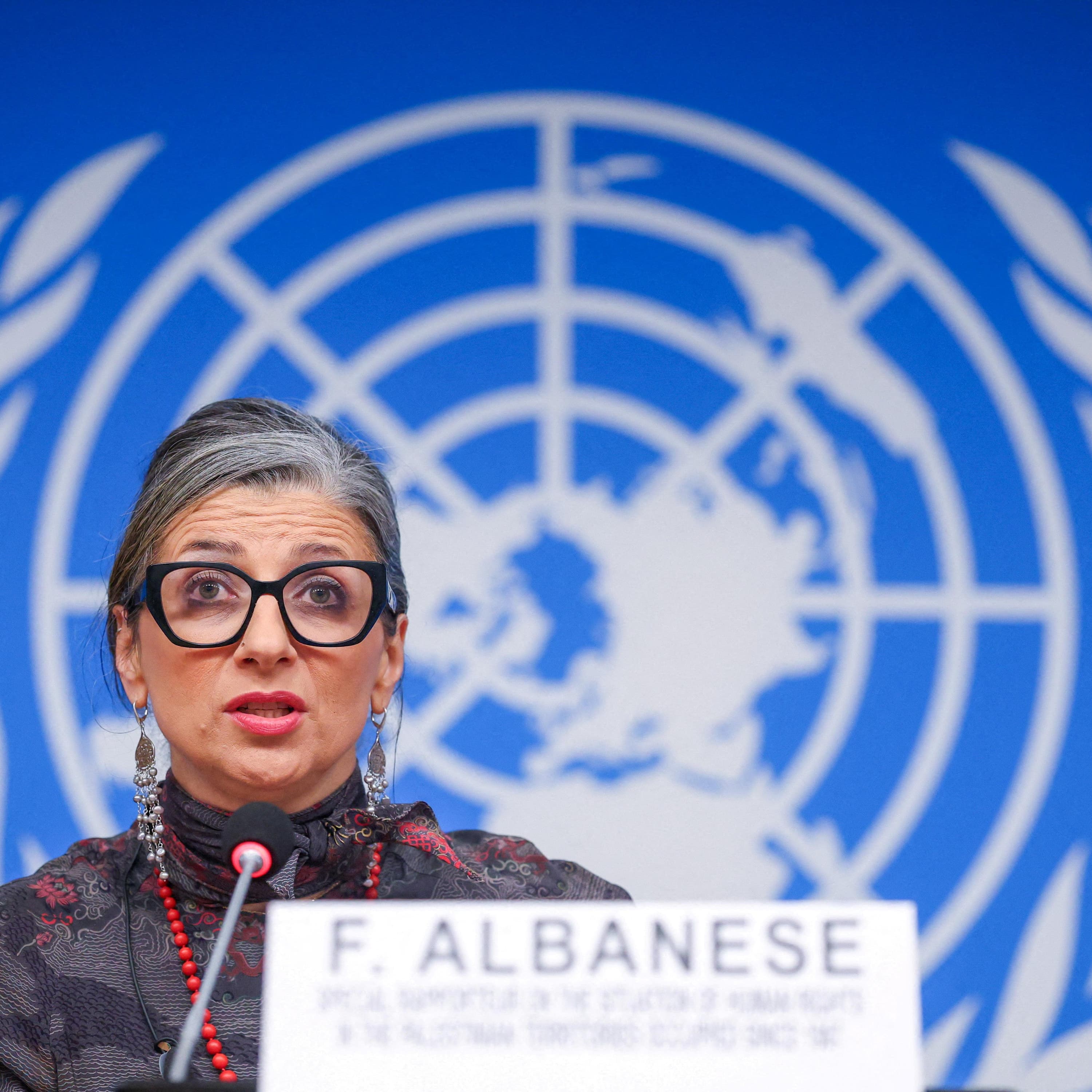
Today in Focus
Human rights lawyer Francesca Albanese on life under US sanctions
00:29:03
The UN’s special rapporteur for Palestine, Francesca Albanese, on the war in Gaza, living under US sanctions and accusations of antisemitism
Loading summary
Transcript48 lines
- [00:00]
Francesca Albanese
This is the Guardian.
- [00:09]
Noshi Nikbal
Today, the cost of speaking out the human rights lawyer sanctioned by the U.S.
- [00:23]
Francesca Albanese
Today's markets move fast. Get the insights you need in 10 minutes with the Barclays Brief, a new podcast from Barclays Investment Bank. Through Sharp Dial and scenario based analysis, our leading experts analyze key market themes each week. So whether you're managing a portfolio or leading a business, the Barclays Brief podcast can help you make smarter decisions today. Stay sharp, stay brief. Find Barclays Brief wherever you get your podcasts. My life was calm. I wouldn't say ordinary, because I don't know what ordinary is, but I was. I mean, I was with my family. I had started lecturing in various uni.
- [01:13]
Noshi Nikbal
This is Francesca Albanese. You might have heard of her. You've probably seen her. She's the Italian lawyer who in May 2022 became UN's Special Rapporteur for the Occupied Palestinian Territories.
- [01:27]
Francesca Albanese
When I started this position, I was full of good intentions, which I still have. But I was so naive. I really thought that Member states didn't know enough or didn't understand enough or were animated by good intentions.
- [01:46]
Noshi Nikbal
It is an unpaid job and it's never been an easy one. Eighteen months into the role came October 7th and Israel's war on Gaza.
- [01:55]
Francesca Albanese
And then my life has been completely turned upside down ever since.
- [02:03]
Noshi Nikbal
Francesca's work is to monitor and compile evidence on human rights abuses. She is called to be an independent expert to the United nations and writes exhaustive reports using international law to assess what's happening in occupied Palestine. It's not work you expect would make her go viral on social media or to see her become sanctioned by the Trump administration.
- [02:25]
Francesca Albanese
The US Secretary of State, Marco Rubio posted on X saying I am imposing sanctions on UN Human Rights Council Special Rapporteur Francesca Albanese for her illegitimate and shameful efforts to prompt International Criminal court action against U.S. and Israeli officials, companies and executives.
- [02:44]
Noshi Nikbal
For many, Albanese is a hero for calling out a genocide in Gaza, but she's divisive. She's been accused of anti Semitism and she's had all sorts of abuse thrown at her, even at the United nations itself.
- [02:58]
Francesca Albanese
Ms. Albanese, you are a witch and this report is another page in your spellbook. You have tried to curse Israel with lies and hatred, but your poison has failed. To be vilified, mistreated, for standing side by with those who are invisibilized and silenced. It's awful. I am no one. I'm just a ligand, expert who has studied and lived in Palestine and has written boring Academic research about Palestinian forced displacement. And then, during my mandate, awful crimes start to happen. What shall I do? I just tell what I see, the way I see it.
- [03:55]
Noshi Nikbal
From the Guardian, I'm Noshi Neqbal. Today in Focus, Francesca Albanese, in her own words. Francesca Albanese, welcome to Today in Focus. Now, you are an international lawyer specializing in human rights in the Middle East. And since 2022, you've been the UN's Special Rapporteur on the occupied Palestinian territories. Last July, in an extraordinary move, the US government sanctioned you. It's a fate that you shared with Vladimir Putin, Bashar Al Assad and the late Ayatollah Khamenei. What impact did that have on your life?
- [04:37]
Francesca Albanese
Yeah, the impact is severe. The impact is severe. It equates to a civil death. I cannot perform transactions, I cannot make payments. I cannot receive payments through financial transactions. So I cannot have a bank account. But this is not just in the us, this is everywhere, because the banking system of the US reaches everywhere, including in the part of the world I come from. I've not been able to open a bank account in Italy or in any other European countries where I've tried.
- [05:07]
Noshi Nikbal
So you can't use a credit card or a debit card? No, no.
- [05:10]
Francesca Albanese
But all the more. I mean, I've not been able to benefit from my health insurance because I'm sanctioned or, you know, I have property in the US was being frozen because we used to live there. So we decided eventually, after so many years of work, to purchase the apartment. It's a small apartment, but this is the place where I gave birth to my first child. And she's American educated, she's 13. And she's been going throughout the US education system. And she's always said that she wants to go to study in the us. So this has not impacted me only it has impacted my family, and not just because of the freezing of my assets and because I'm no longer economically independent. I have the same degree of independence that I had when I was a young child. Someone needs to take care of me, which is absolutely embarrassing and humiliating.
- [06:09]
Noshi Nikbal
So even going to the supermarket, something as trivial as that, you're always having to carry cash.
- [06:14]
Francesca Albanese
No, I need to borrow money. I need to borrow money. I cannot access my earnings. They're blocked in so many places. The US sanctions operate in this way. Their aim is to create a chilling effect around the sanctioned person that you understand. It makes total sense if the person is a narco trafficant or a threat to the us. And so you say Okay. I need to protect my citizens from someone who really represents evil to my people. So all those who support or have relations with the sanctioned person, transferring goods or services, they can be punished up to 20 years in jail or $1 million fine.
- [06:59]
Noshi Nikbal
And so this includes your own employment as a professor as well. Right. So this includes you teaching in the US which you did. You can't do. You can do that no longer.
- [07:06]
Francesca Albanese
Yeah, no. I've lost all my affiliations with the U.S. senate, partnerships with U.S. organizations, with U.S. universities. I've seen people running away from me because, of course, the chilling effect is powerful. Those working on Palestine are vulnerable to the capriciousness of this government, of this administration.
- [07:30]
Noshi Nikbal
The US Government has said it sanctioned Francesca Albanese for cooperating with the icc, the International Criminal Court, which is pursuing prosecution of Israeli nationals for war crimes. It also accused Albanese of being unfit for service as a UN Special Rapporteur. In February, Francesca's husband and daughter filed a lawsuit against the Trump administration, arguing that she was being punished for speaking out about Israel's abuses against Palestinians. Two weeks ago, a federal judge in Washington, D.C. backed their claim. Albanese, he wrote in quite a scathing legal opinion, has done nothing but speak. He ruled the sanctions should, for now, be lifted. Finally, Francesca had some relief. Last Friday, a U.S. court of Appeal overturned that decision. Francesca remained sanctioned. As the UN Special Rapporteur. You were one of the first people in the United nations to call Israel's military campaign in Gaza a genocide. And you knew making that argument was going to be huge, risky even. What was the legal basis for your argument at that point?
- [08:55]
Francesca Albanese
My main legal basis was the Genocide Convention. The Genocide Convention is one of the most adamant and clear legal instruments ever produced by international community. And it says that intention to destroy a national, ethnic, religious or racial group as such is considered genocidal. And it can happen through various acts, acts of killing members of the group or inflicting severe bodily or mental harm to members of the group, creating the conditions of life calculated to destroy the group as such, the prevention of birth, of this attraction of children. The thing is that these acts are crimes in and of themselves. However, they constitute genocide when they are committed with intent to destroy the group, with the intent to destroy physically and biologically the group as such. This is what I used. I, of course, read the main jurisprudence existing in the Rwanda Tribunal, former Yugoslavia Tribunal, the International Court of Justice. I studied what the main experts have said, and I had no doubt whatsoever that we could already speak of genocide. In March 2024, Israel was killing without respite, without distinctions, without respect for proportionality and precautions, which are the basic tenets of International Humanitarian Law. 150 civilians each day, it didn't count. It didn't matter if they were doctors, priests, infants. Everyone was destroyable. Everyone was killable, everyone was memeable. And this is how Israel had managed to kill 30,000, 30,000 Palestinians in Gaza alone in a few months. And it has used international law jargon to justify its operations, and international community has allowed it to do so using evacuation orders, human shields, collateral damage, safe zones. Nothing of this has ever been real. And still this is the language that has allowed Israel to benefit from impunity
- [11:16]
Noshi Nikbal
legally. How do you measure in the case of Gaza, that there is an intention to destroy, rather than what could be argued it's a criminal or reckless, even vengeful pursuit of war?
- [11:30]
Francesca Albanese
Okay, so first of all. First of all, let's put genocide aside for a moment. The occupation is unlawful, and the very presence of Israel there is unlawful. The second is Israel should take precautions, should not kill civilians the moment it kills for days, weeks, months, civilians without respite. What is it? A series of war crimes? Shall not the international community intervene? Of course it should. So war crimes are violations of the law of war. So destroying hospitals, destroying schools, destroying homes. Israel has raided, raided, pulverized the Gaza Strip. Most of it. Very little remains standing. Was it necessary? No. Was it justified under international humanitarian law? No. So why has it not been stopped? But there is another element. Certain crimes, when they are widespread and systemic, like the deprivation of food, the deprivation of humanitarian aid. This is systemic. It's not a single act, it's not a single bombing. This is a crime against humanity. Forced displacement is a crime against humanity. Using starvation as a tool of war. It can be both a war crime, but when it's systematic and widespread, is a crime against humanity. So why has this not been stopped? But the point is that the intention has been communicated. Communicated by leaders, communicated by soldiers. We will annihilate Gaza. We will turn Gaza to the Middle Age. There will not be Palestinians remaining Gaza. Everyone is responsible. They are human animals. Even the newborns are responsible because they will grow into. This is really. You know that you. You have this kind of language. In the Nuremberg Trials. In the Nuremberg trials, there was an officer asked, but why would you kill civilians? Because they represented the security threat, including children. Ask the prosecutors. Yes, because they will grow hating us for what we did to them.
- [13:43]
Noshi Nikbal
Francesca, I don't think anyone listening doubts your passion, clarity, expertise on the subject. It's why people see you as brave and courageous and all those things. Of course, others have taken a very different view. And I want to talk about some of the criticisms leveled at you. Firstly, that you've been described as unfit for your role, that you lack the impartiality required for the un. How do you address that?
- [14:07]
Francesca Albanese
What is impartiality? This is my question. What is impartiality? Because impartiality is assessing the facts for what they are. Okay? And we are entitled machine to different opinions, but we are not entitled to different facts. So impartiality is to look at the facts for what they are and then draw conclusions. And my conclusions are always legal qualification. I don't say what I think as personal opinion. I produce legal analysis. So I tell the Israelis, the Israeli governments, or the IT allies, Germany, Italy or France in Europe, challenge the facts. Challenge the facts. They don't have arguments to challenge the facts. So they accuse me and they think that they're going to. I mean, of course they are harming me. Of course, of course it's exhausting and of course it takes a psychological toll. But look, if we were in 19, people like me would endure the same would be not heard or ridiculed or accused or vilified. But I would say today everyone is morally clear that they would have defended the Jewish people 100 years ago. But 100 years ago, defending the Jewish people was not popular at all because the Jewish people were considered an unwanted population, an unwanted encumbrance. This is what like the Palestinians today. So I don't mind taking the brand. And again, it's just a minority of people who stands against what I'm saying or what Amnesty International, the Commission of Inquiry on Israel Palestine, the Special Committee on Israeli Practices, Israeli historians, Israeli human rights organizations, we are all partials. The only one in partials are the Israelis, the Italian government, the German government, the US government, and France.
- [15:58]
Noshi Nikbal
I want to talk also specifically about other criticisms you've received, namely of antisemitism. Now, firstly, in 2014, you said that the US was subjugated by the Jewish lobby, which you have apologized for. And then, since then, there was a recent retweet which compared a photo of Benjamin Netanyahu to one of Adolf Hitler and another tweet where you draw a direct link between the Holocaust and what is happening in Gaza. You wrote in February 2024 that October 7th victims weren't killed because of their Judaism, but in reaction to Israel's oppression. Francesca, how do you explain those statements? How do you address them?
- [16:38]
Francesca Albanese
First of all, the question of the Jewish lobby being subjugating the us I was referring to aipac. AIPAC is one of the largest lobbying groups who's on record for influencing U.S. policy. Now the thing is that I know now, like over. Over a decade later, first of all, I never said anything like that in my capacity as a special rapporteur. I didn't apologize. I clarified what I said because I've never meant to offend anyone. But I learned after that saying Jewish lobby is something antisemitic. I said, I'm really sorry if it caused suffering, but this was not intentional. And of course, I've not done it ever since. The other examples that you quote should be contextualized because of course, if you say, oh, you published a picture of Hitler and Netanyahu next to each other, okay, I would say people listening to you could say, oh, my God, this person is really, is really not even minded. But this is not what I did. There was a former UN official who had stood 30 years experience in the US so it's not a random guy. He posted a picture of a cheering crowd receiving Hitler next to a cheering crowd in the US receiving Netanyahu. It was about the cheering, the cheering of people who then would be accused of heinous crimes. And so I didn't post anything. I just commented under the picture as I. I've been thinking the same. Because, yes, I've been thinking the same when I saw the US Giving a standing ovation to Netanyahu when there were already reports of war crimes and crimes against humanity. What's the point of receiving him and giving him a standing ovation? And actually, I do make the connection, which doesn't mean a comparison. I do make the connection to the Holocaust all the time. And you know why? Because I'm European and this is my history. Like any American, any US citizen should realize that their history is one of settler colonialism. Native Americans have been subjugated, oppressed, and eventually erased. So I'm telling people, never again is not a tribal slogan. We need to learn from the past. Because for decades, discriminating, mistreating the Jewish people was considered normal and acceptable in Europe. Now it's not. But the accusation of antisemitism is being thrown at people as confettis just as a way to distract from Israel's responsibilities.
- [19:22]
Noshi Nikbal
Francesca, I hear what you're saying, but do you not accept that the language and the constant invocation of the Holocaust is in one part hurtful to Jewish people and on the other, clunky and perhaps undermines and counterproductive to the arguments you're trying to make.
- [19:44]
Francesca Albanese
So let's say. Let's say. If I say we have learned nothing from the genocide in Rwanda or from the genocide in Bosnia, I'm going to offend the Rwandis, the Tutsi survivors, or the memory of the Tutsi victims, or the Bosnian survivors and their memory of the victims. Is this what you are inferring?
- [20:08]
Noshi Nikbal
No, what I'm saying is I don't doubt your intent, but the minute that one invokes the Holocaust, you almost lose the room, irrespective of how true it is.
- [20:16]
Francesca Albanese
But this is the comparison.
- [20:18]
Noshi Nikbal
But so then, if you're. As a sophisticated legal scholar, if you're trying to. In hearts and minds, is language not important when we all agree that it really matters?
- [20:29]
Francesca Albanese
Yes, and this is why I use the language. Great precisions. The problem is that certain people, especially in the west, continue to describe the Holocaust as an exception. The Holocaust was not an exception. The Holocaust has been the worst crime ever committed on European soil, but it was not an exception. It was part and parcel of an aberration that was typical of white supremacism. White supremacism has been the basis of colonialism. So I really take an issue. I really take an issue with the isolation of the Holocaust because it means disconnecting from history, from what has happened to millions and millions of indigenous people in Latin America, in Africa, or in Australia. So I'm sorry if some Jewish people get offended by this, but again, I do not distinguish human beings on the ground of religion. For me, all humans are the same, regardless of sex, gender, political identity, religious identity or anything. I mean, people are all the same, and they should be protected and recognized all the same. And especially because, as a European, I've learned from my family and my education that never again is to keep alive the memory of the past. I say let's unpack what the Holocaust has been. The Holocaust. We have conveniently reduced the Holocaust to the concentration camps. The concentration camp was. Or the gas chambers. They were the final solutions. But do you think that the Jewish people have enjoyed living in ghettos, being kicked out of their professions, being victim of events like Kristallnacht, having to be on the run or hide in people's homes, not to be killed? This is not genocide. Of course it's genocide. Even if Jewish people were killed outside the concentration camps. And this is why I'm saying, no, no, I'm going to keep on bringing the Holocaust to the center because people need to understand that the genocide happens when there is dehumanization. And I really take an issue with the fact that, you know this posture of oh, you know, you are not impartial because or you know, you do not respect the Jewish people. Of course I respect the Jewish people so much that their pain is inside my mind every day. And especially because of that I recognize that their pain is Palestinians life every day. Is it that difficult to see the humanity of the other?
- [23:16]
Noshi Nikbal
Coming up Are we living through the death of international law?
- [23:39]
Advertisement Narrator
This message comes from Jackson. Taxes aren't something you can only think about once a year with investments planning for tax day is year round. Fortunately, Jackson offers tax efficient products. Visit Jackson.com for more information on how our products can make your tax bill a little bit less painful. Jackson is short for Jackson Financial, Inc. Jackson National Life Insurance Co. Lansing, Michigan and Jackson National Life Insurance Co. Of New York Purchase, New York. Running a business means juggling a lot of moving parts. And when your communication tools can't keep up, things start to slip. Missed calls, slow replies, scattered conversations. They're not just frustrating, they're lost opportunities and revenue left on the table. That's where quo comes in. Spelled Q U O. Quo is the number one rated business phone system on G2, trusted by over 90,000 businesses. One shared business number for calls and texts so every conversation stays visible, organized and accountable. It works from an app or computer. You can keep your existing number, add teammates and sync your CRM, letting you scale without adding complexity. And with built in AI, Quo logs, calls, summarizes conversations and flags next steps, even after hours Stop missing customers. Stop leaving revenue on the table. Try quo free and get 20% off your first six months at quo.comtech that's quo.comtech quo no missed calls, no missed customers.
- [25:20]
Noshi Nikbal
Both since the ceasefire last October and especially since the outbreak of war in Iran, the world's attention has shifted away from Gaza. What's the situation there day to day? Right now it's horrible.
- [25:33]
Francesca Albanese
It's really horrible. The Gaza Strip was already one of the highest populated places in the world before October 2023. Now Israel has occupied and has leveled to the ground most of the Gaza Strip. And the population that remains, about 1.8 million people. Those who have not been killed, those who have not fled, they are corralled in a piece of land that is in proximity of the sea. So for example, last winter they were living in makeshift tents which have not resisted the elements. There were storms that they were Flooding. And now that the weather has improved and the temperature are rising, there is a plague of rodents attacking them and there is no humanitarian aid properly entering. There are civilian trucks so good for sale that have entered but the health system has collapsed long ago. So they are just on a survival mode and it's painful to see that intellectual media and many politicians have decided to move on.
- [26:46]
Noshi Nikbal
What toll do you think it's had on you and your mental health? Looking and studying and examining what's been happening in Gaza over the last couple of years.
- [26:55]
Francesca Albanese
It's dehumanizing. It's dehumanizing because you, you know, we are, I'm trained to interview victims of violence. I'm trained to deal with children who have gone through what the Palestinians have gone through. And at the same time you are not supposed to do that on a daily basis for four years. So clearly it has taken a toll on me. Look, there is no softer pillow than a light conscience. I'm so happy I have an opportunity to do the right thing instead of sitting in the margins and letting history be written by others. I've never been particularly, you know, I've never been an activist, so I've never been particularly courageous, particularly generous other than with my, in my own environment. This time I'm called upon doing something that is bigger than me, is bigger than anything I've ever imagined doing in my life. And I take it humbly and I say I'll do my best. And my sense of duty becomes only stronger with every day of unaddressed violence, of every day of non delivered justice.
- [28:19]
Noshi Nikbal
Francesca, when listeners are taking in everything you've said and when we look at what we've seen and what's happening in the world and commentators saying that there's been a death of international law and that when you look at what's happening not just in Gaza, Ukraine, Venezuela, it's a collapse of the rules based order. What hope is there that there will be accountability? And what could it look like? Or what will it look like?
- [28:43]
Francesca Albanese
Look, it's not the international law that is dead. International law is being violated by those who should apply it, but those who pay the price is citizens is entire communities. And this is why it's time to push for a convergence. I often say those who have nothing to gain from the collapse of the rule of law system, those who have nothing to gain from a return of fascism, ordinary citizens, wherever they are on the left or right of the political spectrum, those who do not own the extractive industry, the military industry, the big tech financial powers and banks and main financial assets, which means the majority of the world. What do we have to gain from condoning this lawlessness? Why would we let politicians run away with crimes instead of holding them accountable? If all of us wake up from these sort of slumber and realize that if they go after the defenders, ordinary citizens have no means left. If the decisions of the international criminal justice or the arrest warrants of the ICC become dead letter, what is the guarantee we have against the abuse of power? Let me tell you in one word. None. This is the time to educate. This is the time to stand together and defend the rule of law system fighting injustice. It's not like winning a battle on a video game. It's a marathon.
- [30:31]
Noshi Nikbal
Francesca, thank you so much for your time.
- [30:34]
Francesca Albanese
Thank you.
- [30:37]
Noshi Nikbal
That was UN Special Rapporteur Francesca Albanese. Her book when the World Stories, Words and Wounds of Palestine is out now and available to buy from all good bookshops. That's it for today. This episode was presented by me, Noshi Nikbal. It was produced by Eli Block and Saskia Khalet. Sound design is by Ross Burns. The executive producers were Sami Kent and Huma Khalili. We'll be back this afternoon with the latest.
- [31:10]
Francesca Albanese
This is the guardian.
- [31:15]
Advertisement Narrator
Foreign.
- [31:21]
Francesca Albanese
Summer smells like backyard evenings. Get your home ready for the season with Pura's summer savings event. 20% off site wide. Save on smart diffusers and premium fragrances
- [31:32]
Advertisement Narrator
today@pura.com most people don't realize how much of their personal information is being bought and sold every day. Data brokers are making billions, pulling details about you from public records and the Internet, then packaging and selling it, usually without your consent. That's how your information lands in the hands of scammers, spammers, even stalkers. It's why you get endless robocalls and why ads seem to follow you everywhere. That's where Aura comes in. Aura actively removes your data from broker sites and keeps it off. They also instantly alert you if your information shows up in a breach or on the dark web. But Aura goes beyond data protection. With one app, you get a vpn, antivirus, password manager, spam call protection, dark web monitoring, and even up to $5 million in identity theft insurance. All backed by 24, 7 US based fraud support. Other companies might sell just credit monitoring or just a vpn. Aura gives you all of it together at the same price competitors charge for just one service. Start your free trial today@aura.com safety. Protect yourself now@aura.com safety.