← Today in Focus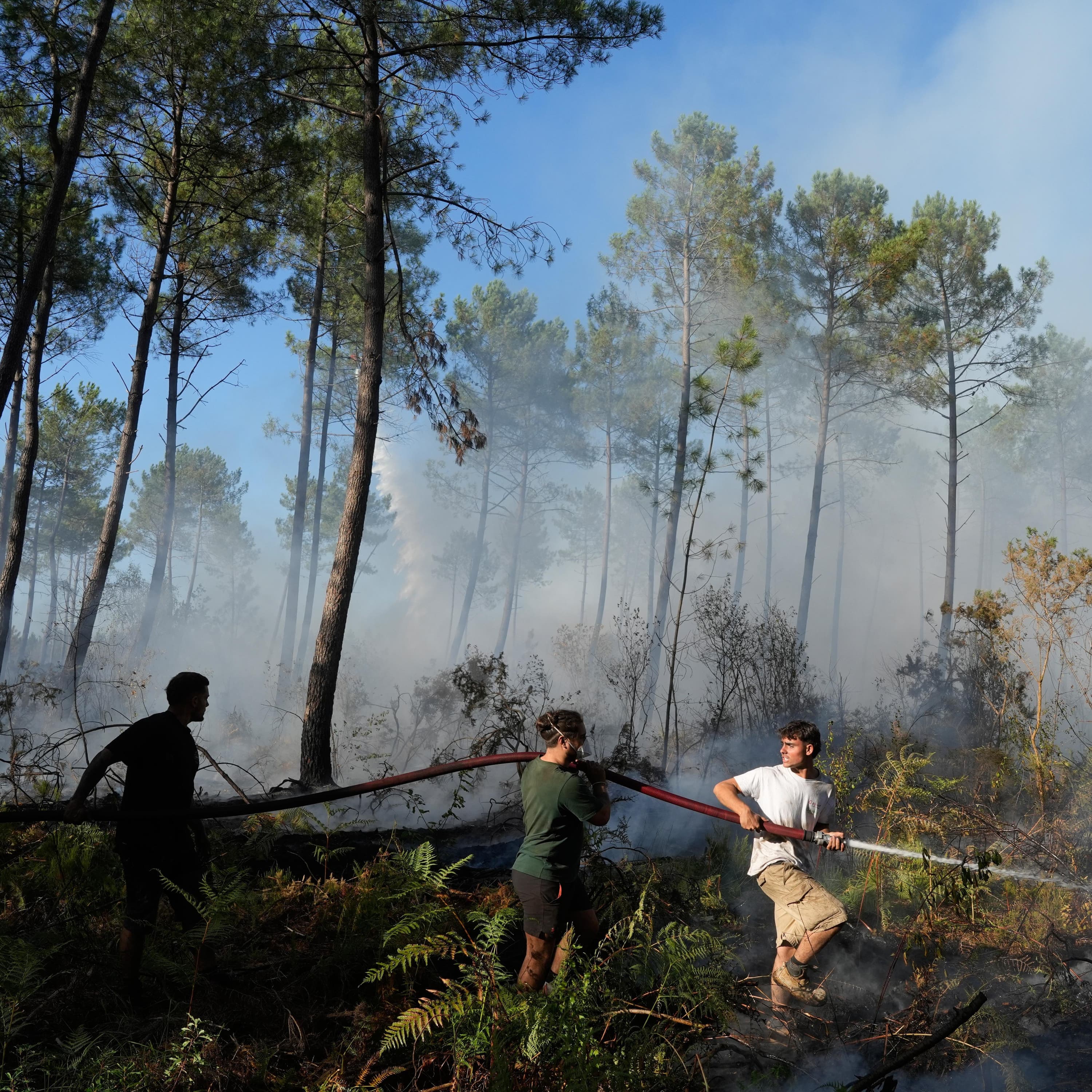
Today in Focus
In Bordeaux as the wildfires close in
00:25:53
Paris correspondent Angelique Chrisafis reports from Bordeaux, as wildfires in the region and beyond cause the biggest peacetime evacuation in French history
Loading summary
Transcript94 lines
- [00:00]
Helen Pitt
This is the Guardian. Today. What next? After the biggest peacetime evacuation in French history?
- [00:20]
Paramount Sponsor Voice
Today In Focus is supported by Paramount. Plus, this isn't the end of a fight, it's the start of one. Lioness, the critically acclaimed original series from Taylor Sheridan, returns August 2nd only on Paramount. In the new season, hidden networks, foreign operatives and personal betrayals collide. Meanwhile, Jo walks the line between duty and family as unseen forces circle her world, leaving her to reckon with a war that now reaches into every part of her life. Don't miss the new season of Lioness, starring Zoe Saldana and Michael Kelly, with Morgan Freeman and Nicole Kidman. Streaming August 2nd only on Paramount. Plus.
- [01:16]
William (Student)
There was a very strong smell of burning in the air. The sunlight that was coming through this cloud of smoke was giving everything a very orange golden tint, making everything look very dystopian.
- [01:31]
Helen Pitt
Over the past six days, huge wildfires have raged through southern France. President Emmanuel Macron has called it perhaps the most severe crisis his country has faced since World War II. The worst affected region is around Bordeaux in the southwest. That's where William, a student, described the skies above Arcachon, a coastal resort famous for its enormous sand dunes.
- [01:54]
William (Student)
There were even ashes falling from the sky. And in the evening after dark, from the seafront, you could see the flames on the other side of the Arkachon Bay. That was a very hellish sight because the whole horizon was lit up with fire and it really was like looking at the gates of Mordor in Lord of the Rings.
- [02:19]
Helen Pitt
People living more than 100 miles away were feeling its effects as the wind blew inland.
- [02:25]
Maria Louise
I was woken up in the middle of the night, very early hours of Saturday morning, because I was coughing. It had been very hot, so the windows were all open and I just couldn't breathe. And then I realized when it was light, about seven o', clock, that the sky was a very strange colour.
- [02:44]
Helen Pitt
This is Maria Louise, an English woman who's been living in the Terre Ault region of tourance for 20 years.
- [02:50]
Maria Louise
I realized the fire was different to recent fires because it was so far from me over two hours. It seemed a long way from me, and yet it was impossible to breathe here and my eyes were running and I was coughing non stop.
- [03:08]
Interviewer / Reporter
Over in Trevillac in the south of France, Antoine, a winemaker, has been battling to save his vines.
- [03:14]
Antoine (Winemaker)
These were perfect conditions for what was to come. The fire just exploded. It just started everywhere on the plateau. We are taking position on hills just a bit higher than the farm, so we could also warn our friends about incoming Flames. And we could see what was happening during that day. The whole plateau was scorched during that fire. We lost about six and a half hectares of our eight hectares of vines, and most of them will never recover. It means that we probably will never replant those vines that were lost. It's a terrible thing because some of them were over 50 years old. You also have sentimental attachment to vines because they were planted by the prior generation. And we put a lot of work into growing them, maintaining them, harvesting them, making sure they are healthy, the grounds is rich enough, and so on and so on.
- [04:48]
Helen Pitt
Many people worry that this is just the start of what could become a new and terrifying normal.
- [04:54]
Maria Louise
What have I seen the changes and things since the first time I arrived here in 2002? When I was here originally, it was mainly high 20s, maybe mid-30s occasionally. But now this year I've had 35, 36 degrees at night in my house and 40, 42 during the day. So it really has got a lot, lot hotter. And I don't believe it's a natural thing. I believe that it's due to people and their lifestyle and obviously global warming that we are creating as fires spread
- [05:32]
Interviewer / Reporter
across Europe to Italy, Greece and Turkey. Is this what summers are going to look like now?
- [05:38]
Helen Pitt
From the Guardian, I'm Helen Pitt. Today in Focus, meet France's climate change evacuees. Angelique Christophus.
- [05:52]
Interviewer / Reporter
You've been our Paris correspondent for about
- [05:54]
Helen Pitt
20 years, is that right?
- [05:55]
Angelique Christophus
A long time, yeah.
- [05:57]
Interviewer / Reporter
Have you ever seen anything like this in all your time in France?
- [06:00]
Angelique Christophus
No. No. This is an exceptional fire for many reasons. First of all, the scope of it, but also the actual nature of the fire itself. It's a form of fire cloud, which we've never seen in France before. A state of emergency in Western Europe was described as apocalyptic fire.
- [06:20]
Fire Official
This is the most highest risk we have never, never, never seen in France.
- [06:26]
Interviewer
Does it scare you?
- [06:27]
Fire Official
It will be the fire of the century.
- [06:30]
Angelique Christophus
It's already burnt an area about four times the size of Paris in southwestern France, and it's proving very difficult to contain because we're in heat wave conditions now. And those are also record temperatures.
- [06:40]
Interviewer / Reporter
Yeah. And you decamped to Bordeaux earlier this week, a city that many people will associate with its wine. You were heading there just as many people were trying to get the hell out of there.
- [06:50]
Helen Pitt
What was it like?
- [06:51]
Angelique Christophus
First of all, you have to imagine where this fire is. So on the southwestern Atlantic coast of France, southwest of Bordeaux, is an area in the Gironde, which is this beautiful dense pine forest. This is a man made forest from the mid 19th century, which was really increased in size under Napoleon III with this idea of planting pine trees in the area. People might know it if they'd been on holiday in the area. You've got a lot of French celebrities that go, and this fire really began in that southwestern forested area. And what was different about it was that it spread very, very fast and it came within 15 km. Outer edge of the outer suburbs of Bordeaux. The morning I arrived in Bordeaux, everyone was watching it on the news, everyone was talking about it. Lots of people were volunteering to help evacuees. So there was this contrast between this beautiful capital of the wine region and this idea that fire was burning 30km away in a very erratic and uncontrolled way. So in the town itself, the main mood was this idea of solidarity, of how can we help? Who can we help? Because it was the biggest evacuation operation in France in many, many years. It was one of the biggest evacuation operations since the Second World War. And there were 220,000 people who had to evacuate their homes, including tourists as well, in the area of Gironde. And many of those people were flocking up to Bordeaux. So there was a mood of a sense of emergency.
- [08:24]
Interviewer / Reporter
And where did you go when you arrived in Bordeaux?
- [08:35]
Angelique Christophus
So I went straight up to the Bordeaux Exhibition center, which is this great sort of trade fair hall, Massive hangars on the northern edge of the city. I'm in a vast hangar space at Bordeaux Exhibition Centre. There are rows of camp beds as far as the eye can see. There are lots of dogs under the camp beds, on the camp beds, under tables. There's a vet's area with lots of cats in travel cases. There are children playing volleyball on mats and quite a few people trying to get a bit of sleep. Many of the people I saw were the people who had evacuated homes more in suburban areas. Small towns and villages were west of Bordeaux, and they'd been sleeping for days there and they didn't know when they're going to be able to go home.
- [09:24]
Interviewer / Reporter
Can you tell us about some of the people that you met there and what they told you?
- [09:27]
Angelique Christophus
One of the people I spoke to was called Florence and she used to work as a school assistant and she lived in a small town on the outskirts of Bordel and she'd had to evacuate. And she was sitting on the side of a camp bed that she'd just arrived at, thirsty, tired, extremely stressed, with two cats beside her, one on each side in little cat carrying cases. And she said, you know, I Wasn't leaving without my cats. I'm thirsty, they're thirsty. And I don't know what to do. And I struggle in this massive hangar with hundreds of people around me. I don't feel comfortable. And she said she was really, really scared and in an extreme state of stress. And she said to me this felt like a disaster movie. And she said, I've always loved disaster movies, but now I feel like I've actually been in a disaster movie. I never want to see another disaster movie again.
- [10:17]
Interviewer / Reporter
And you wrote, in some ways, quite a beautiful piece, actually, a dispatch from this conference center. You met a chap, am I pronouncing this correctly?
- [10:24]
Helen Pitt
Loic.
- [10:24]
Angelique Christophus
Loic.
- [10:25]
Interviewer / Reporter
Tell us about Louis.
- [10:32]
Angelique Christophus
So Loic was really interesting. So he's 66, he was a widower. And he said on Friday night he had sat down and watched the news and then gone to bed. And he had switched his phone off. And then at 1 in the morning, there was this pounding on his front door. And it was his neighbor who was a firefighter, who said, you've got to leave, got to leave now. So he picked up his wallet and he picked up his car keys. He went outside. His car was covered in ash, so we had to use the windscreen wipers to try and clear the windscreen. Loic was talking in very poetic terms about what he described as a kind of apocalyptic skyscape. He said, I'd been watching this strange fog in the sky. It was a darkness almost like an eclipse. And he said there was a kind of ochre mist as light from the sun was diffused through falling ash. And he said, so much ash was falling, recalling that, my car was turning completely grey.
- [11:43]
Interviewer / Reporter
Wow. I can really visualise that scene as well as being sort of poetic and beautiful. It's terrifying, isn't it? Goodness, it is.
- [11:50]
Angelique Christophus
And he just drove. And if you can imagine this convoy of cars with tens of thousands of people leaving different towns, all heading towards Bordeaux, and it was chock a block. And he said, you know, I'm gonna pull over and go to sleep in my car. So he pulled over, went to sleep in his car, woke up the next morning, no phone, put on the car radio for news, and realized he couldn't go back because many of these people thought they were just going for an hour or so or for a night and they could come straight back. And he didn't know what to do. So he said, well, it would be safe to go into the centre of Bordeaux and go to the cinema. So he arrived early in the morning. And just booked tickets for whatever he could see, which was the two parts, Charles de Gaulle epic. He said he watched the second part first the wrong way round. But he said, it's okay. I knew the story, of course, everyone knows the story. And then he watched the Odyssey. So he comes out about midnight, goes back to sleep in his car, and he said he'd been eating pain au chocolat, chocolatine, as it's called in the area, chocolatine. And when I saw him, he said, you know, I haven't shaved, I haven't changed. And then he didn't know what to do. So the following day he went to his wife's grave, which is more in the metropolitan area of Bordeaux. And then he was sort of coming towards the exhibition center when I was. Because he was then deciding what he should do next. He really felt at a loss because the authorities have said, you know, you cannot go back. This is such an unpredictable thing, fire. And that's what's new here, that even people returning to houses in the suburbs, which have got no risk of catching fire at the moment, even those people can't go back, just in case. And what I also found was really interesting when I met a couple who were from Afghanistan, who were very well settled in southwestern France, a very well integrated family who work as interpreters at quite a high level.
- [13:30]
Krishma
It was like a very big cloud, but it wasn't the cloud.
- [13:36]
Nasir
It was.
- [13:36]
Krishma
Was just the smoke that covered the sun. It was not something natural, like a cloudy weather.
- [13:44]
Nasir
Yeah, we were. We were waiting for rain.
- [13:48]
Angelique Christophus
And of course a fire in the sky that's turning the sky dark above your head in the middle of the day where you think it's going to rain, and then you realize, no, it's the sun Being blocked by smoke sparked their memories of war in Afghanistan.
- [14:02]
Nasir
For me, when I saw the smoke, I thought to myself that here was a big experience. Explosion in the airport, because it was near to the airport and they live
- [14:11]
Angelique Christophus
not that far from Bordeaux. Airports at Marignac. And they could breathe it. They said they felt it in their lungs.
- [14:17]
Krishma
We. We couldn't breathe very easily.
- [14:23]
Angelique Christophus
Krishma and Nasir described this acrid burning smell that they first thought was burning rubber.
- [14:29]
Krishma
At the first I thought that there is something like rubber, that it's burning. But when we open the windows, we feel that it's the smell of the wood.
- [14:42]
Angelique Christophus
And then they realized it was unmistakably
- [14:45]
Interviewer / Reporter
wood smoke from all the pine trees.
- [14:48]
Angelique Christophus
Yes. Blowing across to the area where they live on the wind. And when they were asked to evacuate. They actually thought, yeah, we are brilliant, let's go. And they packed their toothbrush, they put their kids in the car who were 10 and 8, a couple of toys, and also neighbors and friends. Not everyone has a car, not everyone could travel. So their car was packed, hacked by the time they left. And there they were three days with their children in this hangar. And that's actually where lots of children from low income families are still there. Because of course, climate inequality is rife. If you have more money, maybe you can go to your sister's holiday home, maybe you can go somewhere else in France, but if you can't, you can't. You're stuck in the hangar.
- [15:43]
Interviewer / Reporter
And the people that you spoke to in Bordeaux, what were they saying about how the authorities both have responded and how well prepared the authorities were for a fire on this scale?
- [15:54]
Angelique Christophus
I think in Bordeaux, everyone is extremely supportive of the fire services and fire officers as individuals. People are wanting to provide food. People who can get near the areas are trying to drive food trucks with roast chickens and things to give food to the fire offices. And especially farmers in the area are wanting to help with their big trucks that can transport large volumes of water. So there's a great, on a human level, a great sense of solidarity with the fire services, that is for sure. There's an element of inequality in terms of who is affected and who's not affected. And of course, there have been over 240 houses destroyed in some villages. And some people are saying, did our houses get destroyed in order to save other areas of the country? You know, were there enough people down here fighting for us? Did the authorities care enough? And those are questions without really answers at the moment. But fundamentally, the fire services, and there have been over 90 injuries. Fire services and the fire services themselves have been saying, do we have enough proper respiratory protection that's required for this type of work? You know, they've been taking their own risks and many have had to be evacuated because they were injured.
- [17:01]
Interviewer / Reporter
And what about civilian injuries? Have any people died or been hurt by these fires?
- [17:06]
Angelique Christophus
No. And that is what the fire service. Yes, that's what the fire service and the government are highlighting. And part of the reason for these huge evacuations from areas that are bordering the fire area, suburban areas which wouldn't normally be evacuated in this type of wildfire in a forest. The prefect is very, very serious about making sure that's happening to try and avoid deaths. One of the biggest issues of this fire is the toxic smoke with fine particles, which is blowing across France, and there's a very poor air quality in the region where the fire is, which is a very big region. But that smoke is also blowing across France on the wind. And depending on how the wind blows, people in areas, even in central France, towards eastern France, have warned that they can smell smoke and have called into the fire service saying, is there a fire? The French Prime Minister's office has made sure that they have been sent millions now of FFP2 masks.
- [17:59]
Government Official
The French government is rushing two and a half million masks to the Department of Gironde to help protect against smoke full of toxic fine particulate matter. Calls to emergency service lines are mounting, especially for respiratory difficulties.
- [18:13]
Angelique Christophus
Many people are wearing those on days where you can really smell the smoke. And even if you can't actually smell burning smoke, I felt it and people said as well to me in boldor, you can sort of sense your lungs are working in a different way. Certainly the government health authorities in that area have said if you're vulnerable, and that means if you're in your later years pregnant, you should be inside with the windows closed.
- [18:48]
Interviewer / Reporter
And obviously, these fires are not just affecting France, but Spain, too. Other parts of Europe, including the UK, there were 300 wildfires reported in England and Wales just in the first two weeks of July. In the Peak District, near where I live, there's been a fire that's been raging for weeks now. In fact, you can probably hear it in my voice. I'm blaming some of my sore throat on the smoke that has been enveloping this Greater Manchester region. Do we know why fires this year seem to be so much worse than any that many of us can remember?
- [19:19]
Angelique Christophus
Well, the French government has said that we had a very wet winter and that winter created this growth of foliage in forested areas. And now, of course, we're in a moment of extreme dryness. And so when you have these hot, windy and dry conditions with a lot of foliage, foliage that's very dry and hasn't been cleared, this has been fodder for this fire. We know that Western Europe certainly is having an exceptional heat wave and that these temperatures are contributing to these increasing wildfires. So in Spain, for example, it's the first time the government has declared a national emergency for wildfires.
- [19:57]
Narrator (Spain Wildfire Segment)
From the ground and from the air, the vistas are equally terrifying. Fires across a huge area west of Madrid have triggered Spain's first ever wildfire national emergency.
- [20:09]
Angelique Christophus
Many people have been evacuated. I think up to 80,000 people have been evacuated, another 30,000 having to stay in their homes. There was A fire in the kind of hilly terrain west of Madrid, which has become Spain's largest fire on record. And if you step back and go back a few decades, those wildfires in Spain and Portugal were a known risk, as it were. These were fires that authorities were used to having to deal with. And, and it's spreading north. And we've had very serious fires in the same area of the Gironde in the past, even four years ago in France. But fires are now spreading all across the north of France. And it creates the issue whereby resources, fire offices, water, bombing planes could always be sent from the north of France or other European countries. But if we have fires burning on all fronts and spreading north, there is the issue of how is it possible to contain them.
- [20:59]
Interviewer / Reporter
And we've been hearing too, about how this fire is so unpredictable and that it might even have generated its own thunderstorm. I know you're not a meteorologist, but can you explain how that works?
- [21:10]
Angelique Christophus
Yes. I'm going to have to attempt this word pyrocumulunimbus, which is the official word for it. I'm not an expert, but to explain it briefly from other scientists who have explained it to my climate colleagues, these are very severe wildfires that can generate their own unique weather systems. So they have these form of fire clouds or fire generated thunderstorms, which are the most severe form of fire clouds. And it means that they can self sustain themselves and they can change direction. It's very intense, it's extremely unpredictable. That is what's new about this fire. So we're talking about this fire rising very high up into the sky and almost raining down in different areas. And the firefighters in France said this meant it was extremely hard to contain the fire. It was almost as if the fire had its own life.
- [22:05]
Helen Pitt
Coming up, are these fires changing the
- [22:08]
Interviewer / Reporter
politics around the climate crisis?
- [22:23]
French Official / Politician
From globalization to innovation sustainability to market volatility, there's always more than one side to a story. Explore different perspectives on today's most important business and economic issues with the Flipside podcast from Barclays Investment Bank. Hear two research analysts in a lively debate and get insights from every angle. To further inform your view, listen to the Flipside on your favorite platform.
- [22:49]
Automated Voice Message
Your call has been forwarded to an automatic voice message system.
- [22:53]
Quo Sponsor Voice
Running a business means you're always reachable. Until you're not. And the moment you miss that call, a competitor picks it up. That's why this episode is brought to you by Quo spelled quo, the business phone system built so you never miss an opportunity. All your calls, texts, and voicemails live in one place. Anyone on your team can pick up a conversation, see the full history and respond fast. Quo is the 1 rated business phone system on G2 trusted by over 90,000 businesses. Set up in minutes on any device. Keep your existing number, add teammates as you grow. No it, no hassle. Quo's built in AI agent, even handles after hours calls and books appointments so you're covered around the clock. Money is on the line. Always say hello with quo. Try quo free plus 20% off your first six months at quo.com tech that's qu-uo.com tech.
- [23:56]
Interviewer / Reporter
You've been on Today In Focus many times in recent years, talking about how divided politics is in France, as in so many other places across Europe. What has the political reaction been to these wildfires? Have the parties been united on the cause and how to deal with them?
- [24:10]
Angelique Christophus
Very interesting. So in France, we've got a presidential election coming up within a year, which means that everyone is on alert over what they're saying and what they're promising. Emmanuel Macron is coming to the end of his two terms in office. Now, Emmanuel Macron with this fire in Gironde has been using, and he's used it before during COVID this kind of war language.
- [24:33]
French Official / Politician
We must understand that we are facing a completely unprecedented wildfire. The situation we are dealing with today is the most severe we have ever recorded, the toughest since the Second World War. And the season is far from over.
- [24:50]
Angelique Christophus
We're going to battle. We're going to win this. We've got to stick together. It's the troops out there and there's no point having a kind of reckoning about policy when we're in the middle of a battle. We've got to win it first.
- [25:03]
Helen Pitt
Right? And has Macron explicitly made the link
- [25:06]
Interviewer / Reporter
between climate change and these fires, as
- [25:08]
Helen Pitt
his Spanish counterpart, Pedro Sanchez did when he called them the most painful expression of a climate emergency?
- [25:16]
Angelique Christophus
I think Sanchez has gone further than any other, that's for sure. I think Macron doesn't shirk the issue of the climate crisis. You know, he's very good at coming out with brilliant rhetoric on the climate, you know, make the planet great again, standing up to Trump and so on the Paris agreement. I think what's needed now is funding and a long term plan and he's been criticized for that because if you step back a bit, for example, the Green Party will say, well, look, the government, which is of course facing high debt in France and is looking how to cut its budgets and this idea of We've got to cut money, and let's cut money by cuts to the Green Fund, which was designed to help local authorities address climate and environmental challenges. That is really coming under attack. But there's also this focus on the material aspect of things. So Marine Le Pen of the far right National Rally is considered one of the favorites for the election next year. She doesn't like talking about the climate crisis.
- [26:20]
Interviewer / Reporter
Right. Does she deny it, though? Does she deny that climate change has undoubtedly made this kind of extreme heat, these fires, more likely to spread?
- [26:27]
Angelique Christophus
Let's just say she's someone who's very careful with her language. However, her statements and the party themselves, and they've done this in parliament this week, is firefighters, the army, police. This party is really appealing to them at the moment. And they'll say, look, their work is incredible. Look at these people. We do need extra funds to help. That's quite an easy one for Le Pen to. She's also talking about what's the answer to the heat wave? Give everyone air conditioning, which is not as easy as that might sound. She has talked about the devastation of the fire, but she sidestepped the wider issue of carbon emissions.
- [27:04]
Helen Pitt
And finally on Wednesday, I saw that
- [27:06]
Interviewer / Reporter
60,000 French residents are being allowed to go back to their homes.
- [27:10]
Helen Pitt
But we're talking to you as temperatures
- [27:11]
Interviewer / Reporter
in France are on the up again, potentially surpassing 40 degrees once more.
- [27:16]
Helen Pitt
Is there a sense from the authorities
- [27:18]
Interviewer / Reporter
just how long long these wildfires might go on for?
- [27:20]
Angelique Christophus
Well, European officials have said there could be wildfires in Europe well into November. Certainly in France, there's the sense that for the Gironde fire, we don't know, weeks or months because of course, fires can be contained, but then they can still be burning or susceptible to flaring up again. So there's definitely no quick end to this.
- [27:41]
Interviewer / Reporter
Angelique, thank you so much.
- [27:43]
Angelique Christophus
Thanks, Helen.
- [27:46]
Helen Pitt
That was Angelique Christopher.
- [27:47]
Interviewer / Reporter
So you can read all of her reporting on the wildfires@the guardian.com and that
- [27:51]
Helen Pitt
is all for today. This episode was produced by Natalie Kattena and Hannah Adnan and presented by me, Helen Pitt. Sound design was by Brian McNamara and the executive producer was Sammy Kent. We'll be back in your feeds this
- [28:03]
Interviewer / Reporter
afternoon with the latest.
- [28:14]
Helen Pitt
This is the Guardian.
- [28:24]
Narrator (Spain Wildfire Segment)
This message comes from Jackson. Taxes aren't something you can only think about once a year. With investments, planning for tax day is year round. Fortunately, Jackson offers tax efficient products. Visit Jackson.com for more information on how our products can make your tax bill a little bit less painful. Jackson is short for Jackson Financial Inc. Jackson National Life Insurance Co. Lansing, Michigan and Jackson National Life Insurance Co. Of New York, Purchase, New York.
- [28:49]
Aura Sponsor Voice
Most people don't realize how much of their personal information is being bought and sold every day. Data brokers are making billions, pulling details about you from public records and the Internet, then packaging and selling it, usually without your consent. That's how your information lands in the hands of scammers, spammers, even stalkers. It's why you get endless robocalls and why ads seem to follow you everywhere. That's where Aura comes in. Aura actively removes your data from broker sites and keeps it off. They also instantly alert you if your information shows up in a breach or on the dark web. But Aura goes beyond data protection. With one app, you get a vpn, antivirus, password manager, spam, call protection, dark web monitoring, and even up to $5 million in identity theft insurance, all backed by 24. 7 US based fraud support. Other companies might sell just credit monitoring or even just a vpn. Aura gives you all of it together at the same price Competitors charge for just one service. Start your free trial today@aura.com safety. Protect yourself now@aura.com safety.